What’s Next for California’s Public Pensions?

Last week, the California Supreme Court issued an important ruling regarding public pensions. The case, CalFire Local 2881 v. CalPERS, was one of several lawsuits challenging the major 2013 pension reform law that was championed by then-Governor Brown. By upholding the changes contained in the law, the court’s decision answered one important question about the law’s legality. But it also left a much larger one unanswered: whether state or local governments will be able to alter some pension provisions during a future economic downturn.

Pensions present a significant challenge for California. The largest funds at the pension systems for California’s public employees (CalPERS) and state teachers (CalSTRS) have reported gaps of more than $138.9 billion and $107.3 billion, respectively, between their estimated obligations to retirees and the current value of their assets.

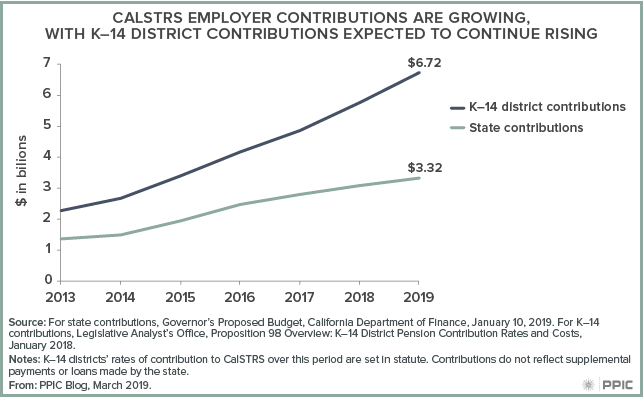
Closing those gaps will require larger payments from state and local governments, squeezing out dollars that would otherwise be used for programs and services. Employer contributions have already increased substantially in recent years. For example, public agency contributions into CalPERS increased from $4.19 billion to $6.71 billion from 2013 to 2017. And K–14 district contributions into CalSTRS have increased even more sharply, from $2.27 billion to $6.72 billion between 2013 and 2019. Indeed, the need to meet pension obligations was one of the financial pressures factoring into both the Los Angeles and Oakland teacher strikes.
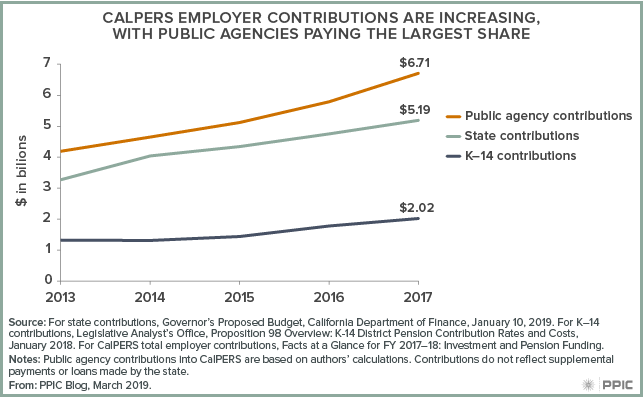
CALPERS Employer Contributions Are Increasing with Public Agencies Paying the Largest Share

CALSTRS Employer Contributions Are Growing, with K-12 District Contributions Expected to Continue Rising

Prior to the end of his final term, Governor Brown anticipated that the court would rule broadly, giving future governors “the option of considering pension cutbacks for the first time in a long time.” Such flexibility would be helpful to policymakers trying to balance budgets should a future recession lead to a drop in revenues.

But the court’s ruling was far more narrow, saying that a pension provision provided by the legislature could later be removed. The provision in question—referred to as airtime—allowed public employees to “purchase” additional years of service for their pension calculations. By paying more into the system, someone with 15 years of service could have their pension calculated as if they had worked 20 years. It turned out this was costing more in future pension payouts than the value paid by the employee for the added years. The legislature ended the practice in 2013 and the court decision affirmed it could do that.

The court went on to say that since this specific benefit was not a “core pension right,” it was not part of an implicit contract with the employee. Treating certain pension benefits as a protected contract is part of a long-standing legal precedent known as the California Rule—a precedent that the court explicitly did not address.

So, what happens now? Two upcoming cases before the court, concerning employees from Alameda and Marin Counties, involve another provision of the 2013 reform that excludes certain kinds of pay (e.g., pay for on-call or standby work) from an employee’s pension calculation. Similar to the CalFire Local 2881 case, the unions maintain that how pay is calculated is part of the pension contract and cannot be changed.

Given the clear distinction the court just made between the airtime provision and the California Rule, it very well might take the same approach regarding the calculation of pay—ruling narrowly on the provision but leaving the bigger question untouched. If that happens, it would affirm the 2013 reform but fall far short of Brown’s vision of being able to reduce pensions outright as part of an effort to balance the budget.
The Challenges of Changing Land Use in the San Joaquin Valley

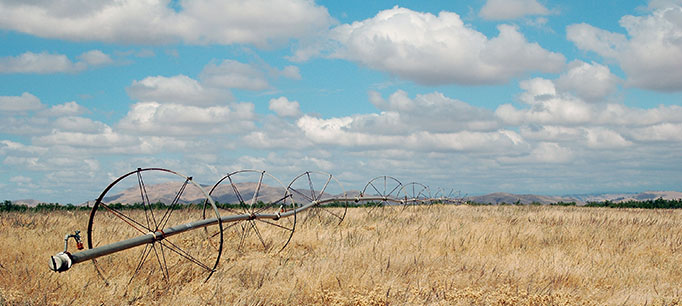
Implementing the state’s Sustainable Groundwater Management Act—which requires overdrafted groundwater basins to achieve balance between supply and demand by the 2040s—could require taking at least 500,000 acres of irrigated cropland out of production in the San Joaquin Valley. While some lands will be converted to uses such as solar energy, groundwater recharge, and restored habitat, there are no current plans for most of this acreage. We talked to Soapy Mulholland, president and CEO of Sequoia Riverlands Trust, about this impending challenge.

photo of Soapy MulhollandPPIC: What key challenges does this land use transition pose?
Soapy Mulholland: The challenges of managing this amount of land if it’s fallowed piecemeal―5 acres here, 30 there—are huge. A hodgepodge of retired lands would be very difficult to manage and restore.

When farmland is left bare it can cause dust and weed problems, so it will need cover crops. Finding the right cover crops that don’t use a lot of water is likely to be expensive. Grazing can help keep weeds down, but that requires fencing and most of the valley’s farms aren’t fenced.

PPIC: What are some top priorities for ensuring these lands are well managed?

SM: What we need is a vision for how to retire large blocks of land. That will require a “banking” system that pays farmers for retiring land and allows other farmers to purchase credits for a portion of the retired lands’ water, which they can then use on their own lands.

Let’s say you are a highly productive walnut farmer. You don’t want to fallow any of your 100 acres, so you would prefer to purchase a block of unproductive land to get water credits and keep your farm going. It’s a form of water trading. We need to figure out systems for how best to do that.

The idea is to buy farmland with low productivity, retire it, and link it to existing natural habitats. This could extend wildlife corridors from other parts of the region and allow for landscape-scale conservation on the valley floor. For example, there is a lot of potential to do this with less-productive lands at the edge of Tulare Lake Basin—we could conceivably get blocks of land 30,000 to 40,000 acres in size there.

We’ll need an organization or agency that can buy up retired lands—and systems in place to help manage them. We’ll also need a broad coalition of expertise, for example, appraisers and bankers to keep track of credits, and land managers with expertise in open space. We’ll need sophisticated systems that address all the different rules and regulations in California, and that connect all the various stakeholders and agencies that will be involved. And we’ll need funding—both for planning and for the systems themselves.

PPIC: Are there good examples of ways to use the idled lands?

SM: The establishment of solar plants in the Carrizo Plain area in eastern San Luis Obispo County is a good example. The solar companies had to figure out how to mitigate for impacts to habitat and agricultural land. They ultimately purchased more than 30,000 acres of rangeland and dry farmland, and entrusted future management to state agencies or land trusts (including our organization). Using grazing and other management techniques, these lands are now being restored, and even the areas under solar arrays are being managed to benefit at-risk species like the San Joaquin kit fox. Connecting these lands with the nearby Carrizo Plain National Monument offers even greater opportunities to multiply the benefits that each protected area provides on its own. It’s a good example of how to manage large parcels for multiple uses: habitat, agriculture, and renewable energy.

We need more pilot projects to set examples and figure out how best to do this. In the San Joaquin Valley, projects could focus on converting large parcels of retired farmland to semi-irrigated pasture or native grassland, with management in the hands of experienced land trusts. This approach could have benefits ranging from carbon sequestration and natural groundwater recharge to improved air quality and habitat for threatened and endangered species. As in Carrizo, landscape-scale conservation could produce much better outcomes than disconnected projects.

Bringing our region’s groundwater use in line with sustainable supplies will require significant changes in land use, agriculture, and water markets. Figuring out the right answers is likely to push all of us―farmers and ranchers, urban dwellers and conservationists alike―out of our comfort zones. But a coordinated approach to farmland retirement offers opportunities for landscape-scale conservation that can benefit people and nature.

Watch a video with Soapy Mulholland and other panelists discussing planning for water and land use transitions in the San Joaquin Valley

Californians Deeply Divided on Leaders—But Show Signs of Optimism

With Governor Newsom and President Trump clashing over policy and federal funding, how do Californians view the two leaders? Our January survey found that opinions of the governor and the president are very different—and very partisan. But while the partisan divide runs deep, Californians are unexpectedly hopeful about overcoming political differences and working together.

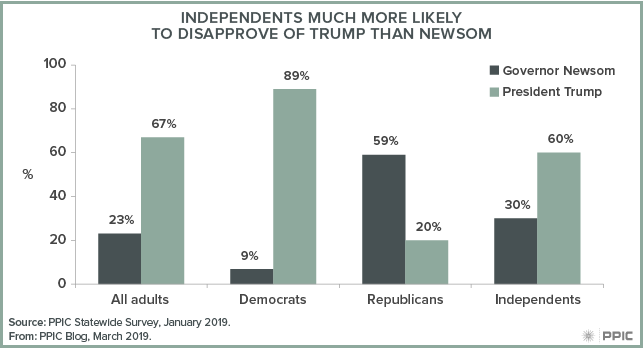
Not surprisingly, newly elected Governor Newsom is far more popular in California than President Trump. Our first reading of Governor Newsom’s approval rating came within the first few weeks of his term. A plurality of Californians said they approve of his job performance, while one in four disapproved and one in three were unsure how to rate him. Meanwhile, three in ten Californians approved of President Trump’s job performance, while two in three disapproved. This question was asked during and after the partial government shutdown in January.

Opinions of both leaders differ widely by party, but President Trump is more polarizing: nine in ten Democrats disapproved of President Trump, while a smaller share of Republicans—six in ten—disapproved of Governor Newsom. Notably, independents were twice as likely to disapprove of President Trump, compared to Governor Newsom.

figure - Independents Much More Likely to Disapprove of Trump Than Newsom

The two leaders couldn’t be in more different positions when it comes to their legislative counterparts. Governor Newsom is working with Democratic supermajorities in both houses, while President Trump has to work with a new Democratic majority in the House of Representatives and a slim Republican majority in the Senate.

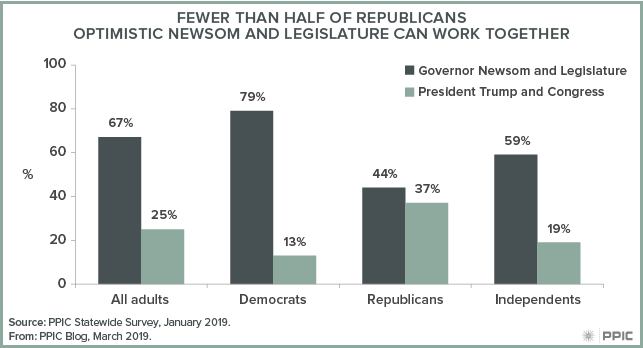
Californians are optimistic that Governor Newsom and the California Legislature will be able to work together and accomplish a lot in the next year. In fact, the share of Californians who are optimistic (67%) is the highest it’s been since we began asking this question in 2006.

In contrast, Californians’ views on the likelihood of cooperation in Washington, DC, are at a record low—with just 25% of Californians optimistic. Notably, Democrats and independents are polarized, while fewer than half of Republicans are optimistic about cooperation at either level.

figure - Fewer Than Half of Republicans Optimistic Newsom and Legislature Can Work Together

Despite the rancorous political environment and the contentious relationship between Governor Newsom and President Trump, most Californians (58%) are optimistic that Americans of different political views can still come together and work out their differences. Notably, about half of Democrats (52%), Republicans (49%), and independents (52%) are optimistic these differences can be overcome. As the governor looks to advance his agenda during his first year in office, we will continue to track Californians’ perceptions of their leaders and monitor attitudes about the state and the nation.

A Winning Approach for Managing Groundwater in the San Joaquin Valley

The San Joaquin Valley is in a time of great change. Decades of groundwater overuse have caused drinking water and irrigation wells to go dry, increased the amount of energy required to pump water, harmed ecosystems, and reduced the reserves available to cope with future droughts. Groundwater overdraft has also caused land to sink, damaging major regional infrastructure, including canals that deliver water across the state.

These problems spurred the enactment of the Sustainable Groundwater Management Act (SGMA), which requires local water users across California to bring groundwater use to sustainable levels by the early 2040s. With California’s largest groundwater deficit, the San Joaquin Valley is ground zero for implementing SGMA.

Although the region will reap many long-term benefits from ending overdraft, the transition to groundwater sustainability will be challenging and costly. The good news is that some approaches can greatly reduce the costs of bringing basins into balance.

The valley faces a groundwater deficit of nearly 2 million acre-feet per year (11% of net annual water use). To close the deficit, local agencies will have to augment their supplies, reduce their demands, or use some combination of these two approaches.

Our new report shows how a portfolio approach—with supply investments that farmers can afford and tools that increase flexibility for managing demand—offers a winning combination. The most promising supply options are to capture and store more local runoff, especially in groundwater basins, and to increase water imports by managing the system differently. On the demand side, increasing water trading—both within and across groundwater basins—can significantly mitigate the impacts of reducing water use, by allowing farmers to maintain the crops that generate the most revenue and jobs.

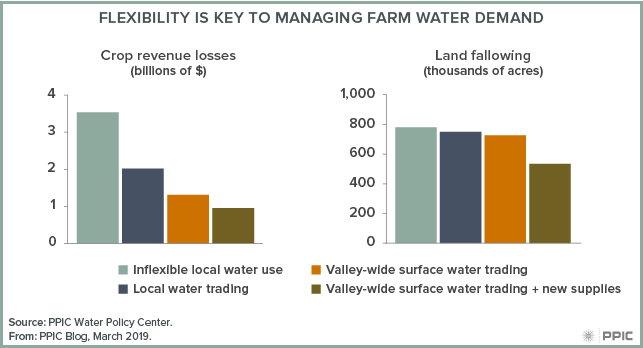
As the figure below shows, if farmers have no flexibility to trade water or adapt crop choices, ending overdraft without new supplies would require fallowing 780,000 acres—about 15% of the valley’s 5.2 million acres of irrigated cropland. It would also cause crop revenue losses of about $3.5 billion per year—roughly 17% of current crop revenues in the region.

figure - Flexibility Is Key to Managing Farm Water Demand

But if farmers can make flexible crop choices and trade ­water within local groundwater basins, fallowing would decline slightly, and crop revenue losses would fall by nearly half (to $2 billion per year). And with broader, surface water trading across the San Joaquin Valley, farmers in the south would buy some water from the north, where it is more abundant. This also would not change the amount of fallowed acreage by much, but it would further reduce the need to fallow the most profitable fruit, nut, and vegetable crops—lowering revenue losses by nearly two-thirds (to $1.3 billion per year).

Finally, a portfolio approach combining water trading and cost-effective supplies would reduce crop revenue losses by three-quarters (to $0.9 billion per year). The new supplies would also make a large dent in the need for land fallowing, which would fall by nearly one-third (to 535,000 acres).

Using a portfolio approach to achieve groundwater sustainability and avoid economic disruptions in the valley will require coordinated efforts among local, state, and federal agencies. The most pressing priorities are those related to expanding groundwater recharge and water trading, including:

  • Assessing infrastructure needs and modernizing water operations
  • Incentivizing recharge on farmlands
  • Clarifying how much water is available for recharge
  • Developing a healthy local trading culture
  • Facilitating state and federal approvals for trading and banking

Finally, to reap the most benefits from recharge, trading, and other tools, local entities will need to collaborate both within and across basins. Since the valley has more than 120 groundwater sustainability agencies for its 15 groundwater basins, overcoming institutional fragmentation will be key to success.

Video: A Conversation with Chief of Staff Ann O’Leary

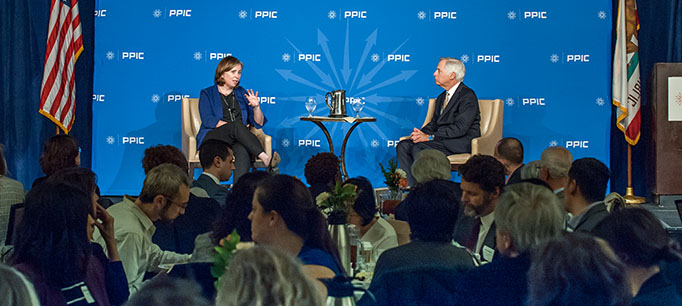
As the Newsom administration lays out its initial plans, PPIC invited chief of staff Ann O’Leary to discuss some of the governor’s top priorities. In a wide-ranging discussion with PPIC president Mark Baldassare last week, O’Leary identified the “cost crisis” in California as one of the main challenges that Governor Newsom plans to address.

“By ‘cost crisis,’ I mean how do we make sure that people in California can have affordability and the opportunity to really take advantage of the California dream?” O’Leary said. “I think too many people in California are really seeing that slip away. They’re not able to afford homes, they’re not able to afford child care, and they’re not able to pay for college for their children as they grow older.”

O’Leary pointed out that confronting this cost crisis would take many forms, such as taking on health care affordability, investing in “cradle to career” education, and addressing housing production and rising rents.

She underscored that the governor’s first proposed budget reflects his vision for promoting affordability and opportunity while ensuring the state’s long-term financial stability. Newsom’s plan includes a mix of one-time and ongoing funding as well as a robust rainy day fund, but “we also go further than that. We have a reserve fund for the safety net, and we also look at how we could use some of the surplus to pay down pension liabilities.”

The governor has also focused on other key challenges—for example, responding to wildfires and tackling the unmet need for safe drinking water in many parts of the state.

On wildfires, O’Leary noted that the governor wants to “make sure that we’re continuing with those recovery efforts to help communities that have been harmed, but also to prepare for future wildfires.” On drinking water, O’Leary said that the governor has already worked with the legislature to provide $20 million in emergency funding to address this issue.

Navigating the PG&E bankruptcy filing is another immediate priority. O’Leary said that over the next 60 days the governor’s team would be creating a roadmap for the state to “protect wildfire victims, protect employees who are out there every day trying to make sure we’re safe, and make sure fundamentally that we have safe and affordable power and that we’re meeting our clean-energy goals.”

O’Leary also discussed the federal-state relationship and how the governor plans to manage it. While pointing out that the state and federal governments need to work together as much as possible, O’Leary also underscored that California must stand up for its values when fundamental disagreements exist, especially on issues such as immigration and family planning. “These are differences of opinion. And it’s a needle we have to thread, but we’re going to do our best.”

Reviving the Health Care Mandate: Who Pays?

Governor Newsom has proposed creating a state individual mandate to help fund increased health insurance subsidies for low- and middle-income Californians. One of the major reforms ushered in by the Affordable Care Act, the federal individual mandate—which was rolled back in the federal tax bill passed in 2017—required most individuals to have comprehensive health insurance or pay a tax penalty. The governor’s administration projects approximately $500 million in revenue from the mandate, based on the total amount paid by Californians in 2016.

As the governor and legislature consider a state mandate, it’s worth examining which Californians paid the federal mandate penalty.

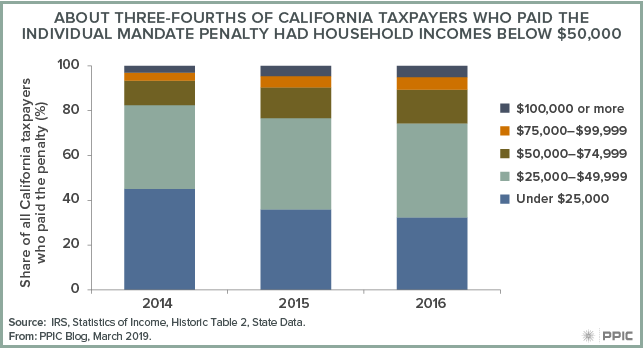
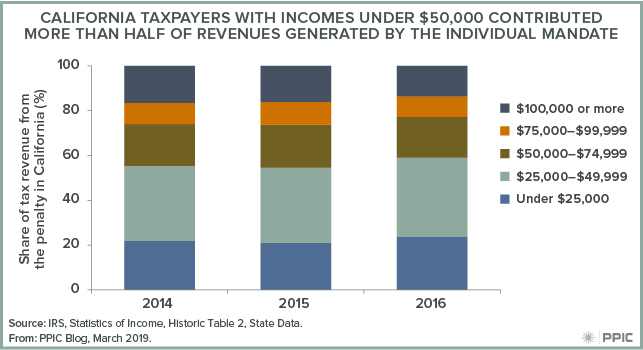
Between 2014 and 2016, taxpayers with incomes below $50,000 accounted for a vast majority of returns that included the individual mandate penalty. In 2014, the first year the individual mandate went into effect, the penalty was 1% of income or a maximum of $285 per family ($95 per adult and $47.50 per child). More than 1 million tax returns in California paid the penalty. Taxpayers with incomes below $25,000 accounted for about 45% of returns subject to the penalty, while those with incomes between $25,000 and $50,000 accounted for another 37%. Even more low-income individuals would have been subject to the penalty if not for certain exemptions—such as having an income below the tax filing threshold ($12,500 for a single adult) or facing hardships like bankruptcy and eviction.

In 2016, the minimum payment rose to 2.5% of income or a maximum of $2,085 per family ($695 per adult and $347.50 per child). The total number of taxpayers subject to the penalty dropped to about 600,000. Those with incomes below $50,000 still accounted for nearly three-fourths of all payments, though this was down from 83% in 2014.

About Three-fourths of California Taxpayers Who Paid the Individual Mandate Penalty Had Household Incomes Below $50,000

The revenues generated also disproportionately came from taxpayers in lower income brackets. In 2014, taxpayers with incomes below $50,000 accounted for more than 55% of the $222 million in total payments from California taxpayers. Those with incomes under $25,000 paid more than $48 million and those with incomes between $25,000 and $50,000 paid more than $74 million.

Although the number of taxpayers subject to the penalty dropped from 2014 to 2016, tax revenue doubled—in part because the penalty amount increased—and reached $446 million in 2016. Over this time, the share of the total amount paid by households with incomes of $100,000 or more decreased, from 17% to 14%. Meanwhile, the share of revenue paid by those with incomes below $50,000 rose, from 55% in 2014 to 59% in 2016.

California Taxpayers with Incomes Under $50,000 Contribute More Than Half of Revenues Generated by the Individual Mandate

If the state does implement the governor’s proposal, the revenue would increase subsidies currently available for individuals with incomes between 250% and 400% of the federal poverty level ($31,225–$49,960 for a single adult) and expand subsidies to individuals with incomes between 400% and 600% of the federal poverty level ($49,960–$74,940). Most Californians with lower incomes are eligible either for no-cost Medi-Cal or heavily subsidized coverage through Covered California—though not everyone who is eligible enrolls in these programs.

The repeal of the federal individual mandate is expected to lead to an increase in the number of uninsured individuals and higher insurance premiums. A state individual mandate might help counteract those effects by encouraging healthy individuals to enroll in coverage—but at a cost.

In an otherwise progressive state tax structure, the implementation of the federal mandate disproportionately affected low-income Californians. There’s also evidence that some Californians paid the penalty even though they should have been exempt. If the state revives the mandate, the governor and legislature should consider how to improve awareness about eligibility and exemptions so this problem can be avoided. At the same time, reducing the number of people paying the penalty also means that the governor’s revenue estimate may need to be lowered. As policymakers engage in discussions over a state individual mandate, assessing who bears the burden of the tax and who benefits will be an important consideration.

Declining K–12 Enrollment Forces Major Budget Cuts in Many Districts

The teacher strikes in Los Angeles and Oakland reflect the fiscal stresses facing many school districts across the state. Rising pension and health care costs account for some of this pressure. For many districts, declining student enrollment is another factor.

Because state funding is based on average daily attendance, falling enrollment leads to lower state funding levels. Significant, sustained declines require districts to make difficult decisions to stay afloat financially. Since an average of 82% of K–12 spending goes to salaries and benefits, downsizing often means reducing teachers and administrators—or possibly closing a school.

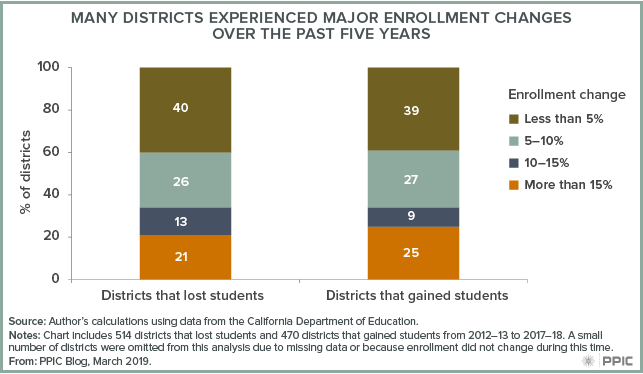
Over the past five years, overall K–12 enrollment in California increased by only 0.1%, or 6,600 students out of the more than 6.2 million attending public schools. This stable picture masks significant variation across districts. Roughly half of the state’s nearly 1,000 districts experienced enrollment losses, while the other half grew over this time. In many cases, the change was small: about 40% of districts experienced a net change—gain or loss—of less than 5% from 2012–13 to 2017–18.

However, the majority of districts saw an enrollment change of more than 5%. Indeed, 107 districts lost more than 15% of students. These districts were generally small: the average school had 700 enrolled students in 2012–13 and lost more than 170 students over the five-year period. In some cases, these large enrollment losses were associated with the closing of a charter school. Many of these districts, though, have only one school, and large percent reductions in enrollment require significant cuts in teachers, administrators, and other staff.

Many Districts Experienced Major Enrollment Changes Over the Past Five Years

Many large districts also lost significant numbers of students over the past five years. In Los Angeles County, for instance, 61 of 79 districts experienced enrollment declines—including Los Angeles Unified, which lost 34,000 students (a 5% decline) and Long Beach Unified, which lost almost 7,600 students (9%). In addition, seven districts with more than 10,000 students lost between 10% and 15% of enrollment. For a district of 10,000 students, losing 10% of enrollment translates into 1,000 fewer students—equal in size to two typical elementary schools. For example, Montebello Unified saw a dramatic 13% decline, losing more than 4,000 students during the five-year period.

Declining student enrollments can be due to a wide range of factors—changes in charter school enrollments, decreasing birth rates, or families moving away, among others. Laying off teachers and adminsitrators is painful—and closing schools is a particularly wrenching topic, as parents value their local schools.

Governor Newsom’s proposal to help districts with rising pension costs may relieve some—but not much—of the financial pressure for districts. K–12 financing in California is also affected by voter-approved initiatives that make significant school funding increases unlikely in the near term. There’s no easy solution, but unless these dynamics change, districts will need to learn to adjust to long-term enrollment and revenue reductions or face the risk of insolvency.