Video: A Conversation with San Francisco Mayor London Breed

As part of our Speaker Series on California’s Future, PPIC invites elected leaders from across the political spectrum to participate in public conversations. The purpose is to give Californians a better understanding of how our leaders are addressing the challenges facing our state.

As a mayoral candidate, London Breed promised to focus on homelessness and affordable housing—two major challenges for San Francisco and for California as a whole. Not surprisingly, these issues took center stage in her conversation with PPIC president Mark Baldassare earlier this week.

“It is no secret that homelessness is one of the biggest challenges that’s facing our city, and that also comes with the need to build more housing,” said Breed. “I’ve been on a mission! I hired a housing delivery director—someone whose sole purpose is to cut back on bureaucratic red tape that gets in the way of building housing.”

Breed stressed the need for new approaches to behavioral health issues that complicate homelessness: “We have to think about this challenge differently and we have to make hard decisions.” For example, she favors strengthening conservatorship laws. She acknowledged that conservatorship for mentally ill adults is “very controversial.” But, she added, “our jails are being used as mental health facilities, and that’s not a solution.” She is also pushing for safe injection sites, which can provide substance abuse treatment when people are ready to seek it. “Treatment on demand is something we have to start looking at.”

The mayor is also committed to trying new strategies in other policy areas, such as police-community relations and education. “I do think we need to take some risks and propose some things that may make people uncomfortable but ultimately may help us to get the kind of results that will . . . make a difference.”

But Breed also emphasized accountability. Explaining why she wants to hire a mental health director, she said, “We’re a little bit all over the place right now and I want us to address those issues, organize things a lot better for the purposes of helping people.” In this and other areas, she said, “I want to see us make the right investments.”

2020 Census: Hurdles Remain as the Count Nears

This post is part of a series examining challenges involved in the 2020 Census and what’s at stake for California. Click here to see our full coverage.

Described as the largest peacetime operation undertaken by the federal government, the census is used for everything from allocating congressional seats to redrawing voting districts to distributing billions of dollars in federal funding. Many Californians are at risk of being undercounted, and an inaccurate count could have far-reaching implications.

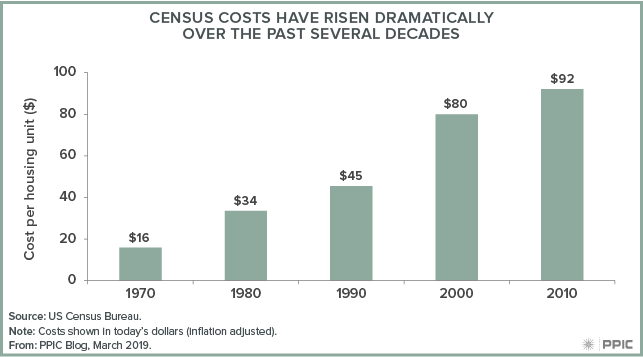
Following decades of escalating costs, the Census Bureau has made significant changes to modernize the census, in hopes of keeping costs similar to what they were in 2010 ($92 per household). For the first time, most households will be invited to respond online, and newly developed tools will help manage field operations. These changes should reduce the staffing levels and infrastructure necessary to conduct the census.

Census Costs Have Risen Dramatically Over the Past Several Decades

But new approaches also create new risks. The US Government Accountability Office has designated the 2020 Census at high risk of failure, citing capacity and planning issues and the fact that the testing of new systems has been scaled back. Several field tests were cancelled in 2017, and the full end-to-end test, which is designed to approximate actual census operations, took place in only one location rather than three, as originally planned. Recently, the NAACP released documents suggesting that chronic underfunding and understaffing at the Census Bureau have negatively affected census preparations.

As of December 2018, the Census Bureau had identified almost 1,100 security weaknesses in its IT systems that still needed to be addressed. Possible threats include disruptions to the website platform, malware from respondents’ personal devices, and impersonation of the Census Bureau. The bureau maintains that it is fully vetting new processes—including working with industry and the Department of Homeland Security to identify and protect against IT threats.

Another big uncertainty concerns the federal administration’s plans to add a citizenship question. Several lawsuits have challenged this decision, and the Supreme Court is scheduled to make a ruling by the end of June on whether the question can be included. Regardless of the ruling, census responses are confidential and, under federal law, the Census Bureau cannot share any personally identifiable information, even with other government agencies. However, combined with federal government rhetoric and actions around deportation, a citizenship question may lower response rates among California’s 10 million immigrants, especially households with undocumented members.

Last year’s end-to-end test did not include a citizenship question. But this July, the Census Bureau will conduct a nationally representative test that should shed light on the question’s potential impact on response rates. Results will help shape the bureau’s outreach strategy and determine if more census workers are needed to follow up with households that don’t respond.

In the meantime, what can California do to ensure an accurate count next year? The state has already invested more in census outreach than any other: $100 million for 2018–19, with an additional $54 million proposed for 2019–20. State and local governments and organizations all have a role to play. Building awareness about the role of the census in determining funding for local public services will go a long way toward motivating Californians to respond, as will assuring residents that their data will be safe and secure.

To discuss what’s needed as California prepares for the 2020 Census, PPIC will be hosting an event on Monday, March 25 in Sacramento with Secretary of State Alex Padilla and other distinguished leaders and experts. Those who cannot attend in person are welcome to join the live webcast, or visit our website later to watch a video of the event.

Californians’ Views of Immigration Policy—Now and Then

From building a border wall to declaring a crisis at the border, immigration policy proposals from the Trump Administration continue to provoke controversy and stir national debate. How do Californians—who live with the nation’s highest share of immigrants—view such proposals? And more broadly, how have their views of immigration policy changed over time?

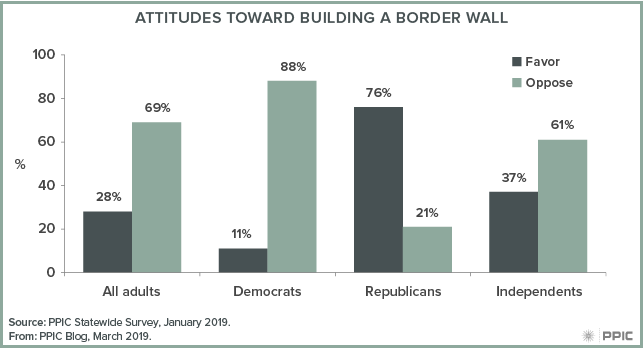
When it comes to a border wall, Californians’ views are decidedly different than those of adults nationwide. Fewer than three in ten Californians (28%) supported building a wall along the entire border with Mexico in our January survey, but twice as many American adults (56%) were in favor of this proposal in a January CNN survey.

However, the wall is a highly partisan issue in California. Support among California Republicans is quite notable, with 76% in favor. Among other partisans—and across regions and demographic groups—support fails to eclipse 40%.

figure - Attitudes Toward Building a Border Wall

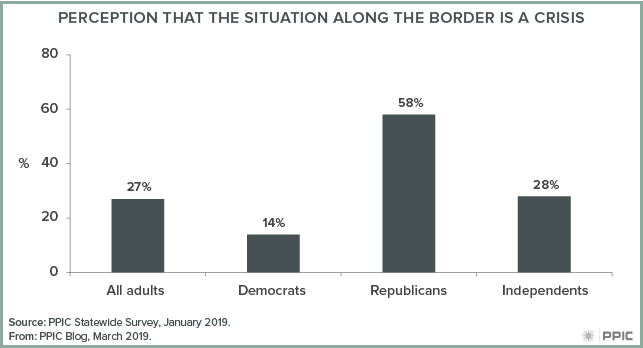
There’s more agreement between Californians and other Americans regarding the situation at the border. Relatively few Californians in our January survey or adults nationwide in a January ABC/Washington Post survey call the situation at the US-Mexico border a “crisis” (27% California, 24% nationwide).

Again, there are stark partisan differences over this topic in California. Republicans (58%) are far more likely than Democrats (14%) and independents (28%) to call the border situation a crisis. Across regions and demographic groups, one in three—or fewer—say this.

figure - Perception that the Situation Along the Border Is a Crisis

Californians’ views of immigration policy have changed a great deal since the passage of Proposition 187 nearly 25 years ago. Supported by 58% of the vote, Prop 187 sought to make undocumented immigrants ineligible for public benefits. Blocked by a federal judge, the measure was never enforced.

Today, 58% of Californians support California’s state and local governments in making their own policies and taking their own actions—separate from the federal government—to protect the legal rights of undocumented immigrants in California.

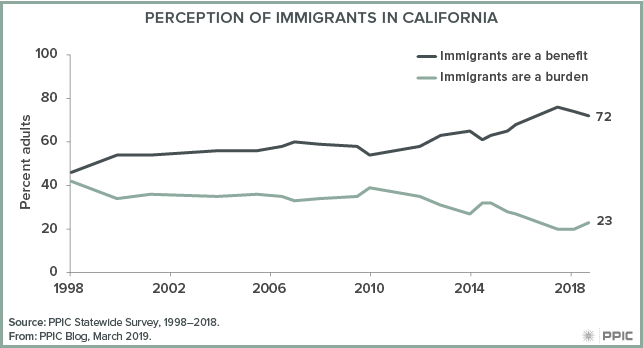
Not only have Californians’ views of immigration policy changed over time, so have their perceptions of immigrants. While state residents have generally held positive views of immigrants, in recent years these perceptions have become much more positive.

figure - Perception of Immigrants in California

Since the PPIC Statewide Survey last talked to Californians, President Trump has declared a national emergency as he seeks funds to build the wall, while California—along with other states—has sued the federal government over this claim. As California and the Trump Administration continue to spar over immigration policy, stay tuned while we track Californians’ perceptions and policy preferences related to this issue.

State-level Strategies to Reduce Student Debt

As college costs have increased, the total amount of loan debt in California has risen. At four-year colleges and universities in California in 2016, 40% of first-time, full-time students took out loans to help pay for their education, according to federal data.

The average debt for California students who attend four-year public and private nonprofit schools is nearly $22,800. Repaying college debt can be a big challenge, in part because the federal landscape for repaying loans is extremely complicated. To reduce student debt, state policymakers are actively thinking about new ways to help students repay their college costs.

In 2018, nearly half (47%) of borrowers enrolled in the federal “standard repayment” plan. Under this plan, a graduate makes fixed monthly payments over the course of ten years, paying down the entire loan with interest. Regardless of income level, a graduate with a loan of $22,800—the average amount—would, at 5% interest, face payments of about $240/month. For those in less well-paying occupations or who face very high monthly payments, this kind of plan can be financially challenging.

Another option is income-based repayment, which is often more financially manageable—but a much smaller share (29%) of borrowers enrolled in an income-based program in 2018. Monthly payments might start at 10% of discretionary income, but payments increase if the graduate starts earning more. Under these plans, borrowers generally pay smaller monthly amounts over a longer period of time.

Possible reasons for lower participation in income-based repayment programs include complex eligibility requirements and missing the deadline for declaring income. Streamlining the federal loan process, including clarifying eligibility criteria, could help make the process less confusing and allow students to make the best financial choices.

At the state level, policymakers are exploring other options to ease the burden of college debt. For example, AB 140 (Cervantes) would authorize the California Student Aid Commission, which administers the state’s financial aid programs, to pay an eligible student’s monthly loan payments for two years. And AB 154 (Voepel) would pilot an “income share” program at one University of California campus and one California State University campus. This program would enable campuses to pay for some of an eligible student’s educational expenses. After graduating, students then repay a portion of their income to the campus.

It’s a positive sign that California policymakers are pursuing state-level strategies to address growing college debt. Establishing an easy-to-use application process and clear-cut eligibility criteria will be key to ensuring that students are able to benefit from these programs. Perhaps most important, more comprehensive financial aid counseling and outreach are necessary to help students make the best choice when repaying their loans.

Widening the Conversation about Safe Drinking Water in the San Joaquin Valley

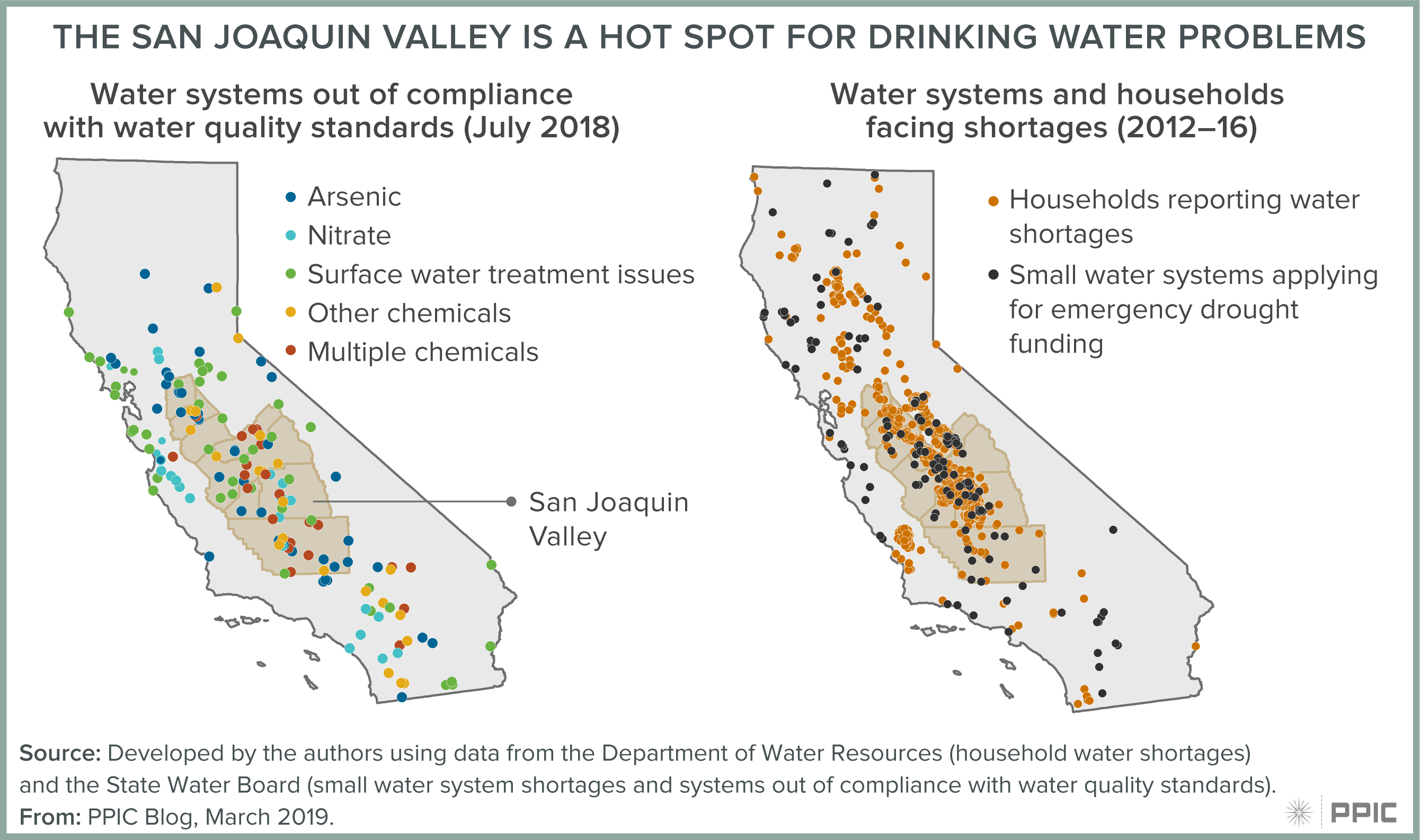
The theme of this Friday’s World Water Day is the lack of safe drinking water that affects many millions of people worldwide. Here in California, the San Joaquin Valley is a hot spot for unsafe drinking water. The region has more than half of all public water systems that are out of water-quality compliance in California, but just 10% of the state’s population. In addition, chronic decline in groundwater levels has caused drinking water wells go dry in a number of the region’s communities. We talked to Veronica Garibay—co-founder and co-director of the Leadership Counsel for Justice and Accountability—about ways to ensure community involvement in water management decision-making processes.

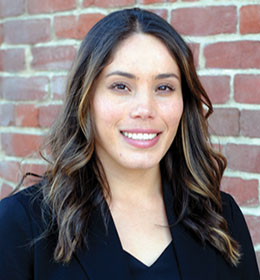
photo - Veronica Garibay

PPIC: What is key to understanding the valley’s safe drinking water crisis?

VERONICA GARIBAY: Water management is a particularly opaque and complex process, and past decision-making processes related to land use and water management failed to meaningfully include disadvantaged community voices and address their needs.

Climate change brings major risks to our water resources. The communities that are already the most vulnerable to the impacts of climate change—including water shortages during droughts, worsening water quality, flooding, and other problems—will see their vulnerability exacerbated. We have to change the way we manage water resources to adapt to these changes.

We have to bring our most vulnerable communities into these conversations, prioritize their needs, and make sure they, too, have decision-making authority over policy, programs, and projects.

Disadvantaged communities have been at the forefront of the progress we’ve already made on providing safe drinking water. They led the charge that gave the State Water Board the authority to consolidate small systems into larger ones, brought emergency funds to communities whose wells went dry during the drought, and led to the board’s establishment of the Office of Sustainable Drinking Water Solutions. Now their leadership is building momentum around the proposed safe and affordable drinking water fund, which would provide much-needed resources to pay for ongoing operations and maintenance costs and capital projects to ensure safe drinking water.

figure - The San Joaquin Valley Is a Hot Spot for Drinking Water Problems

PPIC: The Sustainable Groundwater Management Act requires local agencies to protect water quality while balancing groundwater supplies and demands. Why is it important for disadvantaged communities to participate in this process?

VG: Water is a critical resource to all of us, and the most vulnerable people should have a say in its management. Communities have a lot to contribute and need to be part of the solution. As a region we need to democratize the process and make sure that all interests are considered.

We’re working to ensure that planning for groundwater sustainability is more inclusive by encouraging groundwater sustainability agencies to establish authentic and meaningful space for direct community input and engaging communities most vulnerable to water quantity and quality issues in the region. We want to see sustainability plans that incentivize programs, policies, and projects that support safe drinking water and benefit households in disadvantaged communities.

PPIC: Are there good models for participation in the process?

VG: The North Fork Kings groundwater sustainability agency (GSA) has established a rural community advisory committee. It helps bring disadvantaged rural communities into the process to develop a sustainability plan. That’s a good step in making sure communities are providing direct input.

And the Madera GSA is encouraging all stakeholders to learn from each other and talk to each other. They’re making sure a variety of stakeholders get in the same room to learn how decision making on water affects different groups, and how we can shape solutions together.

We’d like to see more GSAs give some authority to disadvantaged communities and meaningfully build space into their processes for communities to participate.

Equal access to information is also key—what’s being presented at meetings should be accessible and in different languages if needed. And we need to ensure there is space to give feedback and that this feedback is reflected in the final sustainability plans.

These efforts will take work. Organizations like ours, and Self Help Enterprises and the Community Water Center, have all offered to collaborate with GSAs and help them engage community participation. The state has provided some funds for community engagement as part of its support of the SGMA planning process. But GSAs will also need to budget for equity—plan for and allocate resources to make sure they’re intentionally engaging communities.

Watch a video of Veronica Garibay and other panelists discussing water supply and water quality management in the San Joaquin Valley

A Coordinating Council for Higher Education

The California Legislature and Governor Newsom are interested in creating a new coordinating entity for the state’s public higher education system. The state has been without such an entity since 2011, when Governor Brown vetoed funding for the California Postsecondary Education Commission (CPEC). A new coordinating entity can help the governor and legislature improve higher education by providing expertise and analysis. But it will require policymakers to provide a solid foundation for its work.

California’s 1960 Master Plan for Higher Education gives the three state public higher education segments—the University of California, the California State University, and the California Community Colleges—significant autonomy. CPEC was created to help policymakers conduct long-term planning, monitor student outcomes, and oversee intersegmental policies that make it easier for students to navigate through the college and university systems. A new PPIC report looks at the strengths and weaknesses of CPEC to provide suggestions about how to make a new coordinating entity as effective as possible.

CPEC’s experience underlines the need for clear state goals and objectives. A higher education coordinating body can advocate effectively for student success and assess how well the segments are meeting the needs of the state economy. But higher education in California has changed significantly over the past several decades, and the Master Plan is either silent or outdated in important areas.

CPEC’s history also shows that the details of the coordinating entity’s design are important in giving it a strong, unified voice in the budget and policy process. A coordinating entity should be empowered to monitor whether the state’s higher education goals are being met and suggest ways to make the system more effective. When the segments fall short or when there are conflicts about how best to accomplish state goals, the coordinating entity should be able to work with the colleges, universities, and state policymakers to find workable solutions.

In this time of heightened demand for higher education, the governor and legislature could benefit from a coordinating body that acts as an honest broker in helping the state provide access to all interested students while maintaining the quality of public higher education that California is known for.

What’s Next for California’s Public Pensions?

Last week, the California Supreme Court issued an important ruling regarding public pensions. The case, CalFire Local 2881 v. CalPERS, was one of several lawsuits challenging the major 2013 pension reform law that was championed by then-Governor Brown. By upholding the changes contained in the law, the court’s decision answered one important question about the law’s legality. But it also left a much larger one unanswered: whether state or local governments will be able to alter some pension provisions during a future economic downturn.

Pensions present a significant challenge for California. The largest funds at the pension systems for California’s public employees (CalPERS) and state teachers (CalSTRS) have reported gaps of more than $138.9 billion and $107.3 billion, respectively, between their estimated obligations to retirees and the current value of their assets.

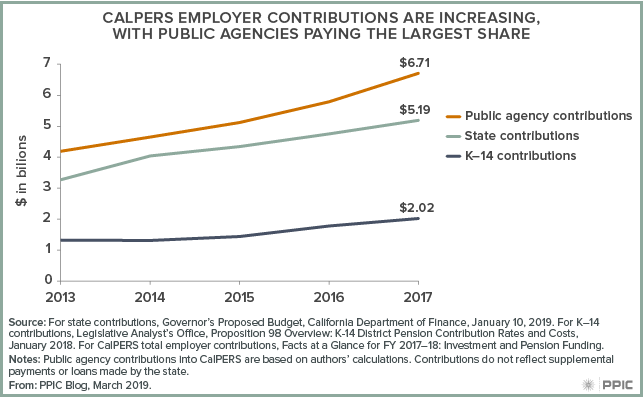
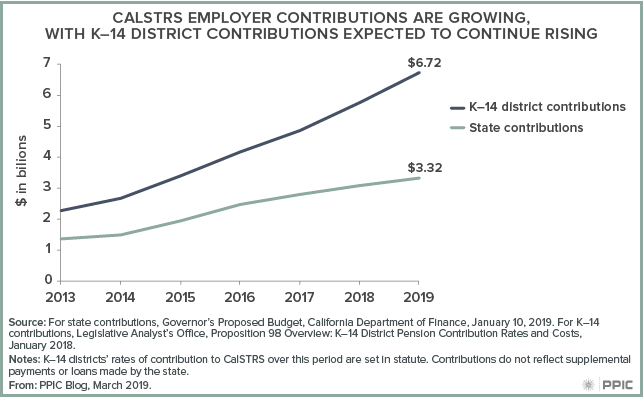
Closing those gaps will require larger payments from state and local governments, squeezing out dollars that would otherwise be used for programs and services. Employer contributions have already increased substantially in recent years. For example, public agency contributions into CalPERS increased from $4.19 billion to $6.71 billion from 2013 to 2017. And K–14 district contributions into CalSTRS have increased even more sharply, from $2.27 billion to $6.72 billion between 2013 and 2019. Indeed, the need to meet pension obligations was one of the financial pressures factoring into both the Los Angeles and Oakland teacher strikes.

CALPERS Employer Contributions Are Increasing with Public Agencies Paying the Largest Share

CALSTRS Employer Contributions Are Growing, with K-12 District Contributions Expected to Continue Rising

Prior to the end of his final term, Governor Brown anticipated that the court would rule broadly, giving future governors “the option of considering pension cutbacks for the first time in a long time.” Such flexibility would be helpful to policymakers trying to balance budgets should a future recession lead to a drop in revenues.

But the court’s ruling was far more narrow, saying that a pension provision provided by the legislature could later be removed. The provision in question—referred to as airtime—allowed public employees to “purchase” additional years of service for their pension calculations. By paying more into the system, someone with 15 years of service could have their pension calculated as if they had worked 20 years. It turned out this was costing more in future pension payouts than the value paid by the employee for the added years. The legislature ended the practice in 2013 and the court decision affirmed it could do that.

The court went on to say that since this specific benefit was not a “core pension right,” it was not part of an implicit contract with the employee. Treating certain pension benefits as a protected contract is part of a long-standing legal precedent known as the California Rule—a precedent that the court explicitly did not address.

So, what happens now? Two upcoming cases before the court, concerning employees from Alameda and Marin Counties, involve another provision of the 2013 reform that excludes certain kinds of pay (e.g., pay for on-call or standby work) from an employee’s pension calculation. Similar to the CalFire Local 2881 case, the unions maintain that how pay is calculated is part of the pension contract and cannot be changed.

Given the clear distinction the court just made between the airtime provision and the California Rule, it very well might take the same approach regarding the calculation of pay—ruling narrowly on the provision but leaving the bigger question untouched. If that happens, it would affirm the 2013 reform but fall far short of Brown’s vision of being able to reduce pensions outright as part of an effort to balance the budget.

The Challenges of Changing Land Use in the San Joaquin Valley

Implementing the state’s Sustainable Groundwater Management Act—which requires overdrafted groundwater basins to achieve balance between supply and demand by the 2040s—could require taking at least 500,000 acres of irrigated cropland out of production in the San Joaquin Valley. While some lands will be converted to uses such as solar energy, groundwater recharge, and restored habitat, there are no current plans for most of this acreage. We talked to Soapy Mulholland, president and CEO of Sequoia Riverlands Trust, about this impending challenge.

photo of Soapy MulhollandPPIC: What key challenges does this land use transition pose?
Soapy Mulholland: The challenges of managing this amount of land if it’s fallowed piecemeal―5 acres here, 30 there—are huge. A hodgepodge of retired lands would be very difficult to manage and restore.

When farmland is left bare it can cause dust and weed problems, so it will need cover crops. Finding the right cover crops that don’t use a lot of water is likely to be expensive. Grazing can help keep weeds down, but that requires fencing and most of the valley’s farms aren’t fenced.

PPIC: What are some top priorities for ensuring these lands are well managed?

SM: What we need is a vision for how to retire large blocks of land. That will require a “banking” system that pays farmers for retiring land and allows other farmers to purchase credits for a portion of the retired lands’ water, which they can then use on their own lands.

Let’s say you are a highly productive walnut farmer. You don’t want to fallow any of your 100 acres, so you would prefer to purchase a block of unproductive land to get water credits and keep your farm going. It’s a form of water trading. We need to figure out systems for how best to do that.

The idea is to buy farmland with low productivity, retire it, and link it to existing natural habitats. This could extend wildlife corridors from other parts of the region and allow for landscape-scale conservation on the valley floor. For example, there is a lot of potential to do this with less-productive lands at the edge of Tulare Lake Basin—we could conceivably get blocks of land 30,000 to 40,000 acres in size there.

We’ll need an organization or agency that can buy up retired lands—and systems in place to help manage them. We’ll also need a broad coalition of expertise, for example, appraisers and bankers to keep track of credits, and land managers with expertise in open space. We’ll need sophisticated systems that address all the different rules and regulations in California, and that connect all the various stakeholders and agencies that will be involved. And we’ll need funding—both for planning and for the systems themselves.

PPIC: Are there good examples of ways to use the idled lands?

SM: The establishment of solar plants in the Carrizo Plain area in eastern San Luis Obispo County is a good example. The solar companies had to figure out how to mitigate for impacts to habitat and agricultural land. They ultimately purchased more than 30,000 acres of rangeland and dry farmland, and entrusted future management to state agencies or land trusts (including our organization). Using grazing and other management techniques, these lands are now being restored, and even the areas under solar arrays are being managed to benefit at-risk species like the San Joaquin kit fox. Connecting these lands with the nearby Carrizo Plain National Monument offers even greater opportunities to multiply the benefits that each protected area provides on its own. It’s a good example of how to manage large parcels for multiple uses: habitat, agriculture, and renewable energy.

We need more pilot projects to set examples and figure out how best to do this. In the San Joaquin Valley, projects could focus on converting large parcels of retired farmland to semi-irrigated pasture or native grassland, with management in the hands of experienced land trusts. This approach could have benefits ranging from carbon sequestration and natural groundwater recharge to improved air quality and habitat for threatened and endangered species. As in Carrizo, landscape-scale conservation could produce much better outcomes than disconnected projects.

Bringing our region’s groundwater use in line with sustainable supplies will require significant changes in land use, agriculture, and water markets. Figuring out the right answers is likely to push all of us―farmers and ranchers, urban dwellers and conservationists alike―out of our comfort zones. But a coordinated approach to farmland retirement offers opportunities for landscape-scale conservation that can benefit people and nature.

Watch a video with Soapy Mulholland and other panelists discussing planning for water and land use transitions in the San Joaquin Valley

Californians Deeply Divided on Leaders—But Show Signs of Optimism

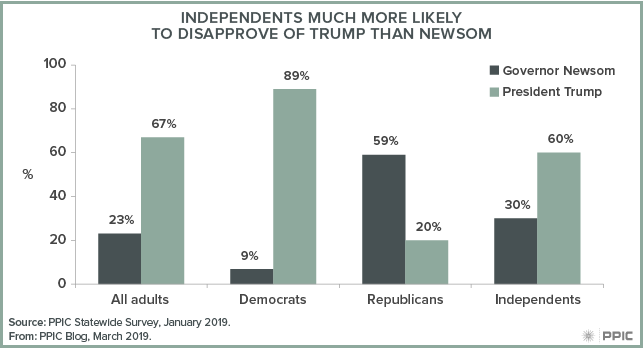
With Governor Newsom and President Trump clashing over policy and federal funding, how do Californians view the two leaders? Our January survey found that opinions of the governor and the president are very different—and very partisan. But while the partisan divide runs deep, Californians are unexpectedly hopeful about overcoming political differences and working together.

Not surprisingly, newly elected Governor Newsom is far more popular in California than President Trump. Our first reading of Governor Newsom’s approval rating came within the first few weeks of his term. A plurality of Californians said they approve of his job performance, while one in four disapproved and one in three were unsure how to rate him. Meanwhile, three in ten Californians approved of President Trump’s job performance, while two in three disapproved. This question was asked during and after the partial government shutdown in January.

Opinions of both leaders differ widely by party, but President Trump is more polarizing: nine in ten Democrats disapproved of President Trump, while a smaller share of Republicans—six in ten—disapproved of Governor Newsom. Notably, independents were twice as likely to disapprove of President Trump, compared to Governor Newsom.

figure - Independents Much More Likely to Disapprove of Trump Than Newsom

The two leaders couldn’t be in more different positions when it comes to their legislative counterparts. Governor Newsom is working with Democratic supermajorities in both houses, while President Trump has to work with a new Democratic majority in the House of Representatives and a slim Republican majority in the Senate.

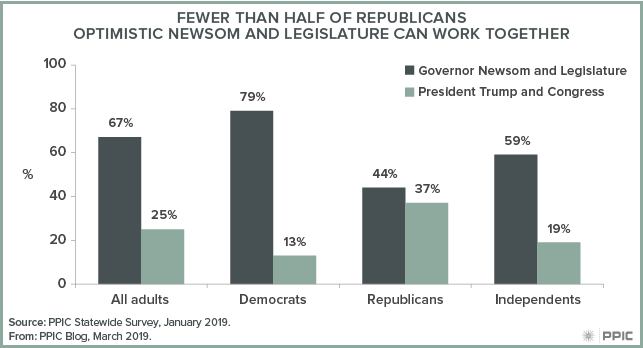
Californians are optimistic that Governor Newsom and the California Legislature will be able to work together and accomplish a lot in the next year. In fact, the share of Californians who are optimistic (67%) is the highest it’s been since we began asking this question in 2006.

In contrast, Californians’ views on the likelihood of cooperation in Washington, DC, are at a record low—with just 25% of Californians optimistic. Notably, Democrats and independents are polarized, while fewer than half of Republicans are optimistic about cooperation at either level.

figure - Fewer Than Half of Republicans Optimistic Newsom and Legislature Can Work Together

Despite the rancorous political environment and the contentious relationship between Governor Newsom and President Trump, most Californians (58%) are optimistic that Americans of different political views can still come together and work out their differences. Notably, about half of Democrats (52%), Republicans (49%), and independents (52%) are optimistic these differences can be overcome. As the governor looks to advance his agenda during his first year in office, we will continue to track Californians’ perceptions of their leaders and monitor attitudes about the state and the nation.

A Winning Approach for Managing Groundwater in the San Joaquin Valley

The San Joaquin Valley is in a time of great change. Decades of groundwater overuse have caused drinking water and irrigation wells to go dry, increased the amount of energy required to pump water, harmed ecosystems, and reduced the reserves available to cope with future droughts. Groundwater overdraft has also caused land to sink, damaging major regional infrastructure, including canals that deliver water across the state.

These problems spurred the enactment of the Sustainable Groundwater Management Act (SGMA), which requires local water users across California to bring groundwater use to sustainable levels by the early 2040s. With California’s largest groundwater deficit, the San Joaquin Valley is ground zero for implementing SGMA.

Although the region will reap many long-term benefits from ending overdraft, the transition to groundwater sustainability will be challenging and costly. The good news is that some approaches can greatly reduce the costs of bringing basins into balance.

The valley faces a groundwater deficit of nearly 2 million acre-feet per year (11% of net annual water use). To close the deficit, local agencies will have to augment their supplies, reduce their demands, or use some combination of these two approaches.

Our new report shows how a portfolio approach—with supply investments that farmers can afford and tools that increase flexibility for managing demand—offers a winning combination. The most promising supply options are to capture and store more local runoff, especially in groundwater basins, and to increase water imports by managing the system differently. On the demand side, increasing water trading—both within and across groundwater basins—can significantly mitigate the impacts of reducing water use, by allowing farmers to maintain the crops that generate the most revenue and jobs.

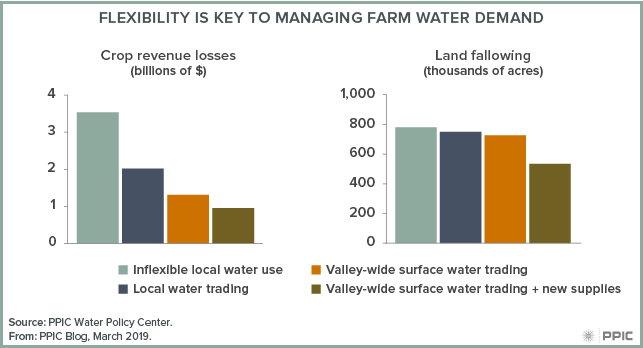
As the figure below shows, if farmers have no flexibility to trade water or adapt crop choices, ending overdraft without new supplies would require fallowing 780,000 acres—about 15% of the valley’s 5.2 million acres of irrigated cropland. It would also cause crop revenue losses of about $3.5 billion per year—roughly 17% of current crop revenues in the region.

figure - Flexibility Is Key to Managing Farm Water Demand

But if farmers can make flexible crop choices and trade ­water within local groundwater basins, fallowing would decline slightly, and crop revenue losses would fall by nearly half (to $2 billion per year). And with broader, surface water trading across the San Joaquin Valley, farmers in the south would buy some water from the north, where it is more abundant. This also would not change the amount of fallowed acreage by much, but it would further reduce the need to fallow the most profitable fruit, nut, and vegetable crops—lowering revenue losses by nearly two-thirds (to $1.3 billion per year).

Finally, a portfolio approach combining water trading and cost-effective supplies would reduce crop revenue losses by three-quarters (to $0.9 billion per year). The new supplies would also make a large dent in the need for land fallowing, which would fall by nearly one-third (to 535,000 acres).

Using a portfolio approach to achieve groundwater sustainability and avoid economic disruptions in the valley will require coordinated efforts among local, state, and federal agencies. The most pressing priorities are those related to expanding groundwater recharge and water trading, including:

  • Assessing infrastructure needs and modernizing water operations
  • Incentivizing recharge on farmlands
  • Clarifying how much water is available for recharge
  • Developing a healthy local trading culture
  • Facilitating state and federal approvals for trading and banking

Finally, to reap the most benefits from recharge, trading, and other tools, local entities will need to collaborate both within and across basins. Since the valley has more than 120 groundwater sustainability agencies for its 15 groundwater basins, overcoming institutional fragmentation will be key to success.