Videos: Higher Education Priorities

Last week in Sacramento, PPIC researcher Lunna Lopes outlined key findings from the latest PPIC Statewide Survey, which focuses on higher education. The following day in San Francisco, PPIC president Mark Baldassare and Monica Lozano, president of the College Futures Foundation, talked about the survey’s implications for governor-elect Gavin Newsom.

The survey finds that most Californians think public higher education should be a high priority for the next governor. For Monica Lozano, this is a key takeaway: “Overwhelmingly, Californians said that a four-year degree is essential to the economic vitality of the state. And, as much as we have considered Jerry Brown a real progressive on lots of issues, there is a sense that he did not do enough on higher education.”

Lozano also noted that Californians are focused on helping students succeed. Their concerns are less about access and enrollment capacity and more about student support: student debt, financial aid, and academic and other kinds of support. “The public is putting students at the center of this equation,” she said.

A majority of Californians see affordability as a big problem. In a state with one of the highest costs of living in the country, residents are divided on whether tuition and fees or housing and living expenses are the bigger burden: 45% say tuition and fees, 34% say housing and living expenses, and 17% volunteer that the two are equally burdensome. As Baldassare put it, “There’s more to affordability than tuition and fees.”

Noting that governor-elect Newsom has an ambitious agenda for “cradle to career” education, Baldassare asked how higher education advocates and experts could help the new administration move forward.

Lozano replied, “Our challenge is to actually help them think about the fundamental issues that surfaced in this survey.” For example, most Californians think state higher education funding is inadequate and many support a funding guarantee for UC and CSU. “If the system of financing higher education has to change so that it’s more predictable—so that there’s some sort of a dedicated revenue stream that’s tied to some accountability measures—how would you actually do that?”

More generally, Lozano and Baldassare agreed that the survey shows how highly Californians value higher education; as Lozano put it, “This survey gives the next governor permission to be bold.”

Gender Differences in Higher Education Start Early

Female students in California tend to have stronger high school records and greater rates of college attendance and completion than male students do. At the same time, there are large gender differences in many college majors, with some majors (e.g., computer science) predominantly male and others (e.g., liberal arts) predominantly female.

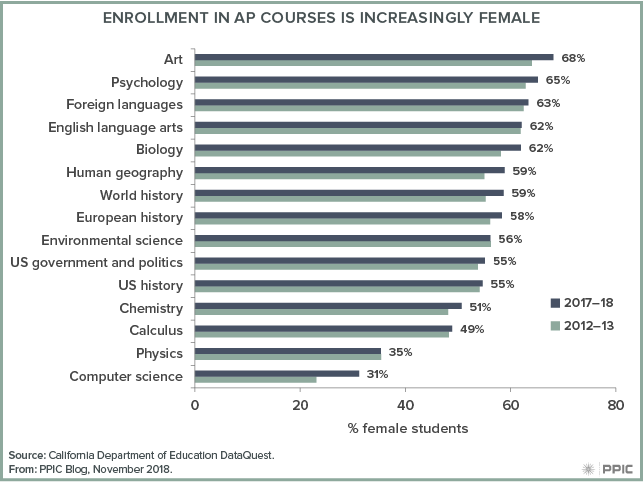
New data on high school courses shows that gender divides in college are already evident by high school. For example, only 31% of high school students in AP computer science courses are girls, while only 38% of students in AP English courses are boys. AP courses provide college-level curricula to high school students and are an important indicator of student pathways to college.

Mirroring differences by college major, AP course enrollments are also notably unbalanced in art, psychology, and foreign languages—all have large majorities of girls. In contrast, physics has a large majority of boys. But in other cases, gender differences in AP courses are not reflected in college majors. For example, in high school more female students take history and math AP classes, but in college more male students major in these subjects.

The low share of girls and women in computer science has been a particular cause for concern. But there is some good news. The share of girls in computer science AP courses has increased markedly in just five years (from 23% in 2012–13 to 31% in 2017–18).  Across the state, some high schools have achieved near gender parity in their AP computer science courses. For example, at Troy High School in Fullerton, a magnet school with the largest AP computer science enrollment in the state, 45% of students are girls.

Overall, female students in California are doing well. Female students make up 57% of enrollment in AP courses and a similar majority of college students. But the lack of women in some key fields is a concern. Colleges should do more to increase enrollment and access for women in subjects like engineering and computer science. High schools also have an important role to play—encouraging more girls to take AP classes in these subjects in high school could help pave the way for more women to pursue them as college majors and careers.

New Reforms at California Community Colleges

California community colleges are reforming to the way they assess their students’ college readiness and place them in remedial courses. A recently passed measure—Assembly Bill (AB) 1805—may increase both the uniformity and transparency of placement policies. PPIC research indicates that AB 1805 has the potential to improve student outcomes and narrow achievement gaps.

Our research finds that clearer and more uniform policies can make assessment results more portable for students. A previous measure, AB 705, established a set of measures a college must use to determine college readiness (e.g., coursework, grades, and/or grade point average). However, colleges continue to have autonomy to set their own rules, as opposed to using the Chancellor’s Office default placement rules. Our latest study finds that varying policies across colleges is a cause for concern. For example, two colleges within the same district might both use high school GPA to place students, but their GPA cutoffs might differ; this could pose problems for students who are assessed at one institution but want to take a transfer-level course at the other college.

AB 1805—which will be implemented systemwide in fall 2019—may help address this concern by mandating that colleges publicize their placement policies. As a result, students will be better informed and may also be more motivated to challenge placement decisions or enroll at colleges with broader access to transfer-level courses.

Variation in placement policies may also contribute to inequitable access to transfer-level courses. Our research indicates that underrepresented students may have more difficulty gaining access to transfer-level courses if they attend colleges with stricter placement rules. AB 1805 requires colleges to report the number of students placed into transfer-level coursework (with or without concurrent support) to the Chancellor’s Office and the public each year, providing racial/ethnic breakdowns. This should make it easier to see whether colleges are implementing placement policies that are fostering inequitable student outcomes.

Over the summer, PPIC engaged in an exhaustive scan of college websites and catalogs to get a sense of how placement policies are being communicated to students. We found that most community colleges do not provide clear and complete information—in fact, only 19 colleges provide placement details (e.g., GPA cutoffs). As we move forward, it will be critical to monitor the implementation of AB 705 and AB 1805 at the college level—including the placement measures being used and levels of access to transfer-level courses. By examining the policies and practices at colleges where underrepresented students experience uneven access to transfer-level courses, progress can be made toward improving outcomes and narrowing achievement gaps.

Standardized Testing and College Eligibility

In California and across the nation, there has been a growing focus on increasing college access by improving college readiness for high school students and encouraging more eligible students to attend college. To this end, many states and educational institutions have changed how they use college entrance exams like the SAT and ACT.

One approach has been to have more students take the SAT or ACT in hopes of identifying those who are eligible for college but might not have taken a college entrance exam on their own. As of 2016–17, 25 states use the SAT or ACT as their standardized test for 11th graders.

Assemblymember O’Donnell (D-Long Beach) has proposed AB 1951, which would give districts the option to use the SAT or ACT in place of California’s 11th-grade standardized test. Though Governor Brown vetoed the bill at the end of the 2017–18 legislative session, O’Donnell promised to bring it back in the next session, when California has a new governor.

But even as many states are administering the SAT or ACT to all students, a growing number of colleges and universities are dropping these tests as an entrance requirement. Citing concerns about biases in the exams, as well as the extra financial or time constraints for students, liberal arts colleges like Mills College in California and prominent universities such as the University of Chicago have made submitting test scores optional. Currently, California State University (CSU) does not require students to submit an SAT score (though most still do) if they meet the high school GPA threshold of 3.0 or higher. Despite this trend, most four-year colleges continue to use college entrance exams in their admissions decisions and a growing share of high school graduates take either the SAT or ACT.

In his veto message, the governor suggested another possible way to expand eligibility. California universities could consider using the state’s standardized test (SBAC) as an eligibility measure. All California 11th graders in public schools take the SBAC, which is aligned with the Common Core State Standards and is already used as an early diagnostic of college readiness at CSU and many community colleges. New evidence suggests that the SBAC does as well as the SAT in predicting first-year performance at California’s public universities.

Any of these strategies could increase the number of students eligible for California’s universities—but not all of them would work well together. For example, the University of California and CSU are further scrutinizing the role of the SAT in the admissions process. If the systems decide to drop the SAT requirement, then AB 1951 might have less of an impact. Looking forward, as state policymakers and districts continue to craft policies to improve college access, they should first consider how California’s universities are using—or not using—standardized tests.


College Rankings and Social Mobility

As high school seniors decide where to apply, numerous websites, magazines, and organizations are releasing lists of the “best colleges.” These rankings try to evaluate a college’s quality or highlight a particular factor, such as best value. Most rankings use similar data sources and variables, but each weighs factors differently in order to define and evaluate quality. Popular categories include student outcomes (graduation rate, earnings after college), measures of institutional quality (faculty quality, monetary value of resources for students), and affordability (net cost, institutional aid). Improving a college’s rank generally involves doing better in one or more of those areas relative to other institutions.

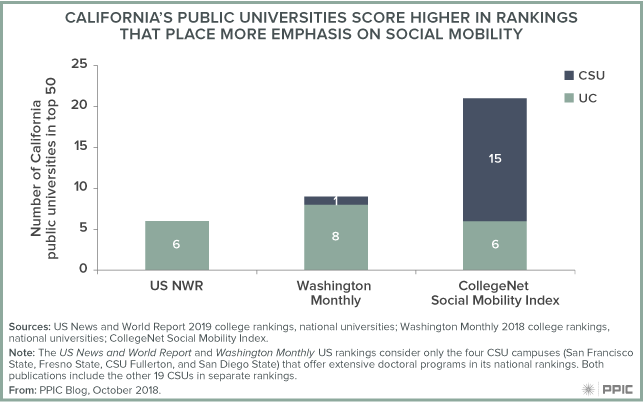
Recently, many rankings have started to consider social mobility—a school’s ability to move students up the ladder of economic opportunity. But the importance of social mobility in overall rankings varies widely. Just this year, US News World Report—a longtime leader in college rankings—removed acceptance rates from its methodology and instead factored in graduation rates for students who receive Pell Grants (these students are from the lowest-income families in the nation). Even so, the US News and World Report rankings do not give much weight to that measure. In contrast, Washington Monthly, another well publicized ranking, bases one third of its ranking scores on social mobility, including new data on graduation rate gaps between students who receive Pell Grants and those who do not. At the other end of the spectrum, the relatively new CollegeNet Social Mobility Index (established in 2014) focuses exclusively on elements of social mobility.

Research by the Equality of Opportunity Project shows that California’s public colleges do relatively well in promoting social mobility, particularly in moving students from the lowest to the highest quartile of income. The figure below shows the number of California’s public universities the top 50 according to each of three rankings; the greater the importance of social mobility, the higher California public universities rank relative to both private and public schools in other states.

Colleges pay attention to rankings, and highly rated schools publicize their ranks and use them in recruitment literature. A closer link between higher rankings and improved social mobility can be a win for California, its colleges, and its students.

California Community Colleges Are Transforming Developmental Education

With the passage of AB 705 in October 2017, California community colleges are in the midst of a major transformation of developmental education. The new law requires that community colleges restructure developmental education to maximize the likelihood that students will enter and complete transfer-level coursework in English and mathematics/quantitative reasoning in a one-year time frame.

Full implementation of AB 705 is expected no later than fall 2019. As colleges replace standardized test scores with high school records as their primary placement criteria, it is likely that the majority of entering students will enroll in transfer-level courses. To improve the likelihood of success, especially among students with the lowest high school performance levels, colleges are being encouraged to implement curricular reforms as well. Co-requisite remediation is an essential component of these reforms: it allows students who would otherwise be deemed underprepared to enroll directly in transfer-level math or English courses with concurrent remedial support.

While the vast majority of the state’s 114 community colleges have not yet implemented co-requisite models, a few colleges began experimenting with co-requisites and other reforms before the passage of AB 705. According to a recent PPIC report that looks at the efforts of these “early implementers,” co-requisites in English are more common than those in math. Nine California community colleges provided co-requisite courses in English to about 3,000 students in 2016–17 (the latest year of available data), and at least seven additional colleges began offering English co-requisite models in 2017–18.

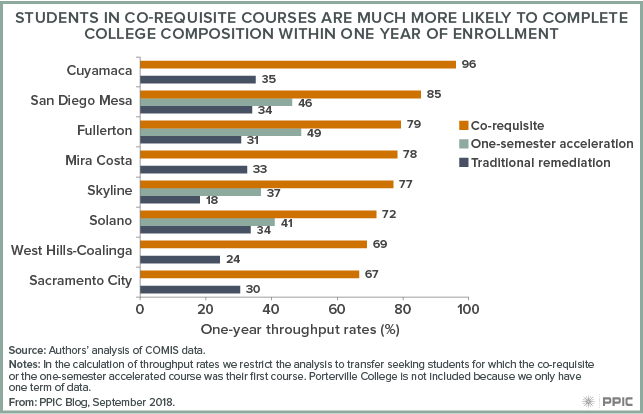
Early implementer colleges have seen dramatic gains in the completion of transfer-level English courses. Results for the fall 2016 cohort show that 78% of all co-requisite students completed a college composition course within a year; this metric, known as throughput rate, will be used to measure success under AB 705. The throughput rate of co-requisite students is 50 percentage points higher than the throughput rate of students who started in traditional remedial courses (27%); it is 36 percentage points higher than the throughput rate of students who took one-term accelerated developmental English courses (42%), and similar to the throughput rate of students who enrolled in transfer-level English without co-requisite support.

Throughput rates ranged from 67% to 96% across this group of colleges; rigorous research is needed to understand which factors are driving this variation. However, this early evidence—while not causal—does shed light on what we can expect to see in terms of student outcomes as more colleges move toward compliance with AB 705 requirements.

Video: Remedial Education Reform in Community College

Since the passage of Assembly Bill (AB) 705, California community colleges have been transforming their approach to remedial—or developmental—education. AB 705 requires community colleges to maximize the probability of their students completing transfer-level courses in the one-year time frame. To comply with AB 705, colleges are revising the way they assess student readiness for college-level courses—giving priority to high school GPA rather than tests. They are also changing course offerings and classroom approaches. How will the reforms affect student outcomes, and how are colleges dealing with the challenges of implementation?

At an event in Sacramento last week, PPIC researcher Marisol Cuellar Mejia outlined the findings of a new report that sheds light on AB 705’s potential impact by looking at the efforts of “early implementers”—colleges that began experimenting with reforms before AB 705 was signed into law. A panel of experts then offered a range of perspectives on AB 705 implementation.

Roanna Bennie, interim president of Las Positas College—an early implementer—noted that only a small fraction of students who start at the beginning of a traditional, multi-course math remediation pathway end up taking transfer-level courses. “It’s the data that’s been really influencing our campus to take measures,” she added. But she also said that her college is wrestling with full-scale implementation. The challenges include covering the cost of additional courses, getting input from faculty and other staff across campus, and helping students adjust to the changes.

Laura Metune, vice chancellor for external relations in the California Community Colleges Chancellor’s Office, emphasized the importance of professional development for both faculty and staff: “Everybody needs to understand what these changes are that we’re asking for, the research behind them, and what their individual roles are in helping them be successful.”

What comes next? As Katie Hern, an English instructor at Chabot College who co-founded the California Acceleration Project, put it: “The debate up until now has been whether to make these changes. That debate is over—the legislature settled that one. Now we have to make these changes and now we get to really study how to do it as effectively as possible.”

Year-Round Support for Low-Income Students

This summer marked the first time in eight years that summer Pell Grants were available. A need-based award to low-income, first-time undergraduates, the federal Pell Grant promotes access to postsecondary education. A summer component means that eligible students can use their Pell Grants year-round and receive up to one and a half awards in one academic year. For example, a student with the maximum school-year award of $6,095 can now receive a summertime award of $3,047—the total Pell Grant for the year would be $9,412. Unlike a student loan, Pell Grants do not need to be repaid. Previous PPIC work suggests that the availability of summer Pell Grants not only expands summer course enrollment but may also increase retention rates and accelerate time to degree.

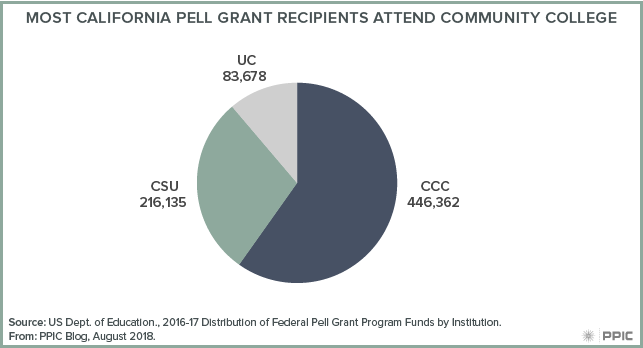
Who is likely to benefit from summer Pell Grants? Of all California students who received Pell Grants in 2016–17, more than 80% attended a public institution. Further, the California Community Colleges (CCC) enrolled the most Pell recipients of all California’s public institutions: about 60%. The California State University (CSU) and University of California (UC) systems enrolled 29% and 11% of recipients, respectively.

Many students at CCC who receive a Pell Grant also receive state aid, most commonly in the form of a California College Promise Grant tuition waiver. This year, the CCC tuition waiver covers summer enrollment fees as well. Applying the summer Pell Grant on top of the tuition waiver at CCC may enable students to cover significant non-tuition costs like housing, which is often a larger expense than tuition itself. The return of the summer Pell Grant makes year-round college attendance more affordable and enables students to make timely progress to their education goals.

Gender Imbalances in STEM Majors

In California and the United States as a whole, women have made strong educational progress over many decades. In 2006, for the first time ever in California, women became more likely to hold a bachelor’s degree than men. Women’s educational advantage over men has continued to grow in the past decade. In 2017, women received 57% of the bachelor’s degrees, 58% of the master’s degrees, and 54% of the doctorates awarded by California colleges. Much of this advantage stems from better preparation: women are more likely to graduate from high school than men and are also more likely to complete the college preparatory courses required for admission to the state’s public universities. Even so, women remain underrepresented in key science, technology, engineering, and mathematics (STEM) majors—in California and across the nation.

Statewide, only a few majors are gender balanced—meaning that half the bachelor’s degrees are awarded to women and half to men. In 2016, according to federal data, among the 22 most popular majors in California’s public and private nonprofit colleges, more than 60% of the bachelor’s degrees in 10 majors and fewer than 45% of degrees in 5 majors were awarded to women. At one extreme, women make up more than 80% of the graduates in consumer sciences, education, liberal arts, social services, and health professions. At the other extreme, only about 20% of bachelor’s degrees in engineering and computer science were awarded to women in 2016.

Because engineering and computer science are associated with strong labor market outcomes, low shares of women in those fields is cause for concern. The proportion of women majoring in these fields has not risen much in recent years: from 2010 to 2016, the share of bachelor’s degrees awarded to women in California increased from 19% to 21% in engineering and from 16% to 18% in computer science.

Efforts to address STEM gender imbalances are under way. For example, an NSF study by UCLA researchers is using longitudinal data across a set of colleges to identify actions that can increase the share of women in computer science. Given California’s high tech economy, the state’s colleges and universities should play a leading role in meeting this challenge.

Out-of-State Students and Tuition at UC

After the Great Recession, growing demand among out-of-state students, including international students, helped the University of California (UC) offset funding cuts. But as nonresident tuition goes up, and as UC places caps on enrollment that trend may be changing—raising questions about the stability of what’s now an important source of university revenue.

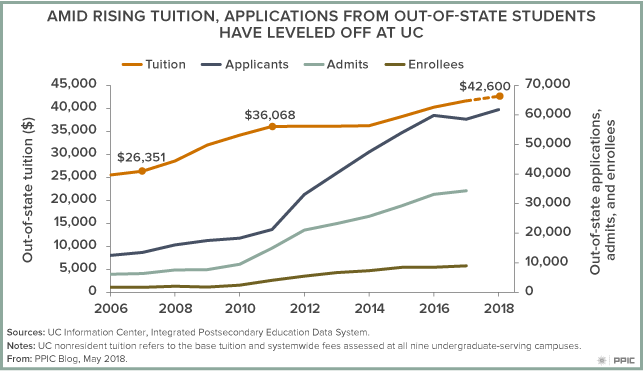
The recession brought heavy cuts to state education budgets, and public universities in California and nationwide increased tuition substantially to compensate. UC implemented cost-saving strategies and looked for other sources of revenue. Campuses began enrolling more out-of-state students, who pay an extra $20,000 or more in supplemental tuition every year. As a result, nonresident applications, admits, and enrollees all more than doubled from 2010 to 2016, and out-of-state students became a reliable—and growing—source of revenue. UC states that this additional revenue helps provide funding to enroll California residents.

From 2011 to 2014, tuition was frozen for all students as the state recovered from the recession, but nonresident tuition started to grow again in 2014. By 2017, nonresident tuition surpassed $41,000, leaving it comparable to the most expensive public universities in the nation (Michigan: $47,476; Virginia: $46,643) and to the most expensive private schools in the state (Stanford: $48,987; University of Southern California: $53,448). UC tentatively approved another increase in March that would put nonresident tuition at about $42,600, but may scale that back if the state kicks in more funds.

However, growth in out-of-state demand may be starting to slow at UC. The number of applications from out-of-state students, which had grown steadily since 2010, dropped in 2017, though it then rebounded to previous levels in 2018.

Nonresident Tuition Figure

There are many possible reasons for the potential slowing growth in demand among out-of-state students. UC has put a yearly cap on nonresident enrollment and stopped giving out-of-state students financial aid, which means they pay the full price of tuition plus living expenses, about $61,000 total. In contrast, private institutions do give financial aid, so even with higher tuition, they may be cheaper for some students overall. For example, the average estimated net cost for students who receive financial aid at the University of Southern California is $32,932, and at Stanford the net cost is $16,695.

Given the cap on out-of-state students—as well as the potential slowdown in the growth of demand—the University of California may have to look to other sources to increase revenue for its campuses.