Career Technical Education: Funding & New State Oversight

President Donald Trump recently signed the Strengthening Career and Technical Education for the 21st Century Act, or Perkins V, which reauthorized $1.2 billion dollars in federal funds for career and technical educational (CTE) programs. The new law gives states more flexibility to set their own goals for CTE programs, along with reporting progress toward those goals. Who might benefit from these changes, and what new challenges do they present to the state?

Perkins V supports programs that integrate career skills and prepare students at the secondary, postsecondary, and adult education level for the workforce—for such careers as IT technician, accountant, or nurse. Funding is based on student enrollment, and each year California receives more than $110 million in Perkins dollars, the vast majority (85%) of which go to CTE programs in high schools and community colleges. During the 2017–18 school year, close to 780,000 (40%) high school students and 420,000 (35%) full-time community college students participated in CTE.

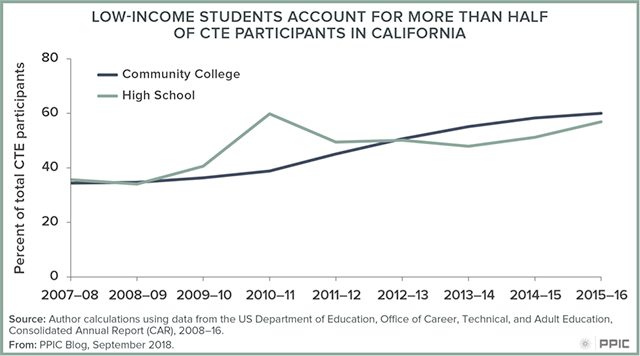
California’s CTE students generally reflect the demographics of the overall student population, though Asian American, Latino, and female students are slightly underrepresented. Over time, the overall number of students participating in CTE has decreased, but the percentage of low-income students who do so has increased. Today, low-income students account for more than half of CTE participants. Benefits associated with CTE programs include decreased high school dropout rates (for low-income students in particular), increased high school graduation rates, and higher wage returns (particularly in health fields).

Figure: Low-income students account for more than half of CTE participants in California

Although the new law provides states with greater flexibility, some of the provisions may present a challenge for those hoping to measure the impact of Perkins dollars in California. For example, under the new requirements performance indicators follow only students deemed to be “concentrators,” or those who complete a substantial number of courses in a single CTE program of study. Currently, concentrators account for less than half of CTE participants, so the indicators may not capture the outcomes of all who are served by Perkins funding. In addition, some of the core indicators—such as student placement in postsecondary CTE education—require the use of a comprehensive longitudinal database on student outcomes, a tool that California does not yet have. Furthermore, performance indicators are not broken down by industry sector, which makes it difficult to evaluate state-specific sectors, such as fashion and interior design or energy and utilities, which are unique to California’s economy.

Going forward, the Perkins reauthorization ushers in a new form of CTE program accountability at the state level. If California wants to continue to close the gap of 1.5 million workers with “some” college education, it needs to make inroads on designing, improving, and scaling up effective CTE programs—and on improving the quality of data on CTE programs and students.

Is the Decline in the Humanities Overstated?

While there has been a strong increase in STEM degrees awarded at California colleges and universities over the past 16 years, many have noted a decline in student interest in the humanities. Colleges have adjusted their offerings to reflect changes in student demand, and some observers have questioned whether liberal arts colleges can sustain their enrollments in the face of diminishing student interest.

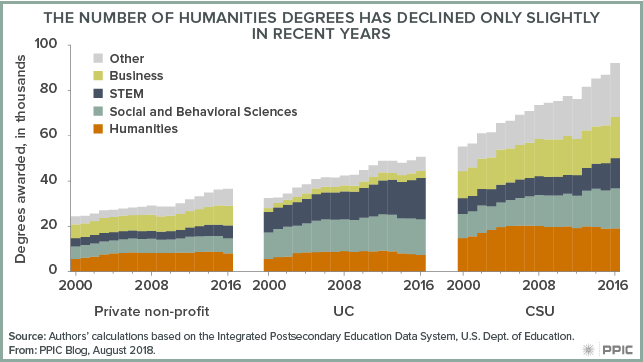
In California, the real story is not one of outright declines in humanities majors but a lack of growth compared to other majors. The number of students earning a bachelor’s degree in the humanities in California increased from just over 26,000 in 2000 to almost 38,000 in 2006. It has since declined—but only slightly—to 35,000. This pattern is widespread, with the University of California (UC), the California State University (CSU), and the state’s private nonprofits all experiencing sharp increases from 2000 to 2006 and slight declines since that time. Because other degrees have continued to increase, the share of degrees awarded to humanities majors has declined noticeably—from 27% in 2006 to 19% in 2016.

Humanities majors make up a larger share of students at private nonprofit colleges and CSU than at UC, but there is wide variation across campuses. At Cal Tech (the California Institute of Technology) only 0.8% of bachelor’s degrees were awarded in the humanities in 2016, whereas at Biola and Chapman Universities humanities degrees made up almost 40%. At CSU only 9% of degrees at Cal Poly San Luis Obispo were in the humanities (just 1% at Cal Maritime were), compared to 28% at Cal State Channel Islands. And at UC only 4% of UC Merced students earned a humanities degree, compared to 22% at UC Santa Barbara.

These patterns and trends suggest that the decline of the humanities is overstated, at least for now. But there are indications that these trends will persist. Economic returns tend to be higher for students in STEM than in the humanities, and students are increasingly citing job prospects as the primary reason they enroll in college. The College Board reports that among the newest college-bound students in California, only 9% expressed an interest in majoring in the humanities. Going forward, colleges and universities that emphasize the humanities will need to make the case (and it can be made) for the value of those degrees.

More Students Are Earning STEM Degrees

The number of students graduating with a bachelor’s degree in science, technology, engineering, or math (STEM) has risen dramatically in California. Both students and colleges are responding to changes in our economy, which increasingly rewards highly educated workers, especially those with STEM degrees.

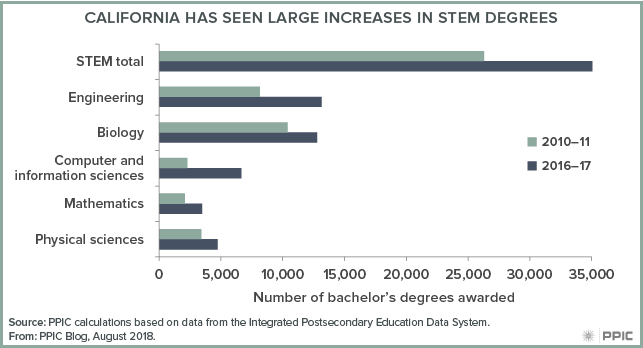
Between 2010–11 and 2016–17, the number of STEM bachelor’s degrees awarded by colleges and universities in California increased 55%, more than triple the rate of growth in other degrees (17%). By 2016–17, 20% of all bachelor’s degrees awarded were in a STEM field, up from 16% in 2010–11.

These increases occurred across the board for all STEM fields and for all higher education sectors in the state. Increases were especially sharp in engineering, which surpassed biology as the most common STEM degree. Computer and information sciences also saw big gains, with almost three times as many bachelor’s degrees awarded in 2016–17 as in 2010–11. The increase in computer science is particularly notable, as its popularity had declined after the “dot com” bust of the early 2000s.

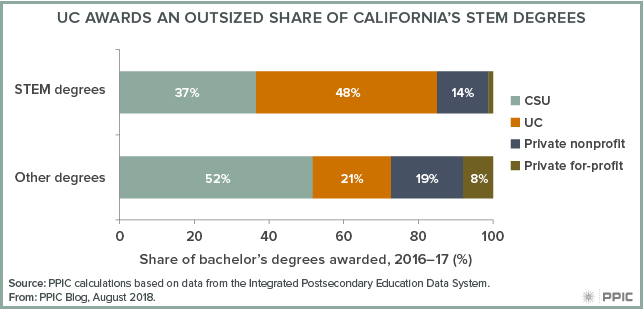
STEM fields are especially popular at the University of California (UC), which awards almost half of the state’s STEM degrees (compared to only 21% of other bachelor’s degrees). In contrast, California State University (CSU) awards 37% of the state’s bachelor’s degrees in STEM, compared to more than half (52%) in other majors. STEM is also less common at private colleges, especially for-profit institutions.

But there is wide variation across colleges. At UC San Diego (56%) and UC Merced (48%), about half of bachelor’s degrees awarded in 2016–17 were in a STEM field, compared to only 27% at UC Santa Barbara. In the CSU system, 37% of bachelor’s degrees at Cal Poly San Luis Obispo were in STEM, compared to only 8% at Cal State Dominguez Hills. And among the state’s larger private nonprofit colleges (those with at least 1,500 bachelor’s degrees awarded), half of Stanford University’s bachelor’s degrees were in STEM, compared to only 8% at Azusa Pacific.

The rapid growth in STEM majors is a testament to changing interests among students. Those interests are academic, but also economic. Strong labor market outcomes for STEM graduates—especially for those with degrees in engineering and computer science—almost certainly contribute to the increasing demand for those majors.

Colleges have responded, at least in part, by building more capacity for STEM majors. Moreover, public colleges have led the way, with UC and CSU experiencing the largest shifts toward STEM degrees. Between 2010–11 and 2016–17, the share of bachelor’s degrees awarded in STEM fields increased 6.8 percentage points at UC (from 30.0% to 36.8%) and 4.4 percentage points at CSU (from 10.7% to 15.1%), compared to only 2.7 percentage points at private nonprofit colleges (from 12.4% to 15.1%).

While more could be done to fully meet student demand—at many campuses, engineering and computer science majors have more applicants than can be accommodated—the evidence to date shows that California’s higher education system has been able to substantially increase capacity in STEM fields.

Gender Imbalances in STEM Majors

In California and the United States as a whole, women have made strong educational progress over many decades. In 2006, for the first time ever in California, women became more likely to hold a bachelor’s degree than men. Women’s educational advantage over men has continued to grow in the past decade. In 2017, women received 57% of the bachelor’s degrees, 58% of the master’s degrees, and 54% of the doctorates awarded by California colleges. Much of this advantage stems from better preparation: women are more likely to graduate from high school than men and are also more likely to complete the college preparatory courses required for admission to the state’s public universities. Even so, women remain underrepresented in key science, technology, engineering, and mathematics (STEM) majors—in California and across the nation.

Statewide, only a few majors are gender balanced—meaning that half the bachelor’s degrees are awarded to women and half to men. In 2016, according to federal data, among the 22 most popular majors in California’s public and private nonprofit colleges, more than 60% of the bachelor’s degrees in 10 majors and fewer than 45% of degrees in 5 majors were awarded to women. At one extreme, women make up more than 80% of the graduates in consumer sciences, education, liberal arts, social services, and health professions. At the other extreme, only about 20% of bachelor’s degrees in engineering and computer science were awarded to women in 2016.

Because engineering and computer science are associated with strong labor market outcomes, low shares of women in those fields is cause for concern. The proportion of women majoring in these fields has not risen much in recent years: from 2010 to 2016, the share of bachelor’s degrees awarded to women in California increased from 19% to 21% in engineering and from 16% to 18% in computer science.

Efforts to address STEM gender imbalances are under way. For example, an NSF study by UCLA researchers is using longitudinal data across a set of colleges to identify actions that can increase the share of women in computer science. Given California’s high tech economy, the state’s colleges and universities should play a leading role in meeting this challenge.

How Changes in Immigration Affect California’s Workforce

[vc_row][vc_column][vc_column_text]Immigrants are essential to California’s workforce. In the past two decades, as labor market needs have shifted, the composition of recent immigrants (those arriving in the last five years) has changed dramatically. Today, recent immigrants to California are much more likely to hold a bachelor’s or more advanced degree than in the past—and in fact are now more likely than US-born Californians to do so.

While the number of recent immigrants to California fell by 24% between 2000 and 2016, the number of highly educated immigrants rose by 41%. In 2016, about half of recent immigrants held at least a bachelor’s degree. Highly educated immigrants work in every major industry in the state and comprise about 30% of the highly educated workforce.

These changes in educational attainment coincide with other shifts in immigration patterns. A large portion of the decline in immigration to California can be attributed to the falling numbers of immigrants arriving from Mexico. In 2000, over half a million recent immigrants came from Mexico. By 2016, that number fell by more than 70% to less than 150,000 people.

Now, China has slightly edged out Mexico as the leading country of origin, and these top two countries are followed by India, the Philippines, and Vietnam. Immigrants from China and India tend to be highly educated: in 2016, 47% of recent immigrants from China—and around 80% of recent immigrants from India—had at least a bachelor’s degree. The interactive below allows you to further explore changes in education levels over time among recent immigrants overall and from these five countries.

The sharp increase in highly educated immigrants and the decline in less-educated immigrants reflect the changing labor market in California. Unemployment rates for workers with at least a bachelor’s degree (3.3%) are about half those of less-educated workers (6.5%). With California expected to face a shortfall of 1.1 million college graduates by 2030, highly educated immigrants are a key component to helping the state address the workforce skills gap.[/vc_column_text][/vc_column][/vc_row][vc_row][vc_column][vc_raw_html]JTNDZGl2JTIwY2xhc3MlM0QlMjd0YWJsZWF1UGxhY2Vob2xkZXIlMjclMjBpZCUzRCUyN3ZpejE1Mjc4Nzg3ODgxNDYlMjclMjBzdHlsZSUzRCUyN3Bvc2l0aW9uJTNBJTIwcmVsYXRpdmUlMjclM0UlMEElMDklM0Nub3NjcmlwdCUzRSUwQSUwOSUzQ2ElMjBocmVmJTNEJTI3JTIzJTI3JTNFJTNDaW1nJTIwYWx0JTNEJTI3RURVQ0FUSU9OJTIwTEVWRUxTJTIwVkFSWSUyMEFDUk9TUyUyMElNTUlHUkFOVCUyMEdST1VQUyUyMCUyNyUyMHNyYyUzRCUyN2h0dHBzJTNBJTI2JTIzNDclM0IlMjYlMjM0NyUzQnB1YmxpYy50YWJsZWF1LmNvbSUyNiUyMzQ3JTNCc3RhdGljJTI2JTIzNDclM0JpbWFnZXMlMjYlMjM0NyUzQkNhJTI2JTIzNDclM0JDYWxpZm9ybmlhc2ltbWlncmFudHNhbmRlZHVjYXRpb25sZXZlbHNfMCUyNiUyMzQ3JTNCSW1taWdyYW50c2luQ2FsaWZvcm5pYWJ5ZWR1Y2F0aW9uYW5kY291bnRyeW9mb3JpZ2luJTI2JTIzNDclM0IxX3Jzcy5wbmclMjclMjBzdHlsZSUzRCUyN2JvcmRlciUzQSUyMG5vbmUlMjclMjAlMkYlM0UlM0MlMkZhJTNFJTBBJTA5JTNDJTJGbm9zY3JpcHQlM0UlMEElMDklM0NvYmplY3QlMjBjbGFzcyUzRCUyN3RhYmxlYXVWaXolMjclMjAlMjBzdHlsZSUzRCUyN2Rpc3BsYXklM0Fub25lJTNCJTI3JTNFJTBBJTA5JTA5JTNDcGFyYW0lMjBuYW1lJTNEJTI3aG9zdF91cmwlMjclMjB2YWx1ZSUzRCUyN2h0dHBzJTI1M0ElMjUyRiUyNTJGcHVibGljLnRhYmxlYXUuY29tJTI1MkYlMjclMjAlMkYlM0UlMEElMDklMDklM0NwYXJhbSUyMG5hbWUlM0QlMjdlbWJlZF9jb2RlX3ZlcnNpb24lMjclMjB2YWx1ZSUzRCUyNzMlMjclMjAlMkYlM0UlMEElMDklMDklM0NwYXJhbSUyMG5hbWUlM0QlMjdzaXRlX3Jvb3QlMjclMjB2YWx1ZSUzRCUyNyUyNyUyMCUyRiUzRSUwQSUwOSUwOSUzQ3BhcmFtJTIwbmFtZSUzRCUyN25hbWUlMjclMjB2YWx1ZSUzRCUyN0NhbGlmb3JuaWFzaW1taWdyYW50c2FuZGVkdWNhdGlvbmxldmVsc18wJTI2JTIzNDclM0JJbW1pZ3JhbnRzaW5DYWxpZm9ybmlhYnllZHVjYXRpb25hbmRjb3VudHJ5b2ZvcmlnaW4lMjclMjAlMkYlM0UlMEElMDklMDklM0NwYXJhbSUyMG5hbWUlM0QlMjd0YWJzJTI3JTIwdmFsdWUlM0QlMjdubyUyNyUyMCUyRiUzRSUwQSUwOSUwOSUzQ3BhcmFtJTIwbmFtZSUzRCUyN3Rvb2xiYXIlMjclMjB2YWx1ZSUzRCUyN25vJTI3JTIwJTJGJTNFJTBBJTA5JTA5JTNDcGFyYW0lMjBuYW1lJTNEJTI3c3RhdGljX2ltYWdlJTI3JTIwdmFsdWUlM0QlMjdodHRwcyUzQSUyNiUyMzQ3JTNCJTI2JTIzNDclM0JwdWJsaWMudGFibGVhdS5jb20lMjYlMjM0NyUzQnN0YXRpYyUyNiUyMzQ3JTNCaW1hZ2VzJTI2JTIzNDclM0JDYSUyNiUyMzQ3JTNCQ2FsaWZvcm5pYXNpbW1pZ3JhbnRzYW5kZWR1Y2F0aW9ubGV2ZWxzXzAlMjYlMjM0NyUzQkltbWlncmFudHNpbkNhbGlmb3JuaWFieWVkdWNhdGlvbmFuZGNvdW50cnlvZm9yaWdpbiUyNiUyMzQ3JTNCMS5wbmclMjclMjAlMkYlM0UlMEElMDklMDklM0NwYXJhbSUyMG5hbWUlM0QlMjdhbmltYXRlX3RyYW5zaXRpb24lMjclMjB2YWx1ZSUzRCUyN3llcyUyNyUyMCUyRiUzRSUwQSUwOSUwOSUzQ3BhcmFtJTIwbmFtZSUzRCUyN2Rpc3BsYXlfc3RhdGljX2ltYWdlJTI3JTIwdmFsdWUlM0QlMjd5ZXMlMjclMjAlMkYlM0UlMEElMDklMDklM0NwYXJhbSUyMG5hbWUlM0QlMjdkaXNwbGF5X3NwaW5uZXIlMjclMjB2YWx1ZSUzRCUyN3llcyUyNyUyMCUyRiUzRSUwQSUwOSUwOSUzQ3BhcmFtJTIwbmFtZSUzRCUyN2Rpc3BsYXlfb3ZlcmxheSUyNyUyMHZhbHVlJTNEJTI3eWVzJTI3JTIwJTJGJTNFJTBBJTA5JTA5JTNDcGFyYW0lMjBuYW1lJTNEJTI3ZGlzcGxheV9jb3VudCUyNyUyMHZhbHVlJTNEJTI3eWVzJTI3JTIwJTJGJTNFJTBBJTA5JTNDJTJGb2JqZWN0JTNFJTBBJTNDJTJGZGl2JTNFJTBBJTNDc2NyaXB0JTIwdHlwZSUzRCUyN3RleHQlMkZqYXZhc2NyaXB0JTI3JTNFJTBBJTIwJTIwJTIwJTIwJTIwJTIwJTIwJTIwJTIwJTIwJTIwJTIwJTIwJTIwJTIwJTIwJTIwJTIwJTIwJTIwdmFyJTIwZGl2RWxlbWVudCUyMCUzRCUyMGRvY3VtZW50LmdldEVsZW1lbnRCeUlkJTI4JTI3dml6MTUyNzg3ODc4ODE0NiUyNyUyOSUzQiUwQSUyMCUyMCUyMCUyMCUyMCUyMCUyMCUyMCUyMCUyMCUyMCUyMCUyMCUyMCUyMCUyMCUyMCUyMCUyMCUyMHZhciUyMHZpekVsZW1lbnQlMjAlM0QlMjBkaXZFbGVtZW50LmdldEVsZW1lbnRzQnlUYWdOYW1lJTI4JTI3b2JqZWN0JTI3JTI5JTVCMCU1RCUzQiUwQSUyMCUyMCUyMCUyMCUyMCUyMCUyMCUyMCUyMCUyMCUyMCUyMCUyMCUyMCUyMCUyMCUyMCUyMCUyMCUyMGlmJTIwJTI4JTIwZGl2RWxlbWVudC5vZmZzZXRXaWR0aCUyMCUzRSUyMDcwMCUyMCUyOSUyMCU3QiUyMCUwQSUwOSUwOSUwOSUwOSUwOSUwOXZpekVsZW1lbnQuc3R5bGUud2lkdGglM0QlMjc2NTBweCUyNyUzQnZpekVsZW1lbnQuc3R5bGUuaGVpZ2h0JTNEJTI3NjAwcHglMjclM0IlMEElMDklMDklMDklMDklMDklN0QlMjBlbHNlJTIwaWYlMjAlMjglMjBkaXZFbGVtZW50Lm9mZnNldFdpZHRoJTIwJTNFJTIwNTAwJTIwJTI5JTIwJTdCJTBBJTA5JTA5JTA5JTA5JTA5JTA5dml6RWxlbWVudC5zdHlsZS53aWR0aCUzRCUyNzUwMHB4JTI3JTNCdml6RWxlbWVudC5zdHlsZS5oZWlnaHQlM0QlMjc3MzBweCUyNyUzQiUwQSUwOSUwOSUwOSUwOSUwOSU3RCUyMGVsc2UlMjAlN0IlMEElMDklMDklMDklMDklMDklMDl2aXpFbGVtZW50LnN0eWxlLndpZHRoJTNEJTI3MTAwJTI1JTI3JTNCdml6RWxlbWVudC5zdHlsZS5oZWlnaHQlM0QlMjc3MzBweCUyNyUzQiUwQSUwOSUwOSUwOSUwOSUwOSU3RCUwQSUwOSUwOSUwOSUwOSUwOXZhciUyMHNjcmlwdEVsZW1lbnQlMjAlM0QlMjBkb2N1bWVudC5jcmVhdGVFbGVtZW50JTI4JTI3c2NyaXB0JTI3JTI5JTNCJTBBJTA5JTA5JTA5JTA5JTA5c2NyaXB0RWxlbWVudC5zcmMlMjAlM0QlMjAlMjdodHRwcyUzQSUyRiUyRnB1YmxpYy50YWJsZWF1LmNvbSUyRmphdmFzY3JpcHRzJTJGYXBpJTJGdml6X3YxLmpzJTI3JTNCJTBBJTA5JTA5JTA5JTA5JTA5dml6RWxlbWVudC5wYXJlbnROb2RlLmluc2VydEJlZm9yZSUyOHNjcmlwdEVsZW1lbnQlMkMlMjB2aXpFbGVtZW50JTI5JTNCJTBBJTNDJTJGc2NyaXB0JTNF[/vc_raw_html][/vc_column][/vc_row]

Guaranteeing Transfer Admission to the University of California

Improving transfer from community colleges to four-year universities is an important step in meeting the state’s future workforce needs. In April 2018, the California Community College Chancellor’s Office and the University of California (UC) entered an agreement to guarantee admission to community college students who meet certain qualifications. If sufficient funding and space exist, the guarantee could take effect in fall of 2019.

There are already several pathways for community college students to enroll in UC. For example, all but three campuses (Berkeley, Los Angeles, and San Diego) have a guaranteed admission program for students from certain community colleges. UC has also established academic road maps in 21 majors to help prepare students who plan to apply to transfer. However, completing an academic road map does not guarantee admission.

The new plan would guarantee admission for eligible community college students to a UC campus, but not necessarily to their preferred campus. Specifically, it creates a referral pool—a way to redirect students away from full campuses toward campuses with space. This transfer referral pool would be similar to UC’s referral pool for freshmen. At this time only one campus, UC Merced, accepts applicants from the freshman referral pool. In 2017, thousands of eligible students were redirected to UC Merced, but few actually enrolled.

How might a referral pool work for transfer students? Currently, three campuses—Santa Cruz, Riverside, and Merced—are having a particularly difficult time enrolling sufficient numbers of transfer students. These campuses would need to absorb redirected transfer students. However, it’s not certain that redirected students would enroll, even if offered admission. Right now, many transfer applicants decline their offer of admission to these campuses.

To improve transfer pathways for community college students, UC and the state should consider both expanding capacity at high-demand campuses and exploring ways to encourage students to attend other campuses.

Parents Have High Educational Hopes for Their Children—Can California Keep Up?

The most recent PPIC Statewide Survey on Californians’ views on education finds that the vast majority of parents (83%) hope their children will obtain at least a bachelor degree—in fact, nearly half (48%) want their children to earn a graduate degree. These parental aspirations are relatively constant across race/ethnicity, political ideology, and income. They are also fairly consistent across regions—although, among the regions represented in the survey, parents in the Central Valley are the least likely (77%) and San Francisco Bay Area parents are the most likely (96%) to want their children to earn college or graduate degrees. These parental aspirations may be linked to student course taking and performance in high school. Over the past decade, there has been a 48% increase in completion of the coursework that makes California high school graduates eligible for UC or CSU; in 2015, 43% of the state’s graduating class met this eligibility requirement.

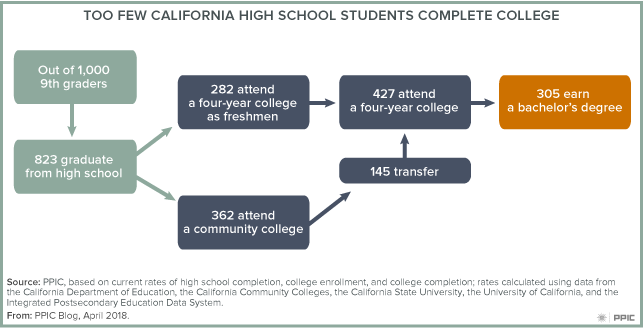
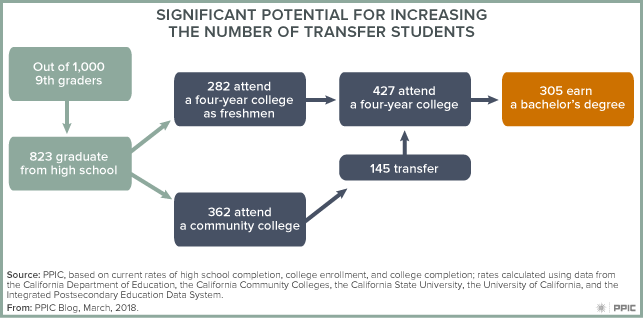
Moreover, these aspirations are aligned with urgent state needs. If current economic and educational trends persist, California will fall 1.1 million bachelor’s degrees short of economic demand by 2030. The state economy is increasingly reliant on high-skill workers, but most K–12 students do not stay on track to obtain a bachelor’s degree, let alone a graduate degree. Previous PPIC research has shown that for every 1,000 9th graders in California, only 305 will earn a bachelor’s degree at UC or CSU.

Parental Aspiration Figure

California has a long way to go in meeting demand for higher education, but there are signs of progress. The state has been reinvesting in public higher education, increasing undergraduate enrollment, and improving student outcomes—and the public education systems are increasingly willing to work together to streamline the higher education pipeline. California will need continued innovation and significant investment in facilities and faculty in order to accommodate the kind of enrollment growth that can keep up with economic demand and individual aspirations. Moreover, given the large share of Californians who see advanced degrees as important, the state may want to begin a more robust discussion about graduate school, along the lines of its recent focus on career technical education.

Testimony: Transfer Is Key to Closing the Workforce Skills Gap

Hans Johnson, director and senior fellow at the PPIC Higher Education Center, testified March 20, 2018, before the Senate Select Committee on Student Success.

Here are his prepared remarks.

California faces a shortage of highly educated workers. Specifically, economic projections to 2030 show that about two in five jobs will require at least a bachelor’s degree, while demographic projections suggest that only about one in three Californians will attain this level of education. This shortfall equates to 1.1 million workers. To close the gap, all higher education systems will need to play a role, increasing access, transfer, and completion. Improving access and outcomes among groups historically underrepresented in higher education—including low-income students, first-generation college students, Latinos, and African Americans—is essential if we are to close the workforce skills gap.

The good news is that California’s students are rising to the challenge. College preparation among high school graduates has increased, with the share of students completing the college preparatory requirements of UC and CSU now at an all-time high. Strong demand for UC and CSU is likely to continue as college preparation improves and the transfer pathway becomes more efficient and effective. In addition, new initiatives, including reforms in remedial education at the community colleges and CSU, have the potential to substantially improve student success rates and boost transfer. Finding ways to accommodate all these students remains a central challenge, but one that must be met in order to ensure a better future for all Californians.

In this testimony, I will focus on the importance of transfer. California enrolls a disproportionate share of students in community college. We rank 47th in the nation in the share of recent high school graduates enrolling in four-year colleges and 5th in the nation in the share enrolling in community colleges. This means that we must do more to ensure that community college students reach their educational goals—since the vast majority of recent high school graduates attending community colleges say that they want to transfer and earn a bachelor’s degree. As shown in the chart below, there is a lot of room for improvement—only 40% of recent high school graduates who go to community college will end up transferring to a four-year institution.
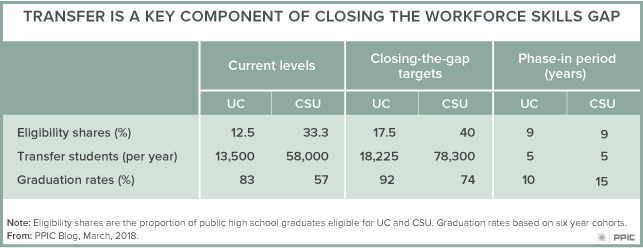
PPIC has identified ambitious targets that would close the workforce skills gap. As shown in the table below, doing so will require large increases in access to UC and CSU, both for first time freshmen and for transfer students. In its Vision for Success, a blueprint for improving student outcomes, the community colleges have established new goals for transfer that align exactly with the PPIC targets. Those targets include a 35% increase in the number of transfer students at UC and CSU, increasing from about 72,000 combined in 2015 to almost 100,000 by 2020.
I’m pleased to say that the colleges are currently on track to meet those targets. We are now two years into PPIC’s projections, and both UC and CSU have met the closing-the-gap targets (see charts below). The concerted efforts of policymakers, higher education officials—including staff and faculty—and, of course, students have led to these early gains.  State general fund allocations for each system have increased since the Great Recession, allowing for increased enrollment. At UC, those budget allocations were partially tied to increasing enrollment, hence the sharp rise in transfers from 2015 to 2016.  New articulation agreements, such as the Associate Degree for Transfer (ADT), have streamlined the pathway from community colleges to four-year colleges, especially CSU. And an increased focus on improving student outcomes in the community colleges has led to multiple substantive reforms designed to increase persistence and completion (including transfer).

These early successes are very promising. Still, California needs to build on them if it is to close the degree gap.  We offer the following recommendations for moving forward:

  • First, the state should work with the systems to ensure that students who are eligible for transfer successfully make the transition. Some students who are eligible to transfer never even apply to do so. More work needs to be done to understand factors that prevent those students from moving on, including an assessment of equity implications. At the same time, many transfer-eligible students do apply to transfer, but are not admitted because of insufficient resources at UC and CSU. Because of budget constraints, CSU reports turning away more than 32,000 transfer applicants from 2013–14 through 2016–17, even though they had met CSU admission requirements (based on systemwide unduplicated counts of California resident applications). UC does not report how many qualified applicants have been turned away, partly because UC eligibility is less clearly defined. UC has general transfer requirements, including courses and grade point average requirements, but advises students that “meeting these basic requirements doesn’t guarantee admission to the campus or major of your choice.” Enrolling more students will almost certainly require more funding, either from the state via the general fund or from students and their families through tuition increases.
  • Second, the pathway from community college to UC and CSU needs to become systematically and comprehensively streamlined. The Associate Degree for Transfer is a step in the right direction. Students earning an ADT are guaranteed admission to CSU in a major aligned to their course of study. But these degrees are offered only in some majors at some colleges. While the number of students earning an ADT has grown rapidly, it is still the case that the majority of transfers to CSU do not have the degree. As shown in the chart below, institutional participation in the program varies by college and by major. Some majors, including engineering, have no ADT at all.  Moreover, UC does not formally participate in the ADT guarantee. At UC, transfer admission requirements vary by campus and by majors within campuses.  For example, UC Berkeley’s College of Engineering has much higher standards than the UC minimum requirements for transfer, including a 3.5 grade point average and the completion of courses that are not offered at all community colleges.

  • Third, the state and its higher education institutions need to plan for potentially large increases in the number of community college students prepared and ready to transfer. New reforms in the community colleges hold the promise of dramatically increasing persistence and completion. Assessment and placement reform, spurred by AB 705, is likely to lead to an enormous increase in the number of students placed directly into college-level English and math courses—bypassing traditional remedial classes that have been the single largest impediment to student success. Other new initiatives, including “guided pathways” intended to provide a clear road map to students on courses of study and the supports needed to succeed, could lead to further gains. Because most transfer students enroll in CSU and UC, capacity issues at those institutions must be addressed. The state’s private nonprofit colleges are also an important destination for transfer students, and continued efforts should seek to gain greater participation and enrollment in that vital sector.

Through thoughtful planning—and yes, additional funding—closing the workforce skills gap is possible. Improving the transfer pathway is a necessary and critical component. And because community colleges are highly representative of California’s economic and demographic diversity, improving transfer pathways will ensure that more low-income, first-generation, and underrepresented students have access to a four-year degree.

Occupational Shifts Favor California’s High-Skill Workers

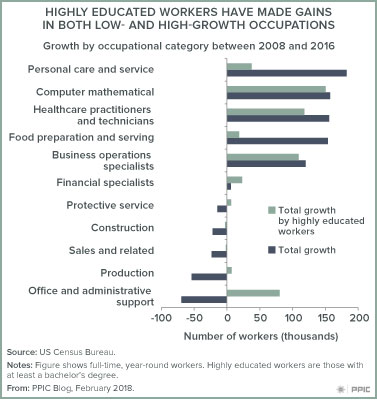
[vc_row][vc_column][vc_column_text]The recession and recovery have reshaped California’s workforce. Between 2008, when employment peaked, and 2010, when it bottomed out, the state lost three quarters of a million jobs. Since then, the state has experienced sustained job growth; according to US Census Bureau data, by 2016 there were 1 million more workers in California than there had been in 2008. This job growth has not been evenly distributed. Some occupations experienced large losses during the recession and have not fully recovered, while others experienced small losses and now have much higher employment levels than they did at their pre-recession peak. While there are some high-growth occupations that do not require high levels of education, workers with at least a bachelor’s degree have prospered the most over the past several years.

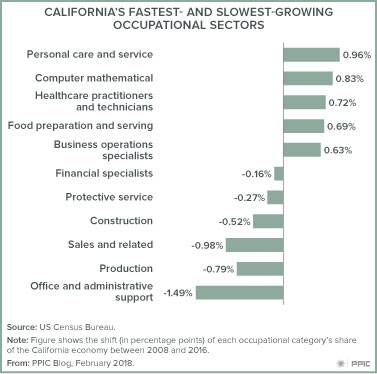
Overall, California’s workforce is becoming more educated: the share of the full-time year-round workforce with at least a bachelor’s degree grew from 31% in 2008 to 35% in 2016. Highly educated workers got more than half of the jobs created in the five fastest-growing occupational categories (based on increases in the share of total full-time year-round workers) between 2008 and 2016:
  1. Personal care and service
  2. Computer and mathematical
  3. Healthcare practitioners and technicians
  4. Food preparation and serving
  5. Business operations specialists

All of these occupations experienced small declines during the recession and strong growth during the recovery. The number of full-time year-round workers increased 28%—from 2.5 million in 2008 to 3.2 million in 2016. Workers in some of these occupations, such as food preparation and serving, earn relatively low wages and tend to have low levels of educational attainment, while workers in other areas, such as computer and mathematical, collect high wages and tend to be college graduates. Altogether, workers with at least a bachelor’s degree made up 433,000 (56%) of the 770,000 jobs gained between 2008 and 2016 by the top five categories.

Workers with at least a bachelor’s degree also made gains in the five slowest-growing occupational categories:

  1. Protective service
  2. Construction
  3. Production
  4. Sales and related
  5. Office and administrative support

These occupations experienced sharp losses during the recession and have not returned to their pre-recession peaks. The number of full-time year-round workers in these occupations declined from 5.3 million in 2008 to 5.1 million in 2016. On average, educational attainment levels are low in these occupations, but workers with at least a bachelor’s degree fared relatively well: the number with at least a bachelor’s degree grew by 89,000, even though these categories have experienced a net loss of 184,000 jobs.

In short, the recession and recovery have accelerated some long-term trends in California’s economy. High-skill occupations and highly educated workers have fared well, while less-educated workers in lower-skilled jobs have faced declining employment opportunities.

[/vc_column_text][/vc_column][/vc_row]

Retraining Workers for the Future Economy

As the economy continues to shift toward computers and digital technology—and braces for a potential future with more robots—workers have been called upon to adapt and learn new skills. New industries and new kinds of jobs may lead to economic growth, but whether these gains are shared by all of California’s workers depends critically on their retraining. And that retraining, in turn, depends on the ability of educational institutions to also adapt to new labor market needs.

While workers can sometimes learn new skills on the job or on their own, other times retraining means obtaining a new credential and returning to the classroom. That’s especially true for people who work in technical industries that are being reshaped by forces like routinization, automation, and outsourcing.

California’s higher education system has an important role to play in delivering retraining options. The state’s community colleges are the primary provider, with hundreds of programs in skilled trades and applied sciences and technologies. Notably, community colleges offer retraining options at a much lower cost to students than do private for-profit two-year colleges, another major provider. In addition, many community college programs show substantial economic returns for students—especially in health professions.

Effective retraining through the state’s colleges would help ensure that all Californians are productive and self-sufficient, which would benefit not just families but also employers and the state economy. However, the current model of higher education was largely built for 18-year-old, first-time freshmen and does not necessarily work for older, returning students, who are almost certainly balancing training with career, family, and other demands.

Flexible course scheduling—for example, through online courses or “distance” education—is one way to better reach workers. California’s community colleges are the clear leader in offering online options. PPIC research has highlighted some limitations to online training and outlined ways to improve student outcomes. Online courses for technical programs may require additional innovation, especially those that require hands-on training. Governor Brown’s proposed budget for fiscal year 2018–19 includes funding for a fully online community college that has the potential to bring innovation to how retraining opportunities (and educational opportunities, broadly speaking) are offered to Californians.

For individuals or training programs not amenable to online options, expanding course offerings near job centers is key. Cal State Los Angeles’s satellite campus in downtown LA aims to do exactly this. Information about the job market is also crucial—and California’s community colleges have taken a big step in the right direction by providing easily accessible information on the labor market outcomes of different colleges and programs across the state.

Retrained workers may pursue all kinds of new skills, but career technical programs, most of which are in community colleges, are particularly important because they offer short-term credentials in industry-relevant fields. Efforts to make career technical programs more flexible—through, for example, online courses, convenient locations, and partnerships with employers—are critical to filling student, employer, and state needs in a rapidly changing workplace.

Learn more
Visit the PPIC Higher Education Center