Video: Feinstein on Her Role in a New World

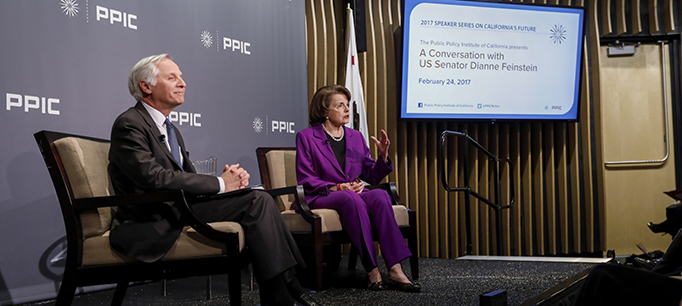
Senator Dianne Feinstein was clear about the challenges ahead for a California Democrat in contentious times.

“Here we are: outnumbered, outvoted, in the West, fairly liberal,” she said.

Speaking before an energetic capacity crowd in San Francisco, Feinstein said her office had received more than a million phone calls about Trump’s cabinet nominees. She described her approach to them: careful evaluation, rather than blanket opposition—an approach too conciliatory for some sign-carrying audience members. Feinstein said that in her role on the Senate Judiciary Committee, she needed to work with the administration officials in charge of national security and felt she could work with Trump appointees James Mattis, defense secretary; John Kelley, secretary of homeland security; and Mike Pompeo, CIA director. But she opposed other nominees because they lacked credentials for the job or they aren’t right for the county, she said. Nevertheless, they went on to win approval.

“The key for me is to figure out how we can begin to win some of these battles.”

Asked about Trump’s nominee to the Supreme Court, Neil Gorsuch, Feinstein wouldn’t say how she would vote. She said she will be particularly interested in his views on gun laws and on women’s reproductive rights.

Feinstein’s visit was greeted by dozens of protesters who marched outside, upset that she had not hosted a traditional town hall. Inside, Feinstein touched on a range of issues from climate change to immigration to health care, in a wide-ranging conversation with Mark Baldassare, PPIC president and CEO. His questions included a number that PPIC solicited online in advance of the event.

Governor’s Funding Plan for Climate, Drought

Governor Brown has released a proposed budget that reaffirms the state’s commitment to boosting drought resiliency and battling climate change. While specifics are likely to change before the budget is finalized in June, here is a summary of key proposals.

  • Cap and trade. California’s recent efforts to combat climate change have been funded from its cap-and-trade program. The program faces an uncertain future because its statutory authority is set to expire in 2020. Partly due to this uncertainty, 2016 cap-and-trade auctions raised a fraction of the money raised in previous years. At the governor’s budget press conference, he announced legislation that would extend the program beyond 2020. Appropriation of cap-and-trade funds in the new budget is dependent on the passage of this bill—which will require a two-thirds vote in both the senate and the assembly. Should it pass, the governor proposes appropriating $2.2 billion for cap and trade, a decrease from last year’s $3.1 billion. As in past years, 60 percent of the proceeds would be for ongoing funding of public transit, affordable housing, sustainable communities, and high-speed rail. The rest is split among one-time investments. This year, the largest sum in the one-time investment pot ($863 million) is for public transit improvements aimed at increasing ridership and decreasing greenhouse gas emissions. Smaller sums include $142 million to fund local climate actions in the state’s most disadvantaged communities and $128 million for projects in forests and urban and agricultural landscapes that remove carbon dioxide from the atmosphere and store it in vegetation or soils.
  • Emergency drought spending. While recent rains have drenched California, the governor’s emergency drought declaration is still in effect, and the new budget appropriates an additional $188 million in one-time resources for drought relief. Roughly half ($91 million) is allocated to CAL FIRE—the agency dedicated to fire protection and stewardship of the state’s forests—to enhance its firefighting capacities and support the removal of dead trees. The drought has contributed to widespread tree mortality, which has raised concerns that the dead trees might fuel future destructive wildfires.
  • Water bond updates. Nearly 80 percent of Proposition 1 water bond funding has already been appropriated (though far less has been awarded for spending). This year, the governor proposes appropriating $248 million from the bond for an Integrated Regional Water Management grant program. These funds are meant to incentivize regional cooperation with the goal of resolving complex water management challenges at a broad scale while balancing social, environmental, and economic objectives. For instance, these funds could foster a regional approach to helping water systems adapt to climate change. An additional $3.8 million would enable the State Water Resources Control Board to enforce the implementation of California’s groundwater law.

Although state money represent only a fraction of California’s total water sector spending (13%—the rest is mostly locally funded), it is an important piece of the funding pie. While the governor’s proposed budget would bring welcome funding to a number of critically important areas, key water challenges continue to experience long-term funding gaps—especially safe water for small rural communities, flood control systems, stormwater management, and ecosystem management.

Learn more

Read California’s Water: Paying for Water (from California’s Water briefing kit, October 2016)
Visit the PPIC Water Policy Center

Video: Assessing California’s Global Warming Law

Ten years ago, California enacted a law to combat global warming that set an ambitious goal: reducing greenhouse gas emissions to 1990 levels by 2020. Today, the state is poised to reach this target, and policymakers are discussing aiming for a new one.

Each year since the law—AB 32—took effect, the PPIC Statewide Survey has examined Californians’ views on climate change and the state’s actions to address it. The survey has consistently found that most Californians believe that the effects of global warming have begun and that majorities support the state taking action to address it.

But a partisan split has emerged since the law took effect. AB 32’s goals no longer have the bipartisan support they did in 2006. Today, Democrats and independents are much more likely than Republicans to support the goals of AB 32. This divide is reflected in a number of findings in the 2016 Californians and the Environment Survey.

Research associate David Kordus presented the survey at a briefing in Sacramento last week.

Video: Reforming Federal Drought Management

The federal government is a key partner in just about every aspect of western water management. It’s the West’s largest landowner, chief environmental regulator, major supplier of irrigation water and hydropower, key provider of water information, and an important source of water-related funding. The vast scale of its involvement has brought big challenges to how it manages the drought that has affected the entire 11-state region in recent years.

The fed’s role in managing droughts in the West was the topic of a seminar in Washington, DC, last week, a joint effort of Resources for the Future and the PPIC Water Policy Center. Along with a panel of prominent national experts, we discussed how to improve policies and practices to build drought resilience at the federal level, with a focus on pragmatic changes that are doable in the near term. I introduced recommendations from our new report, Improving the Federal Response to Drought: Five Areas for Reform, to help structure the conversation.

A panel discussion followed, with my colleague Jeffrey Mount moderating. He asked panelist Ann Mills, deputy under secretary for natural resources and environment at the US Department of Agriculture, about how USDA’s vast array of programs could be better coordinated for drought.

Noting that there are 15 agencies just within the department that have some influence on water management, Mills said, “We’ve started to create USDA water teams at the senior policy level … to make sure we’re coordinating our work as effectively as possible. There are real challenges in breaking down silos in the USDA and the federal family.” Mills noted that USDA is also seeking to improve its data and make it actionable and more available to customers. “And we’re building on the really great work that’s already happening on the ground,” she said.

Panelist Mark Kramer of The Nature Conservancy was asked about the lack of a “drought plan” for the environment during the latest drought, which might have reduced the crisis now facing some species.

“The pressure to squeeze more water out of the system is enormous,” Kramer said. Water has been framed as an “either-or” proposition—either it goes to the environment or to human uses. But, he noted, it can be managed in ways that address environmental needs without harming other users. The Nature Conservancy has been working on pilot projects that help farmers put water “when and where it’s needed”—for example, to create temporary wetlands for birds during drought. To scale up these efforts, some agencies may need more funding and other tools.

These are tough, multidimensional problems, and solving them will require a heavy lift. But increasingly, people in the West realize we can’t continue with “business-as-usual” water management. Tom Iseman, deputy assistant secretary for water and science at the US Bureau of Reclamation, noted that westerners are already experiencing the impacts of hotter, longer droughts, and realizing some things will need to change. “We’re trying to get ahead of these problems, to promote long-term drought resilience.”

Learn more

Read a summary of policy recommendations from Improving the Federal Response to Western Drought (February 2016)
Read “There’s Always Drought Somewhere in the West” (PPIC blog, February 4, 2016)

Video: PPIC Survey Examines Election Landscape

As California heads into an election year, the PPIC Statewide Survey looks at residents’ views on a broad range of issues that are already flashpoints in the presidential primary races and will likely surface in statewide campaigns next year.

PPIC research associate Lunna Lopes presented the survey’s key findings at a Sacramento briefing last week. She was joined by Mark Baldassare, PPIC president and CEO, for a question and answer session afterward. He noted a link between Californians’ “modestly optimistic view of the economy,” their belief that there is income inequality in the state, and their attitudes about which ballot issues are important. Twice as many residents say that increasing the state minimum wage is very important than say legalizing marijuana is very important.

“In California, the belief that this state is divided into the haves and have-nots—and the feeling among many Californians that they are among the have-nots—are going to be driving forces in the election,” he said. The survey briefing was held just after the mass shooting in San Bernardino, and the briefing touched on Californians’ views about gun laws. PPIC research associate David Kordus provided findings from the September survey on this issue: Compared to adults nationwide, Californians are more likely to favor stricter laws than we have now. Most also say that controlling gun ownership is more important than protecting the right of Americans to own guns.

Video: Governing in a Time of Change

At a time when economic, environmental, and demographic forces are changing California, Governor Jerry Brown’s chief aide, Nancy McFadden, was asked to describe three administration priorities requiring bold leadership.

The first priority is keeping the state on a fiscally stable road, she told PPIC president and CEO Mark Baldassare before a Sacramento audience last week. This requires tough choices, she said, as the governor demonstrated when he vetoed bills that were worthy ideas but had budget implications for the state General Fund.

“Sometimes bold leadership means saying no,” she said.

Second, the administration will continue to implement the far-reaching changes adopted in past years, such as corrections realignment and the Local Control Funding Formula for schools, which targets money to the state’s neediest students and shifts funding control to the local level.

McFadden said the third priority is the “whole panoply of climate change and environment issues facing not only our state but our world.” Extreme weather events—drought, wildfires, and flooding—pose immediate challenges that have to be managed.

McFadden’s conversation with Baldassare was followed by a panel discussion about leadership—what it takes and when elected officials have demonstrated it. The panelists were Jim Brulte, chair of the California Republican Party and former state senate Republican leader; state senators Loni Hancock and Carol Liu; and Darrell Steinberg, chair of the California Government Law and Policy Practice at Greenberg Traurig and former senate president pro tem. The moderator was John Myers, Sacramento bureau chief of the Los Angeles Times.

State Struggles to Enact More Robust Climate Targets

California’s efforts to cut greenhouse gas emissions thus far have made the state a national leader. But the momentum may be slowing. A struggle over recent climate legislation resulted in a less-ambitious version of the Clean Energy and Pollution Reduction Act (SB 350) being signed into law by Governor Brown last week and the deferment of a bill (SB 32) that would have strengthened the state’s 2006 climate law.

The Global Warming Solutions Act of 2006 (AB 32) established the foundation of California’s plan to address climate change by reducing GHG emissions to 1990 levels by 2020. The state is on track to meet the 2020 limit, and now policy efforts are shifting to longer term goals. Emission-reduction targets of 40 percent below 1990 levels by 2030 and 80 percent by 2050 are already set forth in executive orders (former Gov. Schwarzenegger’s S-3-05 and Gov. Brown’s B-30-15) but have not yet been incorporated into law.

SB 350 is seen as a major step toward reducing GHG emissions in the longer term. It mandates that half of the state’s electricity come from renewable resources and that buildings double their energy savings by 2030. But a third piece of the original plan, which proposed to cut petroleum use in cars and trucks by half over the next 15 years, was dropped. Since the transportation sector is a major contributor to GHG emissions (37% in 2013), this is could make it more challenging to meet long term emissions reductions. To make up for the loss, the Air Resources Board adopted a modified version of its Low Carbon Fuel Standard that requires a 10 percent reduction in carbon intensity of transportation fuels by 2020.

The second slowdown was the deferment of SB 32 until at least next year. The bill would amend the California Global Warming Solutions Act of 2006 to include the 2030 and 2050 emission-reduction targets from the executive orders. It failed to pass in the assembly.

Our July PPIC Statewide Survey found that solid majorities of Californians (69% adults, 62% likely voters) favored the proposal to reduce GHG emissions to 80 percent below 1990 levels by 2050. When asked about the original goals of SB 350, 82 percent of adults supported the increase of electrical generation from renewables, 70 percent favored doubling energy efficiency in buildings, and 73 percent supported reducing petroleum use in cars and trucks by 50 percent by 2030. Although Democrats are more likely than Republicans to support these goals, majorities of Republicans support the goals of increasing renewables and energy efficiency. Overwhelming majorities who favor these policies also view global warming as a serious threat to the economy.

The state’s approach to reducing GHG emissions has achieved important results. The mix of policies has resulted in a cleaner economy, while population and GDP have continued to grow. Looking ahead, a study for the California Energy Commission shows that with the mix of technologies and practices proposed by state agencies, emission reductions of 26–38 percent below 1990 levels could be achieved by 2030 at a cost of $8 per household per month (or $14 if commercial and industrial costs are all passed on to households).

California’s multi-faceted approach to combating global warming has placed it in the vanguard of worldwide policies. Yet 2020 is just around the corner, and clear targets to reduce GHG emissions for the longer term still evade us. To remain on the leading edge of global climate regulations, the state will need to adopt more robust and forward-looking policies. It would also be worthwhile to explore a new narrative to reduce the partisan divide on this issue, given Californians’ widespread support for the state’s energy goals.

Learn More

Explore PPIC’s climate change page.


Video: Senator Boxer Comes to PPIC

In more than 20 years in the US Senate, Barbara Boxer said there have been good changes (more women today) and bad (the “chasm” that divides the parties). But sometimes, despite the gridlock and insults, there is common ground, she told an audience at PPIC yesterday. She and Republican Senator Mitch McConnell found it in teaming up on a multi-year highway bill.

“Working with Mitch McConnell was unexpected,” she said. “We actually hadn’t talked too much in 20 years.” Bringing senators from both parties to an agreement—particularly on how to pay for the bill—was tough. But the bill got the votes. It passed the Senate and is now pending in the House.

Boxer told this story and others in a wide-ranging conversation with Mark Baldassare, PPIC’s president and CEO, that touched on climate change, California water policy, the presidential race, and the nuclear deal with Iran.What’s next? For the record, Boxer says she is not retiring. She’s just not running for Senate again.

Californians and Climate Change

It’s been nine years since the movie “An Inconvenient Truth” had its debut and AB 32, the “California Global Warming Solutions Act of 2006” was passed by the Democratic-controlled legislature and signed by Republican Governor Arnold Schwarzenegger. Since then, Republicans and Democrats at the federal level have sparred over the scientific evidence on global warming, the government’s role in regulating greenhouse gases, and energy policies that will promote economic growth and well-being. Still, California likely voters’ strong support of AB 32—through good economic times and bad—has barely budged (66% PPIC July 2006, 63% PPIC July 2015).

The July 2015 PPIC poll finds that Californians’ economic fears are part of the reason for their steady support for AB 32—which requires California to reduce its greenhouse gas emissions back to 1990 levels by 2020. Among California’s likely voters, 69 percent say global warming is a threat to California’s economy and quality of life.

Another reason for likely voters’ support for AB 32 is their hope that it may improve the jobs outlook. Asked about the economic impact of state actions to reduce global warming, they are more likely to say the result will be more jobs for people in the state (34%) than to say that the result will be fewer jobs (24%) or that there will be no impact on jobs (29%).

Our polling finds a strong link between likely voters’ fears about the impact of climate change and hopes about state action to address it. Among those in favor of AB 32 today, the overwhelming majority say that global warming is a serious threat to the state’s economy. And a plurality of the supporters of AB 32 say the state’s actions to reduce global warming would lead to more jobs (44%). Less than a third (30%) say these actions would have no effect on job numbers. Just 14% say the result would be fewer jobs.

Californians have not only expressed consistent support for the state’s current goals to curb greenhouse gas emissions, they favor expanding those efforts. Solid majorities of likely voters strongly support three ideas proposed by Governor Brown earlier this year and reflected in SB 350, which is under consideration in the legislature: reducing petroleum use in cars and trucks by 50% by 2030, increasing the use of renewable energy for the state’s electricity to 50% by 2030, and doubling the energy efficiency in existing buildings by the year 2030. Most likely voters also support the proposal in another bill, SB 32, which would require the state to reduce its greenhouse gas emissions to 80% below 1990 levels by 2050.

Once again, strong support of these more ambitious climate goals is tied to the perceived economic effects of both climate change and the state’s actions to address it. Overwhelming majorities of likely voters who favor the new proposals say that global warming is a very serious or somewhat serious threat to the economy (88% reduce petroleum use; 82% increase renewable energy; 85% double energy efficiency; 87% reduce greenhouse gas emissions). Among likely voters who favor these new proposals, pluralities say that California’s actions to reduce global warming will lead to more jobs. Small minorities who favor the new climate change proposals say there would be fewer jobs as a result of actions to reduce global warming.

To reach California’s goals to curb emissions, the state will need to find ways to drastically reduce its greenhouse gases and reliance on fossil fuels. On this topic, the poll finds strong majority support for policies that encourage more electric vehicles and solar power. Overwhelming majorities who favor these policies also view global warming as a serious threat to the economy. Pluralities of those who favor these proposals expect that actions to reduce global warming would lead to more jobs.

PPIC’s surveys have consistently shown that most Californians are aligned with the state’s current efforts and proposed policies, and that they have made up their minds about the perceived economic impacts of climate change and state actions to curb it. Still, the ongoing political debate over what steps to take relies on partisan talking points borrowed from the national arena. There is a shortfall of factual analysis to help leaders—and all Californians—understand the costs, benefits, and trade-offs they are being asked to make. Specifically, will climate change take a greater toll on poor and disadvantaged communities? How will climate change policies improve job prospects in these communities?

As one of the most important issues facing California’s future, climate policy is certainly deserving of a well-informed discussion and a thorough public hearing as new climate-oriented proposals make their way through the legislative process this summer.
Video: PPIC’s Annual Survey on the Environment

As California pursues its goals to reduce greenhouse gas emissions—and considers still more ambitious ones—PPIC’s annual survey on environmental issues asked the state’s residents their views on climate change and energy. At a recent event in the capital, PPIC researcher Lunna Lopes provided the survey findings. Among the key points:

  • Californians see global warming as a serious threat—and most do not think action to reduce global warming will lead to fewer jobs.
  • There is strong support for the greenhouse gas emission reduction requirements in AB 32 and SB 32.
  • Californians favor the energy goals in SB 350, and they also favor state support for solar power and electric vehicles.
  • Many say water is the state’s top environmental issue—but most do not know the reduction targets of their local water district.