‘Tis the Season for College Applications

Across the nation, millions of high school seniors are in the process of completing college applications. Friday is the deadline to submit applications for freshmen admission to the fall 2019 term to California’s public universities (the University of California and the California State University); most private colleges have January deadlines. The number of applications this year should be staggering—in California most of all. But the state is having difficulty keeping up with demand.

Recent years have seen all-time records in freshman applications. In fall 2016 (the year of most recent nationwide data), more than 10 million applications went to more than 1,500 four-year colleges and universities, leading to 5.7 million admittances and 1.5 million enrolled freshmen. Ten years earlier, just over 6 million applications were submitted, leading to 3.6 million admittances and 1.3 million enrolled freshmen.

Significant growth has occurred in California, too. In fall 2016, 1.5 million applications went to 110 four-year colleges and universities, leading to more than 600,000 admittances and 139,000 enrolled freshmen. Ten years earlier in the state, 800,000 applications were submitted, leading to slightly more than 400,000 admittances and 104,000 enrolled freshmen.

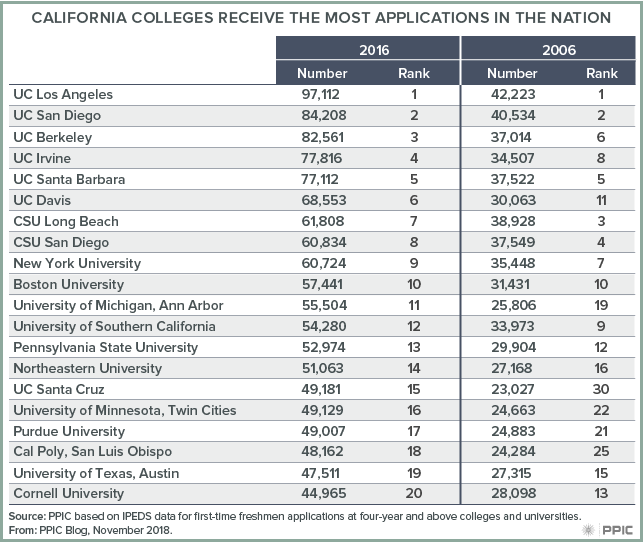
California colleges and universities garner the most applications in the nation. Of the top 10 most popular schools, eight are in California (six UC campuses and two CSU campuses), as are 11 of the top 20. UCLA has led the nation in applications every year for at least the past 17 years, and in 2017 it became the first college in the country to receive more than 100,000 freshmen applications.

The popularity of UC campuses has surged over the past 10 years, with UC Irvine moving from 8th in 2006 to 4th in 2016, UC Davis moving from 11th to 6th, and UC Santa Cruz moving from 30th to 15th. In the CSU system, Cal Poly San Luis Obispo has moved from 25th to 18th. And even though other CSU campuses fell in the rankings, they still experienced large increases in applications.
Of course it makes sense that California colleges would lead the nation: the state has more high school graduates than any other and offers a robust system of public universities. And students are applying to more colleges than they did in the past, which is part of the growth in applications. But much of the increase is attributable to improvements in college preparation. Between 2006 and 2016, the number of California high school graduates completing the courses required for UC and CSU eligibility increased by almost 60% (compared to a decline of 1% in the number of high school graduates who do not complete the college prep courses).

Unfortunately, California’s public universities have not been able to accommodate all qualified applicants. Indeed, California universities lead the nation in rejecting applicants. Each of the UC campuses except Merced are unable to admit all of the eligible students who apply. Six CSU campuses (including Long Beach, San Diego, and San Luis Obispo) are impacted for all undergraduate programs, meaning they cannot admit all qualified applicants, and most of the other campuses are impacted in certain majors. Both UC and CSU refer qualified applicants to campuses that have more room, but more needs to be done to expand capacity at campuses with high demand.


Videos: Higher Education Priorities

Last week in Sacramento, PPIC researcher Lunna Lopes outlined key findings from the latest PPIC Statewide Survey, which focuses on higher education. The following day in San Francisco, PPIC president Mark Baldassare and Monica Lozano, president of the College Futures Foundation, talked about the survey’s implications for governor-elect Gavin Newsom.

The survey finds that most Californians think public higher education should be a high priority for the next governor. For Monica Lozano, this is a key takeaway: “Overwhelmingly, Californians said that a four-year degree is essential to the economic vitality of the state. And, as much as we have considered Jerry Brown a real progressive on lots of issues, there is a sense that he did not do enough on higher education.”

Lozano also noted that Californians are focused on helping students succeed. Their concerns are less about access and enrollment capacity and more about student support: student debt, financial aid, and academic and other kinds of support. “The public is putting students at the center of this equation,” she said.

A majority of Californians see affordability as a big problem. In a state with one of the highest costs of living in the country, residents are divided on whether tuition and fees or housing and living expenses are the bigger burden: 45% say tuition and fees, 34% say housing and living expenses, and 17% volunteer that the two are equally burdensome. As Baldassare put it, “There’s more to affordability than tuition and fees.”

Noting that governor-elect Newsom has an ambitious agenda for “cradle to career” education, Baldassare asked how higher education advocates and experts could help the new administration move forward.

Lozano replied, “Our challenge is to actually help them think about the fundamental issues that surfaced in this survey.” For example, most Californians think state higher education funding is inadequate and many support a funding guarantee for UC and CSU. “If the system of financing higher education has to change so that it’s more predictable—so that there’s some sort of a dedicated revenue stream that’s tied to some accountability measures—how would you actually do that?”

More generally, Lozano and Baldassare agreed that the survey shows how highly Californians value higher education; as Lozano put it, “This survey gives the next governor permission to be bold.”

Is the Decline in the Humanities Overstated?

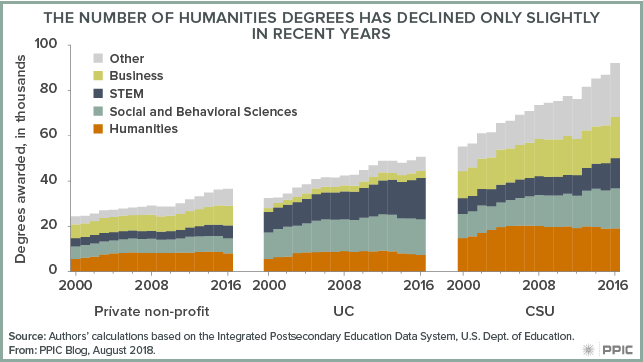
While there has been a strong increase in STEM degrees awarded at California colleges and universities over the past 16 years, many have noted a decline in student interest in the humanities. Colleges have adjusted their offerings to reflect changes in student demand, and some observers have questioned whether liberal arts colleges can sustain their enrollments in the face of diminishing student interest.

In California, the real story is not one of outright declines in humanities majors but a lack of growth compared to other majors. The number of students earning a bachelor’s degree in the humanities in California increased from just over 26,000 in 2000 to almost 38,000 in 2006. It has since declined—but only slightly—to 35,000. This pattern is widespread, with the University of California (UC), the California State University (CSU), and the state’s private nonprofits all experiencing sharp increases from 2000 to 2006 and slight declines since that time. Because other degrees have continued to increase, the share of degrees awarded to humanities majors has declined noticeably—from 27% in 2006 to 19% in 2016.

Humanities majors make up a larger share of students at private nonprofit colleges and CSU than at UC, but there is wide variation across campuses. At Cal Tech (the California Institute of Technology) only 0.8% of bachelor’s degrees were awarded in the humanities in 2016, whereas at Biola and Chapman Universities humanities degrees made up almost 40%. At CSU only 9% of degrees at Cal Poly San Luis Obispo were in the humanities (just 1% at Cal Maritime were), compared to 28% at Cal State Channel Islands. And at UC only 4% of UC Merced students earned a humanities degree, compared to 22% at UC Santa Barbara.

These patterns and trends suggest that the decline of the humanities is overstated, at least for now. But there are indications that these trends will persist. Economic returns tend to be higher for students in STEM than in the humanities, and students are increasingly citing job prospects as the primary reason they enroll in college. The College Board reports that among the newest college-bound students in California, only 9% expressed an interest in majoring in the humanities. Going forward, colleges and universities that emphasize the humanities will need to make the case (and it can be made) for the value of those degrees.

More Students Are Earning STEM Degrees

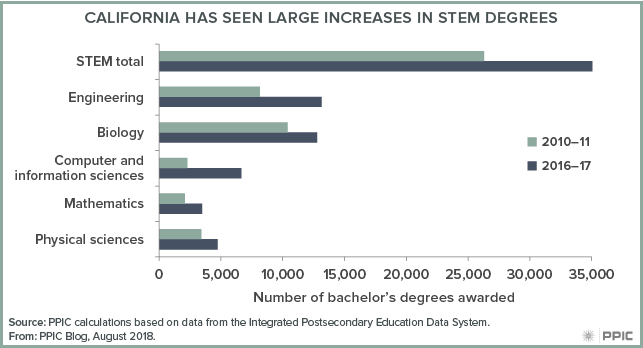
The number of students graduating with a bachelor’s degree in science, technology, engineering, or math (STEM) has risen dramatically in California. Both students and colleges are responding to changes in our economy, which increasingly rewards highly educated workers, especially those with STEM degrees.

Between 2010–11 and 2016–17, the number of STEM bachelor’s degrees awarded by colleges and universities in California increased 55%, more than triple the rate of growth in other degrees (17%). By 2016–17, 20% of all bachelor’s degrees awarded were in a STEM field, up from 16% in 2010–11.

These increases occurred across the board for all STEM fields and for all higher education sectors in the state. Increases were especially sharp in engineering, which surpassed biology as the most common STEM degree. Computer and information sciences also saw big gains, with almost three times as many bachelor’s degrees awarded in 2016–17 as in 2010–11. The increase in computer science is particularly notable, as its popularity had declined after the “dot com” bust of the early 2000s.

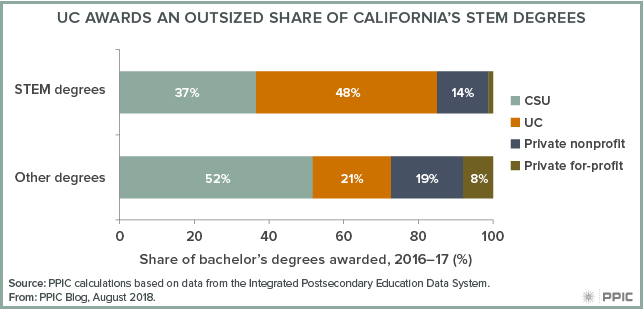
STEM fields are especially popular at the University of California (UC), which awards almost half of the state’s STEM degrees (compared to only 21% of other bachelor’s degrees). In contrast, California State University (CSU) awards 37% of the state’s bachelor’s degrees in STEM, compared to more than half (52%) in other majors. STEM is also less common at private colleges, especially for-profit institutions.

But there is wide variation across colleges. At UC San Diego (56%) and UC Merced (48%), about half of bachelor’s degrees awarded in 2016–17 were in a STEM field, compared to only 27% at UC Santa Barbara. In the CSU system, 37% of bachelor’s degrees at Cal Poly San Luis Obispo were in STEM, compared to only 8% at Cal State Dominguez Hills. And among the state’s larger private nonprofit colleges (those with at least 1,500 bachelor’s degrees awarded), half of Stanford University’s bachelor’s degrees were in STEM, compared to only 8% at Azusa Pacific.

The rapid growth in STEM majors is a testament to changing interests among students. Those interests are academic, but also economic. Strong labor market outcomes for STEM graduates—especially for those with degrees in engineering and computer science—almost certainly contribute to the increasing demand for those majors.

Colleges have responded, at least in part, by building more capacity for STEM majors. Moreover, public colleges have led the way, with UC and CSU experiencing the largest shifts toward STEM degrees. Between 2010–11 and 2016–17, the share of bachelor’s degrees awarded in STEM fields increased 6.8 percentage points at UC (from 30.0% to 36.8%) and 4.4 percentage points at CSU (from 10.7% to 15.1%), compared to only 2.7 percentage points at private nonprofit colleges (from 12.4% to 15.1%).

While more could be done to fully meet student demand—at many campuses, engineering and computer science majors have more applicants than can be accommodated—the evidence to date shows that California’s higher education system has been able to substantially increase capacity in STEM fields.

Higher Education Finance: How Does California Stack Up?

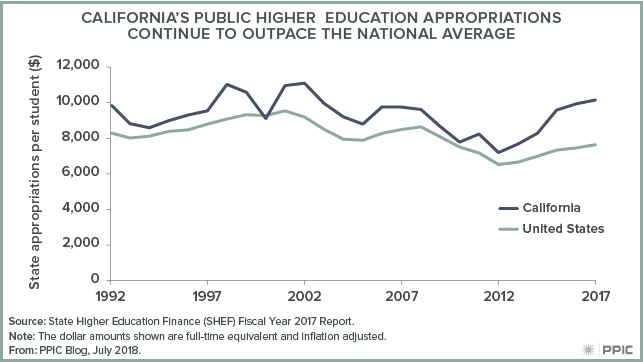
California’s public higher education spending per student has increased significantly since the end of the Great Recession—it is now higher than at any time since 2002. According to a recent report by the State Higher Education Executive Officers Association (SHEEO), spending increased 41% per student (based on full-time equivalents and adjusted for inflation) between 2012 and 2017 in California, compared to 17% across the rest of the nation. California’s percentage change was third highest in the nation, after Oregon and New Hampshire (both with an increase of 47%). However, both of those states provide much less support per student: in 2017, New Hampshire appropriated $2,959 per student and Oregon allocated $6,514, compared to California’s $10,157. California also ranked third in terms of absolute increases ($2,960 in California, compared to $3,781 in Hawaii and $3,608 in Illinois).

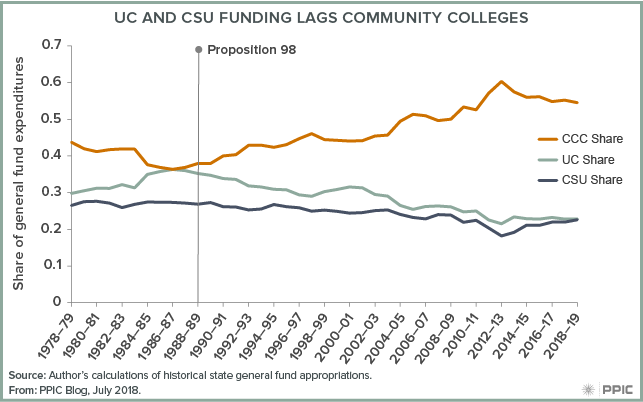
California’s funding increases have not been evenly distributed across the three public systems. Since 1988, the community colleges have benefited from the Proposition 98 funding guarantee for K–14 education. As a result, per student funding for the community colleges is now at an all-time high, but is still below peak UC and CSU funding levels.

Governor Brown recently signed the state budget for 2018–19, which includes $19.2 billion General Fund and local property tax funds for all public higher education systems—about 8% more than the 2017–18 allocation. This continues the recession recovery trajectory and prevents tuition increases at UC and CSU. Moreover, the governor and legislature have made investments in the Rainy Day Fund—increasing reserves to $13.8 billion—that will help protect higher education from recession-related cuts during the next economic downturn.

Good Budget News for Higher Education

The California State Legislature and Governor Brown recently reached a $200 billion budget deal that includes just over a billion dollars in new funding for the state’s public higher education systems. This funding forestalls proposed tuition increases at UC and CSU and allows each system to support increasing student access and success. Moreover, the governor and legislature’s work to maximize the state’s rainy day fund should help to reduce the likelihood of drastic tuition increases in the future, should an economic downturn threaten higher education funding.

The new funding will allow UC and CSU to enroll an additional 1,500 and 3,641 undergraduates, respectively, next fall.  These enrollment increases—coupled with more dollars allocated to improve time-to-degree, boost graduation rates, and close achievement gaps—will help each system to do their part to provide much-needed growth in the number of college graduates in the state.

The budget deal also includes the governor’s top two higher education priorities: the creation of an online-only community college and the introduction of a new community college funding formula. This year, community college funding per full-time student will exceed $8,000—the highest level in the systems’ hundred-year history. (Mainly this is because community college funding falls under Proposition 98, the K–12 funding guarantee passed by voters in 1988.)

The online community college will be launched with $100 million and receive $20 million per year going forward. The goal? To provide opportunities to earn short-term credentials to California’s “stranded workforce” (workers stuck in low paying jobs or jobs that are likely to be automated soon), to help such workers to better compete in today’s labor market. The online college will offer credential programs that have demonstrated labor market value and are not already offered at brick-and-mortar community colleges.

The establishment of a community college funding formula will be phased in over three years. It will provide funding for low-income and underrepresented minority students, reward colleges for improved student outcomes, and reduce reliance on increased enrollment to secure state funding. This approach represents the ongoing emphasis on improving student outcomes at the community colleges.

This is Jerry Brown’s final budget deal—it will be up to the next governor to work with the legislature to ensure the ongoing health of the public higher education system. California’s future economy depends on it.

Encouraging Full-Time Enrollment to Boost College Graduation Rates

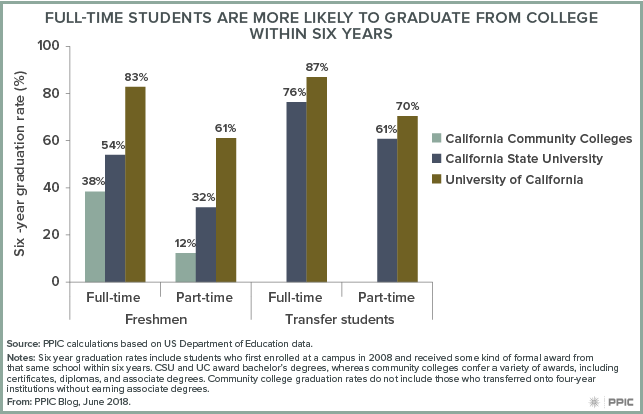
As colleges seek to improve graduation rates, many have focused on increasing the number of students enrolled full time. New data from the US Department of Education show that students at California’s public colleges and universities who first enroll on a full-time basis are much more likely to graduate within six years than students who first enroll part time. These higher graduation rates are observed both for first-time freshmen and for transfer students.

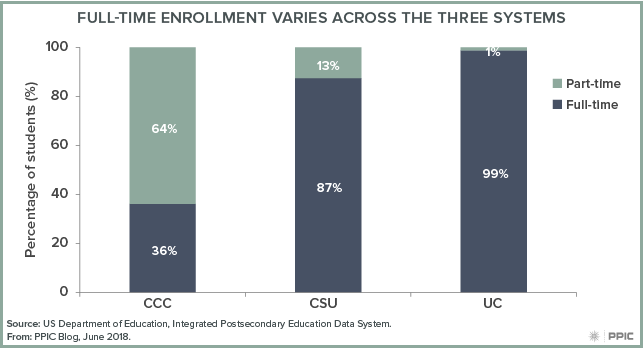
Full-time enrollment varies widely across California’s public systems of higher education. Students at California State University (CSU) and the University of California (UC) are overwhelmingly full time, whereas most students at the community colleges enroll part time. UC requires students to enroll full time (at least 12 units per semester) unless they receive approval for part-time status. Some CSU campuses recently started encouraging students to agree to take 15 units per semester (a full-time course load), as have some community colleges.

Full-time enrollment campaigns (frequently known as “15 to finish”) have been gaining traction across the country. In some states, such as Hawaii and Indiana, more students are completing 15 credits per semester and four-year graduation rates are rising. But messaging and financial incentives aren’t enough to help all part-time students make the transition to full-time enrollment. Community colleges enroll large numbers of nontraditional students who have significant work, family, and other outside obligations. Some of these students may not be able to enroll full time and/or may need holistic supports such as child care services and transportation subsidies in order to succeed. To the extent possible, the state and its higher education institutions should look for ways to help more students enroll full time so that they can progress toward graduation.

The Governor’s Revised Budget Targets Tuition at UC and CSU

Governor Brown’s May Budget Revision has short- and long-term funding implications for both CSU and UC. The annual May Revision to the governor’s January budget proposal reflects an unanticipated revenue increase of $7.6 billion. The revised budget does add $100 million in one-time funding for deferred maintenance at each system as part of a larger infrastructure spending plan. However, while increases are proposed for other major spending areas, funding for UC and CSU remains unchanged from the January budget: each system is still slated to receive $92.1 million from the General Fund. This is in contrast to revised budgets in previous years that increased funding for both systems by 3% to 4%. Moreover, if UC and/or CSU raise tuition, the Department of Finance would be allowed to reduce each system’s funding by an amount equal to the additional revenues raised.

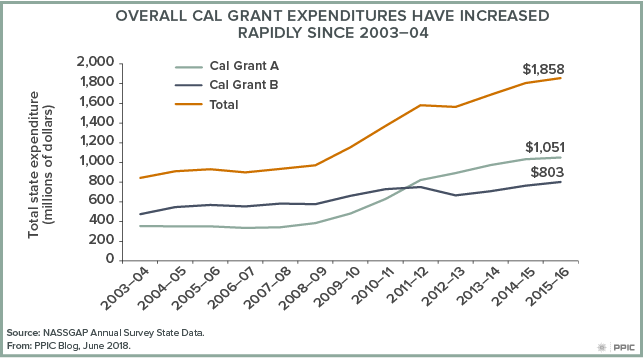
This proposed policy has two goals: it creates a disincentive to raise tuition and is meant to account for additional state costs incurred when tuition increases. California’s primary financial aid programs— the Cal Grant A and B entitlements—cover tuition for more than 300,000 students, most of them enrolled at UC and CSU. For students who meet financial and academic requirements, UC or CSU tuition is fully covered for the equivalent of four years for Cal Grant A and three years for Cal Grant B. Consequently, when UC and/or CSU raise tuition, the state must cover the additional cost. Since the Cal Grant program’s inception in 2000, tuition increases in response to state funding cuts coupled with a rise in the number of eligible students has increased annual program costs from a little more than $800 million to nearly $2 billion.

Although the governor’s proposal, coupled with a healthy state funding reserve, could help keep tuition flat in the near future, it may have unintended consequences for large numbers of students. UC and CSU allocate one third of the revenue from tuition increases to institutional aid that augments Cal Grants and Federal Pell Grants to cover tuition for more than half of their students. Moreover, restricting state allocations to the two systems while also discouraging tuition increases could prompt each institution to turn away eligible students (in fact, CSU turned away 32,000 students last fall) or ratchet up eligibility requirements.

In the longer term, restricting access to UC and CSU could have a negative effect on California’s economy. If the state hopes to meet growing demand for skilled workers, it must produce 1.1 million more bachelor’s degrees by 2030. Achieving this goal will require a long-term funding plan that addresses not only the cost of tuition but also the full cost of attending college as part of a larger effort to increase access and improve outcomes for all students.

New Admission Requirements at the University of California?

The University of California (UC) is considering revising its eligibility standards for admission, focusing on requirements for science education. California changed its K–12 standards in this area five years ago, when the State Board of Education adopted the Next Generation Science Standards (NGSS). UC must decide whether and how to align the NGSS with the a–g requirements—a set of courses students must complete in order to be considered eligible for admission to UC. A change in science requirements was proposed by the UC Board of Admissions and Relations with Schools and was approved by the UC Academic Senate earlier this year.

The NGSS has profound implications for science curriculum and instruction in high schools. Currently, to meet the a–g requirements, students must take two science courses from three core disciplines: biology, chemistry, and physics. But the NGSS includes four science categories: physical sciences; life sciences; earth and space sciences; and engineering, technology, and applications of science.

Changes approved by the UC Academic Senate include increasing the minimum science requirement from two to three years. UC would continue to require two years of work in at least two of three disciplines: biology, chemistry, and physics. Students may take a third course within these disciplines or in other science disciplines identified by the NGSS.

If the UC Regents vote on and approve the recommendations of the UC Academic Senate, the change will take effect in the fall of 2023—meaning that students entering high school in the 2019–20 school year will be subject to the new requirements. (CSU is in the process of updating its science requirements—which are currently similar to those of UC—and may follow UC’s guidelines.)

Some high schools would need to make changes to align their curriculum with the NGSS. One area of concern is the relatively low number of course-offerings in science among small and rural schools. PPIC’s work has shown that not every high school offered the entire a–g sequence in science in 2016–17; small and rural schools were much less likely to do so. Another area of concern is staffing, as a teacher shortage has left California schools struggling with large class sizes for years. Finally, ensuring awareness of these changes will be important. Parents and students should be informed of the new requirements with adequate time and detail to be able to plan accordingly.

Under NGSS, science course sequencing in high school may affect whether and how students meet the proposed a–g requirements. PPIC researchers are examining early implementation of the NGSS in the K-12 system and will discuss findings in an upcoming report. Moving forward, more research is needed to understand the implications of any new a–g requirements for high school graduates’ eligibility for UC and CSU.

Guaranteeing Transfer Admission to the University of California

Improving transfer from community colleges to four-year universities is an important step in meeting the state’s future workforce needs. In April 2018, the California Community College Chancellor’s Office and the University of California (UC) entered an agreement to guarantee admission to community college students who meet certain qualifications. If sufficient funding and space exist, the guarantee could take effect in fall of 2019.

There are already several pathways for community college students to enroll in UC. For example, all but three campuses (Berkeley, Los Angeles, and San Diego) have a guaranteed admission program for students from certain community colleges. UC has also established academic road maps in 21 majors to help prepare students who plan to apply to transfer. However, completing an academic road map does not guarantee admission.

The new plan would guarantee admission for eligible community college students to a UC campus, but not necessarily to their preferred campus. Specifically, it creates a referral pool—a way to redirect students away from full campuses toward campuses with space. This transfer referral pool would be similar to UC’s referral pool for freshmen. At this time only one campus, UC Merced, accepts applicants from the freshman referral pool. In 2017, thousands of eligible students were redirected to UC Merced, but few actually enrolled.

How might a referral pool work for transfer students? Currently, three campuses—Santa Cruz, Riverside, and Merced—are having a particularly difficult time enrolling sufficient numbers of transfer students. These campuses would need to absorb redirected transfer students. However, it’s not certain that redirected students would enroll, even if offered admission. Right now, many transfer applicants decline their offer of admission to these campuses.

To improve transfer pathways for community college students, UC and the state should consider both expanding capacity at high-demand campuses and exploring ways to encourage students to attend other campuses.