2020 Primary: Funding Higher Education Facilities

The state legislature recently passed a $15 billion bond measure to fund upgrades to education buildings and facilities. Voters will decide whether to support this bond as part of the March 2020 primary ballot.

For higher education, the measure would provide $6 billion to the state’s three higher education systems, the University of California (UC), the California State University (CSU), and the California Community Colleges (CCC). These funds would be distributed equally ($2 billion each)—even though the systems enroll significantly different numbers of students.

The legislature will approve specific projects as part of the annual budget process. As a condition of making funds available, the bill requires UC and CSU to develop affordable housing plans for their students.

figure - Proposed Bond Funding Varies on a per Student Basis

The last time the state proposed and passed a ballot measure supporting higher education was more than a decade ago. Proposition 1D (2006) passed with almost 57% support. The total amount of funding for higher education in that initiative was about half of what is proposed in the current measure ($3.1 billion compared to $6 billion).

figure - 2020 Initiative Proposes Much More Funding for CSU and CCCs than the 2006 Measure

During the Great Recession funding for UC, CSU and the community colleges fell. One of the ways the systems responded was to defer maintenance on buildings, foregoing repairs and upgrades as a way to save money in the short run. Our estimate of the cost of addressing the resulting backlog of capital projects tops $30 billion for the UC and CSU systems. The proposed ballot initiative would provide bond authority to cover a little more than 10% of that.

The state’s community colleges are in a slightly different position. Local community college districts can issue their own bonds and make most of their own capital finance decisions. Since passage of Proposition 39 (2000), which made it easier for community colleges to pass bond measures, community college districts have been relatively successful in funding their capital needs. From 2001 to 2016, voters approved $35 billion in borrowing for local community college capital projects. In addition, Proposition 51 (2016) provided community colleges with $2 billion in state bond funding.

We know that bond measures for education generally have the support of voters, and recent PPIC polling suggests that a $15 billion education bond has a slim margin of support. Time will tell whether voters will be persuaded this time around.

New Federal Data Sheds Light on Student Debt in California

For the first time ever, the federal government has released data on loan debt for college graduates by type of degree and field of study. The data includes federal loans from three programs (Direct Loans, Federal Family Education Loans, and Graduate PLUS Loans) for students graduating in 2014–15 and 2015–16. This release is especially timely in light of national discussions about the cost of college–with some Democratic presidential candidates arguing for debt-free college and loan forgiveness. In just those two academic years, more than 300,000 Californians graduated from college (with degrees ranging from PhDs to vocational certificates) with debt. The total amount of federal debt among those graduates exceeded $10 billion.

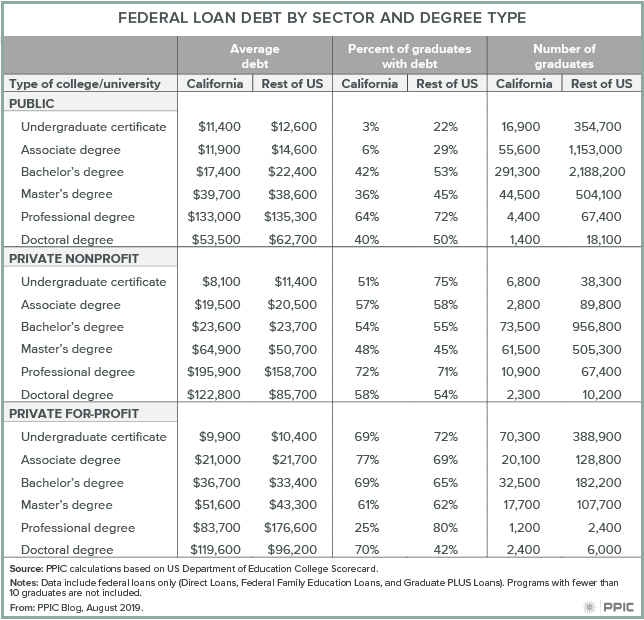
Some of the findings from the recently released data are not surprising. For example, undergraduates at public colleges and universities in California are less likely to take on debt than their peers in the rest of the country. And when students in California do take on debt, the amounts tend to be lower. Federal loan debt for Californians earning bachelor’s degrees at UC and CSU averages $5,000 less than at public universities in the rest of the country ($17,400 versus $22,400). And undergraduates in California are less likely to take out federal loans (42%) than their peers in the rest of the country (53%). Only 6% of associate degree holders from the state’s community colleges have federal loans, compared to 29% of public community college graduates in the rest of the country. Students at California’s public colleges and universities are also less likely than their counterparts at the state’s private institutions to take on debt, and those who do take out loans graduate with less debt.

Other findings are striking. In California and the rest of the nation, graduate students tend to have far higher loan amounts than undergraduates, with professional degree holders incurring the most debt—generally well over $100,000. The most common professional degrees are in law, medicine, and dentistry. Graduates of professional schools at private nonprofits in California incur the most federal loan debt—almost $200,000. In general, graduate students at California’s public universities are less likely to take on debt, and their loan amounts are lower than those for students at private colleges. Even so, graduate students at public institutions are incurring large amounts of debt.

table - Federal Loan Debt by Sector and Degree Type

Large debt levels among graduate students reflect higher tuition for many programs. For example, tuition and fees at UC Berkeley’s law school are almost $60,000 for 2019–20, compared to less than $20,000 for academic graduate programs such as English. High demand for many graduate professional programs coupled with expectations of earnings premiums account for both the higher tuition and students’ willingness to take on debt.

Policies to address student debt must be mindful of which students take on debt, the range of institutions and areas of study, and the ability of students to pay back their debt. These are critical concerns in putting college graduates on the path to economic mobility and long-term financial security.

Proposed Changes in Admission Requirements at CSU

For the first time in over 15 years, California State University (CSU) and the University of California (UC) may have different course requirements for admission. CSU is currently considering changing its three-year high school math requirement to a quantitative reasoning requirement of four years that broadens the list of eligible courses.

The proposed change—scheduled for a November vote by the CSU Board of Trustees—would create a difference from UC’s three-year requirement, meaning that some students who would qualify for UC may not qualify for CSU. Both CSU and UC have historically defined their math requirements around algebra, geometry, and advanced algebra, as well as any advanced courses (e.g., pre-calculus and calculus) that require these subjects as prerequisites. Under the proposed change, students could continue with the traditional math sequence or take applied courses in the fourth year, including personal finance, laboratory science, computer science, or statistics. The new requirement would first apply to the high school graduating class of 2026.

The goal of the change is to better prepare students for success at CSU and to enable more students to pursue STEM majors once they enter college. But critics cite access and equity concerns, arguing that the changes may disproportionately affect low-income students in districts that are struggling to hire enough math teachers. CSU, which trains a large share of California’s K–12 teachers, has recently announced an expansion of its Mathematics and Science Teacher Initiative to increase the number of new math and science teachers.

CSU and UC have had the same course requirements since 2003, when UC adopted CSU’s visual and performing arts requirement, thus fulfilling “the long-sought goal of giving UC and the California State University a common set of subject requirements” (2000-05-24 Notice of the Meeting, Assembly of the UC Academic Senate).

The proposed change could cause confusion for students who may want to apply to more than one system. Complicating the issue, UC is currently considering adding another year to its science requirement but has not yet scheduled a vote by the UC Board of Regents.

Students in California would benefit from clearly organized admission requirements, but the state lacks an entity that could help K–12 and the higher education systems coordinate these requirements. A higher education coordinating body could provide expertise around this decision, clarify its goals, and help determine whether the proposed requirement is the best approach to meet those goals.

A New Look at College Enrollment Rates

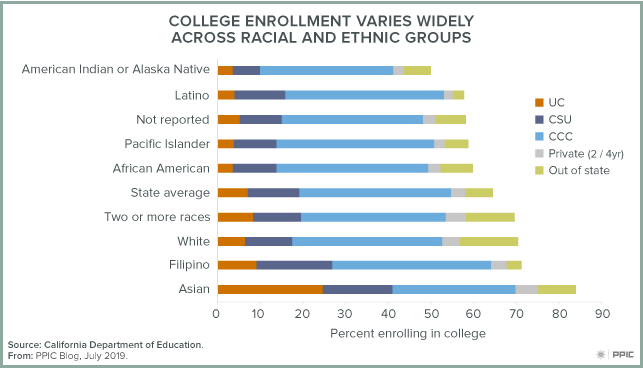
California’s K–12 districts and schools are responsible for preparing students for college and career. But until recently, data has not been available to determine their success in actually getting students to apply to and attend college. Now, however, the California Department of Education has published data on college enrollment among recent high school graduates, using information from the National Student Clearinghouse. Initial findings show wide disparities in college enrollment across racial/ethnic groups and throughout the state’s regions—including within school districts themselves.

According to the data, about 65% of California’s high school graduates attended college within a year of graduation in 2017–2018 (the most recent data available). But there are wide differences. For instance, Latino students—the majority of K–12 students—have a relatively low rate of college enrollment (58%), while rates for Asian American students (84%) are quite high. Asian American students are also much more likely to attend a University of California campus than other students. African-American students have a similar enrollment pattern as Latino students, except many more opt to go to college in another state. White and multi-racial students also enroll in out-of-state colleges or universities at rates above the state average.

Figure - College Enrollment Varies Widely Across Racial and Ethnic Groups

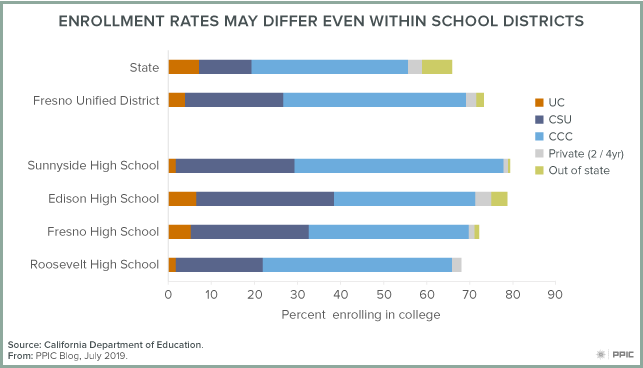
Differences by school, district, and region are also available in the data (you can check your local district’s college enrollment rates here). Fresno provides a good example. Fresno County has higher college enrollment rates than the state, but students are much less likely to attend a UC and much more likely to attend a CSU or community college—perhaps because of the strong presence of Fresno State and local community colleges, as well as the greater distance to most UC campuses.

Figure - Enrollment Rates May Differ Even Within School Districts

Among the many districts in Fresno County, students from Fresno Unified School District are relatively more likely than others to attend college. But there is plenty of variation within the district. Sunnyside High has very high enrollment rates; however, rates are lower than the district average for UC and much higher for community college. By contrast, Edison High has much higher than district average enrollment at UC, private, and out-of-state schools.

Enrolling in college or university is a goal for many high school students. But because the existing K–12 and higher education data systems are not linked in California, this is the first time in over a decade that the state has good information about whether high school students are meeting that goal. With the passage of SB75, California has begun the process of building a statewide longitudinal data system that will connect the existing student data systems between K–12 and higher education. The new enrollment data provide the first glimpse of the promise of a connected education data system. Linking data across segments could yield useful new information—such as whether students were successful in their college courses—which would fit nicely in the state’s dashboard on college readiness.

Expanding Enrollment at UC and CSU

California’s economy is increasingly demanding highly educated workers. To meet this demand, and to ensure that more Californians are successful in the 21st century economy, the state’s universities will need to admit and graduate greater numbers of students than they do today.

Governor Newsom’s budget proposal offers a step in the right direction, but it could go further.

The governor’s budget provides General Fund increases of 7% for the University of California (UC) and 8% for the California State University (CSU), including funding for enrollment increases of 1,000 and 7,000 students respectively.  The budget also provides $95 million ($50 million for UC and $45 million for CSU) in ongoing funding to improve student success efforts at both systems. This is good news and represents substantial reinvestment in the state’s public universities.

But the enrollment increases fall short of what CSU and UC had been hoping for, and more importantly, short of student demand. In its 2019-2020 budget plan, UC had sought enrollment increases for 2,500 California resident undergraduates in order “to maintain access for projected increases in UC-eligible high school graduates and transfer-ready California Community College students.” CSU had sought an even more ambitious increase of more than 18,000 in order to accommodate more freshmen and transfer students.

As the state moves into the eleventh straight year of economic growth, ensuring investments in higher education is critical—especially in the face of an eventual downturn. Higher education is often one of the first budget areas to be cut during a recession. Today, even after a decade of reinvestment and one of the largest economic expansions in state history, funding per student at UC and CSU still remains below pre-Great Recession levels. And it is far below the funding peaks of the late 1990s and early 2000s.

As the legislature and governor negotiate over the budget, it may be time to consider creating a long-term funding plan for public higher education. An effective multi-year plan would account for increased enrollment, incentivize student success, prioritize equity, and provide a sensible tuition growth plan.  This would allow students and their families, as well as universities, to better plan for the future—and would put the state on a path to meeting the economic demands of the future.

Coping with High Housing Costs in College

California’s housing crisis affects college students around the state. Over the past eight years—even as tuition has been stable at California’s public colleges and universities—the cost of attending college has risen because housing costs have gone up. Most students at California’s community colleges and in the California State University system pay more for housing than they do for tuition. At the University of California, housing costs are on par with tuition (for those who pay full tuition).

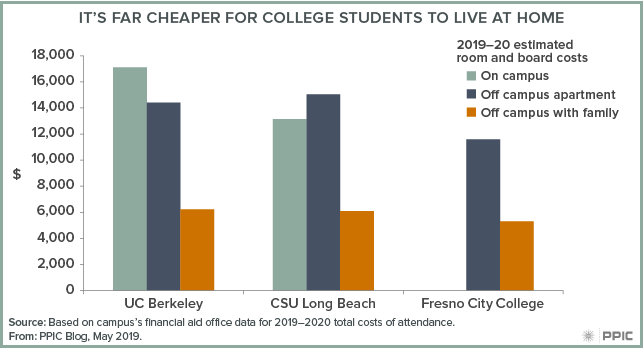
One way students limit their housing costs is by living with their parents or other family members. For most students, living at home is much cheaper than living in housing provided by the university or in an apartment off campus. Housing costs vary across systems, but in every case living with family is much less expensive than other housing options. And the savings are large—as much as $10,000 a year.

figure - It’s Far Cheaper for College Students to Live at Home

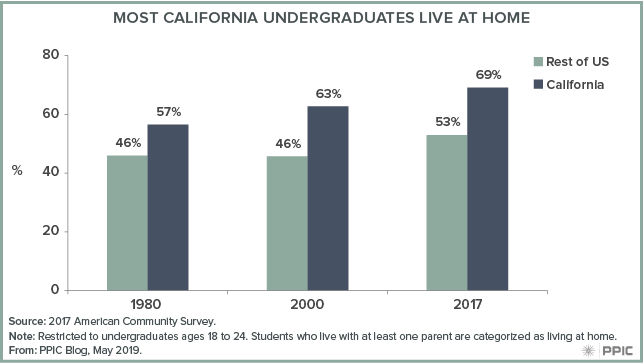
In fact, the large majority of California undergraduates do live at home (69% in 2017), and that share has been increasing over the past few decades, according to the American Community Survey. Moreover, California college students are substantially more likely to live at home than their counterparts in the rest of the nation.

figure - Most California Undergraduates Live at Home

Partly, this difference reflects the mix of colleges in California. Community college students are especially likely to live with parents—not surprising given the broad geographic coverage of this system. And CSU students are more likely to live at home than UC students. But the difference in living situations between California students and their peers nationwide almost certainly reflects California’s higher housing costs.

Living at home while attending college can be a great way to reduce costs. But it also has a downside. Research suggests that students who live at home are less connected to their college—and less likely to graduate.

California’s colleges and universities cannot solve the state’s housing crisis, but many of them are working to expand on-campus housing opportunities. They are also working with the state to develop ways to expand grants to cover housing costs as well as tuition. The governor’s proposed budget includes $40 million to provide emergency housing support for UC and CSU students (including those struggling with homelessness).

With no quick solution to the high cost of housing in California, thoughtful actions will be critical to providing support to college students across the state.

Leveling the Playing Field in College Admissions

Recent news of wealthy parents allegedly paying bribes to get their children into elite colleges has raised a lot of questions about the college admissions process. While fewer than 100 students were involved—out of more than 1 million new college freshmen every year—the scandal brings up larger issues of equitable college access and high income inequality in California.

More than half of Californians (53%) say qualified students from low-income families have less opportunity than other students to get a college education, according to a 2018 PPIC survey. Even without resorting to bribery, there are many advantages that students from high-income families have in college admissions, including living in safer neighborhoods, attending better high schools, and having more help preparing for the application process (e.g., paying for SAT or ACT prep courses). Admission practices at most private colleges also favor students who can pay the full price of attending.

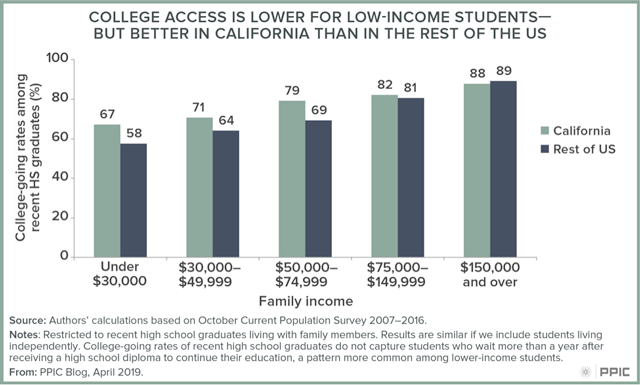
Our recent report on economic mobility and higher education highlights the challenges facing low-income students in California—but also offers some hope. Although recent high school graduates from low-income families are less likely to enroll in college than students from higher-income families, a greater percentage of low-income students go to college in California (67%) compared to other states (58%). Enrollment gaps between low- and high-income students in California (21 percentage points) are also substantially lower than in the rest of the country (31 percentage points).

Figure 1: College Access is Lower For Low-Income Students--But Better in California Than In the Rest of the US

California’s large public higher education system is key to ensuring broad access. The University of California (UC) enrolls more low-income students than any other public research university system in the country. Indeed, applicants from disadvantaged backgrounds are given extra consideration in UC’s “holistic review” process. Thirty-eight percent of UC undergraduates in 2016–17 received Pell grants (federal grants to low-income students), compared to 26% of undergraduates at public research universities in the rest of the country.

California State University (CSU), the largest public university system in the country, provides even more access than UC. Almost half (49% in 2016–17) of CSU students receive Pell grants. California’s private nonprofit colleges also play an important role, with 29% of their undergraduates receiving Pell grants.

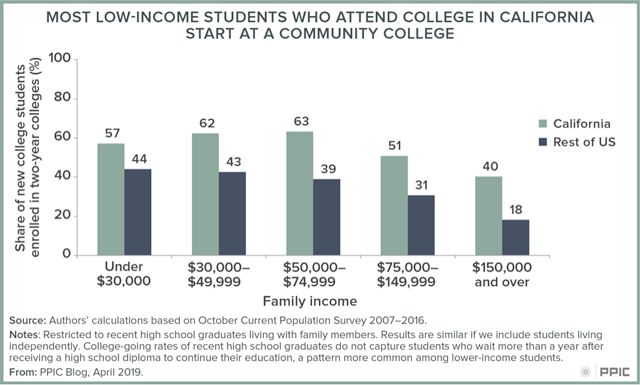
But perhaps most important are California’s community colleges. More than half of low-income students who attend college in California start at a community college.

Figure 2: Most Low-Income Students Who Attend College in California Start at a Community College

Although college access for low-income students in California is relatively good compared to the rest of the nation, more can be done. For example, improving financial aid would make college more accessible to more low-income students and would likely lead to higher graduation rates. And because so many low-income students start at community colleges, increasing transfer rates is critical to ensuring that higher education continues to serve as a ladder of economic mobility. New reforms at the community colleges—including changes in remediation and the Associate Degree for Transfer program—should lead to substantial increases in transfer and help more students achieve their academic and economic goals.

A Coordinating Council for Higher Education

The California Legislature and Governor Newsom are interested in creating a new coordinating entity for the state’s public higher education system. The state has been without such an entity since 2011, when Governor Brown vetoed funding for the California Postsecondary Education Commission (CPEC). A new coordinating entity can help the governor and legislature improve higher education by providing expertise and analysis. But it will require policymakers to provide a solid foundation for its work.

California’s 1960 Master Plan for Higher Education gives the three state public higher education segments—the University of California, the California State University, and the California Community Colleges—significant autonomy. CPEC was created to help policymakers conduct long-term planning, monitor student outcomes, and oversee intersegmental policies that make it easier for students to navigate through the college and university systems. A new PPIC report looks at the strengths and weaknesses of CPEC to provide suggestions about how to make a new coordinating entity as effective as possible.

CPEC’s experience underlines the need for clear state goals and objectives. A higher education coordinating body can advocate effectively for student success and assess how well the segments are meeting the needs of the state economy. But higher education in California has changed significantly over the past several decades, and the Master Plan is either silent or outdated in important areas.

CPEC’s history also shows that the details of the coordinating entity’s design are important in giving it a strong, unified voice in the budget and policy process. A coordinating entity should be empowered to monitor whether the state’s higher education goals are being met and suggest ways to make the system more effective. When the segments fall short or when there are conflicts about how best to accomplish state goals, the coordinating entity should be able to work with the colleges, universities, and state policymakers to find workable solutions.

In this time of heightened demand for higher education, the governor and legislature could benefit from a coordinating body that acts as an honest broker in helping the state provide access to all interested students while maintaining the quality of public higher education that California is known for.

Serving California’s Diverse College Students

As part of his cradle-to-career initiative, Governor Newsom has emphasized higher education as a key means of expanding Californians’ social and economic opportunities. From proposing more higher education funding in this year’s budget to supporting two years of free tuition for first-time community college students, many of his initiatives are focused on making college accessible and affordable to more of the state’s residents. For these initiatives to succeed, it will be essential to enroll a broad array of students—in particular, those who have been historically underserved in higher education–and to ensure that more students successfully complete college.

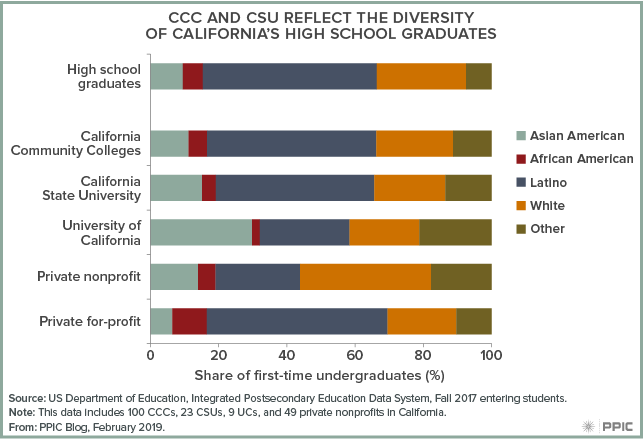
The good news is that the state is enrolling a diverse set of students, especially at the two largest systems, California State University (CSU) and the California community colleges (CCC). Overall, these two systems closely reflect the racial and ethnic make-up of California’s high school population—which is critical given that these two systems are key entry points for African American, Latino, low-income, and first generation college students. UC and private nonprofit colleges in California serve diverse populations, including more first generation and low-income students than their peer institutions in the rest of the country, but they do not reflect the full ethnic diversity of the state’s high school graduates.

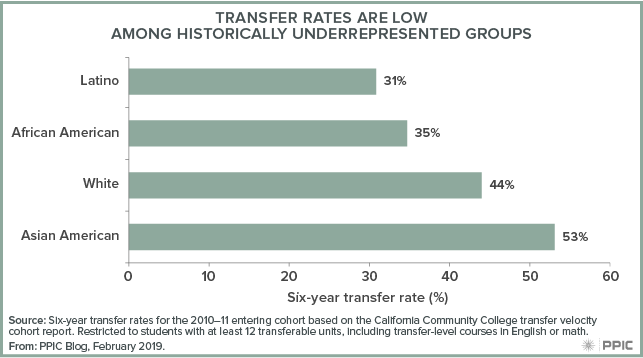
More challenging is helping students to successfully complete a four-year degree. Graduation rates are very high at UC and at most private nonprofit colleges. At CSU, graduation rates have improved dramatically, but even so about 40% of students do not earn a degree within six years. Most students who enter community colleges with the intent to transfer to a four-year college never do so. Transfer rates are especially low for African American and Latino students.

Both CSU and CCC have launched new policies and programs that hold the promise of improving transfer and reducing inequities. For example, community college reforms in developmental—also known as remedial—education will lead to substantial increases in the share of students taking college-level courses in English and math. The Associate Degree for Transfer (ADT) program is making the transition to California State Universities much more straightforward. And the new Guided Pathways initiative provides support services and clear course-taking patterns to community college students to promote success.

These are important steps in the right direction. Renewed interest in Sacramento regarding higher education will help. And Californians are well aware of the stakes. A majority of adults in California (56%) say a four-year college degree is very important for economic and financial success in today’s economy, and 75% believe California’s higher education system is very important to the quality of life and economic vitality of the state.

More Students Than Ever Ready for UC and CSU

Governor Newsom’s budget proposal assumes enrollment growth at the University of California (UC) and California State University (CSU). But these two systems are seeking to expand even more to accommodate increasing demand, as more California students than ever graduate high school prepared for college.

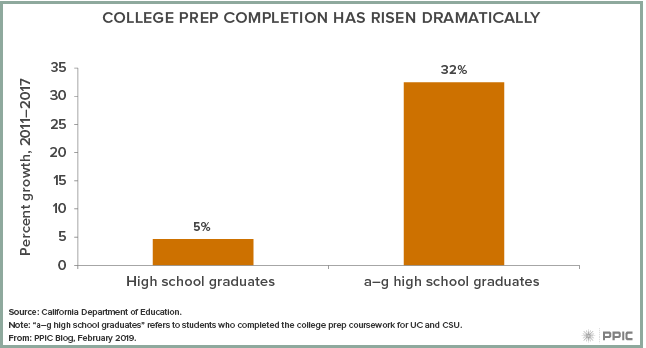
Between 2011 and 2017, the state saw a dramatic increase of more than 49,000 students (a 32% increase) completing college prep coursework, despite there being only 19,000 more high school graduates (a 5% increase).

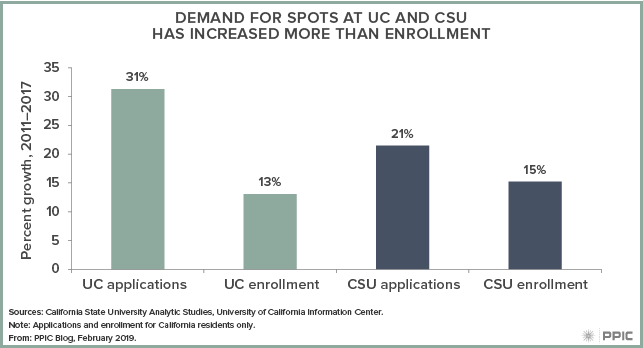
Applications to UC and CSU have grown substantially as well. Since 2011, UC applications from California high school graduates are up 31%, and applications to CSU are up 21%.

UC and CSU have been able to accommodate some of that increased demand, but not all of it. Since 2011, UC and CSU enrollment has grown much faster, at 13% and 15%, respectively, than the increase in all high school graduates. But enrollment growth was much smaller than the increase in applications and the number of high school graduates completing college prep courses.

Allowing more students who are academically prepared to start at a four-year college is a good policy choice. Studies show that students who start at a four-year college are more likely to graduate than if they start at a community college. And attending a public school in California leaves students in less debt on average than attending a private college or paying nonresident tuition in other states. Policymakers and institutional leaders will need to think strategically about how to accommodate the growing number of high school graduates who are now prepared for UC and CSU.