2020 Census: Counting the Central Coast

The decennial census plays an essential role in American democracy. Our series of blog posts examines what’s at stake for California and the challenges facing the 2020 Census, including communities that are at risk of being undercounted.  

PPIC’s interactive census maps are an important tool for Californians working to ensure an accurate census count. Using estimates from the Census Bureau and the Federal Communications Commission, they highlight hard-to-count communities across the state and pinpoint reasons why certain areas may be hard to reach.

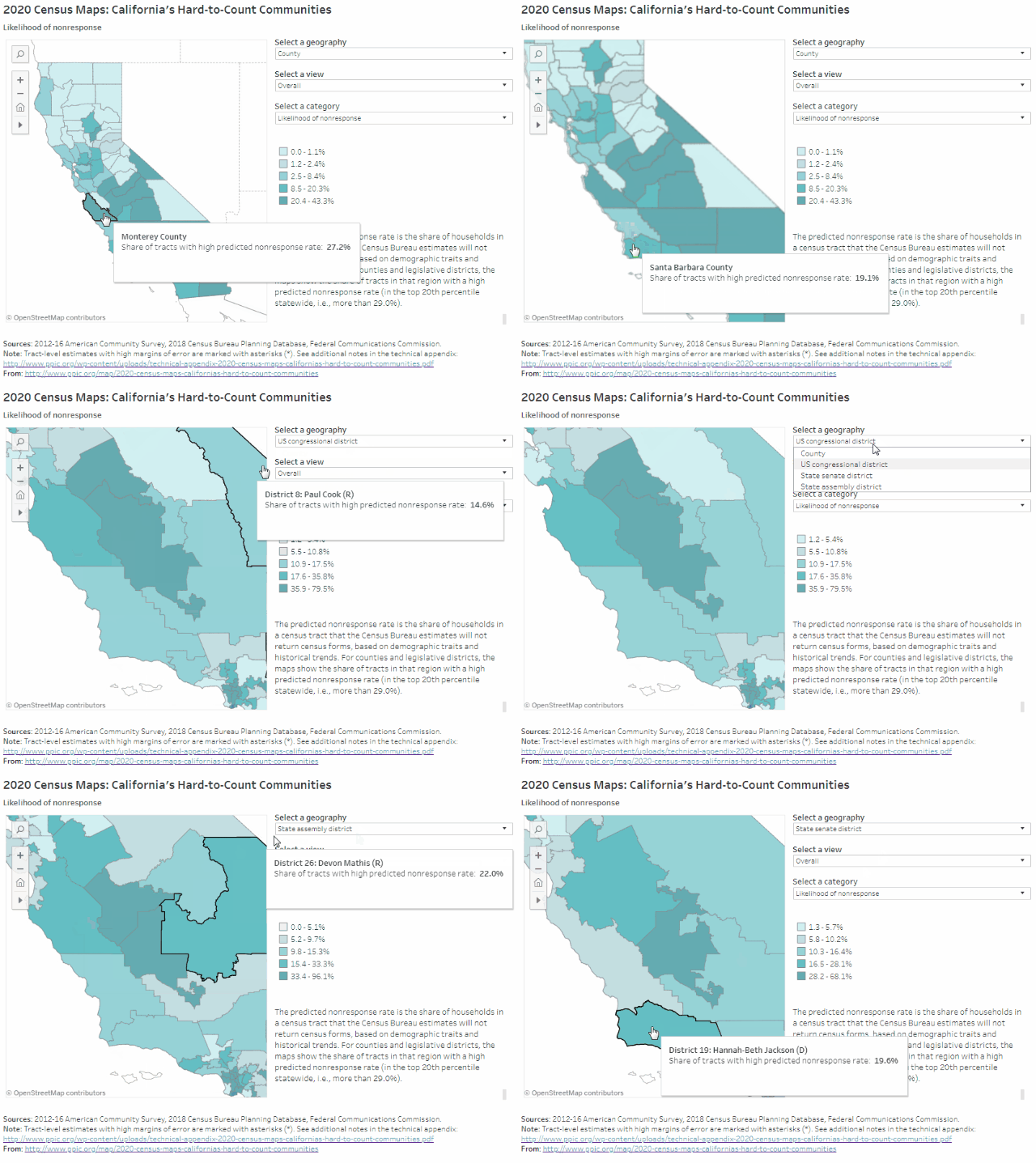
More than 2 million Californians live in the Central Coast counties of Monterey, San Benito, San Luis Obispo, Santa Barbara, and Ventura. Monterey County has by far the region’s highest share of very hard-to-count census tracts (27%), followed by Santa Barbara (19%) and Ventura (12%). Households in these very hard-to-count areas are at risk of being undercounted because they are less likely to respond initially to census forms, according to Census Bureau estimates that draw on historical trends and local demographic characteristics (e.g., race/ethnicity, age, citizenship, and housing conditions).
Census Central Coast

Some highlights:

  • The implications of undercounting very hard-to-reach places differ widely for Central Coast legislators. In two districts representing much of Monterey County—Assembly District 30 (Caballero) and Congressional District 20 (Panetta)—about a fifth or more of census tracts are likely to be very hard to count. The same is true for Senate District 19 (Jackson), covering Santa Barbara and most of Ventura County. Other Central Coast districts have relatively low shares of hard-to-count areas. Given this wide variation, understanding the overlapping factors that can make populations hard to reach will be key to ensuring an accurate count of the Central Coast.
  • There are hard-to-reach areas scattered throughout the region. In Monterey County, areas around Salinas and the Salinas Valley are likely to be the most difficult to count, with 30% or more of households predicted not to respond initially to the census. Other hard-to-reach areas can be found in the city of San Luis Obispo; Santa Maria, Santa Barbara, and Isla Vista in Santa Barbara County; and around Oxnard and Port Hueneme in Ventura County.
  • Monterey and San Benito Counties have relatively high shares of historically undercounted racial/ethnic groups. The census has typically undercounted African Americans, Latinos, and Native Americans. These groups make up about 60% of residents in Monterey and San Benito Counties—but just 24% of San Luis Obispo residents. In Santa Barbara and Ventura Counties, these racial/ethnic groups comprise about 45% of the population, similar to the state overall.
  • Undercounting young children and noncitizens would dramatically misrepresent Monterey County. Young children have been historically undercounted in the census. In addition, noncitizens may be less likely to respond in 2020 due to the planned addition of a citizenship question and fears about privacy and deportation. Almost 22% of Monterey County residents are noncitizens, and about 8% are under five years old—some of the highest concentrations in the state.
  • Outreach to residents in hard-to-count housing will be key to accurately representing the Central Coast. Monterey and Santa Barbara Counties have especially high shares of rental units, overcrowded rentals, and mobile homes. These conditions make it difficult for the Census Bureau to find and count residents. In both counties, nearly 1 in 10 housing units is an overcrowded rental. Northern San Benito County, coastal San Luis Obispo County, Santa Maria, Oxnard, and the Santa Clara River Valley also have hard-to-count housing and will require targeted outreach to fully count residents.
  • Limited internet access may be an issue in rural areas throughout the region. The Census Bureau plans to collect the majority of responses online in 2020—a change from previous practice. Each county along the Central Coast has some census tracts with minimal residential high-speed connectivity, with the lowest access outside cities. In Monterey County, for example, fewer than 400 out of every 1,000 households around Prunedale have high-speed internet connections, compared with 600–800 in neighboring Salinas. While people in these areas may have internet through smartphones or public libraries, in general they may have more trouble responding to the census online.

We hope these maps serve as a starting point to help local, regional, and state leaders think about which activities, resources, and partnerships—including language assistance, awareness raising, and community outreach—might be most effective for accurately counting different parts of California. Stay tuned for future posts that examine hard-to-count communities in other regions of the state.

 

Groundwater Management is Key to Adapting to Climate Change

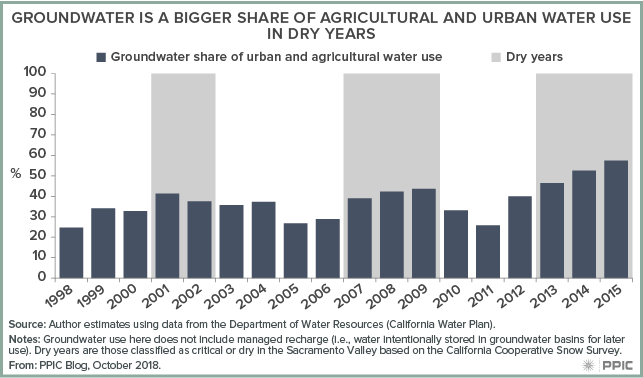
California relies heavily on groundwater for its water supply, particularly during drought.  Climate change is increasing drought intensity, making groundwater―with its immense potential for low-cost storage―an ever more important water source. Sustainable groundwater management will be vital to adapting to a warmer future and should be a top policy priority for the next administration.

In non-drought years, groundwater supplies approximately one-third of urban and agricultural water use in California, but its share rises during droughts, when snow and surface water are scarce. In severe drought years, it provides more than half of urban and agricultural water use.

A recent report by the PPIC Water Policy Center and a large team of experts highlighted the impacts of climate change on water supply and ecosystem management during drought. As winter precipitation shifts from snow to rain in a warming climate, a key issue will be adapting the management of the state’s water storage system. A more volatile climate and changes in precipitation could shift the use of large multipurpose reservoirs from water storage to protection against flood risk, thus reducing the water available from reservoirs in some years―and making groundwater storage even more important.

In some regions, including the San Joaquin Valley, groundwater overdraft—taking more water out of aquifers than is put back—has been going on for decades. This has increased the cost of groundwater pumping, dried up wells in many rural areas, and caused land to sink, damaging infrastructure.

But the greatest long-term impact of unsustainable groundwater use is the loss of stored water that can be economically pumped during dry periods. This makes the state increasingly vulnerable to drought in a changing climate.

The 2014 Sustainable Groundwater Management Act (SGMA) requires water users and other stakeholders to self-organize into groundwater sustainability agencies (GSAs) and prepare and implement plans to achieve sustainability in the next 20 years. Done well, these efforts will restore the capacity of the state’s groundwater basins to supply water during drought.

GSAs have begun the hard work of developing their sustainability plans—due in January 2020 for critically overdrafted basins and two years later for the rest. The Department of Water Resources is providing technical and planning assistance, and the State Water Board―which has ultimate authority over these plans―is offering policy and legal guidance where it can.

Making SGMA a success will require additional action in the following four areas:

  • Advance planning. At the top of the list is expanding state and regional support for groundwater sustainability plans. Factoring in the predicted effects of climate change and developing robust water accounting and regional strategies for managing scarcity will be key.
  • Modernizing the water grid. A major priority for helping groundwater basins achieve sustainability is to upgrade and modernize the state’s water “grid”―the network of reservoirs, canals, rivers, and groundwater basins that store and convey water. Improving the grid’s capacity to move surface water into groundwater storage during wet periods is essential.
  • Updating water allocation rules. For the improved grid capacity to function well, the state will need to make it easier to recharge, trade, and bank groundwater.
  • Finding the money. Finding the money for groundwater sustainability programs will be crucial. The best solutions focus on expanding funding from local water bills and taxes—which currently fund roughly 85% of water management expenditures—and using state general obligation bonds to fund projects with clearly defined public benefits.

Achieving sustainable groundwater management is one of the most important things California can do to prepare for a warming climate. Getting there will require a suite of actions―including some reforms beyond those called for under SGMA. Better planning, modernizing the grid, streamlining water allocation, and finding program funding can help us manage this critical water supply.

Video: Californians and Their Government

In the last weeks of the fall campaign, Democrat Gavin Newsom remains ahead of Republican John Cox in the race for governor. In the US Senate race, Dianne Feinstein continues to lead fellow Democrat Kevin de León. Two closely watched ballot measures—Proposition 6, which would repeal the recent gas tax increase, and Proposition 10, which would expand local authority to enact rent control—are still trailing. These and other key findings of the latest PPIC Statewide Survey were outlined by PPIC researcher Alyssa Dykman at a Sacramento briefing last week.

Democrats are more likely than Republicans to be very or extremely enthusiastic about voting in congressional races, and a majority of likely voters favor the Democratic candidate in their US House district. However, most likely voters have negative views of both major parties.

Other survey highlights:

  • Approval ratings for Governor Jerry Brown and the state legislature continue to be much higher than those for President Trump and the US Congress.
  • A majority of likely voters disapprove of the Senate vote to confirm Brett Kavanaugh’s appointment to the Supreme Court.
  • A majority of likely voters favor the Affordable Care Act, and a solid majority say the federal government is responsible for making sure all Americans have health care coverage.
  • Two-thirds of likely voters oppose building a wall along the entire border with Mexico; a slim majority favor the state making its own policies to protect the rights of undocumented immigrants.

Video: Stackable Credentials at California Community Colleges

California’s community college system is the state’s primary provider of postsecondary career education and plays a critical role in meeting workforce needs. Stackable credentials are a key component of career education programs—students who “stack” multiple, related awards can build skills and increase their potential to advance in a career over time. As the state continues to invest in career education, it is important to understand how these programs can expand employment opportunities, particularly for students who do not get four-year degrees.

In Sacramento this past Tuesday, PPIC researcher Shannon McConville outlined findings from a new report that identifies stackable credential pathways in several disciplines and looks at whether programs with well-defined pathways facilitate stacking. Building on previous PPIC work on stackable credentials in health care, this new report focuses on several other fields—including business, information technology, and engineering.

Nearly 40% of community college students in career education programs start with short-term certificates, which can be earned relatively quickly. Most return to college after earning a short-term award, but fewer than one in four obtain an additional credential. Making it easier for these students to move along a stackable credential pathway could help them get better jobs and earn higher wages.

PPIC’s analysis of existing programs across the community college system suggests that well-defined pathways with clearly mapped course sequences and multiple exit and reentry points do increase the odds of students stacking credentials. It also indicates that few programs have course and credential sequences that are designed to be stackable. Expanding the number of programs with clearly designated stackable features could go a long way toward strengthening the links between career education and long-term employment opportunities.

Is California Turning Even Bluer?

California is already a fairly Democratic state, but in the last two years many have wondered if it has become even more so. In the 2016 presidential election, California was one of a few states that did not shift away from the Democrats. In most of the country, Hillary Clinton garnered a smaller share of the vote than Obama received in either of his campaigns for president—but in California, Clinton improved on Obama’s 2012 vote share by 1.3%, while Donald Trump fell short of Mitt Romney’s share by 5.6%.

Some areas of the state, such as Orange County, have experienced long-term demographic trends that favor the Democrats, yet the swing to Clinton in these places outpaced these trends. Seven of California’s congressional districts are held by Republicans but were won by Clinton in 2016. Just two years earlier, five of those seats favored Republican Neel Kashkari for governor by at least 10 points—in a race that Democrat Jerry Brown won by 20 points statewide.

The 2016 presidential vote therefore marked a big change of fortune for California Democrats, particularly in some districts. Does this mean that these districts have become more Democratic for good, or was the 2016 result a reaction to the personalities on the ballot?

One way to answer this question is to compare the change in the Democratic presidential vote in each congressional district to the change in party registration. Party registration indicates a more enduring attachment—something closer to a permanent change in allegiance. If party registration changed to match the latest presidential vote, it might indicate that something longer-term is afoot.

The figure below compares the change in the Democratic presidential vote between 2012 and 2016 to the change in party registration in the state’s 53 congressional districts from 2014 to 2018. The blue dots indicate Democratic registration change, and the red dots indicate Republican change.

Statewide, the Democratic Party has mostly held steady in registration while the Republican Party has lost ground. We can see this pattern above: the blue Democratic dots are clustered around zero on the vertical axis, indicating little average change, while all the red dots are below zero, indicating a decline in Republican registration. However, our question is whether a larger 2016 surge led to a larger change in party registration by 2018. If this has happened, the blue dots should be higher toward the right side of the graph and the red dots should be lower. We can see such a pattern, but it is weak. Districts on the left have indeed seen both smaller increases in Democratic registration and smaller decreases in Republican registration. Likewise, those on the right have seen larger Democratic gains and larger Republican losses. But the difference is modest.

The districts with the largest Democratic shifts—seen on the far right of the graph—display the expected pattern more clearly. In fact, most of the competitive congressional races mentioned above are represented here. Of the seven races considered most competitive by the Cook Political Report, four are in districts that shifted more than 6 percent toward the Democrats in the 2016 presidential race. All four districts are in or around Orange County: 39 (outgoing incumbent Ed Royce), 45 (incumbent Mimi Walters), 48 (incumbent Dana Rohrabacher), and 49 (outgoing incumbent Darrell Issa). Each of these districts also saw a Democratic registration gain of at least 1.4% and a Republican registration loss of at least 4.4%. So the districts with the most surprising results in 2016 are generally also the places with the biggest Democratic gains in registration.

Overall, these results do provide some support for the idea that the 2016 election marked a more permanent change in the state’s politics. But party registration tends to change slowly, and the patterns we are seeing suggest there may be years to go before any transition is complete.

Video: 2020 Census: ¿Por qué es tan importante el censo?

El censo decenal juega un papel muy clave en la democracia estadounidense. Es bastante lo que está en juego para Californiay el año 2020 se acerca rápidamente.

En este video grabado en español, Joe Hayes, investigador de PPIC, explica la importancia del censo del año 2020, y comenta sobre la propuesta de incluir una pregunta sobre la ciudadanía.

Vea más videos en esta serie.


The decennial census plays an essential role in American democracy. The stakes are huge for California—and 2020 is fast approaching.

In this Spanish-language video, PPIC researcher Joe Hayes explains the importance of the 2020 Census and discusses the proposed citizenship question.

View more videos in this series.


An English transcript of the video is available here.

Tackling Safe Drinking Water in the San Joaquin Valley

Unsafe drinking water is a significant problem in parts of California, especially in small, disadvantaged rural communities. We talked to Maria Herrera—a California water commissioner and community development manager at Self-Help Enterprises—about how to tackle this ongoing problem.

Maria HerreraPPIC: What’s behind California’s safe drinking water problem?
Maria Herrera: Too many California residents still lack access to safe drinking water. In the San Joaquin Valley, drinking water delivered by small water systems and private domestic wells is contaminated by many natural and manmade contaminates. Typical water quality issues for valley communities are contamination from nitrate, arsenic, uranium and a chemical called 1,2,3-TCP. Small community systems and private well owners often don’t have the resources to address these issues. They face a lot of challenges—for starters, they have little to no staff and lack the resources to maintain or upgrade aging infrastructure. Some rely on just one or two wells. Historically, these communities haven’t been prioritized for state funding or in planning processes.

PPIC: How should we be tackling this problem?

MH: I grew up in communities experiencing these problems and have worked on these issues for more than 10 years, and I’ve seen a big shift in visibility over safe drinking water in recent years. California has taken a number of steps to address the problem, especially with the passage of the human-right-to-water law (AB 685), which makes it state policy that every Californian should have safe and affordable drinking water. That was the biggest signal that this issue is now being prioritized. Also, Proposition 1 prioritized safe drinking water in disadvantaged communities by increasing technical assistance funding and giving communities an opportunity to hire consultants to develop shovel-ready projects and fund safe drinking water projects.

We need to continue on that path in order to make these communities less vulnerable to drought. We need to not only fund mitigation of contaminated wells and treatment plants, but also help communities develop redundant water sources, promote consolidation of small systems to larger ones, and help them with drought contingency planning. Communities need guidance and technical assistance in order to develop solutions and participate in water planning.

This year California came close to establishing a safe drinking water fund, which would have created an ongoing fund for disadvantaged communities to improve their water infrastructure and clean up contamination. A safe drinking water fund is still a priority for drinking water advocates going forward.

PPIC: How might the Sustainable Groundwater Management Act (SGMA) affect the safe drinking water effort?

MH: SGMA creates a good opportunity for people to come together and identify ways to protect and improve drinking water supplies. But achieving sustainability will bring some tough decisions and will have some impact on agriculture. We want farmers to thrive—and rural communities to have adequate water supplies. SGMA provides groundwater sustainability agencies (GSAs) an opportunity to play a very meaningful role in improving groundwater supplies. We’d like to work with GSAs and communities to develop joint solutions, improve coordination between GSAs and the agencies that work on water quality, and ensure that good information is available regarding groundwater supplies used by these communities. We’d like to encourage GSAs to look more closely at domestic wells. We’re trying to encourage them to develop more protections for vulnerable communities. Our ultimate objective is to ensure that rural communities have the information and resources they need to play a meaningful role in developing and implementing their groundwater sustainability plans.

PPIC: What gives you hope?

MH: I’m inspired by the interest of rural residents in building capacity and leadership skills to engage on water issues. There’s a new generation of young adults that know the issues, have lived in impacted communities, and are now ready to a make change in their communities by participating in water management and planning. I’m also energized by the partnerships we’ve helped establish between the communities, irrigation districts, cities, and agencies. It gives me hope that they are interested in finding common ground. And, I’m  encouraged by the attention the issue is getting at the state level—the legislature, governor, the voters have all shown interest in funding propositions and programs that will help bring safe water to these communities.

Watch a video with Maria Herrera and other panelists discussing managing drought in a changing climate.

Many Support Rent Control, but Prop 10 Lags

While most of California’s likely voters are satisfied with the way the initiative process is working in California, an overwhelming majority also think that the wording for citizens’ initiatives is often too complicated and confusing for voters to understand what happens if the initiative passes. This may be the case with Proposition 10, as our September survey findings suggest.

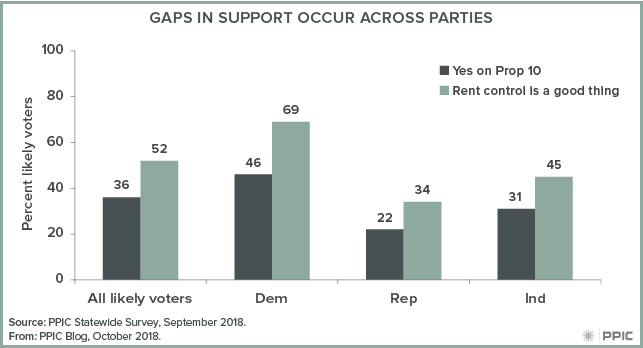
When read the ballot title and label of Proposition 10—which would expand the authority of local governments to enact rent control—about half of likely voters say they would vote no (48%) while far fewer (36%) would vote yes. However, when asked a general question about rent control by local governments, half of likely voters say it is a “good thing” (52%) while fewer (41%) say it is a “bad thing.” This translates to a 16-point gap between support for Prop 10 and support for the concept of rent control.

This gap widens when we dig a little deeper. For example, we find double digit differences in support for Prop 10 and for rent control in general across parties (Democrats 23 points, independents 14 points, Republicans 12 points).

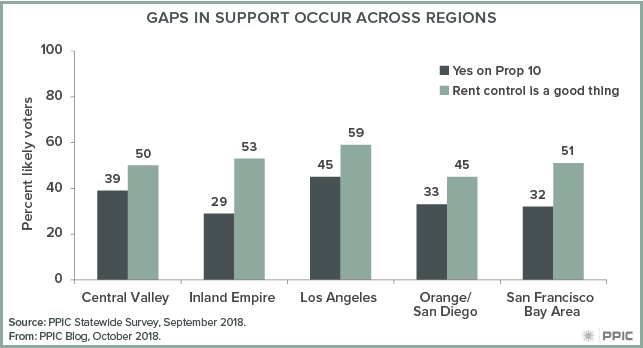
Support for Prop 10 and for rent control in general varies across regions, but the gap in support remains.

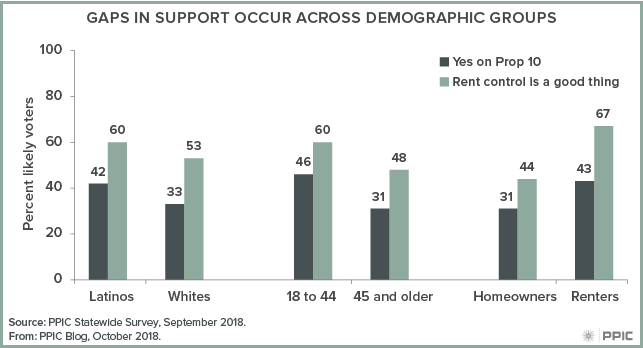
Gaps in support also occur across demographic groups: likely voters who are white (20 points) and Latino (18 points), those age 18 to 44 (14 points) and those age 45 and older (17 points), those making less than $80,000 annually (19 points) and those making $80,000 or more (14 points). Support for Proposition 10 is also lower than the share saying rent control is a good thing among renters (24 points) and homeowners (13 points).

It’s not entirely clear why these differences exist or why they are so pervasive. Perhaps the wording of Proposition 10 is having an impact. The ballot title and label—which are read to our survey participants—describe repealing the current state law that restricts the scope of rent-control policies. (This is the 1995 Costa-Hawkins Rental Housing Act.) It also mentions the potential net reduction of tens of millions of dollars in state and local revenues.

Proposition 10 Ballot Language
Proposition 10 is called the “Expands Local Governments’ Authority to Enact Rent Control on Residential Property. Initiative Statute.” It repeals state law that currently restricts the scope of rent-control policies that cities and other local jurisdictions may impose on residential property. The fiscal impact is potential net reduction in state and local revenues of tens of millions of dollars per year in the long term. Depending on actions by local communities, revenue losses could be less or considerably more. If the election were held today, would you vote yes or no on Proposition 10?

Is this a case of confusing ballot language? Or are voters simply not interested in this particular approach to rent control? As Californians learn more about the propositions during the run up to November it will be interesting to see the impact on Proposition 10. Stay tuned to the PPIC Statewide Survey for timely coverage of this year’s election.

Video: A Conversation with Candidates for US Senate

As part of our Speaker Series on California’s Future, PPIC is inviting all major candidates in selected statewide races to participate in public conversations. The purpose is to give Californians a better understanding of how candidates would approach the challenges facing our state.

To give Californians a chance to hear directly from the two candidates for California’s US Senate seat, PPIC invited California state senator Kevin de León and US senator Dianne Feinstein to San Francisco on Wednesday to talk about their visions for California and the nation. PPIC president Mark Baldassare moderated a lively discussion that covered a range of topics.

The candidates, both Democrats, were in agreement on many state and national issues—including gun regulations, the Delta tunnel proposal, and comprehensive immigration reform. Both would support revisiting the allegations against Supreme Court justice Brett Kavanaugh, and both feel that there are Republicans in Congress who want to reach across the aisle.

But while both candidates talked about the need for universal health care, they had different views on the way to proceed. As Feinstein put it, “I believe in universal health care. The question is how we get it.” She outlined an incremental approach—offering a public insurance option, lowering the age of eligibility for Medicare to 55, and allowing Medicare to negotiate drug prices. By contrast, de León characterized health care as a right: “I believe that health care is a human right. I believe in Medicare for all.” He also cited his leadership in creating the Covered California health care exchange, expanding access to the exchange to undocumented minors, and instituting drug price transparency in California.

The candidates’ views on health care epitomize their overall approaches to governing. For de León, the key is to bring his experience in California to Washington. Asked about the tensions between California and the federal government, he said, “California has been the leading voice for the entire nation. The world looks to California, not Washington, DC.” And he argued that Democrats in Congress need to elevate key issues, “even if we’re in the minority.” In response to a question about why he wants to be California’s US senator, de León said, “I’m running to give you a new voice, and a new approach.”

Feinstein often focused on what her years of experience in the Senate have taught her about the complexities and difficulties of governing. She reminded the audience more than once that Democrats are in the minority: “When you have both houses and the White House controlled by one party, it is extraordinarily difficult.” Explaining why she’s running in 2018, she focused on the work that needs to be done: “In terms of American public policy domestically, we can achieve a great deal . . . if we’re smart in how we go about it.”

The 2020 Census and Political Representation in California

California’s political representation will be affected by the 2020 Census—but an accurate count is far from guaranteed. Inadequate funding and fear in the state’s large immigrant population are heightening concern about an undercount. At a briefing in Sacramento last week, PPIC researcher Eric McGhee outlined a new report that draws on population trends and research on past undercounts to develop plausible scenarios for 2020.

“I think it’s fair to say that we are unlikely to lose a congressional seat if there is an accurate count,” said McGhee. However, California is more vulnerable to an undercount than most other states. Three in four Californians belong to at least one of the populations that are difficult to count: children, young men, Latinos, African Americans, immigrants, and renters.

An undercount could cause the state to lose one of its 53 seats in the House of Representatives. It could also have an impact on political representation within California. If the state does a poor job of reaching hard-to-count populations, it might end up drawing congressional and state legislative districts that shift representation from poorer areas with larger communities of color to areas that are wealthier and less diverse.

Privacy concerns have increased both the difficulty and the cost of conducting census surveys. The current political climate is likely to exacerbate these concerns, especially now that a question on citizenship status has been added to the 2020 survey. (The addition is being contested in the courts.) Moreover, the 2020 Census will be the first to collect a majority of responses online. The Census Bureau is testing the Internet survey but lacks the resources to test outreach and follow-up. Because California has a disproportionate share of historically undercounted residents, these challenges are of particular concern.

But, as McGhee pointed out, “California’s fate is still in its own hands.” This year’s state budget allocates about $90 million for census outreach, which should help community organizations and state and local governments educate residents about the importance of the census and the security of the information collected. Californians need to know that “a better count in California could make a big difference.”