Without Testing, Challenges for School Districts Add Up

Distance learning due to COVID-19 is not going to be a temporary phenomenon. Now, with K–12 campuses closed since mid-March and likely to stay shuttered for the remainder of the school year, students will miss out on about a third of their 180 in-person instructional days. The timing of these closures means no statewide end-of-year standardized tests, posing significant difficulties for teachers and districts when schools reopen.

Even before most districts announced the end of in-person classrooms, most California public school parents expressed concerns over providing productive learning at home—70% say they are somewhat or very concerned, in PPIC’s April Statewide Survey.

And success at distance learning for some students is uncertain because access to the internet and devices, curriculum, the demands of home life, and learning needs—especially for English Learners and students with disabilities—can vary so widely. Differences are already being revealed—according to a survey of public school teachers in late April, 25% of students are not logging in or making contact with their teachers during distance learning. In districts where poverty rates exceed three-quarters of the student population, 36% of students are not in contact with their teachers.

When schools do reopen, teachers must determine how to accelerate the learning of students who fell behind—whether opening happens in July, as Governor Newsom has advocated, or through expanded summer school, or on planned fall start dates. And without results from spring 2020 standardized tests, helping students catch up may require a sustained effort.  Some local education agencies are making plans to use formative assessments to assist in reopening, given that California, like all other states, has received a waiver for the federally required statewide assessments.

Typically, students in grades 3–8 and in grade 11 take statewide standardized tests in the spring. These tests of English language arts, math, and science help measure student learning during the year and may be used to place students in fall math courses. Such end-of-year assessments to gauge student learning are essential to California’s accountability system.

The results can also give teachers more insight into the mix of students who show up in their classroom in the fall, as well as identify schools and districts in need of extra support.  For 11th graders, the assessments can signal how prepared they are for the rigors of college coursework: the results are later used to place students in English and math in the CSU system.

Furthermore, few districts completed the standardized tests that measure the English proficiency of English Learners before spring closures, tests that determine if students can exit English Learner status. In some districts, English proficiency test results determine the courses students take in the fall.

Given how rapidly the COVID-19 crisis unfolded, these test cancellations were unavoidable.  But the absence of test results compounds the challenges of reopening schools: teachers will lack vital knowledge about how distance learning has impacted their students.

Teachers and school staff will likely conduct plenty of assessing on their own, planning lessons for the diverse needs of their students. The hope is their efforts can smooth the way for students’ return to their classrooms; but we are at least a year away from understanding how the crisis has impacted our students systemwide.

California’s Jail Population Has Plummeted during COVID-19

When the COVID-19 crisis began, state and county governments recognized that overcrowded jail conditions could pose unacceptable health risks for inmates and staff. As the crisis has unfolded, all counties have taken steps to decrease their jail populations. Some have made steeper reductions than others, and some of the measures that have facilitated these reductions—reducing pretrial detention and setting bail at zero for many crimes—may have longer-term significance as California considers whether to eliminate money bail.

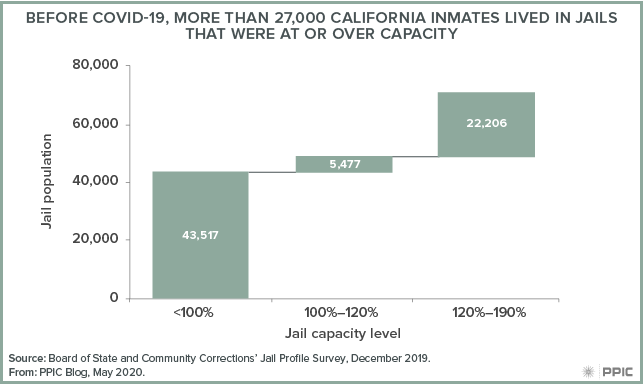
In December 2019, the average statewide daily population was 71,200—89% of capacity. However, about one in six county jails were at or over capacity, and twelve were between 120% and 190%. Looking only at numbers of jails understates the scale of the problem, because overcrowding was most prevalent in the biggest ones in a few large counties—Fresno, Los Angeles, Orange, Riverside, and San Diego. About four in ten (39%) California inmates—more than 27,000 people—lived in jails that were filled to or beyond capacity just prior to the pandemic.

Figure - Before COVID-19, More than 27,000 California Inmates Lived in Jails that Were at or Over Capacity

To reduce their jail populations, many counties began admitting fewer people to jail and releasing some inmates early. From February 29—when the Board of State and Community Corrections began reporting additional data—to April 11, the statewide jail population had fallen by 19%, to about 58,000 inmates. However, two county jail systems (Kings and Los Angeles Counties) remained over capacity and six county systems were at least 85% of capacity, accounting for over 20,000 inmates in total. Social distancing is challenging for inmates and staff at these capacity levels.

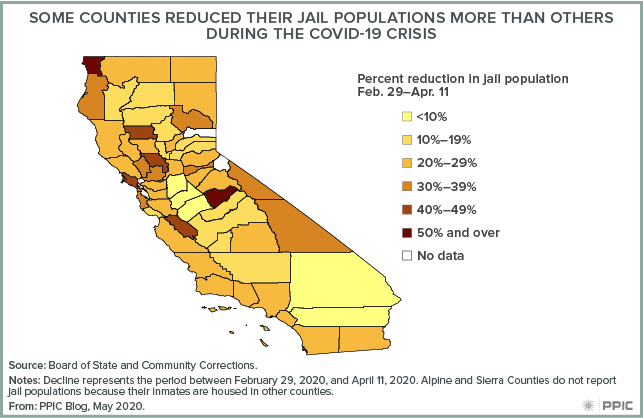
Between February 29 and April 11, all of California’s counties reduced their jail populations by releasing more people than they admitted. However, the reductions varied across counties: some lowered their jail populations by less than 10%, whereas others made reductions in excess of 50%.

Figure - Some Counties Reduced Their Jail Populations More than Others during the COVID-19 Crisis

To encourage further reductions in the jail population, the Judicial Council issued a statewide rule setting bail at $0 for misdemeanors and low-level felonies that went into effect on April 13. The “zero-bail” rule targets pretrial detainees, who historically have been about two-thirds of California’s jail population; many of these detainees are incarcerated mainly because they cannot pay bail. From April 11 to April 25, county jail releases continued to outpace admissions, with 14,154 people admitted and 19,924 released statewide.

Temporary state and county efforts to reduce jail populations come as California considers a permanent shift from cash bail to a risk-based system of determining pretrial release. Given the public safety concerns raised as the zero-bail rule was implemented, and the fact that voters will decide whether to make a permanent shift away from cash bail in November, it is important to assess the impact of zero bail and other emergency measures.

Who Lives in California’s Nursing Homes?

Seniors aged 65 and over are the age group most at risk of dying from the COVID-19 virus. As of May 6, according to the California Department of Public Health, seniors accounted for 79% of all COVID-19 deaths (1,894 out of 2,412) in the state. Seniors who live in nursing homes—skilled nursing facilities—are especially vulnerable. But state programs that allow seniors to remain living at home rather than entering nursing homes may help protect California’s most vulnerable population.

Residents of nursing homes make up less than 1% of the state’s population, but account for 39% (929 out of 2,412) of all COVID-19 deaths in the state and 10% (5,604 out of 56,212) of all confirmed COVID-19 cases. And at 78%, the vast majority of nursing home residents are seniors. Health care workers in the state’s nursing homes are also at risk. Seventeen have died and over 3,000 have contracted the disease.

Even as the senior population has grown with the aging of the baby boom cohort, the number of seniors in nursing homes has remained steady. According to the American Community Survey, about 88,300 seniors, or 1.7% of all seniors in California, live in nursing homes in 2018; that’s about the same number as in 2010 (87,500).

Figure - Little Change in Number of Seniors at California Nursing Homes

Women make up the majority of the seniors in California nursing homes (65%). Residents also tend to be very old—43% are age 85 or older—and not married. Similar to the overall senior population, the majority are white (58%). Even so, many residents (32%) speak a language other than English. Los Angeles County, the locus of the pandemic in California, has 35% of the state’s nursing home residents, but 26% of the state’s population.

Almost all nursing home residents have self-care limitations. That is, these seniors have a physical or mental health condition that has lasted at least six months and makes it difficult for them to attend to their own personal needs such as bathing, dressing, or getting around. And at least half (51%) are on Medi-Cal.

However, state and county programs have allowed more seniors to live at home. One such program, In-Home Supportive Services (IHSS), is intended to keep low-income seniors in their own homes rather than in nursing homes. IHSS offers services such as housecleaning, meal preparation, laundry, grocery shopping, personal care services—such as bathing, grooming, and paramedical services—and accompaniment to medical appointments.

Because of this arrangement, even seniors with self-care limitations are increasingly likely to stay in their own homes rather than move to a nursing home. Hundreds of thousands of California seniors receive care through IHSS.

The share of seniors in nursing homes across the rest of the country is about one-third higher than in California. A likely outcome of state efforts to keep seniors in their own homes has been to protect many seniors in this state from exposure to the pandemic.

Jail Bookings Down Significantly during COVID-19

In the midst of the coronavirus pandemic, California has sought to reduce county jail populations through a range of actions, including a “zero bail” emergency measure. This means that most misdemeanor and lower-level felonies currently have no bail amount associated with them, and that suspects are more likely to be cited and released instead of booked into jail. This new practice, along with decreases in crime and local directives to reduce arrests and bookings, appear to have drastically reduced the number of people sent to jail at this time.

A number of offenses—including felony burglary, driving under the influence, and the most serious sexual and violent crimes—can still receive a bail amount above zero.  And law enforcement can still book someone into jail even for a so-called zero bail offense—but the arresting law enforcement agency (or the district attorney) has to request to a judge to set a bail amount. If the court denies the request then the suspect has to be released.

To get a sense of the magnitude of zero bail’s effect on releases and bookings, we looked at data from the Monthly Arrest and Citations Register (from 2016, the most recent available). These data do not perfectly identify zero bail offenses or the offenses excluded from the zero bail list. But they do allow us to identify an upper bound of the impact on jail bookings.

Of the roughly 1,140,000 arrests that we analyzed, about 791,000 were booked into jail (about 69% of arrests). About 317,000 of these bookings (or 40%) were for offenses in which bail is still is an option today. The remaining 474,000 bookings (or 60%) were for zero bail offenses.

This suggests that today, if the arrest offense distribution is currently the same as it was in 2016 and there are practically no requests to set bail for zero bail offenses, then only about 28% of arrests in California would lead to a booking into jail.

In 2016, misdemeanors made up the majority of arrests booked into jail (about 77%) for what are now zero bail crimes. Of these, the most common offenses were drugs (almost 28%), failure to appear in court on a misdemeanor offense (about 21%), drunk and disorderly conduct (12%), and traffic and petty theft (each about 5%). The most common felony offense bookings now set at zero bail were drug offenses (almost 30%), theft (22%), and vehicle theft (roughly 14%).

While crime appears to be down since the COVID-19 outbreak, and the type of crimes committed during the pandemic almost surely have changed, our examination of 2016 arrest data suggests that the implementation of zero bail—in addition to the effects of local directives and fewer crimes—means that far fewer people are being booked into jail at this time.

Recent statewide data from the Board of State and Community Corrections supports this conclusion, as it reveals that weekly jail bookings have dropped from 17,140 the week of February 23 to 6,880 the week of April 12 (a decrease of about 60%, consistent with our data analysis).

These findings suggest that the zero bail measure is playing a significant role in reducing crowding in California’s county jails and helping to make social distancing more achievable. Going forward, it will be important to monitor other possible impacts this reduction in jail bookings might have, including on homelessness, public safety, and access to health care.

COVID-19 Alters College Admissions

[vc_row][vc_column][vc_column_text]Admissions may look different for students entering college in fall 2021. Social distancing to protect communities during the COVID-19 outbreak will impact where students attend classes and where they will live—and recent policy updates around standardized testing and GPA requirements will impact how colleges determine eligibility and placement in courses. But even as admissions become more flexible, some students still struggle to get on the path to college.

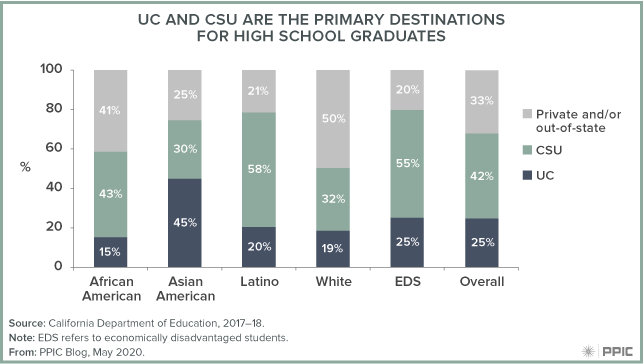
California’s public universities are the primary destination of the state’s high school graduates and community college transfers headed to a four-year college. In 2017–18, nearly 200,000 California high school graduates applied to the University of California (UC) or California State University (CSU), and 84,000 were enrolled.

figure - UC and CSU Are the Primary Destinations for High School Graduates

For students applying for admission to colleges in fall 2021, eligibility requirements and application processes are changing. Most standardized tests used for admission—such as SAT and ACT—and for placement purposes, such as the Smarter Balanced Assessment, are either postponed or cancelled.

In light of these cancellations, UC and CSU temporarily suspended testing requirements for fall 2021 applicants, meaning students do not need to include a test score on their application. In addition, UC and CSU systems are temporarily accepting pass/fail in lieu of a letter grade for courses completed in winter, spring, and summer 2020, as more K–12 districts and community colleges choose not to assign letter grades while students adjust to distance learning during the pandemic.

These adjustments are meant to ease anxiety over college admissions in a time of crisis, and there is some evidence that eliminating high stakes standardized tests could lead to more underrepresented students being placed in college-level courses and being eligible for college.

However, when high schools and community colleges lack sufficient resources, even with flexible grading in place, remote education may fail disadvantaged students. More than half of K–12 students from low-income households do not have broadband access at home. Notably, PPIC research found that online courses at community colleges exacerbated achievement gaps.

During their junior and senior years, high school students are more likely to fall off the college pathway, and disadvantaged students are even more likely to do so. And until recently, disadvantaged students were also more vulnerable to being diverted away from community college courses necessary for transfer admissions.

All students must cope with the changing college application process. But first-generation college applicants come from families who are new to the process; those with less internet/technology access may also be less familiar with how to apply. These students may see less support in the college application process than they would if they were still in school.

Now, more than ever, targeted outreach efforts and collaborations between K–12 and higher education will be critical to ensuring equitable access to a college education and economic mobility.[/vc_column_text][/vc_column][/vc_row]

Video: The Benefits of Headwater Forest Management

The health of California’s headwater forests is in decline, leaving them increasingly vulnerable to major wildfires and droughts that threaten the many benefits they provide. Even in the midst of the current COVID-19 pandemic, California must plan for the upcoming fire season, and continue work to reduce its risks.  At a virtual event last week, PPIC researcher Henry McCann described how improved management can make Sierra forests more resilient and avoid major wildfire-related disasters, and summarized the findings of a new report that identifies the benefits and beneficiaries of such management practices.

“Expanding on the pace and scale of long-term forest stewardship is going to be a heavy lift for private and public entities,” said McCann. “Developing a clear sense of the benefits and beneficiaries of improving forest health is key to motivating long-term stewardship and identifying the partners to support it.”

An expert panel moderated by study coauthor and UC cooperative extension specialist Van Butsic discussed how this translates into practice.

What does the science tell us about managing California’s wildfire- and drought-prone forests? “It tells us there are opportunities for win-win scenarios, where a forest treatment designed to reduce fire risk will likely also have other benefits—for carbon storage, biodiversity, wildlife habitat, water output,” said panelist Carmen Tubbesing, a PhD candidate in forest ecosystems and fire sciences at UC Berkeley.

Tubbesing said that we can’t implement treatments “on every inch of forest in California,” but “research has shown that even treating a fraction of a landscape can have landscape-wide benefits on a forest” and reduce wildfire risk.

Angela Avery, executive officer of the Sierra Nevada Conservancy, talked about programs her agency is involved in that “combine the social with the ecological” to build more resilient forests. California needs to build a workforce that can do this work, she said, noting that community colleges might be a venue for expanding forest workforce training. Highlighting another important gap, she pointed out that “we really need additional wood processing infrastructure across the Sierra Nevada if we’re truly going to manage our forests to resilience.”

Willie Whittlesey, general manager of the Yuba Water Agency, talked about collaborative work between his agency and a forest management project to protect the watershed by restoring local forests to a resilient condition. “We didn’t know what the direct benefits would be but we knew that we wanted to prevent our watershed from undergoing a catastrophic wildfire,” he said. “We have to look long term and we have to look forest-wide. Our forests aren’t sustainable in the condition they’re in,” he added.

Panelists also explored ways to expand forest management—and to build understanding of and support for such work. Tubbesing noted that “better investment in community outreach, and putting more people with scientific backgrounds as liaisons in the communities influenced by these decisions” would be a good first step.

We invite you to watch the event video.

Lessons from the Pandemic for Addressing Climate Change

Clear skies and less air pollution. Dramatic drops in harmful greenhouse gases. What can these environmental “silver lining” aspects of the COVID-19 pandemic teach us about addressing climate change? We talked to Louise Bedsworth—executive director of the California Strategic Growth Council, a state agency that brings together multiple agencies to support sustainable communities and strong economies—about the issue.

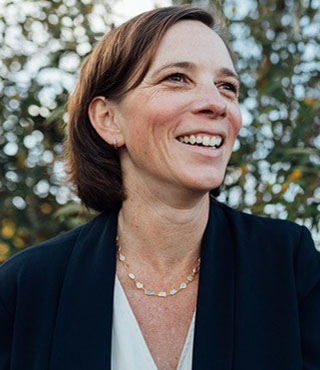
photo - Louise Bedsworth

PPIC: What has the COVID-19 pandemic taught us about our efforts to tackle climate change?

LOUISE BEDSWORTH: The pandemic has caused us to make a lot of changes quickly, some of which we know are also necessary to tackle climate change—such as the dramatic reductions in travel by car and air. Businesses have implemented telework policies at a scale we’ve never seen before, and meetings that would have taken place in person are now remote. We’ve seen that these sorts of changes can rapidly reduce air pollution and greenhouse gas emissions. Looking ahead, we can think about how to incorporate some of these changes into how we work.

In addition to changes that reduce emissions, we have also seen a number of actions that are important for building resilience. We’re seeing more people out in their communities, walking, biking, and getting outside. And we see people checking in on vulnerable residents, neighbors coming outside to talk to each other, and growing movements to shop at local businesses.

These social connections are really important for building a resilient California—one able to withstand the shocks to come. In the face of a changing climate, we have to reduce emissions, but also ensure that that our people, economies, and ecosystems are resilient in responding to  shocks and stresses. And that means building robust equitable communities that can weather these changes together.

We need to think about how we incorporate these lessons going forward—not just in our efforts to reduce emissions but also in how we’re thinking about building resilience in our communities.

PPIC: Do you see any long-term effects arising from the pandemic’s drop in emissions?

LB: We’ve seen what’s possible. We can make changes that have immediate impacts on air quality and emissions. That’s a really valuable lesson. The next step is figuring out how to make some level of these positive changes stick as we come out of the pandemic. For example, what policies do we need to encourage telework, or to encourage people to continue to drive less and walk more? Enabling just one day a week of telework could reduce commuter travel and associated emissions by 20%.

We also have to focus on how we rebuild our public transit systems, which have suffered steep declines in revenue and ridership. I think we have to be honest about the challenges facing transit systems, not just because of the financial hit they’ve taken but also to address people’s fear of being on crowded transit. How can we maintain these important systems even as we encourage more telework, biking, and walking?

PPIC: What are the economic implications of COVID-19 on the state’s climate change efforts?

LB: The pandemic has highlighted California’s equity challenges. Communities with high levels of poverty, joblessness, pollution, and poor health are bearing the brunt of this illness. We have to address the underlying causes of these inequities. The pandemic underscores the need for stronger efforts to reduce pollution and mitigate the effects of climate change—and for solutions that reduce these inequities.

We have to pay attention to how we rebuild our economy. Let’s put people to work to build more resilient infrastructure and a cleaner economy. Our long-term recovery must include investments that are in line with our goals on climate change and the environment, housing production, and quality job creation.

PPIC: What opportunities should we take from the coronavirus crisis to help address the climate crisis?

LB: We need to continue to focus on building a sustainable, equitable California. This includes building resilience in the state’s physical infrastructure as well as in our social and economic systems. If we don’t remain committed to our environmental goals as we recover from this, it will be harder and more costly to fix these problems down the road. In addition to working to maintain some new workplace practices, we need to prioritize actions that promote equity and sustainability. We must redouble our efforts to build safe and affordable housing located near jobs, schools, and transit and create high quality jobs and job training opportunities.

California can set an example for the world. The state is a leader in addressing climate change, but these changes have to happen globally. California must continue to lead by successfully demonstrating how we can emerge from the pandemic fully committed to sustainability and equity.