Commentary: How Better Wastewater Management Can Help California Adapt to Climate Change

This commentary was published on CALmatters on May 9, 2019.

Our public health relies on wastewater management to treat sewage and remove pollutants coming from our homes and businesses.

This system is fundamental to protecting our health. In California, treated wastewater also is a critical source of water for the environment, and, increasingly, a source for recycled water. Climate change is worsening water scarcity and flood risks. Advancements in engineering and technology can help prepare wastewater agencies for a changing climate. But significant shifts in policy and planning are needed to address these challenges.

Wastewater agencies must reliably remove pollutants even as the quantity and quality of the water they treat declines during droughts, and when large storms push their equipment to the breaking point.

In February, an atmospheric river storm—the type that is expected to become more common as the climate warms―inundated Healdsburg’s wastewater treatment facility and pushed more than five times the normal flow of wastewater and runoff into Santa Rosa’s treatment plant.

In a drought, reduced flows to wastewater plants can hamper agencies’ ability to comply with treatment standards, damage equipment, increase costs, and shrink revenue. Lower inflows also reduce the volumes available for recycled water, often considered a “drought-proof” supply.

The drought of 2012–16 brought all of these problems to the fore. Many wastewater agencies are now changing their operations, infrastructure, or finances in response to the challenges they experienced. Our new study recommends sector-wide changes in three areas to help build the sector’s climate resilience:

  • Maintain water quality in the face of reduced indoor water use. Short-term water conservation during droughts and longer term reductions in water use from indoor efficiency measures challenge wastewater management. All wastewater agencies should assess their vulnerability to major climate pressures, and plan for future droughts. Better coordination and information sharing with suppliers about indoor water conservation and efficiency efforts are also key.
  • Make smart recycled water investments. Coordination among wastewater and water supply agencies is needed to address the demand for recycled water. Regional planning for recycled water projects can result in investments that are more responsive to changing water use and an increasingly volatile climate, bringing financial and environmental benefits.
  • Balance conflicting objectives within watersheds. Many wastewater treatment plants discharge treated water into inland watersheds.

Meeting increased demand for recycled water may fuel conflict over the use of treated discharge to support ecosystems and downstream users. Rivers and streams are expected to experience lower flows and higher temperatures, which will heighten threats to aquatic ecosystems. Resources are needed to identify areas most at risk of conflict over the use of treated wastewater, and to develop tools to evaluate the impacts of water recycling projects on the environment and downstream water users.

The state can help wastewater managers make these adaptations, which are critical to building a more integrated and resilient water system. The State Water Board should align its policies on water use, wastewater, recycled water, and environmental protection to better manage for these multiple objectives.

Forging new partnerships to tackle the full range of climate-related risks will help wastewater agencies determine the best adaptations and improvements needed to prepare wastewater management—and California’s water system as a whole—for a more volatile future.


Divided Views on Charter Schools and School Choice

Nearly three decades after California started authorizing charter schools, state lawmakers have renewed the debate over their rules and regulations. Today, there is a package of bills aimed increasing charter oversight moving through the legislature, and the governor has taken steps to address related issues. As the debate continues, the PPIC Statewide Survey has taken an in-depth look at Californians’ views of charter schools and school choice.

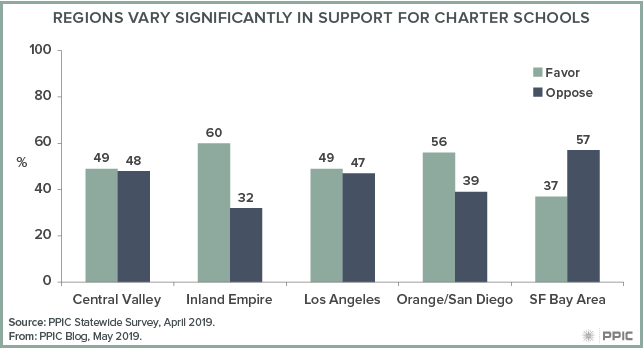
PPIC’s latest survey on K–12 education finds that Californians have mixed views on charter schools overall (49% favor, 46% oppose). Differences across regions and demographic groups are particularly notable. For example, half of Latinos (51%) and whites (50%) are in favor of charters in general, compared to fewer Asian Americans (43%) and African Americans (36%). Regionally, majorities in the Inland Empire and Orange/San Diego are in favor, while those in the Central Valley and Los Angeles are divided; a majority of San Francisco Bay Area residents are opposed.

figure 1 - Regions Vary Significantly in Support for Charter Schools

Looking more closely at charter school issues further highlights regional and racial/ethnic differences. On the question of transparency and accountability, overwhelming majorities across racial/ethnic groups say it is important for charters to operate with the same standards as traditional public schools. This includes 87% of Asian Americans, Latinos, and whites, and 72% of African Americans.

When it comes to charters taking away state funding that would otherwise be available for traditional public schools, seven in ten Los Angeles residents (71%) say they are concerned, compared to about six in ten in the Inland Empire (65%), San Francisco Bay Area (63%), and Orange/San Diego (62%); over half in the Central Valley (55%) express concern.

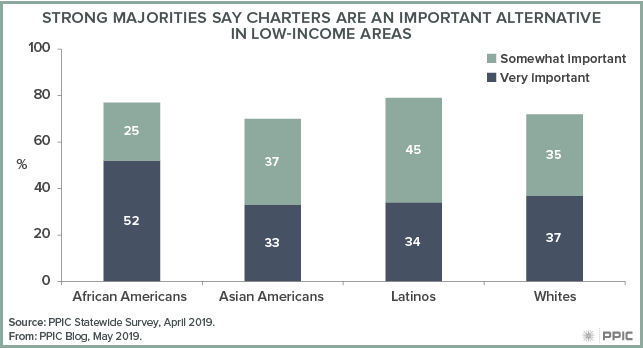
With respect to school choice, African Americans (52%) are much more likely than whites (37%), Latinos (34%), and Asian Americans (33%) to say it is very important for parents in lower-income areas to have the option of sending their children to charters instead of traditional public schools.

figure 2 - Strong Majorities Say Charters Are an Important Alternative in Low-income Areas

Earlier this year, Governor Gavin Newsom commissioned a task force to examine the impact of charter school growth on district budgets. He also signed legislation requiring the state’s 1,300-plus charter schools to follow the same transparency laws that apply to public school districts. As these policies play out, the PPIC Statewide Survey will continue to track Californians’ concerns and preferences on charter school issues.

Exploring Math Pathways under Common Core

California adopted the Common Core State Standards (CCSS) in math and English in 2010. CCSS describes what students should know in math and English by the end of each grade. These standards also prepare students to be ready for college and beyond. Nearly nine years after its adoption, awareness of and support for CCSS remain strong among Californians. What do we know so far about the reach and effectiveness of this change, particularly in math?

One of the paradigm shifts introduced by CCSS is how math is organized and taught in high schools. CCSS standards are organized into two pathways:

  • Traditional, which follows the standard sequence and includes Algebra I, Geometry, and Algebra II.
  • Integrated, which consists of Mathematics I, II, and III, with each course containing standards from all conceptual categories. For instance, Mathematics I covers topics in numbers, algebra, geometry, and statistics.

Acceleration, which gives students the opportunity to reach higher-level math such as calculus earlier, is possible in both pathways. For instance, a 9th grade student may complete 9th grade math (Algebra I or Mathematics I) and 10th grade math (Geometry or Mathematics II) concurrently. Districts can decide when and how students may accelerate.

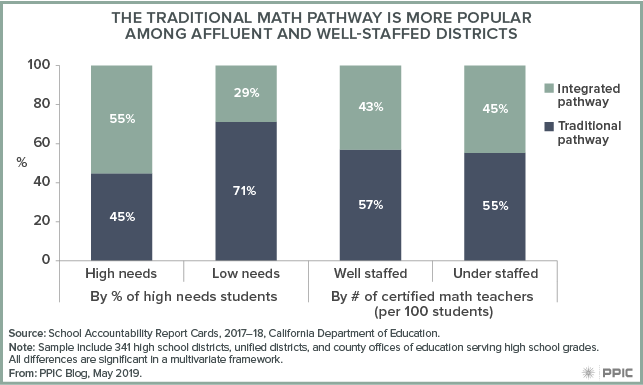
During the 2017–18 school year, 54% of districts followed the traditional pathway while 46% percent chose the integrated pathway. Significant and important differences in these choices exist across districts. Districts with more high-need students—low-income students, English learners and/or foster youth—were more likely to adopt an integrated model; districts with more certified math teachers, who are authorized to teach both pathways, were slightly more likely to choose the traditional pathway.

figure - The Traditional Math Pathway Is More Popular Among Affluent and Well-staffed Districts

Does the difference suggest that students in high-need districts may be left behind? Not necessarily. There was no significant variation based on student performance, such as the a-g completion rate. In addition, staffing, which tends to be worse in high-need districts, did not drive most of the differences in those decisions. Other factors, such as district capacity, pedagogical approach, and teaching philosophy may also be at play.

State assessment data does not seem to show any significant difference in student performance based on pathways; however, more formal evaluation is needed. So far, there have been no large scale studies that compare the effectiveness of these approaches. Doing so will require more and better data on a district’s chosen pathway (e.g., the first time these pathways were available) and student outcomes (e.g., postsecondary outcomes)—which the state currently does not collect. The governor’s proposal to create a statewide longitudinal database is a good first step toward building the capacity to evaluate one of California’s signature educational reforms.

Video: English as a Second Language in California Community Colleges

While the educational goals of students who enroll in ESL courses at California’s community colleges may vary, the economic benefits of effective ESL programs are clear: English proficiency can facilitate social and economic mobility for non-native speakers. But little is known about ESL programs across the state, or about the trajectories of ESL students. Now that a new law—Assembly Bill (AB) 705—is motivating colleges across the state to assess and reform their ESL programs, we need to better understand the ESL student population and the programs that serve them.

At an event in Sacramento earlier this week, PPIC researcher Bonnie Brooks outlined the findings of a new report on ESL in the community colleges and a panel of experts discussed AB 705’s impact on ESL in the community college system.

Kathryn Wada, who has taught ESL for 30 years at Cypress College, noted that the fact that AB 705 distinguishes ESL from developmental (or remedial) English and recognizes that ESL students are working toward proficiency in a foreign language is “huge for our field.”

AB 705 requires colleges to reform “credit” ESL programs—which offer credit-bearing courses for which students pay tuition—so that they do not deter or delay educational progress. By fall 2020, colleges must implement policies that maximize the chances that students complete a transfer-level English course within three years.

A look at the length of ESL course sequences across the system indicates that students at many colleges could, theoretically, complete transfer-level English in three years. In reality, however, most students don’t get this far. As Brooks noted, simply offering a sequence that is short enough to allow students to get through transfer-level English in three years “isn’t necessarily enough to maximize the probability of completion.”

Fortunately, many colleges are taking new approaches to ESL instruction that do increase the likelihood of completion. Courses that take an integrated approach—teaching more than one English skill at a time—and policies that allow students to move directly from ESL to transfer-level English instead of requiring them to enroll in developmental courses are likely to be key to fulfilling AB 705’s mandate. And, as Wada noted, new policies that make credits from advanced ESL courses transferable to UC and CSU moves credit ESL programs beyond the goals of AB 705: “If students are able to fulfill CSU and UC general education requirements directly with ESL courses . . . that’s huge.”

These new instructional approaches usher in a new era for ESL students. As Alice Perez, vice chancellor of academic affairs in the California Community Colleges Chancellor’s Office noted, “Many of our faculty and our institutions are set up to receive students assuming a major deficit: ‘You’re not college ready, and this placement test shows us this.’” Melissa Reeve, an English and ESL professor at Solano College, echoed Perez’s call for a “mindset shift,” citing the importance of “all of us having a belief in our students and what they are able to do, and sharing that with them in every facet of what we do.”

Immigrants Are Key to California’s Health Workforce

Governor Newsom’s proposed budget includes more than $85 million to train health care workers—a reflection of the state’s anticipated need to fill over 107,000 new health care jobs every year between 2016 and 2026. This projected increase is due to a growing and aging population, as well as greater access to care under the Affordable Care Act. California’s immigrant population will be an important source of workers in this sector.

In California, nearly one in three health care workers is foreign born, compared to one in six nationwide. This is partly because of the high share of immigrants among California’s working-age population. While immigrants make up about a quarter of all Californians, they are almost a third of working-age Californians—with even higher shares of immigrants among those with less than a high school diploma (49%) or those holding a graduate or professional degree (36%).

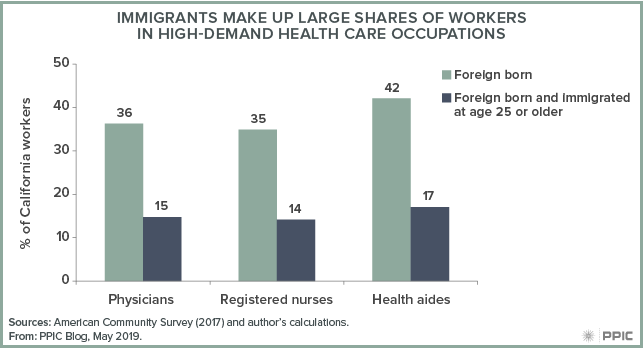
Immigrants also make up a large proportion of California workers in high-demand health care occupations, such as primary care providers (who are particularly needed in rural areas), nurses, and health aides. In 2017, 36% of the state’s physicians and 35% of registered nurses were foreign born. Forty-two percent of California’s nursing, psychiatric, and home health aides were foreign born.

figure - Immigrants Make Up Large Shares of Workers in High-demand Health Care Occupations

As California considers how to train people for these jobs, programs that account for the diversity of immigrants’ educational backgrounds will be important. Many highly skilled immigrant health workers were age 25 or older when they arrived in the country, suggesting that they may have had at least some training abroad. To help foreign-trained health professionals, some California universities already have programs to guide them through the steps necessary to enter the state’s health workforce. Training programs for support roles in health that require less than a four-year college degree are another opportunity that could encourage lower-skilled immigrants to enter the health sector.

Immigrants can also benefit the health workforce in other ways. For example, health care workers who speak languages other than English, as many immigrant workers do, can be a resource for low-income patients facing linguistic barriers to health care access. In the coming years, meeting California’s health care workforce needs will require multiple strategies—but engaging the state’s immigrant population can be a part of the solution.

Testimony: Water Supply and Quality Challenges in the San Joaquin Valley

Ellen Hanak, director of the PPIC Water Policy Center, testified today (April 30, 2019) before the Assembly Subcommittee on Water, Parks and Wildlife, at a hearing on balancing water needs into the future in the San Joaquin Valley. Here are her prepared remarks. View her presentation.

The San Joaquin Valley produces more than half of California’s agricultural output. Irrigated farming is the region’s main economic driver and predomi­nant water user. The region is also ground zero for many of the state’s most difficult water management problems―including long-term depletion of groundwater reserves, lack of safe drinking water in many rural communities, and accumulation of a variety of groundwater contaminants.

Over the past three years, the PPIC Water Policy Center has worked with an interdisciplinary team of researchers from Fresno State, Point Blue Conservation Science, UC Davis, and UC Merced to examine these challenges and identify promising solutions. Today, I’ll provide you with some highlights from our latest report, Water and the Future of the San Joaquin Valley, including areas where the California Legislature can be most helpful in facilitating progress. Two of my coauthors on this study—Sarge Green from Fresno State and Thomas Harter from UC Davis—are also here to answer your questions.

I’ll touch on four priority areas for action: balancing water supplies and demands; ensuring safe and reliable drinking water supplies; managing groundwater quality for the long-term; and fostering beneficial water and land use transitions.

Balancing water supplies and demands

Chronic groundwater overdraft—pumping in excess of the amount that is replenished—averages nearly 2 million acre-feet per year in the San Joaquin Valley, or roughly 11 percent of the region’s net water use. The consequences include dry wells, sinking lands, damaged infrastructure, and reduced reserves to cope with future droughts.

In light of these problems, the valley is on a fast track to implement the Sustainable Groundwater Management Act (SGMA), which requires groundwater users to bring water supplies and demands into balance by the 2040s. The first local sustainability plans must be finalized and launched in early 2020.  Although attaining balance will benefit the valley’s economy over the long-term, it will entail some near-term costs.

To end overdraft, local groundwater sustainability agencies (GSAs) will have to augment supplies, reduce demands, or use some combination of these approaches. We estimate that about a quarter of the historical deficit can be filled with new supplies at prices farmers can afford.  The balance will likely need to be met by managing farm water demand—with the idling of at least 500,000 acres of irrigated cropland (about 10% of current acreage).

On the supply side, the most promising options are to capture and store more local runoff in groundwater basins, and to increase water imports by managing the system differently. On the demand side, increasing water trading—both within and across groundwater basins—can significantly mitigate the economic impacts of reducing water use, by allowing farmers to maintain the crops that generate the most revenue, GDP, and jobs. Reducing overdraft gradually between now and 2040—the “glide path” approach to implementing SGMA—can also lessen the costs of adjustment by giving farmers more time to adapt.

Priority actions to facilitate the adoption of an optimal supply and demand portfolio approach include:

  • Assessing which new infrastructure investments—including conveyance—are warranted to support more recharge and water trading.
  • Incentivizing recharge on farmland—one of the most cost-effective ways to store water.
  • Developing transparent and equitable local water trading rules, including for groundwater.
  • Clarifying how much additional high winter and spring runoff is available for recharge.
  • Facilitating state and federal approvals for water trading and groundwater banking projects.
  • Coordinating both within and across groundwater basins to maximize benefits.

Although local and regional water users and agencies will need to take the lead on many of these actions, both the state and federal governments can play vital roles. The state can be especially helpful in clarifying how much water is available for recharge, facilitating approvals for water trading and groundwater banking projects, and working with local partners to assess infrastructure needs.

Ensuring safe and reliable drinking water

The valley’s most urgent water issue is addressing chronic problems of unsafe and unreliable drinking water in rural communities, most of which rely on groundwater. The region is a hot spot for unsafe drinking water. With just 10 percent of the state’s population, it is home to more than half of all community water systems that have persistently contaminated tap water. Contamination is also a problem for very small water systems that are regulated by counties and for homes served by domestic wells. Some groundwater contaminants—such as arsenic and uranium—occur naturally. Others are caused by human activity. For instance, agriculture is the primary source of nitrate, a serious contaminant that is widely present in shallow wells.

The region is also a hot spot for unreliable drinking water supplies in communities that depend on shallow wells. During the latest drought, roughly half of the 150 small water systems that sought emergency assistance from the state were in the valley, as were nearly 80 percent of all residents who reported dry domestic wells. Without concerted action, this vulnerability will persist. Several thousand additional drinking water wells are vulnerable if groundwater levels fall another 30 feet—something that could easily happen during the next drought, or if local groundwater sustainability plans allow continued overdraft under a glide path approach and fail to mitigate the problem.

In recent years, various legal and administrative changes have helped address the drinking water crisis. But there is still an urgent need to build a robust, comprehensive framework for tackling it. Affected communities will require technical, financial, and managerial assistance. Here are some top priorities:

  • Consolidating or aggregating systems to provide economies of scale to small water systems.
  • Providing technical support.
  • Planning for shortages and developing rapid response procedures to mitigate dry wells.
  • Ensuring funding support for both capital investments and ongoing operations and maintenance.

A variety of local parties—including counties, urban water suppliers, irrigation districts, groundwater sustainability agencies, pollution dischargers, and NGOs—will need to play a major role in helping to address this problem. But the state must take leadership in developing funding solutions and ensuring there’s a comprehensive plan for addressing both quality and supply vulnerabilities in a timely manner.

Managing groundwater quality for the long-term

Valley farmers and other dischargers of contaminants must also meet new requirements for protecting groundwater and soils from the long-term buildup of nitrate and salts. California has been a national leader in seeking to address these problems, with a suite of new regulations adopted over the past decade. The Salt and Nitrate Control Program (SNCP)—adopted by the Central Valley Regional Water Quality Control Board in 2018 and pending approval by the State Water Board—provides an umbrella framework for addressing these challenges. SGMA also requires GSAs to protect water quality while balancing groundwater supplies and demands.

Nitrate in drinking water wells, which originates primarily from inorganic nitrogen fertilizer and manure used in farming, poses significant public health risks. Dairies face special challenges in managing manure efficiently, and solutions have remained elusive.

Salinity is a growing threat to local agricultural productivity. Roughly 250,000 acres of cropland have already been retired due to salinity in soils, and another 1.5 million acres are considered impaired.

But managing for these contaminants is costly. The SCNP seeks to find a balance between protecting water and land resources for the long run and maintaining the viability of agricultural production in the present, while also ensuring safe drinking water solutions.

Here are some top priorities for action:

  • Coordinating water quality and quantity management. This will be especially important for managing groundwater recharge, which under some circumstances can accelerate the migration of chemicals in the soil (especially nitrate) into the aquifer and impair drinking water quality, at least for a time.
  • Implementing new technologies to manage pollutants. This will be especially important for dairies, which need to remove excess manure and transform it for other uses.
  • Providing regulatory flexibility. This includes flexibility to allow some continued loading of nitrogen and salt as long as impacts on drinking water supplies are mitigated, as proposed under the SNCP.

While local water managers, farmers, and the agricultural industry will need to take the lead in addressing these issues on the ground, the state can play a major role in providing effective and responsible regulatory flexibility, and in supporting research and development (R&D).

Fostering beneficial water and land use transitions

Finally, the valley will need to plan for and manage the changing landscape as some cropland is idled—both to avoid negative consequences from dust, pests, and weeds, and to get the most value from these lands in other uses. Pursuing approaches that seek multiple benefits on this land can support the regional economy, public health, and the environment. There are numerous stewardship options: healthy soils, habitat, wildlife-friendly solar, recharge, flood protection, and recreation.

There are already some models of how this can work. For instance, the Kern Water Bank provides thousands of acres of upland habitat for San Joaquin desert species and abundant intermittent wetlands, while also serving as a major groundwater storage site. But to date, there is no serious planning effort to see how lands coming out of production might be used most productively, and how to provide the right incentives to realize this potential.

Here are some top priorities for action:

  • Initiating broad-based, inclusive planning. For many issues—ranging from determining the best areas for habitat investments to coordinating recharge and managing salinity—taking a valley-wide perspective will be key.
  • Implementing flexible regulatory approaches to make it easier to implement multi-benefit restoration projects.
  • Providing incentives and funding to support activities on the ground.
  • Boosting technical support and R&D.

Again, local and regional parties will need to take the lead on many aspects of this work. But state and federal agencies can facilitate good outcomes by providing regulatory flexibility, financial incentives, and support for technical assistance and R&D.

How can the Legislature be most helpful now?

The valley is at a pivotal moment, and there are many ways in which the state can assist the region’s residents implement efficient, equitable, and sustainable solutions to their water-related challenges. Here are some final thoughts on how the Legislature can be most helpful in the near-term:

First, ensure a robust, comprehensive framework for safe and reliable drinking water solutions. This is an urgent public health issue and needs urgent attention. The framework should include reliable funding, as well as a sound, timely approach to providing technical and managerial solutions on the ground.

Second, support the building blocks for the region’s transition to groundwater sustainability. Planning for sustainable groundwater management is well underway, but this transition won’t happen overnight. Early actions to promote forward momentum will be especially valuable in the next few years.

To create the preconditions for success, the state should accelerate its own efforts to provide regulatory clarity, consistency, and flexibility. Key areas include how much water is available for recharge, how to recharge in ways that are acceptable from a water quality perspective, and how to implement broad-based, multi-benefit restoration projects that put land coming out of production to best use.

Support for local and regional initiatives can also make a difference. Key areas include assistance with the assessment of smart infrastructure investments, pilot efforts to implement innovative approaches on the ground, technical support and R&D for water quality and land stewardship solutions, and broad-based planning to develop regional approaches for multi-benefit management of water and land.

California has long been a model for others in the management of natural resources. Many are now looking to see how we tackle the tough challenges of providing safe drinking water to all residents and managing our groundwater resources sustainably for the long term. The San Joaquin Valley is on the front line for addressing both of these challenges. The region’s farmers and residents have a history of creatively adapting to difficult and changing conditions, and constructive solutions are in reach. The state can provide vital support to help ensure success.


Video: Californians and Education

Last week in Sacramento, Alyssa Dykman outlined the key findings from PPIC’s 15th annual survey on Californians and K–12 education, which tracks opinions on educational quality and school funding. This month’s survey was the first ever to be conducted with a fully online methodology.

A strong majority of Californians want Governor Newsom to prioritize K–12 public education, and majorities support many of the governor’s education-related budget proposals—including the expansion of special education and full-day preschool and kindergarten. Solid majorities also support teacher strikes for higher pay.

But Californians have mixed views on charter schools: most say they are an important option for parents in low-income areas, but many express concern about charters diverting funding from traditional public schools.

Other survey highlights:

  • Most Californians think the level of state funding for local public schools is not adequate.
  • More than half of residents across regions say teacher salaries in their community are too low.
  • Majorities of adults and likely voters would vote for a ballot measure that would amend Proposition 13 to create a “split roll” property tax system and direct some of the revenue to K–12 education.
  • Many parents think the goal of K–12 public education should be to prepare students for college—but many worry about the affordability of a college education.

How California’s Digital Divide Affects Students

As the internet becomes increasingly essential for student learning and testing, California’s digital divide threatens to exacerbate preexisting inequities in education.

The good news is that K‒12 schools have largely made the digital transition. In 2018, 90% of California schools met the Federal Communications Commission’s (FCC) minimum threshold for digital learning and had the internet resources necessary to administer the state’s online assessment.

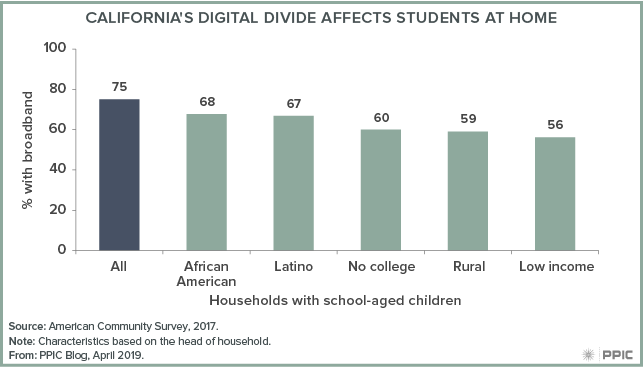
But at home not all students have reliable internet access or a traditional computer, such as a desktop or laptop. Overall, 16% of school-aged children in California do not have any internet access at home, and 27% do not have a high-speed connection, meaning they rely on slower connections like dialup or satellite. In addition, nearly 10% access the internet with a cellular data plan, which usually means slower speeds and suggests they are relying solely on a smartphone or tablet.

Gaps exist for several demographic groups. For example, 56% of low-income households with school-aged children have broadband subscriptions, compared to 75% of all households with school-aged children.

figure -California’s Digital Divide Affects Students at Home

This digital divide in broadband access at home—known as the “homework gap”—may affect student learning. An analysis by the Pew Research Center found 17% of teens say they are often or sometimes unable to complete their homework due to a lack of reliable internet or computer access, with about a quarter of low-income and African American teens saying this. Another study shows that eighth graders who do not have internet access at home score lower on national exams in reading and math than their peers. Similarly, students without computers at home score lower in their ability to use computers and other digital devices. These factors may worsen the disadvantages faced by lower-income students, who have lower high school graduation rates and lower standardized test scores than their wealthier peers.

While there are discounts available to lower-income families struggling to afford internet access, three in four California households without broadband are unaware of these discounts, according to a Berkeley Institute of Government Studies poll—suggesting that federal and state policymakers can do a better job promoting these programs.

Some districts have developed innovative approaches to address the digital divide. For example, a few years ago Coachella Valley Unified outfitted school buses with Wi-Fi and parked them throughout the district’s rural neighborhoods to serve as mobile hotspots. As more schools embrace digital learning, developing new ways to broaden internet access is key to closing equity gaps and ensuring that learning continues outside the classroom.

Video: Managing Wastewater in a Changing Climate

California’s wastewater sector plays a key role in protecting public health and the environment. It is also the source of recycled water—a growing part of the water supply. But as climate change increases the risks of water scarcity and creates other new challenges, the sector is at a turning point. A recent event brought together PPIC researchers and a panel of experts to explore how wastewater management can adapt to a more volatile future.

Caitrin Chappelle, associate director of the PPIC Water Policy Center, outlined findings from a new report on climate risks to the sector and strategies needed to manage them. She noted that drought—as well as ongoing efforts to conserve water—can have unintended consequences for the sector. Less water flowing into treatment plants affects treatment processes and can harm infrastructure. Less treated water flowing out of these plants reduces supplies for downstream users, ecosystems, and recycled water uses.

Chappelle noted that cooperation is a key strategy for building resilience: “Local wastewater agencies will need to work closely with one another, with water supply agencies, and with the state to build a more resilient future.”

Identifying tradeoffs and understanding the unintended consequences of water conservation and the use of treated wastewater are key to developing good policy, noted the panel’s moderator, Kurt Schwabe, a professor at the University of California, Riverside, and an adjunct fellow at the PPIC Water Policy Center.

The three panelists—Jelena Hartman of the California State Water Board, Adam Link of the California Association of Sanitation Agencies, and Nina Hawk of the Santa Clara Valley Water District—discussed the interactions between water use and wastewater, lessons learned from the latest drought, and ways to improve coordination and information sharing with water suppliers going forward.

Hartman noted that with the 2012‒16 drought emergency behind us, “it’s a good opportunity to talk about what worked, what didn’t work” for managing future low-flow situations. “We need to plan, adapt, and be prepared, because the next drought will come,” she added.

Hawk said her agency is fully behind efficient water use but also recognizes that conservation can have impacts on wastewater management and recycled water supplies. “We really have to step back and take a planning look at it,” she said. Collaboration between water suppliers and treatment agencies is key to managing wastewater for multiple uses, she noted.

Link highlighted the difficulty in planning for future capital improvements for both sanitation and recycled water in a changing climate. “If you’re not sure how low your flows will go, how do you plan for a plant that will be useful 30 years from now?” This may require more creative planning for capital investments to ensure that new infrastructure is flexible enough for changing conditions—for example, connecting recycled water plants to groundwater and surface storage to help them weather drought.

We invite you to watch the video from the event.


2020 Census: Will All of California’s Children Be Counted?

This post is part of a series examining challenges involved in the 2020 Census and what’s at stake for California. Click here to see our full coverage.

As the country gears up for the 2020 Census, one big challenge will be ensuring a complete and accurate count of young children. Nationwide, the 2010 Census missed nearly a million children under five years old, including about 210,000 young Californians, according to Census Bureau estimates.

This undercount—which has worsened in the past few decades—has consequences for political representation at the federal, state, and local levels. An inaccurate census could also affect federal funding for educational and health programs. For example, the distribution of Head Start funds depends in part on census counts to determine the number of young children living in poverty.

Young children were undercounted by 4.6% in 2010, the worst undercount across all age groups. In contrast, people in their late teens and early twenties, as well as those over age 50, were overcounted—meaning people in these age groups were often erroneously included in multiple households.

figure - Young Children Were the Age Group Least Likely To Be Counted Accurately in the 2010 Census

The count of young children in California was even less accurate: 7.7% of Californians ages 0–4 were undercounted in the 2010 Census, the third-highest rate in the nation. In follow-up research, the Census Bureau has found that households in Monterey County, much of the Central Valley, Los Angeles County, the Inland Empire, and Imperial County were especially likely to indicate confusion over whether to include young children when completing their census questionnaires.

Multiple reasons account for why young children are often missed in the census. Families may forget to include newborns or children who split their time between two homes. Young children in low-income families and those with young or single parents are especially at risk of being undercounted.

Young children are also more likely than other age groups to live in households with multiple generations, unmarried partners, nonrelatives, or extended family—which can lead to confusion over who should be included in the census form. African American, Latino, and Native American children are much more likely than white children to live in households with these kinds of “complex” living arrangements, which have probably become more common in California because of the housing crisis.

figure - Young Children Are Much More Likely To Be in Families with “Complex” Living Arrangements

In preparation for the 2020 Census, the Census Bureau has taken several steps to improve its count of young children. These include adjusting the wording on the census form to clarify that everyone living in the household should be included, as well as undertaking advertising and education campaigns about the importance of counting all children.

California has committed $100 million for census outreach, and the governor has proposed an additional $54 million for the next fiscal year. The California Complete Count Committee, which is spearheading the state’s efforts, has allocated these funds to the state’s hard-to-count communities, with options for many other organizations to receive funding. Given what we know about the historical difficulties of counting young children, it will be particularly important for community organizations and agencies working with young children and families to be involved with outreach efforts.