Emergency Child Care for Essential Workers

Of the state’s estimated 5.1 million essential workers, about 1.9 million have children younger than 13. These parents may be having difficulty finding care for their children amid the COVID-19 crisis, with most schools closed and many child care providers shuttered.

To address this need, the California Department of Education issued guidelines last Thursday for temporarily restructuring state-provided child care services. Parents who are essential workers can apply for services during the pandemic even as the state continues to prioritize certain at-risk children regardless of parents’ occupations.

Child care programs that receive state funds are now encouraged to remain open—or to reopen—if they can safely do so in order to care for the children of essential workers. To be eligible, all parents in the household must be essential workers and require child care so they can continue working (for example, they do not have the option to work remotely).

More than half a million essential workers with about 640,000 children younger than 13 could qualify. About 43% of these essential workers have a youngest child between 0 and 4 years old at home, while the rest have older children. Most of these parents work in health-related occupations, which are prioritized in the guidelines to receive child care services.
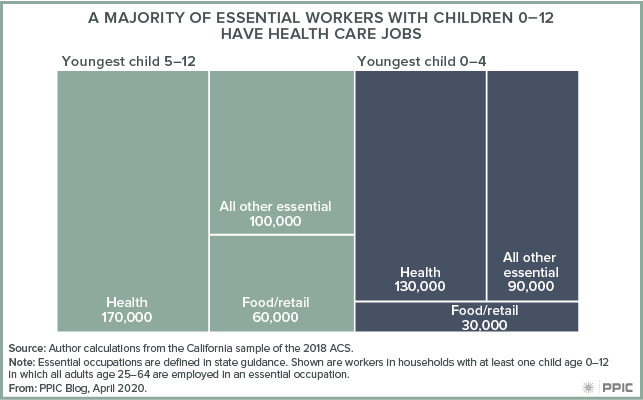
figure - A Majority of Essential Workers with Children 0-12 Have Health Care Jobs

On Monday, Governor Newsom announced that $100 million of the funds allocated in SB 89, emergency legislation to fight the coronavirus pandemic, will go toward funding up to 20,000 more short-term child care slots—and making child care programs safe for those children and their teachers. The CARES act provides federal funds to states for these purposes, so California will recoup these expenditures.

While we don’t know how many state-subsidized programs have remained open, even in the best of times the number of spaces is limited so most children—including those in low-income families—cannot access such care. However, demand for child care is indicated by the number of children in low-income, essential worker families. During this emergency, essential worker families do not need to show they are low income when they seek child care. However, programs are instructed to prioritize families.

About 400,000 children in essential worker families live on incomes below 85% of the state median—the income cut-off for state preschool in normal times. While a majority of parents in essential jobs work in health occupations, most low-income children have parents working in other essential occupations. In other words, tension may arise between serving children of low-income essential workers and serving children of health workers.
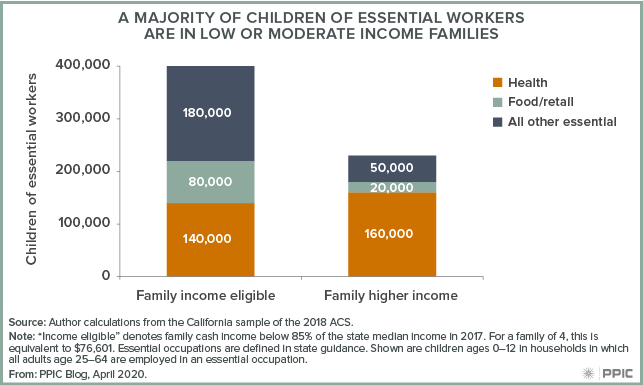
figure - A Majority of Children of Essential Workers Are in Low or Moderate Income Families

In this time of uncertainty, the state has existing capacity to support child care, and it has shifted the goals of state-supported programs to help essential workers meet—and afford—their child care needs. By tracking the response, the state could gain insight into whether it is meeting the needs of essential workers in this difficult time, how to meet these needs in the longer term, and to what extent needs vary across the state.


Coping with COVID-19 in California’s Cities

California’s cities have been at the forefront of bold actions to manage the coronavirus pandemic. We talked to Carolyn Coleman, executive director of the League of California Cities, about the big challenges that the pandemic is bringing to cities across the state.

PPIC: How are cities coping with this unprecedented crisis?

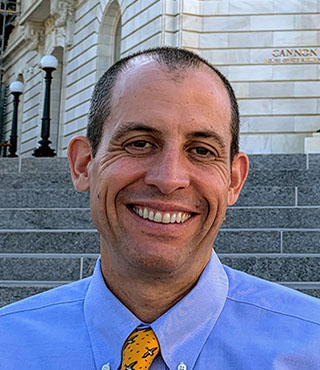
Photo of Carolyn ColemanCAROLYN COLEMAN: Local government leaders are some of the most pragmatic people I know. This comes from being on the front lines and hearing from your constituents everywhere you go—grocery stores, parks, and churches. Local officials are problem solvers, and they signed on to help their residents have a better quality of life. They have approached this crisis with the same dedication and commitment to serve that they brought to dealing with past crises, like the recent wildfires.
Across California, city leaders have stepped up with tools like eviction moratoriums and measures to prevent utility shutoffs or price gouging to protect their residents. Several are creating funds that will provide short-term financial assistance to help keep their small businesses afloat.

City officials are also working with public health entities, hospitals, schools and faith-based organizations to make sure medicines and meals are delivered to vulnerable populations.

Cities have also been very nimble in adapting government business to a virtual model. Council meetings, town halls, and public hearings have moved online with virtual tools that ensure public engagement. They are also using websites, social media, and new technology platforms to engage with their residents and make sure they have needed information.

Early orders by California cities to stay at home or restrict gatherings are being credited with flattening the curve. There was some pushback when these orders were announced, but they’re saving lives here in California, and that started with local government leaders who were out in front of the crisis.

The economic disruption this crisis is having on families, businesses and governments is devastating. While saving lives, stay-at-home orders have led to business closures, furloughs, and layoffs, as well as decreases in tax revenues that local governments use to fund essential services like police, fire, and code enforcement. At the same time, cities are experiencing increased expenses because of COVID-19. We’ll be working closely with federal and state partners to fill revenue gaps so we can continue to provide the services our communities need right now.

PPIC: Are there particular needs in rural communities?

CC: For years, we’ve known that access to high-quality broadband is not as widely available as it should be in our rural communities. With schools closed and some health services moving online, this crisis is a wake-up call to get more broadband deployed across the state.

Rural communities also tend to have smaller budgets with fewer resources to respond to economic disruption caused by this crisis. As they navigate the shortfall in revenues and increase in expenses, their need for fiscal assistance from the state and federal governments could be proportionately as large as our biggest cities.

The federal Coronavirus Aid, Relief, and Economic Security (CARES) Act targets cities with more than 500,000 residents. Most of California’s 482 cities are smaller than that, and yet they may end up with needs that are proportionally as large as those of big cities. That’s why the League will continue to advocate for fiscal assistance for all of our cities, to ensure that none are left behind—during either the pandemic or the financial recovery from it.

PPIC: Talk about the ongoing housing shortages and homelessness in the context of this emergency.

CC: I applaud the governor and local leaders who in recent weeks have partnered closely to safely house more Californians. Every day we hear about cities opening new emergency shelters, putting out more handwashing stations, passing out hand sanitizer in homeless encampments, and taking other steps to protect public health. The governor is sending more trailers to cities for emergency housing, and housing construction is continuing—it’s an essential service. Pandemic or not, we all know we have to increase housing production so more of our families have places to live.

We’re also seeing some new ways to streamline the housing production process, which could become mainstream once the health crisis is over.

PPIC: What gives you hope during these challenging times?

CC: I’m heartened by the public leadership we’re seeing. Local leaders, and leaders at all levels of government, are stepping up to save lives. And the selflessness that surfaces in times like these is a reminder that we’re all connected. People rise.

Unemployment Benefits in the COVID-19 Pandemic

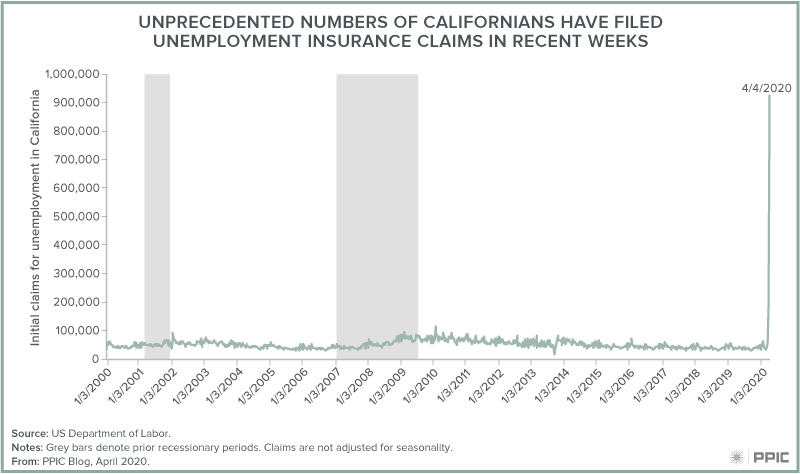
Today, the US Department of Labor revealed that 925,450 Californians filed initial unemployment insurance claims during the week ending April 4. This makes for a record-breaking three-week period during which nearly two million claims were filed in California, representing roughly 10% of the labor force. What kind of benefits can these millions of newly unemployed workers receive?

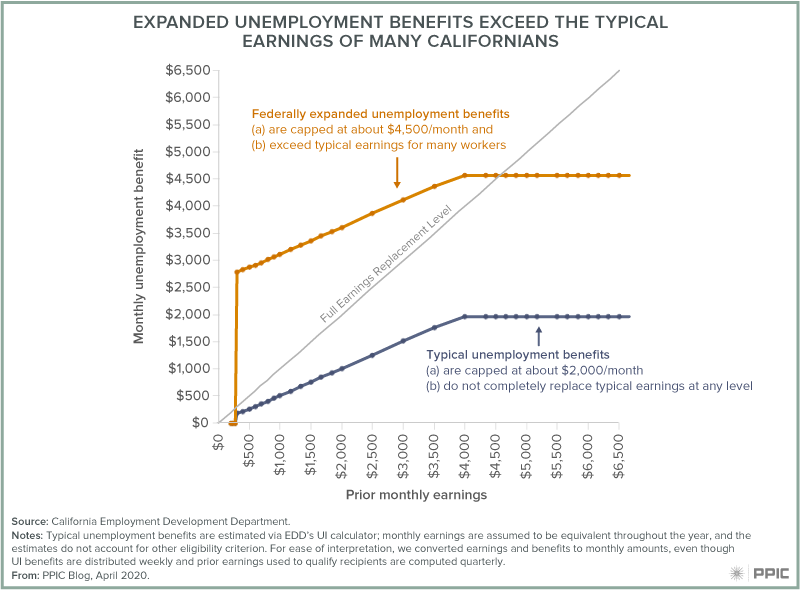
Typically, Californians who qualify for unemployment receive a maximum of $450 per week as long as they are actively looking for work, and that assistance can last for up to 26 weeks. (Notably, benefits in California are less generous than those in most other states: in 2019, its average weekly benefit of $345 ranked 29th.) However, federal policymakers are responding to unprecedented circumstances; so far, they have expanded both eligibility and benefits.

Federal legislation temporarily expands eligibility. The Coronavirus Aid, Relief, and Economic Security (CARES) Act makes self-employed Californians—including gig workers and other independent contractors—who are unable to work or have had hours reduced by COVID-19 eligible to receive benefits. Also, laid-off workers who expect to return to their current jobs are not required to be searching for work.

The new law also supplements and extends benefits. The CARES Act provides $600 per week on top of typical benefits for up to four months. This represents a dramatic boost for most unemployed Californians. The legislation also covers the cost of a 13-week extension of benefits, so that laid-off workers can now receive unemployment for up to 39 weeks.

Unemployed Californians who earn less than $4,000/month would normally qualify for a benefit that replaces roughly half of their earnings, and the benefit covers a smaller and smaller share of earnings above $3,894/month. The $600 federal supplement is higher than California’s maximum benefit and more than covers prior earnings for many unemployed Californians.

It is likely that workers in the state’s hardest-hit sectors make up a large share of early applicants for unemployment benefits. In the accommodation and food service industry—one of the hardest-hit sectors—the average monthly wage is roughly $2,000; an unemployed worker could receive up to $3,700 per month. The average worker in transportation and warehousing, another impacted industry, earns more than twice as much ($5,000/month), but unemployment benefits for this worker would be only slightly higher: up to $4,550 per month.

These expanded benefits will help millions of newly unemployed Californians, but the state and its workers face important limitations and challenges. Given the massive surge in applications, workers may have to wait several weeks—or months—to receive benefits. Moreover, laid-off immigrants who are unauthorized to work in the US will have to rely on other support.

More generally, California’s unemployment insurance fund reserves are inadequate to weather even a mild recession, although the federal government steps in to loan the funds when needed. In the longer term, policymakers should seriously consider reforms to the unemployment system, so that it can respond quickly and comprehensively in the next economic crisis.

Challenging Times for California

This is a time of global crisis. We are all living through a fast-moving, large-scale disaster that is having extraordinary public health and economic consequences. Here in California, public leaders and private industries took early action to mitigate the effects of COVID-19, putting policies in place to flatten the curve sooner than any other state. And while the full extent of the pandemic has yet to be realized, Californians should feel proud of our state’s ability to assess and respond rapidly to counteract this generational challenge.

The pandemic is touching every aspect of life today. Students, agricultural workers, health care practitioners—all Californians are struggling to adjust to enormous changes in their responsibilities and daily routines. At PPIC, we are thinking about the effects on our state’s most vulnerable populations: seniors living in areas with sparse medical care, children receiving free or reduced price lunches, essential workers struggling to stay above the poverty line.

We are also deeply concerned with what lies ahead. How will our economy—just recently in the longest growth cycle ever recorded—respond in the long term? How can the state improve opportunities for those hardest hit by this crisis? What can we observe, measure, and propose that will help California to rebuild itself efficiently, effectively, and equitably?

PPIC will be delving into these questions as this crisis plays out. For now, in these fluid and rapidly changing times, we are focused on bringing critical facts and information to the table—assessing the state’s economy, people, communities, and environment. Our blog series on COVID-19 provides wide-ranging analyses across key policy areas, from education to health care, from criminal justice to water policy. And the PPIC Statewide Survey will be offering perspectives on the pandemic and the economy from Californians across the state.

For 25 years, PPIC has worked hard to inform and improve public policy in California. 2020 may be one of our most challenging years yet, but we are ready and able to meet that challenge.

For PPIC’s full series on the coronavirus and California, visit our COVID-19 page.

Essential Workers and COVID-19

California is grappling with the dual threats of a public health crisis caused by the coronavirus and the additional economic fallout of necessary social distancing measures.  In the past week, we have seen unemployment claims skyrocket and policymakers forge supports for workers and businesses.

Meanwhile, there is a workforce that is tackling the public health crisis, keeping the economy going, and supporting Californians who are sheltering in place. While this essential workforce supports the state’s health and basic economic needs, many of these workers are not well equipped to weather the economic challenges of the COVID-19 crisis.

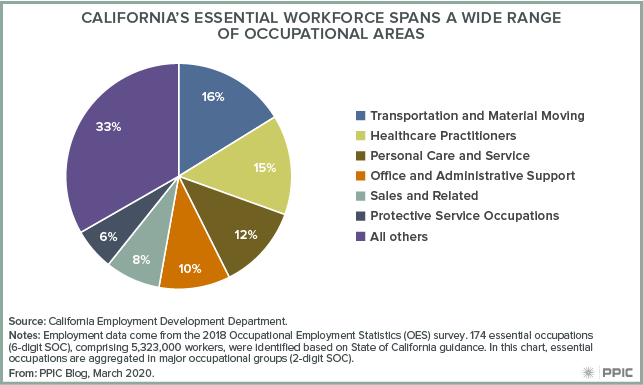
We estimate that in a typical year, roughly one-third to one-half of California’s labor force is employed in essential occupations. Essential workers fulfill a wide variety of roles in our economy, including in health care services, energy provision, food service, agriculture, and transportation. Some workers in these areas may be seeing layoffs and hours reductions depending on their industry, firm, or region.

figure - California’s Essential Workforce Spans a Wide Range of Occupational Areas

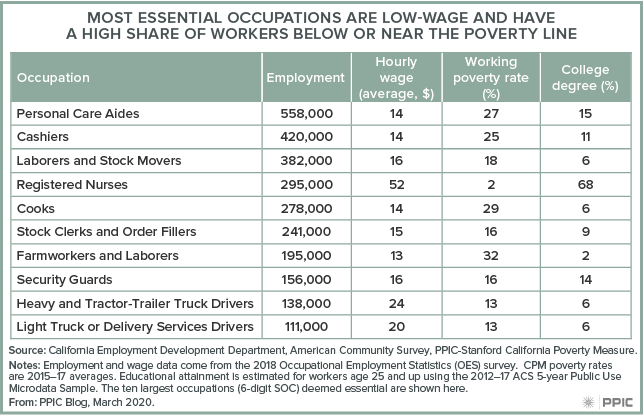
Some essential jobs are obvious, as they are on the front lines of the public health crisis. For example, registered nurses (the largest occupation within the healthcare practitioner category) are essential, have two- or four-year degrees (68% have a college degree, according to our analysis of American Community Survey data), and earn relatively high wages ($52.32 an hour).

However, workers outside of the health care sector are also on the front lines. Personal care aides—those who assist the elderly and others in their homes or personal care facilities—are the single largest essential job category. These workers earn $13.50 an hour on average and 85% do not have a college degree.

Differences in skills and pay translate into notable differences in economic well-being for these workers and their families. A slightly higher share of essential workers than non-essential workers are poor or nearly poor, according to the California Poverty Measure: 14% of essential workers live in poor families compared to 11% of non-essential workers (the comparable estimates for near poverty are 19% and 14%, respectively).

figure - Most Essential Occupations Are Low-Wage and Have a High Share of Workers Below or Near the Poverty Line

Grocery store cashiers, store clerks, farmworkers, and delivery and truck drivers make up sizeable shares of the essential workforce.  Given the low hourly wage rates for these workers, some may face hardships in caring for children or family members with schools and care facilities shuttered.

In addition, many essential workers experience the cost and risk of maintaining their own health while interacting with the public. In low wage essential jobs, access to health benefits and paid sick leave is limited, even in normal times. During the COVID-19 crisis, expanding access to personal protective gear could reduce the health risks among workers whose job requires some level of contact with the public.

Mandated lockdowns are now slated to continue through at least May 1 in some parts of the state and  may last even longer. Ensuring the ability of essential workers to continue their jobs safely and effectively will be crucial over the coming months. As policymakers implement support for unemployed Californians, it is important that they also consider ways to assist and protect the many essential workers on the front lines. Paid sick leave, adequate health coverage, income support, access to child care, and sufficient personal protective gear should all be part of the policy discussion.

Food Security in a Time of COVID-19 Insecurity: How the Virus Affects Farming

How will the COVID-19 pandemic affect California’s agricultural sector—which is important for food supplies locally, nationally, and in many other countries? We talked to Cannon Michael—a sixth-generation farmer and member of the PPIC Water Policy Center Advisory Council—about the pandemic’s potential to disrupt farming.

photo - Cannon Michael

PPIC: What risks does the virus bring to California’s farm sector?

CANNON MICHAEL: For most farmers, the immediate focus is on our workers—not only keeping them safe from the virus, but also being mindful of the pressures they’re facing at home right now. Most of our workers can’t work from home. Many have kids out of school or partners who’ve lost their jobs.

The big concern going forward is the virus going through our workforce. The disruptions of food supply we’re seeing in stores right now is caused by changes in buying habits and difficulty keeping shelves stocked. But if there’s disruption on farms—if crops don’t get harvested in time or the logistics for getting food to market go down, that would be much scarier. We’re already facing labor uncertainty due to changes to a visa program that allows workers from Mexico and Central America to come here for seasonal farm work. Many of California’s larger farms rely heavily on this temporary labor force. In the early days of the crisis, the H-2A visa program was restricted so that only workers already in the program last year were allowed to come back this year. Rule changes and congestion have made getting across the border harder, too. We’re seeing a slowdown of workers at a time when we may need more. That’s a real concern for the food supply.

There’s a finite pool of people living here to do the hand work required on the state’s farms. There’s a risk that the large companies will do whatever it takes to get those folks if they can’t get seasonal laborers. It could be a threat to smaller farms if larger entities start to pull workers away using incentives that smaller farms can’t match.

The disruption of markets—such as the closure of restaurants and food service operations—is a huge concern for growers. Impacts will vary by region, commodity, and individual company exposure. Western Growers reports that some farmers are heavily embedded in the food service supply chain with crops in the ground now. They have nowhere to put that food, because other growers with retail channels for those commodities are operating at maximum capacity and can’t take any more product into their systems. Other farmers say they may need to scale back acreage. Some crops could be affected by changing international markets or the general financial downturn. There’s the potential for huge swings in marketability and profitability for many farmers.

We’re also not sure if there will be any new requirements for food safety in coming months. There are already good protocols in place for food safety that anyone involved in fresh produce has to comply with, and farmers are accustomed to these high standards. The good news is that food safety experts say there is a low risk of getting the virus from food products or packaging. The advice from the experts is that normal food safety practices will suffice.

PPIC: What steps are being taken to protect farm workers from infection?

CM: We are rapidly approaching the time when most farms will be extremely busy, which means a lot of people on the farm. New state guidance on protecting farmworkers from COVID-19 is being developed. But most farmworkers live in very close conditions and so even with safe practices on the farm, it’s going to be harder to control the risk in their homes and communities under current conditions. If the virus gets into the farmworker population I think we’d see a very fast rise in infection, which would have a dramatic impact on the farm sector and food supply.

On our farm we’re providing regularly updated health information in all the places that people congregate. The California Farm Bureau and industry groups have reacted quickly to make information available in English and Spanish. We’re making sanitation equipment widely available, and presenting guidelines on hand washing and social distancing.

PPIC: What policy changes could help address these risks?

CM: Fixing federal immigration policy is critical. The key point is we need to get food off the farms, and to do that we have to have enough laborers. One hopeful sign is that the federal government recently announced it will relax the new restrictions on the H-2A program. That should help people get here to work.

It’s also critical that rural communities aren’t forgotten in this public health crisis. We need a plan to address the special public health challenges in farm communities.

I don’t want to pound people over the head with this, but the crisis really drives home the importance of agriculture and the value of a stable food supply.

And I’d just like to encourage everyone to reduce the panic buying, which has created big challenges in the supply chain as well as making it harder for more vulnerable people who can’t shop that way. We will produce the food and get it to the markets but we will all be safer if people just buy what they need.


How Will the Coronavirus Affect California’s Economy?

As Californians limit their daily activities to slow the spread of the coronavirus, the state economy is poised to take a major hit. The pandemic is increasing the need for some goods and services (such as health care) and reducing demand for others (such as travel- and entertainment-related services), so the near-term economic consequences are more serious in some sectors than in others. Moreover, these consequences could exacerbate the unevenness of economic conditions and opportunities across regions.

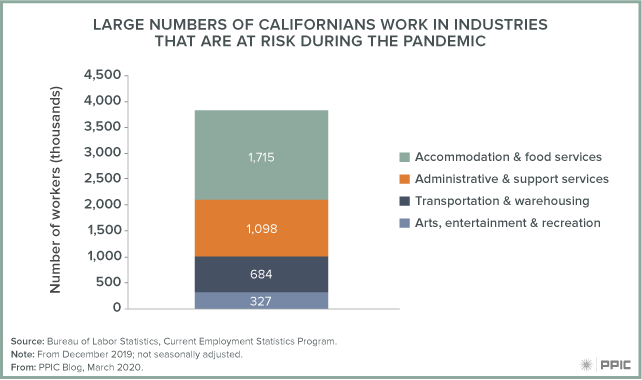
Initially, the largest downturns are likely to occur in sectors that rely on the movement of people and nonessential goods. Recent forecasts have identified several “at risk” sectors: accommodations and food service; arts, entertainment, and recreation; administrative and support services, especially employment services; mining and oil/gas extraction; transportation and warehousing; and agriculture (UCLA Anderson and Moody’s Analytics). Shocks in these industries will be driven by reduced local demand, as well as slowing of trade in and out of California’s ports (especially relevant for the transportation and warehousing and agriculture sectors).

These sectors—excluding agriculture—comprise 10% of the state GDP and employ 3.9 million workers. Unemployment insurance claims data is starting to show the impact on workers, but it will be a while before we get detailed data for all California workers (including those who do not apply for unemployment insurance).

We can, however, learn a lot about the pandemic’s impact on workers, sectors, and regions from recent employment statistics. Employment in these sectors makes up more than a fifth of overall non-farm employment in both California (22%) and the nation as a whole (21%).

figure - Large Numbers of Californians Work in Industries that Are at Risk during the Pandemic

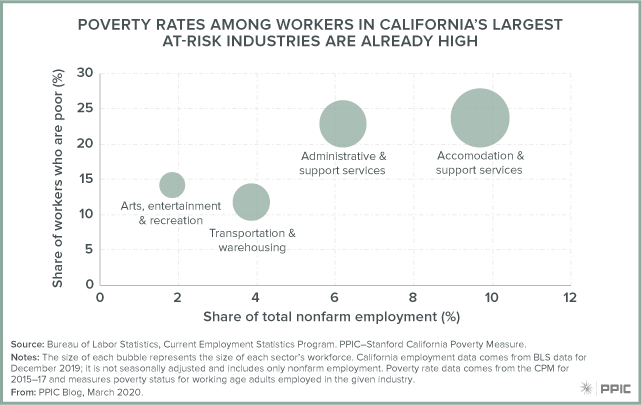
The workforce in these industries is not just large; it also comprises a wide range of occupations (for example, pilots as well as baggage handlers in the transportation industry; hotel managers as well as cleaning staff in the accommodation industry). At this point, we cannot predict exactly how the COVID-19 crisis will affect these workers. But reduced hours and layoffs are highly likely, and the workers least able to weather the storm are those who already struggle with poverty.

Overall, we estimate that 19% of Californians employed in these industries are working poor and another 22% are just above the poverty line (“near poor”). The poverty rate among workers in the accommodation and food service sector is 24%. This sector, which is being hit hard by reduced tourism and dining out, is the largest of those expected to experience the most immediate economic consequences.

figure - Poverty Rates among Workers in California’s Largest At-Risk Industries Are Already High

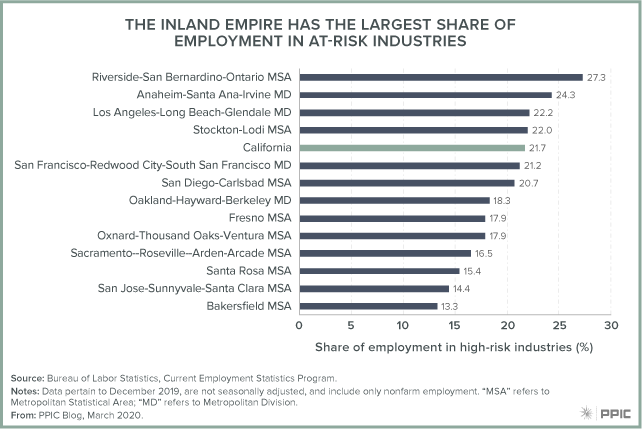
Because California’s industries are not evenly distributed, the initial impact on economic activity and on workers will likely vary across the state. Among major metro areas, Los Angeles, Anaheim–Santa Ana–Irvine, Stockton, and Riverside–San Bernardino have larger shares of jobs (ranging from 22% to 28%) in at-risk sectors than the state as a whole.

As one might imagine, these areas differ from one another in many ways. While Stockton has a relatively large share of employment in transportation and warehousing, Anaheim–Santa Ana–Irvine has a large share in accommodation and food services. Not surprisingly, given its population, the Los Angeles metro area has by far the largest number of workers in at-risk sectors: 1,043,000. Riverside and Anaheim follow with 433,000 and 417,000, respectively.

figure - The Inland Empire Has the Largest Share of Employment in At-Risk Industries

The longer-term economic impact of the coronavirus on these and other sectors will depend on how long the crisis lasts. Policy responses can play a critical role in mitigating the economic damage. State and federal leaders face the challenge of helping businesses weather the crisis and rebound quickly, while also addressing the tangible needs of workers who may be losing income, especially those who are already in or near poverty.

A host of economic interventions—many of which aim to help dislocated workers—have already been announced, and more will be implemented as the economic consequences of this pandemic become clearer. As they develop these interventions, policymakers will want to take into account industries and workers across all of California’s regions.

The COVID-19 Crisis Is Affecting Low-Income Workers

As California responds to COVID-19, its low-income workers face particularly urgent difficulties. These Californians are not necessarily at high risk of health complications from COVID-19, but they will be deeply affected by the economic consequences of the steps being taken by cities, counties, and regions to contain the outbreak and protect public health.

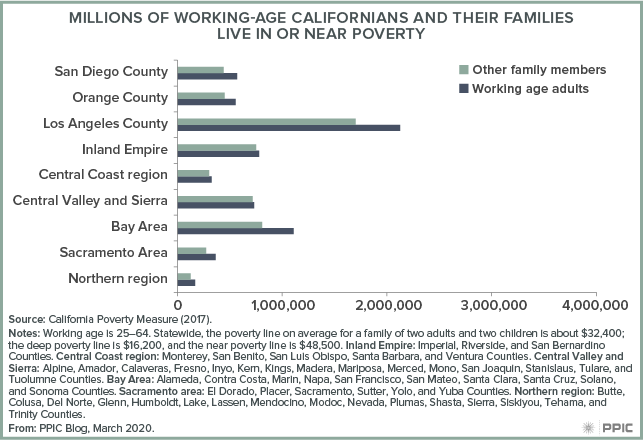
About 12.3 million Californians in families headed by working age adults live in or near poverty; a majority (58%) are Latino, while 21% are white, 12% are Asian, 6% are African American. About 1.5 million live in deep poverty (with resources less than half of the poverty line), while 4.3 million are just below the poverty line and 6.5 million are just above it (within one and one and a half times the poverty line).

The largest number of poor and near-poor Californians live in Los Angeles County (about 4 million), followed by the Bay Area (about 2 million).

figure - Millions of Working-age Californians and Their Families Live in or Near Poverty

The federal and state governments have been developing a range of short-term measures that promise to bolster the resources of Californians who are economically affected by this public health emergency. These measures include the expansion of food assistance benefits, paid sick leave, and unemployment benefits.

Steps like these are important because 12.2% of California’s working adults live in poverty, and after-tax income from work makes up 72% of poor and near-poor family resources, on average. A loss of $500 in annual income would push an additional 215,000 Californians into poverty, while a loss of $1,000 would put an additional 425,000 Californians below the poverty line. In short, even a relatively small financial loss can make a big difference.

Interactive: Many Californians Live in or Near Poverty

[vc_row][vc_column][vc_column_text]More than 7 million Californians are “near poor”: out of poverty, but within 1.5 times the poverty line, according to the California Poverty Measure. The near-poor population is slightly larger than the poor population, and many could be pushed into poverty by small expenses.

In California, a near-poor family of four who rents has annual resources that range between $32,500 and $48,800. Adults with less education and fewer work hours, renters, African Americans, and Latinos often have the highest poverty and near-poverty rates. Disparities that persist across poor and near-poor groups are reminders that the poverty threshold is not a hard line where economic hardship ends.

Among adults, full-time work does not remove the risk of poverty: 21% of people ages 25–64 working full-time, full-year jobs are in or near poverty. These full-time workers are more likely to live in near poverty (13.9%) than in poverty (7.1%). At the same time, adults in less than full-time jobs live in near poverty at about the same rate (19.7%) as those with no work (20.9%). But they are less likely to live in poverty (22.3%) than those with no work (32%).[/vc_column_text][/vc_column][/vc_row][vc_row max_width=”80″ visibility=”visible-desktop”][vc_column][vc_column_text]

[infogram id=”1p9yd5nm9kxnddf7zryd5dqnp1b3xnwkjnq?live”]

[/vc_column_text][/vc_column][/vc_row][vc_row max_width=”80″ visibility=”visible-tablet-landscape”][vc_column][vc_column_text]

[infogram id=”1p9yd5nm9kxnddf7zryd5dqnp1b3xnwkjnq?live”]

[/vc_column_text][/vc_column][/vc_row][vc_row visibility=”visible-tablet-portrait”][vc_column][vc_column_text]

[infogram id=”1p9yd5nm9kxnddf7zryd5dqnp1b3xnwkjnq?live”]

[/vc_column_text][/vc_column][/vc_row][vc_row visibility=”visible-phone”][vc_column][vc_column_text]

[infogram id=”1p9yd5nm9kxnddf7zryd5dqnp1b3xnwkjnq?live”]

[/vc_column_text][/vc_column][/vc_row][vc_row][vc_column][vc_column_text]Resources from social safety net programs play a substantial role in moving people out of poverty—2.7 million more Californians would be poor if not for the social safety net. However, many of those moved out of poverty nonetheless live in near poverty, as broader factors like the cost of housing and available jobs play key roles in the resources they have on hand.

As California policymakers address poverty through tax credits, safety net programs, and housing policies, near-poverty rates provide another view into the state’s lowest-income populations. Reducing poverty in California will require attention to how families can be lifted out of poverty and also positioned for long-term economic security.[/vc_column_text][/vc_column][/vc_row]

Video: Californians and Their Government

In California’s March 3 primary, the state ballot will feature several initiatives—including a $15 billion bond for the construction and modernization of public education facilities. Slightly more than half of likely voters approve, while 42% are opposed and 8% are undecided. PPIC researcher Dean Bonner outlined this and other key findings from the latest PPIC Statewide Survey at a briefing in Sacramento last Friday.

In November, Californians may be asked to vote on a constitutional amendment that would require state and local governments to provide housing or shelter beds to all homeless residents. About six in ten adults and 55% of likely voters say they would vote yes on such an amendment. Majorities of adults and likely voters also support Governor Newsom’s proposal to allocate $1 billion to address homelessness.

Other survey highlights:

  • More than six in ten Californians say housing affordability is a big problem in their part of the state, and the cost of living is causing many to consider moving out of California.
  • A majority of Californians (53%) approve of the way Governor Newsom is handling his job; this is the governor’s highest approval rating to date.
  • Views on the governor’s plan to scale back the high-speed rail project are mixed, while most approve of his proposal to build only one tunnel under the Sacramento–San Joaquin Delta.
  • Bernie Sanders leads all other Democratic presidential candidates with 32% support among Democratic primary likely voters. Joe Biden has 14% support, 13% support Elizabeth Warren, and Pete Buttigieg and Michael Bloomberg were tied at 12%.