Californians Are Grappling with Homelessness

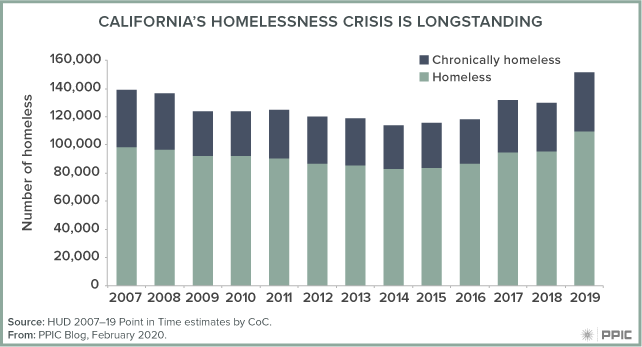
In his State of the State address last week, Gavin Newsom focused almost exclusively on homelessness—a significant long-term problem and major concern for state residents. In 2019, 150,000 Californians—more than a quarter of the US homeless population—were counted as homeless. California’s rate of homelessness rose to 38 per 10,000 residents, the third highest in the nation.

What is more, 72% of California’s homeless residents are unsheltered, living on the street or in parks and other makeshift spaces. And nearly three in ten self-report as chronically homeless—having been on the streets for more than a year.

Figure: California's Homelessness Crisis is Longstanding
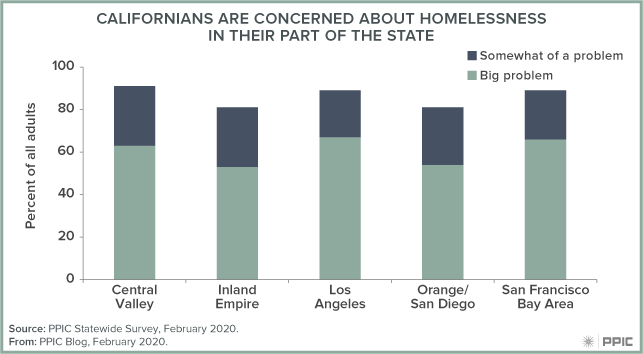
Californians across the state are feeling the gravity of this issue. The latest PPIC Statewide Survey finds that more than 8 in 10 Californians see homelessness as a problem in their part of the state (86% adults, 89% likely voters).

figure -

Considering these numbers, it does not come as surprise that Governor Newsom has made homelessness a major focus. Citing the connection between chronic homelessness, mental health, and behavioral health, Newsom has underlined the importance of policies and investments that allow for “whole person” care. By linking current funding sources and asking lawmakers to expand the use of funds for services provided to the homeless population—especially those involved with the criminal justice system and at-risk foster youth—the governor hopes to improve and integrate these services.

The PPIC Statewide Survey finds that a full 70% of Californians—and 64% of likely voters—favor the governor’s proposed $1 billion budget expenditure to address homelessness. State leadership and investment are key, but there is only so much that can be done at the statewide level. Finding solutions to homelessness requires coordination between the federal, state, and local levels, as well as collaboration across sectors—including housing, health, and social services.

Testimony: California Is on Track to Close the Degree Gap

[vc_row][vc_column][vc_column_text]Hans Johnson, director and senior fellow at the PPIC Higher Education Center, testified February 25, 2020, before the Assembly Budget Subcommittee (No. 2) on Education Finance, chaired by Assemblymember Kevin McCarty. Here are his prepared remarks.

At the PPIC Higher Education Policy Center, we have long been concerned about the future of California’s workforce. Would the state have enough college graduates to meet evolving economic demands? We have produced a series of reports addressing the dynamics of this issue.

Five years ago, we projected a shortage of highly educated workers in California. Specifically, our economic projections to 2030 showed that about two in five jobs would require at least a bachelor’s degree, while demographic projections suggested that only about one in three Californians would attain this level of education. This shortfall amounts to 1.1 million bachelor’s degrees.

PPIC noted that to fill this shortfall, the state and its higher education systems would need to act—increasing access, transfer, and completion especially among groups historically underrepresented in higher education, including low-income students, first-generation college students, Latinos, and African Americans.

We identified ambitious targets that—if met—would close the degree gap. Those targets included large increases in access to the University of California (UC) and California State University (CSU), both for first-time freshmen and for transfer students. They also included substantial increases in graduation rates. At the request of the legislature, UC and CSU both issued reports on how they might meet those targets.

Today, I’m pleased to say that California is currently on track to close the gap. The concerted efforts of policymakers, higher education officials—including staff and faculty—and, of course, students have led to these early gains.

State General Fund allocations for each system have increased substantially since the Great Recession, allowing for increased enrollment and renewed efforts to improve student persistence and completion. Both UC and CSU have exceeded PPIC’s closing-the-gap targets. These early gains have reduced the degree gap by almost 80,000.
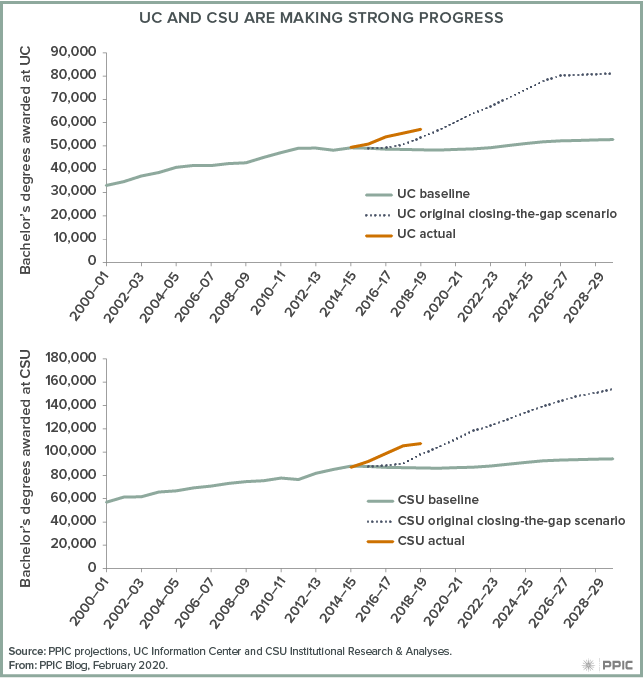
figure - UC and CSU Are Making Strong Progress

Two primary actions have led to these gains.

First, increases in state funding have allowed UC and CSU to enroll substantially more first-time students from California—both freshmen and transfer students. At UC, enrollment of transfer students went up 16% between fall 2010 and fall 2019. Enrollment of freshmen grew 14%. At CSU, enrollment increased 41% for transfer students and 33% among freshmen over the same time period. Notably, UC’s gains occurred primarily in one year, from 2015 to 2016, when the legislature and governor tied a $25 million allocation to increasing enrollment by 5,000 students. In that single year, total first-time enrollment of freshmen and transfer students went up 10%, with gains concentrated among African Americans (36%) and Latinos (25%).
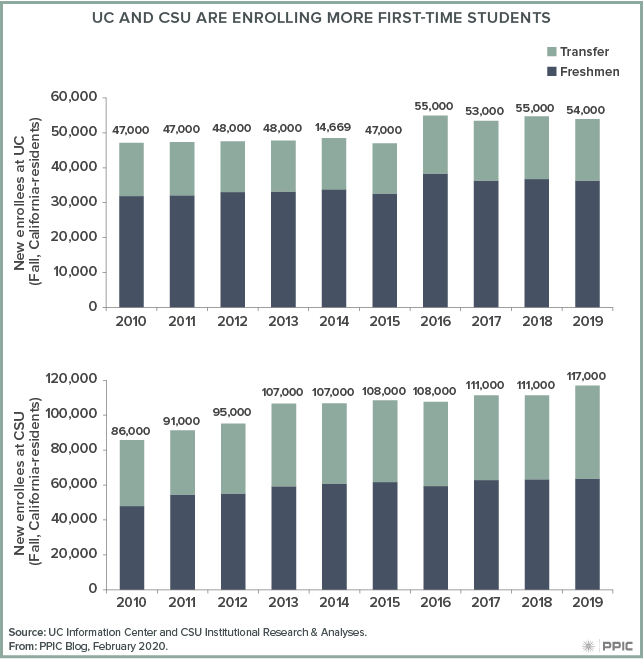
figure - UC and CSU Are Enrolling More First-Time Students

Second, programs to improve student persistence and graduation rates have also paid off—and contributed to enrollment growth. These gains have been especially sharp at CSU, which has received substantial funding from the state to support its graduation initiative. At CSU, six-year graduation rates for California-residency students have increased from 57% for 2009 entering freshmen to 67% for the 2013 cohort. At UC, four-year graduation rates for California-residency students have increased from 62% for 2010 entering freshmen to 68% for the 2014 cohort. (Six-year graduation rates at UC remain very high, around 85%). Graduation rates for transfer students have also increased at both systems.

These early successes are very promising. Still, California needs to build on them if it is to close the degree gap fully. The demand for college remains high. PPIC’s statewide surveys show that the vast majority of parents (79%) want their child to earn at least a bachelor’s degree. College preparation among high school graduates has increased, with the share of students completing the college preparatory requirements of UC and CSU now at an all-time high. And while applications to UC and CSU have levelled off or even declined a bit recently, application levels are still near record highs. All but one UC campus and many CSU campuses already do not have room to admit all eligible applicants.

Looking ahead, strong demand for UC and CSU is likely to continue as college preparation improves and the transfer pathway becomes more efficient and effective. New initiatives, including reforms in remedial education at the community colleges and CSU, have the potential to substantially improve student success rates and boost transfer. New articulation agreements, such as the Associate Degree for Transfer, have streamlined the pathway from community colleges to four-year colleges, especially CSU. (PPIC will be issuing a report on transfer trends later this year.) And an increased focus on improving student outcomes has led to multiple substantive reforms designed to increase persistence and completion at UC and CSU.

Finding ways to accommodate all eligible students is a pressing challenge, but one that must be met in order to ensure a better future for all Californians. Through thoughtful planning—and yes, additional funding—closing the degree gap is possible. Improving access and completion is a necessary and critical component to ensuring that more low-income, first-generation, and underrepresented students enjoy the benefits of a college degree. The early progress I’ve highlighted here has led to greater access and success for underrepresented students, creating momentum to improve the wellbeing of all Californians.[/vc_column_text][/vc_column][/vc_row]
Video: A Conversation with Governor Gavin Newsom

Governor Gavin Newsom’s conversation with PPIC president Mark Baldassare last week focused on energy policy and climate change. After noting that it had been one year since PG&E declared bankruptcy, Baldassare asked the governor about his vision for the future of California utilities. Newsom responded by broadening the question. “We have to start thinking about our energy future and our transportation future and our low-carbon, green growth future in a collaborative mindset.”

In this context, he continued, “PG&E’s bankruptcy has turned out to be an extraordinary opportunity for this state. . . . It’s allowed us to ask questions . . . that otherwise weren’t front and center.” PG&E, he said, has to come out of bankruptcy with a vision for the future that prioritizes long-term thinking and public safety rather than shareholder return. The bottom line? California needs a “transformatively different” utility. And, he added, “if PG&E can’t do it, we’ll do it for them.”

Key to planning for the state’s energy future is making sure it works for all Californians. Going green, Newsom said, “can’t mean more income inequality.” It has to benefit both the “haves” and the “have nots”—creating jobs and ensuring affordable energy, and mitigating the dislocation that comes with change.

Another key area is wildfire mitigation and prevention. Newsom noted that the 2019 fire season was less damaging than other recent seasons, in part because “we’ve never been more prepared.” The state has been investing in new technology that monitors and predicts wildfires, as well as equipment for suppressing fires and responding to crises.

Wildfire prevention is complex, in part because, as Newsom pointed out, the federal government owns the majority of forest land in California. “We are doing the job the federal government is no longer doing,” Newsom said, adding that “the Trump administration’s budgets have been proposing cuts to forest management.” Land-use patterns are another complicating factor. New building codes have helped recently built housing survive fires, but there are a large number of older buildings in fire-prone areas.

As Newsom sees it, the challenge of implementing the state’s ambitious climate mandates is to bring politics and policy into alignment. “Politically, I recognize that what’s necessary may be impossible. But also I recognize from a policy perspective that what is impossible has to become necessary.” The ultimate goal, of course, is to move California forward: “The world is changing. We have to change with it.”

Concerns about Poverty and Income Inequality Are Running High

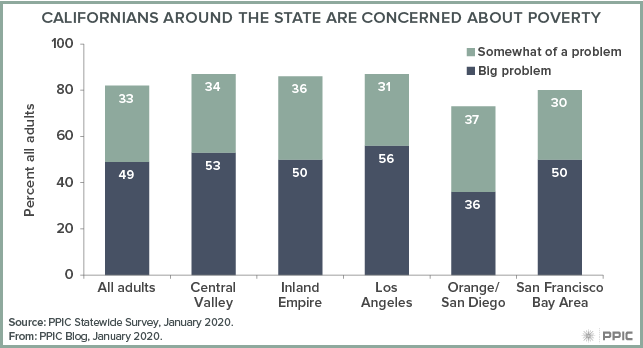
Even as California’s economy is surging—with unemployment at a historically low 3.9% last month—residents around the state are worried about poverty. About eight in ten adults say that poverty is a big problem (49%) or somewhat of a problem (33%) in their part of California. Likely voters hold similar views (47% big, 35% somewhat). This concern is high across every region of the state.

figure - Californians around the State Are Concerned about Poverty

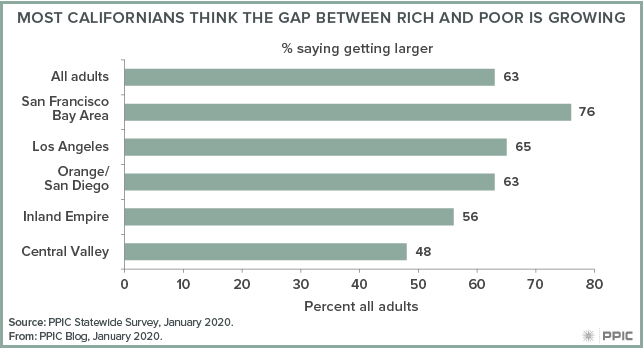
Income inequality has grown substantially across the nation, and it is particularly notable in California. About two in three adults (63%) and seven in ten likely voters (68%) think the gap between rich and poor is getting larger in their part of California. Across regions, nearly half to three-quarters of residents hold this view.

figure - Most Californians Think the Gap between Rich and Poor Is Growing

Demand for UC and CSU Enrollment Remains Strong

The number of high school graduates has remained steady for several years, with no expectation of significant increases any time soon. And yet demand for admission to the state’s public universities continues to grow.

A quick look at trends among California’s high school graduates—in particular, their preparation for college—helps explain this paradox. Other sources of enrollment growth, including increases in transfer students and improved retention, also play an important role. Understanding these trends is critical, since annual state funding for the University of California (UC) and the California State University (CSU) depends partly on anticipated enrollment growth.

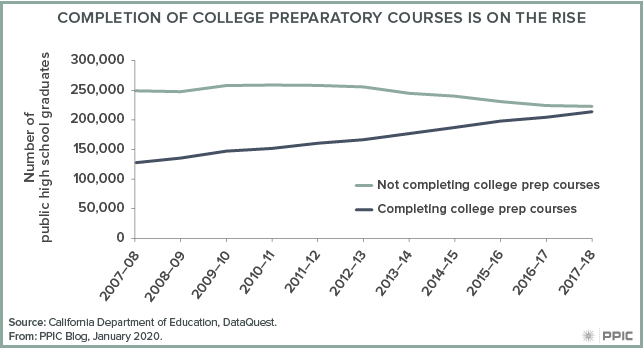
The good news is that more and more of California’s high school graduates have passed the college preparatory curriculum (known as the “A-G” courses) required by UC and CSU. Over the past five years, the number of high school graduates completing the A-G courses has increased 28%, even as the total number of high school graduates has remained largely unchanged.

By 2017–18 (the most recent data available), almost half (49%) of California’s high school graduates had completed the A-G courses, a remarkable increase from just ten years earlier when only about one-third (34%) did so. As a consequence, the number of high school graduates eligible for UC and CSU has reached record numbers.

figure - Completion of College Preparatory Courses Is on the Rise

Of course, enrollment demand depends on more than just new freshmen. The number of students that transfer from the state’s community colleges also adds to enrollment growth. Over the past five years, that number has also grown (up 25% at UC and 14% at CSU).

Improvements in persistence and completion also lead to greater enrollment, as fewer students drop out. At both UC and CSU, persistence and graduation rates are increasing. For example, at CSU the share of freshmen that graduate within six years has increased from 54% (fall 2008 entering cohort) to 62% (fall 2013 entering cohort).

Accommodating this enrollment growth is good for the state. College graduates are in high demand in the state’s labor market and—on average—earn far higher wages than less educated workers. PPIC has projected that demand for highly educated workers will keep growing as the state’s economy continues to change. Finding ways for California students to attend and graduate from college improves their well-being—and that of the state.

For Many Californians, Poverty Is One Minor Expense Away

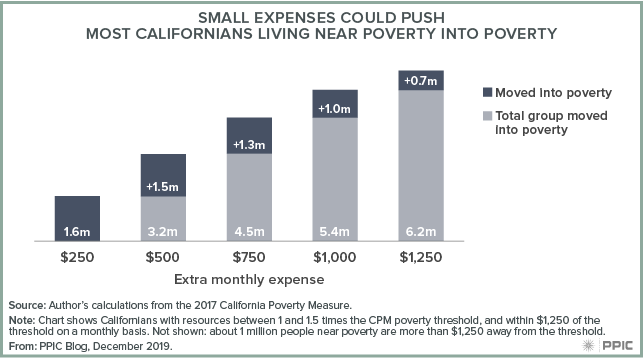
Add one extra expense and families living just above the poverty line could fall into poverty. Data from the California Poverty Measure (CPM) show that 7.2 million Californians live near poverty, that is, with just enough resources to meet their basic needs. All told, in 2017 as many Californians lived just above the poverty line as below it, or about 18% in each case. Even a small change, a monthly expense of $250 or less, could push 1.6 million people under the line.

We define “near poverty” to mean having resources worth 1 to 1.5 times the poverty threshold after taxes and necessary expenses. Since the CPM accounts for California’s varied living costs, the range for near poverty differs across regions. In Fresno County, a family of four who rents their home and has $25,900 to $38,900 in resources is near poverty, while in Santa Clara County, the same is true of a family of four with $40,000 to $60,000.

Because the poverty line is a blunt standard, “near poverty” includes families earning just a few dollars above the poverty threshold—even though a few dollars are unlikely to make it easier to make ends meet. This makes it especially important to understand how many Californians are near poverty, and how close those near poverty are to falling into it.

Californians can be pushed into poverty by the smallest expenses. Overall, people near poverty are more likely to be pushed into poverty by a small expense than a large expense. As expenses grow, the total number of people threatened climbs. Three out of four people near poverty, or 5.4 million, are pushed into poverty by an extra $1,000.

figure - Small Expenses Could Push Most Californians Living Near Poverty into Poverty

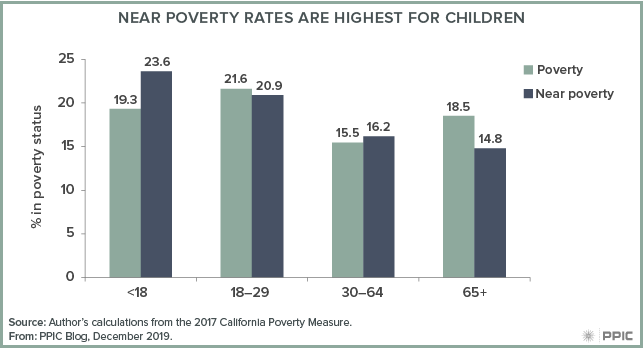
Near poverty affects young people more than it does older Californians, and children under 18 are more likely to be near poverty (23.6%) than in poverty (19.3%). Young adults and seniors, however, are more likely to be in poverty. Regional differences in living costs, opportunity levels, and the impact of existing policies and programs are key factors driving this variation.

figure - Near Poverty Rates Are Highest for Children

Without safety net programs, more people, and in particular, more families with children, would face poverty instead of near poverty: resources from programs including CalFresh and the federal and state Earned Income Tax Credits (EITCs) keep 7.1% of Californians out of poverty. Yet almost all people (93%) who move out of poverty via the safety net move into near poverty. This fact has implications for policymakers’ ongoing efforts to help ensure all Californians can meet their basic needs. As the state works to reduce poverty, strategies that promote economic mobility complement investments in programs like the CalEITC and the new Young Child Tax Credit.

Covering the Real Costs of College

Faced with the state’s high cost of living, California college students struggle to secure adequate food and housing. Even amid one of the largest and longest economic expansions in state history, 33% of students are housing insecure and 35% have low or very low food security, according to a California Student Aid Commission survey of 150,000 college students. As the state seeks to meet economic demand by producing more students with degrees and certificates, the full cost of college remains a barrier to progress.

Governor Newsom and the legislature have recognized the need to reform state financial aid programs to address the full cost of college. The 2019–20 state budget provided $41 million in ongoing funding to help colleges address food and housing insecurity, $19 million to support rapid rehousing programs, and increased the number of competitive state grants for non-traditional students from 25,750 to 41,000.  Additionally, the legislature increased the maximum award amount that students with children pay for non-tuition college costs from $1,672 to about $6,000.

However, broader reform of the state grant aid program remains elusive. Two recent bills sought to expand eligibility for Cal Grants by eliminating current age, time out of high school, and high school GPA requirements. The bills also sought to provide additional non-tuition aid to community college students and students in career education programs.  The bills did not make it to a vote; however, they will be re-examined in the next legislative session. Estimated at $2 billion per year, proposed reforms would nearly double the annual cost of the program.

Consequently, the California Student Aid Commission, the agency that distributes financial aid, intends to streamline these proposals to constrain costs while increasing access. Higher education is a vital tool that increases economic and social mobility; ensuring all students have equal access to an affordable education is paramount to modernizing California’s economy. An equitable and financially viable approach to financial aid will be critical if the state’s booming economy slows in coming years.

The Democratic Presidential Primary: What Do Californians Care About?

Mark Baldassare, PPIC president and CEO, and director of the PPIC Statewide Survey, participated in a panel on election issues at the Pacific Chapter of the American Association of Public Opinion Research meeting on December 6, 2019 in San Francisco. This post is excerpted from his prepared remarks.

Californians are turning their attention to the March 3 Super Tuesday primary as they play a new role in deciding the next Democratic presidential nominee. This is unfamiliar territory for California’s Democratic primary voters, who have become accustomed to casting ballots in June after other states have already determined the winner of their party’s presidential sweepstakes.

The 2019 PPIC surveys have consistently identified three frontrunners—Joe Biden, Bernie Sanders, and Elizabeth Warren—with no clear favorite. At the same time, likely voters have signaled an openness to considering alternatives. In this context, the debates loom large, and eight in ten likely voters in the September PPIC survey say they are important (41% very, 43% somewhat) in deciding their vote.

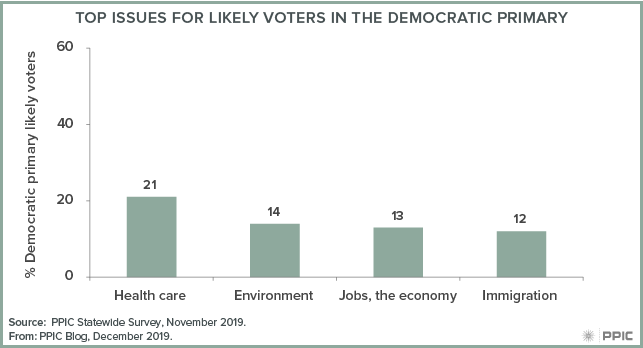
What do California’s Democratic primary likely voters most want to hear from the candidates as the stage is being set for a December 19 Democratic debate in Los Angeles? In an open-ended question in the November PPIC survey, the top four issues mentioned are health care (21%), the environment (14%), jobs and the economy (13%), and immigration (12%). Several other issues—such as education, homelessness, housing affordability, gun control, crime, and taxes—are each mentioned by less than one in ten likely voters.

figure - Top Issues for Likely Voters in the Democratic Primary

Across demographic groups, likely voters differ on the issues that matter the most. For instance, voters age 45 and older want to hear about health care more often than younger voters do (26% to 13%), while Latinos want to hear about immigration more often than whites do (24% to 5%), and whites want to hear about the environment more often than Latinos do (23% to 4%). Jobs and the economy is the only top issue generating a similar amount of interest across age, education, gender, income, race/ethnic, and regional groups.

The issues of greatest concern also vary according to candidate preference. Biden’s supporters name health care more often (25%), Warren’s supporters mention the environment more often (26%), and Sander’s supporters name immigration more often (22%). By contrast, supporters of the three leading candidates are similarly likely to mention jobs and the economy (13% Sanders, 11% Biden, 7% Warren).

One area of strong consensus? Views of President Trump. In the November PPIC survey, 91% of California Democratic primary likely voters say they disapprove of President Trump and 84% support his impeachment and removal from office.

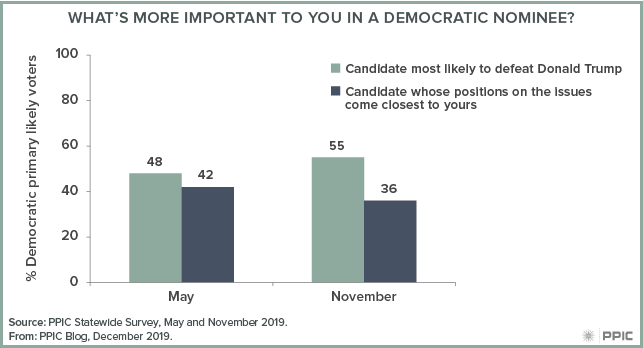
When asked what’s more important, nominating a candidate who seems most likely to defeat Trump or one whose positions on issues are closest to theirs, 55% want to defeat Trump, while 36% want alignment on positions. Since the May PPIC survey, support for impeachment (65% to 84%) and the importance of nominating an electable candidate (48% to 55%) has risen.

figure - What’s More Important to You in a Democratic Nominee?

Those who say that electability is most important, compared with those who say policy positions are most important, are more likely to mention health care (25% to 15%) and less likely to name immigration (7% to 18%) as the issue that they most want to hear about in the presidential debates. We find no differences between these two voter groups in the mention of the environment or jobs and the economy. Interestingly, education (11% to 2%) is noted more often among those who say that alignment on the issues is more important to them.

The Los Angeles debate is the next big opportunity for the presidential candidates to connect with California voters whose preferences are still being formed. Many Democratic primary likely voters already report that they are closely following the election news, but the debate could still result in an expanded electorate—and a scrambling of the race—if candidates connect with voters on issues that matter the most to them.

Throughout 2020, PPIC surveys will be monitoring what is likely to be an historic year for voter participation, as Californians engage in a consequential primary and a highly anticipated general election.

Video: Californians and Their Government

Joe Biden, Elizabeth Warren, and Bernie Sanders continue to lead the field in California’s primary race. Most Californians say President Trump should be impeached and removed from office, though views are mixed on how Democrats in Congress are handling the impeachment inquiry. In Sacramento last Wednesday, PPIC researcher Alyssa Dykman outlined these are other key findings from PPIC’s latest statewide survey, which was conducted before the November 20 debate.

Among Democrats and Democratic-leaning likely voters, support for Joe Biden (24%), Elizabeth Warren (23%), and Bernie Sanders (17%) is much higher than for Kamala Harris (8%), Pete Buttigieg (7%), and Andrew Yang (5%). No other candidate is preferred by more than 1%, while 9% say they don’t know which candidate they would choose.

Views on impeachment are divided along party lines: 83% of Democrats, 51% of independents, and 11% of Republicans think the president should be impeached and removed from office. Democrats are also much more likely than independents or Republicans to approve of the way the inquiry is being handled in Congress.

In other news, most Californians are concerned about wildfires (34% very, 29% somewhat) and power shutoffs (32% very, 27% somewhat). Governor Newsom gets mixed reviews for his handling of these issues: 46% of adults and 42% of likely voters approve, while 39% of adults and 46% of likely voters disapprove. Only about a third of Californians have either a great deal or quite a lot of confidence in their utility providers.

Other survey highlights:

  • Six in ten Californians (61% adults, 63% likely voters) say things in the US are generally going in the wrong direction, but about half think the nation will have good times financially over the next 12 months.
  • Nearly two-thirds of adults (63%) say California is divided into the “haves” and the “have nots”; 41 percent say they are haves, while 44 percent see themselves as have nots.
  • Most Californians are very concerned about homelessness in their communities; majorities across regions say the number of homeless people in their local community has increased over the past 12 months.
  • A potential citizens’ initiative that would raise state income taxes on the wealthiest Californians to fund K–12 public schools has majority support. Fewer than half of likely voters favor two other measures—a school construction bond and a “split roll” property tax—that would benefit the K–12 system.

Interactive: Californians’ Views on Homelessness

[vc_row][vc_column][vc_column_text]Homelessness is a growing concern in California, where nearly a quarter of the nation’s homeless population lives. The crisis comes amid sky-high housing costs and widening income inequality. PPIC’s latest survey explores residents’ perceptions of homelessness in their part of the state.

Eighty-five percent of Californians say they are concerned about the presence of homeless people in their local community, including 58 percent who are very concerned. Majorities across regions and demographic groups say they are very concerned about this issue.

In addition, about six in ten Californians (58%) say the presence of homeless people has increased in their local community over the past year. Four in ten say it has stayed the same, while only 3% say it has decreased.

The chart below allows you to take a closer look at how different Californians view this issue. Across regions, Los Angeles (63%) residents are the most likely to say the presence of homeless people has increased. This is in line with recent data showing Los Angeles County saw a spike in homelessness in 2019. African Americans (73%) and residents with annual household incomes under $40,000 (61%) are also especially likely to report an increase in homelessness in their community. Very small shares of Californians report a decrease in the presence of homeless people.[/vc_column_text][/vc_column][/vc_row][vc_row max_width=”80″ visibility=”visible-desktop”][vc_column][vc_column_text][infogram id=”1p0621pw3w90yltegez9kvk6xdanq1qd6ey?live”][/vc_column_text][/vc_column][/vc_row][vc_row max_width=”80″ visibility=”visible-tablet-landscape”][vc_column][vc_column_text][infogram id=”1p0621pw3w90yltegez9kvk6xdanq1qd6ey?live”][/vc_column_text][/vc_column][/vc_row][vc_row visibility=”visible-tablet-portrait”][vc_column][vc_column_text][infogram id=”1p0621pw3w90yltegez9kvk6xdanq1qd6ey?live”][/vc_column_text][/vc_column][/vc_row][vc_row visibility=”visible-phone”][vc_column][vc_column_text][infogram id=”1p0621pw3w90yltegez9kvk6xdanq1qd6ey?live”][/vc_column_text][/vc_column][/vc_row][vc_row][vc_column][vc_column_text]Given the complexity of the homelessness crisis, the governor and state legislature must think of creative and sustainable solutions. One possible approach is a law that would require local governments to construct enough shelter beds so that any homeless person requesting to come indoors could do so. When asked about this proposal, an overwhelming majority of Californians (76% adults, 70% likely voters) are in favor. There is support for the policy across parties, regions, and demographic groups.[/vc_column_text][/vc_column][/vc_row][vc_row max_width=”80″ visibility=”visible-desktop”][vc_column][vc_column_text][infogram id=”1prd6drdjkx025ig27z3kwz276smgp3jj2r?live”][/vc_column_text][/vc_column][/vc_row][vc_row max_width=”80″ visibility=”visible-tablet-landscape”][vc_column][vc_column_text][infogram id=”1prd6drdjkx025ig27z3kwz276smgp3jj2r?live”][/vc_column_text][/vc_column][/vc_row][vc_row visibility=”visible-tablet-portrait”][vc_column][vc_column_text][infogram id=”1prd6drdjkx025ig27z3kwz276smgp3jj2r?live”][/vc_column_text][/vc_column][/vc_row][vc_row visibility=”visible-phone”][vc_column][vc_column_text][infogram id=”1prd6drdjkx025ig27z3kwz276smgp3jj2r?live”][/vc_column_text][/vc_column][/vc_row][vc_row][vc_column][vc_column_text]As state policymakers work on their policy agendas for the next year, we will continue to monitor Californians’ views on homelessness and related policies closely.[/vc_column_text][/vc_column][/vc_row]