Interactive: Will Housing Costs Drive Californians Away?

[vc_row][vc_column][vc_column_text]Home values and rental markets in California are among the most expensive in the nation, and supply shortages continue to put upward pressure on housing prices. Over the last decade, the state averaged fewer than 80,000 new homes annually—far below the estimated need of 180,000 additional units each year, according to a recent report from the California Department of Housing and Community Development.

In our March survey, we found that a record-high share of Californians (68%) believe that housing affordability is a big problem in their region, and 47% are seriously considering moving away from the part of the state they live in now due to housing costs.

The interactive below allows you to take a closer look at how interest in moving due to housing costs varies across demographic groups. For example, Los Angeles County residents (39%) are the most likely to say housing costs have made them seriously consider moving out of the state, with another 13% saying they’re considering moving elsewhere in California. Overall, half of coastal residents say they’re seriously thinking about moving away from where they live now.

Young adults are also much more likely to have considered moving than older residents. More than half (56%) of young adults age 18–34 have seriously thought about moving due to housing costs—including four in ten who have considered leaving the state—compared to 38% of adults over 55.

We hope this interactive sheds light on Californians’ perceptions of housing costs. As the new governor and state legislature work on their policy agendas for the year, the PPIC survey team will continue to monitor the issue of housing closely.[/vc_column_text][/vc_column][/vc_row][vc_row][vc_column][vc_raw_html]JTNDZGl2JTIwY2xhc3MlM0QlMjd0YWJsZWF1UGxhY2Vob2xkZXIlMjclMjBpZCUzRCUyN3ZpejE1NTU3MDc3NzcyNTUlMjclMjBzdHlsZSUzRCUyN3Bvc2l0aW9uJTNBJTIwcmVsYXRpdmUlMjclM0UlM0Nub3NjcmlwdCUzRSUzQ2ElMjBocmVmJTNEJTI3aHR0cHMlM0ElMjYlMjM0NyUzQiUyNiUyMzQ3JTNCd3d3LnBwaWMub3JnJTI2JTIzNDclM0JibG9nJTI2JTIzNDclM0JpbnRlcmFjdGl2ZS13aWxsLWhvdXNpbmctY29zdHMtZHJpdmUtY2FsaWZvcm5pYW5zLWF3YXklMjclM0UlM0NpbWclMjBhbHQlM0QlMjclMjAlMjclMjBzcmMlM0QlMjdodHRwcyUzQSUyNiUyMzQ3JTNCJTI2JTIzNDclM0JwdWJsaWMudGFibGVhdS5jb20lMjYlMjM0NyUzQnN0YXRpYyUyNiUyMzQ3JTNCaW1hZ2VzJTI2JTIzNDclM0JNYSUyNiUyMzQ3JTNCTWFueUNhbGlmb3JuaWFuc0FyZVRoaW5raW5nb2ZNb3ZpbmdkdWV0b0hvdXNpbmdDb3N0cyUyNiUyMzQ3JTNCQ3Jvc3N0YWJzJTI2JTIzNDclM0IxX3Jzcy5wbmclMjclMjBzdHlsZSUzRCUyN2JvcmRlciUzQSUyMG5vbmUlMjclMjAlMkYlM0UlM0MlMkZhJTNFJTNDJTJGbm9zY3JpcHQlM0UlM0NvYmplY3QlMjBjbGFzcyUzRCUyN3RhYmxlYXVWaXolMjclMjAlMjBzdHlsZSUzRCUyN2Rpc3BsYXklM0Fub25lJTNCJTI3JTNFJTNDcGFyYW0lMjBuYW1lJTNEJTI3aG9zdF91cmwlMjclMjB2YWx1ZSUzRCUyN2h0dHBzJTI1M0ElMjUyRiUyNTJGcHVibGljLnRhYmxlYXUuY29tJTI1MkYlMjclMjAlMkYlM0UlMjAlM0NwYXJhbSUyMG5hbWUlM0QlMjdlbWJlZF9jb2RlX3ZlcnNpb24lMjclMjB2YWx1ZSUzRCUyNzMlMjclMjAlMkYlM0UlMjAlM0NwYXJhbSUyMG5hbWUlM0QlMjdzaXRlX3Jvb3QlMjclMjB2YWx1ZSUzRCUyNyUyNyUyMCUyRiUzRSUzQ3BhcmFtJTIwbmFtZSUzRCUyN25hbWUlMjclMjB2YWx1ZSUzRCUyN01hbnlDYWxpZm9ybmlhbnNBcmVUaGlua2luZ29mTW92aW5nZHVldG9Ib3VzaW5nQ29zdHMlMjYlMjM0NyUzQkNyb3NzdGFicyUyNyUyMCUyRiUzRSUzQ3BhcmFtJTIwbmFtZSUzRCUyN3RhYnMlMjclMjB2YWx1ZSUzRCUyN25vJTI3JTIwJTJGJTNFJTNDcGFyYW0lMjBuYW1lJTNEJTI3dG9vbGJhciUyNyUyMHZhbHVlJTNEJTI3bm8lMjclMjAlMkYlM0UlM0NwYXJhbSUyMG5hbWUlM0QlMjdzdGF0aWNfaW1hZ2UlMjclMjB2YWx1ZSUzRCUyN2h0dHBzJTNBJTI2JTIzNDclM0IlMjYlMjM0NyUzQnB1YmxpYy50YWJsZWF1LmNvbSUyNiUyMzQ3JTNCc3RhdGljJTI2JTIzNDclM0JpbWFnZXMlMjYlMjM0NyUzQk1hJTI2JTIzNDclM0JNYW55Q2FsaWZvcm5pYW5zQXJlVGhpbmtpbmdvZk1vdmluZ2R1ZXRvSG91c2luZ0Nvc3RzJTI2JTIzNDclM0JDcm9zc3RhYnMlMjYlMjM0NyUzQjEucG5nJTI3JTIwJTJGJTNFJTIwJTNDcGFyYW0lMjBuYW1lJTNEJTI3YW5pbWF0ZV90cmFuc2l0aW9uJTI3JTIwdmFsdWUlM0QlMjd5ZXMlMjclMjAlMkYlM0UlM0NwYXJhbSUyMG5hbWUlM0QlMjdkaXNwbGF5X3N0YXRpY19pbWFnZSUyNyUyMHZhbHVlJTNEJTI3eWVzJTI3JTIwJTJGJTNFJTNDcGFyYW0lMjBuYW1lJTNEJTI3ZGlzcGxheV9zcGlubmVyJTI3JTIwdmFsdWUlM0QlMjd5ZXMlMjclMjAlMkYlM0UlM0NwYXJhbSUyMG5hbWUlM0QlMjdkaXNwbGF5X292ZXJsYXklMjclMjB2YWx1ZSUzRCUyN3llcyUyNyUyMCUyRiUzRSUzQ3BhcmFtJTIwbmFtZSUzRCUyN2Rpc3BsYXlfY291bnQlMjclMjB2YWx1ZSUzRCUyN3llcyUyNyUyMCUyRiUzRSUzQ3BhcmFtJTIwbmFtZSUzRCUyN2ZpbHRlciUyNyUyMHZhbHVlJTNEJTI3cHVibGlzaCUzRHllcyUyNyUyMCUyRiUzRSUzQyUyRm9iamVjdCUzRSUzQyUyRmRpdiUzRSUyMCUyMCUyMCUyMCUyMCUyMCUyMCUyMCUyMCUyMCUyMCUyMCUyMCUyMCUyMCUyMCUzQ3NjcmlwdCUyMHR5cGUlM0QlMjd0ZXh0JTJGamF2YXNjcmlwdCUyNyUzRSUyMCUyMCUyMCUyMCUyMCUyMCUyMCUyMCUyMCUyMCUyMCUyMCUyMCUyMCUyMCUyMCUyMCUyMCUyMCUyMHZhciUyMGRpdkVsZW1lbnQlMjAlM0QlMjBkb2N1bWVudC5nZXRFbGVtZW50QnlJZCUyOCUyN3ZpejE1NTU3MDc3NzcyNTUlMjclMjklM0IlMjAlMjAlMjAlMjAlMjAlMjAlMjAlMjAlMjAlMjAlMjAlMjAlMjAlMjAlMjAlMjAlMjAlMjAlMjAlMjB2YXIlMjB2aXpFbGVtZW50JTIwJTNEJTIwZGl2RWxlbWVudC5nZXRFbGVtZW50c0J5VGFnTmFtZSUyOCUyN29iamVjdCUyNyUyOSU1QjAlNUQlM0IlMjAlMjAlMjAlMjAlMjAlMjAlMjAlMjAlMjAlMjAlMjAlMjAlMjAlMjAlMjAlMjAlMjAlMjAlMjAlMjBpZiUyMCUyOCUyMGRpdkVsZW1lbnQub2Zmc2V0V2lkdGglMjAlM0UlMjA4MDAlMjAlMjklMjAlN0IlMjB2aXpFbGVtZW50LnN0eWxlLndpZHRoJTNEJTI3MTAwJTI1JTI3JTNCdml6RWxlbWVudC5zdHlsZS5oZWlnaHQlM0QlMjhkaXZFbGVtZW50Lm9mZnNldFdpZHRoJTJBMC43NSUyOSUyQiUyN3B4JTI3JTNCJTdEJTIwZWxzZSUyMGlmJTIwJTI4JTIwZGl2RWxlbWVudC5vZmZzZXRXaWR0aCUyMCUzRSUyMDUwMCUyMCUyOSUyMCU3QiUyMHZpekVsZW1lbnQuc3R5bGUud2lkdGglM0QlMjcxMDAlMjUlMjclM0J2aXpFbGVtZW50LnN0eWxlLmhlaWdodCUzRCUyOGRpdkVsZW1lbnQub2Zmc2V0V2lkdGglMkExLjc3JTI5JTJCJTI3cHglMjclM0IlN0QlMjBlbHNlJTIwJTdCJTIwdml6RWxlbWVudC5zdHlsZS53aWR0aCUzRCUyNzEwMCUyNSUyNyUzQnZpekVsZW1lbnQuc3R5bGUubWluSGVpZ2h0JTNEJTI3NzgwcHglMjclM0J2aXpFbGVtZW50LnN0eWxlLm1heEhlaWdodCUzRCUyOGRpdkVsZW1lbnQub2Zmc2V0V2lkdGglMkExLjc3JTI5JTJCJTI3cHglMjclM0IlN0QlMjAlMjAlMjAlMjAlMjAlMjAlMjAlMjAlMjAlMjAlMjAlMjAlMjAlMjAlMjAlMjAlMjAlMjAlMjAlMjAlMjB2YXIlMjBzY3JpcHRFbGVtZW50JTIwJTNEJTIwZG9jdW1lbnQuY3JlYXRlRWxlbWVudCUyOCUyN3NjcmlwdCUyNyUyOSUzQiUyMCUyMCUyMCUyMCUyMCUyMCUyMCUyMCUyMCUyMCUyMCUyMCUyMCUyMCUyMCUyMCUyMCUyMCUyMCUyMHNjcmlwdEVsZW1lbnQuc3JjJTIwJTNEJTIwJTI3aHR0cHMlM0ElMkYlMkZwdWJsaWMudGFibGVhdS5jb20lMkZqYXZhc2NyaXB0cyUyRmFwaSUyRnZpel92MS5qcyUyNyUzQiUyMCUyMCUyMCUyMCUyMCUyMCUyMCUyMCUyMCUyMCUyMCUyMCUyMCUyMCUyMCUyMCUyMCUyMCUyMCUyMHZpekVsZW1lbnQucGFyZW50Tm9kZS5pbnNlcnRCZWZvcmUlMjhzY3JpcHRFbGVtZW50JTJDJTIwdml6RWxlbWVudCUyOSUzQiUyMCUyMCUyMCUyMCUyMCUyMCUyMCUyMCUyMCUyMCUyMCUyMCUyMCUyMCUyMCUyMCUzQyUyRnNjcmlwdCUzRQ==[/vc_raw_html][/vc_column][/vc_row]


Video: Emergency Department Use in California

Hospital emergency departments (EDs) are an important part of California’s health care system. They are sometimes called the safety net of the safety net because they provide care to all comers. Policymakers, health plans, and health providers have long focused on ED use, partly because it serves as a proxy for lack of access to other, less costly forms of health care. So how has the expansion of insurance coverage under the Affordable Care Act (ACA) affected ED use in California? At an event last week in Sacramento, PPIC researcher Shannon McConville outlined a new PPIC report that addresses this question, and a panel of experts offered their perspectives on recent ED trends.

While many predicted that coverage expansion would reduce ED use by providing access to other kinds of medical care, such as primary care physicians, some worried that because insurance coverage typically reduces patients’ out-of-pocket costs, the ACA would increase ED use. The good news is that the PPIC report estimates that ED use rates would be higher in the absence of the ACA. But ED use statewide has been increasing for the past decade. To get a sense of how recent trends in ED use are being experienced and addressed around the state, PPIC convened a panel of experts.

All of the panelists highlighted the importance of finding out why people are using EDs. Some frequent ED users may not know about other ways to get medical care, while others may have behavioral or mental health issues that could be addressed more effectively by other kinds of care—from housing assistance to substance abuse programs. As Sara Kate Levin, medical director for Contra Costa Health Services, put it, “What are the unmet social needs that are driving a lot of this high utilization?”

But filling information gaps and addressing behavioral and mental health issues does not solve all ED use problems. In many areas, there is a scarcity of primary care doctors and urgent care clinics, and many patients cannot take time off to go to medical appointments during the workday. Moreover, primary care doctors sometimes refer their privately insured patients to EDs, in part so they won’t have to wait for tests.

This range of issues points to what Renee Hsia, an ED physician at Zuckerberg San Francisco General Hospital and a professor of emergency medicine and health policy, called “the elephant in the room”: because the United States has “a very market-based approach to health care,” there are two very different stories about ED use. On the one hand, EDs in affluent areas broadcast their availability and convenience. On the other hand, there are long waits for treatment at EDs serving low-income areas. “In some areas, your ER is a revenue center . . . and in some places, where you don’t have paying patients, your ER is a cost center.”

Jennifer Rasmussen, vice president of health care services at Molina Healthcare of California, highlighted the geographical differences across the state that make it difficult to find “one size fits all” solutions. She pointed out that Molina serves Imperial and San Bernardino Counties, “a vast geography” with fewer social services than a dense urban area has to offer. In other words, “a solution for Imperial County is not going to be the same as a solution for San Francisco.”

Video: Californians and Their Government

Californians are increasingly concerned about the cost of housing—a record-high share see affordability as a big problem in their region, and a majority support Governor Newsom’s proposal to put $1.8 billion toward increasing housing production. Dean Bonner outlined these and other key findings of the latest PPIC Statewide Survey at a Sacramento briefing last week.

This month’s survey gauges views on statewide challenges and the governor’s proposals for addressing them. For example, in the wake of last year’s historically destructive wildfires, an overwhelming majority of Californians support the governor’s plan to spend $415 million on wildfire preparedness and forest management. About two-thirds say the gap between rich and poor is widening in their part of the state, and a solid majority favor the governor’s proposal to allocate a billion to expand eligibility for the earned income tax credit.

Other survey highlights:

  • Slim majorities support the governor’s plan to scale back two major infrastructure projects: high-speed rail and the Sacramento–San Joaquin tunnels.
  • When asked whether the penalty for first-degree murder should be death or imprisonment for life with no chance of parole, a record-high 62% of Californians choose life imprisonment.
  • An overwhelming majority oppose President Trump’s declaration of a national emergency over the border wall—but support for the declaration is much higher among Republicans.
  • A majority of residents have a favorable view of the Affordable Care Act and most say that Covered California, the state’s health insurance exchange, has been working well.

Video: Preparing California for Census 2020

Is California ready for the 2020 Census? PPIC convened a group of experts last week for a progress report on preparations for the decennial population count, which begins next April 1. PPIC president Mark Baldassare started off by asking California secretary of state Alex Padilla to outline what is at stake.

Padilla offered a “quick civics lesson,” explaining that the census helps determine the amount of federal funding that goes to each state, as well as each state’s overall number of congressional seats and its configuration of legislative districts. If there’s an undercount in California, the state could lose billions of dollars over the next decade.

Are we ready? “Not yet,” Padilla answered. But he added that California is “a little ahead of the curve,” with the highest level of state investment in outreach and preparation in the nation. In addition to longstanding challenges—for example, California has 30% of the recognized “hard to count” communities nationwide—the state faces some new issues, such as inadequate federal funding, cybersecurity issues, a rule that bars legal permanent residents from working as canvassers, and the possible inclusion of a question about citizenship.

How is the state preparing? Marc Berman, a state assemblymember and chair of the Assembly Select Committee on the Census, outlined three major areas of focus: adequate funding, coordination of efforts, and collaboration by state and local government as well as community-based, philanthropic, and business organizations. “We are better prepared than we ever have been before,” he added.

Ditas Katague, director of California Complete Count, offered a wealth of detail on the progress her office has made—opening five field offices, dividing the state into ten regions based on hard-to-count populations, and working with community groups and media in these regions.

Non-governmental groups are playing a key role. Melina Sanchez, the program officer for civic participation initiatives at the James Irvine Foundation, outlined the two overarching goals of a recently convened statewide philanthropic roundtable: to help California reach its hardest-to-count populations and to use the census as a movement-building opportunity for historically underrepresented groups. For Sanchez, it is important to “flip the narrative” so that it’s not about people’s fear of participating in the census but is instead a story about “folks feeling the empowerment of standing up despite all the barriers.”

Sarah Bohn, PPIC’s director of research, highlighted the need to counteract widespread mistrust of government, concerns about privacy and misuse of data, and mistaken ideas about the purpose of the census. A key way to motivate most people, she added, is to make sure they know that their community benefits from an accurate count: “Understanding the funding that goes to your community . . . really seems to encourage participation.”

What would a successful census look like? Katague summed it up: “No undercount, no loss of a congressional seat, no disinformation snafus”—and, on the positive side, increased civic engagement.

Video: A Conversation with San Francisco Mayor London Breed

As part of our Speaker Series on California’s Future, PPIC invites elected leaders from across the political spectrum to participate in public conversations. The purpose is to give Californians a better understanding of how our leaders are addressing the challenges facing our state.

As a mayoral candidate, London Breed promised to focus on homelessness and affordable housing—two major challenges for San Francisco and for California as a whole. Not surprisingly, these issues took center stage in her conversation with PPIC president Mark Baldassare earlier this week.

“It is no secret that homelessness is one of the biggest challenges that’s facing our city, and that also comes with the need to build more housing,” said Breed. “I’ve been on a mission! I hired a housing delivery director—someone whose sole purpose is to cut back on bureaucratic red tape that gets in the way of building housing.”

Breed stressed the need for new approaches to behavioral health issues that complicate homelessness: “We have to think about this challenge differently and we have to make hard decisions.” For example, she favors strengthening conservatorship laws. She acknowledged that conservatorship for mentally ill adults is “very controversial.” But, she added, “our jails are being used as mental health facilities, and that’s not a solution.” She is also pushing for safe injection sites, which can provide substance abuse treatment when people are ready to seek it. “Treatment on demand is something we have to start looking at.”

The mayor is also committed to trying new strategies in other policy areas, such as police-community relations and education. “I do think we need to take some risks and propose some things that may make people uncomfortable but ultimately may help us to get the kind of results that will . . . make a difference.”

But Breed also emphasized accountability. Explaining why she wants to hire a mental health director, she said, “We’re a little bit all over the place right now and I want us to address those issues, organize things a lot better for the purposes of helping people.” In this and other areas, she said, “I want to see us make the right investments.”

Many of California’s Highly Educated Workers Are Retiring

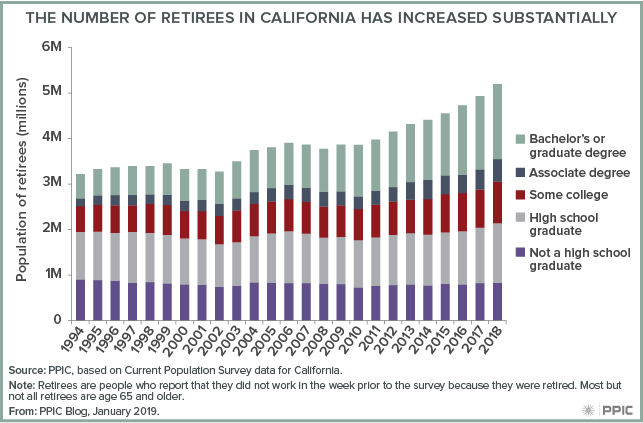
As California’s population ages, record numbers of people are now going into retirement. Because so many of these recent retirees are highly educated, this trend has important implications for workforce needs in the state. Replacing these highly educated retirees will require large increases in college enrollment and completion among young Californians.

The number of retirees in California has grown dramatically over the past 10 years. Their total numbers grew from 3.8 million in 2008 to 5.2 million in 2018, a 38% increase—far higher than the state’s overall population growth of 8% during this same period. This rapid growth in retirees is a consequence of the aging baby boom, the very large cohort of people born between 1946 and 1964. During that post-war era, new social norms meant that the typical family had three or four children. The leading edge of the baby boom reached age 65 in 2011. Because the tail end of the baby boom is larger than the leading edge (in California, the birth rate peaked in 1957 and the number of births peaked in 1961), the number of retirees will continue to grow strongly for the next decade. The tail end of the baby boom will reach age 65 in 2029.

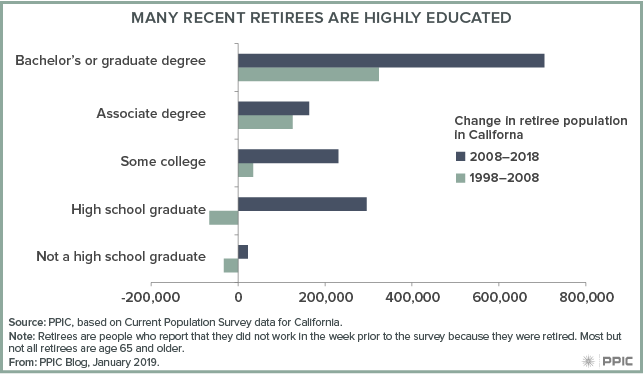
Children born during the baby boom ended up far better educated than their parents. Policies such as the GI Bill, along with public investments in California’s public higher education system, allowed for relatively inexpensive, widespread access to college. Today, the number of retirees with a bachelor’s or graduate degree is larger than ever. Between 2008 and 2018, this group increased by more than 700,000 and made up a majority of the net increase in the retiree population.

The retirement of so many highly educated workers is unprecedented and poses a tremendous challenge for California. Every year, the number of new retirees with a bachelor’s degree (more than 70,000 per year in the last decade) exceeds the number of bachelor’s degrees awarded by the entire University of California system (55,000 in academic year 2017–18). Without producing more college graduates, California could see a shortfall of 1.1 million highly educated workers by 2030.

The good news is that the state and its higher education institutions are making progress by increasing enrollment, graduation rates, and degrees awarded. These advances have been made possible at least partly because of renewed funding from the state. With the additional funding for higher education in the governor’s proposed budget, California’s higher education system will be better positioned to take on the workforce challenges posed by the retirement of the baby boom.

One Step Closer to a Statewide Educational Data System

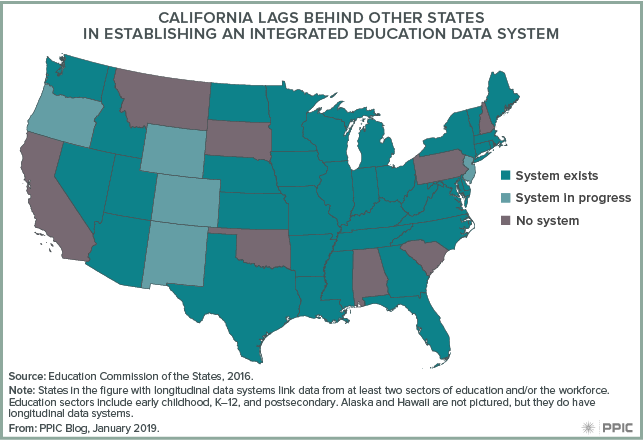
Governor Newsom’s recently proposed budget includes $10 million in one-time funding for the planning, creation, and implementation of a statewide longitudinal data system—including early childhood education, K–12, higher education, the workforce, and health and human services. As we wrote in a recent PPIC report, this idea holds a lot of promise. An integrated data system could allow for improved feedback for educational institutions, more efficient use of public funds, and better evaluation and coordination for the state. The idea also has support in the state senate, where Senators Glazer and Allen proposed a similar system (SB 2) last December.

Each public education system—K–12, the community colleges, California State University, and the University of California—already recognizes the importance of data. They all collect, store, and analyze data on students within their respective systems to improve instruction and outcomes. However, few connections are ever made between educational sectors. Even though a high school senior may graduate from a K–12 school, attend a community college, and then transfer to a UC, data isn’t shared across those systems in any systematic way. So each system has no idea if students are successful in the next stage of their academic career. California is one of the few states that does not follow students across sectors.

The governor’s budget summary also suggests that the data system could be used to improve K–12 measures of career and college readiness. Current measures are based on high school test scores and high school course-taking. But connecting K–12 data to higher education and employment data could lead to more meaningful measures of whether students are able to take and succeed in college-level courses, or whether they work in a job with a living wage.

With the Newsom administration’s support, California may be closer than ever to establishing a data system that can answer key questions about how students move along the educational pipeline. Creation and implementation will involve security, privacy, and governance challenges, but California has 42 other states that can serve as models. This is a much-needed first step in helping the state develop effective policy solutions that will improve students’ progress through school and into the workforce.

Video: Californians and Their Government

As Governor-Elect Gavin Newsom prepares for his first term, half of Californians think he should take a different policy direction than Governor Brown. Four in ten approve of Newsom’s plans and priorities—while three in ten don’t yet know enough to have an opinion. These and other key findings of the latest PPIC Statewide Survey were outlined by Dean Bonner at a Sacramento briefing last week.

The survey asked Californians about four major policy areas that were highlighted in the governor’s campaign. Most see universal health coverage and free community college as top priorities, while fewer see universal preschool as a high or very high priority and only one in four prioritize high-speed rail.

The survey also asked how the state should use the projected surplus in the next budget year. A majority of Californians say they would prefer to use the surplus to increase funding for education and health and human services. Far fewer prefer to use it to pay down debt and build up a reserve or to spend on one-time funding for transportation, water, and infrastructure.

When asked to identify the state government’s highest priority in planning for the future, 39% name improving jobs and the economy, 20% say protecting the environment, and 15% say updating water and transportation infrastructure. Improving jobs and the economy is the highest priority across all parties and demographic groups.

Other survey highlights:

  • Two-thirds of Californians say the state is divided into two economic groups: the “haves” and the “have nots.” Four in ten characterize themselves as haves and 45% say they are have nots.
  • While more than half of Californians think the state is generally headed in the right direction, only about a third are satisfied with the way things are going in the nation. Half have no confidence that President Trump will make the right decisions for the country’s future.
  • Only two in ten likely voters approve of Congress; more than half see the shift in control of the US House from the Republicans to the Democrats as a good thing.
  • Two-thirds of state residents continue to see immigrants as a benefit, and there is still bipartisan support for allowing undocumented immigrants to stay in the US legally if certain requirements are met.

What Approval Ratings Say about Jerry Brown’s Legacy

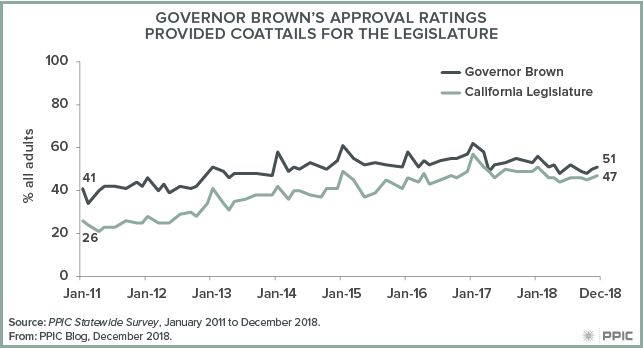
Perhaps Governor Jerry Brown’s most important contribution—rooted in the higher approval ratings for the executive and legislative branches—was to restore public confidence in state government.

That’s my conclusion after we at the Public Policy Institute of California have taken 64 surveys since Brown took office in January 2011 asking the same question: “Overall, do you approve or disapprove of the way that Jerry Brown is handling his job as governor of California?”

For most of the time since 2011, political gridlock stymied Barack Obama, Donald Trump, and Congress.

But in California, Brown and the state legislature were solving problems. Survey results show that the public responded. Brown’s latest (and our final) approval rating stands at 51 percent. That’s 10 points higher than his approval rating in our January 2011 survey. Brown’s approval rating surpassed 60 percent twice—after his 2014 reelection and after Trump’s election, when our January 2017 survey had the governor at a 62 percent approval rating. Not surprisingly, Brown’s highest approval ratings today are among Democrats and self-identified liberals, 68 percent and 69 percent, respectively, and is least popular among Republicans at 18 percent and self-identified conservatives at 36 percent.

Notably, his canoe theory of politics—paddle to the left, and then paddle to the right—seems to have worked well. About half of independents and moderates approve of the governor. Brown’s approval rating has never dipped below 47 percent since the voters passed his Proposition 30 tax increase in October 2012. The recent campaign for the Proposition 6 gas tax repeal and the race for his successor apparently had no effect on Brown’s popularity.

Brown steered through troubled fiscal waters that damaged other political careers. The approval rating for Gray Davis hit 31 percent in the September 2003 PPIC survey as he faced the recall that ended his time in office. His replacement, Arnold Schwarzenegger, had a 25 percent approval rating in the November 2010 PPIC survey, as the state suffered from massive budget deficits and he and the legislature struggled with unpopular spending and tax decisions.

The state legislature had been mired in low approval ratings for years. Perhaps the legislature rode the coattails of Brown’s success—its approval rating increased by 21 points, from 26 percent in the January 2011 PPIC survey to 47 percent in December. California’s fiscal recovery was certainly tied to more positive views of the governor and legislature. The perception that the state budget situation “is a big problem” fell by 25 points, from 68 percent in January 2011 to 43 percent in January 2018. At the same time, during Brown’s time in office, the belief that the state is generally going in the right direction grew by 16 points to 54 percent in December 2018.

Brown and the legislature took the drama out of the annual budget process, passed popular laws on education funding and climate change, responded to crises such as drought and wildfire, and maintained a united front against Trump’s unpopular policies.

Will Brown be be a hard act to follow for Gavin Newsom?

Maintaining fiscal stability and an effective partnership with the state legislature will be the key ingredients. Jerry Brown will be leaving office with Californians in a better state of mind than they were in eight years ago. His tenure offers a successful model for governing the state in the future.

Video: Higher Education as a Driver of Economic Mobility

Higher education plays a key role in helping Californians move up the income ladder—but equity gaps are a big challenge. Among young adults born in California, 60% of Asian Americans and 40% of whites have at least a bachelor’s degree, compared to 21% of African Americans and 18% of Latinos. At a Sacramento briefing yesterday, PPIC researcher Sarah Bohn outlined these and other key findings of a new report.

Bohn noted that “higher education is correlated with a host of benefits in today’s society.” Workers with at least a bachelor’s degree earn 73% more than high school graduates. While earnings levels are affected by many factors—including the subject area of a college major, geographic location, and the field of employment—Bohn stressed that “the higher the level of education you have, the greater the economic return that you experience.”

California has historically enjoyed strong economic and education gains. However, while the economy is currently booming, recent trends in educational attainment are not as encouraging. Young adults in California today are only slightly more likely to have graduated from college than older adults. Moreover, graduation rates are lower for low-income residents and underrepresented race/ethnic groups.

These equity gaps are especially troubling because low-income, Latino, and African American students—as well as students who would be the first generation in their families to attend college—make up the vast majority of California’s high school population. The community colleges, UC, and CSU have undertaken serious efforts to narrow these gaps—but, as Bohn noted, all educational sectors, including K–12 schools and private institutions, play an important role.

California’s higher education systems have been implementing policies and programs that are likely to increase college graduation rates among the state’s diverse population. Bohn concluded by highlighting the progress that has been made and outlining additional actions that can help more Californians—particularly underrepresented students—benefit from higher education.