Training California’s Students for Well-Paying Jobs

California’s community college system is the largest provider of career education—also known as career technical education or vocational education—in the state. Career education programs play a critical role in training students, especially underserved and nontraditional students, for jobs that provide solid wages but don’t require a four-year college degree.

How can colleges identify these jobs? In a recent PPIC report, we compare occupational earnings to regional poverty thresholds to assess how future workforce needs connect to well-paying jobs that don’t require a four-year degree. Other work by the Brookings Institute focuses on “opportunity industries,” in which good jobs—those that provide stable employment, middle-class wages, and benefits—represent an above-average share of the industry’s total jobs and are filled by workers with only some college training.

Opportunity industries are largely concentrated in fields that align with many of the community colleges’ career education disciplines, including business, engineering, health, information technology (IT), and public and protective services. A critical question is whether students are successfully completing programs that will prepare them for careers in these fields.

The good news is that over the past 20 years, there has been a consistent upward trend in the completion of career education credentials in California’s community colleges, with major gains observed in the last decade. This increase spans industries. Notably, more degrees and certificates are being earned in health than in any other discipline—this is important since health credentials are especially valuable in increasing students’ subsequent earnings.
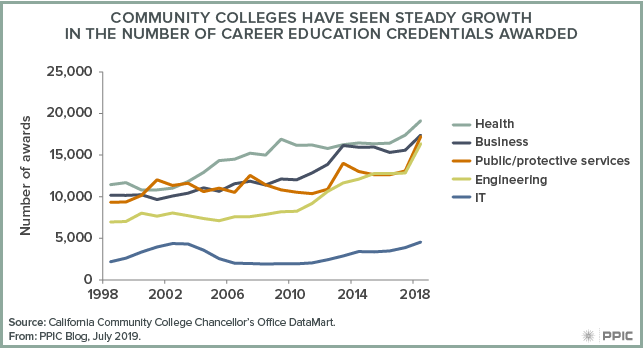
Figure - Community Colleges Have Seen Steady Growth in the Number of Career Education Credentials Awarded

But not all credentials are associated with large economic gains. For example, in our analysis of wage returns, we find that career education credentials in business and IT do not provide much of a wage boost.

Furthermore, there seems to be a mismatch between the awards with the most value and the awards students are earning. While awards from longer programs generally tend to confer more value than those from shorter ones, completion of short-term awards has increased in several career education disciplines.

Community colleges and industry partners need to work together to ensure students have a path to well-paying jobs and the tools needed to succeed. As shown in our research, some of that work begins with colleges structuring effective pathways to these industries and clearly communicating the economic returns and opportunities available to students.

Moreover, strong partnerships between community colleges and nearby industries will be essential in creating a bridge between students and their industry of choice. Ultimately, these efforts can help improve the economic well-being of individual students and the state as a whole.

Record Growth Puts Money in the Bank for California

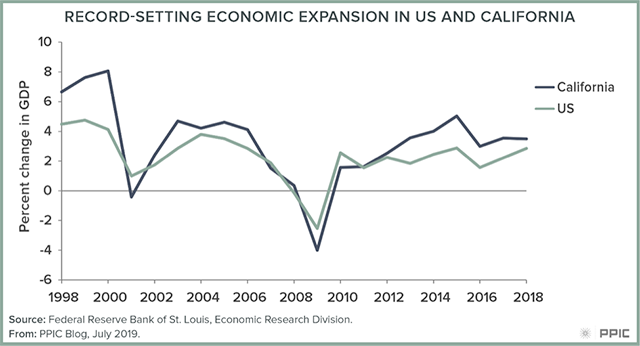
This July marks the longest period of economic expansion in US history. For 121 months and counting, the national and state economies have experienced continuous growth.

Figure: Record-Setting Economic Expansion in US and California

One consequence of this sustained economic growth? An increasing stream of tax revenue flowing into the state’s treasury. This, in turn, has shaped a new state budget that contains record-breaking levels of spending.

In terms of fiscal sustainability, however, the most intriguing element of the new budget may be the dollars that weren’t spent. The budget that the legislature passed and governor just signed includes total budget reserves of more than $20 billion—also a record for the state.

The continued accumulation of budget reserves represents important progress toward preparing the state for an economic slowdown. Because of California’s tax structure, recessions hit the state’s budget particularly hard. Past recessions have caused deep drops in the level of General Fund dollars available, leading to a combination of spending cuts, tax increases, and borrowing to balance the state’s budget.

Building budget reserves should enable California to reduce the impact of a recession. Our estimates suggest that the current level of reserves would allow the state to weather the impact of a mild recession. However, they would be insufficient in the face of a moderate to severe downturn. In other words, there is still work to be done.

None of this matters if the economy never slows down. Just because the economy has gone up for so long, doesn’t mean it must fall—there is no equivalent to gravity when it comes to economics. But history suggests that recessions have a way of interrupting periods of growth. And there are some signs that clouds are gathering on the economic horizon: bond rate curves, drops in consumer confidence, and uncertainty surrounding tariffs and trade. At the same time, the stock market just finished a very positive first half of the year.

Forecasting the timing of the next recession is a much more difficult proposition than asserting that there will be one. The same could be said of California’s earthquakes. But as with earthquakes, the fact that we don’t know exactly when the next recession will hit shouldn’t stop the state from preparing for it.

California’s Brain Gain Continues

[vc_row][vc_column][vc_column_text]California’s heyday of rapid population growth—the post-World War II era—was fueled by millions of migrants coming to the state from the rest of the country. Those days are long gone. California’s population continues to grow (through births and international migration), but every year it loses tens of thousands of people to other states. And yet there is one group that California continues to attract: college graduates.

This interstate migration pattern—gaining large numbers of college graduates while losing large numbers of less educated adults—doesn’t happen anywhere else in the country. Over the past five years, California has attracted 162,000 more college graduates (adults with at least a bachelor’s degree) from other states than it has lost. Over the same period, the University of California (UC) awarded about 300,000 bachelor’s degrees at its nine undergraduate campuses. In other words, interstate migration provides California with half as many college graduates as the entire UC system.

figure - California Gains College Graduates While Losing Less Educated Adults

College  graduates  come  to  California  from  all  over,  but  eight  states send California substantially more college graduates than they get in return. Between 2012 and 2017, net gains of college graduates from New York (51,000), Illinois (31,000), Pennsylvania (24,000), New Jersey (20,000), Massachusetts (20,000), Florida (16,000), Michigan (13,000), and Ohio (11,000) totaled more than 186,000. California experienced smaller but still sizable net losses (totaling 80,000) to five states: Texas (29,000), Oregon (16,000), Nevada (13,000), Arizona (12,000), and Washington (10,000).

The new migrants to California tend to be quite young. Indeed, college graduates age 20–29 account for almost all of the net gains. (In contrast, California experiences small net losses of older college graduates.) From a labor market perspective, attracting young college graduates is especially advantageous. Young adults with college degrees are at the start of their careers and provide the state with much-needed highly educated workers.

figure - College Graduates Moving To California Tend To Be Young

In fact, college graduates moving to California are more likely to be employed than those leaving the state. The largest gains are primarily in majors that are in relatively high demand in the labor market, including engineering (33,000), communications (18,000), business (18,000), and computer science (17,000).

The migration of young college graduates to California is a consequence of the state’s growing demand for highly skilled and highly educated workers. But the numbers are not high enough to fully meet the state’s changing needs. Although many college graduates move to California from other states, the most important source of highly educated workers in California are the state’s own colleges and universities. Policies and practices to improve college access and completion in the state will ensure that more Californians are able to help create and benefit from a strong economy.[/vc_column_text][/vc_column][/vc_row]

Video: Career Pathways and Economic Mobility at California’s Community Colleges

About a third of future jobs in California will require more than a high school diploma but less than a bachelor’s degree. By training workers for these jobs, career education—also known as career technical education or vocational training—plays an integral role in meeting California’s workforce needs and improving students’ economic well-being.

At an event in Sacramento last week, PPIC researcher Shannon McConville outlined the findings of a new report on career education and economic mobility, and a panel of experts discussed the implications for students, colleges, and the state as a whole.

McConville noted that completing a career education credential at a California community college confers a 20% wage gain, on average. But economic benefits vary greatly across program areas. For instance, returns to health credentials tend to be substantial, while business and IT credentials yield lower returns.

The panelists began by highlighting current efforts to improve students’ labor market outcomes. Marty Alvarado, executive vice chancellor for educational services at California’s community colleges, explained the system’s “two-pronged approach” to making sure programs connect to in-demand, high-return careers. One area of focus is regional infrastructure, which includes regional labor market centers that provide colleges with data on local industries. The second area includes tools to help students better navigate their program choices, “while also trying to make transparent the earnings projections for students as they move into these career options.”

Supporting students—especially low-income students from underrepresented demographic groups—in completing high-return credentials was another topic of conversation. Alvarado discussed efforts at the community colleges to streamline processes that may be creating “unnecessary barriers for students,” while Assemblymember Autumn Burke emphasized the importance of access to social safety net services so students can focus on their career.

Alma Salazar, senior vice president of the Center for Education Excellence and Talent Development at the Los Angeles Area Chamber of Commerce, noted that all stakeholders need to be involved. “How do we get the system as a whole to take ownership in helping us collectively solve for these problems? . . . It has to go beyond Sacramento. It has to go beyond the system’s leadership. It has to get to the institutional level and the people who work [there], who have to be equally committed.”

While many see the evolving nature of work and increasing automation as challenges, Assemblymember Burke was optimistic about providing a “just transition” for workers who may lose jobs in fast-changing industries. “We can train people for this new economy [and] prepare them now. . . . It’s a shortcoming to worry about losing minimum-wage jobs, because there’s so much opportunity on the other side.”

Interview: Citizenship and the 2020 Census

This post is part of a series examining challenges involved in the 2020 Census and what’s at stake for California. 

photo - Eric McGheeAfter a heated legal battle, the Supreme Court has ruled that the Trump administration cannot for now include a question on the 2020 Census asking if residents are US citizens. We spoke with PPIC senior fellow Eric McGhee about what this decision means for California.

PPIC: Why is the citizenship question controversial?

Eric McGhee: First, the question could significantly discourage responses among immigrants, who might fear the data would be used to target them. It didn’t go through the normal testing process for new questions, and many Census Bureau employees recommended against adding it because of concerns about data quality.

Second, the Trump administration says the question is necessary to properly enforce the Voting Rights Act. But advocates for immigrant communities dispute this justification and argue that current citizenship data is sufficient to protect against voting discrimination.

Third, it could have a huge impact on political representation and how congressional and state legislative districts are drawn. Districts are currently drawn based on total population. But this question could make it possible for states to use citizens or voting-eligible residents instead, which would tilt representation in favor of those groups.

PPIC: What does all this mean for California?

EM: Response rates will likely be better if the question is not added. But there’s also concern that the damage has already been done—immigrants still might not be inclined to respond. Immigrants make up about a quarter of California’s population, so we’re particularly vulnerable.

A large undercount could result in less federal funding for California. We’re also the only state at risk of losing a congressional seat from an undercount—other states with high immigrant populations like Arizona and Texas might not gain as many seats, but they probably won’t lose a seat they already have, even if there’s a bad count.

Households with undocumented members are the most likely to be undercounted. PPIC research looked at the possibility of a 10% undercount of these households, a reasonable assumption based on existing research. It would mean missing about half a million Californians.

The reality is that census data is thoroughly protected, even from law enforcement agencies like the FBI and ICE. But our May PPIC survey—conducted before the Supreme Court decision—found 63% of Californians were concerned the Census Bureau will not keep responses confidential. Latinos (74%), immigrants (71%), and African Americans (70%) were especially likely to be concerned.

There are other uncertainties too. The 2020 Census will use a new internet-based approach, which hasn’t been comprehensively tested. And people in general are becoming more reluctant to respond to the census. This means the bureau has to do more follow-up, which is expensive and increases the likelihood of problems arising.

PPIC: What can California do to ensure a complete and accurate count?

EM: California is way ahead of other states in terms of funds it has dedicated to census outreach. The state has already appropriated about $100 million to support a better count, and Governor Newsom has proposed another $50 million or so. Philanthropic organizations have chipped in about $30 million. There’s been a great deal of planning at the state and local levels to get the best count possible.

Addressing concerns about confidentiality could go a long way toward encouraging people to respond. Research also suggests that raising awareness about the census’s role in funding public services like health care, roads, highways, and fire and police departments is another promising approach.

Interview: Filling the Gaps in California’s Education Data

California is one of only a few states without a database showing how students advance from K–12 schools to college and into the workforce. As part of his “cradle to career” initiative, Governor Newsom has proposed $10 million to develop such a system.

photo - Dr. Jessica CunninghamWe talked to Dr. Jessica Cunningham, interim executive director of the Kentucky Center for Statistics (KYSTATS), about Kentucky’s preschool-to-workforce data system and what California can learn from their experiences.

PPIC: What are the benefits of an integrated student database?

Jessica Cunningham: One major benefit is improving current programs and education-to-career pathways. We work with K–12 career technical education (CTE) programs to provide them with better labor market data to guide their offerings. We’ve also evaluated the impact of expanding work-ready scholarships for students earning high-demand associate degrees at community colleges.

Our research helps policymakers, practitioners, agencies, and the public make more informed decisions. We recently showed that students who completed K–12 CTE programs earned more than their peers. This information contributed to the state’s decision to include CTE pathways as an alternative to the standard high school equivalency test.

PPIC: What hurdles did you encounter establishing the system?

JC: Funding is an ongoing challenge. We’re 85% funded by federal grants, so we face some financial uncertainty year to year. We’re currently looking at the potential for state appropriations as a more sustainable funding source.

More broadly, managing the data system is like working on a puzzle. Sometimes there are missing pieces, since you’re only able to report on the data you have. For example, we don’t have data on private K–12 schools or on children’s experiences prior to preschool or Head Start, so we need to be mindful of those gaps.

Also, some benefits of a data system take time and it’s important to set expectations accordingly. When we published our very first report on high school graduates, readers were eager for information on college completion rates and earnings. But we needed many more years of data before we could examine those long-term outcomes.

PPIC: What recommendations do you have for California?

JC: In Kentucky, we’re legislatively authorized to receive education and workforce data. A governance structure that includes different stakeholder groups (K–12, higher education, workforce development, financial aid) is also critical.

In the early stages, it’s necessary to figure out the key questions for the state—and to determine who should be engaged in that process. Those questions will drive decisions about the data you collect. You won’t be able to do everything at once, so developing a strong research agenda is essential.

Setting up a centralized system makes things easier. This way, no one has to recreate all the necessary data connections for every report or request. Our reporting data warehouse has zero personally identifiable information. We do everything in house—we don’t have to send data back and forth to a vendor and we know that we’re maintaining confidentiality and following the rigorous rules outlined in our data use and access policy.

We also emphasize that we’re nonpartisan. We provide data and results, but policymakers and other leaders are the ones driving the conversation about how to use this information to improve programs and policies.

Skills-based Immigration and California’s Workforce

[vc_row][vc_column][vc_column_text]The White House recently issued a summary of an immigration plan that would shift the nation’s largely family-based immigration system toward a skills-based approach that would probably prioritize immigrants with higher levels of formal education. Given that the education levels of new immigrants are already on the rise, what impact might a skills-based system have on in California, the state with the largest immigrant population?

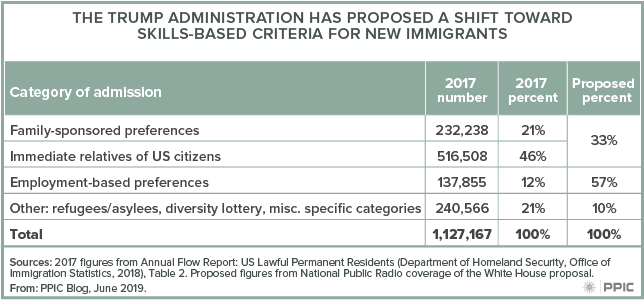
The proposed new system would increase the percentage of skills-based legal immigrants from 12% to 57%, leaving the total number of immigrants at 1.1 million per year.

table - The Trump Administration Has Proposed a Shift Toward Skills-based Criteria for New Immigrants

In recent years, about two-thirds of immigrants with lawful permanent residence status (or “Green Cards”) have been admitted to the US through family-based preferences. The proposed new system would reduce this by half, to 33%. The White House statement emphasizes that priority would still be given to immediate family members of both US citizens and lawful permanent residents.

Past PPIC research suggests that family-preference immigrants have historically been high- and low-skilled. And California’s economy relies on immigrants at both ends of the educational spectrum. Nearly a third of the state’s working-age immigrants lack a high school diploma, and they make up a large portion of the workforce in industries requiring less formal education. However, the foreign-born now constitute 31% of California workers who have at least a BA, and they are overrepresented in high-skill industries like technology and health care.

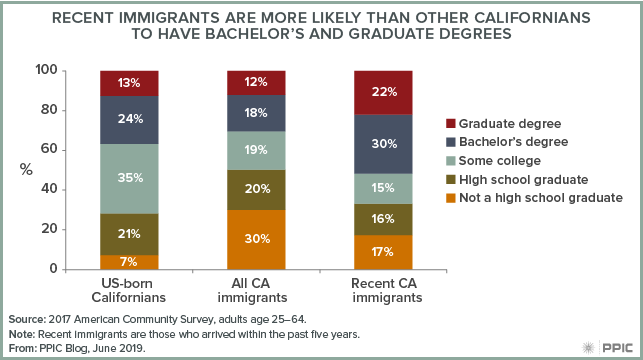
Recent PPIC research finds that new immigrants in California are increasingly well-educated. In 2017, a slight majority (52%) of the state’s working-age immigrants with fewer than five years in the US had a bachelor’s or graduate degree, compared to only 22% in 1990. Only 17% had not graduated from high school, down from 47% in 1990. Indeed, recently arrived immigrants are more likely than US-born Californians to have college or graduate degrees.

figure - Recent Immigrants Are More Likely than Other Californians to Have Bachelor’s and Graduate Degrees

It is impossible to know exactly how a skills-based immigration system would affect California. But given the trend toward higher education levels among new immigrants and state economy’s reliance on both high- and low-skilled workers, a shift toward such a system might not be necessary to meet California’s workforce needs.[/vc_column_text][/vc_column][/vc_row][vc_row][vc_column][/vc_column][/vc_row]

Video: Californians and Their Government

Less than a year before California’s presidential primary, likely voters who are Democrats or who lean Democratic are divided on strategy: is it more important for the party to nominate the candidate who seems mostly likely to defeat President Trump or the candidate whose positions align most closely their views? But almost all Californians see voting in the 2020 elections as very important. At a lunchtime briefing in Sacramento last Thursday, PPIC researcher Dean Bonner outlined these and other key findings from the latest statewide survey.

Two in three California likely voters say they will definitely or probably choose a candidate other than Trump. There is a huge partisan divide on this question: 93% of Democrats and 66% of independents would definitely or probably vote for another candidate if the election were held today, while 82% of Republicans would definitely or probably vote for Trump.

Most Californians say that the investigation by special counsel Robert Mueller did not clear the president of wrongdoing, and Californians are more likely that the nation as a whole to say impeachment proceedings should begin. But here, too, there is a partisan divide: 66% of Democrats say Congress should begin the process, compared to only 39% of independents and 9% of Republicans.

Other survey highlights:

  • A majority of Californians say their housing costs cause a financial strain; six in ten favor the governor’s plan to allocate $1 billion to address homelessness, and similar shares favor proposed new rules intended to create more affordable housing.
  • Three-quarters of Californians see participation in the 2020 Census as very important—but most have concerns about confidentiality.
  • An overwhelming majority are concerned about rising electricity bills in the wake of the PG&E bankruptcy.
  • Californians are concerned that the recent outbreak of measles could spread; most believe that vaccines are very safe and an overwhelming majority say vaccination against measles and other diseases should be required.

2020 Census: Counting California’s Homeless Population

This post is part of a series examining challenges involved in the 2020 Census and what’s at stake for California. 

Accurately counting the homeless population is notoriously difficult. People experiencing homelessness can be hard to find—they tend to move around a lot, and at any given time, they might be in a shelter, in a car, outdoors, or couch surfing with family and friends. They may also conceal their living arrangements for privacy reasons or to avoid law enforcement.

The issue is particularly urgent for California as the 2020 Census approaches. California has the most homeless individuals of any state, with 130,000 people living in shelters or outdoors, according to estimates from January 2018. Since this count doesn’t include people staying temporarily with family or friends, it’s almost certainly an underestimate.

Undercounting homeless Californians could affect political representation and lead to reduced federal funding for low-income and homeless families, especially in urban areas with large homeless populations. In addition to determining congressional seats, the census is used to allocate billions of federal dollars for health care, education, and housing programs, including Section 8 housing vouchers for low-income families.

The goal of the census is to count all residents “in the right place,” meaning where they usually live and sleep. People who are couch surfing without a permanent place to live should be included in the household where they’re staying on Census Day (April 1, 2020).

What about people staying in shelters, living outdoors, and residing in other temporary locations? The census bureau has two approaches:

  • Census workers will interview and record responses from people experiencing homelessness at service-based locations or outdoors. These sites include emergency and transitional shelters, soup kitchens, mobile food vans, and targeted outdoor locations (e.g., under bridges, in parking lots, in encampments). This effort will take place from March 30 to April 1, 2020. Census workers in 2010 counted nearly 28,000 Californians in homeless shelters and about 64,000 Californians at other service-based locations and outdoors.
  • Census workers will go to “transitory” locations to collect responses from people who don’t have a usual home elsewhere. These locations include RV parks, motels, campgrounds, racetracks, circuses, carnivals, and marinas. This effort will take place from April 9 to May 4, 2020. Census workers in 2010 collected data from nearly 24,000 transitory locations in California.

The Census Bureau works with local partners to identify service-based and outdoor locations. Input on the latter is particularly important, as California has high shares of homeless individuals who are not living in shelters. The bureau’s new construction program allows governments to submit addresses for new shelters and transitory locations that are expected to be completed by April 1, 2020.

Getting input from local officials and on-the-ground organizations will be critical. They likely have the most up-to-date information about service-based and outdoor locations in their communities, as well as on those who have been displaced due to fire or other disasters. Individuals with experience working directly with the homeless population may also consider applying to be census workers—speaking with a trusted person from the community can help encourage participation among those who might otherwise distrust government officials.

Together, these efforts could go a long way toward motivating homeless individuals to participate in the census, while also ensuring that census workers have accurate information about where to count these Californians.

Coping with High Housing Costs in College

California’s housing crisis affects college students around the state. Over the past eight years—even as tuition has been stable at California’s public colleges and universities—the cost of attending college has risen because housing costs have gone up. Most students at California’s community colleges and in the California State University system pay more for housing than they do for tuition. At the University of California, housing costs are on par with tuition (for those who pay full tuition).

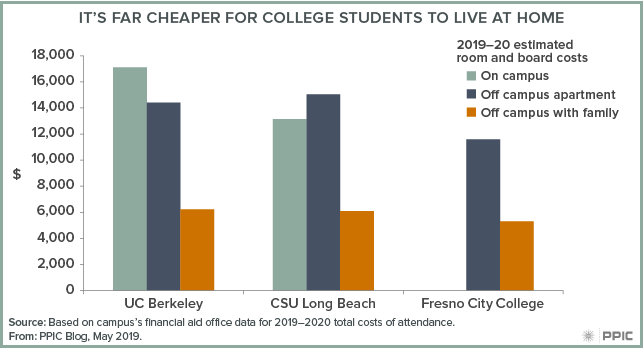
One way students limit their housing costs is by living with their parents or other family members. For most students, living at home is much cheaper than living in housing provided by the university or in an apartment off campus. Housing costs vary across systems, but in every case living with family is much less expensive than other housing options. And the savings are large—as much as $10,000 a year.

figure - It’s Far Cheaper for College Students to Live at Home

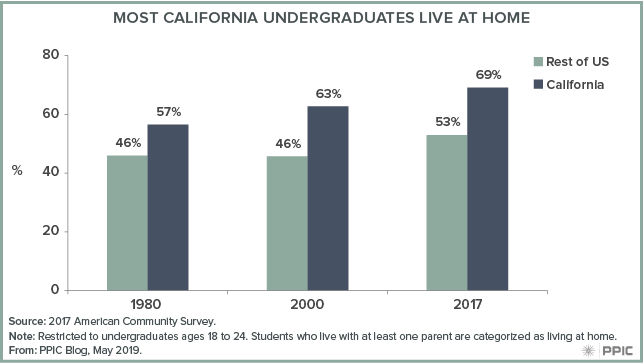
In fact, the large majority of California undergraduates do live at home (69% in 2017), and that share has been increasing over the past few decades, according to the American Community Survey. Moreover, California college students are substantially more likely to live at home than their counterparts in the rest of the nation.

figure - Most California Undergraduates Live at Home

Partly, this difference reflects the mix of colleges in California. Community college students are especially likely to live with parents—not surprising given the broad geographic coverage of this system. And CSU students are more likely to live at home than UC students. But the difference in living situations between California students and their peers nationwide almost certainly reflects California’s higher housing costs.

Living at home while attending college can be a great way to reduce costs. But it also has a downside. Research suggests that students who live at home are less connected to their college—and less likely to graduate.

California’s colleges and universities cannot solve the state’s housing crisis, but many of them are working to expand on-campus housing opportunities. They are also working with the state to develop ways to expand grants to cover housing costs as well as tuition. The governor’s proposed budget includes $40 million to provide emergency housing support for UC and CSU students (including those struggling with homelessness).

With no quick solution to the high cost of housing in California, thoughtful actions will be critical to providing support to college students across the state.