Testimony: Career Education Is Key to Meeting California’s Workforce Needs

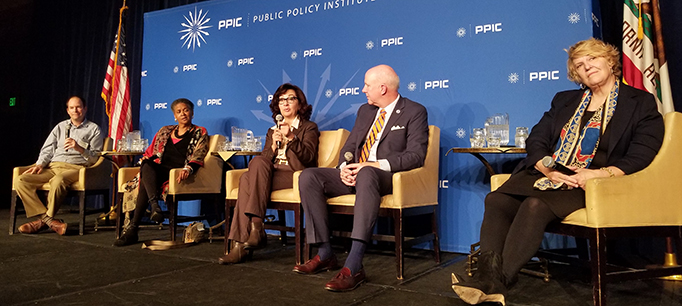
Sarah Bohn, research director and senior fellow at PPIC, testified today, November 27, 2018, before the Assembly Select Committee on Career Technical Education and Building a 21st Century Workforce. Here are her prepared remarks.

Thank you for convening this informational hearing on higher education and the workforce. PPIC recently surveyed Californians on these topics and a large majority (75%) view the state’s higher education system as very important to the quality of life and economic vitality of California. Not surprisingly, the same share say that the higher education system should be a high or very high priority for the new governor. So this hearing is extremely timely and I’m so pleased to share PPIC research on education and workforce needs.

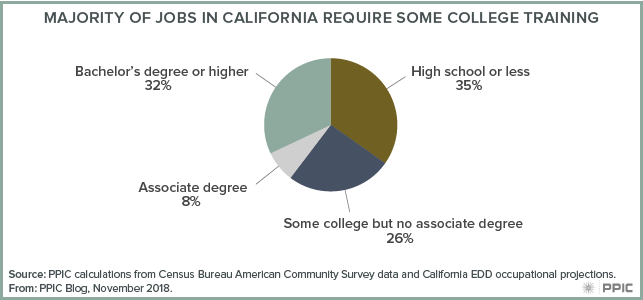
Most jobs require some college training

The majority of jobs today and in the future will require education beyond high school—split about equally between jobs that require a four-year college degree and those that require education or credentials provided at community colleges. Only about one-third of new jobs created in California over the next decade or so will be available to workers with no more than a high school diploma. These workforce needs are the result of long-term shifts toward a knowledge-based economy. It’s not just that there are new jobs that require more postsecondary education, but the need for credentials within professions has grown as well. For example, more office administrators now have a college education than in the past.
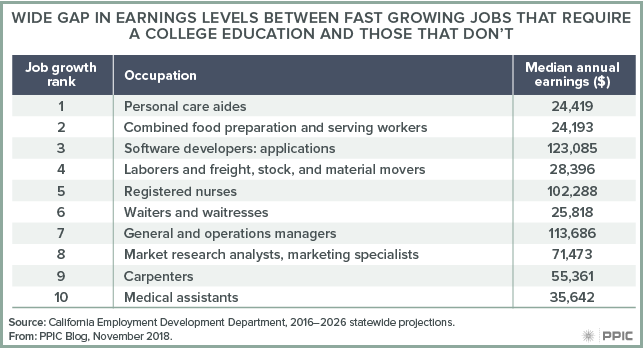
Better-paying jobs are more likely to need college training

College credentials are also the route to accessing better-paying jobs. With the trend toward a knowledge-based economy comes an increasingly wide gap in terms of earnings between jobs that require a college education and those that don’t. Among the top ten occupations in terms of job growth you find many service sector jobs that pay less than $35,000 in annual earnings (personal care aides, food preparation, freight/stock movers, medical assistants) and do not require a college education. And you find a handful of jobs at the opposite extreme—which pay three to four times as much and require a college education (registered nursing, software developers, managers). This trend is likely to continue and might become more extreme with additional pressures like AI (artificial intelligence) and further automation.
California’s community college system is key to meeting state workforce needs

Ensuring we have the workforce to meet these demands—and ensuring future workers can access higher-paying jobs—requires a higher education system that is responsive to student and economic needs. The young workers of today and tomorrow are much more diverse than the current workforce, comprised of demographic groups with historically lower levels of college attainment (including racial/ethnic minorities and first-generation college students). And though we’ve made progress, there’s still room to broaden access to college—and narrow achievement gaps.

For that reason, community colleges—and career education programs in particular—are critical to educating our future workforce. The community colleges are the most common entry point to higher education for Californians, serving almost three times as many students as CSU and UC combined. They also serve a more diverse mix of students. In career education (or CTE) programs, the majority of students are nonwhite and low income. Students range from recent high school graduates to stranded workers (who lack the skills needed to succeed in the job market) to older workers in need of retraining. And these programs provide opportunities in a wide spectrum of careers. As just one mission of the community colleges, CTE is so consequential for meeting workforce needs and improving economic outcomes because it is often the fastest route to new and better careers.

Career education programs can pay off for students

Earning credentials in CTE pays off for students. Those who earn an associate degree see a 20–35% increase in their wages. The payoff wanes for shorter credentials but remains positive even for certificates that can be earned in less than a year (certificates of 6–18 units). But the choice of program or career matters a lot. If health programs are excluded from these calculations, the payoff is much lower on average (4–7% for an associate degree). The health field offers the highest returns across all broad program types. But there’s even variation in which health programs pay off (e.g., registered nursing is more remunerative than medical assisting).
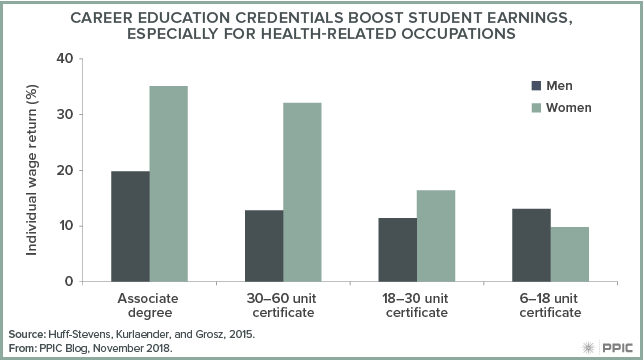
Because CTE credentials vary so much in terms of what they offer in the labor market, the choice of what to study can be as important as the choice to go to college. That information is critical for policymakers evaluating effectiveness and especially for students choosing programs. I commend the community colleges in sharing earnings potential data on their website through tools like Salary Surfer.

Some students may need new job skills to move along a career pathway to higher-paying jobs

Instead of pitting one type of credential or program against another, what we should be thinking about is improving long-term economic mobility for students. A lot of CTE students start by earning a short-term credential, which offers the lowest earnings bump, on average. But those credentials might help an individual switch to an industry with more opportunity in the long run or to start an educational career pathway toward higher-level achievement (i.e., earning “stackable” credentials). Unfortunately our research shows that only a small share of CTE programs (at most 18%) have well-defined career pathways and less than one-quarter of students who start with short-term certificates take additional steps toward broader career options.

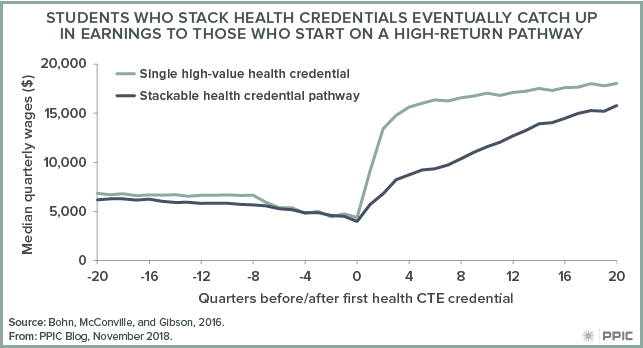
But there’s great promise in improving those career pathways. We found that students who “stack” credentials—in this example, in a health field—eventually catch up in earnings to those who started on a high-return pathway like registered nursing. Students who earn a single health credential (mostly high-return associate degrees) see a marked improvement in their earning trajectory. Those who complete a lower-value credential but then return and complete a second one later do nearly as well. Of course this takes time (which is not free), but it’s a reminder that a single credential is not the end of the road. Effective CTE programs can connect students to in-demand and high-return careers in many ways.
In closing, this research suggests state investments in CTE are worthwhile, both for improving student career outcomes and meeting workforce needs. But the state and colleges can’t operate alone; partnership with businesses will be key to making sure that programs address workforce needs and adjust as those needs change. Only then can the state be deliberate in its investments to make sure that CTE programs improve long-term outcomes for students and the state’s economy.

Californians’ Priorities for the Next Governor

Mark Baldassare, PPIC president and CEO and director of the PPIC Statewide Survey, spoke to the Sacramento Press Club on November 19, 2018 in a post-election discussion with Mark DiCamillo, director of the Berkeley IGS Poll. Here are his prepared remarks.

While we are still counting votes in California, the 2018 election can be called a sweeping success for Democratic candidates in the statewide races. Democrats also won the coveted two-thirds majorities in the state senate and state assembly, and increased their dominance of the California congressional delegation. The Republican Party’s efforts to stem their losses by getting behind what they hoped would be a popular gasoline tax repeal stalled as Proposition 6 fell short (57% no).

In the governor’s race, Democrat Gavin Newsom defeated Republican John Cox by a double-digit margin that was similar to the re-election win of Governor Jerry Brown over Neil Kashkari in 2014 (60% to 40%). Newsom was the leader in eight PPIC Statewide Surveys on the governor’s race conducted since last December. Cox surged to second place after President Trump endorsed him in the June primary, but he was unable to expand his base much beyond the president’s approval rating (39%, October PPIC survey).

What are Californians’ priorities for Governor-elect Newsom? California voters mentioned health care, immigration, the economy, the environment, and gun policy when asked to choose the most important issues facing the country in the exit polls (CNN poll, Fox poll). This list covers most, though not all, of the most important state issues mentioned in 2018 PPIC surveys. It also offers a good starting point for identifying issues that will shape the Newsom era. Here is what the 2018 PPIC surveys have to say about each one:

Health Care. A record-high 59 percent of Californians have a favorable view of the Affordable Care Act (ACA) in the October PPIC survey. While 65 percent think it is the responsibility of the federal government to make sure that all Americans have health coverage, just 34 percent say it should be provided via a single government program instead of the current mix of private and public programs. While 64 percent of adults favor a single-payer state government health plan, support drops to 41 percent if it means raising taxes, according to the May PPIC survey. In the wake of ACA repeal and replace efforts, California’s health insurance exchange and MediCal expansion seem to be generating more public support, while the desire for wholesale change are tempered by concerns about choices and costs.

Immigration. Seventy-four percent of Californians believe that immigrants are a benefit to the state, while 85 percent say that there should be a way for undocumented immigrants to stay in the country legally, according to the May PPIC survey. About three in four (74%) oppose building a wall along the border with Mexico in the October PPIC survey. Nearly six in 10 (58%) favor state and local governments taking action, separate from the federal government, to protect the legal rights of undocumented immigrants in California in the October PPIC survey. Given the large immigrant population and strongly held public views, the next governor will be expected to lead the resistance against federal policies.

The Economy. About half of Californians say they expect good times financially for the state (48%) and the nation (48%) over the next 12 months, according to the October PPIC survey. Still, jobs and the economy tops their list when asked to name the most important issue facing the state in the September PPIC survey. Related to this concern, 60 percent say that the state government should be doing more to reduce the gap between the rich and the poor in California. At least half across demographic groups and regions say the state should do more. The next governor’s challenge in meeting this expectation will be the ambivalence about footing the bill. Fifty percent say they prefer to pay higher taxes and have a state government that provides more services, and 77 percent of them say the state should do more. But of the 44 percent of Californians who would rather pay lower taxes and have fewer services, just 42 percent hold this view.

Environment. A record-high 56 percent of likely voters say that the gubernatorial candidates’ positions on the environment are very important in determining their vote, according to the July PPIC survey. Many Californians say they are concerned about the personal impact of global warming in the wake of a prolonged drought and in the face of growing evidence that extreme weather from climate change is resulting in more severe wildfires. As the federal government has dramatically changed course on environmental issues, most Californians say they want the state government to make its own policies to address global warming, and many say that it is important for California to act as a world leader in fighting climate change. Californians will be looking to the next governor to build on the work in progress, while dealing with environmental crises like the wildfires this fall and with legal challenges from the Trump Administration.

Gun Policy. Most Californians (64%) say the laws covering the sale of guns should be made stricter, according to the October PPIC survey. The belief that gun laws should be stricter was at a record-high 73 percent in the March PPIC survey, shortly after the devastating high school shooting in Parkland, Florida. In the wake of the recent tragic shooting in a bar in Thousand Oaks, California, the public’s belief that gun laws should be made stricter may climb higher. And with the absence of new federal legislation to address gun violence, the governor-elect will be asked to find ways to improve the current laws restricting guns in California.

Californians’ priorities also include big-ticket items such as universal preschool and tuition-free community college that would add up to “cradle to career” education, initiatives to tackle housing affordability and homelessness, and adequate water and transportation infrastructure. The next governor will also be tested by a Democratic-controlled legislature with pent-up demand for spending after eight years of fiscal caution under Governor Brown. The October PPIC survey offers this guidance if voter approval is needed: a majority of California adults prefer a bigger government with more services to a smaller government with fewer services (54% to 39%); however, a majority of likely voters prefer a smaller government with fewer services to a bigger government with more services (53% to 41%).

As the priorities, plans, and programs of the new governor take shape in the next year, the mission of the PPIC Statewide Survey—­­ to provide a voice for all adults and likely voters— is one that we take very seriously during this critical moment of policy development. And as we look to 2020, it’s important to remember that California will be playing an early and outsized role in the presidential election, with an early March 3 primary. PPIC will host a series of one-on-one public forums next year with state and national leaders, to discuss their leadership style and to explore their vision for the state’s and nation’s future.

Video: Water Priorities for California’s Next Governor

California’s many water challenges are complex, with many possible solutions and even more opinions about best approaches. How can a new governor forge a path forward in this critical area?

The PPIC Water Policy Center assembled a group of 16 experts this week for a half-day workshop in Sacramento to discuss how the new administration can promote water policies and practices that benefit the state’s people, economy, and environment. Lively discussions addressed three overarching topics: how local and state water policies intersect with California’s most pressing economic issues; innovations in policy, practice, and technology that offer better solutions for key water problems; and steps needed to adapt the state’s water systems to a changing climate.

Ellen Hanak, director of the PPIC Water Policy Center, summarized some major water challenges the new administration will face, including increased risks of drought and floods; poor water quality and drying wells in disadvantaged rural communities; and finding durable ways to pay for needed water system improvements. Leadership will be key to advancing solutions, she said.

“California has been a leader both nationally and internationally” on climate change mitigation and reducing emissions, Hanak said. “We think California has the potential to be a leader when it comes to climate adaptation as well.” She noted that water is a lynchpin issue for addressing the effects of a changing climate.

The first panel shed light on the links between water and the state’s leading economic challenges, from housing affordability to jobs. For example, growing water scarcity in the San Joaquin Valley—one of California’s fastest-growing areas―will affect plans to build new housing there. And regulation can complicate efforts to build affordable housing. Dan Dunmoyer of the California Building Industry Association noted that some water-related regulations—such as strict rules to prevent runoff from construction sites during the rainy season—can significantly increase building costs. Panelists agreed that better coordination could help open up many of these bottlenecks.

Denise Fairchild of Emerald Cities Collaborative highlighted the potential for job training programs in the water sector—which is grappling with the “silver tsunami” of an aging workforce—to create economic opportunities for low-income communities. “If we take this opportunity to rebuild California’s water infrastructure, it has great job generation potential” in communities affected by a historical lack of water sector investment.

The next panel looked at technical and policy-related innovations that can improve water management, such as weather forecasting tools that enable more nimble water management in dams—key to adapting to an increasingly volatile climate. Also, better information on agricultural water use can “empower communities to stop arguing about numbers and start working on solutions,” said Robyn Grimm of Environmental Defense.

The final panel explored opportunities to modernize the state’s water “grid”—its vast network of reservoirs, aquifers and conveyance systems—to make it more resilient in the face of five climate pressures: warming temperatures, shrinking snowpack, shorter and more intense wet seasons, more volatile precipitation, and rising seas. Improving water conveyance and reworking the current system would enable the state to “take advantage of bigger storms” linked to climate change by capturing their water for recharge, said Ashley Boren of Sustainable Conservation.

Each panel discussion included a quick round of “elevator pitch” advice for the governor-elect. Jennifer Pierre of the State Water Contractors captured the mood of the group with her pitch: “In water, flexibility is the name of the game—we need it for managing the existing grid, and for grid improvements. Don’t wait for the perfect plan; we’ll suffer every year that we delay.”

We invite you to watch the videos from this event and hope you find the discussions helpful:

Video: Stackable Credentials at California Community Colleges

California’s community college system is the state’s primary provider of postsecondary career education and plays a critical role in meeting workforce needs. Stackable credentials are a key component of career education programs—students who “stack” multiple, related awards can build skills and increase their potential to advance in a career over time. As the state continues to invest in career education, it is important to understand how these programs can expand employment opportunities, particularly for students who do not get four-year degrees.

In Sacramento this past Tuesday, PPIC researcher Shannon McConville outlined findings from a new report that identifies stackable credential pathways in several disciplines and looks at whether programs with well-defined pathways facilitate stacking. Building on previous PPIC work on stackable credentials in health care, this new report focuses on several other fields—including business, information technology, and engineering.

Nearly 40% of community college students in career education programs start with short-term certificates, which can be earned relatively quickly. Most return to college after earning a short-term award, but fewer than one in four obtain an additional credential. Making it easier for these students to move along a stackable credential pathway could help them get better jobs and earn higher wages.

PPIC’s analysis of existing programs across the community college system suggests that well-defined pathways with clearly mapped course sequences and multiple exit and reentry points do increase the odds of students stacking credentials. It also indicates that few programs have course and credential sequences that are designed to be stackable. Expanding the number of programs with clearly designated stackable features could go a long way toward strengthening the links between career education and long-term employment opportunities.

Video: 2020 Census: ¿Por qué es tan importante el censo?

El censo decenal juega un papel muy clave en la democracia estadounidense. Es bastante lo que está en juego para Californiay el año 2020 se acerca rápidamente.

En este video grabado en español, Joe Hayes, investigador de PPIC, explica la importancia del censo del año 2020, y comenta sobre la propuesta de incluir una pregunta sobre la ciudadanía.

Vea más videos en esta serie.


The decennial census plays an essential role in American democracy. The stakes are huge for California—and 2020 is fast approaching.

In this Spanish-language video, PPIC researcher Joe Hayes explains the importance of the 2020 Census and discusses the proposed citizenship question.

View more videos in this series.


An English transcript of the video is available here.

Video: A Conversation with Candidates for US Senate

As part of our Speaker Series on California’s Future, PPIC is inviting all major candidates in selected statewide races to participate in public conversations. The purpose is to give Californians a better understanding of how candidates would approach the challenges facing our state.

To give Californians a chance to hear directly from the two candidates for California’s US Senate seat, PPIC invited California state senator Kevin de León and US senator Dianne Feinstein to San Francisco on Wednesday to talk about their visions for California and the nation. PPIC president Mark Baldassare moderated a lively discussion that covered a range of topics.

The candidates, both Democrats, were in agreement on many state and national issues—including gun regulations, the Delta tunnel proposal, and comprehensive immigration reform. Both would support revisiting the allegations against Supreme Court justice Brett Kavanaugh, and both feel that there are Republicans in Congress who want to reach across the aisle.

But while both candidates talked about the need for universal health care, they had different views on the way to proceed. As Feinstein put it, “I believe in universal health care. The question is how we get it.” She outlined an incremental approach—offering a public insurance option, lowering the age of eligibility for Medicare to 55, and allowing Medicare to negotiate drug prices. By contrast, de León characterized health care as a right: “I believe that health care is a human right. I believe in Medicare for all.” He also cited his leadership in creating the Covered California health care exchange, expanding access to the exchange to undocumented minors, and instituting drug price transparency in California.

The candidates’ views on health care epitomize their overall approaches to governing. For de León, the key is to bring his experience in California to Washington. Asked about the tensions between California and the federal government, he said, “California has been the leading voice for the entire nation. The world looks to California, not Washington, DC.” And he argued that Democrats in Congress need to elevate key issues, “even if we’re in the minority.” In response to a question about why he wants to be California’s US senator, de León said, “I’m running to give you a new voice, and a new approach.”

Feinstein often focused on what her years of experience in the Senate have taught her about the complexities and difficulties of governing. She reminded the audience more than once that Democrats are in the minority: “When you have both houses and the White House controlled by one party, it is extraordinarily difficult.” Explaining why she’s running in 2018, she focused on the work that needs to be done: “In terms of American public policy domestically, we can achieve a great deal . . . if we’re smart in how we go about it.”

1 in 4 Child Care Workers in California Lives in Poverty

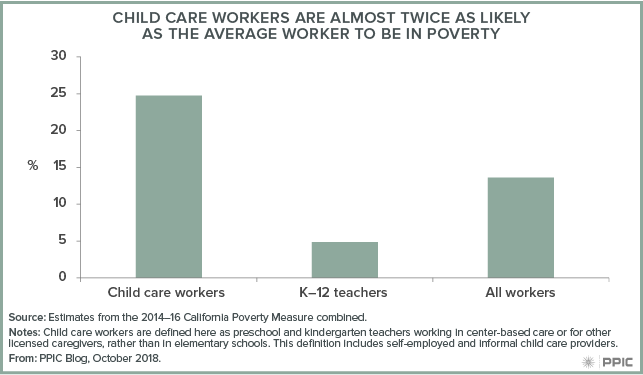
While preschools and child care providers in many parts of California are straining to fill a unmet need, the state’s child care workers are poorly paid and almost twice as likely to live in poverty than workers overall.

California’s child care workers earn significantly less than their school-based counterparts. Given that about 95% of child care workers not based in schools are women, and 53% are African American or Latina (compared with 43% of the overall workforce), women—particularly women of color—are most affected by low pay in the child care workforce.

UC Berkeley found that in 2017, the median hourly wage for child care workers in California was $12.29—just one-third the median wage for kindergarten teachers. Earnings among child care workers track more with low-wage workers across California (defined as those earning less than two-thirds of the median wage). These low wages translate to about a quarter of child care workers living in poverty as compared to 14% of all working adults (ages 18-64)—according to the California Poverty Measure, developed by PPIC and the Stanford Center on Poverty and Inequality.

Low wages are just one piece of the poverty puzzle. Relative to all working adults, child care workers are more likely to have only part-time work (more than a third, compared with less than a quarter of the overall workforce), which is associated with dramatically higher poverty rates than full-time employment. Many have completed some college credit or have an associate’s degree (44%), but just a fifth have a four-year degree, in a workforce where more than a third of working adults have four-year degrees. And while people working in child care are as likely to have children as the average working adult, those who do are more likely to be parenting alone (11%) than the average worker (6%).

The social safety net is an important part of helping child care workers make ends meet. Half of all child care workers benefit from at least one safety net program or tax credit, with the two largest being CalFresh (25%) and the federal Earned Income Tax Credit (37%). Without this assistance, poverty among child care workers would be even higher—2.5 points higher without the Earned Income Tax Credit, and 2.1 points without CalFresh. Minus all major safety net programs, one in three child care workers would live in poverty.

Recent policy changes could start to boost incomes for child care workers. Expanded eligibility for 18–24-year-olds for the state’s new Earned Income Tax Credit, starting in 2019, will specifically help the 20% of the workforce who are under 25. Steady increases in California’s minimum wage could improve earnings of child care workers employed by providers subject to minimum wage laws. Yet many workers are self-employed, providers often operate with limited incomes, and the cost of care itself is already high for low-income families. Minimum wage increases will likely result in a better-paid child care workforce only if they are accompanied by sector-wide changes aimed at making child care both affordable and accessible.

The needs of child care workers will affect efforts to improve and expand California’s complex child care system. While the state and federal governments have begun to increase access to child care with expanded programs and additional funding, improving living standards for child care workers will be a major challenge for California’s next governor.

Video: Californians and Their Government

As the November election approaches, Democrat Gavin Newsom has a 12 point lead over Republican John Cox in the race for governor. In the US Senate race, Dianne Feinstein leads fellow Democrat Kevin de León by 11 points. Half of likely voters see this election as more important than past midterms; most lean toward Democratic candidates in US House races. These and other key findings in the latest PPIC Statewide Survey were outlined by PPIC researcher Dean Bonner at a Sacramento briefing last week.

A slim majority of California’s likely voters oppose Proposition 6, a ballot measure that would repeal recently enacted increases in the gas tax and vehicle registration fees. Proposition 10—which would expand the authority of local governments to enact rent control—is also trailing.

Other survey highlights:

  • Three in four likely voters view the choice of the next Supreme Court justice as very important to them personally.
  • Majorities of registered voters across parties say they do not want to see the Supreme Court’s Roe v. Wade decision completely overturned.
  • A third of likely voters approve of President Trump’s job performance and only 20% approve of Congress; by contrast, more than half approve of Governor Brown and the state legislature has a 44% approval rating.
  • Likely voters are most likely to name jobs and the economy, immigration, and housing as the most important issues facing the state.

Poverty in California Is High by Any Measure

The Census Bureau recently released updated income and poverty statistics for the years 2015–2017 combined, including information on the Supplemental Poverty Measure (SPM) for states. The SPM updates official poverty statistics, which are released annually, by accounting for the varying cost of housing across states and the impact of key social safety net programs like federal and state Earned Income Tax Credits (EITCs). According to the SPM, California continues to have one of the nation’s highest poverty rates, neck-and-neck with Florida (18.1%) and Louisiana (17.6%). While California’s poverty rate for 2015–2017 was 19%, the national poverty rate was much lower, at 14.1%.

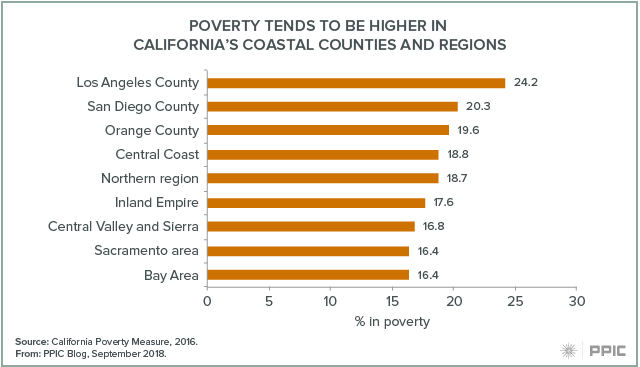
The California Poverty Measure (CPM), a collaborative effort by PPIC and the Stanford Center on Poverty and Inequality, provides additional detail needed to understand our large, complex state. It takes into account both the varying cost of living and the poverty-mitigating role of social safety net programs like the EITC and CalFresh within different regions of California. PPIC published CPM estimates in July indicating that 19.4% of Californians lived in poverty in 2016. Poverty rates are highest in certain coastal areas, including Los Angeles County, where the mix of the high cost of housing, employment opportunities for low-skilled workers, and access to large-scale social safety net programs create particularly challenging circumstances.

Blog figure: Poverty tends to be higher in coastal counties and regions

Despite the important role of social safety net programs, employment is a key factor in determining poverty status. Adults working full time and for the whole year have a poverty rate of just 8.3%, while nearly a quarter (23.5%) of those working less are in poverty. At the same time, employment does not eliminate poverty: 44.6% of working adults in poverty are actually working full time, year round.

Blog figure: Close to half of working poor adults in California are working full time, year round

What can policymakers do to improve the situation in California? The good news is that there are diverse opportunities to address poverty. Moderating housing costs, supporting proven employment and training programs, and vigorously supporting social safety net programs all offer opportunities to improve the well-being of disadvantaged Californians.

Could Wildfires Affect the 2020 Census?

The decennial census plays an essential role in American democracy. The stakes are huge for California, and 2020 is fast approaching. This series of blog posts takes a detailed look at California communities that may be at risk of being undercounted.

Wildfires in California have burned millions of acres and destroyed or threatened thousands of homes, displacing families around the state. Among their many devastating long-term effects, disasters may elevate the risk of undercounting some communities in the upcoming census.

The Census Bureau’s goal is to “count everyone, only once, and in the right place.” In practice, this means that people are counted where they reside as of “Census Day” (April 1, 2020), even if this is not their permanent residence. Given that Californians who lose their homes in disasters must then find housing in a notoriously difficult market, housing conditions alone could pose a hurdle to accurately counting communities that have been displaced by wildfires.

Hurricane Katrina presented similar issues for the 2010 Census. While some people displaced from the Gulf Coast moved away permanently, many others were counted in counties or states they intended to leave once their homes were again habitable. Still others stayed in accommodations closer to home, which—depending on resources—were sometimes shared, non-standard, or even not yet considered habitable. These families proved difficult to reach by mail, with just 45% of New Orleans households returning forms at first (compared with 61% in 2000). On-the-ground staff were ultimately responsible for hand-delivering questionnaires to the majority of New Orleans homes. Even though the Census Bureau can request a funding contingency for such costly efforts, it will have many competing demands for resources in 2020.

In the aftermath of California’s recent fires, local areas face unique challenges to getting an accurate census count—particularly in terms of housing. Here we look at three of those areas across the state. Current estimates show that 20,000 residents were affected by the Carr fire (Redding, 2018) and that the Thomas fire (Ventura County, 2017) and the Tubbs fire (Santa Rosa, 2017) each affected about 40,000 residents. Before the fires, none of these areas stood out in terms of having large populations of hard-to-count residents, but the loss of housing could create new obstacles.

Even in normal times, housing plays a key role in getting an accurate census count. Rental units and mobile homes are less likely to appear on official census address lists. Moreover, their residents tend to move more often, making them hard to reach. Wildfire displacement heightens these challenges, especially in places where housing was already hard to count. For example, mobile homes made up 6% of housing in the Thomas fire area—double the statewide average. In the Carr fire area, they constituted 10%.

Before the fires, the share of renters in all three fire areas was lower than the statewide share, but the loss of homes likely changed this picture. CalFire reports that the Thomas fire destroyed 775 homes—and subsequent mudslides in the area demolished at least another 100. The Carr fire destroyed 1,079 homes, and the Tubbs fire razed 3,000. Displaced residents are more likely to rent, reside in non-standard arrangements, and/or struggle with poverty, creating new challenges for the census count.

Blog figure: Housing conditions in fire zones varied widely

In 2020, given the likelihood that families will continue to be displaced by wildfires or other natural disasters, it will be important for state and local leaders to coordinate with the Census Bureau to ensure that all Californians are counted accurately—regardless of their housing situation. For more on areas with hard-to-count housing and other challenges, visit PPIC’s interactive census maps.