2020 Census: Hurdles Remain as the Count Nears

This post is part of a series examining challenges involved in the 2020 Census and what’s at stake for California. Click here to see our full coverage.

Described as the largest peacetime operation undertaken by the federal government, the census is used for everything from allocating congressional seats to redrawing voting districts to distributing billions of dollars in federal funding. Many Californians are at risk of being undercounted, and an inaccurate count could have far-reaching implications.

Following decades of escalating costs, the Census Bureau has made significant changes to modernize the census, in hopes of keeping costs similar to what they were in 2010 ($92 per household). For the first time, most households will be invited to respond online, and newly developed tools will help manage field operations. These changes should reduce the staffing levels and infrastructure necessary to conduct the census.
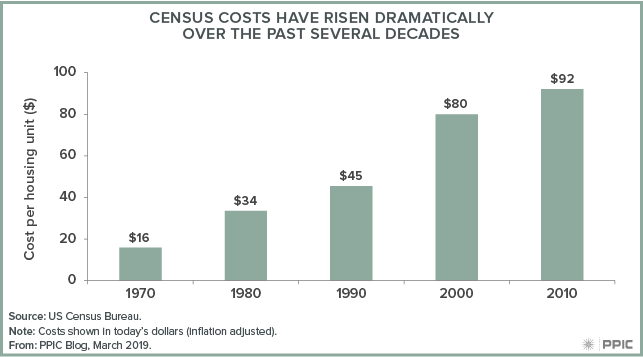
Census Costs Have Risen Dramatically Over the Past Several Decades

But new approaches also create new risks. The US Government Accountability Office has designated the 2020 Census at high risk of failure, citing capacity and planning issues and the fact that the testing of new systems has been scaled back. Several field tests were cancelled in 2017, and the full end-to-end test, which is designed to approximate actual census operations, took place in only one location rather than three, as originally planned. Recently, the NAACP released documents suggesting that chronic underfunding and understaffing at the Census Bureau have negatively affected census preparations.

As of December 2018, the Census Bureau had identified almost 1,100 security weaknesses in its IT systems that still needed to be addressed. Possible threats include disruptions to the website platform, malware from respondents’ personal devices, and impersonation of the Census Bureau. The bureau maintains that it is fully vetting new processes—including working with industry and the Department of Homeland Security to identify and protect against IT threats.

Another big uncertainty concerns the federal administration’s plans to add a citizenship question. Several lawsuits have challenged this decision, and the Supreme Court is scheduled to make a ruling by the end of June on whether the question can be included. Regardless of the ruling, census responses are confidential and, under federal law, the Census Bureau cannot share any personally identifiable information, even with other government agencies. However, combined with federal government rhetoric and actions around deportation, a citizenship question may lower response rates among California’s 10 million immigrants, especially households with undocumented members.

Last year’s end-to-end test did not include a citizenship question. But this July, the Census Bureau will conduct a nationally representative test that should shed light on the question’s potential impact on response rates. Results will help shape the bureau’s outreach strategy and determine if more census workers are needed to follow up with households that don’t respond.

In the meantime, what can California do to ensure an accurate count next year? The state has already invested more in census outreach than any other: $100 million for 2018–19, with an additional $54 million proposed for 2019–20. State and local governments and organizations all have a role to play. Building awareness about the role of the census in determining funding for local public services will go a long way toward motivating Californians to respond, as will assuring residents that their data will be safe and secure.

To discuss what’s needed as California prepares for the 2020 Census, PPIC will be hosting an event on Monday, March 25 in Sacramento with Secretary of State Alex Padilla and other distinguished leaders and experts. Those who cannot attend in person are welcome to join the live webcast, or visit our website later to watch a video of the event.


A Coordinating Council for Higher Education

The California Legislature and Governor Newsom are interested in creating a new coordinating entity for the state’s public higher education system. The state has been without such an entity since 2011, when Governor Brown vetoed funding for the California Postsecondary Education Commission (CPEC). A new coordinating entity can help the governor and legislature improve higher education by providing expertise and analysis. But it will require policymakers to provide a solid foundation for its work.

California’s 1960 Master Plan for Higher Education gives the three state public higher education segments—the University of California, the California State University, and the California Community Colleges—significant autonomy. CPEC was created to help policymakers conduct long-term planning, monitor student outcomes, and oversee intersegmental policies that make it easier for students to navigate through the college and university systems. A new PPIC report looks at the strengths and weaknesses of CPEC to provide suggestions about how to make a new coordinating entity as effective as possible.

CPEC’s experience underlines the need for clear state goals and objectives. A higher education coordinating body can advocate effectively for student success and assess how well the segments are meeting the needs of the state economy. But higher education in California has changed significantly over the past several decades, and the Master Plan is either silent or outdated in important areas.

CPEC’s history also shows that the details of the coordinating entity’s design are important in giving it a strong, unified voice in the budget and policy process. A coordinating entity should be empowered to monitor whether the state’s higher education goals are being met and suggest ways to make the system more effective. When the segments fall short or when there are conflicts about how best to accomplish state goals, the coordinating entity should be able to work with the colleges, universities, and state policymakers to find workable solutions.

In this time of heightened demand for higher education, the governor and legislature could benefit from a coordinating body that acts as an honest broker in helping the state provide access to all interested students while maintaining the quality of public higher education that California is known for.

What’s Next for California’s Public Pensions?

Last week, the California Supreme Court issued an important ruling regarding public pensions. The case, CalFire Local 2881 v. CalPERS, was one of several lawsuits challenging the major 2013 pension reform law that was championed by then-Governor Brown. By upholding the changes contained in the law, the court’s decision answered one important question about the law’s legality. But it also left a much larger one unanswered: whether state or local governments will be able to alter some pension provisions during a future economic downturn.

Pensions present a significant challenge for California. The largest funds at the pension systems for California’s public employees (CalPERS) and state teachers (CalSTRS) have reported gaps of more than $138.9 billion and $107.3 billion, respectively, between their estimated obligations to retirees and the current value of their assets.

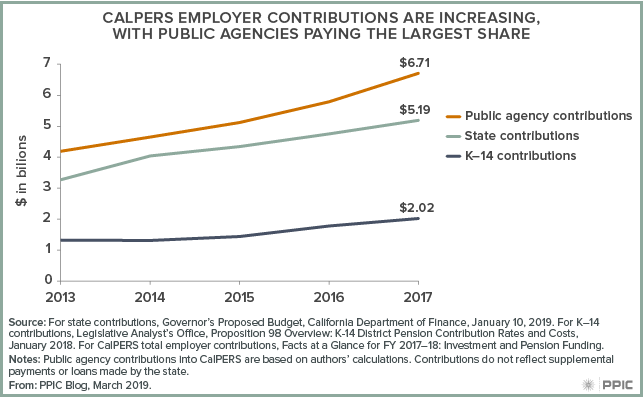
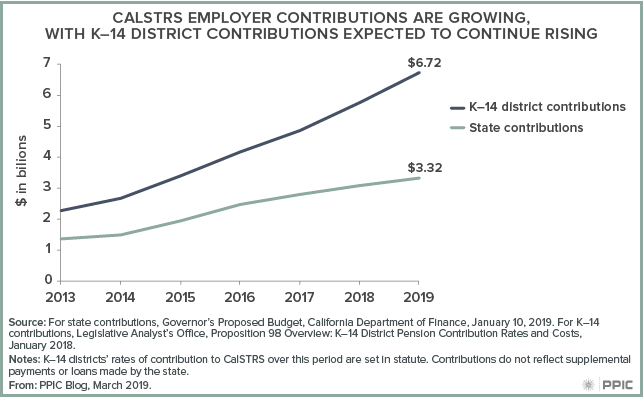
Closing those gaps will require larger payments from state and local governments, squeezing out dollars that would otherwise be used for programs and services. Employer contributions have already increased substantially in recent years. For example, public agency contributions into CalPERS increased from $4.19 billion to $6.71 billion from 2013 to 2017. And K–14 district contributions into CalSTRS have increased even more sharply, from $2.27 billion to $6.72 billion between 2013 and 2019. Indeed, the need to meet pension obligations was one of the financial pressures factoring into both the Los Angeles and Oakland teacher strikes.

CALPERS Employer Contributions Are Increasing with Public Agencies Paying the Largest Share

CALSTRS Employer Contributions Are Growing, with K-12 District Contributions Expected to Continue Rising

Prior to the end of his final term, Governor Brown anticipated that the court would rule broadly, giving future governors “the option of considering pension cutbacks for the first time in a long time.” Such flexibility would be helpful to policymakers trying to balance budgets should a future recession lead to a drop in revenues.

But the court’s ruling was far more narrow, saying that a pension provision provided by the legislature could later be removed. The provision in question—referred to as airtime—allowed public employees to “purchase” additional years of service for their pension calculations. By paying more into the system, someone with 15 years of service could have their pension calculated as if they had worked 20 years. It turned out this was costing more in future pension payouts than the value paid by the employee for the added years. The legislature ended the practice in 2013 and the court decision affirmed it could do that.

The court went on to say that since this specific benefit was not a “core pension right,” it was not part of an implicit contract with the employee. Treating certain pension benefits as a protected contract is part of a long-standing legal precedent known as the California Rule—a precedent that the court explicitly did not address.

So, what happens now? Two upcoming cases before the court, concerning employees from Alameda and Marin Counties, involve another provision of the 2013 reform that excludes certain kinds of pay (e.g., pay for on-call or standby work) from an employee’s pension calculation. Similar to the CalFire Local 2881 case, the unions maintain that how pay is calculated is part of the pension contract and cannot be changed.

Given the clear distinction the court just made between the airtime provision and the California Rule, it very well might take the same approach regarding the calculation of pay—ruling narrowly on the provision but leaving the bigger question untouched. If that happens, it would affirm the 2013 reform but fall far short of Brown’s vision of being able to reduce pensions outright as part of an effort to balance the budget.

Video: A Conversation with Chief of Staff Ann O’Leary

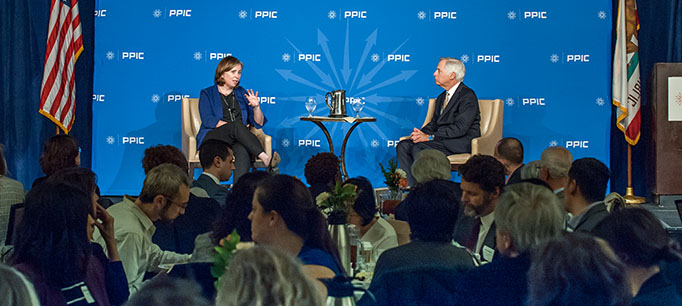
As the Newsom administration lays out its initial plans, PPIC invited chief of staff Ann O’Leary to discuss some of the governor’s top priorities. In a wide-ranging discussion with PPIC president Mark Baldassare last week, O’Leary identified the “cost crisis” in California as one of the main challenges that Governor Newsom plans to address.

“By ‘cost crisis,’ I mean how do we make sure that people in California can have affordability and the opportunity to really take advantage of the California dream?” O’Leary said. “I think too many people in California are really seeing that slip away. They’re not able to afford homes, they’re not able to afford child care, and they’re not able to pay for college for their children as they grow older.”

O’Leary pointed out that confronting this cost crisis would take many forms, such as taking on health care affordability, investing in “cradle to career” education, and addressing housing production and rising rents.

She underscored that the governor’s first proposed budget reflects his vision for promoting affordability and opportunity while ensuring the state’s long-term financial stability. Newsom’s plan includes a mix of one-time and ongoing funding as well as a robust rainy day fund, but “we also go further than that. We have a reserve fund for the safety net, and we also look at how we could use some of the surplus to pay down pension liabilities.”

The governor has also focused on other key challenges—for example, responding to wildfires and tackling the unmet need for safe drinking water in many parts of the state.

On wildfires, O’Leary noted that the governor wants to “make sure that we’re continuing with those recovery efforts to help communities that have been harmed, but also to prepare for future wildfires.” On drinking water, O’Leary said that the governor has already worked with the legislature to provide $20 million in emergency funding to address this issue.

Navigating the PG&E bankruptcy filing is another immediate priority. O’Leary said that over the next 60 days the governor’s team would be creating a roadmap for the state to “protect wildfire victims, protect employees who are out there every day trying to make sure we’re safe, and make sure fundamentally that we have safe and affordable power and that we’re meeting our clean-energy goals.”

O’Leary also discussed the federal-state relationship and how the governor plans to manage it. While pointing out that the state and federal governments need to work together as much as possible, O’Leary also underscored that California must stand up for its values when fundamental disagreements exist, especially on issues such as immigration and family planning. “These are differences of opinion. And it’s a needle we have to thread, but we’re going to do our best.”

Reviving the Health Care Mandate: Who Pays?

Governor Newsom has proposed creating a state individual mandate to help fund increased health insurance subsidies for low- and middle-income Californians. One of the major reforms ushered in by the Affordable Care Act, the federal individual mandate—which was rolled back in the federal tax bill passed in 2017—required most individuals to have comprehensive health insurance or pay a tax penalty. The governor’s administration projects approximately $500 million in revenue from the mandate, based on the total amount paid by Californians in 2016.

As the governor and legislature consider a state mandate, it’s worth examining which Californians paid the federal mandate penalty.

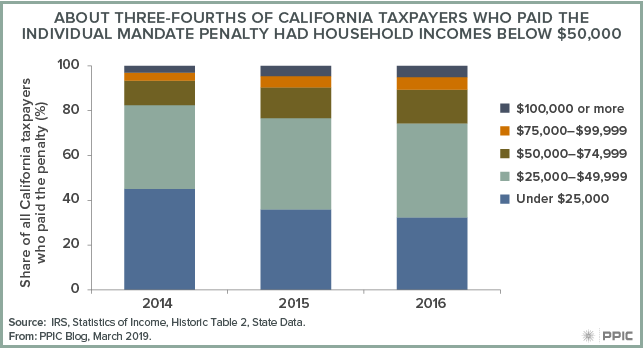
Between 2014 and 2016, taxpayers with incomes below $50,000 accounted for a vast majority of returns that included the individual mandate penalty. In 2014, the first year the individual mandate went into effect, the penalty was 1% of income or a maximum of $285 per family ($95 per adult and $47.50 per child). More than 1 million tax returns in California paid the penalty. Taxpayers with incomes below $25,000 accounted for about 45% of returns subject to the penalty, while those with incomes between $25,000 and $50,000 accounted for another 37%. Even more low-income individuals would have been subject to the penalty if not for certain exemptions—such as having an income below the tax filing threshold ($12,500 for a single adult) or facing hardships like bankruptcy and eviction.

In 2016, the minimum payment rose to 2.5% of income or a maximum of $2,085 per family ($695 per adult and $347.50 per child). The total number of taxpayers subject to the penalty dropped to about 600,000. Those with incomes below $50,000 still accounted for nearly three-fourths of all payments, though this was down from 83% in 2014.

About Three-fourths of California Taxpayers Who Paid the Individual Mandate Penalty Had Household Incomes Below $50,000

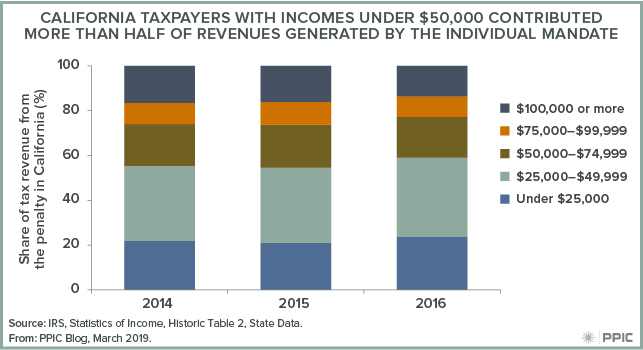
The revenues generated also disproportionately came from taxpayers in lower income brackets. In 2014, taxpayers with incomes below $50,000 accounted for more than 55% of the $222 million in total payments from California taxpayers. Those with incomes under $25,000 paid more than $48 million and those with incomes between $25,000 and $50,000 paid more than $74 million.

Although the number of taxpayers subject to the penalty dropped from 2014 to 2016, tax revenue doubled—in part because the penalty amount increased—and reached $446 million in 2016. Over this time, the share of the total amount paid by households with incomes of $100,000 or more decreased, from 17% to 14%. Meanwhile, the share of revenue paid by those with incomes below $50,000 rose, from 55% in 2014 to 59% in 2016.

California Taxpayers with Incomes Under $50,000 Contribute More Than Half of Revenues Generated by the Individual Mandate

If the state does implement the governor’s proposal, the revenue would increase subsidies currently available for individuals with incomes between 250% and 400% of the federal poverty level ($31,225–$49,960 for a single adult) and expand subsidies to individuals with incomes between 400% and 600% of the federal poverty level ($49,960–$74,940). Most Californians with lower incomes are eligible either for no-cost Medi-Cal or heavily subsidized coverage through Covered California—though not everyone who is eligible enrolls in these programs.

The repeal of the federal individual mandate is expected to lead to an increase in the number of uninsured individuals and higher insurance premiums. A state individual mandate might help counteract those effects by encouraging healthy individuals to enroll in coverage—but at a cost.

In an otherwise progressive state tax structure, the implementation of the federal mandate disproportionately affected low-income Californians. There’s also evidence that some Californians paid the penalty even though they should have been exempt. If the state revives the mandate, the governor and legislature should consider how to improve awareness about eligibility and exemptions so this problem can be avoided. At the same time, reducing the number of people paying the penalty also means that the governor’s revenue estimate may need to be lowered. As policymakers engage in discussions over a state individual mandate, assessing who bears the burden of the tax and who benefits will be an important consideration.

Declining K–12 Enrollment Forces Major Budget Cuts in Many Districts

The teacher strikes in Los Angeles and Oakland reflect the fiscal stresses facing many school districts across the state. Rising pension and health care costs account for some of this pressure. For many districts, declining student enrollment is another factor.

Because state funding is based on average daily attendance, falling enrollment leads to lower state funding levels. Significant, sustained declines require districts to make difficult decisions to stay afloat financially. Since an average of 82% of K–12 spending goes to salaries and benefits, downsizing often means reducing teachers and administrators—or possibly closing a school.

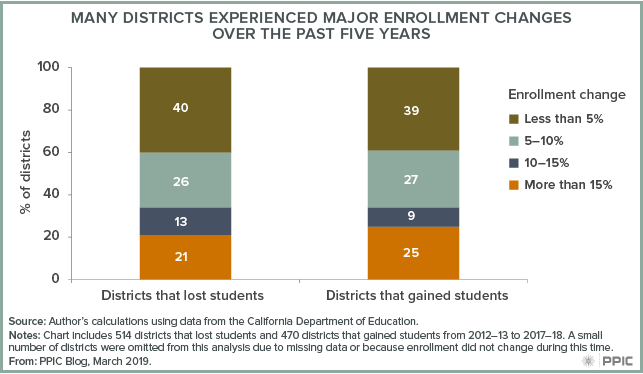
Over the past five years, overall K–12 enrollment in California increased by only 0.1%, or 6,600 students out of the more than 6.2 million attending public schools. This stable picture masks significant variation across districts. Roughly half of the state’s nearly 1,000 districts experienced enrollment losses, while the other half grew over this time. In many cases, the change was small: about 40% of districts experienced a net change—gain or loss—of less than 5% from 2012–13 to 2017–18.

However, the majority of districts saw an enrollment change of more than 5%. Indeed, 107 districts lost more than 15% of students. These districts were generally small: the average school had 700 enrolled students in 2012–13 and lost more than 170 students over the five-year period. In some cases, these large enrollment losses were associated with the closing of a charter school. Many of these districts, though, have only one school, and large percent reductions in enrollment require significant cuts in teachers, administrators, and other staff.

Many Districts Experienced Major Enrollment Changes Over the Past Five Years

Many large districts also lost significant numbers of students over the past five years. In Los Angeles County, for instance, 61 of 79 districts experienced enrollment declines—including Los Angeles Unified, which lost 34,000 students (a 5% decline) and Long Beach Unified, which lost almost 7,600 students (9%). In addition, seven districts with more than 10,000 students lost between 10% and 15% of enrollment. For a district of 10,000 students, losing 10% of enrollment translates into 1,000 fewer students—equal in size to two typical elementary schools. For example, Montebello Unified saw a dramatic 13% decline, losing more than 4,000 students during the five-year period.

Declining student enrollments can be due to a wide range of factors—changes in charter school enrollments, decreasing birth rates, or families moving away, among others. Laying off teachers and adminsitrators is painful—and closing schools is a particularly wrenching topic, as parents value their local schools.

Governor Newsom’s proposal to help districts with rising pension costs may relieve some—but not much—of the financial pressure for districts. K–12 financing in California is also affected by voter-approved initiatives that make significant school funding increases unlikely in the near term. There’s no easy solution, but unless these dynamics change, districts will need to learn to adjust to long-term enrollment and revenue reductions or face the risk of insolvency.

Commentary: A Balancing Act for the Water-Stressed San Joaquin Valley

This commentary was published in the Fresno Bee on February 21, 2019.

The San Joaquin Valley is on the brink of a major transition as it seeks to balance its groundwater accounts. California’s largest farming region has the state’s biggest groundwater deficit—almost 2 million acre-feet per year by our estimates. To put it in context, that’s about one Don Pedro Reservoir’s worth of water a year.

Read the full commentary on fresnobee.com.

Commentary: Delta Interests Should Seize the Opportunity to Cease Water Fights

This commentary was published in CALmatters on February 21, 2019.

The Sacramento–San Joaquin Delta is a major source of water for cities and farms across the state, and a major source of water conflict.

In a Sacramento Bee editorial two years ago, we and our colleague Brian Gray promoted a grand compromise for the Delta. We suggested that the three broad interests fighting about its future—water users, environmental groups, and Delta residents—give up something in order to reduce conflict and make progress. During his first state of the state address, Gov. Gavin Newsom opened the door to just such a compromise.

Three interrelated issues in the Delta are in tension and need resolution:

  • First, the reliability and quality of its water are in decline. More than 25 million Californians and 3 million acres of farmland rely on the Delta for a portion of their water supply.
  • Second, ecosystems in its watershed are changing, harming fisheries and threatening extinction of some native species.
  • Finally, many of the 1,100 miles of fragile levees that protect people’s farms and homes are in need of costly upgrades.

Climate change and rising sea levels are making all of these problems worse.

Gov. Jerry Brown’s WaterFix program aimed to solve the supply problem by building two large tunnels underneath the Delta to route Sacramento River water to Bay Area and Southern California cities and San Joaquin Valley farms.

The project’s size, and its potential for ecological harm if mismanaged, made it untenable to most Delta residents and environmental groups. It also was very costly, with uncertain financing prospects. A stalemate developed in which none of these interrelated issues—water supply, ecosystems, levees—could be adequately addressed.

Gov. Newsom has changed that equation by proposing to build one tunnel, not two.

A single tunnel would perform almost as well as two tunnels, particularly when operated in tandem with the existing pumps in the south Delta. It would cost substantially less. And it would give assurances to environmental groups and Delta residents that the project would not create the large impacts many fear.

Environmental groups should take this opportunity to sign on to a new approach for managing the Delta.

This would involve focusing less on the volume of flows dedicated to protecting endangered species and more on how flows and habitat—managed together—can improve ecosystem conditions.

Doing this well will require major commitments to habitat restoration from the state and water users. It will also require new approaches to managing environmental water.

We recommend establishing ecosystem water budgets that can be stored, traded, and flexibly allocated. This makes the environment a partner in water management rather than merely a constraint. Reliable funding, good governance, and robust scientific support will be essential components of this package.

There’s an opportunity for the new governor to move forward on the ecosystem issue as well. The State Water Board is revising its Water Quality Control Plan for the Delta.

Governors Brown and Newsom have stated their desire that water users and environmental groups develop negotiated agreements as an alternative to new environmental flow regulations from the board.

Done well, such agreements have the potential to create flexible allocations of water for the Delta ecosystem. The clock is ticking. Getting these negotiations completed is critical to resolving the Delta’s problems.

The administration also must address the future of the Delta’s fragile levees. Some are essential for managing water quality, and all are under threat from climate change, sinking land, and earthquakes. There is an opportunity to build upon the recently completed Central Valley Flood Plan and the Delta Stewardship Council’s efforts to prioritize investments in levees. A comprehensive, reliably funded plan that accounts for the multiple threats to levees is sorely needed.

In California’s complicated water wars, some may consider “compromise” synonymous with surrender. But those who insist on fighting will only be rewarded with more fights. Progress happens when parties give up something to get what they really need. By proposing to build one tunnel instead of two, Governor Newsom has opened the door for a grand compromise in the Delta. The Delta’s many interests should seize this opportunity.

A Snapshot of Homelessness in California

In late January communities around the country conducted a point-in-time count of their homeless populations. Federally mandated by the US Department of Housing and Urban Development, these estimates help local, state, and federal governments allocate resources and track progress toward the goal of ending homelessness.

Last year’s count revealed that about 130,000 Californians were homeless—nearly a quarter of the national total. California’s rate of homelessness, 33 per 10,000 residents, was among the highest in the country.

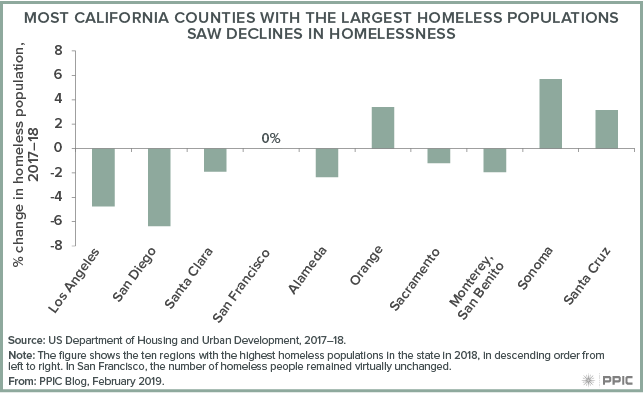
After rising 14% from 2016 to 2017, the total number of homeless Californians declined slightly (by 1%) from 2017 to 2018. Homelessness decreased in many of California’s major urban areas, including in four of the five counties with the largest homeless populations: Los Angeles, San Diego, Santa Clara, and Alameda.

However, even with these decreases homelessness remains a huge problem. Los Angeles County alone recorded nearly 50,000 homeless people. The other nine counties with the largest homeless populations reported between 2,300 and 8,600 people experiencing homelessness. And many areas across the state saw increases in the number of homeless people.

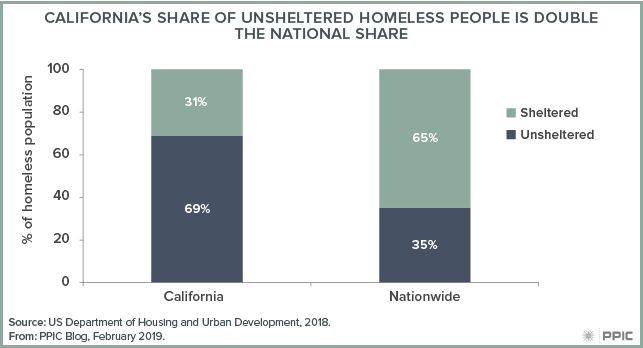
The vast majority of homeless Californians (69%) were unsheltered, meaning they were living in streets, parks, or other locations not meant for human habitation—the highest rate in the nation. Among homeless veterans, California has the nation’s highest share that are unsheltered (67%); and among homeless youth, the share that are unsheltered (80%) ranks second highest.

Homelessness is already on many policymakers’ radar. Governor Newsom’s proposed budget would allocate $500 million in one-time grant funding for emergency homeless shelters and navigation centers, and $25 million ongoing to assist eligible homeless individuals in applying for disability benefits. Localities are also trying a range of approaches to expand affordable housing and increase services for the homeless. For example, voters in Los Angeles, Berkeley, Santa Rosa, and Emeryville recently passed local bonds to fund housing projects and assistance for low- and middle-income households and people experiencing homelessness. Coordinating investments, policies, and programs across federal, state, and local levels will be key to reducing homelessness throughout the state.

Video: Californians and Their Government

As efforts are gearing up in Sacramento to craft a new state budget, a majority of Californians say they approve of Governor Gavin Newsom’s proposed spending plan. Californians also express optimism about the general direction of the state. These and other key findings of the latest PPIC Statewide Survey were outlined by Alyssa Dykman at a Sacramento briefing last week.

The governor’s budget proposal, which calls for increased funds for education and health and human services, garners support from 70% of California adults. More than three-quarters approve of two key components of the proposal: 77% favor allocating $1.8 billion to expand pre-kindergarten and early childhood programs and facilities, and 78% support an $832 million funding increase for public colleges and universities.

The survey also asked whether Californians believe the state is going in the right direction. A majority of adults (55%) approve of where California is headed. This contrasts with less than a third (30%) saying things are going in the right direction for the country. In addition, a record-low 25% of Californians say that President Trump and Congress will be able to work together and accomplish a lot this year.

Other survey highlights:

  • Asked what the most important issue is for the governor and legislature to address in the coming year, more Californians name immigration and illegal immigration (15% adults) than any other issue.
  • Most Californians (67%) are optimistic that Governor Newsom and the legislature will be able to work together and accomplish a lot in the next year.
  • A strong majority of California adults (64%) say President Trump and Republicans in Congress were primarily responsible for the recent partial shutdown of the federal government. Only 24% say Democrats in Congress were responsible.
  • Only about a quarter of Californians (27%) say the situation with illegal immigration across the US-Mexico border is a crisis.