Video: Californians and Their Government

Less than a year before California’s presidential primary, likely voters who are Democrats or who lean Democratic are divided on strategy: is it more important for the party to nominate the candidate who seems mostly likely to defeat President Trump or the candidate whose positions align most closely their views? But almost all Californians see voting in the 2020 elections as very important. At a lunchtime briefing in Sacramento last Thursday, PPIC researcher Dean Bonner outlined these and other key findings from the latest statewide survey.

Two in three California likely voters say they will definitely or probably choose a candidate other than Trump. There is a huge partisan divide on this question: 93% of Democrats and 66% of independents would definitely or probably vote for another candidate if the election were held today, while 82% of Republicans would definitely or probably vote for Trump.

Most Californians say that the investigation by special counsel Robert Mueller did not clear the president of wrongdoing, and Californians are more likely that the nation as a whole to say impeachment proceedings should begin. But here, too, there is a partisan divide: 66% of Democrats say Congress should begin the process, compared to only 39% of independents and 9% of Republicans.

Other survey highlights:

  • A majority of Californians say their housing costs cause a financial strain; six in ten favor the governor’s plan to allocate $1 billion to address homelessness, and similar shares favor proposed new rules intended to create more affordable housing.
  • Three-quarters of Californians see participation in the 2020 Census as very important—but most have concerns about confidentiality.
  • An overwhelming majority are concerned about rising electricity bills in the wake of the PG&E bankruptcy.
  • Californians are concerned that the recent outbreak of measles could spread; most believe that vaccines are very safe and an overwhelming majority say vaccination against measles and other diseases should be required.
2020 Census: Counting California’s Homeless Population

This post is part of a series examining challenges involved in the 2020 Census and what’s at stake for California. 

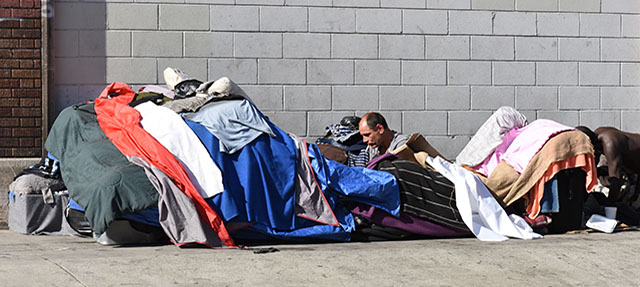
Accurately counting the homeless population is notoriously difficult. People experiencing homelessness can be hard to find—they tend to move around a lot, and at any given time, they might be in a shelter, in a car, outdoors, or couch surfing with family and friends. They may also conceal their living arrangements for privacy reasons or to avoid law enforcement.

The issue is particularly urgent for California as the 2020 Census approaches. California has the most homeless individuals of any state, with 130,000 people living in shelters or outdoors, according to estimates from January 2018. Since this count doesn’t include people staying temporarily with family or friends, it’s almost certainly an underestimate.

Undercounting homeless Californians could affect political representation and lead to reduced federal funding for low-income and homeless families, especially in urban areas with large homeless populations. In addition to determining congressional seats, the census is used to allocate billions of federal dollars for health care, education, and housing programs, including Section 8 housing vouchers for low-income families.

The goal of the census is to count all residents “in the right place,” meaning where they usually live and sleep. People who are couch surfing without a permanent place to live should be included in the household where they’re staying on Census Day (April 1, 2020).

What about people staying in shelters, living outdoors, and residing in other temporary locations? The census bureau has two approaches:

  • Census workers will interview and record responses from people experiencing homelessness at service-based locations or outdoors. These sites include emergency and transitional shelters, soup kitchens, mobile food vans, and targeted outdoor locations (e.g., under bridges, in parking lots, in encampments). This effort will take place from March 30 to April 1, 2020. Census workers in 2010 counted nearly 28,000 Californians in homeless shelters and about 64,000 Californians at other service-based locations and outdoors.
  • Census workers will go to “transitory” locations to collect responses from people who don’t have a usual home elsewhere. These locations include RV parks, motels, campgrounds, racetracks, circuses, carnivals, and marinas. This effort will take place from April 9 to May 4, 2020. Census workers in 2010 collected data from nearly 24,000 transitory locations in California.

The Census Bureau works with local partners to identify service-based and outdoor locations. Input on the latter is particularly important, as California has high shares of homeless individuals who are not living in shelters. The bureau’s new construction program allows governments to submit addresses for new shelters and transitory locations that are expected to be completed by April 1, 2020.

Getting input from local officials and on-the-ground organizations will be critical. They likely have the most up-to-date information about service-based and outdoor locations in their communities, as well as on those who have been displaced due to fire or other disasters. Individuals with experience working directly with the homeless population may also consider applying to be census workers—speaking with a trusted person from the community can help encourage participation among those who might otherwise distrust government officials.

Together, these efforts could go a long way toward motivating homeless individuals to participate in the census, while also ensuring that census workers have accurate information about where to count these Californians.

Health Care Access for California’s Immigrants

Governor Newsom is proposing to expand access to Medi-Cal—the state’s Medicaid program—for low-income young adults up to age 26, regardless of their immigration status. This could help a vulnerable segment of the immigrant population. Californians are signaling broad support.

Overall, immigrants make up about 27% of the state’s population and are less likely to have health insurance than US-born Californians. Immigrants are also less likely to have private insurance, partly due to differences in employment industries and income.

Figure - Health Care Coverage Rates are Lower For California Immigrants in All Age Groups

Documented immigrants—including those with green cards and visas—may qualify for Medi-Cal without being subject to the five-year waiting period required by federal law. They can also purchase private health plans through Covered California, the health insurance exchange that was created as part of the Affordable Care Act (ACA). However, most recently-arrived elderly immigrants are not eligible for Medicare because they have not paid Medicare taxes over a long enough period.

California offers a patchwork of health care options for undocumented immigrants, who are not covered by the ACA. For instance, low-income children and pregnant residents are eligible for Medi-Cal regardless of immigration status, and some counties include undocumented immigrants in programs for those who cannot afford medical care. Additional options for undocumented immigrants include community clinics, rural health clinics, emergency rooms, or a limited version of Medi-Cal for medical emergencies.

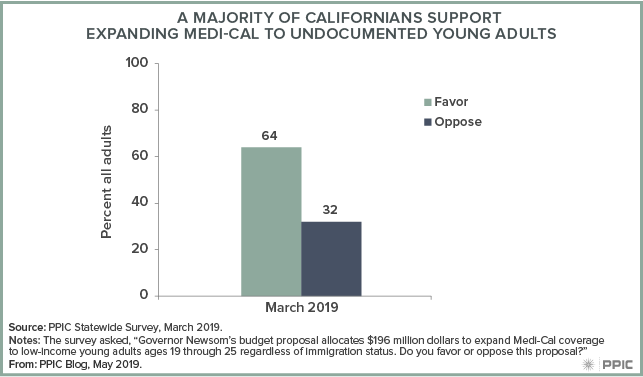
Californians support health care access for undocumented immigrants. In a 2015 PPIC Statewide Survey, a slim majority of Californians (54%) supported the idea of providing health care coverage to undocumented immigrants. In March 2019, about two-thirds (64%) expressed support for the governor’s proposed expansion of Medi-Cal coverage to low-income young adults, including those who are undocumented.

Figure - A Majority of Californians Support Expanding Medi-Cal to Undocumented Young Adults

The governor’s May budget revision delays implementation of the expansion, but it would still have an impact: by providing coverage to approximately 90,000 undocumented young adults in the first year, it could help make the health care landscape less complicated for an important share of California’s immigrant population.

Food Assistance Linked to Student Success in College

Student hunger on college campuses is a serious concern, potentially affecting students’ health and academic achievement. At the University of California (UC), as many as 42% of students faced some degree of food insecurity in 2016, with one in five reporting reduced food intake due to limited resources. With funding provided by the UC system, individual campuses have undertaken a range of strategies to address the problem—including food pantries, free food cafes, and efforts to increase enrollment in CalFresh, the state’s food assistance program for low-income residents.

Increasing CalFresh enrollment among college students has also been the focus of recent state legislation, which has eased work requirements and removed barriers to enrollment. For example, low-income or first-generation students who qualify for California’s Educational Opportunity Program (EOP) are now automatically eligible for CalFresh. In 2016, just 2% of UC students were enrolled in CalFresh, but we don’t yet know how recent changes to eligibility have affected enrollment.

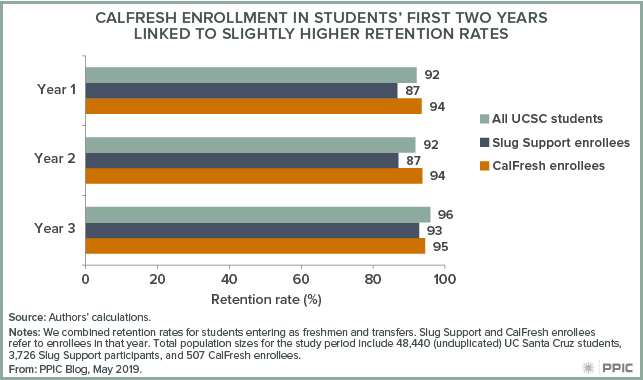
In addition to providing food assistance, enrolling in CalFresh appears to be a promising strategy to promote student success, according to our research at the University of California, Santa Cruz (UCSC). Our study of students who participated in the campus’s Slug Support program—a basic-needs program that provides food, housing, financial, and crisis assistance for students—shows that CalFresh enrollment is associated with improved retention in students’ first two years.

The first-year retention rate for Slug Support students (87%) is substantially lower than the overall retention rate at UCSC (92%), but CalFresh enrollees experienced a slightly higher-than-average first-year retention rate (94%). These results are especially encouraging as students who are eligible for CalFresh are socioeconomically disadvantaged and more likely to come from under-resourced high schools—characteristics typically associated with lower retention. This pattern persists for those enrolling in CalFresh their second year but wanes after that: students who wait to enroll in CalFresh until their third year have slightly lower retention rates than third-year UCSC students overall.

figure - CalFresh Enrollment in Students' First Two Years Linked to Slight Higher Retention Rates

Compared to Slug Support students who used other services but did not enroll in CalFresh, CalFresh enrollees were consistently more likely to return to campus the following fall. About a third (34%) of UCSC students are EOP-eligible—and therefore now eligible for CalFresh—suggesting that recent legislative changes have the potential to greatly improve food security and student outcomes.

Governor Newsom’s revised budget for 2019–20 allocates $18.5 million to address hunger and housing in the UC system. To build upon recent efforts, policymakers and higher education leaders should consider additional mechanisms to support access to CalFresh—such as tracking CalFresh enrollment among eligible students, confirming students are aware of their eligibility, and streamlining the enrollment process. These steps could help further ensure that California students have access to the resources that will help them complete their degrees.

Brandon Balzer Carr is a doctoral candidate in psychology at UC Santa Cruz. Rebecca London is an adjunct fellow at PPIC and an assistant professor in sociology at UC Santa Cruz.

Immigrants Are Key to California’s Health Workforce

Governor Newsom’s proposed budget includes more than $85 million to train health care workers—a reflection of the state’s anticipated need to fill over 107,000 new health care jobs every year between 2016 and 2026. This projected increase is due to a growing and aging population, as well as greater access to care under the Affordable Care Act. California’s immigrant population will be an important source of workers in this sector.

In California, nearly one in three health care workers is foreign born, compared to one in six nationwide. This is partly because of the high share of immigrants among California’s working-age population. While immigrants make up about a quarter of all Californians, they are almost a third of working-age Californians—with even higher shares of immigrants among those with less than a high school diploma (49%) or those holding a graduate or professional degree (36%).

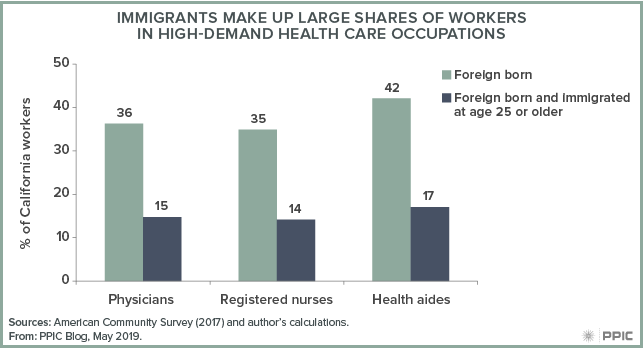
Immigrants also make up a large proportion of California workers in high-demand health care occupations, such as primary care providers (who are particularly needed in rural areas), nurses, and health aides. In 2017, 36% of the state’s physicians and 35% of registered nurses were foreign born. Forty-two percent of California’s nursing, psychiatric, and home health aides were foreign born.

figure - Immigrants Make Up Large Shares of Workers in High-demand Health Care Occupations

As California considers how to train people for these jobs, programs that account for the diversity of immigrants’ educational backgrounds will be important. Many highly skilled immigrant health workers were age 25 or older when they arrived in the country, suggesting that they may have had at least some training abroad. To help foreign-trained health professionals, some California universities already have programs to guide them through the steps necessary to enter the state’s health workforce. Training programs for support roles in health that require less than a four-year college degree are another opportunity that could encourage lower-skilled immigrants to enter the health sector.

Immigrants can also benefit the health workforce in other ways. For example, health care workers who speak languages other than English, as many immigrant workers do, can be a resource for low-income patients facing linguistic barriers to health care access. In the coming years, meeting California’s health care workforce needs will require multiple strategies—but engaging the state’s immigrant population can be a part of the solution.

Video: Emergency Department Use in California

Hospital emergency departments (EDs) are an important part of California’s health care system. They are sometimes called the safety net of the safety net because they provide care to all comers. Policymakers, health plans, and health providers have long focused on ED use, partly because it serves as a proxy for lack of access to other, less costly forms of health care. So how has the expansion of insurance coverage under the Affordable Care Act (ACA) affected ED use in California? At an event last week in Sacramento, PPIC researcher Shannon McConville outlined a new PPIC report that addresses this question, and a panel of experts offered their perspectives on recent ED trends.

While many predicted that coverage expansion would reduce ED use by providing access to other kinds of medical care, such as primary care physicians, some worried that because insurance coverage typically reduces patients’ out-of-pocket costs, the ACA would increase ED use. The good news is that the PPIC report estimates that ED use rates would be higher in the absence of the ACA. But ED use statewide has been increasing for the past decade. To get a sense of how recent trends in ED use are being experienced and addressed around the state, PPIC convened a panel of experts.

All of the panelists highlighted the importance of finding out why people are using EDs. Some frequent ED users may not know about other ways to get medical care, while others may have behavioral or mental health issues that could be addressed more effectively by other kinds of care—from housing assistance to substance abuse programs. As Sara Kate Levin, medical director for Contra Costa Health Services, put it, “What are the unmet social needs that are driving a lot of this high utilization?”

But filling information gaps and addressing behavioral and mental health issues does not solve all ED use problems. In many areas, there is a scarcity of primary care doctors and urgent care clinics, and many patients cannot take time off to go to medical appointments during the workday. Moreover, primary care doctors sometimes refer their privately insured patients to EDs, in part so they won’t have to wait for tests.

This range of issues points to what Renee Hsia, an ED physician at Zuckerberg San Francisco General Hospital and a professor of emergency medicine and health policy, called “the elephant in the room”: because the United States has “a very market-based approach to health care,” there are two very different stories about ED use. On the one hand, EDs in affluent areas broadcast their availability and convenience. On the other hand, there are long waits for treatment at EDs serving low-income areas. “In some areas, your ER is a revenue center . . . and in some places, where you don’t have paying patients, your ER is a cost center.”

Jennifer Rasmussen, vice president of health care services at Molina Healthcare of California, highlighted the geographical differences across the state that make it difficult to find “one size fits all” solutions. She pointed out that Molina serves Imperial and San Bernardino Counties, “a vast geography” with fewer social services than a dense urban area has to offer. In other words, “a solution for Imperial County is not going to be the same as a solution for San Francisco.”

2020 Census: Will All of California’s Children Be Counted?

This post is part of a series examining challenges involved in the 2020 Census and what’s at stake for California. Click here to see our full coverage.

As the country gears up for the 2020 Census, one big challenge will be ensuring a complete and accurate count of young children. Nationwide, the 2010 Census missed nearly a million children under five years old, including about 210,000 young Californians, according to Census Bureau estimates.

This undercount—which has worsened in the past few decades—has consequences for political representation at the federal, state, and local levels. An inaccurate census could also affect federal funding for educational and health programs. For example, the distribution of Head Start funds depends in part on census counts to determine the number of young children living in poverty.

Young children were undercounted by 4.6% in 2010, the worst undercount across all age groups. In contrast, people in their late teens and early twenties, as well as those over age 50, were overcounted—meaning people in these age groups were often erroneously included in multiple households.

figure - Young Children Were the Age Group Least Likely To Be Counted Accurately in the 2010 Census

The count of young children in California was even less accurate: 7.7% of Californians ages 0–4 were undercounted in the 2010 Census, the third-highest rate in the nation. In follow-up research, the Census Bureau has found that households in Monterey County, much of the Central Valley, Los Angeles County, the Inland Empire, and Imperial County were especially likely to indicate confusion over whether to include young children when completing their census questionnaires.

Multiple reasons account for why young children are often missed in the census. Families may forget to include newborns or children who split their time between two homes. Young children in low-income families and those with young or single parents are especially at risk of being undercounted.

Young children are also more likely than other age groups to live in households with multiple generations, unmarried partners, nonrelatives, or extended family—which can lead to confusion over who should be included in the census form. African American, Latino, and Native American children are much more likely than white children to live in households with these kinds of “complex” living arrangements, which have probably become more common in California because of the housing crisis.

figure - Young Children Are Much More Likely To Be in Families with “Complex” Living Arrangements

In preparation for the 2020 Census, the Census Bureau has taken several steps to improve its count of young children. These include adjusting the wording on the census form to clarify that everyone living in the household should be included, as well as undertaking advertising and education campaigns about the importance of counting all children.

California has committed $100 million for census outreach, and the governor has proposed an additional $54 million for the next fiscal year. The California Complete Count Committee, which is spearheading the state’s efforts, has allocated these funds to the state’s hard-to-count communities, with options for many other organizations to receive funding. Given what we know about the historical difficulties of counting young children, it will be particularly important for community organizations and agencies working with young children and families to be involved with outreach efforts.

Video: Californians and Their Government

Californians are increasingly concerned about the cost of housing—a record-high share see affordability as a big problem in their region, and a majority support Governor Newsom’s proposal to put $1.8 billion toward increasing housing production. Dean Bonner outlined these and other key findings of the latest PPIC Statewide Survey at a Sacramento briefing last week.

This month’s survey gauges views on statewide challenges and the governor’s proposals for addressing them. For example, in the wake of last year’s historically destructive wildfires, an overwhelming majority of Californians support the governor’s plan to spend $415 million on wildfire preparedness and forest management. About two-thirds say the gap between rich and poor is widening in their part of the state, and a solid majority favor the governor’s proposal to allocate a billion to expand eligibility for the earned income tax credit.

Other survey highlights:

  • Slim majorities support the governor’s plan to scale back two major infrastructure projects: high-speed rail and the Sacramento–San Joaquin tunnels.
  • When asked whether the penalty for first-degree murder should be death or imprisonment for life with no chance of parole, a record-high 62% of Californians choose life imprisonment.
  • An overwhelming majority oppose President Trump’s declaration of a national emergency over the border wall—but support for the declaration is much higher among Republicans.
  • A majority of residents have a favorable view of the Affordable Care Act and most say that Covered California, the state’s health insurance exchange, has been working well.

Video: Preparing California for Census 2020

Is California ready for the 2020 Census? PPIC convened a group of experts last week for a progress report on preparations for the decennial population count, which begins next April 1. PPIC president Mark Baldassare started off by asking California secretary of state Alex Padilla to outline what is at stake.

Padilla offered a “quick civics lesson,” explaining that the census helps determine the amount of federal funding that goes to each state, as well as each state’s overall number of congressional seats and its configuration of legislative districts. If there’s an undercount in California, the state could lose billions of dollars over the next decade.

Are we ready? “Not yet,” Padilla answered. But he added that California is “a little ahead of the curve,” with the highest level of state investment in outreach and preparation in the nation. In addition to longstanding challenges—for example, California has 30% of the recognized “hard to count” communities nationwide—the state faces some new issues, such as inadequate federal funding, cybersecurity issues, a rule that bars legal permanent residents from working as canvassers, and the possible inclusion of a question about citizenship.

How is the state preparing? Marc Berman, a state assemblymember and chair of the Assembly Select Committee on the Census, outlined three major areas of focus: adequate funding, coordination of efforts, and collaboration by state and local government as well as community-based, philanthropic, and business organizations. “We are better prepared than we ever have been before,” he added.

Ditas Katague, director of California Complete Count, offered a wealth of detail on the progress her office has made—opening five field offices, dividing the state into ten regions based on hard-to-count populations, and working with community groups and media in these regions.

Non-governmental groups are playing a key role. Melina Sanchez, the program officer for civic participation initiatives at the James Irvine Foundation, outlined the two overarching goals of a recently convened statewide philanthropic roundtable: to help California reach its hardest-to-count populations and to use the census as a movement-building opportunity for historically underrepresented groups. For Sanchez, it is important to “flip the narrative” so that it’s not about people’s fear of participating in the census but is instead a story about “folks feeling the empowerment of standing up despite all the barriers.”

Sarah Bohn, PPIC’s director of research, highlighted the need to counteract widespread mistrust of government, concerns about privacy and misuse of data, and mistaken ideas about the purpose of the census. A key way to motivate most people, she added, is to make sure they know that their community benefits from an accurate count: “Understanding the funding that goes to your community . . . really seems to encourage participation.”

What would a successful census look like? Katague summed it up: “No undercount, no loss of a congressional seat, no disinformation snafus”—and, on the positive side, increased civic engagement.

Video: A Conversation with San Francisco Mayor London Breed

As part of our Speaker Series on California’s Future, PPIC invites elected leaders from across the political spectrum to participate in public conversations. The purpose is to give Californians a better understanding of how our leaders are addressing the challenges facing our state.

As a mayoral candidate, London Breed promised to focus on homelessness and affordable housing—two major challenges for San Francisco and for California as a whole. Not surprisingly, these issues took center stage in her conversation with PPIC president Mark Baldassare earlier this week.

“It is no secret that homelessness is one of the biggest challenges that’s facing our city, and that also comes with the need to build more housing,” said Breed. “I’ve been on a mission! I hired a housing delivery director—someone whose sole purpose is to cut back on bureaucratic red tape that gets in the way of building housing.”

Breed stressed the need for new approaches to behavioral health issues that complicate homelessness: “We have to think about this challenge differently and we have to make hard decisions.” For example, she favors strengthening conservatorship laws. She acknowledged that conservatorship for mentally ill adults is “very controversial.” But, she added, “our jails are being used as mental health facilities, and that’s not a solution.” She is also pushing for safe injection sites, which can provide substance abuse treatment when people are ready to seek it. “Treatment on demand is something we have to start looking at.”

The mayor is also committed to trying new strategies in other policy areas, such as police-community relations and education. “I do think we need to take some risks and propose some things that may make people uncomfortable but ultimately may help us to get the kind of results that will . . . make a difference.”

But Breed also emphasized accountability. Explaining why she wants to hire a mental health director, she said, “We’re a little bit all over the place right now and I want us to address those issues, organize things a lot better for the purposes of helping people.” In this and other areas, she said, “I want to see us make the right investments.”