Covering the Real Costs of College

Faced with the state’s high cost of living, California college students struggle to secure adequate food and housing. Even amid one of the largest and longest economic expansions in state history, 33% of students are housing insecure and 35% have low or very low food security, according to a California Student Aid Commission survey of 150,000 college students. As the state seeks to meet economic demand by producing more students with degrees and certificates, the full cost of college remains a barrier to progress.

Governor Newsom and the legislature have recognized the need to reform state financial aid programs to address the full cost of college. The 2019–20 state budget provided $41 million in ongoing funding to help colleges address food and housing insecurity, $19 million to support rapid rehousing programs, and increased the number of competitive state grants for non-traditional students from 25,750 to 41,000.  Additionally, the legislature increased the maximum award amount that students with children pay for non-tuition college costs from $1,672 to about $6,000.

However, broader reform of the state grant aid program remains elusive. Two recent bills sought to expand eligibility for Cal Grants by eliminating current age, time out of high school, and high school GPA requirements. The bills also sought to provide additional non-tuition aid to community college students and students in career education programs.  The bills did not make it to a vote; however, they will be re-examined in the next legislative session. Estimated at $2 billion per year, proposed reforms would nearly double the annual cost of the program.

Consequently, the California Student Aid Commission, the agency that distributes financial aid, intends to streamline these proposals to constrain costs while increasing access. Higher education is a vital tool that increases economic and social mobility; ensuring all students have equal access to an affordable education is paramount to modernizing California’s economy. An equitable and financially viable approach to financial aid will be critical if the state’s booming economy slows in coming years.

Better Data for Better California Health Policy

For over a decade, California lawmakers have tried to establish a comprehensive resource on health care costs. Yet a dearth of information still persists among consumers, purchasers, and policymakers. To address this problem, recent legislation allocated $60 million to develop a health care payments database (HPD) for the state. The California Office of Statewide Health Planning and Development (OSHPD) and a stakeholder review committee have held monthly public meetings since March 2019 to guide development.

PPIC is supporting the effort in key ways, in part by describing how an HPD can answer important questions and inform policy decisions.  At the November 21 OSHPD Healthcare Payments Data Review Committee, we presented research scenarios that highlight issues facing California policymakers:

  • How often do patients overpay for prescription drugs?
  • How does increasing consolidation of health care providers (i.e., hospitals acquiring physician practices) impact costs, quality, and patient outcomes?
  • What types of housing interventions are most effective for low-income Californians with severe mental illness?
  • How often do children transition between different types of health insurance coverage and how does it impact their use of preventive services?

We will release our detailed findings in February – including full results from our online survey of California researchers experienced with health care payments data. A sneak peek indicates that these researchers are very enthusiastic about an HPD. Nearly all 50 respondents reported they would likely submit proposals to use the database to investigate topics including: how health care policies impact health outcomes, implications of racial/ethnic disparities and the social determinants of health, as well as health care costs and usage patterns. Researchers also indicated willingness to pay user fees to access the data—an important consideration given that the HPD must be self-sustaining (i.e., not require General Fund support) once in operation.

Several other states operate health care payment databases (often called an All Payer Claims Database or APCD) that support health policy and practice, along with patient decision making. On Colorado’s database, the public can search for prices of common health care services—such as breast biopsies and ultrasounds—across different providers. It also documents how health conditions (i.e., asthma and diabetes) vary over time and across regions, types of insurance, and age groups.

For California’s HPD to be realized, the legislature must act on recommendations from OSHPD and the HPD review committee, due in July 2020. While many hurdles still remain before a California HPD is in operation, substantial investments to support current efforts signal a commitment from the state and stakeholders. By creating the database, the state gains a crucial resource to support evidence-based policymaking. Along with parallel efforts—including the development of a longitudinal database to track student and employment outcomes—California can be one step closer to having the right data to study the state’s most pressing policy issues.

The Democratic Presidential Primary: What Do Californians Care About?

Mark Baldassare, PPIC president and CEO, and director of the PPIC Statewide Survey, participated in a panel on election issues at the Pacific Chapter of the American Association of Public Opinion Research meeting on December 6, 2019 in San Francisco. This post is excerpted from his prepared remarks.

Californians are turning their attention to the March 3 Super Tuesday primary as they play a new role in deciding the next Democratic presidential nominee. This is unfamiliar territory for California’s Democratic primary voters, who have become accustomed to casting ballots in June after other states have already determined the winner of their party’s presidential sweepstakes.

The 2019 PPIC surveys have consistently identified three frontrunners—Joe Biden, Bernie Sanders, and Elizabeth Warren—with no clear favorite. At the same time, likely voters have signaled an openness to considering alternatives. In this context, the debates loom large, and eight in ten likely voters in the September PPIC survey say they are important (41% very, 43% somewhat) in deciding their vote.

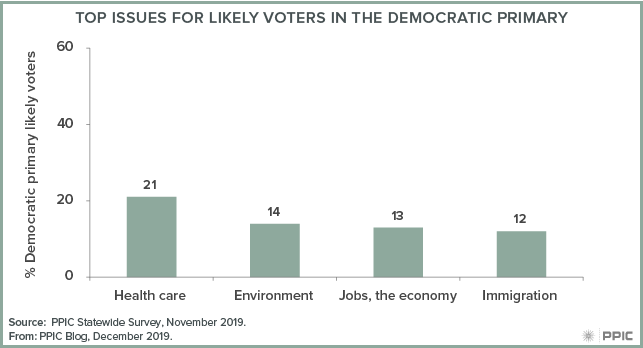
What do California’s Democratic primary likely voters most want to hear from the candidates as the stage is being set for a December 19 Democratic debate in Los Angeles? In an open-ended question in the November PPIC survey, the top four issues mentioned are health care (21%), the environment (14%), jobs and the economy (13%), and immigration (12%). Several other issues—such as education, homelessness, housing affordability, gun control, crime, and taxes—are each mentioned by less than one in ten likely voters.

figure - Top Issues for Likely Voters in the Democratic Primary

Across demographic groups, likely voters differ on the issues that matter the most. For instance, voters age 45 and older want to hear about health care more often than younger voters do (26% to 13%), while Latinos want to hear about immigration more often than whites do (24% to 5%), and whites want to hear about the environment more often than Latinos do (23% to 4%). Jobs and the economy is the only top issue generating a similar amount of interest across age, education, gender, income, race/ethnic, and regional groups.

The issues of greatest concern also vary according to candidate preference. Biden’s supporters name health care more often (25%), Warren’s supporters mention the environment more often (26%), and Sander’s supporters name immigration more often (22%). By contrast, supporters of the three leading candidates are similarly likely to mention jobs and the economy (13% Sanders, 11% Biden, 7% Warren).

One area of strong consensus? Views of President Trump. In the November PPIC survey, 91% of California Democratic primary likely voters say they disapprove of President Trump and 84% support his impeachment and removal from office.

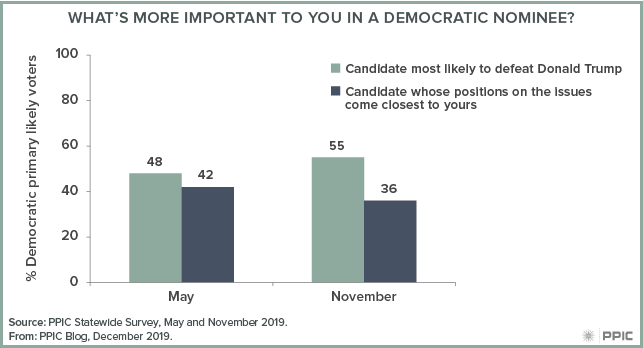
When asked what’s more important, nominating a candidate who seems most likely to defeat Trump or one whose positions on issues are closest to theirs, 55% want to defeat Trump, while 36% want alignment on positions. Since the May PPIC survey, support for impeachment (65% to 84%) and the importance of nominating an electable candidate (48% to 55%) has risen.

figure - What’s More Important to You in a Democratic Nominee?

Those who say that electability is most important, compared with those who say policy positions are most important, are more likely to mention health care (25% to 15%) and less likely to name immigration (7% to 18%) as the issue that they most want to hear about in the presidential debates. We find no differences between these two voter groups in the mention of the environment or jobs and the economy. Interestingly, education (11% to 2%) is noted more often among those who say that alignment on the issues is more important to them.

The Los Angeles debate is the next big opportunity for the presidential candidates to connect with California voters whose preferences are still being formed. Many Democratic primary likely voters already report that they are closely following the election news, but the debate could still result in an expanded electorate—and a scrambling of the race—if candidates connect with voters on issues that matter the most to them.

Throughout 2020, PPIC surveys will be monitoring what is likely to be an historic year for voter participation, as Californians engage in a consequential primary and a highly anticipated general election.

Video: Californians and Their Government

Joe Biden, Elizabeth Warren, and Bernie Sanders continue to lead the field in California’s primary race. Most Californians say President Trump should be impeached and removed from office, though views are mixed on how Democrats in Congress are handling the impeachment inquiry. In Sacramento last Wednesday, PPIC researcher Alyssa Dykman outlined these are other key findings from PPIC’s latest statewide survey, which was conducted before the November 20 debate.

Among Democrats and Democratic-leaning likely voters, support for Joe Biden (24%), Elizabeth Warren (23%), and Bernie Sanders (17%) is much higher than for Kamala Harris (8%), Pete Buttigieg (7%), and Andrew Yang (5%). No other candidate is preferred by more than 1%, while 9% say they don’t know which candidate they would choose.

Views on impeachment are divided along party lines: 83% of Democrats, 51% of independents, and 11% of Republicans think the president should be impeached and removed from office. Democrats are also much more likely than independents or Republicans to approve of the way the inquiry is being handled in Congress.

In other news, most Californians are concerned about wildfires (34% very, 29% somewhat) and power shutoffs (32% very, 27% somewhat). Governor Newsom gets mixed reviews for his handling of these issues: 46% of adults and 42% of likely voters approve, while 39% of adults and 46% of likely voters disapprove. Only about a third of Californians have either a great deal or quite a lot of confidence in their utility providers.

Other survey highlights:

  • Six in ten Californians (61% adults, 63% likely voters) say things in the US are generally going in the wrong direction, but about half think the nation will have good times financially over the next 12 months.
  • Nearly two-thirds of adults (63%) say California is divided into the “haves” and the “have nots”; 41 percent say they are haves, while 44 percent see themselves as have nots.
  • Most Californians are very concerned about homelessness in their communities; majorities across regions say the number of homeless people in their local community has increased over the past 12 months.
  • A potential citizens’ initiative that would raise state income taxes on the wealthiest Californians to fund K–12 public schools has majority support. Fewer than half of likely voters favor two other measures—a school construction bond and a “split roll” property tax—that would benefit the K–12 system.

Interactive: Californians’ Views on Homelessness

[vc_row][vc_column][vc_column_text]Homelessness is a growing concern in California, where nearly a quarter of the nation’s homeless population lives. The crisis comes amid sky-high housing costs and widening income inequality. PPIC’s latest survey explores residents’ perceptions of homelessness in their part of the state.

Eighty-five percent of Californians say they are concerned about the presence of homeless people in their local community, including 58 percent who are very concerned. Majorities across regions and demographic groups say they are very concerned about this issue.

In addition, about six in ten Californians (58%) say the presence of homeless people has increased in their local community over the past year. Four in ten say it has stayed the same, while only 3% say it has decreased.

The chart below allows you to take a closer look at how different Californians view this issue. Across regions, Los Angeles (63%) residents are the most likely to say the presence of homeless people has increased. This is in line with recent data showing Los Angeles County saw a spike in homelessness in 2019. African Americans (73%) and residents with annual household incomes under $40,000 (61%) are also especially likely to report an increase in homelessness in their community. Very small shares of Californians report a decrease in the presence of homeless people.[/vc_column_text][/vc_column][/vc_row][vc_row max_width=”80″ visibility=”visible-desktop”][vc_column][vc_column_text][infogram id=”1p0621pw3w90yltegez9kvk6xdanq1qd6ey?live”][/vc_column_text][/vc_column][/vc_row][vc_row max_width=”80″ visibility=”visible-tablet-landscape”][vc_column][vc_column_text][infogram id=”1p0621pw3w90yltegez9kvk6xdanq1qd6ey?live”][/vc_column_text][/vc_column][/vc_row][vc_row visibility=”visible-tablet-portrait”][vc_column][vc_column_text][infogram id=”1p0621pw3w90yltegez9kvk6xdanq1qd6ey?live”][/vc_column_text][/vc_column][/vc_row][vc_row visibility=”visible-phone”][vc_column][vc_column_text][infogram id=”1p0621pw3w90yltegez9kvk6xdanq1qd6ey?live”][/vc_column_text][/vc_column][/vc_row][vc_row][vc_column][vc_column_text]Given the complexity of the homelessness crisis, the governor and state legislature must think of creative and sustainable solutions. One possible approach is a law that would require local governments to construct enough shelter beds so that any homeless person requesting to come indoors could do so. When asked about this proposal, an overwhelming majority of Californians (76% adults, 70% likely voters) are in favor. There is support for the policy across parties, regions, and demographic groups.[/vc_column_text][/vc_column][/vc_row][vc_row max_width=”80″ visibility=”visible-desktop”][vc_column][vc_column_text][infogram id=”1prd6drdjkx025ig27z3kwz276smgp3jj2r?live”][/vc_column_text][/vc_column][/vc_row][vc_row max_width=”80″ visibility=”visible-tablet-landscape”][vc_column][vc_column_text][infogram id=”1prd6drdjkx025ig27z3kwz276smgp3jj2r?live”][/vc_column_text][/vc_column][/vc_row][vc_row visibility=”visible-tablet-portrait”][vc_column][vc_column_text][infogram id=”1prd6drdjkx025ig27z3kwz276smgp3jj2r?live”][/vc_column_text][/vc_column][/vc_row][vc_row visibility=”visible-phone”][vc_column][vc_column_text][infogram id=”1prd6drdjkx025ig27z3kwz276smgp3jj2r?live”][/vc_column_text][/vc_column][/vc_row][vc_row][vc_column][vc_column_text]As state policymakers work on their policy agendas for the next year, we will continue to monitor Californians’ views on homelessness and related policies closely.[/vc_column_text][/vc_column][/vc_row]

Video: Counting the Central Valley

The 2020 Census is fast approaching, and the stakes are high for California—political representation and federal funding are on the line. The San Joaquin Valley, with a population of 4.3 million, may be one of the state’s hardest-to-count regions. In Sacramento last Friday, PPIC convened a discussion about how valley communities are preparing for the census.

California has long been home to high numbers of “hard to count” residents—including young children, renters, and immigrants. In 2020, the difficulty of counting all Californians will be greater than ever. PPIC researcher Joe Hayes outlined the challenges, which range from uneven internet access to a lack of trust: “Individuals are less likely to respond out of privacy concerns, on the one hand, but also out of distrust for the federal government.”

The good news is that state and local governments have invested heavily in outreach. Complete Count Committees have been established counties across the state, and community-based organizations are spearheading outreach efforts. To help guide these efforts, PPIC created interactive maps that show hard-to-count communities across the state. Maria Jeans, program coordinator for the Maddy Institute, moderated a panel discussion about the factors that make counting the Central Valley so challenging—and how challenges are being addressed.

Jesus Martinez, executive director of Central Valley Immigrant Integration Collaborative, highlighted the challenge of organizational capacity. As local preparations for the census got under way in 2018, he realized that “only a handful” of those who wanted to get involved “had any type of personal or institutional experience with the census.”

Don Saylor, a Yolo County supervisor, cited the difficulty of reaching remote rural settings across the Central Valley and the large numbers of farmworkers, language minorities, young children, and residences with multiple households. He included students enrolled at UC Davis and other colleges in the Central Valley—especially those “who are renters, living in different kinds of group settings”—as a hard-to-count population.

The panelists agreed that the fear generated by federal immigration rhetoric and policies are particularly challenging for the Central Valley. As a result, census outreach must focus on more than just making sure California gets its fair share of federal funding. As Martinez put it, “This is a human rights and civil rights issue for us now. It is the right of immigrants to be included in the 2020 Census.” Much of the outreach involves person-to-person conversations—canvassing and phone banking, “house meetings” among neighbors, and interactive media.

Cindy Quezada, senior program officer at Sierra Health Foundation, noted that encouraging people to participate is not the only challenge. “Sometimes people might want to participate but they don’t have a way to,” she said. “Either you’re living in a trailer in a backyard so you’re not going to get the invite and you’re not going to get an enumerator visit, or you may not speak a language that’s supported.” These structural barriers “are something we should really be paying attention to.”

Video: Poverty and Opportunity in California

Although California has seen strong job growth in recent years, poverty remains persistently high. In many inland regions, the prevalence of unemployment or low-wage work is a key driver of economic hardship, while elsewhere—especially in coastal areas—the high cost of housing and other necessities plays a major part.

At an event in Sacramento last week, PPIC researcher Tess Thorman discussed the latest findings from the PPIC-Stanford California Poverty Measure (CPM), and a panel of experts discussed the role that policymakers, community organizations, and other stakeholders can play in reducing poverty and broadening economic opportunity.

Poverty has declined—slowly—in California, Thorman said. Also, while nearly 7 million people in California (17.8%) are in poverty, a roughly equal number are living just above the CPM poverty threshold. Certain groups are more likely to be living in poverty, such as young children, Latinos, and families without any college graduates.

Panelists discussed the key role that housing stability plays in achieving financial security. Richard Raya, director of Mission Promise Neighborhood in San Francisco, said his organization connects families with a range of supports, including below-market rental housing. He explained how the city has partnered with local foundations to create “an ‘accelerator fund’ that allows affordable housing developers to identify existing apartment buildings that are rent-controlled” and purchase them in order to keep them affordable – an approach Raya says could be a model for other communities.

Kimberley Johnson, director of the California Department of Social Services (CDSS), underscored how housing and financial stability are fundamental to meeting educational and career goals. Johnson noted that the governor has boosted investments in key elements of the social safety net, such as CalFresh food assistance and the California Earned Income Tax Credit. An important focus for CDSS currently is creating linkages across “a very robust array” of programs and services to make them more accessible to those in need.

California Bridge Academies, launched in Fresno and now active in six counties, offers a voluntary, 18-month program designed to help families exit poverty. According to founder Pete Weber, each household has a “career and family navigator” who assesses needs, skills, and interests. The navigator ensures that “each client is connected to the right on-ramps” so that parents as well as their children receive all necessary services and supports.

The panel highlighted the importance of coordinating services with an eye toward improving family well-being. Caroline Danielson, PPIC policy director and senior fellow, discussed the importance of creating linkages “across different kinds of programs” because “it can be a fragmented safety net.” Danielson pointed out that California has made progress in this effort, while also noting that further efforts to “connect these dots” for children could make a substantial difference in poverty.


Most Californians Favor Requiring Vaccinations

The United States is currently experiencing its worst measles outbreak in more than 20 years, with more than 1,234 people diagnosed with the disease this year—including 67 cases in California. One of the year’s most contentious bills, Senate Bill (SB) 276 addresses this issue by establishing stronger standardization and oversight of medical exemptions from vaccines. (In 2015, California was the first state to repeal religious and personal belief exemptions.) Approved by the assembly and senate and awaiting the governor’s signature, the bill has attracted numerous protests in Sacramento. With public health concerns on one hand and parental choice on the other, how do Californians view vaccinations?

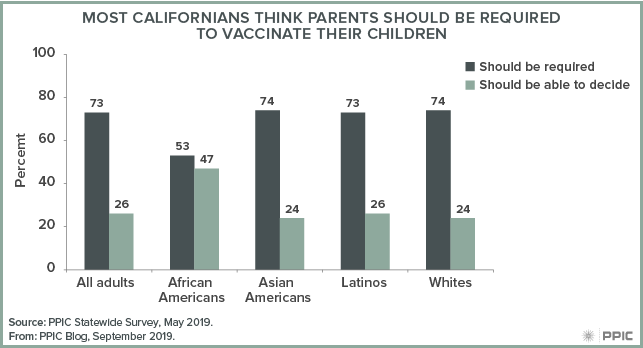
In PPIC’s May Statewide Survey, an overwhelming majority of Californians (73%) said parents should be required to vaccinate their children for diseases like measles, mumps, and rubella. This view is held by at least seven in ten across genders, political parties, and those with and without children in the household. Majorities across demographic groups and regions say vaccinations should be required, as do about three in four Asian Americans, whites, and Latinos—compared to 53 percent of African Americans.

figure - Most Californians Think Parents Should Be Required To Vaccinate Their Children

Vaccine safety has been an ongoing matter of concern, despite assurances from the scientific community. Today, nearly all Californians say that the vaccines given to children are safe (62% very, 27% somewhat). The share that say vaccines are very safe is held by strong majorities across parties, as well as majorities across regions and demographic groups. Notably, among Californians who say parents should be able to decide whether or not to vaccinate their children, 73% say vaccines are safe.

At the same time, eight in ten residents are concerned that measles outbreaks will become more widespread (43% very, 36% somewhat). This view is held by majorities of Californians, although the share who say they are very concerned is higher among older Californians than younger Californians (48% to 34%) and among women than men (48% to 38%).

Even as most Californians support vaccination requirements—and worry about public heath—the discussion around SB 276 remains volatile. PPIC will continue to monitor public opinion as this important issue unfolds.

Video: Understanding Poverty in California

[vc_row][vc_column][vc_column_text]

Despite a booming economy, millions of Californians live in or near poverty. In this video, PPIC research associate Tess Thorman gives an overview of poverty and child poverty in the state, using the latest figures from the California Poverty Measure (CPM).

The CPM is a joint research effort by PPIC and the Stanford Center on Poverty and Inequality that provides a comprehensive look at economic well-being in our state. By accounting for cost of living differences across the state as well as earnings and other family resources—including safety net benefits—the CPM offers valuable insights into the ability of Californians to meet basic needs and be financially secure.[/vc_column_text][/vc_column][/vc_row][vc_row visibility=”hidden-phone”][vc_column][vc_video link=”https://youtu.be/tPh4xE7QLGo” el_width=”70″ align=”center”][/vc_column][/vc_row][vc_row visibility=”visible-phone”][vc_column][vc_video link=”https://youtu.be/tPh4xE7QLGo”][/vc_column][/vc_row][vc_row][vc_column][vc_column_text]To learn more about poverty in California, visit ppic.org/poverty.[/vc_column_text][/vc_column][/vc_row]

Interview: Citizenship and the 2020 Census

This post is part of a series examining challenges involved in the 2020 Census and what’s at stake for California. 

photo - Eric McGheeAfter a heated legal battle, the Supreme Court has ruled that the Trump administration cannot for now include a question on the 2020 Census asking if residents are US citizens. We spoke with PPIC senior fellow Eric McGhee about what this decision means for California.

PPIC: Why is the citizenship question controversial?

Eric McGhee: First, the question could significantly discourage responses among immigrants, who might fear the data would be used to target them. It didn’t go through the normal testing process for new questions, and many Census Bureau employees recommended against adding it because of concerns about data quality.

Second, the Trump administration says the question is necessary to properly enforce the Voting Rights Act. But advocates for immigrant communities dispute this justification and argue that current citizenship data is sufficient to protect against voting discrimination.

Third, it could have a huge impact on political representation and how congressional and state legislative districts are drawn. Districts are currently drawn based on total population. But this question could make it possible for states to use citizens or voting-eligible residents instead, which would tilt representation in favor of those groups.

PPIC: What does all this mean for California?

EM: Response rates will likely be better if the question is not added. But there’s also concern that the damage has already been done—immigrants still might not be inclined to respond. Immigrants make up about a quarter of California’s population, so we’re particularly vulnerable.

A large undercount could result in less federal funding for California. We’re also the only state at risk of losing a congressional seat from an undercount—other states with high immigrant populations like Arizona and Texas might not gain as many seats, but they probably won’t lose a seat they already have, even if there’s a bad count.

Households with undocumented members are the most likely to be undercounted. PPIC research looked at the possibility of a 10% undercount of these households, a reasonable assumption based on existing research. It would mean missing about half a million Californians.

The reality is that census data is thoroughly protected, even from law enforcement agencies like the FBI and ICE. But our May PPIC survey—conducted before the Supreme Court decision—found 63% of Californians were concerned the Census Bureau will not keep responses confidential. Latinos (74%), immigrants (71%), and African Americans (70%) were especially likely to be concerned.

There are other uncertainties too. The 2020 Census will use a new internet-based approach, which hasn’t been comprehensively tested. And people in general are becoming more reluctant to respond to the census. This means the bureau has to do more follow-up, which is expensive and increases the likelihood of problems arising.

PPIC: What can California do to ensure a complete and accurate count?

EM: California is way ahead of other states in terms of funds it has dedicated to census outreach. The state has already appropriated about $100 million to support a better count, and Governor Newsom has proposed another $50 million or so. Philanthropic organizations have chipped in about $30 million. There’s been a great deal of planning at the state and local levels to get the best count possible.

Addressing concerns about confidentiality could go a long way toward encouraging people to respond. Research also suggests that raising awareness about the census’s role in funding public services like health care, roads, highways, and fire and police departments is another promising approach.