Communicating to California’s Seniors about Coronavirus

Older adults are especially vulnerable to the coronavirus (COVID-19). Early data show that mortality rates among people age 60 or older are many times higher than among younger adults. Protecting this population is paramount to limiting the health consequences of the COVID-19 pandemic. In California, this means communicating information in ways that can effectively reach a particularly diverse older population.

California’s senior population is large and growing fast. In 2018 the number of older adults in California reached 8.0 million, up from 5.7 million ten years earlier, according to the American Community Survey. Today, one in five Californians is age 60 or over, a record high.

The rapid growth in the older population is not unique to California. Throughout the nation—as in most developed countries of the world—populations are aging rapidly. The aging of the very large baby boom cohort, declining birth rates, and increasing life expectancy have expanded the senior population.

What sets California apart is its diversity. People of color make up almost half (45%) of California’s 60 and over population, about double the share of the rest of the nation (23%). In California, Latino and Asian American populations make up relatively high shares.
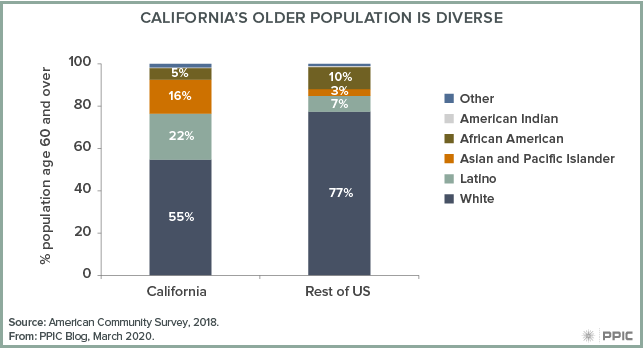
figure - California’s Older Population Is Diverse

California’s older population is also diverse in terms of language: 37% of older Californians speak a language other than English at home, compared to 13% in the rest of the nation. While Spanish predominates among non-English speaking households, dozens of languages have at least 10,000 speakers. Among the 2.9 million Californians who do not speak English at home, 1.2 million are not proficient in English (speaking only some or no English).
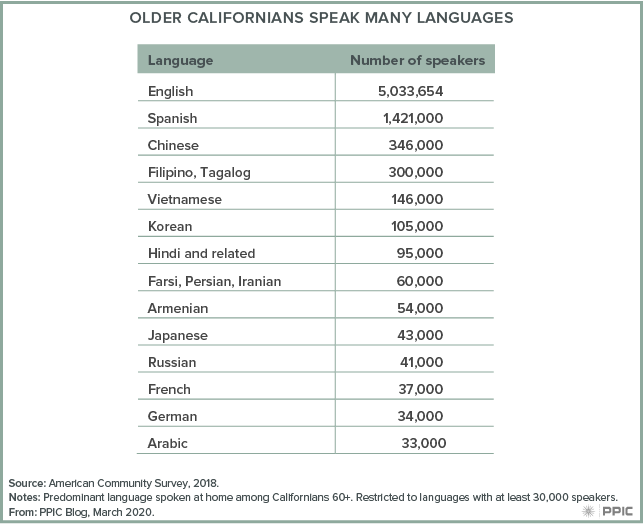
figure - Older Californians Speak Many Languages

The vast majority of older adults live in the state’s large metropolitan areas—Los Angeles, Orange, San Diego, and Ventura Counties, along with the Bay Area. But in some lightly populated rural counties, they make up one-third or more of the population. These counties, in the far northern part of the state (Modoc, Trinity, and Siskiyou) and in the Sierra Nevada (Alpine, Amador, Calaveras, Mariposa, Nevada, Plumas, Sierra, and Tuolumne), could face acute local health care challenges.

It is essential that health services and public health messaging in California consider the state’s diverse population of older adults. Culturally and linguistically appropriate public health announcements, news, and services will help ensure that all Californians in all regions of the state have up-to-date information on the novel coronavirus and steps they can take to protect themselves and lessen its spread.


Interactive: Many Californians Live in or Near Poverty

[vc_row][vc_column][vc_column_text]More than 7 million Californians are “near poor”: out of poverty, but within 1.5 times the poverty line, according to the California Poverty Measure. The near-poor population is slightly larger than the poor population, and many could be pushed into poverty by small expenses.

In California, a near-poor family of four who rents has annual resources that range between $32,500 and $48,800. Adults with less education and fewer work hours, renters, African Americans, and Latinos often have the highest poverty and near-poverty rates. Disparities that persist across poor and near-poor groups are reminders that the poverty threshold is not a hard line where economic hardship ends.

Among adults, full-time work does not remove the risk of poverty: 21% of people ages 25–64 working full-time, full-year jobs are in or near poverty. These full-time workers are more likely to live in near poverty (13.9%) than in poverty (7.1%). At the same time, adults in less than full-time jobs live in near poverty at about the same rate (19.7%) as those with no work (20.9%). But they are less likely to live in poverty (22.3%) than those with no work (32%).[/vc_column_text][/vc_column][/vc_row][vc_row max_width=”80″ visibility=”visible-desktop”][vc_column][vc_column_text]

[infogram id=”1p9yd5nm9kxnddf7zryd5dqnp1b3xnwkjnq?live”]

[/vc_column_text][/vc_column][/vc_row][vc_row max_width=”80″ visibility=”visible-tablet-landscape”][vc_column][vc_column_text]

[infogram id=”1p9yd5nm9kxnddf7zryd5dqnp1b3xnwkjnq?live”]

[/vc_column_text][/vc_column][/vc_row][vc_row visibility=”visible-tablet-portrait”][vc_column][vc_column_text]

[infogram id=”1p9yd5nm9kxnddf7zryd5dqnp1b3xnwkjnq?live”]

[/vc_column_text][/vc_column][/vc_row][vc_row visibility=”visible-phone”][vc_column][vc_column_text]

[infogram id=”1p9yd5nm9kxnddf7zryd5dqnp1b3xnwkjnq?live”]

[/vc_column_text][/vc_column][/vc_row][vc_row][vc_column][vc_column_text]Resources from social safety net programs play a substantial role in moving people out of poverty—2.7 million more Californians would be poor if not for the social safety net. However, many of those moved out of poverty nonetheless live in near poverty, as broader factors like the cost of housing and available jobs play key roles in the resources they have on hand.

As California policymakers address poverty through tax credits, safety net programs, and housing policies, near-poverty rates provide another view into the state’s lowest-income populations. Reducing poverty in California will require attention to how families can be lifted out of poverty and also positioned for long-term economic security.[/vc_column_text][/vc_column][/vc_row]

Voting Matters to Most Californians, but Many Don’t Show Up

Most Californians see voting as critical to a healthy democracy. In our February Statewide Survey, overwhelming majorities of adults (86%) and likely voters (96%) said voting in the 2020 elections is very important, a view held among those registered (90%) and not registered (76%) to vote.

However, while most hold this view, we know that 85% of California adults are eligible to vote but only 70% are registered. Low political participation is cause for worry in and of itself. If a small electorate does not represent the population—as is the case in California—there is even greater cause for concern.

Today, California’s adult population is 42% white and 35% Latino; the remainder are Asian American (15%), African American (6%), and other (3%). Yet 57% of California likely voters are white—only 20% are Latino, and the balance are Asian American, African American, and other. The percentage flips among nonvoters: 56% are Latino and only 22% are white.

figure - Likely Voters Do Not Represent California’s Diversity

And while a third of adults are foreign born, 83% of Californians who frequently vote in state elections are US born. Among nonvoters, 34% are US born (California Department of Finance 2019).

Differences between likely voters and nonvoters sharpen along age and socioeconomic lines. Frequent California voters are age 45 and older (65%), own their home (64%), have attended (39%) or graduated (41%) college, and have annual household incomes of $60,000 or more (59%). Nonvoters are younger than age 45 (65%) and renters (65%); about one in five are college graduates, and one in four earn $60,000 or more.

The political attitudes of voters and nonvoters also differ markedly and often reflect their socioeconomic conditions. Although the many nonvoters in the state may make their preferences known in public opinion surveys on issues, the views of likely voters prevail at the ballot box, when they decide on important matters that affect all Californians.

For example, single-payer healthcare has been a topic of robust discussion leading into the Democratic primary. In California, a split has emerged between nonvoters and likely voters over the question of whether health care coverage should be the responsibility of the federal government. While most nonvoters (72%) say it is the government’s responsibility, fewer likely voters (55%) hold this view.

figure - Nonvoters View Healthcare as a Government Responsibility

On Election Day, it’s important for all Californians eligible to vote make their voices heard. The state has made participating in elections more seamless than ever—even those not yet registered can take advantage of same-day voter registration at a local polling place. Californians overwhelmingly believe in the importance of elections. Today is the day to act on that belief.

Video: Californians and Their Government

In California’s March 3 primary, the state ballot will feature several initiatives—including a $15 billion bond for the construction and modernization of public education facilities. Slightly more than half of likely voters approve, while 42% are opposed and 8% are undecided. PPIC researcher Dean Bonner outlined this and other key findings from the latest PPIC Statewide Survey at a briefing in Sacramento last Friday.

In November, Californians may be asked to vote on a constitutional amendment that would require state and local governments to provide housing or shelter beds to all homeless residents. About six in ten adults and 55% of likely voters say they would vote yes on such an amendment. Majorities of adults and likely voters also support Governor Newsom’s proposal to allocate $1 billion to address homelessness.

Other survey highlights:

  • More than six in ten Californians say housing affordability is a big problem in their part of the state, and the cost of living is causing many to consider moving out of California.
  • A majority of Californians (53%) approve of the way Governor Newsom is handling his job; this is the governor’s highest approval rating to date.
  • Views on the governor’s plan to scale back the high-speed rail project are mixed, while most approve of his proposal to build only one tunnel under the Sacramento–San Joaquin Delta.
  • Bernie Sanders leads all other Democratic presidential candidates with 32% support among Democratic primary likely voters. Joe Biden has 14% support, 13% support Elizabeth Warren, and Pete Buttigieg and Michael Bloomberg were tied at 12%.

Californians Are Grappling with Homelessness

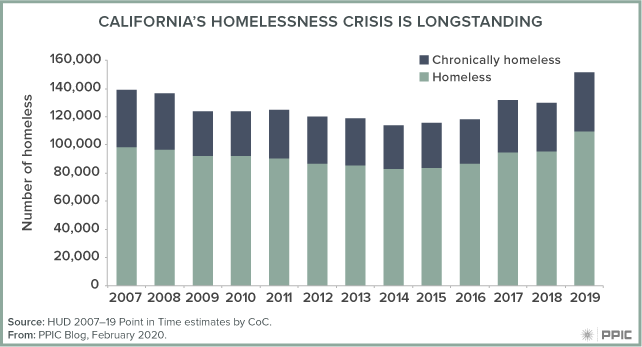
In his State of the State address last week, Gavin Newsom focused almost exclusively on homelessness—a significant long-term problem and major concern for state residents. In 2019, 150,000 Californians—more than a quarter of the US homeless population—were counted as homeless. California’s rate of homelessness rose to 38 per 10,000 residents, the third highest in the nation.

What is more, 72% of California’s homeless residents are unsheltered, living on the street or in parks and other makeshift spaces. And nearly three in ten self-report as chronically homeless—having been on the streets for more than a year.

Figure: California's Homelessness Crisis is Longstanding
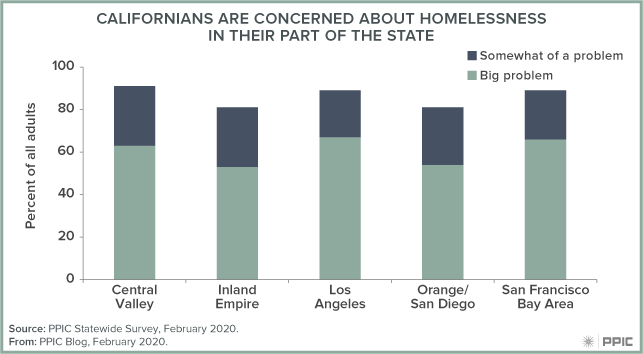
Californians across the state are feeling the gravity of this issue. The latest PPIC Statewide Survey finds that more than 8 in 10 Californians see homelessness as a problem in their part of the state (86% adults, 89% likely voters).

figure -

Considering these numbers, it does not come as surprise that Governor Newsom has made homelessness a major focus. Citing the connection between chronic homelessness, mental health, and behavioral health, Newsom has underlined the importance of policies and investments that allow for “whole person” care. By linking current funding sources and asking lawmakers to expand the use of funds for services provided to the homeless population—especially those involved with the criminal justice system and at-risk foster youth—the governor hopes to improve and integrate these services.

The PPIC Statewide Survey finds that a full 70% of Californians—and 64% of likely voters—favor the governor’s proposed $1 billion budget expenditure to address homelessness. State leadership and investment are key, but there is only so much that can be done at the statewide level. Finding solutions to homelessness requires coordination between the federal, state, and local levels, as well as collaboration across sectors—including housing, health, and social services.

Medi-Cal Expansion for Undocumented Seniors

Under the proposed expansion of Medi-Cal to undocumented seniors, vulnerable Californians would gain comprehensive health insurance. The policy improves access to care for individual seniors and could alleviate the financial burden on counties that serve undocumented immigrants in indigent care programs, increasing resources for other low-income groups.

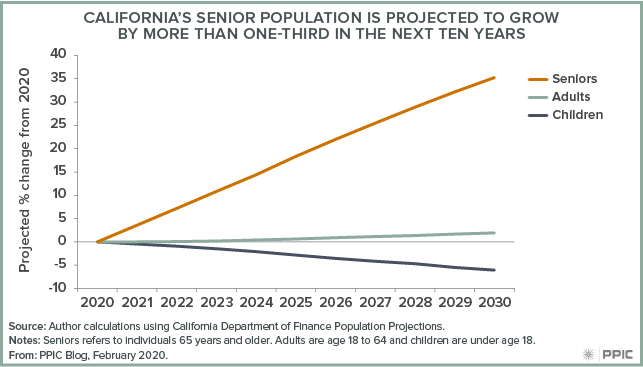
The senior population in California is projected to increase by over 2 million in the next decade, dramatically outpacing growth of younger groups in a demographic shift known as the Silver Tsunami. This increase, in particular among those in older age groups (75 to 84), will test California’s health care delivery and financing systems, because seniors are more likely to be disabled and to have complex or multiple health conditions than younger groups.

Figure - California’s Senior Population Is Projected to Grow by More than One-Third in the Next Ten Years

While most California seniors have health insurance—with Medicare being the most common—not all seniors have coverage. Many uninsured seniors are likely to be undocumented, making them ineligible for Medicare or to purchase coverage through Covered California, the state’s health insurance marketplace. These same seniors may have limited finances and therefore also are likely to struggle to access and afford health care.

Currently, most uninsured, undocumented seniors rely on safety net providers and a limited form of Medi-Cal that covers only emergencies, along with indigent care programs in certain counties that choose to cover undocumented immigrants. Under the expansion, these seniors would gain access to full-scope Medi-Cal, connecting them to preventive care and to programs to improve their disease management. Some expansion funds would also apply to the In-Home Supportive Services (IHSS) program, which pays for a caregiver—often a relative—to provide support for a senior to continue living at home rather than entering a costly long-term care facility.

The budget estimates state costs of $320 million for the expansion, which would benefit 27,000 individuals. If enacted, the policy could have implications for local finances. Counties in California provide health care and mental health services to the medically indigent, with some areas—most notably Los Angeles—serving undocumented immigrants. These county programs, together with community clinics and emergency rooms, are essential access points to health care for undocumented, uninsured seniors. If undocumented seniors become eligible for full-scope Medi-Cal, the state would finance their care instead of the county, where applicable. This shift could free up funding that could then be invested in other health-related county responsibilities, such as disaster preparedness, prevention activities, and substance use disorder treatment.

A complicated fiscal relationship between the state and counties, however, makes it difficult to estimate how much funding could be redirected if this group of seniors gain access to Medi-Cal. As state lawmakers consider the policy change, it will be important to consider how it may affect local and state finances.

Video: Countdown to Census 2020

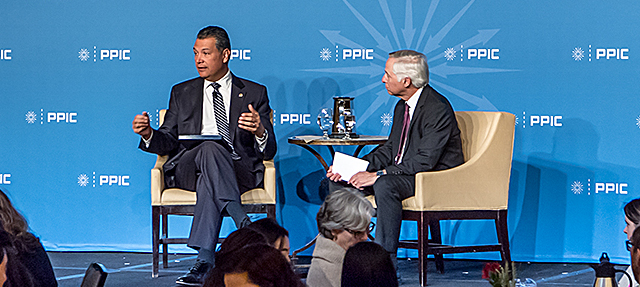
Census Day 2020 is fast approaching, and results from the population count will determine political representation and federal funding for California for the next 10 years. Speaking at a PPIC event in Sacramento last week, Alex Padilla, California secretary of state, joined Mark Baldassare, president and CEO of PPIC, to reflect on the importance of counting the country’s most populous state.

Padilla stressed that along with billions in funding for education, health care, and other critical areas, the count affects the state’s representation in Congress as well as lines drawn at all district levels. “It affects you regardless of the issues you care about, regardless of where you live,” Padilla said. He further emphasized that the census is a population count, not a citizen or adult count. In 2010, California undercounted children under five, which led to underfunded schools over the next 10 years. “Here is a way to make sure schools get the funding they deserve without raising taxes.”

Following the conversation with the secretary of state, Sarah Bohn, PPIC vice president of research and senior fellow, convened an expert panel that expanded on strategies at the frontlines for reaching hard-to-count communities.

Assemblymember Marc Berman discussed the investment by California— which has directed $187 million toward census infrastructure at state, regional, and local levels—that sets the groundwork for outreach and coordination. Partner organizations are now pushing a public awareness and information campaign. “Nobody has ever tried anything like this in a state of 40 million people at the level of specificity and detail that we really need to be successful,” Berman said.

Success depends on participation, however, and trust in government can influence participation in the census—especially among hard-to-count groups who may feel suspicion of the federal government. Apathy is another obstacle. Carolyn Coleman, executive director for the League of California Cities, described how the census returns funds to communities: “We send a lot of dollars to Washington, DC, every year via the tax code, and this is one of the most important ways we get those dollars reinvested back into our communities.”

It takes coordination by trusted messengers to reach hard-to-count groups and communicate this idea. Ditas Katague, director of California Complete Count, said, “We have amazing partners on all levels—whether we’ve contracted them, whether they are foundations, whether they’re state agencies.” Katague outlined efforts by a Sacramento organization mapping territory from the Oregon border to Yolo County, and San Diego ambassadors doing outreach in Arabic, Kurdish, Farsi, Vietnamese, and Somali. Regions are playing to their strengths: Silicon Valley is emphasizing tech; the San Joaquin Valley is partnering with faith-based organizations.

Californians can participate in the census starting in March, and assistance centers around the state will offer help through April. Katague emphasized the importance of motivating others to complete it, saying, “There are 9 questions on the census. It takes 10 minutes to secure the future for the next 10 years.”

Concerns about Poverty and Income Inequality Are Running High

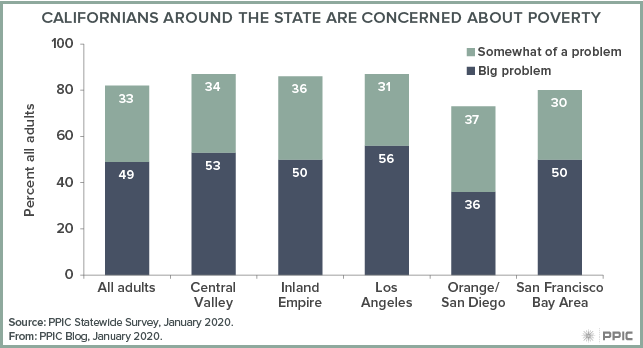
Even as California’s economy is surging—with unemployment at a historically low 3.9% last month—residents around the state are worried about poverty. About eight in ten adults say that poverty is a big problem (49%) or somewhat of a problem (33%) in their part of California. Likely voters hold similar views (47% big, 35% somewhat). This concern is high across every region of the state.

figure - Californians around the State Are Concerned about Poverty

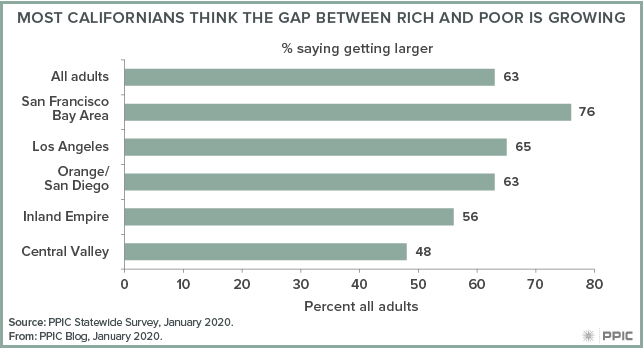
Income inequality has grown substantially across the nation, and it is particularly notable in California. About two in three adults (63%) and seven in ten likely voters (68%) think the gap between rich and poor is getting larger in their part of California. Across regions, nearly half to three-quarters of residents hold this view.

figure - Most Californians Think the Gap between Rich and Poor Is Growing

For Many Californians, Poverty Is One Minor Expense Away

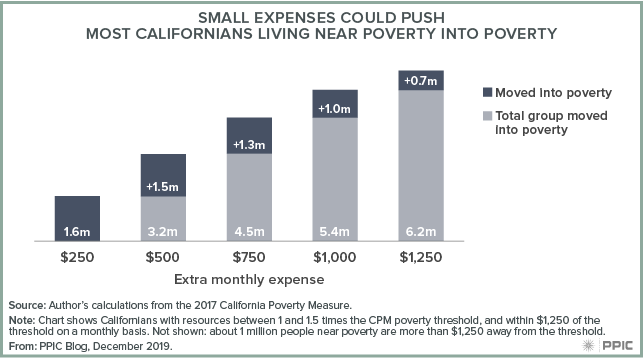
Add one extra expense and families living just above the poverty line could fall into poverty. Data from the California Poverty Measure (CPM) show that 7.2 million Californians live near poverty, that is, with just enough resources to meet their basic needs. All told, in 2017 as many Californians lived just above the poverty line as below it, or about 18% in each case. Even a small change, a monthly expense of $250 or less, could push 1.6 million people under the line.

We define “near poverty” to mean having resources worth 1 to 1.5 times the poverty threshold after taxes and necessary expenses. Since the CPM accounts for California’s varied living costs, the range for near poverty differs across regions. In Fresno County, a family of four who rents their home and has $25,900 to $38,900 in resources is near poverty, while in Santa Clara County, the same is true of a family of four with $40,000 to $60,000.

Because the poverty line is a blunt standard, “near poverty” includes families earning just a few dollars above the poverty threshold—even though a few dollars are unlikely to make it easier to make ends meet. This makes it especially important to understand how many Californians are near poverty, and how close those near poverty are to falling into it.

Californians can be pushed into poverty by the smallest expenses. Overall, people near poverty are more likely to be pushed into poverty by a small expense than a large expense. As expenses grow, the total number of people threatened climbs. Three out of four people near poverty, or 5.4 million, are pushed into poverty by an extra $1,000.

figure - Small Expenses Could Push Most Californians Living Near Poverty into Poverty

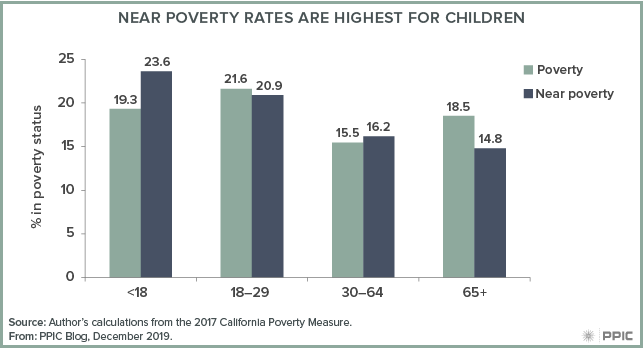
Near poverty affects young people more than it does older Californians, and children under 18 are more likely to be near poverty (23.6%) than in poverty (19.3%). Young adults and seniors, however, are more likely to be in poverty. Regional differences in living costs, opportunity levels, and the impact of existing policies and programs are key factors driving this variation.

figure - Near Poverty Rates Are Highest for Children

Without safety net programs, more people, and in particular, more families with children, would face poverty instead of near poverty: resources from programs including CalFresh and the federal and state Earned Income Tax Credits (EITCs) keep 7.1% of Californians out of poverty. Yet almost all people (93%) who move out of poverty via the safety net move into near poverty. This fact has implications for policymakers’ ongoing efforts to help ensure all Californians can meet their basic needs. As the state works to reduce poverty, strategies that promote economic mobility complement investments in programs like the CalEITC and the new Young Child Tax Credit.

Improving Equity in Mental Health Services

California has seen historic declines in the number of residents without health coverage—since 2014, the state’s uninsured rate has decreased from 17.3% to 10.3% percent among adults  younger than 65. Expansions in the Medi-Cal program account for most of this expanded coverage; since 2014 enrollment in Medi-Cal has increased more than 50% and now provides coverage to nearly one-third of Californians. However, many challenges remain to ensure that coverage translates into access, particularly in the area of mental health.

Over one million Californians use the state’s public mental health system, which includes services provided through Medi-Cal managed care plans and county mental health plans. For many patients, the system is difficult to navigate. The fragmented delivery system is part of the issue, but there are also concerns that mental health providers are unable to meet the needs of California’s diverse communities—and those needs are notable. In a recent survey, 11.2% of Latinos were identified as likely to have experienced serious psychological distress during the past year.

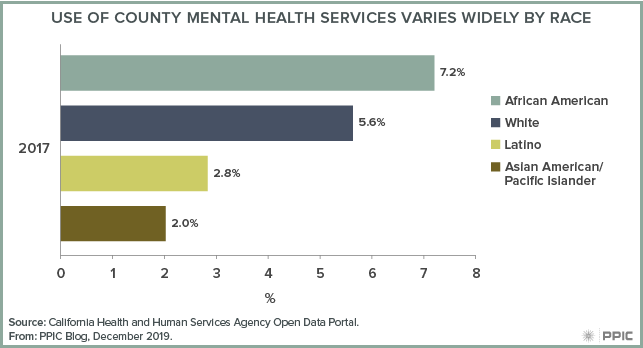
The disparities in access for underrepresented communities may be reflected by current utilization patterns of county mental health services. Among adult Medi-Cal enrollees, fewer Latinos and Asian/Pacific Islanders use these services than African Americans and whites.

figure - Use of County Mental Health Services Varies Widely by Race

These disparities are similar nationwide—and are likely to be related to a variety of factors. One possibility is the higher share of Latinos and Asian Americans/Pacific Islanders who may experience language barriers, compared to African Americans and whites.

A primary vehicle for reducing these disparities are Cultural Competence Plans, which are intended to guide county mental health plans in meeting the cultural competence and linguistic requirements already mandated by law. Recent legislation seeking to codify these requirements for county mental health plans did not make it past the governor’s desk. But its advancement through the legislature signals growing recognition of the need for communities of color to have access to culturally and linguistically appropriate mental health services. As California’s population becomes more diverse, culturally competent care will become even more important in the coming years.