Video: A Conversation with Congresswoman Nancy Pelosi

As part of our Speaker Series on California’s Future, PPIC is inviting elected leaders across the political spectrum to participate in public conversations. The purpose is to give Californians a better understanding of how our leaders are addressing the challenges facing our state.

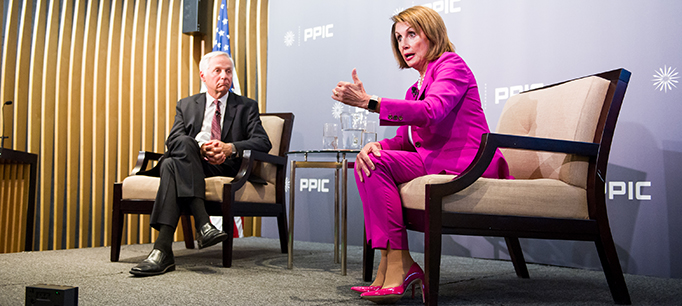
House Democratic Leader Nancy Pelosi and PPIC president Mark Baldassare had a wide-ranging conversation in San Francisco on Wednesday. They focused on the relationship between California and the federal government in a number of areas, including economic and tax policy, immigration, health care, and environmental issues.

Not surprisingly, Pelosi’s take on the state-federal relationship differs from that of her Republican counterpart, Kevin McCarthy, who fielded virtually the same questions from Baldassare in mid-August. In her view, this is an unusual time: “We haven’t had a time where the president has so targeted a state, in tax policy, environmental policy, trade policy.” Californians need to know about the statewide impact of these policies, and their elected leaders need to “try to work as much as possible in a bipartisan way to withstand that.”

She criticized the new federal tax law for significantly increasing the national debt without promoting growth. In fact, she continued, one of the best ways to promote economic growth is to enact comprehensive immigration reform. Asked what this would look like, she cited the bipartisan immigration bill that the Senate passed several years ago as one possible model. She deplored the current “uncivilized, inhumane” policy of separating families at the border. But she argued that while Trump-era ICE policies need to be changed, abolishing ICE is “not the answer.”

Pelosi, who played a major role in the passage of the Affordable Care Act, described health care reform as a “pillar of health and economic security for America’s working families.” She also characterized health care as a major issue in the November midterm elections. “The cost of health care is a very major issue in people’s lives, so we want to work in a bipartisan way, wherever possible, to reduce those costs.”

While she is concerned that Congress is not doing enough to ensure the integrity of the midterm elections, Pelosi is excited about the number of women who are running. “When I went to Congress, there were 12 Democratic and 11 Republican women.” Now, she added, “the majority of the people in our caucus are women, people of color, LGBTQ [. . .] and we want more!”

Why does she want to be Speaker? The short answer: “None of us is indispensable, but I think I’m probably the best person for the job.”
 

Video: A Conversation with Congressman Kevin McCarthy

As part of our Speaker Series on California’s Future, PPIC is inviting elected leaders across the political spectrum to participate in public conversations. The purpose is to give Californians a better understanding of how our leaders are addressing the challenges facing our state.

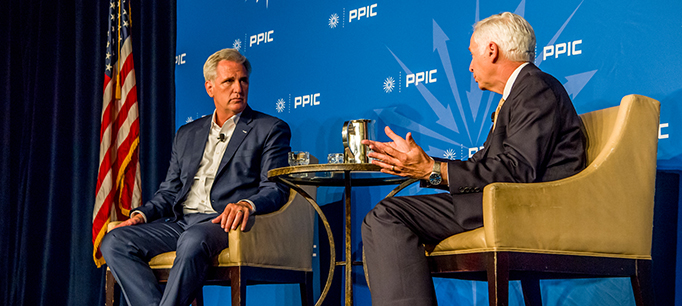
House Majority Leader Kevin McCarthy and PPIC president Mark Baldassare had a wide-ranging conversation in Sacramento last week. They focused on the relationship between California and the federal government in several areas, including tax reform, immigration, health care, water policy, wildfire management, and fuel emissions standards.

When asked about the impact of the recently passed federal tax law on Californians, he emphasized the bigger economic picture. The focus, he said, should be on the overall Republican agenda and whether it inspires optimism about the future: “Do you feel better off? How many quarters of economic growth have you had?”

McCarthy criticized the state’s leadership for its “backwards thinking” on the gas tax and other issues, and its oppositional stance to the Trump administration. He also talked about the need for bipartisan compromise in Congress. “I try to work with everybody,” he said, citing the work he did with Senator Feinstein to pass “the first major piece of water legislation in quite some time.” He returned to this theme after the conversation was briefly interrupted by a pro-DACA demonstration, asking why we can’t “sit down and communicate with one another” and decrying “elected officials who stand up and say ‘Divide us, not unite us’.”

Nonetheless, he seemed confident about finding ways to address major issues. About immigration policy, he said “I think we’re going to solve this problem” in the next congressional session. Asked about the 2020 Census, he said that Congress is making sure there will be an accurate count. “It is a big job,” he added, “and this is always the big fear before a census—are we prepared for it?”

Finally, when asked why he wants to become Speaker of the House, he said, “I want to make sure a Republican can be Speaker,” so that the party can continue to enact its agenda. He went on to describe the electoral landscape leading up to the November midterms, offering up a key takeaway: “This will be the year of the woman.”

Environmental Priorities and the Midterm Election

Just three months ahead of a consequential midterm election, California and the federal government continue to move in very different directions on environmental policy. Last week, the Trump administration’s efforts to roll back strict automobile emission standards were strongly criticized by the Brown administration. State officials have also pushed back on federal efforts to increase offshore oil drilling and the president’s decision to exit the Paris Agreement on climate change. Meanwhile, personal experiences with a prolonged drought and recent severe wildfires are raising Californians’ awareness about the impacts of climate change. Where do California voters stand on environmental issues and what are the implications for November?

Californians’ support for environmental protection runs deep. Consider emissions standards. In the July PPIC survey, 60% of California registered voters say that they are in favor of setting higher emissions standards for automobiles. Majorities of voters across age, education, gender, income, and racial/ethnic groups support this environmental policy. Majorities of Democrats (74%) and independents (62%) and 34% of Republicans are in favor. Notably, 52% of registered voters living in the nine competitive House districts—as rated by the Cook Political Report—favor higher auto emission standards.

Or take another area of state-federal policy conflict over the environment, offshore oil drilling. Sixty-six percent of California registered voters are opposed to more drilling off the California coast. Opposition is high among Democrats (82%) and independents (66%), and reaches 40% among Republicans. Majorities oppose it in both the coastal and inland regions of the state and across age, education, gender, income, and racial/ethnic groups. As for the registered voters living in the nine competitive House districts, 56% are opposed to allowing more offshore drilling off the California coast.

These views on particular environmental policy issues are similar to larger concerns related to global warming. About two in three California registered voters believe that global warming has already begun (67%), say that they are very concerned about its possible impact on more severe wildfires (64%), and favor the state law that requires California to reduce its greenhouse gas emissions (67%). Majorities of Democrats and independents share these views, along with substantial proportions of Republicans and majorities of voters across regions and age, education, gender, income, and racial/ethnic groups. In the nine competitive House districts, majorities of registered voters believe that global warming has already begun (59%), say they are very concerned about the impact of global warming on more severe wildfires (56%), and favor the state law that requires greenhouse gas emission reductions (62%).

Personal views about global warming could shape the size and profile of the electorate this year. Majorities of California voters say that the issue of global warming is extremely or very important to them personally (62%). If this high level of personal concern motivates voter turnout, it will provide a partisan advantage (80% Democrats, 61% independents, 29% Republicans). It could also serve as a catalyst in several Democratic-leaning groups with a low propensity to vote (64% under age 35; 68% earning less than $40,000; 69% renters; 70% Latinos). Moreover, in the nine competitive House districts, majorities of registered voters (55%) say that global warming is extremely or very important to them personally.

In the midterm election context, Californians are indicating strong opinions on environmental matters. A record-high number of registered voters say that the gubernatorial candidates’ positions on the environment are very important in determining their vote (39% 2002, 46% 2006, 42% 2010, 40% 2014, 53% 2018).

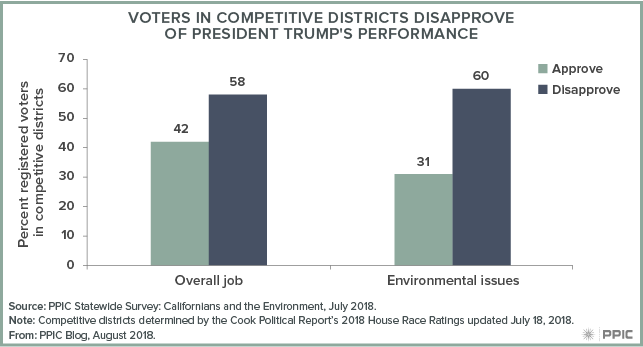
California voters say that they want statewide candidates to push back rather than work with the Trump administration on environmental issues (53% to 40%), and a majority disapprove of the way that President Trump is handling environmental issues (67%). Since the midterm elections are in part a referendum on the president, it is perhaps most significant that a majority of registered voters living in the nine competitive House districts disapprove of President Trump’s handling of environmental issues (60%)—similar to their disapproval of his overall job performance (58%).

Californians’ environmental priorities are high on our list of political wildcards in this important midterm election. Stay tuned as the PPIC Statewide Survey monitors this trend and other topics in our pre-election polling.

Video: 2020 Census: Why Is the Citizenship Question Such a Big Deal?

The decennial census plays an essential role in American democracy. The stakes are huge for California—and 2020 is fast approaching.

In this video, PPIC research fellow Eric McGhee discusses the controversial addition of a citizenship question to the 2020 Census. View more videos in this series.


2020 Census: Where Are California’s Hard-to-Count Communities?

The decennial census plays an essential role in American democracy. The stakes are huge for California, and 2020 is fast approaching. This series of blog posts takes a detailed look at California communities that may be at risk of being undercounted.

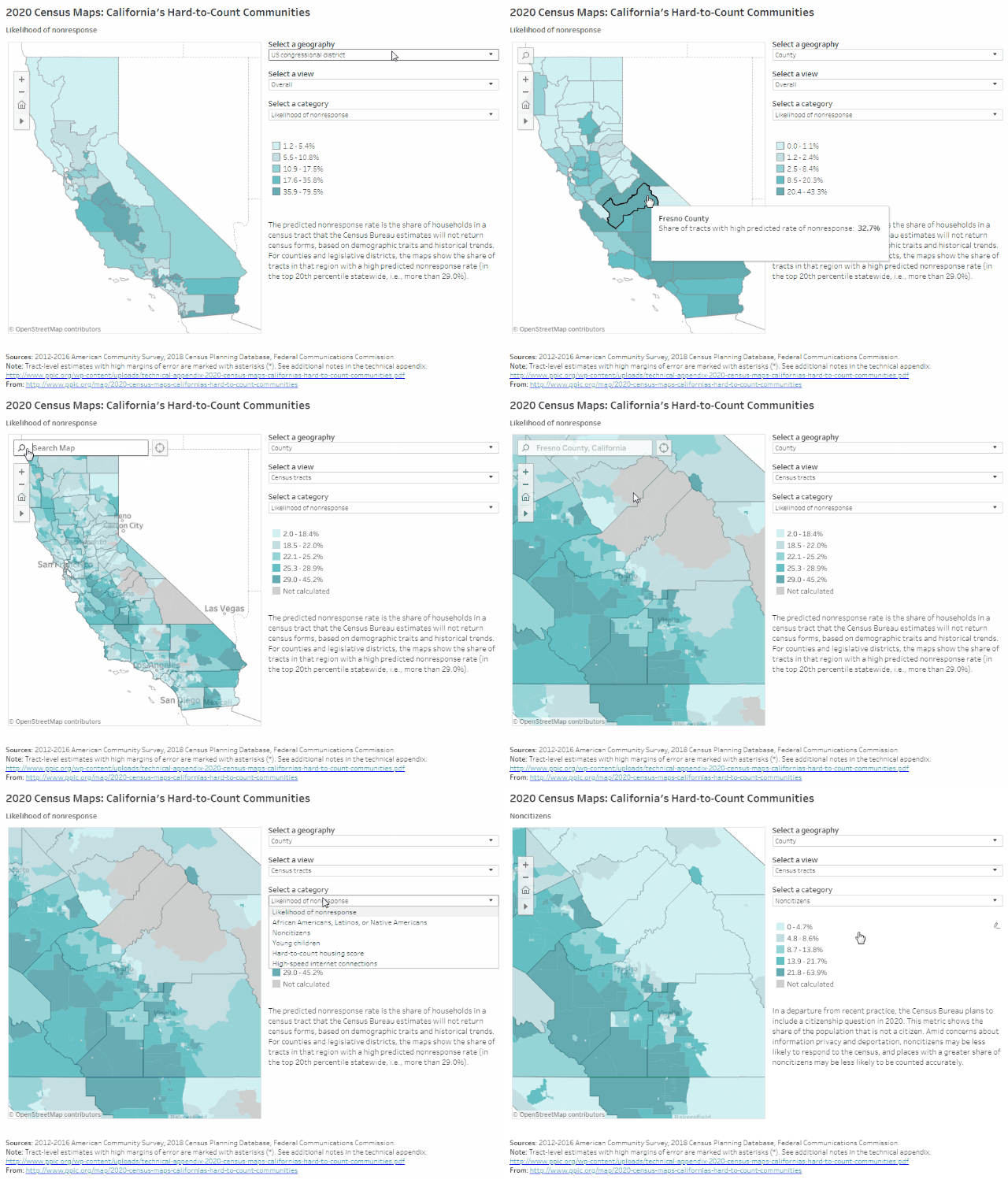
PPIC’s new interactive maps are an important tool for Californians working to ensure an accurate census count. They highlight hard-to-count communities across the state, providing an overall assessment of how hard an area will be to count and pinpointing reasons why certain areas may be hard to reach.

The overall assessment is based on an area’s “low response score,” a measure developed by the Census Bureau using historical trends. This score (what we call the “predicted nonresponse rate”) helps visualize a community’s vulnerability to being omitted from the census. However, it doesn’t capture all areas that will be hard to count in 2020, and it doesn’t indicate the underlying reasons why a community might be hard to count. PPIC’s new maps expand our understanding of hard-to-count communities in several ways.

As shown in the graphic below, the maps provide information for multiple geographies. First, you can select whether you want to see data by county, congressional district, state assembly district, or state senate district. Then, you can examine data for those broad regions or for individual census tracts. Zooming in allows you to identify which census tracts have the highest predicted nonresponse rates in a particular region.

In addition, by selecting different categories, you can get a sense of why these areas might be hard to count:

  • Does the area have high shares of people that are typically undercounted? Certain racial/ethnic groups—African Americans, Latinos, and Native Americans—and young children are historically undercounted in the census. Counties in the San Joaquin Valley and southern parts of California tend to have higher shares of these vulnerable populations.
  • Does the area have many noncitizens? The census is supposed to count all residents, but noncitizens may be less likely to respond in 2020 due to the planned addition of a citizenship question and concerns about privacy and deportation. Monterey County on the central coast has the highest share of noncitizens (22%), followed by Santa Clara County (18%) and Los Angeles County (17%).
  • Does the area have a lot of renters, overcrowded housing, and other factors that can make it hard for the Census Bureau to locate residents? To examine this issue, we created a housing score using data on renters and mobile homes. Seventeen counties in various regions of the state have scores indicating they may face particular challenges counting residents due to their housing conditions.
  • Does the area seem to have adequate internet access? The Census Bureau plans to collect the majority of responses online in 2020—a departure from its usual practice. We provide data on residential high-speed internet connections—a measure created by the Federal Communications Commission that does not include mobile data plans—as a proxy for service coverage. Rural areas are less likely to have residential high-speed internet access.

Overall, the maps show there are hard-to-count communities across the entire state—and regions have different risk factors for being undercounted. In addition, communities may be hard to count for multiple reasons: for example, low-income populations are more likely to live in hard-to-find housing like garages and trailers, and they are also less likely to have reliable internet access.

We hope these maps help local leaders determine the likelihood that their communities might not be accurately counted and provide guidance on targeting outreach efforts. Stay tuned for future posts that examine hard-to-count communities in specific regions of the state.

Video: 2020 Census: What’s at Stake for California?

The decennial census plays an essential role in American democracy. The stakes are huge for California—the state stands to lose political representation and federal funding if there is a significant undercount—and 2020 is fast approaching. At a time when straightforward facts are in short supply, PPIC is providing essential, objective information about the importance of an accurate census count in California.

In this video, PPIC research director Sarah Bohn explains why the census is of particular importance to the Golden State this time around.

How Changes in Immigration Affect California’s Workforce

[vc_row][vc_column][vc_column_text]Immigrants are essential to California’s workforce. In the past two decades, as labor market needs have shifted, the composition of recent immigrants (those arriving in the last five years) has changed dramatically. Today, recent immigrants to California are much more likely to hold a bachelor’s or more advanced degree than in the past—and in fact are now more likely than US-born Californians to do so.

While the number of recent immigrants to California fell by 24% between 2000 and 2016, the number of highly educated immigrants rose by 41%. In 2016, about half of recent immigrants held at least a bachelor’s degree. Highly educated immigrants work in every major industry in the state and comprise about 30% of the highly educated workforce.

These changes in educational attainment coincide with other shifts in immigration patterns. A large portion of the decline in immigration to California can be attributed to the falling numbers of immigrants arriving from Mexico. In 2000, over half a million recent immigrants came from Mexico. By 2016, that number fell by more than 70% to less than 150,000 people.

Now, China has slightly edged out Mexico as the leading country of origin, and these top two countries are followed by India, the Philippines, and Vietnam. Immigrants from China and India tend to be highly educated: in 2016, 47% of recent immigrants from China—and around 80% of recent immigrants from India—had at least a bachelor’s degree. The interactive below allows you to further explore changes in education levels over time among recent immigrants overall and from these five countries.

The sharp increase in highly educated immigrants and the decline in less-educated immigrants reflect the changing labor market in California. Unemployment rates for workers with at least a bachelor’s degree (3.3%) are about half those of less-educated workers (6.5%). With California expected to face a shortfall of 1.1 million college graduates by 2030, highly educated immigrants are a key component to helping the state address the workforce skills gap.[/vc_column_text][/vc_column][/vc_row][vc_row][vc_column][vc_raw_html]JTNDZGl2JTIwY2xhc3MlM0QlMjd0YWJsZWF1UGxhY2Vob2xkZXIlMjclMjBpZCUzRCUyN3ZpejE1Mjc4Nzg3ODgxNDYlMjclMjBzdHlsZSUzRCUyN3Bvc2l0aW9uJTNBJTIwcmVsYXRpdmUlMjclM0UlMEElMDklM0Nub3NjcmlwdCUzRSUwQSUwOSUzQ2ElMjBocmVmJTNEJTI3JTIzJTI3JTNFJTNDaW1nJTIwYWx0JTNEJTI3RURVQ0FUSU9OJTIwTEVWRUxTJTIwVkFSWSUyMEFDUk9TUyUyMElNTUlHUkFOVCUyMEdST1VQUyUyMCUyNyUyMHNyYyUzRCUyN2h0dHBzJTNBJTI2JTIzNDclM0IlMjYlMjM0NyUzQnB1YmxpYy50YWJsZWF1LmNvbSUyNiUyMzQ3JTNCc3RhdGljJTI2JTIzNDclM0JpbWFnZXMlMjYlMjM0NyUzQkNhJTI2JTIzNDclM0JDYWxpZm9ybmlhc2ltbWlncmFudHNhbmRlZHVjYXRpb25sZXZlbHNfMCUyNiUyMzQ3JTNCSW1taWdyYW50c2luQ2FsaWZvcm5pYWJ5ZWR1Y2F0aW9uYW5kY291bnRyeW9mb3JpZ2luJTI2JTIzNDclM0IxX3Jzcy5wbmclMjclMjBzdHlsZSUzRCUyN2JvcmRlciUzQSUyMG5vbmUlMjclMjAlMkYlM0UlM0MlMkZhJTNFJTBBJTA5JTNDJTJGbm9zY3JpcHQlM0UlMEElMDklM0NvYmplY3QlMjBjbGFzcyUzRCUyN3RhYmxlYXVWaXolMjclMjAlMjBzdHlsZSUzRCUyN2Rpc3BsYXklM0Fub25lJTNCJTI3JTNFJTBBJTA5JTA5JTNDcGFyYW0lMjBuYW1lJTNEJTI3aG9zdF91cmwlMjclMjB2YWx1ZSUzRCUyN2h0dHBzJTI1M0ElMjUyRiUyNTJGcHVibGljLnRhYmxlYXUuY29tJTI1MkYlMjclMjAlMkYlM0UlMEElMDklMDklM0NwYXJhbSUyMG5hbWUlM0QlMjdlbWJlZF9jb2RlX3ZlcnNpb24lMjclMjB2YWx1ZSUzRCUyNzMlMjclMjAlMkYlM0UlMEElMDklMDklM0NwYXJhbSUyMG5hbWUlM0QlMjdzaXRlX3Jvb3QlMjclMjB2YWx1ZSUzRCUyNyUyNyUyMCUyRiUzRSUwQSUwOSUwOSUzQ3BhcmFtJTIwbmFtZSUzRCUyN25hbWUlMjclMjB2YWx1ZSUzRCUyN0NhbGlmb3JuaWFzaW1taWdyYW50c2FuZGVkdWNhdGlvbmxldmVsc18wJTI2JTIzNDclM0JJbW1pZ3JhbnRzaW5DYWxpZm9ybmlhYnllZHVjYXRpb25hbmRjb3VudHJ5b2ZvcmlnaW4lMjclMjAlMkYlM0UlMEElMDklMDklM0NwYXJhbSUyMG5hbWUlM0QlMjd0YWJzJTI3JTIwdmFsdWUlM0QlMjdubyUyNyUyMCUyRiUzRSUwQSUwOSUwOSUzQ3BhcmFtJTIwbmFtZSUzRCUyN3Rvb2xiYXIlMjclMjB2YWx1ZSUzRCUyN25vJTI3JTIwJTJGJTNFJTBBJTA5JTA5JTNDcGFyYW0lMjBuYW1lJTNEJTI3c3RhdGljX2ltYWdlJTI3JTIwdmFsdWUlM0QlMjdodHRwcyUzQSUyNiUyMzQ3JTNCJTI2JTIzNDclM0JwdWJsaWMudGFibGVhdS5jb20lMjYlMjM0NyUzQnN0YXRpYyUyNiUyMzQ3JTNCaW1hZ2VzJTI2JTIzNDclM0JDYSUyNiUyMzQ3JTNCQ2FsaWZvcm5pYXNpbW1pZ3JhbnRzYW5kZWR1Y2F0aW9ubGV2ZWxzXzAlMjYlMjM0NyUzQkltbWlncmFudHNpbkNhbGlmb3JuaWFieWVkdWNhdGlvbmFuZGNvdW50cnlvZm9yaWdpbiUyNiUyMzQ3JTNCMS5wbmclMjclMjAlMkYlM0UlMEElMDklMDklM0NwYXJhbSUyMG5hbWUlM0QlMjdhbmltYXRlX3RyYW5zaXRpb24lMjclMjB2YWx1ZSUzRCUyN3llcyUyNyUyMCUyRiUzRSUwQSUwOSUwOSUzQ3BhcmFtJTIwbmFtZSUzRCUyN2Rpc3BsYXlfc3RhdGljX2ltYWdlJTI3JTIwdmFsdWUlM0QlMjd5ZXMlMjclMjAlMkYlM0UlMEElMDklMDklM0NwYXJhbSUyMG5hbWUlM0QlMjdkaXNwbGF5X3NwaW5uZXIlMjclMjB2YWx1ZSUzRCUyN3llcyUyNyUyMCUyRiUzRSUwQSUwOSUwOSUzQ3BhcmFtJTIwbmFtZSUzRCUyN2Rpc3BsYXlfb3ZlcmxheSUyNyUyMHZhbHVlJTNEJTI3eWVzJTI3JTIwJTJGJTNFJTBBJTA5JTA5JTNDcGFyYW0lMjBuYW1lJTNEJTI3ZGlzcGxheV9jb3VudCUyNyUyMHZhbHVlJTNEJTI3eWVzJTI3JTIwJTJGJTNFJTBBJTA5JTNDJTJGb2JqZWN0JTNFJTBBJTNDJTJGZGl2JTNFJTBBJTNDc2NyaXB0JTIwdHlwZSUzRCUyN3RleHQlMkZqYXZhc2NyaXB0JTI3JTNFJTBBJTIwJTIwJTIwJTIwJTIwJTIwJTIwJTIwJTIwJTIwJTIwJTIwJTIwJTIwJTIwJTIwJTIwJTIwJTIwJTIwdmFyJTIwZGl2RWxlbWVudCUyMCUzRCUyMGRvY3VtZW50LmdldEVsZW1lbnRCeUlkJTI4JTI3dml6MTUyNzg3ODc4ODE0NiUyNyUyOSUzQiUwQSUyMCUyMCUyMCUyMCUyMCUyMCUyMCUyMCUyMCUyMCUyMCUyMCUyMCUyMCUyMCUyMCUyMCUyMCUyMCUyMHZhciUyMHZpekVsZW1lbnQlMjAlM0QlMjBkaXZFbGVtZW50LmdldEVsZW1lbnRzQnlUYWdOYW1lJTI4JTI3b2JqZWN0JTI3JTI5JTVCMCU1RCUzQiUwQSUyMCUyMCUyMCUyMCUyMCUyMCUyMCUyMCUyMCUyMCUyMCUyMCUyMCUyMCUyMCUyMCUyMCUyMCUyMCUyMGlmJTIwJTI4JTIwZGl2RWxlbWVudC5vZmZzZXRXaWR0aCUyMCUzRSUyMDcwMCUyMCUyOSUyMCU3QiUyMCUwQSUwOSUwOSUwOSUwOSUwOSUwOXZpekVsZW1lbnQuc3R5bGUud2lkdGglM0QlMjc2NTBweCUyNyUzQnZpekVsZW1lbnQuc3R5bGUuaGVpZ2h0JTNEJTI3NjAwcHglMjclM0IlMEElMDklMDklMDklMDklMDklN0QlMjBlbHNlJTIwaWYlMjAlMjglMjBkaXZFbGVtZW50Lm9mZnNldFdpZHRoJTIwJTNFJTIwNTAwJTIwJTI5JTIwJTdCJTBBJTA5JTA5JTA5JTA5JTA5JTA5dml6RWxlbWVudC5zdHlsZS53aWR0aCUzRCUyNzUwMHB4JTI3JTNCdml6RWxlbWVudC5zdHlsZS5oZWlnaHQlM0QlMjc3MzBweCUyNyUzQiUwQSUwOSUwOSUwOSUwOSUwOSU3RCUyMGVsc2UlMjAlN0IlMEElMDklMDklMDklMDklMDklMDl2aXpFbGVtZW50LnN0eWxlLndpZHRoJTNEJTI3MTAwJTI1JTI3JTNCdml6RWxlbWVudC5zdHlsZS5oZWlnaHQlM0QlMjc3MzBweCUyNyUzQiUwQSUwOSUwOSUwOSUwOSUwOSU3RCUwQSUwOSUwOSUwOSUwOSUwOXZhciUyMHNjcmlwdEVsZW1lbnQlMjAlM0QlMjBkb2N1bWVudC5jcmVhdGVFbGVtZW50JTI4JTI3c2NyaXB0JTI3JTI5JTNCJTBBJTA5JTA5JTA5JTA5JTA5c2NyaXB0RWxlbWVudC5zcmMlMjAlM0QlMjAlMjdodHRwcyUzQSUyRiUyRnB1YmxpYy50YWJsZWF1LmNvbSUyRmphdmFzY3JpcHRzJTJGYXBpJTJGdml6X3YxLmpzJTI3JTNCJTBBJTA5JTA5JTA5JTA5JTA5dml6RWxlbWVudC5wYXJlbnROb2RlLmluc2VydEJlZm9yZSUyOHNjcmlwdEVsZW1lbnQlMkMlMjB2aXpFbGVtZW50JTI5JTNCJTBBJTNDJTJGc2NyaXB0JTNF[/vc_raw_html][/vc_column][/vc_row]

How the Census Affects State Finances

The US Constitution requires a decennial census for the purposes of determining how many seats each state will have in the House of Representatives. Just as critical, a number of federal programs rely on census data to calculate the share of federal dollars distributed to each state. In the case of California, the census-connected funds are big money. Undercounting Californians in the upcoming census could have significant fiscal consequences for the state.

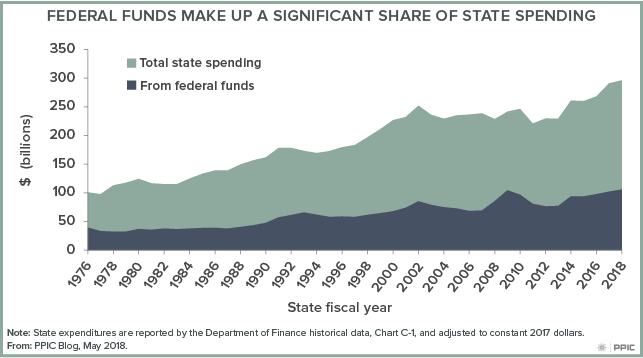
Federal dollars account for more than one-third all state spending (including the general fund, special funds, and bonds). This translates into more than $100 billion in state spending derived from the federal government.

Not all federal programs rely on the census to determine the distribution of dollars, but the vast majority are connected to it in some way. One study estimates that 132 federal programs rely on census data to distribute more than $675 billion. Another estimates the share of census-related funding for the largest programs for each state. For California, that amount was $77 billion, or more than 80 percent of the federal funds the state received in 2015 (the most recent estimate available).

Given the dollars at stake, getting an accurate count of California’s residents is critical—but could be a challenge since large segments of California’s population are historically difficult to count.

But population counts alone do not determine funding, so it is difficult to precisely forecast the impact of an undercount. Compounding the difficulty, the way federal programs use census data to allocate dollars varies, and in some cases, involves other factors such as the relative wealth of the state. For example, a significant share of census-related dollars are determined by a specific federal reimbursement rate. Because California already receives the minimum rate, an undercount would not reduce the amount of federal dollars that the state can count on.

Finally, the use of the census to distribute dollars is, in some cases, a zero-sum-game. For California to avoid “losing” relative to other states, it needs to count as well, or better, than the rest of the country. Other large states—notably Texas and Florida—face similar challenges.

California’s creation of a state committee to ensure an accurate count—along with funding to support such efforts—are crucial to a successful outcome. In fact, a relatively modest investment has the potential to provide enormous returns to the state.

Video: California Primary Preview

In the run-up to California’s June 5 primary, Democrat Gavin Newsom remains the top choice among likely voters in the governor’s race, according to the latest PPIC poll. Republican John Cox is in a close race with Democrat Antonio Villaraigosa to gain the second spot on November’s general election ballot. Senator Dianne Feinstein holds a wide lead over fellow Democrat Kevin de León.

Dean Bonner, PPIC associate survey director, detailed these findings and more at a recent Sacramento briefing.

The survey shows Newsom (25%) leading among likely voters, followed by Cox (19%), Villaraigosa (15%), Republican Travis Allen (11%), and Democrats John Chiang (9%) and Delaine Eastin (6%). Fifteen percent of likely voters are still undecided. Results were similar in an April PPIC poll (26% Newsom, 15% Cox, and 13% Villaraigosa). Cox’s support has more than doubled since the January (7%) PPIC poll.

Other highlights of the survey include:

  • A majority of likely voters (63%) favor Governor Brown’s final budget, and overwhelming majorities like his idea of additional one-time spending on infrastructure, homelessness, and mental health programs.
  • Immigrants are viewed as a benefit to the state by a majority of likely voters (67%) because of their hard work and job skills. The vast majority (80%) favor a way for undocumented immigrants to stay in the US legally—if certain requirements are met.
  • Californians are divided on the motivation of the Russia investigation, but a strong majority of likely voters (74%) think the Russian government tried to influence the outcome of the 2016 presidential election.
  • Californians distrust both the state and federal government—just 18 percent of likely voters say you can trust Washington to do what’s right.

Video: Celebrating 100 Years of Women in the California Legislature

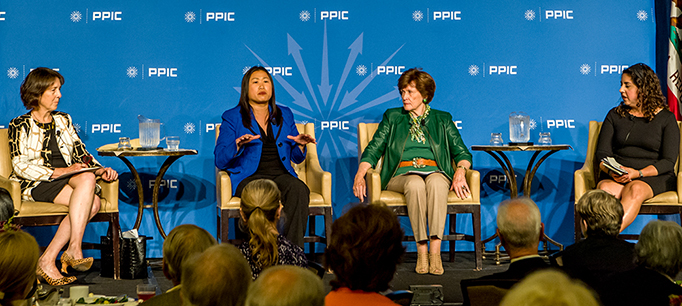
At a recent PPIC event celebrating the centennial year of women in California’s statehouse, female legislators shared stories of how they broke through the political glass ceiling.

The session opened with a conversation between Toni Atkins, the first woman and first openly LGBTQ leader of the state senate, and Mark Baldassare, president and CEO of PPIC. Their talk ranged from the professional to the personal.

Atkins listed her top legislative priorities as emergency services and disaster preparedness. It’s a “new normal” we have to grapple with, she added. Atkins also wants to continue her focus on housing and homelessness, which she called a “humanitarian crisis.”

When Baldassare asked how the #MeToo movement might change the Sacramento culture, Atkins said change “doesn’t happen overnight” but that she wants “more than anything not to lose this moment, because . . . it may not come again for some time.”

Key to Atkins’s leadership style is to listen well and value other points of view. California has a progressive bent, but in today’s political climate, “we’ve left some voices behind,” she said.

This centennial offers a reminder that women remain underrepresented in the legislature. Although they comprise more than half of California’s likely voters (53%), they make up just 23% of its legislators. A panel of lawmakers discussed that imbalance in a conversation moderated by New York Times correspondent Jennifer Medina.

Becky Morgan, a state senator from 1985 to 1993, recalled setting up the first committee on early childhood. She was also the first female legislator to wear pants on the senate floor. It wasn’t an act of protest—it was simply “a cold January morning,” Morgan said, drawing laughter from the audience.

State senator Janet Nguyen recounted her stint as the first woman to chair the Orange County Board of Supervisors and the first to lead its meetings while pregnant—which “shocked” a few supervisors, she said. Despite the daily challenge of balancing work and family, Nguyen said, “I’m not going to give up family or career. I want both!”

All the panelists agreed that gender diversity was essential to effective state leadership. State senator Nancy Skinner agreed that we need more family-friendly policies in the state, but she emphasized that women should also champion issues related to their areas of expertise—in her case, criminal justice reform and climate change. Her view on women serving in the legislature? “It’s just right,” she argued—which led to sustained applause.