Do Californians Support State Action on Immigration?

California became the nation’s first sanctuary state in January, when Governor Jerry Brown signed legislation (SB 54) that limits cooperation by local law enforcement with federal immigration authorities. In March, the US Justice Department announced that it was suing California over three immigration-related laws—including SB 54. Since then, six counties—including San Diego and Orange—and at least 13 cities have voiced opposition to the sanctuary laws, either by passing resolutions or by joining the Justice Department’s lawsuit against California.

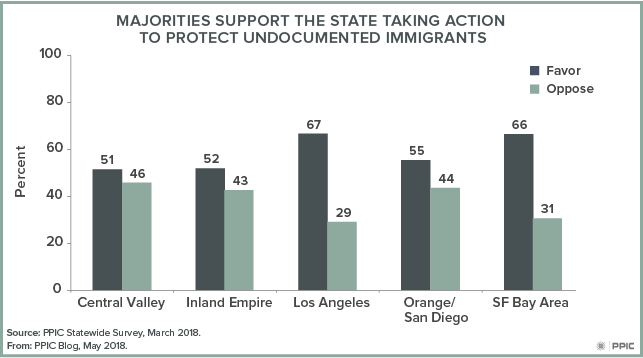
A solid majority of Californians (61%) support the state taking action to protect undocumented immigrants. But there is a stark partisan divide: the March PPIC Statewide Survey found eight in ten Democrats in favor of and eight in ten Republicans opposed to the state taking action. It is notable that there is majority support across the state’s regions. This includes 55% support among residents in Orange and San Diego Counties, home to a majority of the cities opposing the sanctuary laws. About half of residents in the Central Valley and the Inland Empire favor the state taking action. And support is even higher in Los Angeles and the San Francisco Bay Area, where it hovers around two-thirds. There are some differences between coastal (64%) and inland (52%) residents.
Across demographic groups, there is considerable support for state action on this issue—in fact majority support drops below 50% only among whites (47%). Support is highest among Latinos (76%), immigrant residents (73%), those with a high school degree or less (71%), Californians age 18 to 34 (67%), and those living in households making less than $40,000 (67%).

While the courts will ultimately decide the fate of the federal lawsuit, two things are clear: 1) California will continue to chart its own course on issues its leaders care about, and 2) immigration continues to be a topic that divides partisans but unites many other Californians across the state. Stay tuned to PPIC as the Statewide Survey will continue to monitor the opinions of Californians on this important policy issue.
The 100th Anniversary of Women in the California Legislature

The Public Policy Institute of California is hosting a public event in Sacramento to commemorate the election of the first women to the California Legislature in 1918. Today, with Toni Atkins as the first woman in the powerful position of senate president—and in the wake of the capitol’s sexual misconduct scandals—we want to offer some reflections on the status of women in California’s statehouse.

First, it’s important to point out that the legislature has far fewer women than men at a time when women have an edge over men in voting. Women now make up slightly more than half of California’s likely voters (53%). This edge persists across racial/ethnic groups: women make up more than half of African American (57%), Latino (57%), white (52%), and Asian American (51%) likely voters. Across parties, women make up 62% of Democratic likely voters, 49% of Republican likely voters, and 44% of independent likely voters.

But the predominance of women voters is not reflected in the composition of the California Legislature. After the path-breaking elections of 100 years ago, the following decades saw relatively few women serving in the assembly. And it wasn’t until 1966 that women of color won assembly seats. A decade later, the first woman was finally elected to the state senate. The top two leadership roles in the assembly and senate were filled even more slowly. No woman held the assembly Speaker position until 1995—and that was for only three months. The next woman Speaker wasn’t elected until 2008.

Legislative term limits—passed by voters in 1990—were partially conceived as a path toward increasing diversity in the statehouse. But in the nearly 30 years since—an era that has been defined by California’s increasing ethnic and racial diversity, and Democratic leanings—there has been little change. The proportion of women in the legislature has ranged from a low of 18% in the 1991–92 session to a high of 31% in the 2005–06 session; overall, the average has hovered around 25%. A slew of recent reforms such as independent legislative redistricting, the top-two primary, and additional legislative term limit reforms—as well as efforts to encourage voter registration and voting—have had little impact.

Today, the proportion of women in the California Legislature stands at 23% and is similar in both houses. However, Republicans trail Democrats in the proportion of women legislators, with 6 women among the 38 Republican members and 22 women among the 79 Democratic members.

Surprisingly, California is a laggard in this area. Although a 2018 Rutgers University report finds that 25.4% of state legislators across the US are women, California ranks just 32nd out of the 50 states, close to the next-largest state, Texas (#35, 20.4%). Compared to our western neighbors, California is well behind Arizona (#1, 40%), Nevada (#3, 38.1%), Oregon (#8, 33.3%), and Washington (#5, 37.4%).

The lack of gender diversity in the California Legislature raises serious questions about the effects of political representation. What is the impact of the gender gap on equitable and effective policymaking? What are the greatest barriers for women in political careers? Will electing more women to legislative office provide inspiration and pathways for others—and help to build a more inclusive culture? One thing is certain: California’s current gender gap has consequences for the ability to recruit and retain top talent in the legislature today.


Video: Preparing California for the 2020 Census

The 2020 census will be a defining moment for California. Much is at stake—including billions in federal funds and the state’s political representation in the US Congress. The lasting impact of an undercount can’t be overstated. Governments, K–12 and higher education institutions, businesses, and nonprofits depend on the census to understand the needs of their communities, target services, and plan for the future.

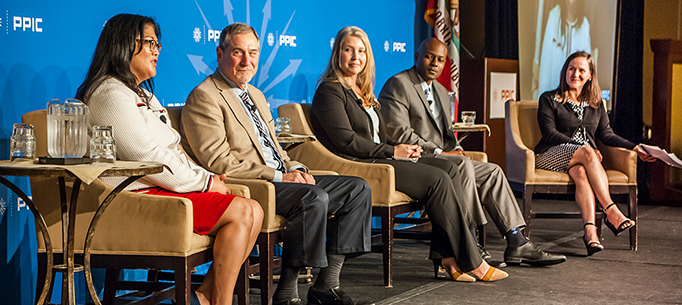
A panel of experts discussed the critical role of the decennial census at a PPIC event in Sacramento on April 24. They examined the challenges of reaching “hard-to-count” communities, the state’s part in ensuring an accurate tally, the impact of the recently-added citizenship question, and more.

The event opened with a wide-ranging conversation between Marc Berman, state assembly member, and Mark Baldassare, PPIC president. One of Berman’s biggest concerns is that California could lose its political clout in DC. The state has “40 million unique stories,” he said, and the census is about “making sure that every voice” gets counted. But the new citizenship question is counterproductive, in his view. We know that adding it “will discourage a lot of people from participating,” he said. “People are so fearful” that it could make a successful census count that much more difficult, he added.

For the first time, the US Census Bureau will try to collect most responses (55%) online, with the rest obtained by mail or in person. John Thompson, former director of the bureau, identified the government’s main rationale for the change—namely, cost. He also detailed best practices for adding a new census question: In the past, he said, the bureau would spend years testing it, partly to craft appropriate messaging and to ensure that residents were comfortable answering it. The new citizenship question did not have that review, a concern Thompson raised with Commerce Secretary Wilbur Ross to no avail.

John Dobard, associate director of political voice with Advancement Project California, discussed ways to involve the state’s hard-to-reach communities. One way to overcome residents’ fear of participation, he said, is to involve trusted leaders in outreach. Otherwise, entire multi-generational immigrant families could be left out.

An undercount could mean a direct hit to essential state services—such as the Children’s Health Insurance Program. In that scenario, young children in poverty would be hurt most of all, said Sarah Bohn, a panelist and PPIC research fellow.

Ditas Katague, the state’s 2020 census director, said her office is steeped in planning for the statewide rollout. Importantly, she said, California needs an “agile, flexible ground team,” and called on citizen volunteers to join state and local agencies, nonprofits, and philanthropic groups to help make that happen.

The Gender Gap in California Politics

In the past year, women have led large-scale political protests nationwide and an increasing number are running for elected office. In California, likely women voters have a numeric edge over men (53% to 47%), according to PPIC’s analysis. With the midterm elections quickly approaching, will women make a pivotal difference?

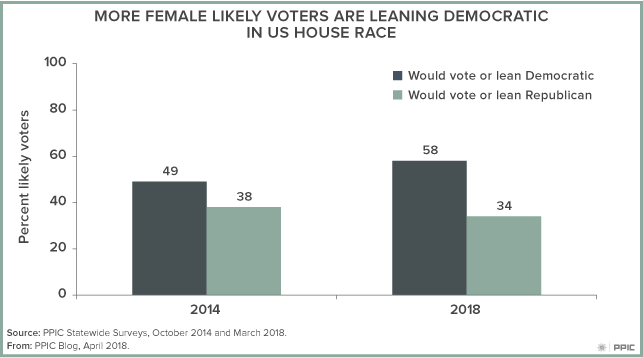
PPIC’s March 2018 survey offers some insight: nearly six in ten women (58%) support the Democratic candidate on the generic ballot for the U.S. House of Representatives—a 9-point increase since 2014. Preferences among men are unchanged.

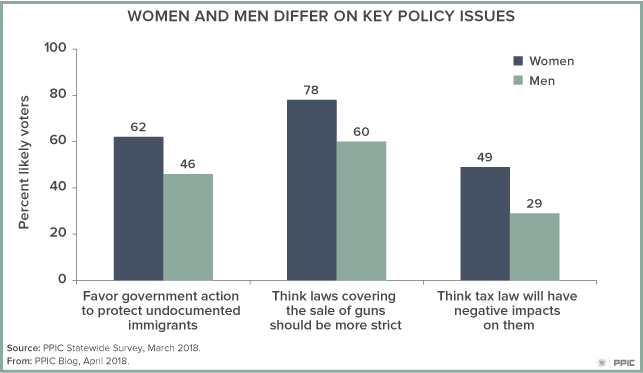
Although PPIC surveys show female likely voters are much more likely than their male counterparts to disapprove of President Trump (67% to 52%), issues like immigration policy, gun control, and taxes also reveal degrees of a gender gap. Examples include:

  • Immigration policy. Six in ten female (62%) likely voters are in favor of state and local governments making their own policies—separate from the federal government—to protect the rights of undocumented immigrants; fewer than half of men (46%) are in favor.
  • Gun control. While solid majorities of men and women think laws covering the sale of guns should be stricter, more women (78%) than men (60%) hold that view.
  • Federal tax law. Differences are also apparent between women (49%) and men (29%) who believe that the tax laws will have a negative impact on their families in the coming years.

However, it is important to note the role that party plays in policy preferences. For each of the aforementioned issues, there are sizable differences between Democratic women and Republican women. It’s also notable that among Republican likely voters, more women (54%) than men (38%) think gun laws should be stricter.

California is often mentioned as a battleground state in the 2018 elections, and tension between the federal and state governments is palpable. California’s government stands in opposition to many policies coming out of Washington and several of its congressional seats could be up for grabs—potentially determining the party that will lead the next US Congress. As a result, the nation will be watching California. And the PPIC Statewide Survey will continue to follow the perceptions and preferences of California’s likely voters, with particular interest in the gender gap.

Expanding Health Care Coverage for Undocumented Immigrants

As efforts to create a state-based single-payer health system confront complex questions of costs and federal uncertainty, advocates and state lawmakers are pushing forward with incremental policy measures to expand access to health coverage. The largest group of Californians that remain without comprehensive health insurance are undocumented immigrants, who were largely excluded from the coverage expansions created by the Affordable Care Act. Estimates suggest that almost 60% of uninsured Californians are undocumented.

Today, the Senate Health Committee is holding a hearing on SB 974 (Lara), which would allow all income-eligible California residents, regardless of immigration status, to enroll in comprehensive coverage through Medi-Cal (the state’s Medicaid program). California has already extended Medi-Cal coverage to undocumented children under 19, who have been eligible for comprehensive health benefits since May 2016. At the end of last year, nearly 220,000 undocumented children were enrolled in Medi-Cal, with costs estimated at $280 million in the recent fiscal year’s budget. No cost estimates are available yet for covering undocumented adults. But comprehensive coverage for the undocumented population must come from state funds, since federal Medi-Cal funding can only be used to support emergency services for undocumented immigrants.

In previous research, we estimated that about half of California’s undocumented population would likely qualify for Medi-Cal based on their income levels if restrictions on immigration status were removed. But this varied across regions. In Los Angeles County and parts of the Central Valley, more than half of undocumented immigrants had incomes below the Medi-Cal eligibility threshold of 138% of the federal poverty level, or FPL ($34,600 for a family of four). Bay Area counties had lower shares of income-eligible undocumented immigrants.

Currently, undocumented adults rely on the health care safety net—including community clinics, public hospital systems, and emergency departments—to access needed medical care. These providers play an integral role in caring for both those that remain uninsured and those covered by our vastly expanded Medi-Cal program. As policymakers consider ways to expand comprehensive health coverage, it is important that they continue to support the state’s safety net providers.

California’s Immigrants and the 2018 Election Context

This piece is excerpted from a presentation at the USC Annenberg School for Communication and Journalism given on March 30, 2018, in Los Angeles.

Many eyes will be on California in this midterm election year, especially since control of Congress may hinge on the outcome of 10 competitive House races in the Golden State. Currently, more than a quarter of the state’s residents are born outside the US—and one in five immigrants make up what we consider likely voters in California elections. With federal immigration policy playing a lead role in today’s polarized political discussions, will California’s immigrants have an impact—and to who’s advantage—in the 2018 election?

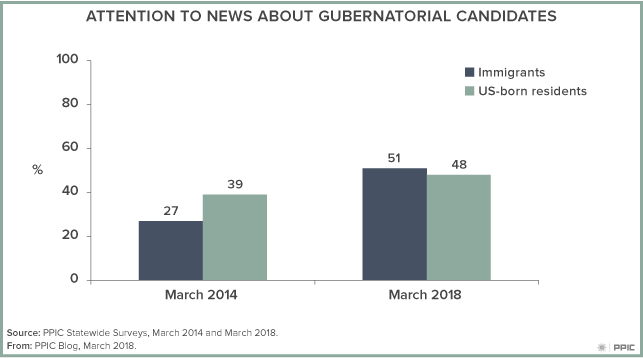
Typically, California’s immigrants are less interested in politics than their US born counterparts. But not when it comes to the 2018 election cycle. Among likely voters in our current survey, immigrants and nonimmigrants are similarly likely to be following the news about gubernatorial candidates “very” or “fairly” closely (51% immigrants, 48% US born). Both groups say that voting this year is more important than in past midterm elections (47% immigrants, 51% US born). Perhaps most telling for this year, both likely voter groups mention immigration and illegal immigration when asked about the issue that they would most like to hear the gubernatorial candidates talk about before the June primary (23% immigrants, 23% US born).

When it comes to current candidate choices, we do see some divergence between immigrant and US-born likely voters:

  • Democrat Gavin Newsom slightly trails Democrat Antonio Villaraigosa among immigrants (17% to 23%), while he is favored by three to one over Villaraigosa among nonimmigrants (30% to 9%).
  • Republican John Cox does equally well with both groups (15% immigrants, 14% US born).
  • Democrat Dianne Feinstein is favored by large margins over Democrat Kevin de León both among immigrants (50% to 18%) and nonimmigrants (40% to 16%). She has a higher approval rating among immigrants than nonimmigrants (68% to 51%).
  • Immigrants are more likely than nonimmigrants to favor the Democratic candidates in their local House races (63% to 51%) and less likely to favor the Republican candidates (30% to 41%). Immigrants also give higher approval ratings than nonimmigrants to their current local House member (59% to 51%).

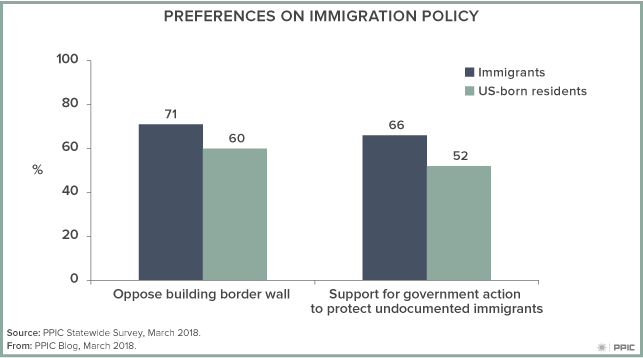
Despite these differences, immigrant and nonimmigrant Californians are aligned in their views of the current policy landscape. Majorities in both likely voter groups disapprove of President Donald Trump (63% immigrants, 60% US born), oppose the new federal tax law (65% immigrants, 56% US born), want gun laws to be stricter (82% immigrants, 67% US born), and oppose building a wall along the entire border with Mexico (71% immigrants, 60% US born). When it comes to state and local governments making their own policies and taking action separate from the federal government, majorities in both likely voter groups say they are in favor of protecting the legal rights of undocumented immigrants (66% immigrants, 52% US born).

One of the political wildcards in this California mid-term election is whether the strong opposition to federal immigration policy will motivate more naturalized citizens to vote and more noncitizens to become citizens and register to vote. As noted earlier, immigrants make up a larger share of the state’s population than is reflected in the likely voter group—leaving much room for growth that could transform the state’s electorate. The PPIC Statewide Survey will be closely monitoring the trends in political engagement and ballot choices in this consequential election for California and the nation.

The 2020 Census Is Critical for California

The decennial census plays an essential role in American democracy. Most fundamentally, it ensures that communities get the right number of representatives in government. Less well known is the role it plays in determining how hundreds of billions of federal dollars are allocated to states and localities for a wide range of public services, including health care and child nutrition programs.

Although census information is essential, the Census Bureau is currently budget constrained, behind schedule, and scaling back the number of full-scale test runs it was planning. This is of particular concern since several key changes to the census process are in the works: the majority of census information will be collected online, resources for door-to-door outreach may be reduced, and a question about immigration status will be added to the official questionnaire. These and other factors increase the potential for an undercount, especially among vulnerable populations. Just today, California Attorney General Xavier Becerra has filed a lawsuit over this issue.

Why are the stakes so high? A significant undercount could cost California political representation in Congress at a time of record polarization and a deep partisan divide over the direction of the state and the nation. Critical decisions that affect California’s future will be determined to a large extent by federal rules on such issues as climate change, health care, and immigration.

An undercount also means that an important amount of federal funding could dry up. Federal, state, and local government programs that target disadvantaged neighborhoods or populations rely critically on census surveys to identify those in need and distribute funds accordingly. For example, two programs crucial to the health and well-being of children in California—the Children’s Health Insurance Program and the Women, Infants, and Children program—rely on population estimates that use the decennial census count as a baseline for population estimates with which they aim to accurately allocate funds across states.

The impact on California could be huge—and 2020 is fast approaching. At a time when objective facts and information are in short supply, PPIC will be working to raise awareness about the importance of the 2020 Census for California and motivate elected leaders and organizations across the state to work together to ensure an accurate count. Stay tuned for more facts and analysis of the 2020 Census from PPIC.

Californians and Immigration Policy

During President Trump’s first year, perhaps no issue caused more conflict between the state and federal government than immigration. In January, California became a sanctuary state. Yesterday, the US Justice Department filed a lawsuit against California over three state immigration-related laws that were passed by the California Legislature in 2017. How do residents feel about the state and local governments making their own policies and taking actions, separate from the federal government, to protect the legal rights of undocumented immigrants?
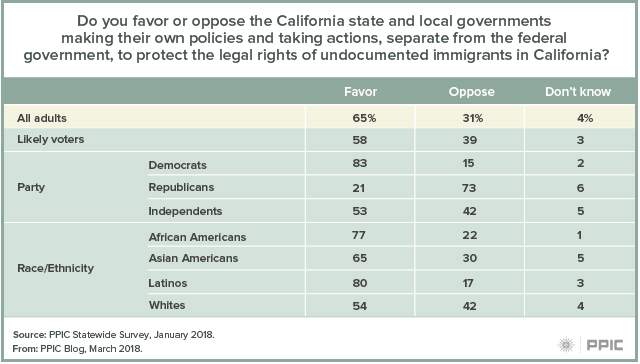
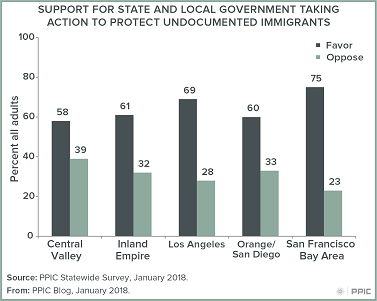
In January, we found that most Californians are in favor (65% adults, 58% likely voters), as we also found a year ago (65% adults, 58% likely voters). Today, eight in ten Democrats are in favor, compared to half of independents and two in ten Republicans. Majorities across regions support state and local government action.

We also find support across age, education, income, and racial/ethnic groups. Latinos and African Americans are more likely than Asian Americans and whites to be in favor.

Read “Californians and DACA” (PPIC blog, February 6, 2018)


Californians and DACA

In September, the Trump administration announced an end to the DACA (Deferred Action for Childhood Arrivals) program, which includes protections for some undocumented immigrants who were brought to the United States as children. Under DACA, those who qualify and pass a background check can receive protection from deportation and a work permit. California is home to about 223,000 DACA recipients—more than one-fourth of the national total.

The administration and Congress have been negotiating a potential compromise that would preserve DACA protections for qualifying individuals. In January, the PPIC Statewide Survey found that 85% of adults and 81% of likely voters in California favor the protections offered by DACA. Recent surveys by ABC/Washington Post and CNN have found similarly high levels of support for DACA among adults nationwide. In California, support has increased slightly since September, when three-quarters of adults and likely voters were in favor of DACA protections.

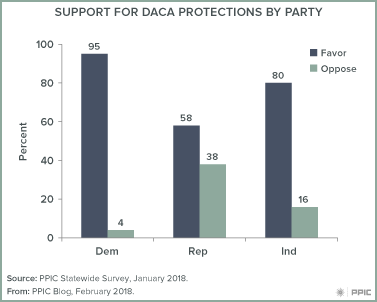
In today’s politically polarized environment, it is notable that majorities of California Democrats, Republicans, and independents support the DACA program. In PPIC’s January survey, we find that while Republicans are less likely than Democrats and independents to support DACA protections, a solid majority (58%) are in favor. Indeed, DACA has a high level of support across the state’s regions and demographic groups, with at least three in four adults in favor. Results were similar in September, when strong majorities across parties and at least seven in ten across demographic and regional groups expressed support.
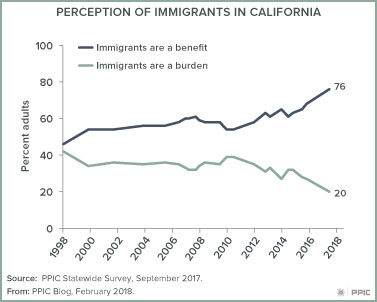
The high levels of support for DACA are perhaps unsurprising given Californians’ shifting attitudes toward immigrants. In PPIC’s September survey, three in four Californians (76%) said that immigrants are a benefit to the state because of their hard work and job skills—a high mark in PPIC surveys. Only 20% said immigrants are a burden because they use public services. Indeed, Californians are now far more likely to see immigrants as a benefit than they were in April 1998 when we first asked this question (46% benefit, 42% burden).

Interestingly, this shift in attitudes is not unique to California. In a June 2017 survey of adults nationwide, the Pew Research Center found that 65% of adults thought immigrants strengthened the country, while 26% felt immigrants burdened the country. This is a stark contrast to 1994, when only 31% of adults nationwide felt immigrants strengthened the country and 63% said they were a burden. As the debate on DACA and immigration policy continues, looking at changes in public attitudes on this issue can highlight areas of potential compromise for policymakers.


Video: Legislative Leaders Address Sexual Misconduct

When Anthony Rendon was asked to name the biggest issues for the governor and state legislature to address this year, he prefaced his answer with a look back. “Last year was a banner year,” the California assembly speaker said, citing infrastructure, housing, and climate change efforts. Then he added a caveat:

“Some of that was obscured—and rightly so—by the sexual harassment crises that developed in the fall. This year we have to start with that.”

Rendon said the assembly is revising sexual harassment policies and procedures that have not been updated since 1993, and he acknowledged that this is only the start in a larger change needed in the way the institution conducts its business.

Rendon spoke as part of an annual event that brings together California’s legislative leaders from both parties in a conversation with Mark Baldassare, PPIC president and CEO. Rendon was the lone leader on stage for much of the event because the state senate was discussing the fate of a colleague accused of sexual harassment.  Patricia Bates, Republican state senate leader, and Kevin de León, president pro tem, later joined the assembly speaker on stage.

Bates said her top issue for 2018 is addressing the high cost of living in California. “Affordability affects every socioeconomic level in our state,” she said.

De León referred to California’s resistance to the direction of federal policies in describing his top priority: defending what he called “our incredible gains” in California—a higher minimum wage, gun safety and ammunition regulation, and extension of the Global Warming Solutions Act. He also emphasized protecting the state’s immigrants.

Both senate leaders described a bipartisan approach to addressing sexual harassment. Bates commended de León for quickly turning the investigation of allegations over to outside law firms independent of the senate. The leaders pointed to process changes in the works to address harassment, and both said that changing the culture is a much longer term goal. How does cultural change come about?

“You build in trust with the policies that are there—that they are responsive, they are fair, they give due process, and they have just consequences,” Bates said.