California’s Brain Gain

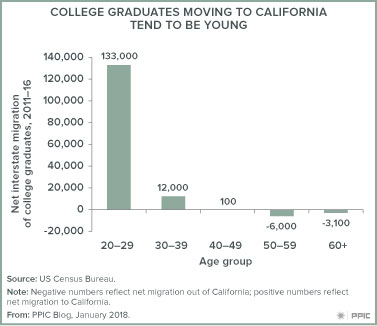
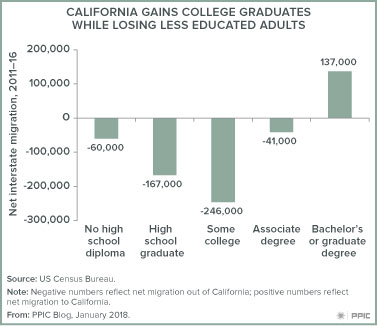
Recently released data from the US Census Bureau show that even as California continues to experience large net losses of residents moving out of state, the state is still a net importer of college graduates from other states. This interstate migration pattern—gaining large numbers of college graduates while losing large numbers of less educated adults—is unique among the states. Over the past five years, California has attracted 137,000 more college graduates (adults with at least a bachelor’s degree) from other states than it has sent to those states. For comparison purposes, the University of California (UC) awarded about 250,000 bachelor’s degrees at its nine undergraduate campuses over this same time period. In other words, interstate migration provides California with half as many college graduates as the entire UC system.

College graduates come to California from all over, but seven states send California substantially more college graduates than they get in return. Between 2011 and 2016, net gains of college graduates from New York (45,000), Illinois (32,000), New Jersey (20,000), Pennsylvania (17,000), Michigan (15,000), Florida (14,000), and Massachusetts (14,000) totaled more than 150,000. California experienced sizable net losses of college graduates to just four states: Texas (-26,000), Oregon (-20,000), Nevada (-14,000), and Arizona (-11,000).

The new migrants to California tend to be quite young. Indeed, college graduates age 20–29 account for almost all of the net gains. (In contrast, California experiences small net losses of older college graduates.) From a labor market perspective, attracting young college graduates is especially advantageous. Young adults with college degrees are at the start of their careers and provide the state with much-needed highly educated workers. The largest gains are in majors that are in relatively high demand in the labor market, including engineering (22,000), social sciences (19,000; mostly economics and political science), computer science (17,000), communications (17,000), biology and health sciences (14,000), and business (13,000).

The migration of young college graduates to California is a consequence of the state’s growing demand for highly skilled and highly educated workers. But the numbers are not high enough to meet the state’s changing needs. PPIC’s research has shown that by 2030 California will face a shortfall of 1.1 million college graduates. Failing to keep up with the demand for skilled workers could curtail economic growth and limit economic mobility—resulting in a less productive economy, lower incomes, less tax revenue, and increased dependence on the social safety net. Although many college graduates move to California from other states, the most important source of highly educated workers in California are the state’s colleges and universities. Policies and practices to improve college access and completion in the state will ensure that more Californians are able to help create and benefit from a strong economy.

Video: Strategies for Reducing Child Poverty

High housing costs and low-wage work make it hard for low-income Californians to meet their basic needs. The result? Nearly a quarter of California’s youngest residents live in poverty—a fact with profound educational, health, and economic repercussions now and in the future. Social safety net benefits help low-income families supplement their incomes but do not reach the working poor in high-cost areas and the very poor across the state.

A new PPIC report examines how high housing costs and low wages contribute to child poverty. It also looks at additional policy approaches: an expansion of the Earned Income Tax Credit, establishment of a state child credit, and an overhaul of the state renter’s credit. Each approach holds promise, and each involves trade-offs.

Researcher Caroline Danielson presented the report in Sacramento last week. She also demonstrated an interactive tool that allows for a deeper exploration of how policy changes could affect California’s diverse counties. It underscores the need for policymakers to be strategic in determining how best to help families in need throughout the state.

Explore the accompanying tool Interactive: Reducing Child Poverty in California.

College Graduates and California’s Future

The University of California Board of Regents invited Mark Baldassare, PPIC president and CEO, and Hans Johnson, PPIC senior fellow and director of the PPIC Higher Education Center, to present their perspectives on the role of higher education in California’s future, November 16, 2017. Here are their prepared remarks:

Good morning, I am Mark Baldassare, president and CEO of the Public Policy Institute of California (PPIC). I am here with my colleague and PPIC’s higher education center director Hans Johnson to present the institute’s research findings on the need for college graduates in California’s future economy. To kick off this session, I am going to make a few remarks about public opinion to place this issue in perspective.

The November PPIC Statewide Survey points to the importance of this topic for most Californians. Eighty percent of California adults say that the state’s higher education system is very important to the quality of life and economic vitality of the state, and another 14% say it is somewhat important. Strong majorities across political, regional, racial/ethnic, and demographic groups say that the state’s higher education system is very important. In fact, strong majorities of Californians have been saying that higher education is very important to the state’s future since we first asked this question in 2007.

In the context of the 2018 governor’s race, 63% of California adults say that candidate positions on higher education are very important, and another 28% say they are somewhat important to them. Majorities across political, regional, racial/ethnic, and demographic groups hold this view.

When asked about the current workforce, 83% of Californians say that a four-year degree from a college and university prepares someone very well (30%) and somewhat well (53%) for a well-paying job in today’s economy. Fifty percent of Californians think that a college education is necessary for a person to be successful in today’s work world, with majorities of Latinos (67%), Asian Americans (54%), and African Americans (51%) and fewer whites (35%) holding this view. Moreover, about half of Californians, with pluralities across the state’s major regions, say that California will not have the college-educated residents needed for the jobs and skills likely to be in demand 20 years from now.

In sum, the importance of a higher education and the need for college graduates are issues on the minds of many residents today. Hans will provide the demographic and workforce analysis that demonstrates why the state’s higher education system is essential for a better future for all Californians.

PPIC has produced a series of reports on California’s future population and economy. Our report Will California Run Out of College Graduates? provides projections of the demand for and supply of workers across all levels of educational attainment to 2030. Our primary finding is that California faces a shortage of highly educated workers. Specifically, economic projections to 2030 show that about two in five jobs will require at least a bachelor’s degree, while demographic projections suggest only about one in three Californians will have at least a bachelor’s degree. This shortfall equates to 1.1 million workers.


In this presentation, I first describe how California’s population and economy are changing and then identify how the state and its higher education institutions can increase college enrollment and completion to produce more college graduates.

California’s economy increasingly demands highly educated workers

To develop our economic projections, we apply trends in educational attainment levels to occupational projections developed by the California Employment Development Department. We examine changes in labor market demand that are occurring due to shifts both in occupational structure and changes in educational attainment within occupations. Our primary finding is that the state’s economy will continue along a well-established trajectory, with a growing share of jobs requiring at least a bachelor’s degree.
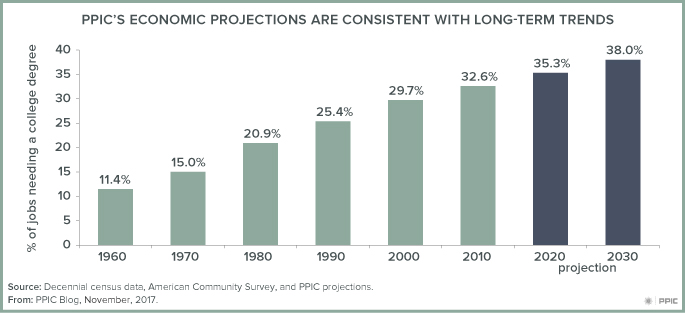

There are two key drivers of increasing demand for college graduates: (1) faster growth in occupations that commonly require a college degree (e.g., computer technology), and (2) increases in demand for highly educated workers within occupations (e.g., nursing). In recent years, most (74%) of the increased demand for highly educated workers has occurred because of faster job growth in occupations that commonly require a college degree. Among occupations with at least 100,000 full-time year-round workers, there have been especially rapid growth rates for software developers (56% increase between 2010 and 2015), computer scientists and systems analysts (42% increase), and managers (35% increase). These and other highly skilled occupations have experienced faster growth than most occupations that require lower levels of education.


That said, the increase in educational attainment within occupations has been significant. For example, the share of registered nurses with a bachelor’s degree has grown from 57% in 2000 to 68% in 2015. From 2010 to 2015, about 26% of the increase in jobs for college graduates was attributable to growing demand for highly educated workers within specific occupations.

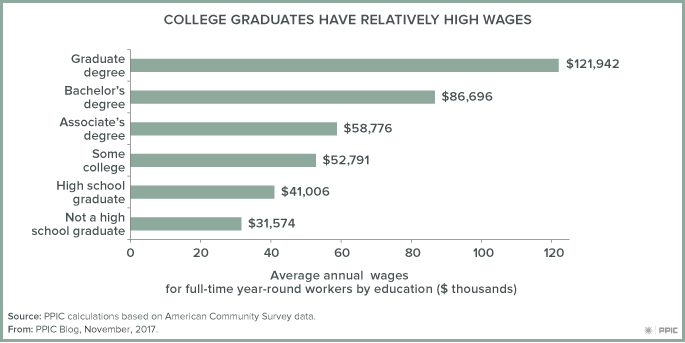
Are college degrees really necessary for these jobs? To answer this question, we examined a number of labor market outcomes. Within and across occupations, we find that workers with bachelor’s degrees have higher labor force participation rates, lower unemployment rates, and higher wages than those without—and that, in general, as educational attainment increases, wages also increase. Overall, the wage premium for college graduates relative to less-educated workers has grown. By 2015, the average annual wage for full-time year-round workers was more than twice as high for workers with a bachelor’s degree than for those with only a high school diploma.
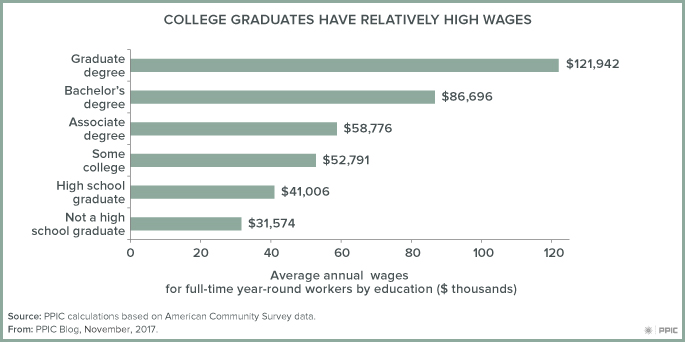
Within each of 51 occupational groupings we see higher wages for college graduates than for high school graduates. Among registered nurses, for example, those with a bachelor’s degree earned 12% more than those with an associate degree.

California’s educational institutions are not keeping up with demand

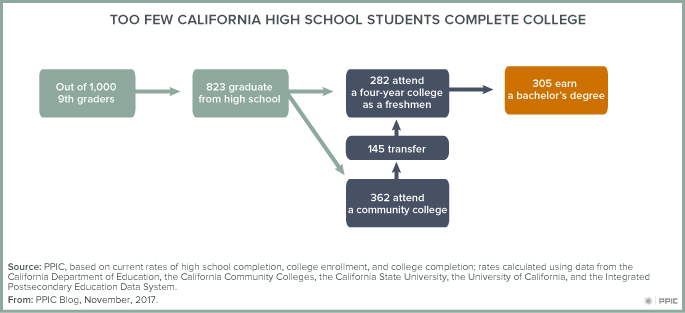
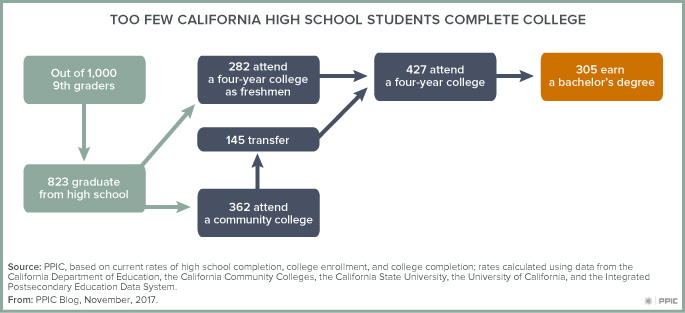
Too few Californians are graduating from college. At current college enrollment and completion rates, only 30.5% of 9th graders in California will eventually earn a bachelor’s degree either in California or elsewhere in the United States. Among all states, California ranks 47th in the share of high school graduates who enroll in four-year colleges and 5th in the share who go to community colleges. Low rates of transfer from community colleges to four-year colleges exacerbate the problem.

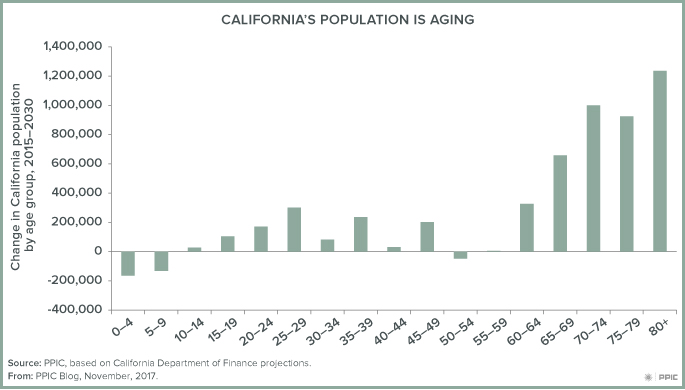
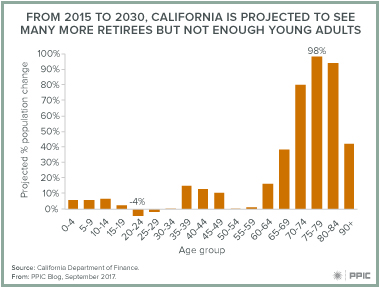
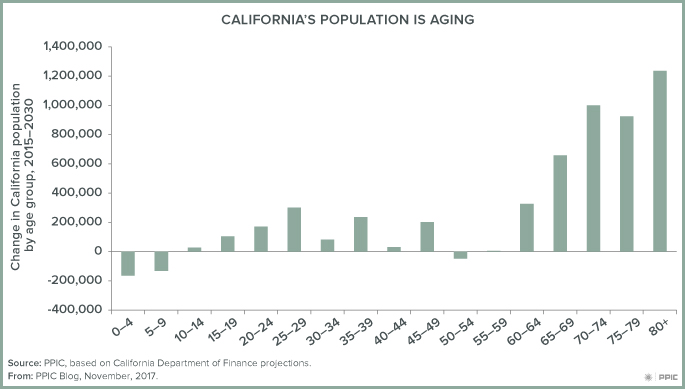
A critical challenge is the retirement of the baby boom generation. Called the “silver tsunami” by some, this is the first time in California’s history that such a large and well-educated group is exiting the labor force. In contrast, the number of young adults in California is projected to increase only modestly.

Not all degrees are equal

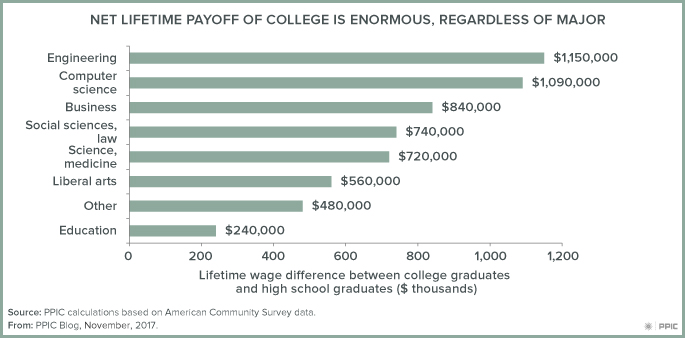
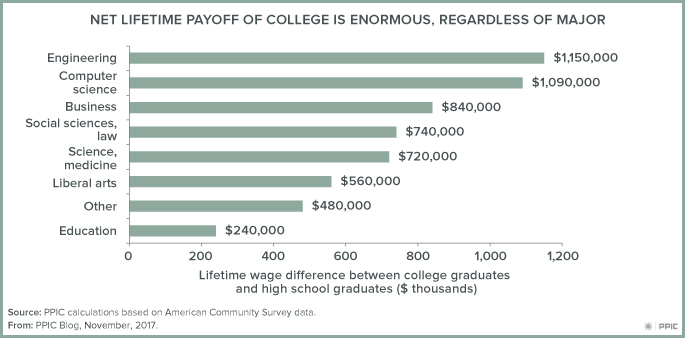
On average, college graduates have very strong labor market outcomes. At any point in time, some college graduates are working in jobs that do not necessarily require a college degree, but over the course of their careers the vast majority of college graduates will move into occupations that reward their educational training. Our estimates show that students who earn bachelor’s degrees in engineering and computer science fare very well in the labor market, but even those with less remunerative majors, such as education and the liberal arts, will earn far more in wages than less-educated workers, even after taking into account all the costs of going to college.

How to close the degree gap

To close the degree gap, California and its higher education institutions need to establish new policies and practices to enroll more students, especially in our four-year colleges and universities, and improve graduation rates among students already in college. In previous testimony, PPIC has identified targets for each of the state’s public systems with respect to admission, transfer (from community colleges to four-year colleges), and improved graduation rates.

The University of California (UC) will play a central role. In our scenario, UC would need to award approximately one-quarter of the additional degrees necessary to close the gap. This is an ambitious target, but the increase over current levels (and over the baseline projection) would not be without precedent. For example, between the 1999–2000 and 2016–17 academic years, the number of bachelor’s degrees awarded by UC increased 62% (from slightly more than 33,000 to almost 54,000). Our closing-the-gap scenario would require UC to award about 81,000 degrees by 2029–30, a 51% increase over current levels.
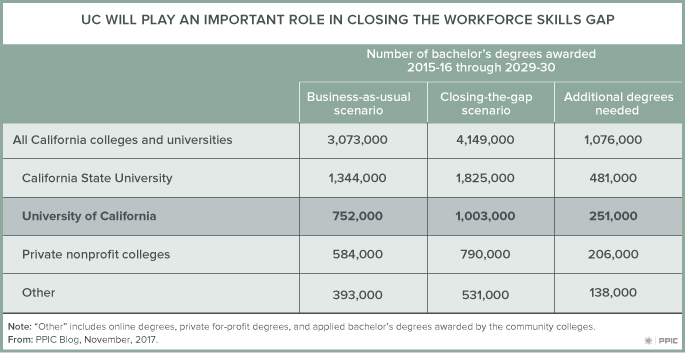

Improving access and success among groups historically underrepresented in higher education—including low-income students, first-generation college students, Latinos, and African Americans—is essential if we are to close the degree gap. Compared to other public research universities, UC has an impressive record in enrolling low-income and first-generation students.

The California State University (CSU) system and the California Community College system have adopted new goals that are entirely consistent with PPIC’s targets. New initiatives, including remediation reform at the community colleges and at CSU, have the potential to substantially improve student success rates. CSU’s new graduation initiative aims to increase graduation rates and eliminate gaps between groups of students. College preparation among the state’s high school graduates has also increased, with the share of students completing the college preparatory requirements of UC and CSU reaching an all-time high. Strong demand for UC is likely to continue as college preparation continues to improve and the transfer pathway is better articulated. UC has seen consistent increases in graduation rates for many years, and new efforts to improve on-time graduation are likely to continue this trend.

Finding ways to accommodate all these students remains a central challenge, but one we must meet in order to ensure a better future for all Californians.
Video: Gavin Newsom’s Priorities

Gavin Newsom, California’s lieutenant governor and a candidate for governor in 2018, was asked in a San Francisco forum last week to name the three issues that will make the biggest difference in California’s future. Newsom, who is also a former mayor of San Francisco, predicted that both California and the nation will be grappling with these issues over the next ten years:

  • Debt and demographics. With California’s population aging rapidly, the state and its cities face growing public employee pension and health care liabilities. “As a progressive Democrat, I’m not naïve about the commitments we’ve made and the commitments we must fulfill,” Newsom said. “Nor am I naïve, as a former mayor, about the challenge of meeting those commitments . . . Cities like Richmond are facing the prospect that by 2021, by one estimate, upwards of 40% of their general fund will go to retiree contributions.”
  • Energy and climate change. The state has set ambitious goals to reduce greenhouse gas emissions and increase energy efficiency. “The next governor has to deliver,” he said.
  • Information technology and globalization. “The issue that animates my anxiety: work, the future of work.” The days of having a job or career have given way to something radically different, forcing us to think in terms of portable benefits and retirement security, he said. Further, workers in retail, food and beverage, and clerical jobs—the top employment categories—are on the “edge of automation.” Displacement of these workers will require us to have a different conversation about skills, education, and social mobility, Newsom said.

The conversation with Newsom was part of the PPIC Speaker Series on California’s Future. PPIC is inviting all major candidates for governor to participate in a public event if they reach a certain threshold in the polls. The goal is to give Californians a better understanding of how the candidates intend to address the challenges facing our state.

Watch all candidate videos.

Video: Californians Concerned about Cost but Give State’s Colleges Good Grades

Many Californians say the state’s public higher education system is going in the wrong direction, a new PPIC Statewide Survey shows. But they are more likely to say they are concerned about affordability than about the quality of the state’s colleges and universities. Just 18% of all adults say quality is a big problem, compared to 56% who call affordability a big problem.

Researcher Lunna Lopes presented the findings of PPIC’s annual survey on higher education to a Sacramento audience last week.

Among the survey findings underscoring Californians’ concerns about college affordability: 75% say the cost of college keeps students who are qualified and motivated from attending, 79% say students have to borrow too much money to pay for college, and 85% say colleges and universities should do more to make sure that all students have affordable housing options.

In contrast to Californians’ views on costs, solid majorities of residents give excellent or good ratings to the state’s community colleges, California State University, and the University of California.

Californians are divided on whether a college education is necessary to succeed in today’s work world, with half saying it is and 48% saying there are many ways to succeed without college. There are strong differences among demographic groups on this question. Two-thirds of Latinos say college is necessary, compared to just 35 percent of whites. And 59% of Californians with household incomes of $40,000 or less say college is necessary, compared to 42% of those whose incomes are $80,000 or more.

Despite this divide over whether college is necessary for success, 80% of Californians say the public higher education system is very important to the future quality of life and economic vitality of the state.

Testimony: The Need for College Graduates in California’s Future Economy

Hans Johnson, director and senior fellow at the PPIC Higher Education Center, testified today, November 1, 2017, before the Assembly Select Committee on the Master Plan for Higher Education in California. The master plan defined a strategy to meet the state’s education needs in 1960—but today, California faces new challenges. The topic of today’s hearing: ensuring that the master plan meets workforce needs.

Here are his prepared remarks.

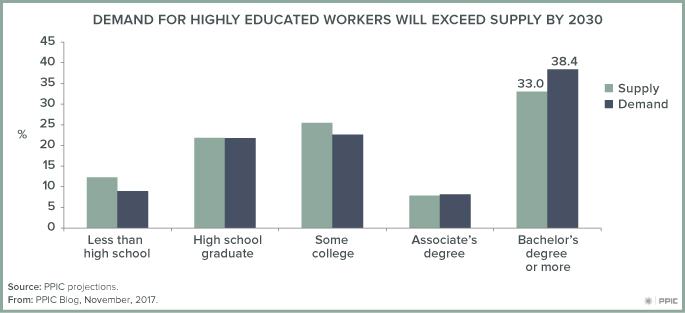
PPIC has produced a series of reports on California’s future population and economy.  Our report Will California Run Out of College Graduates?, provides projections of the demand for and supply of workers by educational attainment to 2030. Our primary finding is that California faces a shortage of highly educated workers. Specifically, economic projections to 2030 show that about two in five jobs will require at least a bachelor’s degree, while demographic projections suggest only about one in three Californians will have at least a bachelor’s degree. This shortfall equates to 1.1 million workers.

figure - Demand for Highly Educated Workers Will Exceed Supply by 2030

In this testimony, I first describe how California’s population and economy are changing, and then identify how the state and its higher education institutions can increase college enrollment and completion to produce more college graduates.

California’s economy is increasingly demanding highly educated workers

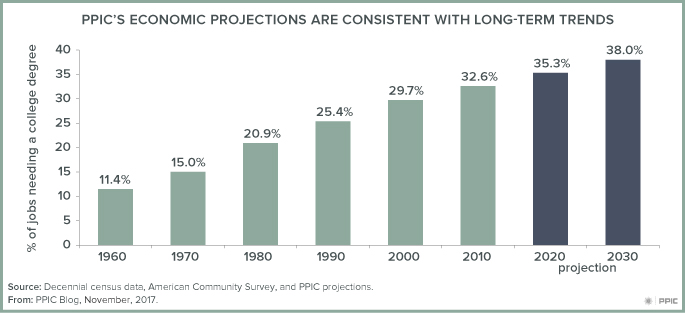
To develop our economic projections, we apply trends in educational attainment levels within occupations to occupational projections developed by the California Employment Development Department. We examine changes in labor market demand that are occurring due to shifts in the distribution of occupations and changes in educational attainment within occupations. Our primary finding is that the state’s economy will continue along a well-established trajectory, with a growing share of jobs requiring at least a bachelor’s degree.

figure - PPIC's Economic Projections Are Consistent with Long-term Trends

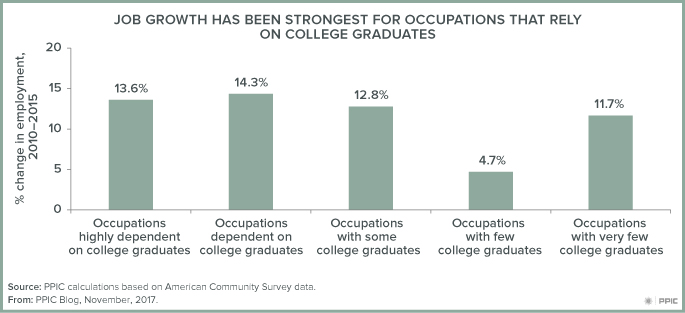
The two key drivers of increasing demand for college graduates are: 1) faster growth in occupations that commonly require a college degree (e.g., computer technology occupations), and 2) increases in demand for highly educated workers within occupations (e.g., nursing).  While both drivers are important, in recent years most of the increased demand (74%) for highly educated workers has occurred because of faster job growth in occupations that commonly require a college degree. Among large occupations (with at least 100,000 full-time year-round workers), those with especially rapid growth rates over the past five years include software developers (56% increase between 2010 and 2015), computer scientists and systems analysts (42% increase), and managers (35% increase). These and other highly skilled occupations have experienced faster growth than most less skilled occupations.

figure - Job Growth Has Been Strongest for Occupations that Rely on College Graduates

The second key driver of demand has been an increase in educational attainment within occupations.  For example, the share of registered nurses with a bachelor’s degree has grown from 57% in 2000 to 68% in 2015.  Altogether, over a five year period (from 2010 to 2015) about 26% of the increase in jobs for college graduates has occurred as demand for highly educated workers has grown within specific occupations.

Are college degrees really necessary for these jobs? We examine a number of labor market outcomes to answer this question.  Within and across occupations, we find higher labor force participation rates, lower unemployment rates, and higher wages for workers with a bachelor’s degree than for those without. And in general, as educational attainment increases, wages also increase. Overall, the wage premium for college graduates relative to less educated workers has grown. By 2015, the average annual wage for full-time year-round workers was more than twice as high for workers with a bachelor’s degree than for those with a high school diploma.

figure - College Graduates Have Relatively High Wages

Within each of 51 occupational groupings we see higher wages for college graduates than for high school graduates. Among registered nurses, for example, those with a bachelor’s degree earned 12% more than those with an associate’s degree.

California’s educational institutions are not keeping up with demand

Too few Californians are graduating from college. At current college enrollment and completion rates, only 30.5% of 9th graders in California will eventually earn a bachelor’s degree either in California or elsewhere in the United States.  Compared to other states, California ranks 47th in the share of high school graduates that enroll in four-year colleges and 5th in the share that go to community colleges. Low rates of transfer from community colleges to four-year colleges exacerbates the problem.

figure - Too Few California High School Students Complete College

A critical challenge is the retirement of the large and relatively well-educated baby boom. Called the “silver tsunami” by some, this aging out of the labor force of millions of older adults is the first time in the history of California that such a large and well-educated group is exiting the labor force. In contrast, the number of young adults in California is projected to increase only modestly.

figure - California's Population Is Aging

Not all degrees are equal

On average, college graduates have very strong labor market outcomes. While at any point in time, some college graduates are working in jobs that do not necessarily require a college degree, over the course of their careers the vast majority of college graduates will move into occupations that reward their educational training. Our estimates show that students who earn bachelor’s degree in engineering and computer science fare very well in the labor market, but even those in less remunerative majors such as education and the liberal arts will still earn far more in wages than less educated workers, even after taking into account all the costs of going to college.

figure - Net Lifetime Payoff of College Is Enormous Regardless of Major

How to close the degree gap

To close the gap, California and its higher education institutions will need to establish new policies and practices to enroll more students, especially in our four-year colleges and universities, and ensure greater success of students already in college. In previous testimony, PPIC has identified targets for each of the state’s public systems with respect to admission, transfer (from community colleges to four-year colleges), and improved graduation rates. Improving access and success among groups historically underrepresented in higher education, including low-income students, first-generation college students, Latinos, and African Americans is essential if we are to close the degree gap.

The good news is that new goals adopted by the California State University (CSU) system and the California Community College system are entirely consistent with PPIC’s identified targets. New initiatives, including remediation reform at the community colleges and at CSU, have the potential to substantially increase student success. CSU’s new graduation initiative aims to substantially increase graduation rates and eliminate gaps between groups of students. Strong increases in college preparation among the state’s high school graduates are also a positive sign, with the share of students completing the college preparatory requirements of UC and CSU reaching an all-time high.

Finding ways to accommodate all these students remains a central challenge, but one we must meet in order to ensure a better future for all Californians.

Learn moreVisit the PPIC Higher Education Center

Video: How Californians View National Issues

With the nation focused on a range of contentious issues, the September PPIC Statewide Survey provides a California perspective. Dean Bonner, associate survey director, shared the key findings at a Sacramento briefing last week.

Among them:

  • A record-high share of Californians have a favorable opinion of the Affordable Care Act, and most want Republicans to work with Democrats to improve the law. While most Californians say it is the federal government’s responsibility to make sure that all Americans have health coverage, just a third favor a single-payer, government-run national health insurance system.
  • Three-fourths of Californians—also a PPIC record high—view immigrants as a benefit rather than a burden. There is broad and bipartisan support for protections provided by DACA, which shields from deportation some undocumented immigrants brought to the US as children and allows them to get a work permit if they pass a background check.
  • Half of Californians say they are very concerned about the possibility of North Korea having a nuclear missile that could reach the state.
  • Two-thirds of Californians view possible Russian interference in the 2016 as a serious issue.
  • Half of Californians say race relations have gotten worse in the United States over the last year. They are less pessimistic when it comes to race relations in the state.

PPIC Polling and the Immigration Debate

This post is excerpted from a presentation to the PPIC Board of Directors and guests on September 12, 2017, in Los Angeles.

One of the most important issues for Californians in the first year of the Trump administration is changing federal immigration policy. Immigrants are a significant presence in California, and even more so in Los Angeles County. Los Angeles, the state’s most populous county, is home to more than 10 million people, including more immigrants than any other California county. Twenty-seven percent of California’s population is foreign born—about twice the US percentage—while 35% of Los Angeles County population is foreign born. Moreover, about 2.6 million undocumented immigrants—about a quarter of the total number in the US—live in California. More than 800,000 of these undocumented immigrants live in Los Angeles. Major shifts in federal immigration policy that are under way thus have profound impacts on California and Los Angeles.
Since January, PPIC has been monitoring state and local responses to changing federal immigration policy through our public opinion polling. We have asked 11 questions about federal immigration policy in four monthly surveys, each involving 1,700 California adults, including more than 400 adults from Los Angeles County, interviewed by landline and cellphone in English or Spanish. The margin of error is +/-3% for California and +/-6% for Los Angeles. While the country is politically divided on immigration issues, we have found some bipartisan agreement in California. Here’s a sampling of our findings this year:

  • Undocumented immigrants living in the US: In our January PPIC Statewide Survey, 85% of Californians and 89% of Los Angeles residents agreed that undocumented immigrants who are living in the US should be allowed to stay legally. These results are consistent with earlier PPIC surveys. Moreover, solid majorities were in favor of state and local governments making their own policies and taking actions, separate from the federal government, to protect the legal rights of undocumented immigrants in California (65% California, 73% Los Angeles).
  • Border wall, travel ban on residents of six Muslim-majority nations: In our March PPIC survey, when asked about building a wall along the entire Mexico border, more than 7 in 10 were opposed (72% Californians, 76% Los Angeles). In the same survey, about 6 in 10 (58% California, 63% Los Angeles) opposed the president’s revised travel ban involving six Muslim countries.
  • Immigration enforcement and schools: In our April survey, 46% of Californians and 55% of Los Angeles residents said they are very concerned that increased federal immigration enforcement efforts will impact undocumented students and their families in their local public school districts. More than 6 in 10 (65% Californians, 73% Los Angeles) favored having their local public school district designated as a sanctuary safe zone in order to protect its undocumented students and their families from federal immigration enforcement efforts.
  • Worries about deportation, impact of enforcement on business and jobs: In our May PPIC survey, 30% of Californians and 34% of Los Angeles residents said they worry a lot that someone they know could be deported as a result of increased federal immigration enforcement. About half said that increased federal immigration enforcement will have a negative impact on businesses, jobs, and the economy in their part of California (49% California, 53% Los Angeles).

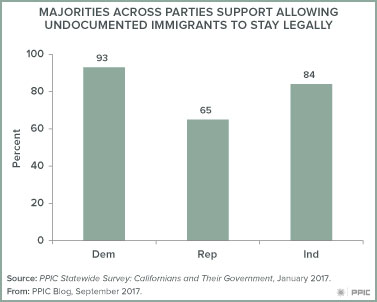
As the federal policy landscape shifted this year, PPIC Statewide Surveys continued to find majority support for a path to citizenship for undocumented immigrants who are living in the US: in our March survey, 68% of Californians and 71% of Los Angeles residents remained supportive. In contrast to the political divide in the rest of the nation, strong majorities across parties in California continue to agree that undocumented immigrants who are living in the US should be allowed to stay legally.

California’s path forward on immigration is a work in progress, as is the case in other areas that are undergoing federal and state policy changes. Moreover, there are uncertainties about federal actions such as the fate of the DACA program—which protects young undocumented immigrants brought to the US as children from deportation—the imposition of fiscal sanctions on sanctuary states and cities, the ban on travel from Muslim countries, and the construction of a wall along the US-Mexico border. As we have seen, California’s immigration policymaking is occurring in the context of strong public opposition to federal shifts, high levels of public concern about how these shifts are affecting undocumented immigrants and our regional economies, and strong support for actions by state and local governments to protect the legal rights of undocumented immigrants. At PPIC, we hope to foster conversations about immigration that lead to a better future for all Californians.

Learn more
Find out more about the PPIC Statewide Survey.

California’s Dream Act

As the federal government moves to end the Deferred Action for Childhood Arrivals (DACA) program, California is continuing to support the higher education aspirations of undocumented students. California’s Dream Act is a set of laws intended to lower the cost of higher education for certain undocumented immigrants brought to the US as children and raised in California. Thousands of California students have benefited from the program so far.

College can be especially expensive for undocumented students. For tuition purposes they are not technically California residents and therefore are not eligible for in-state tuition. Public colleges and universities charge extra tuition for nonresidents: currently an additional $28,000 per year at UC and $6,000 per year at CSU. In addition, undocumented students are not eligible for federal financial aid, such as Pell Grants or federal loans, leaving college out of reach for many who are low-income.

California passed AB 540 in 2001, which waives the nonresident portion of tuition for undocumented childhood arrivals as long as they meet certain criteria, including spending three or more years in California K‒12 schools, graduating from a California high school, and promising  to apply for legalizing their immigration status as soon as they are eligible to do so.  In addition, the state passed AB 130 and AB 131 in 2011, which allows state and institutional financial aid to be given to students eligible under AB 540.

Undocumented students cannot file the Free Application for Federal Student Aid (FAFSA) to apply for federal and state financial aid for college. This means that many do not have access to Cal Grants, one of the state’s main forms of financial aid. Instead, those who are eligible can apply for Cal Grants using the California Dream Act application.

Of all Cal Grant offers in 2014‒15, about 3% have been made to California Dream Act applicants. Of those eligible for the awards, both FAFSA filers and Dream Act filers have similar GPAs. However, those obtaining a Cal Grant through the state Dream Act application were more likely to come from families with parents without college degrees and with lower family incomes.

A student’s DACA status has no bearing on the California’s Dream Act, so AB 540 students will continue to pay in-state tuition rates and can apply for and receive state and institutional aid to help lower the cost of college, even if the federal DACA program ends. However, without a work permit these undocumented students still cannot work legally in the US, even if they obtain a degree from a California college or university. The approximately quarter of a million Californians covered by DACA will still be subject to deportation without further federal legislative or executive action. That uncertainty could keep otherwise qualified students from earning a college degree.

Learn more

Read “DACA and California’s Future” on the PPIC Blog.

Visit the PPIC Higher Education Center.

DACA and California’s Future

Figure Projected Pop Change

President Trump’s administration has announced the end of the Deferred Action for Childhood Arrivals (DACA) program, which allowed some undocumented immigrants who were brought to the United States as children to avoid deportation, obtain work permits, and continue their schooling. California is home to about 223,000 “Dreamers,” as DACA recipients are known, more than one-fourth of the national total. According to estimates cited by EdSource, about 70,000 Dreamers and other undocumented immigrants attend public colleges in California. The president gave Congress six months to come up with a legislative solution to address the issue before the decision takes full effect. Because California is home to a large share of the nation’s immigrants, including undocumented immigrants, changes in federal immigration policies are particularly important in the state.

In California, as in the rest of the nation, a central economic challenge over the next couple decades will be to ensure an adequately sized and skilled workforce to meet the demands of a growing economy.  This challenge is especially daunting in the face of unprecedented increases in the number of retirees. As the baby boomers—a large group that is highly educated—exit the labor market, California and the nation will be hard pressed to find an adequate supply of workers to replace them and help provide for their healthcare and other needs. According to the California Department of Finance, over the next 15 years, the number of people age 65 and over will increase by 3.4 million, while the number of young adults age 20 to 34 will decline by almost 200,000. Requiring the Dreamers to leave the country will deepen this decline. Many of the older adults, about one-third, have a bachelor’s or graduate degree. Largely as a consequence of this demographic certainty, PPIC has projected that the state will see a shortfall of 1.1 million workers with at least a bachelor’s degree by 2030. Were it not for highly educated immigrants, the skills gap would be even larger.

The solution to this demographic, economic, and educational challenge is to make sure that more young Californians acquire the skills necessary to replace those exiting the labor market and to ensure that California’s economy can continue to grow with high-skilled and high-wage jobs. Increasing the number of young Californians going to and graduating from college is essential to closing this workforce skills gap. Because DACA recipients must be high school graduates or attending school, the program helps increase the number of Californians who are on the educational trajectory we need. The large number of Dreamers in college is evidence that they hold promise for helping the state meet its future need for educated workers.

Learn more

Read Higher Education in California: Addressing California’s Skills Gap

Visit the PPIC Higher Education Center.