Commentary: How Better Wastewater Management Can Help California Adapt to Climate Change

This commentary was published on CALmatters on May 9, 2019.

Our public health relies on wastewater management to treat sewage and remove pollutants coming from our homes and businesses.

This system is fundamental to protecting our health. In California, treated wastewater also is a critical source of water for the environment, and, increasingly, a source for recycled water. Climate change is worsening water scarcity and flood risks. Advancements in engineering and technology can help prepare wastewater agencies for a changing climate. But significant shifts in policy and planning are needed to address these challenges.

Wastewater agencies must reliably remove pollutants even as the quantity and quality of the water they treat declines during droughts, and when large storms push their equipment to the breaking point.

In February, an atmospheric river storm—the type that is expected to become more common as the climate warms―inundated Healdsburg’s wastewater treatment facility and pushed more than five times the normal flow of wastewater and runoff into Santa Rosa’s treatment plant.

In a drought, reduced flows to wastewater plants can hamper agencies’ ability to comply with treatment standards, damage equipment, increase costs, and shrink revenue. Lower inflows also reduce the volumes available for recycled water, often considered a “drought-proof” supply.

The drought of 2012–16 brought all of these problems to the fore. Many wastewater agencies are now changing their operations, infrastructure, or finances in response to the challenges they experienced. Our new study recommends sector-wide changes in three areas to help build the sector’s climate resilience:

  • Maintain water quality in the face of reduced indoor water use. Short-term water conservation during droughts and longer term reductions in water use from indoor efficiency measures challenge wastewater management. All wastewater agencies should assess their vulnerability to major climate pressures, and plan for future droughts. Better coordination and information sharing with suppliers about indoor water conservation and efficiency efforts are also key.
  • Make smart recycled water investments. Coordination among wastewater and water supply agencies is needed to address the demand for recycled water. Regional planning for recycled water projects can result in investments that are more responsive to changing water use and an increasingly volatile climate, bringing financial and environmental benefits.
  • Balance conflicting objectives within watersheds. Many wastewater treatment plants discharge treated water into inland watersheds.

Meeting increased demand for recycled water may fuel conflict over the use of treated discharge to support ecosystems and downstream users. Rivers and streams are expected to experience lower flows and higher temperatures, which will heighten threats to aquatic ecosystems. Resources are needed to identify areas most at risk of conflict over the use of treated wastewater, and to develop tools to evaluate the impacts of water recycling projects on the environment and downstream water users.

The state can help wastewater managers make these adaptations, which are critical to building a more integrated and resilient water system. The State Water Board should align its policies on water use, wastewater, recycled water, and environmental protection to better manage for these multiple objectives.

Forging new partnerships to tackle the full range of climate-related risks will help wastewater agencies determine the best adaptations and improvements needed to prepare wastewater management—and California’s water system as a whole—for a more volatile future.


Testimony: Water Supply and Quality Challenges in the San Joaquin Valley

Ellen Hanak, director of the PPIC Water Policy Center, testified today (April 30, 2019) before the Assembly Subcommittee on Water, Parks and Wildlife, at a hearing on balancing water needs into the future in the San Joaquin Valley. Here are her prepared remarks. View her presentation.

The San Joaquin Valley produces more than half of California’s agricultural output. Irrigated farming is the region’s main economic driver and predomi­nant water user. The region is also ground zero for many of the state’s most difficult water management problems―including long-term depletion of groundwater reserves, lack of safe drinking water in many rural communities, and accumulation of a variety of groundwater contaminants.

Over the past three years, the PPIC Water Policy Center has worked with an interdisciplinary team of researchers from Fresno State, Point Blue Conservation Science, UC Davis, and UC Merced to examine these challenges and identify promising solutions. Today, I’ll provide you with some highlights from our latest report, Water and the Future of the San Joaquin Valley, including areas where the California Legislature can be most helpful in facilitating progress. Two of my coauthors on this study—Sarge Green from Fresno State and Thomas Harter from UC Davis—are also here to answer your questions.

I’ll touch on four priority areas for action: balancing water supplies and demands; ensuring safe and reliable drinking water supplies; managing groundwater quality for the long-term; and fostering beneficial water and land use transitions.

Balancing water supplies and demands

Chronic groundwater overdraft—pumping in excess of the amount that is replenished—averages nearly 2 million acre-feet per year in the San Joaquin Valley, or roughly 11 percent of the region’s net water use. The consequences include dry wells, sinking lands, damaged infrastructure, and reduced reserves to cope with future droughts.

In light of these problems, the valley is on a fast track to implement the Sustainable Groundwater Management Act (SGMA), which requires groundwater users to bring water supplies and demands into balance by the 2040s. The first local sustainability plans must be finalized and launched in early 2020.  Although attaining balance will benefit the valley’s economy over the long-term, it will entail some near-term costs.

To end overdraft, local groundwater sustainability agencies (GSAs) will have to augment supplies, reduce demands, or use some combination of these approaches. We estimate that about a quarter of the historical deficit can be filled with new supplies at prices farmers can afford.  The balance will likely need to be met by managing farm water demand—with the idling of at least 500,000 acres of irrigated cropland (about 10% of current acreage).

On the supply side, the most promising options are to capture and store more local runoff in groundwater basins, and to increase water imports by managing the system differently. On the demand side, increasing water trading—both within and across groundwater basins—can significantly mitigate the economic impacts of reducing water use, by allowing farmers to maintain the crops that generate the most revenue, GDP, and jobs. Reducing overdraft gradually between now and 2040—the “glide path” approach to implementing SGMA—can also lessen the costs of adjustment by giving farmers more time to adapt.

Priority actions to facilitate the adoption of an optimal supply and demand portfolio approach include:

  • Assessing which new infrastructure investments—including conveyance—are warranted to support more recharge and water trading.
  • Incentivizing recharge on farmland—one of the most cost-effective ways to store water.
  • Developing transparent and equitable local water trading rules, including for groundwater.
  • Clarifying how much additional high winter and spring runoff is available for recharge.
  • Facilitating state and federal approvals for water trading and groundwater banking projects.
  • Coordinating both within and across groundwater basins to maximize benefits.

Although local and regional water users and agencies will need to take the lead on many of these actions, both the state and federal governments can play vital roles. The state can be especially helpful in clarifying how much water is available for recharge, facilitating approvals for water trading and groundwater banking projects, and working with local partners to assess infrastructure needs.

Ensuring safe and reliable drinking water

The valley’s most urgent water issue is addressing chronic problems of unsafe and unreliable drinking water in rural communities, most of which rely on groundwater. The region is a hot spot for unsafe drinking water. With just 10 percent of the state’s population, it is home to more than half of all community water systems that have persistently contaminated tap water. Contamination is also a problem for very small water systems that are regulated by counties and for homes served by domestic wells. Some groundwater contaminants—such as arsenic and uranium—occur naturally. Others are caused by human activity. For instance, agriculture is the primary source of nitrate, a serious contaminant that is widely present in shallow wells.

The region is also a hot spot for unreliable drinking water supplies in communities that depend on shallow wells. During the latest drought, roughly half of the 150 small water systems that sought emergency assistance from the state were in the valley, as were nearly 80 percent of all residents who reported dry domestic wells. Without concerted action, this vulnerability will persist. Several thousand additional drinking water wells are vulnerable if groundwater levels fall another 30 feet—something that could easily happen during the next drought, or if local groundwater sustainability plans allow continued overdraft under a glide path approach and fail to mitigate the problem.

In recent years, various legal and administrative changes have helped address the drinking water crisis. But there is still an urgent need to build a robust, comprehensive framework for tackling it. Affected communities will require technical, financial, and managerial assistance. Here are some top priorities:

  • Consolidating or aggregating systems to provide economies of scale to small water systems.
  • Providing technical support.
  • Planning for shortages and developing rapid response procedures to mitigate dry wells.
  • Ensuring funding support for both capital investments and ongoing operations and maintenance.

A variety of local parties—including counties, urban water suppliers, irrigation districts, groundwater sustainability agencies, pollution dischargers, and NGOs—will need to play a major role in helping to address this problem. But the state must take leadership in developing funding solutions and ensuring there’s a comprehensive plan for addressing both quality and supply vulnerabilities in a timely manner.

Managing groundwater quality for the long-term

Valley farmers and other dischargers of contaminants must also meet new requirements for protecting groundwater and soils from the long-term buildup of nitrate and salts. California has been a national leader in seeking to address these problems, with a suite of new regulations adopted over the past decade. The Salt and Nitrate Control Program (SNCP)—adopted by the Central Valley Regional Water Quality Control Board in 2018 and pending approval by the State Water Board—provides an umbrella framework for addressing these challenges. SGMA also requires GSAs to protect water quality while balancing groundwater supplies and demands.

Nitrate in drinking water wells, which originates primarily from inorganic nitrogen fertilizer and manure used in farming, poses significant public health risks. Dairies face special challenges in managing manure efficiently, and solutions have remained elusive.

Salinity is a growing threat to local agricultural productivity. Roughly 250,000 acres of cropland have already been retired due to salinity in soils, and another 1.5 million acres are considered impaired.

But managing for these contaminants is costly. The SCNP seeks to find a balance between protecting water and land resources for the long run and maintaining the viability of agricultural production in the present, while also ensuring safe drinking water solutions.

Here are some top priorities for action:

  • Coordinating water quality and quantity management. This will be especially important for managing groundwater recharge, which under some circumstances can accelerate the migration of chemicals in the soil (especially nitrate) into the aquifer and impair drinking water quality, at least for a time.
  • Implementing new technologies to manage pollutants. This will be especially important for dairies, which need to remove excess manure and transform it for other uses.
  • Providing regulatory flexibility. This includes flexibility to allow some continued loading of nitrogen and salt as long as impacts on drinking water supplies are mitigated, as proposed under the SNCP.

While local water managers, farmers, and the agricultural industry will need to take the lead in addressing these issues on the ground, the state can play a major role in providing effective and responsible regulatory flexibility, and in supporting research and development (R&D).

Fostering beneficial water and land use transitions

Finally, the valley will need to plan for and manage the changing landscape as some cropland is idled—both to avoid negative consequences from dust, pests, and weeds, and to get the most value from these lands in other uses. Pursuing approaches that seek multiple benefits on this land can support the regional economy, public health, and the environment. There are numerous stewardship options: healthy soils, habitat, wildlife-friendly solar, recharge, flood protection, and recreation.

There are already some models of how this can work. For instance, the Kern Water Bank provides thousands of acres of upland habitat for San Joaquin desert species and abundant intermittent wetlands, while also serving as a major groundwater storage site. But to date, there is no serious planning effort to see how lands coming out of production might be used most productively, and how to provide the right incentives to realize this potential.

Here are some top priorities for action:

  • Initiating broad-based, inclusive planning. For many issues—ranging from determining the best areas for habitat investments to coordinating recharge and managing salinity—taking a valley-wide perspective will be key.
  • Implementing flexible regulatory approaches to make it easier to implement multi-benefit restoration projects.
  • Providing incentives and funding to support activities on the ground.
  • Boosting technical support and R&D.

Again, local and regional parties will need to take the lead on many aspects of this work. But state and federal agencies can facilitate good outcomes by providing regulatory flexibility, financial incentives, and support for technical assistance and R&D.

How can the Legislature be most helpful now?

The valley is at a pivotal moment, and there are many ways in which the state can assist the region’s residents implement efficient, equitable, and sustainable solutions to their water-related challenges. Here are some final thoughts on how the Legislature can be most helpful in the near-term:

First, ensure a robust, comprehensive framework for safe and reliable drinking water solutions. This is an urgent public health issue and needs urgent attention. The framework should include reliable funding, as well as a sound, timely approach to providing technical and managerial solutions on the ground.

Second, support the building blocks for the region’s transition to groundwater sustainability. Planning for sustainable groundwater management is well underway, but this transition won’t happen overnight. Early actions to promote forward momentum will be especially valuable in the next few years.

To create the preconditions for success, the state should accelerate its own efforts to provide regulatory clarity, consistency, and flexibility. Key areas include how much water is available for recharge, how to recharge in ways that are acceptable from a water quality perspective, and how to implement broad-based, multi-benefit restoration projects that put land coming out of production to best use.

Support for local and regional initiatives can also make a difference. Key areas include assistance with the assessment of smart infrastructure investments, pilot efforts to implement innovative approaches on the ground, technical support and R&D for water quality and land stewardship solutions, and broad-based planning to develop regional approaches for multi-benefit management of water and land.

California has long been a model for others in the management of natural resources. Many are now looking to see how we tackle the tough challenges of providing safe drinking water to all residents and managing our groundwater resources sustainably for the long term. The San Joaquin Valley is on the front line for addressing both of these challenges. The region’s farmers and residents have a history of creatively adapting to difficult and changing conditions, and constructive solutions are in reach. The state can provide vital support to help ensure success.

Video: State and Federal Experts Discuss San Joaquin Valley’s Water Future

How can state and federal agencies help California’s largest agricultural region address its difficult water management problems? This was the theme of an event last week that brought together PPIC experts with top officials working on issues related to water, agriculture, and natural resources.

Ellen Hanak, director of the PPIC Water Policy Center, launched the event by summarizing findings from a new report on the valley’s water- and land-management challenges and outlining some strategies for addressing them.

Groundwater overdraft is the valley’s key water challenge. A state mandate to bring groundwater use to sustainable levels will have broad effects on valley agriculture and the regional economy—most likely including some permanent idling of farmland to balance water budgets. Hanak noted that only about a quarter of the valley’s groundwater deficit can be filled with new supplies at prices farmers can afford.

According to Hanak, the most promising solutions fall into three buckets: “Ways to increase flexibility in how we manage water and related land resources; ways to provide incentives so that growers, who are some of the key decision makers on the ground, can do this so it makes business sense to them; and ways to stack benefits so you get more than one thing out of it—maybe you get groundwater recharge and wetland habitat, for example.”

The three panelists—Wade Crowfoot of the California Natural Resources Agency, Karen Ross of the California Department of Food and Agriculture, and Thomas Hedt of the Natural Resources Conservation Service’s California office―discussed key issues and ways their agencies can partner with local stakeholders to ease the process of replenishing groundwater in coming years.

Crowfoot highlighted the importance of working with local communities, governments, and water agencies to address water challenges. “State government doesn’t actually have the solutions. We have the resources and the power of making new laws, but the solutions that are going to help limit disruption as it relates to water are going to be found on the ground,” he said. “The question is what can we do at the state level to empower the locals to find those solutions.”

Ross said multi-benefit approaches will be critically important, particularly for reaping environmental benefits when land is fallowed. “New partnerships and unusual allies” are key to achieving such benefits and finding durable solutions, she noted.

For example, she added, “the environmental justice community and agriculture community continue to partner to find drinking water solutions”—a process that “also bodes well for what we can do on the land.”

Hedt described new federal pilot projects to improve wildlife habitat and promote groundwater recharge. He noted that a key federal farm program has been made more flexible to allow broader partnerships that can enable habitat conservation on farmlands and address other challenges more efficiently.

We invite you watch the video from the event.

This was the second public event about this research; the first was held in Fresno in February.

Rising Seas Bring Rising Water Management Challenges

Sea level rise—driven principally by melting continental ice and expansion of the oceans as they warm—is a significant threat for those living along the coast. Adapting to increases in coastal erosion and flooding—and managing the broad impacts of sea level rise on the state’s water systems—will be expensive and disruptive for millions of Californians.

A recent study by the US Geological Survey took a sobering look at future risks from rising seas. The authors describe how storm surge, very high tides (popularly known as king tides), and large waves during storms can amplify the effects of sea level rise. They simulated coastal erosion and flooding over the next two centuries and found there could be dramatic increases in damages during modest storms, and catastrophic flooding during rare, large storms. These impacts are projected to appear by the middle of the 21st century, at a scale likely to significantly affect the state’s economy.

Beyond costly efforts to protect against coastal erosion and ocean flooding, coastal areas will also need to manage increased inland flooding. Large storms can amplify the effect of rising seas by bringing greater storm surge, particularly if these coincide with king tides. Storm runoff flowing down coastal creeks will meet rising waters caused by storm surge and tides, exacerbating flooding. This issue is particularly acute in parts of the Bay Area (including much of Silicon Valley) and low-lying areas in Southern California. Major new efforts to manage runoff and protect existing homes and businesses will be needed.

Sea level rise will also affect water management in other ways. One area is wastewater treatment. Throughout coastal California and particularly in the San Francisco Bay Area, wastewater and stormwater treatment takes place in facilities that are currently at or near sea level. The Bay Area alone is home to 30 such facilities that are vulnerable to damage by rising seas and storms.

Water supply will also be affected. Many coastal aquifers will see increases in salinity as sea levels rise and storms push saltwater farther inland. But the most significant impact on supply is likely to be associated with changes in the Sacramento‒San Joaquin Delta.

The Delta lies at the head of the San Francisco Bay estuary and the confluence of the Sacramento and San Joaquin Rivers. More than 25 million Californians and 3 million acres of farmland rely on the Delta for a portion of their water supplies. These exports are managed by large state and federal projects that pump water from the southern Delta.

Sea level rise affects the Delta in two ways. First, to keep its waters fresh enough so that cities and farms can use it, a certain amount of fresh water has to flow out of the Delta and into the San Francisco Bay. If the outflow is insufficient—whether due to drought, reduced inflows from upstream water use, or high export pumping—tides push saltwater into the Delta, making its water unusable.

The second way sea level rise will affect the Delta concerns the 1,100 miles of levees that line its channels. Levees hold water back from Delta islands, whose lands are now well below sea level due to sinking soils. Failure of these levees—particularly in the western Delta—can lead to changes in the way tides circulate water in the Delta. These changes amplify the increases in salinity from sea level rise alone; together, they put additional pressure on water supplies.

Addressing the many effects of sea level rise on California water management requires extensive planning and costly investments in infrastructure. The US Geological Survey study shows that these impacts are not in some distant future, but are likely to become significant in just a few decades. The good news is that state and local officials are starting to work on this problem, which will take many years to address.

Widening the Conversation about Safe Drinking Water in the San Joaquin Valley

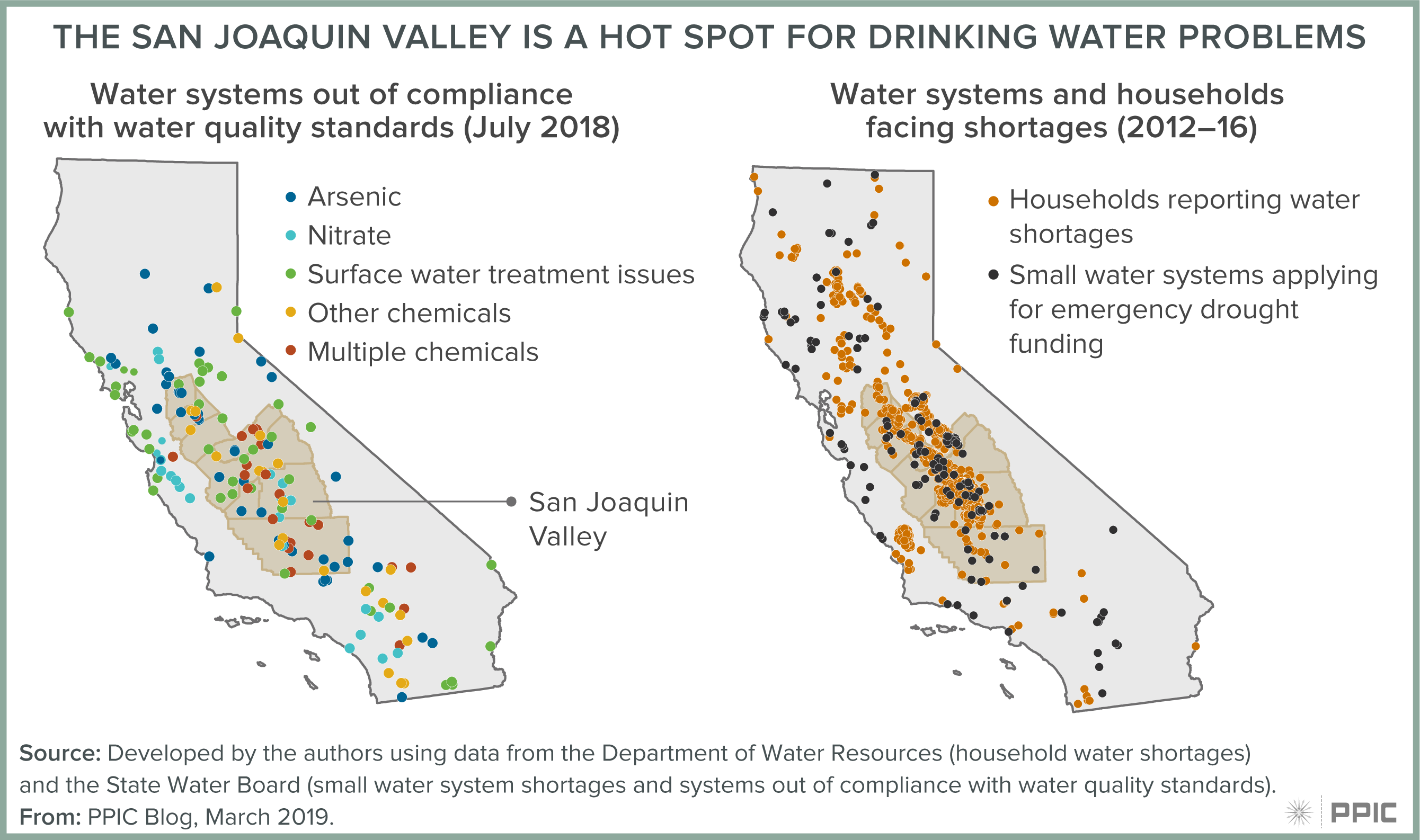
The theme of this Friday’s World Water Day is the lack of safe drinking water that affects many millions of people worldwide. Here in California, the San Joaquin Valley is a hot spot for unsafe drinking water. The region has more than half of all public water systems that are out of water-quality compliance in California, but just 10% of the state’s population. In addition, chronic decline in groundwater levels has caused drinking water wells go dry in a number of the region’s communities. We talked to Veronica Garibay—co-founder and co-director of the Leadership Counsel for Justice and Accountability—about ways to ensure community involvement in water management decision-making processes.

photo - Veronica Garibay

PPIC: What is key to understanding the valley’s safe drinking water crisis?

VERONICA GARIBAY: Water management is a particularly opaque and complex process, and past decision-making processes related to land use and water management failed to meaningfully include disadvantaged community voices and address their needs.

Climate change brings major risks to our water resources. The communities that are already the most vulnerable to the impacts of climate change—including water shortages during droughts, worsening water quality, flooding, and other problems—will see their vulnerability exacerbated. We have to change the way we manage water resources to adapt to these changes.

We have to bring our most vulnerable communities into these conversations, prioritize their needs, and make sure they, too, have decision-making authority over policy, programs, and projects.

Disadvantaged communities have been at the forefront of the progress we’ve already made on providing safe drinking water. They led the charge that gave the State Water Board the authority to consolidate small systems into larger ones, brought emergency funds to communities whose wells went dry during the drought, and led to the board’s establishment of the Office of Sustainable Drinking Water Solutions. Now their leadership is building momentum around the proposed safe and affordable drinking water fund, which would provide much-needed resources to pay for ongoing operations and maintenance costs and capital projects to ensure safe drinking water.

figure - The San Joaquin Valley Is a Hot Spot for Drinking Water Problems

PPIC: The Sustainable Groundwater Management Act requires local agencies to protect water quality while balancing groundwater supplies and demands. Why is it important for disadvantaged communities to participate in this process?

VG: Water is a critical resource to all of us, and the most vulnerable people should have a say in its management. Communities have a lot to contribute and need to be part of the solution. As a region we need to democratize the process and make sure that all interests are considered.

We’re working to ensure that planning for groundwater sustainability is more inclusive by encouraging groundwater sustainability agencies to establish authentic and meaningful space for direct community input and engaging communities most vulnerable to water quantity and quality issues in the region. We want to see sustainability plans that incentivize programs, policies, and projects that support safe drinking water and benefit households in disadvantaged communities.

PPIC: Are there good models for participation in the process?

VG: The North Fork Kings groundwater sustainability agency (GSA) has established a rural community advisory committee. It helps bring disadvantaged rural communities into the process to develop a sustainability plan. That’s a good step in making sure communities are providing direct input.

And the Madera GSA is encouraging all stakeholders to learn from each other and talk to each other. They’re making sure a variety of stakeholders get in the same room to learn how decision making on water affects different groups, and how we can shape solutions together.

We’d like to see more GSAs give some authority to disadvantaged communities and meaningfully build space into their processes for communities to participate.

Equal access to information is also key—what’s being presented at meetings should be accessible and in different languages if needed. And we need to ensure there is space to give feedback and that this feedback is reflected in the final sustainability plans.

These efforts will take work. Organizations like ours, and Self Help Enterprises and the Community Water Center, have all offered to collaborate with GSAs and help them engage community participation. The state has provided some funds for community engagement as part of its support of the SGMA planning process. But GSAs will also need to budget for equity—plan for and allocate resources to make sure they’re intentionally engaging communities.

Watch a video of Veronica Garibay and other panelists discussing water supply and water quality management in the San Joaquin Valley

Video: A Conversation with Chief of Staff Ann O’Leary

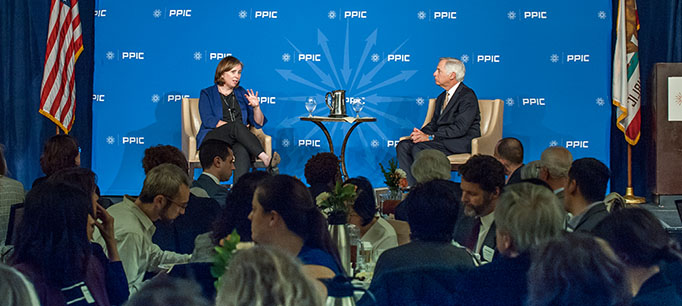
As the Newsom administration lays out its initial plans, PPIC invited chief of staff Ann O’Leary to discuss some of the governor’s top priorities. In a wide-ranging discussion with PPIC president Mark Baldassare last week, O’Leary identified the “cost crisis” in California as one of the main challenges that Governor Newsom plans to address.

“By ‘cost crisis,’ I mean how do we make sure that people in California can have affordability and the opportunity to really take advantage of the California dream?” O’Leary said. “I think too many people in California are really seeing that slip away. They’re not able to afford homes, they’re not able to afford child care, and they’re not able to pay for college for their children as they grow older.”

O’Leary pointed out that confronting this cost crisis would take many forms, such as taking on health care affordability, investing in “cradle to career” education, and addressing housing production and rising rents.

She underscored that the governor’s first proposed budget reflects his vision for promoting affordability and opportunity while ensuring the state’s long-term financial stability. Newsom’s plan includes a mix of one-time and ongoing funding as well as a robust rainy day fund, but “we also go further than that. We have a reserve fund for the safety net, and we also look at how we could use some of the surplus to pay down pension liabilities.”

The governor has also focused on other key challenges—for example, responding to wildfires and tackling the unmet need for safe drinking water in many parts of the state.

On wildfires, O’Leary noted that the governor wants to “make sure that we’re continuing with those recovery efforts to help communities that have been harmed, but also to prepare for future wildfires.” On drinking water, O’Leary said that the governor has already worked with the legislature to provide $20 million in emergency funding to address this issue.

Navigating the PG&E bankruptcy filing is another immediate priority. O’Leary said that over the next 60 days the governor’s team would be creating a roadmap for the state to “protect wildfire victims, protect employees who are out there every day trying to make sure we’re safe, and make sure fundamentally that we have safe and affordable power and that we’re meeting our clean-energy goals.”

O’Leary also discussed the federal-state relationship and how the governor plans to manage it. While pointing out that the state and federal governments need to work together as much as possible, O’Leary also underscored that California must stand up for its values when fundamental disagreements exist, especially on issues such as immigration and family planning. “These are differences of opinion. And it’s a needle we have to thread, but we’re going to do our best.”

Video: Water and the Future of the San Joaquin Valley

The San Joaquin Valley is at a critical juncture in determining its water future. California’s largest agricultural region is ground zero for many of the state’s most difficult water management problems, including groundwater overdraft, drinking water contamination, and declines in habitat and native species.

A state mandate to bring groundwater use to sustainable levels will have a broad impact on valley agriculture and the regional economy in coming years, likely including some permanent idling of farmland.

The PPIC Water Policy Center assembled a group of regional experts last week for a half-day public event at Fresno State to discuss three overarching challenges: balancing the valley’s water supplies and demands, addressing water quality problems, and planning for beneficial water and land use transitions.

Ellen Hanak, director of the PPIC Water Policy Center, launched the day’s discussions with a summary of the valley’s water-related challenges and approaches that could help address them. “The valley faces unprecedented challenges and a lot of change,” she said. Drawing from a new PPIC report on the valley’s water future, she noted that an all-hands-on-deck approach will be needed as the scope of the problems can’t be addressed farm by farm. “The most promising approaches are those that increase flexibility, provide incentives to encourage folks to make decisions that are beneficial, and can be done cooperatively.”

The first panel focused on ways to balance supply and demand in the face of an annual groundwater deficit of nearly 2 million acre-feet a year. Some of the approaches discussed included assessing opportunities to use infrastructure and farmland to augment groundwater recharge, crediting landowners for helping to recharge aquifers, and providing flexibility to farmers—for instance with water trading—so they can avoid fallowing the most profitable crops.

“The goal is to put as many tools into the hands of the landowners to give them the opportunity to manage [groundwater sustainability] to the best of their ability,” said Eric Averett of the Rosedale-Rio Bravo Water Storage District.

The second panel tackled the complex and pressing groundwater quality issues the valley faces—from resolving safe drinking water problems in poor rural communities to addressing ongoing nitrate and salt contamination of groundwater and soils. Key challenges include finding ways to pay for safe drinking water for affected communities; identifying cost-effective approaches to reduce nitrate contamination, especially on farmlands managed by dairies; and ensuring that flooding farmland to recharge basins doesn’t harm groundwater quality.

The final panel explored ways to manage fallowed land to get multiple benefits for people and nature. “We can think about ways to manage recharge basins to create wildlife habitat,” said Nat Seavy of Point Blue Conservation Science, one of the authors of the PPIC report. “There are opportunities to restore retired land and create habitat for San Joaquin desert species, and we can restore floodplains in a way that provides flood benefits for people.”

A common theme to the day’s discussions was finding ways that local stakeholders can work together on these difficult problems. As Hanak noted, “The leadership on this has to come from the valley. State and federal support can help, but folks in the valley will need to drive the change.”

We invite you to watch the videos from this event and hope you find the discussions helpful:

Governor’s Budget Targets Safe Drinking Water, Wildfires, Healthy Soils

Governor Newsom’s first proposed state budget, released earlier this month, addresses several critical water and natural resource management challenges. Here are highlights from his plans to mitigate problems with safe drinking water, improve forest health and reduce the risk of wildfires, and encourage healthy soils to reduce greenhouse gas emissions and increase drought resilience.

Safe and affordable drinking water: The governor’s budget proposal revives last year’s failed legislative proposal to tap urban water customers, agricultural fertilizer users, and dairies to pay for safe drinking water projects in small, disadvantaged communities with water quality challenges.

The proposed budget also includes a one-time capital investment of $168.5 million (compared to $93 million enacted in the previous budget) to fund safe drinking water and wastewater infrastructure projects in disadvantaged communities. The funds will come from Proposition 68—a $4 billion bond approved by voters in June 2018 for investments in water, parks, the environment, and flood protection. The proposed spending represents the remaining two-thirds of the $250 million in Proposition 68 funds for safe drinking water projects.

In addition, the governor proposes allocating $10 million from the General Fund for a State Water Board program that provides technical, operational, and managerial assistance to water systems serving disadvantaged communities. This funding will be used to implement the Board’s relatively new authority to hire third-party administrators to help water systems comply with safe drinking water standards—including tasks such as project planning and grant procurement. This authority was granted by SB 552 in 2016.

The budget also allocates $10 million from the General Fund for water supply emergencies in disadvantaged communities. During the latest drought, more than 2,500 domestic wells ran dry and nearly 150 small water systems requested emergency support. Many rural, disadvantaged communities still do not have reliable supplies, and these funds could provide emergency drinking water, extend water service lines, and repair groundwater wells.

Forests and wildfires: The budget calls for $415 million for programs to improve the health of forests and fight wildfires. Of this sum, $200 million will be sourced from the Greenhouse Gas Reduction Fund (GGRF). This is consistent with a legislative requirement from last year to spend $1 billion from the GGRF over five years for forest health, fire prevention, and fuel reduction activities. These funds will largely be allocated to Cal Fire’s grant programs for forest management projects on private and federal forest lands. The remaining half of the $415 million in proposed spending will go toward upgrading firefighting equipment and increasing firefighting capacity.

Healthy soils: The budget allocates $18 million to the California Department of Food and Agriculture to expand the Healthy Soils Initiative—a $3 million increase from its 2018 budget. Funded by the state’s cap-and-trade revenues, the program incentivizes farmers to adopt sustainable practices and increase their soils’ capacity to sequester more carbon. Activities might include installing riparian forest buffer, composting, and planting cover crops and wind barriers. Such practices can also improve crop yields, drought and flood tolerance, and air and water quality. The funding is projected to enable the sequestration of 5.3 million tons of CO2 on 500,000 acres by 2030, which is equivalent to nearly 2% of California’s annual emissions in 2016.

The proposed budget will be revised by May—and ultimately finalized and passed by the legislature in June.

Reducing Drought Risks in Rural Communities

Disadvantaged rural communities are disproportionately exposed to drinking water risks in California. Too many experience insecure supplies and contamination of their water sources. While there are growing efforts by policymakers to address water contamination, many communities will need further help to prepare for future droughts. Improved planning efforts could help avert water shortages.

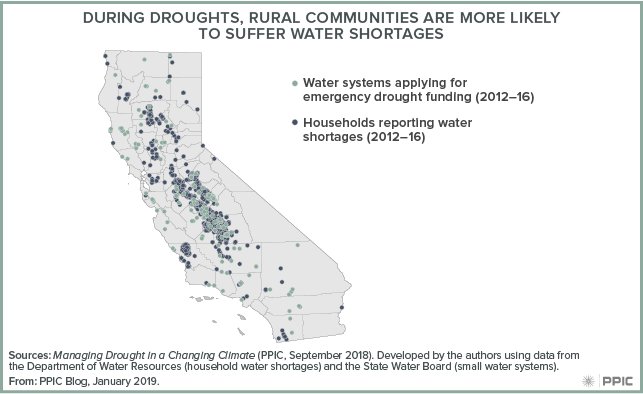
Rural residents are more vulnerable to running out of water during droughts because they are more likely to rely solely on groundwater from small community wells or domestic wells. These wells tend to be relatively shallow, so they are susceptible to running dry when pumping lowers groundwater levels. During the 2012‒16 drought, farmers and cities pumped extra groundwater to make up for surface water shortages. Thousands of wells went dry―mostly domestic drinking water wells in rural communities, especially in the San Joaquin Valley. And roughly 150 small community water systems sought emergency assistance to keep the taps flowing.

Although the state’s Sustainable Groundwater Management Act (SGMA) is expected to lead to balanced groundwater use and reduce over-pumping in the long term, California’s highly variable climate means that groundwater levels will still drop during droughts. This could result in more drinking water wells going dry. In a recent submission to the California Water Data Challenge, several colleagues from UC Davis and I found that a drought similar to the latest one could cause more than 4,000 domestic wells to go dry in the Central Valley.

A recent PPIC report on managing drought in a changing climate offers two ideas for reducing these risks:

  • Develop drinking water plans for rural communities and identify durable funding sources. Small rural systems do not have the financial capacity for drought planning and mitigation. State and local partners should use their experience from the recent drought to identify communities at highest risk, connect them to larger systems where feasible, and devise drought response programs for the others with reliable funding sources. The newly formed groundwater sustainability agencies, working with local partners such as counties and agricultural and urban dischargers, could help coordinate actions and streamline funding mechanisms.
  • Ensure groundwater sustainability plans include mitigation actions for dry drinking wells. Sustainability plans should describe preparation for groundwater drawdowns during severe drought similar to the one in 2012‒16. For instance, as groundwater sustainability agencies develop their plans, mapping drinking water wells that might be at risk for different drought scenarios and proposing mitigation actions that proactively decrease the risks are both imperative.

Studies of institutional responses to the latest drought largely find that planning for drought response and recovery paid off. Making an action plan to avoid further water-supply risks in disadvantaged rural communities―as well as identifying reliable funding mechanisms to implement it―should be top priorities for California policymakers.

Commentary: Peace in California’s Water Wars is Within Grasp

This commentary was published in CALmatters on December 19, 2018.

Dare we say it? The outlines of a truce in California’s unending water battles began to come into focus last week, though not everyone is willing to sign the treaty. The State Water Board adopted the first phase of a far-reaching revision to the Water Quality Control Plan for the Sacramento‒San Joaquin Delta and its watershed.

This is an effort to improve conditions for dwindling populations of endangered native fish such as salmon and steelhead. It also means an increase in water scarcity for farms and cities.

The mere adoption of the plan was significant. But something else happened in the board meeting that may in fact be more important and longer-lasting: state officials presented the framework of a peace treaty for Central Valley water wars.

With support from Governor Jerry Brown and Governor-Elect Gavin Newsom, most of the combatants negotiated the outlines of a comprehensive settlement agreement.

The Natural Resources Agency—including the Department of Water Resources and the Department of Fish and Wildlife—spent countless hours over several years convincing water users to develop a voluntary approach to improve ecosystem conditions for native fishes.

The approach state officials presented to the board would increase flows in rivers and the Delta and make major investments in habitat. And perhaps most important, it would create sustainable funding for these efforts (including fees on water diversions), while improving scientific research on and governance of restoration efforts.

To be clear, a framework was presented, not an actual settlement. But the framework contains commitments of water, habitat restoration and funding.

It also includes timelines for action from water users across the greater Sacramento–San Joaquin River watershed, and a willingness to get this settlement completed by the end of 2019. A few districts—such as the Oakdale, South San Joaquin and Merced Irrigation Districts—balked at the framework and are threatening litigation. But most of the watershed has signed on.

If this settlement is achieved and adopted by the board, it will be a major step forward in water management in the Central Valley. But a lot of work lies ahead. Water and habitat commitments—along with sources of funding—need further negotiation, and a robust governance and science program still needs to be designed. Additionally, many of the non-governmental environmental organizations that were mostly left out of negotiations need to be more involved.

Finally, the federal government can either be a partner or a roadblock to this effort. Federal representatives actively participated in negotiations and helped spur innovative approaches along the way.

But after the State Water Board’s vote, the US Bureau of Reclamation threatened litigation, and the Trump administration is seeking to roll back environmental standards in the Delta. Both actions have the potential to undo the settlements.

Despite these hurdles, there’s reason for optimism that there can be a truce in California’s water wars. What’s clear is that negotiated solutions to water conflicts are fairer and longer-lasting than top-down regulatory solutions or, worse yet, litigated solutions where judges end up trying to manage water.

Incoming Governor Newsom’s support and involvement will be essential to carry this effort to a positive conclusion. It should be a priority for his new administration.