Counting Californians and Holding Elections in a Pandemic

Today is Census Day, the day to count everyone living in the country in 2020. It’s not the deadline for responses—you have until August 14 to complete your census form—just the “anchor day” for counting those living in your household. We talked to California Secretary of State Alex Padilla about the challenges the COVID-19 pandemic brings to counting Californians—and for holding elections in November.
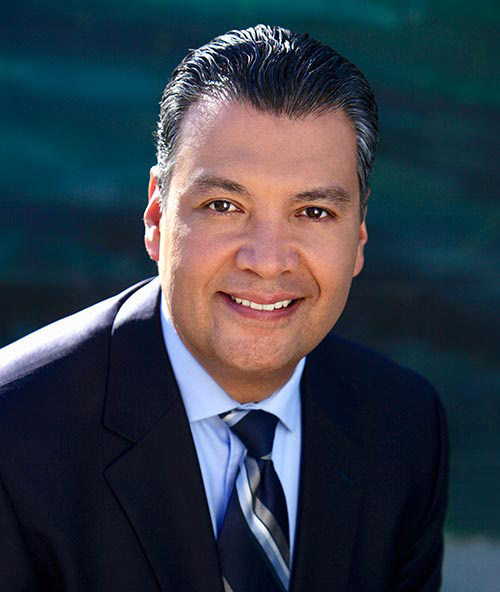
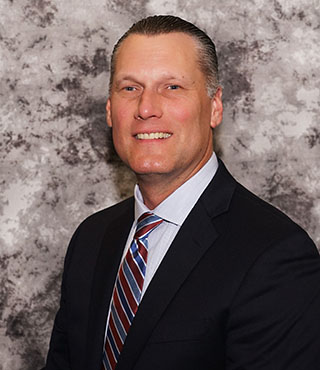
Photo - Alex PadillaPPIC: What challenges does the pandemic bring to conducting the census?

ALEX PADILLA: Ensuring a fair and accurate count is tough under normal circumstances, and it’s made more challenging by this global health pandemic. A lot of the state and local strategies for engaging the public on the census have had to be modified or replaced with ones that are more effective when people are staying at home. The good news is, this is the first time it’s been possible to do the census online, as well as by phone or paper. We’re seeing people get more creative at staying in touch while keeping their distance, whether through video chats with their coworkers or using teleconferencing to stay in touch with family and friends. We can also use these methods to remind everyone to do the census.

It’s really important to remember that participation in the census is how we ensure our communities receive their fair share of federal dollars for critical needs such as public health, education, public safety, housing, and infrastructure. This message is really striking a chord right now.

PPIC: As they shelter in place, what can Californians do to help ensure an accurate census count?

AP: Every Californian should participate in the census, but also remind people they’re in touch with to do so. Assuring a complete and fair count depends on everyone doing the census. It’s not just a count of adults or voters or citizens; it’s for everybody living here.

California has an especially high number of hard-to-count populations—for example, communities of color, young people, and immigrant families and communities. More than 70% of Californians fit into a hard-to-count category. It already takes extra effort to ensure participation by these groups. The pandemic is not making the job any easier—at a time when the job is more important than ever for ensuring the state gets its share of federal funding for critical needs over the next decade.

Based on the prior census 10 years ago, California’s most undercounted population were kids under five years old. My youngest just turned five, and especially now with all the kids at home, it’s hard to imagine forgetting to include him as he’s the loudest member of our household! Today, kids who weren’t counted in 2010 are now teens who’ve been in school for years, but their schools haven’t been getting their full share of federal education dollars. It’s a very tangible way to think about it, and it shows the importance of the census for our quality of life.

There are many options for participating in the census. Go online or call in today. Once you’ve submitted your information, help us by spreading the word with neighbors you’re checking in on and friends and family.

PPIC: Talk about the administration of the upcoming election.

AP: To put it in context, we should recognize that throughout the nation’s history, Americans have gone to the polls—in times of war, during the Great Depression, and even during the deadly 1918 flu pandemic. So it’s not a matter of if or when we’ll hold the election. We have a date: it’s Tuesday, November 3. It’s a matter of how we hold the election in a way that is accessible, secure, and healthy for everyone—voters, elections personnel, poll workers. Many things California has championed to get more people voting really make a lot of sense in an era of public distancing. You can register to vote online. Voting by mail and in-person early voting are good ways to avoid crowds. We’re diligently working on expanding those opportunities.
Essential Workers and COVID-19

California is grappling with the dual threats of a public health crisis caused by the coronavirus and the additional economic fallout of necessary social distancing measures.  In the past week, we have seen unemployment claims skyrocket and policymakers forge supports for workers and businesses.

Meanwhile, there is a workforce that is tackling the public health crisis, keeping the economy going, and supporting Californians who are sheltering in place. While this essential workforce supports the state’s health and basic economic needs, many of these workers are not well equipped to weather the economic challenges of the COVID-19 crisis.

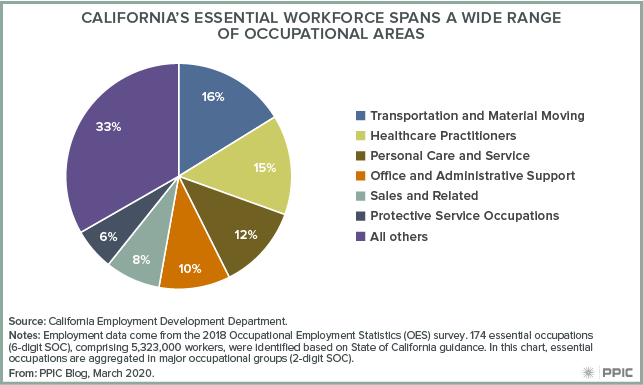
We estimate that in a typical year, roughly one-third to one-half of California’s labor force is employed in essential occupations. Essential workers fulfill a wide variety of roles in our economy, including in health care services, energy provision, food service, agriculture, and transportation. Some workers in these areas may be seeing layoffs and hours reductions depending on their industry, firm, or region.

figure - California’s Essential Workforce Spans a Wide Range of Occupational Areas

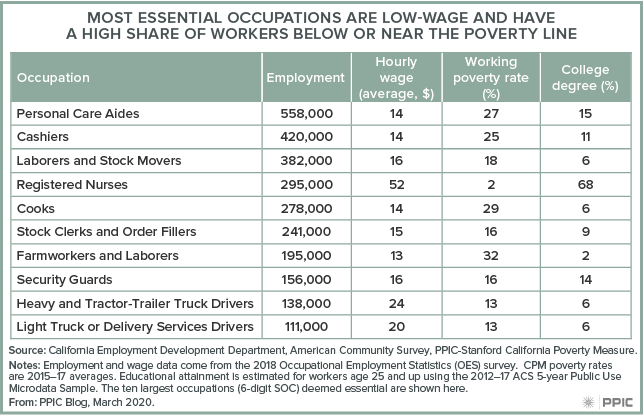
Some essential jobs are obvious, as they are on the front lines of the public health crisis. For example, registered nurses (the largest occupation within the healthcare practitioner category) are essential, have two- or four-year degrees (68% have a college degree, according to our analysis of American Community Survey data), and earn relatively high wages ($52.32 an hour).

However, workers outside of the health care sector are also on the front lines. Personal care aides—those who assist the elderly and others in their homes or personal care facilities—are the single largest essential job category. These workers earn $13.50 an hour on average and 85% do not have a college degree.

Differences in skills and pay translate into notable differences in economic well-being for these workers and their families. A slightly higher share of essential workers than non-essential workers are poor or nearly poor, according to the California Poverty Measure: 14% of essential workers live in poor families compared to 11% of non-essential workers (the comparable estimates for near poverty are 19% and 14%, respectively).

figure - Most Essential Occupations Are Low-Wage and Have a High Share of Workers Below or Near the Poverty Line

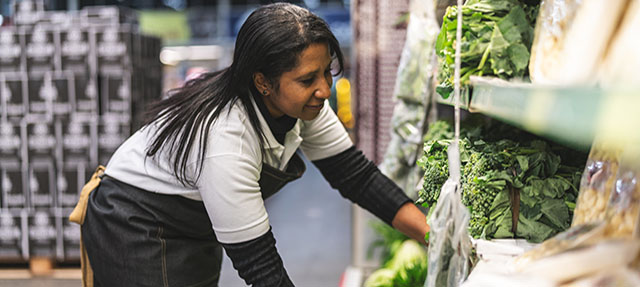
Grocery store cashiers, store clerks, farmworkers, and delivery and truck drivers make up sizeable shares of the essential workforce.  Given the low hourly wage rates for these workers, some may face hardships in caring for children or family members with schools and care facilities shuttered.

In addition, many essential workers experience the cost and risk of maintaining their own health while interacting with the public. In low wage essential jobs, access to health benefits and paid sick leave is limited, even in normal times. During the COVID-19 crisis, expanding access to personal protective gear could reduce the health risks among workers whose job requires some level of contact with the public.

Mandated lockdowns are now slated to continue through at least May 1 in some parts of the state and  may last even longer. Ensuring the ability of essential workers to continue their jobs safely and effectively will be crucial over the coming months. As policymakers implement support for unemployed Californians, it is important that they also consider ways to assist and protect the many essential workers on the front lines. Paid sick leave, adequate health coverage, income support, access to child care, and sufficient personal protective gear should all be part of the policy discussion.

COVID-19 Shutdown Forces Colleges to Ramp up Online Learning

[vc_row][vc_column][vc_column_text]California colleges are moving classes online in response to the COVID-19 pandemic, which means most students at most colleges will take classes remotely. For example, the entire University of California and California State University systems have moved almost all undergraduate education to online settings. Such a dramatic change is necessary for public health, but may interfere with student access and success.

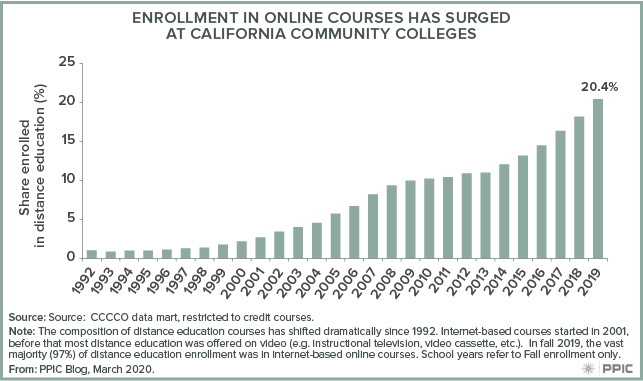
California’s community colleges can offer others a lesson in effective practices for distance education. These schools have been at the forefront of remote learning for more than four decades, from correspondence courses in the early days to instructional television and video cassettes in the 1980s. In the early 2000s, community colleges began to offer internet-based online courses.

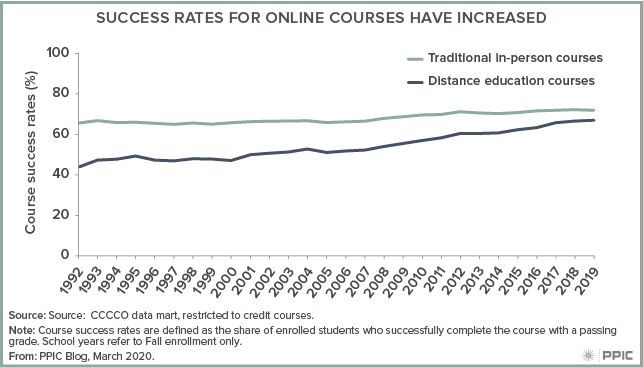
The availability and popularity of distance courses have exploded with the internet, as have course success rates. The share of enrolled students completing and passing a course has skyrocketed, narrowing the gap in success between online and in-person courses substantially.

figure - Enrollment in Online Course Has Surged at California Community Colleges

figure - Success Rates for Online Courses Have Increased

Policies around closing the success gap were intentional, with the Community College Chancellor’s Office leading efforts to improve online courses through the Online Education Initiative and the California Virtual Campus. Resources available to administrators and faculty include modules on effective course design, remote tutoring, student services, and even proctoring of exams.

Effective practices involve more than moving a face-to-face course online. Success means providing faculty support and training, setting appropriate student expectations, and promoting interaction among faculty, students, and course materials.

Better software has also cleared paths to and shifted the debate around online pedagogy. Instead of discussing how to replicate face-to-face learning, educators are examining the advantages of online learning over the traditional model. By identifying student needs, personalizing learning, and giving instant feedback, teachers may have more avenues to eliminate the online performance gap.

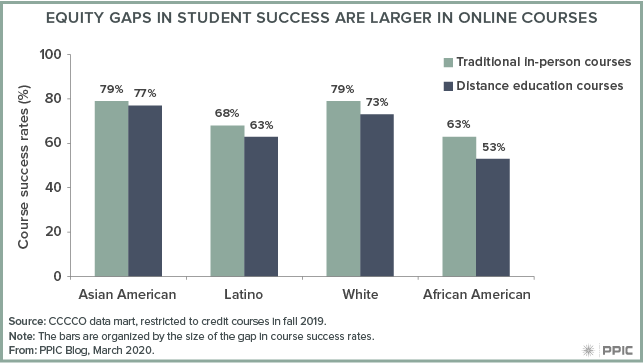
Still, problems remain. Students with limited technology, such as those without access to broadband, may not be able to access online courses. In community colleges, Latinos are less likely to enroll in online courses than other groups, which may reflect the digital divide. And while course success rates have improved across the board, equity gaps remain large.

figure - Equity Gaps in Student Success Are Larger in Online Courses

The COVID-19 crisis is unprecedented, and California’s colleges deserve credit for quickly moving courses and student supports to online platforms. Clear and effective communication with students remains key. More than ever colleges must also identify and reach out to vulnerable students—low income, food insecure, and homeless—who face challenges transitioning online and need extra support.[/vc_column_text][/vc_column][/vc_row]

Food Security in a Time of COVID-19 Insecurity: How the Virus Affects Farming

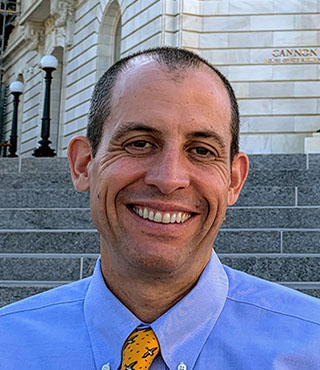
How will the COVID-19 pandemic affect California’s agricultural sector—which is important for food supplies locally, nationally, and in many other countries? We talked to Cannon Michael—a sixth-generation farmer and member of the PPIC Water Policy Center Advisory Council—about the pandemic’s potential to disrupt farming.

photo - Cannon Michael

PPIC: What risks does the virus bring to California’s farm sector?

CANNON MICHAEL: For most farmers, the immediate focus is on our workers—not only keeping them safe from the virus, but also being mindful of the pressures they’re facing at home right now. Most of our workers can’t work from home. Many have kids out of school or partners who’ve lost their jobs.

The big concern going forward is the virus going through our workforce. The disruptions of food supply we’re seeing in stores right now is caused by changes in buying habits and difficulty keeping shelves stocked. But if there’s disruption on farms—if crops don’t get harvested in time or the logistics for getting food to market go down, that would be much scarier. We’re already facing labor uncertainty due to changes to a visa program that allows workers from Mexico and Central America to come here for seasonal farm work. Many of California’s larger farms rely heavily on this temporary labor force. In the early days of the crisis, the H-2A visa program was restricted so that only workers already in the program last year were allowed to come back this year. Rule changes and congestion have made getting across the border harder, too. We’re seeing a slowdown of workers at a time when we may need more. That’s a real concern for the food supply.

There’s a finite pool of people living here to do the hand work required on the state’s farms. There’s a risk that the large companies will do whatever it takes to get those folks if they can’t get seasonal laborers. It could be a threat to smaller farms if larger entities start to pull workers away using incentives that smaller farms can’t match.

The disruption of markets—such as the closure of restaurants and food service operations—is a huge concern for growers. Impacts will vary by region, commodity, and individual company exposure. Western Growers reports that some farmers are heavily embedded in the food service supply chain with crops in the ground now. They have nowhere to put that food, because other growers with retail channels for those commodities are operating at maximum capacity and can’t take any more product into their systems. Other farmers say they may need to scale back acreage. Some crops could be affected by changing international markets or the general financial downturn. There’s the potential for huge swings in marketability and profitability for many farmers.

We’re also not sure if there will be any new requirements for food safety in coming months. There are already good protocols in place for food safety that anyone involved in fresh produce has to comply with, and farmers are accustomed to these high standards. The good news is that food safety experts say there is a low risk of getting the virus from food products or packaging. The advice from the experts is that normal food safety practices will suffice.

PPIC: What steps are being taken to protect farm workers from infection?

CM: We are rapidly approaching the time when most farms will be extremely busy, which means a lot of people on the farm. New state guidance on protecting farmworkers from COVID-19 is being developed. But most farmworkers live in very close conditions and so even with safe practices on the farm, it’s going to be harder to control the risk in their homes and communities under current conditions. If the virus gets into the farmworker population I think we’d see a very fast rise in infection, which would have a dramatic impact on the farm sector and food supply.

On our farm we’re providing regularly updated health information in all the places that people congregate. The California Farm Bureau and industry groups have reacted quickly to make information available in English and Spanish. We’re making sanitation equipment widely available, and presenting guidelines on hand washing and social distancing.

PPIC: What policy changes could help address these risks?

CM: Fixing federal immigration policy is critical. The key point is we need to get food off the farms, and to do that we have to have enough laborers. One hopeful sign is that the federal government recently announced it will relax the new restrictions on the H-2A program. That should help people get here to work.

It’s also critical that rural communities aren’t forgotten in this public health crisis. We need a plan to address the special public health challenges in farm communities.

I don’t want to pound people over the head with this, but the crisis really drives home the importance of agriculture and the value of a stable food supply.

And I’d just like to encourage everyone to reduce the panic buying, which has created big challenges in the supply chain as well as making it harder for more vulnerable people who can’t shop that way. We will produce the food and get it to the markets but we will all be safer if people just buy what they need.


Severe COVID-19 Infections May Threaten California’s Prisons

An inmate in the California prison system has tested positive for COVID-19, as have several corrections officers. California invests more than any other state in prisoners’ health, due to ongoing federal oversight mandating that the California Department of Corrections and Rehabilitation (CDCR) provide adequate health care. But overcrowded conditions where social distancing is improbable could intensify COVID-19 outbreaks in California’s prisons.

To limit the spread of COVID-19 between local communities and prisons, Governor Newsom has issued an executive order halting prison admissions and transfers to community-based reentry programs. Inmates who fall ill are being isolated, and those who work in prisons, including corrections officers and health professionals, are being screened before entering. Similar efforts to contain outbreaks are not unusual in CDCR. However, they usually apply to one prison, rather than to the entire system.

Overcrowding may exacerbate the potential for COVID-19 to spread rapidly though prison systems, threatening prisoners, corrections officers, and prison health professionals alike. According to the Bureau of Justice Statistics, about half of the country’s prison systems operate at or above capacity. In California, a court order mandates that the prison population remain under 137.5 percent of capacity. Currently, the prison population stands at just under 123,000, and the prisons are at 134 percent of capacity.

Prison environments also limit inmates’ and prison workers’ ability to practice social distancing. Dormitories present special challenges. The inmates who live in them and the correctional officers who supervise them must safely navigate open space in concert with each other. However, the cells in which most prisoners are housed present social distancing challenges of their own. While some inmates live alone, most have a cellmate. In some prisons, cell sizes fall short of the standard 25 to 35 square feet of space per person. Cellmates also typically sleep in bunk beds, which do not have six feet between the top and bottom bunks.

In addition, California’s prisoners may be particularly susceptible to COVID-19 because they are older or have preexisting medical conditions. In 2018, more than 30,000 inmates (24%) were over age 50, and over 5,000 (4%) were over 65. Prison populations tend to be far less healthy than the general public—9% of California’s inmates were classified as high clinical risk in 2012, meaning they had serious medical conditions that required significant resources to manage.

During COVID-19 infections, even mild or moderate chronic health problems that would usually be manageable could lead to serious complications. Illnesses that compromise the immune system or weaken the lungs can increase the risk of poor outcomes associated with COVID-19. According to California Correctional Health Care Services, more than 10,000 inmates were treated for hepatitis C in 2018. Approximately 8,000 of California’s inmates are diabetic. Twelve percent of male and one in five female inmates used medication to treat asthma in 2010—about double the rate among Californians. In 2015, 0.8 percent of California’s inmates were HIV positive—also more than double the rate among Californians. The heightened vulnerability of California’s prisoners to serious COVID-19 infections also puts the corrections officers who work alongside them and the health professionals who care for them at elevated risk for contracting the illness.

While older people are at greatest risk of severe outcomes related to COVID-19, younger people, particularly those with preexisting conditions, are also vulnerable to severe outcomes. If an outbreak happens within the prison system, many CDCR workers and inmates—young and old—may be at higher risk of experiencing serious complications as living conditions, age, and preexisting medical conditions combine to amplify the threat from COVID-19.

Feeding Children When Schools Are Closed for COVID-19

By state law, all public schools in California must provide at least one nutritionally adequate meal to students—however, many students eat more than one meal a day at school. Nearly four million students received meals from California’s public schools in the 2018–19 school year: close to 300 million breakfasts and well over 500 million lunches. With schools closed to reduce exposure to the new coronavirus, many students now lack ready access to these meals.

By federal law, low-income students (about $48,000 for a family of four in 2020) are eligible for free or low-cost school meals. Higher income students paid on average $0.98 for breakfast and $2.11 for lunch in 2017–18, according to the California Department of Education.

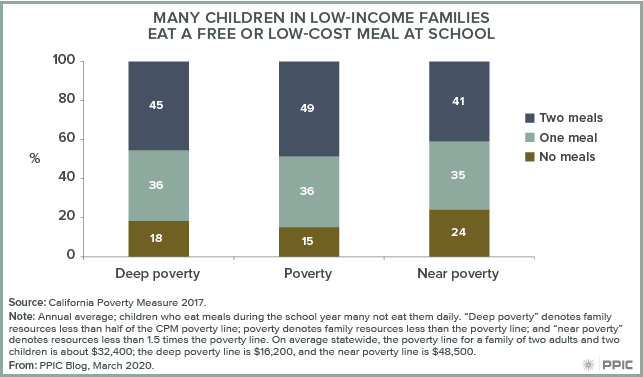
The vast majority of low-income students eat some or all breakfasts, lunches, or both at school. Free and reduced-price meals lower food insecurity, and according to the California Poverty Measure (CPM), meaningfully reduce poverty among families with public school students. Without school meals, the share of students living in deep poverty would be 17% higher; increases for students in less severe poverty would be 2% to 8%.

figure - Many Children in Low-Income Families Eat a Free or Low-Cost Meal at School

With school closures in place for several weeks, school districts have already designated sites where families can pick up meals for children. In higher poverty areas, all children can access meals regardless of enrollment in the local school or eligibility for meal programs because authorities have temporarily relaxed federal regulations.

During closures, Governor Newsom assured that schools will continue to receive state funds to operate and requested efforts focus on certain areas, including providing school meals. However, access remains a concern. For example, Los Angeles Unified School District lists 64 “grab-and-go” sites for its roughly 1,000 schools. San Diego Unified School District has 13 sites for 181 schools, as of March 16. Elk Grove, with 67 schools, has 34 sites for drive-through and grab-and-go meal services along with a mobile service for families with limited transportation.

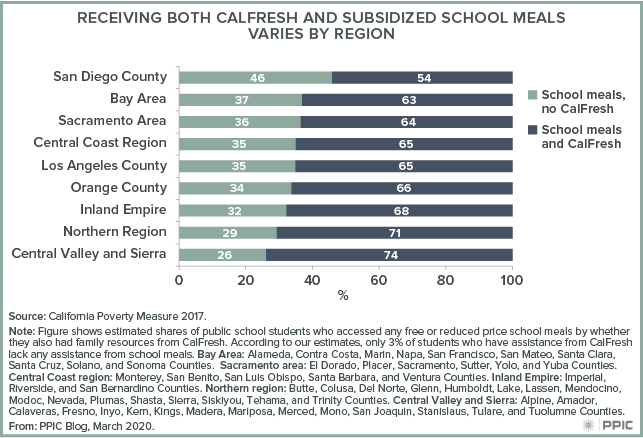
With pandemic EBT (P-EBT), ATM-like cards pre-loaded with funds for groceries, the federal government is also helping low-income students replace missed school meals. The cards will cover the expected number of days that schools will be closed. For students whose families already receive monthly CalFresh benefits on EBT cards, funds can readily be added. For low-income students who do not already receive CalFresh (34% statewide), families must complete some paperwork—mainly electronically—to obtain an EBT card.

Because the reach of CalFresh varies across the state, barriers to getting P-EBT funds to students will also vary. Fortunately, the state already matches student data with their CalFresh, CalWORKs, and Medi-Cal data to automatically determine students eligible for free and reduced-price school meals. If the state can use all existing sources of family income to provide P-EBT to students, they will reach more low-income students.

figure - Receiving Both CalFresh and Subsidized School Meals Varies by Region

Ready access to meals influences student health, learning, and economic wellbeing. Robust access to free and reduced-price meals can decrease the stress low-income families are facing as efforts to limit the spread of COVID-19 dampen economic activity.

COVID-19: Not a Threat to California’s Water Supply

The COVID-19 health emergency has prompted “panic buying” of bottled water that has emptied store shelves and sown confusion over water safety. We talked to Dave Eggerton—executive director of the Association of California Water Agencies (ACWA) and a member of the PPIC Water Policy Center advisory council—about the state’s municipal water supply in light of the ongoing pandemic. ACWA is a statewide association whose 450 local public water agency members are responsible for about 90% of the water delivered in California.

photo - Dave Eggerton

PPIC: Is the state’s water supply safe?

DAVE EGGERTON: The virus is not a danger to our public water supplies, and buying bottled water in response to it is unnecessary. This has been confirmed by the US Environmental Protection Agency, the Centers for Disease Control, and many local water suppliers. Our treatment plants use a disinfectant process that destroys this virus, along with other pathogens that threaten public health. After the water is treated, chlorine is added during the delivery process as an added precaution.

Our public water systems are comprehensively regulated under state and federal law—including the removal of pathogens. The men and women who operate these plants are highly trained to manage crisis situations like this. These people are real heroes in the work they do, and we’re incredibly proud of them, and of the fact that our water supply remains safe.

In addition to providing this essential service, one of the other important things our water agencies do is continuously provide timely, accurate information to the public. That’s a major focus right now, and it’s key to reducing confusion during a crisis. If you have any questions about water safety, contact your local provider; they stand ready to help.

PPIC: Water systems are critical infrastructure and can’t shut down. What steps will the sector need to take to address this risk?

DE: Like the rest of society, we’re faced with the challenge of protecting our employees from getting sick. Public water systems are in many ways automated, which allows us to operate facilities more or less remotely. But you need essential workers on site to monitor conditions at treatment plants and distribution systems and address issues as they arise. These people must be able to get to work sites. So we have to protect them so they can do their jobs.

That said, the water sector is well prepared for emergencies, so you can be sure these supplies will be delivered to people’s homes. For example, if you look back at some of the recent catastrophic fires we’ve experienced, water workers were at frontlines to protect communities’ supplies. They have an incredible commitment to their work. Responding to emergencies is something our agencies do on a regular basis. We have emergency response plans, and the men and women who operate these systems are trained to handle crisis conditions. During Santa Rosa’s huge fire, for example, operators of a water treatment plant kept it functioning so water could continue flowing to hydrants, even when they were at risk of the rapidly approaching flames.

In addition, our agencies are working together to help each other—we have mutual aid agreements to share supplies and labor as needed. And because our drinking water systems are regulated under state law, the state Division of Drinking Water has continuous involvement with our public agencies. So we have longstanding relationships and paths of communication that enable us to be aware and responsive to new challenges. And on the local side, we have strong, ongoing relationships with county response emergency operation centers, and we’ve planned emergency scenarios with them. That level of communication and trust really helps in times like these.

COVID-19 and California’s Census Count

The COVID-19 crisis has upended the carefully laid plans for the 2020 Census in ways that might have disproportionate effects on California’s count. The Census Bureau is making important adjustments, but California needs to be particularly vigilant about the potential consequences.

The Bureau began its self-response period on March 12, when it started mailing out invitations to participate in the census to virtually every household in the country. Self-response remains the safest and simplest way to gather census data because, unlike in-person interviews, it does not raise the risk of coronavirus exposure.

The virus has altered almost every other effort the Bureau had planned. The Bureau always does extensive follow-up with households that fail to self-respond. More people are likely to need follow-up in California than in the average state, so problems with that process will be felt more acutely here. Follow-up is generally in person, which raises risks that didn’t exist just a few weeks ago; at least one census worker has even tested positive for the virus. To accommodate some of these challenges, the Bureau has delayed hiring and pushed back both the start of the follow-up (from May 13 to May 28) and the cutoff date for completed self-response forms (from July 31 to August 14).

The Bureau’s plans for counting those in less conventional living arrangements have been upended as well. The original plan for group quarters such as college dorms and senior living facilities was to send out a census worker to collect information for the entire facility from a contact person. College students are supposed to be counted as if at school, but many have been sent away from their campuses. And senior facilities are protecting their highly vulnerable residents by strictly limiting access. The Bureau is exploring alternative approaches.

People who are homeless, particularly those living on the street or in cars, are especially difficult to count. Estimates suggest that homelessness is a bigger and faster-growing problem in California than in almost any other state. The Bureau had planned to count homeless people wherever they happened to be from March 30 to April 1. But the homeless population is especially vulnerable to the virus, and sending census workers out to count in person would put the workers and their communities at risk. The Bureau has delayed this effort by a month to lower the risk of contagion.

Finally, the Bureau does a wide range of communications work just to get the message out that the census is happening and is important. The Bureau’s carefully developed media campaign is likely to be overwhelmed by news about the pandemic. Moreover, a significant amount of outreach was to be conducted in physical spaces by trusted messengers in each community. All of that will need to be rethought. Not only are large gatherings generally banned, but most community spaces are closed.

Though there is some scheduling flexibility, a hard deadline looms. By law, the Bureau must submit total state populations to the president by December 31 so that congressional representation can be adjusted to reflect changes in population over the previous 10 years. This is the most basic constitutional function of the census. Changing that deadline would require congressional approval and could complicate the process of redrawing the lines of representational districts.

These challenges are significant, but a strong performance during the self-response period will mitigate them. PPIC will be monitoring and providing key analysis of the self-response process to help ensure that the state is in the best possible position before the follow-up period begins.

COVID-19 and California’s Vulnerable Populations

To take a closer look at access to care, PPIC has created an interactive, California Critical Care during COVID-19.

To reduce community spread of COVID-19, California has instituted statewide guidance to shelter in place until further notice, and to practice social distancing when leaving home for approved activities such as grocery shopping or exercise. Because COVID-19 is novel, no vaccine is available and no one has preexisting immunity. However, individuals are not equally at risk, and there are several known sources of vulnerability.

There are Californians at elevated risk of exposure to the coronavirus. For some, this risk is due to the nature of their work, as is the case for physicians, nurses, and other front-line medical staff. For others, such as California’s approximately 115,000 prisoners and 150,000 homeless individuals, living conditions pose serious challenges to social distancing. And being over 60 or having an underlying health condition makes over one-third of California’s adults especially vulnerable to serious or fatal complications—this estimate does not include undiagnosed medical conditions, which puts the actual figure higher.

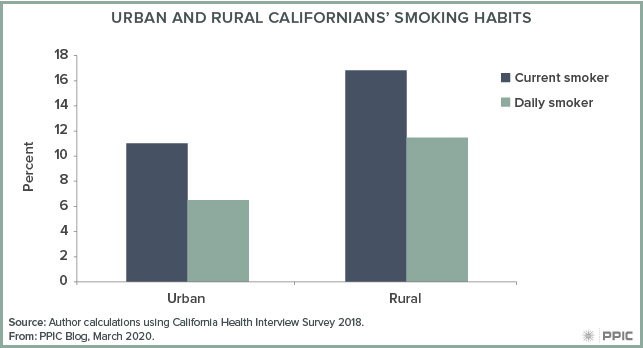
Californians in the state’s 21 rural counties may have lower exposure to the coronavirus because of the relative ease of social distancing. These individuals, who make up over 837,000 residents, may face significant challenges if they do contract the coronavirus. California’s rural adults are more likely to smoke than urban ones (16.8% versus 11.0%) (California Health Interview Survey 2018), and smoking is suspected to put coronavirus patients at higher risk of complications because it is known to damage lung health.

figure - Urban and Rural Californians’ Smoking Habits

Rural residents often have to travel farther to access critical care resources. This is especially concerning for the large numbers of elderly Californians who are low income, geographically isolated, or living alone in the state’s rural areas (California Department of Aging 2019).

How Will the Coronavirus Affect California’s Economy?

As Californians limit their daily activities to slow the spread of the coronavirus, the state economy is poised to take a major hit. The pandemic is increasing the need for some goods and services (such as health care) and reducing demand for others (such as travel- and entertainment-related services), so the near-term economic consequences are more serious in some sectors than in others. Moreover, these consequences could exacerbate the unevenness of economic conditions and opportunities across regions.

Initially, the largest downturns are likely to occur in sectors that rely on the movement of people and nonessential goods. Recent forecasts have identified several “at risk” sectors: accommodations and food service; arts, entertainment, and recreation; administrative and support services, especially employment services; mining and oil/gas extraction; transportation and warehousing; and agriculture (UCLA Anderson and Moody’s Analytics). Shocks in these industries will be driven by reduced local demand, as well as slowing of trade in and out of California’s ports (especially relevant for the transportation and warehousing and agriculture sectors).

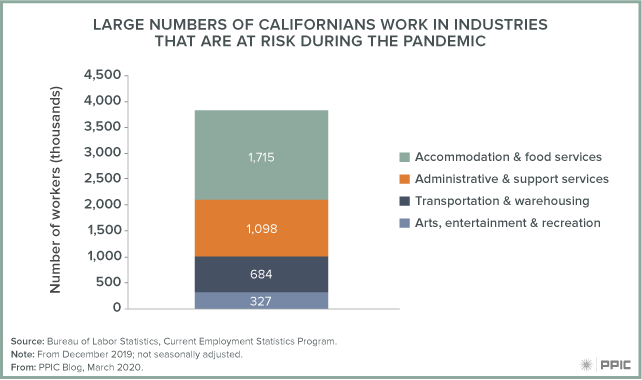
These sectors—excluding agriculture—comprise 10% of the state GDP and employ 3.9 million workers. Unemployment insurance claims data is starting to show the impact on workers, but it will be a while before we get detailed data for all California workers (including those who do not apply for unemployment insurance).

We can, however, learn a lot about the pandemic’s impact on workers, sectors, and regions from recent employment statistics. Employment in these sectors makes up more than a fifth of overall non-farm employment in both California (22%) and the nation as a whole (21%).

figure - Large Numbers of Californians Work in Industries that Are at Risk during the Pandemic

The workforce in these industries is not just large; it also comprises a wide range of occupations (for example, pilots as well as baggage handlers in the transportation industry; hotel managers as well as cleaning staff in the accommodation industry). At this point, we cannot predict exactly how the COVID-19 crisis will affect these workers. But reduced hours and layoffs are highly likely, and the workers least able to weather the storm are those who already struggle with poverty.

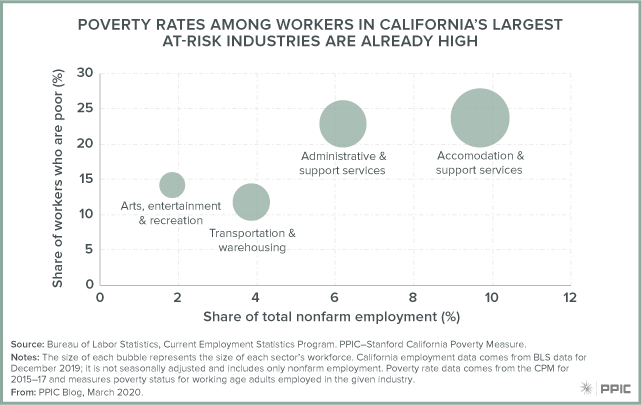
Overall, we estimate that 19% of Californians employed in these industries are working poor and another 22% are just above the poverty line (“near poor”). The poverty rate among workers in the accommodation and food service sector is 24%. This sector, which is being hit hard by reduced tourism and dining out, is the largest of those expected to experience the most immediate economic consequences.

figure - Poverty Rates among Workers in California’s Largest At-Risk Industries Are Already High

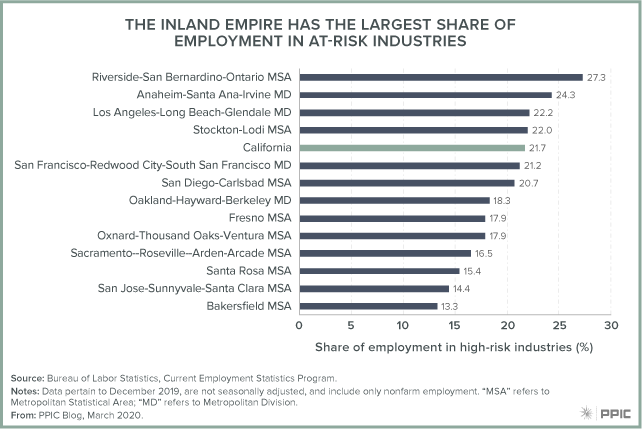
Because California’s industries are not evenly distributed, the initial impact on economic activity and on workers will likely vary across the state. Among major metro areas, Los Angeles, Anaheim–Santa Ana–Irvine, Stockton, and Riverside–San Bernardino have larger shares of jobs (ranging from 22% to 28%) in at-risk sectors than the state as a whole.

As one might imagine, these areas differ from one another in many ways. While Stockton has a relatively large share of employment in transportation and warehousing, Anaheim–Santa Ana–Irvine has a large share in accommodation and food services. Not surprisingly, given its population, the Los Angeles metro area has by far the largest number of workers in at-risk sectors: 1,043,000. Riverside and Anaheim follow with 433,000 and 417,000, respectively.

figure - The Inland Empire Has the Largest Share of Employment in At-Risk Industries

The longer-term economic impact of the coronavirus on these and other sectors will depend on how long the crisis lasts. Policy responses can play a critical role in mitigating the economic damage. State and federal leaders face the challenge of helping businesses weather the crisis and rebound quickly, while also addressing the tangible needs of workers who may be losing income, especially those who are already in or near poverty.

A host of economic interventions—many of which aim to help dislocated workers—have already been announced, and more will be implemented as the economic consequences of this pandemic become clearer. As they develop these interventions, policymakers will want to take into account industries and workers across all of California’s regions.