Many Support Rent Control, but Prop 10 Lags

While most of California’s likely voters are satisfied with the way the initiative process is working in California, an overwhelming majority also think that the wording for citizens’ initiatives is often too complicated and confusing for voters to understand what happens if the initiative passes. This may be the case with Proposition 10, as our September survey findings suggest.

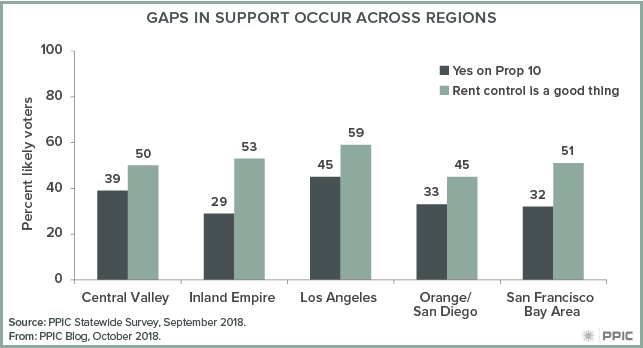
When read the ballot title and label of Proposition 10—which would expand the authority of local governments to enact rent control—about half of likely voters say they would vote no (48%) while far fewer (36%) would vote yes. However, when asked a general question about rent control by local governments, half of likely voters say it is a “good thing” (52%) while fewer (41%) say it is a “bad thing.” This translates to a 16-point gap between support for Prop 10 and support for the concept of rent control.

This gap widens when we dig a little deeper. For example, we find double digit differences in support for Prop 10 and for rent control in general across parties (Democrats 23 points, independents 14 points, Republicans 12 points).
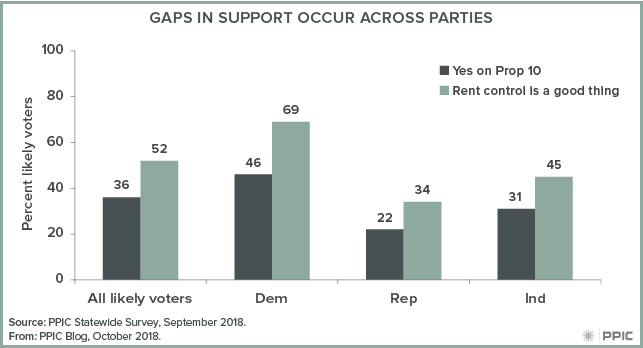
Support for Prop 10 and for rent control in general varies across regions, but the gap in support remains.
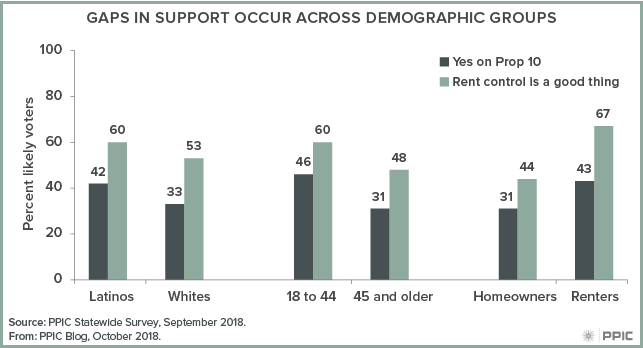
Gaps in support also occur across demographic groups: likely voters who are white (20 points) and Latino (18 points), those age 18 to 44 (14 points) and those age 45 and older (17 points), those making less than $80,000 annually (19 points) and those making $80,000 or more (14 points). Support for Proposition 10 is also lower than the share saying rent control is a good thing among renters (24 points) and homeowners (13 points).
It’s not entirely clear why these differences exist or why they are so pervasive. Perhaps the wording of Proposition 10 is having an impact. The ballot title and label—which are read to our survey participants—describe repealing the current state law that restricts the scope of rent-control policies. (This is the 1995 Costa-Hawkins Rental Housing Act.) It also mentions the potential net reduction of tens of millions of dollars in state and local revenues.

Proposition 10 Ballot Language
Proposition 10 is called the “Expands Local Governments’ Authority to Enact Rent Control on Residential Property. Initiative Statute.” It repeals state law that currently restricts the scope of rent-control policies that cities and other local jurisdictions may impose on residential property. The fiscal impact is potential net reduction in state and local revenues of tens of millions of dollars per year in the long term. Depending on actions by local communities, revenue losses could be less or considerably more. If the election were held today, would you vote yes or no on Proposition 10?

Is this a case of confusing ballot language? Or are voters simply not interested in this particular approach to rent control? As Californians learn more about the propositions during the run up to November it will be interesting to see the impact on Proposition 10. Stay tuned to the PPIC Statewide Survey for timely coverage of this year’s election.

Video: A Conversation with Candidates for US Senate

As part of our Speaker Series on California’s Future, PPIC is inviting all major candidates in selected statewide races to participate in public conversations. The purpose is to give Californians a better understanding of how candidates would approach the challenges facing our state.

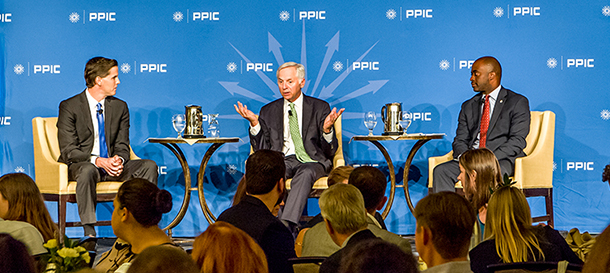
To give Californians a chance to hear directly from the two candidates for California’s US Senate seat, PPIC invited California state senator Kevin de León and US senator Dianne Feinstein to San Francisco on Wednesday to talk about their visions for California and the nation. PPIC president Mark Baldassare moderated a lively discussion that covered a range of topics.

The candidates, both Democrats, were in agreement on many state and national issues—including gun regulations, the Delta tunnel proposal, and comprehensive immigration reform. Both would support revisiting the allegations against Supreme Court justice Brett Kavanaugh, and both feel that there are Republicans in Congress who want to reach across the aisle.

But while both candidates talked about the need for universal health care, they had different views on the way to proceed. As Feinstein put it, “I believe in universal health care. The question is how we get it.” She outlined an incremental approach—offering a public insurance option, lowering the age of eligibility for Medicare to 55, and allowing Medicare to negotiate drug prices. By contrast, de León characterized health care as a right: “I believe that health care is a human right. I believe in Medicare for all.” He also cited his leadership in creating the Covered California health care exchange, expanding access to the exchange to undocumented minors, and instituting drug price transparency in California.

The candidates’ views on health care epitomize their overall approaches to governing. For de León, the key is to bring his experience in California to Washington. Asked about the tensions between California and the federal government, he said, “California has been the leading voice for the entire nation. The world looks to California, not Washington, DC.” And he argued that Democrats in Congress need to elevate key issues, “even if we’re in the minority.” In response to a question about why he wants to be California’s US senator, de León said, “I’m running to give you a new voice, and a new approach.”

Feinstein often focused on what her years of experience in the Senate have taught her about the complexities and difficulties of governing. She reminded the audience more than once that Democrats are in the minority: “When you have both houses and the White House controlled by one party, it is extraordinarily difficult.” Explaining why she’s running in 2018, she focused on the work that needs to be done: “In terms of American public policy domestically, we can achieve a great deal . . . if we’re smart in how we go about it.”

Partisan Loyalty Trumps Gender Solidarity in California

A month until the midterm elections, California’s voters are gearing up for decisions that will have ramifications across the nation. Much has been discussed of a potential “blue wave,” with Democrats eyeing to flip seven Republican congressional seats in California—nearly one-third of the 23 seats needed to shift party control in the US House of Representatives. Concurrently, there are a record number of women running for US Congress and statewide executive offices, including 37 in California. With women comprising 54% of the state’s likely voters, how large a role will they play in the upcoming election?

According to PPIC’s September Statewide Survey, 50% of female likely voters say the upcoming election is more important to them than past midterms; just 3% say it is less important and 46% say it is about the same. Yet when looking at the partisan breakdown among female likely voters there are notable differences: 63% of Democratic women say the upcoming election is more important while 37% of Republican women say the same (sample sizes for independent female likely voters are too small for separate analysis).

In the generic ballot for the US House of Representatives, California’s female likely voters prefer the Democratic candidate over the Republican candidate (58% to 34%). Nearly all partisan female likely voters say they would vote for their own party. When asked about qualities they prefer in a candidate, six in ten Democratic women (60%) prefer those who have experience in politics to those who are new at it, while Republican women are divided (41% experience, 41% new to politics).

Recent prominent events at the national level may impact women’s preferences and turnout in the midterms. Our September survey was fielded following the initial Senate confirmation hearings for Judge Brett Kavanaugh’s appointment to the Supreme Court but prior to the additional hearing on sexual abuse allegations featuring Dr. Christine Blasey Ford. Nonetheless, nearly all female likely voters in our September survey view the choice of the next Supreme Court justice as either very (74%) or somewhat (18%) important to them personally. Across parties, Democratic women are much more likely than Republican women to say the choice is personally very important (82% to 62%).

Meanwhile, President Trump’s approval rating reflects sizable partisan differences among California’s female likely voters: 91% of Democratic women disapprove of the way Donald Trump is handling his job as president, while 80% of Republican women approve.

With women poised to play a pivotal role in the upcoming election, we may see the emergence of a “pink wave” that rivals the “Year of the Woman” associated with the 1992 election. Stay tuned to the PPIC Statewide Survey as we continue to monitor the preferences and attitudes of Californians, with a particular interest in female likely voters, leading up to the midterm.

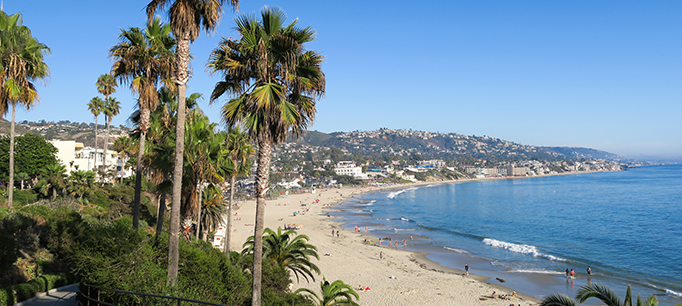
Tectonic Shifts in Orange County

Orange County has evolved from a Republican stronghold to a credible target of opportunity for the Democrats seeking to take control of the U.S. House of Representatives in the November election.

Until the most recent presidential election, Republican candidates had won in every top-of-the-ticket statewide race in Orange County for 20 years. In fact, the last time that a Democratic presidential candidate carried Orange County was in 1936. But in 2016, Democrat Hillary Clinton defeated Republican Donald Trump by 51 to 42 percent, a margin of 102,813 votes. Moreover, Clinton received more votes than Trump in each of the four Orange County House seats now held by Republicans.

Tectonic shifts in Orange County’s demographics and voter registration set the stage for the surprising 2016 presidential outcome and the competitive 2018 House races. First, Orange County’s population is transitioning. Since 2000, the proportion of whites has declined from 51 percent to 41 percent of the population. Latinos now make up to 34 percent and Asian Americans make up 21 percent of the population. Most Latino and Asian American likely voters are registered Democrats today.

Second, Orange County’s political stripes have changed from red to purple. Since 2000, the proportion of registered Republican voters has declined from 49 percent to 36 percent. Registered Democrats have increased to 34 percent and independents have increased to 27 percent. Today, most independent likely voters lean toward the Democratic Party. In sum, Republicans’ electoral clout is diminishing in Orange County.

Since this midterm election is a referendum on the president, how is Donald Trump viewed by Orange County voters? The Public Policy Institute of California’s Statewide Survey has been tracking President Trump’s popularity by asking the following question, “Overall, do you approve or disapprove of the way that Donald Trump is handling his job as president of the United States?” In five 2018 PPIC surveys, 40 percent approve and 56 percent disapprove of President Trump when combining the results for registered voters in Orange County.

Approval of Trump’s presidency in Orange County varies widely by party: 79 percent of Republicans, 30 percent of independents, and 13 percent of Democrats. Half of whites approve of his performance, while 28 percent of nonwhites approve. Overall, Trump’s approval rating in Orange County of 40 percent in 2018 closely mirrors his 2016 vote total, which was 42 percent. This indicates his political base in Orange County has not grown during his time in office.

Voter turnout will be the political wildcard in Orange County. Since 2000, Orange County’s voter turnout in midterms has been on average 21 points lower than in presidential elections. Low turnout this year would be a throwback to the “old” Orange County electorate—more Republicans and whites. A high turnout would reflect the “new” Orange County—more Democrats, independents, and nonwhites.

We’ll know in a month whether the new or old Orange County will prevail in 2018. But given the demographic and registration trends, the Orange County of the future will be very different from the one that consistently voted for Republicans.

Video: Californians and Their Government

As the November election approaches, Democrat Gavin Newsom has a 12 point lead over Republican John Cox in the race for governor. In the US Senate race, Dianne Feinstein leads fellow Democrat Kevin de León by 11 points. Half of likely voters see this election as more important than past midterms; most lean toward Democratic candidates in US House races. These and other key findings in the latest PPIC Statewide Survey were outlined by PPIC researcher Dean Bonner at a Sacramento briefing last week.

A slim majority of California’s likely voters oppose Proposition 6, a ballot measure that would repeal recently enacted increases in the gas tax and vehicle registration fees. Proposition 10—which would expand the authority of local governments to enact rent control—is also trailing.

Other survey highlights:

  • Three in four likely voters view the choice of the next Supreme Court justice as very important to them personally.
  • Majorities of registered voters across parties say they do not want to see the Supreme Court’s Roe v. Wade decision completely overturned.
  • A third of likely voters approve of President Trump’s job performance and only 20% approve of Congress; by contrast, more than half approve of Governor Brown and the state legislature has a 44% approval rating.
  • Likely voters are most likely to name jobs and the economy, immigration, and housing as the most important issues facing the state.

Video: A Conversation with Candidates for State Superintendent of Public Instruction

As part of our Speaker Series on California’s Future, PPIC is inviting all major candidates in selected statewide races to participate in public conversations. The purpose is to give Californians a better understanding of how candidates would approach the challenges facing our state.

In November, Californians will elect a new superintendent of public education. Education is by far the largest state spending area, and California’s public K–12 system—which educates more than 6 million children—is critical to the state’s future. What are the top priorities of the two candidates and what are their visions for California’s schools? PPIC president Mark Baldassare talked to Tony Thurmond, a member of the state assembly, and Marshall Tuck, a school improvement director, about how they would approach the job.

The candidates largely agreed on the need to increase state education funding and the importance of improving outcomes for low-income students, English Learners, and foster youth. Both are strong advocates for universal preschool. And both stressed the need to prepare all students not just for college and careers but also for civic engagement.

After noting that California currently ranks near the bottom among all states in per pupil funding, Tony Thurmond promised to prioritize moving the state into the top ten within his first four years—and to “take us to number one within eight years.” To help close achievement gaps, he would expand successful local approaches. He cited the Freedom School, an Afro-centric literacy program, and Footsteps to Brilliance, which focuses on immigrant families, as models.

Marshall Tuck emphasized the need to “start with equity.” His first priority would be to change the current funding policies to make sure state funding gets to kids with the greatest need. He would also work to streamline the state education code in order to “unlock the creativity of teachers and principals.”

While they agreed on many issues, Thurmond and Tuck emphasized differences in their backgrounds, each arguing that his experience makes him the better candidate.

Tuck argued that, while money is important, “implementation is key,” and cited his experience implementing successful policies in Los Angeles. After noting that the system has not been working, he argued that the next superintendent should be an education professional who can “fundamentally change the way we are approaching public education.”

Thurmond noted that the superintendent needs to be able to work with the county superintendents, the legislature, and the governor. He outlined his experience as an elected official and educator, as well as his “lived experience” as a student in California public schools—an experience, he said, that demonstrates how “education can save lives.”

Video: A Conversation with Congresswoman Nancy Pelosi

As part of our Speaker Series on California’s Future, PPIC is inviting elected leaders across the political spectrum to participate in public conversations. The purpose is to give Californians a better understanding of how our leaders are addressing the challenges facing our state.

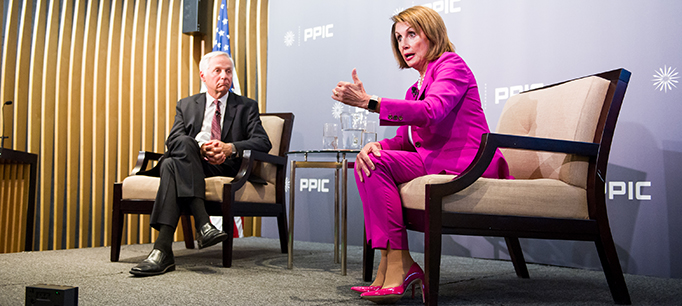
House Democratic Leader Nancy Pelosi and PPIC president Mark Baldassare had a wide-ranging conversation in San Francisco on Wednesday. They focused on the relationship between California and the federal government in a number of areas, including economic and tax policy, immigration, health care, and environmental issues.

Not surprisingly, Pelosi’s take on the state-federal relationship differs from that of her Republican counterpart, Kevin McCarthy, who fielded virtually the same questions from Baldassare in mid-August. In her view, this is an unusual time: “We haven’t had a time where the president has so targeted a state, in tax policy, environmental policy, trade policy.” Californians need to know about the statewide impact of these policies, and their elected leaders need to “try to work as much as possible in a bipartisan way to withstand that.”

She criticized the new federal tax law for significantly increasing the national debt without promoting growth. In fact, she continued, one of the best ways to promote economic growth is to enact comprehensive immigration reform. Asked what this would look like, she cited the bipartisan immigration bill that the Senate passed several years ago as one possible model. She deplored the current “uncivilized, inhumane” policy of separating families at the border. But she argued that while Trump-era ICE policies need to be changed, abolishing ICE is “not the answer.”

Pelosi, who played a major role in the passage of the Affordable Care Act, described health care reform as a “pillar of health and economic security for America’s working families.” She also characterized health care as a major issue in the November midterm elections. “The cost of health care is a very major issue in people’s lives, so we want to work in a bipartisan way, wherever possible, to reduce those costs.”

While she is concerned that Congress is not doing enough to ensure the integrity of the midterm elections, Pelosi is excited about the number of women who are running. “When I went to Congress, there were 12 Democratic and 11 Republican women.” Now, she added, “the majority of the people in our caucus are women, people of color, LGBTQ [. . .] and we want more!”

Why does she want to be Speaker? The short answer: “None of us is indispensable, but I think I’m probably the best person for the job.”


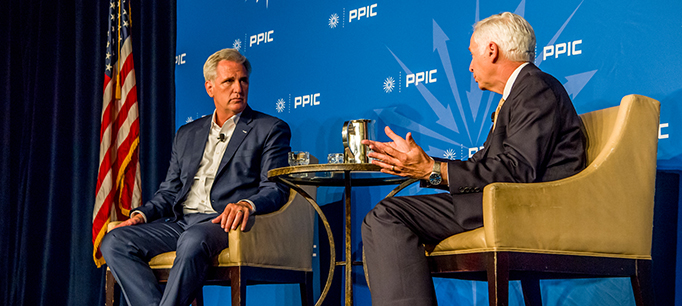
Video: A Conversation with Congressman Kevin McCarthy

As part of our Speaker Series on California’s Future, PPIC is inviting elected leaders across the political spectrum to participate in public conversations. The purpose is to give Californians a better understanding of how our leaders are addressing the challenges facing our state.

House Majority Leader Kevin McCarthy and PPIC president Mark Baldassare had a wide-ranging conversation in Sacramento last week. They focused on the relationship between California and the federal government in several areas, including tax reform, immigration, health care, water policy, wildfire management, and fuel emissions standards.

When asked about the impact of the recently passed federal tax law on Californians, he emphasized the bigger economic picture. The focus, he said, should be on the overall Republican agenda and whether it inspires optimism about the future: “Do you feel better off? How many quarters of economic growth have you had?”

McCarthy criticized the state’s leadership for its “backwards thinking” on the gas tax and other issues, and its oppositional stance to the Trump administration. He also talked about the need for bipartisan compromise in Congress. “I try to work with everybody,” he said, citing the work he did with Senator Feinstein to pass “the first major piece of water legislation in quite some time.” He returned to this theme after the conversation was briefly interrupted by a pro-DACA demonstration, asking why we can’t “sit down and communicate with one another” and decrying “elected officials who stand up and say ‘Divide us, not unite us’.”

Nonetheless, he seemed confident about finding ways to address major issues. About immigration policy, he said “I think we’re going to solve this problem” in the next congressional session. Asked about the 2020 Census, he said that Congress is making sure there will be an accurate count. “It is a big job,” he added, “and this is always the big fear before a census—are we prepared for it?”

Finally, when asked why he wants to become Speaker of the House, he said, “I want to make sure a Republican can be Speaker,” so that the party can continue to enact its agenda. He went on to describe the electoral landscape leading up to the November midterms, offering up a key takeaway: “This will be the year of the woman.”

Voters Favor New Water Bond. What Are They Missing?

One of the most surprising findings in the July PPIC survey is the strong support for an $8.9 billion state water bond among California likely voters (58%). Support for the bond―Proposition 3 on the November ballot―comes close on the heels of California voters passing a $4.1 billion state water and parks bond in June. What’s going on?

Majorities of California likely voters across partisan and demographic groups and the state’s regions say that water supply is a big problem in their part of California. Water supply and drought were the number one environmental problem named by likely voters in the survey (24%). Since Governor Brown took office in 2011, water supply and drought have been among the top environmental issues named by likely voters, and since 2014, together they have been named the most important environmental issue facing the state.

Majorities of likely voters across demographic groups and regions―including most Democrats (72%), nearly half of independents (48%), and four in ten Republicans (43%) and self-described conservatives (46%)―support Proposition 3.

PPIC surveys in the past five years show that support for state water bonds has remained high since the severe drought of 2012–16; voters are anxious about its return in light of other signs of climate change. Since 2014, at least half of California likely voters have said they would vote yes on various state water bonds. Moreover, an earlier PPIC survey found that most likely voters prefer bonds (44%) over fees (25%) and taxes (13%) as the means to fund water infrastructure projects.

What are the voters missing?

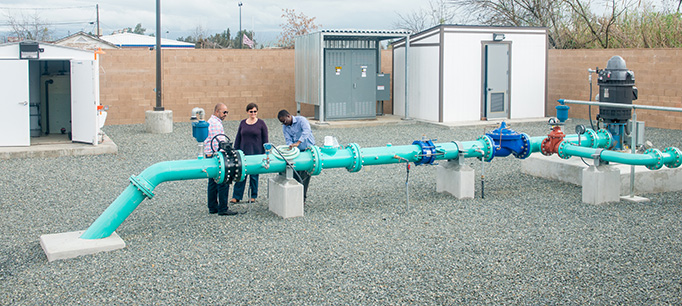
State bonds are important, but they actually play a relatively minor role in funding California’s water. Bonds provide at most $1 billion of the more than $30 billion in annual water-related spending. Local revenue—from water and sewer bills to taxes—provides the lion’s share. In addition, bonds are not a reliable long-term funding source, and they generally don’t cover operating and maintenance costs. State bonds don’t directly raise fees or taxes—which may make them more popular with voters than these alternatives. But they are not free. Every year bonds are repaid with significant interest from the state General Fund, which can reduce funding available for other important budget areas, such as education and health and human services.

California faces critical water funding gaps—totaling about $2–$3 billion annually—across several essential areas: safe drinking water in small, disadvantaged communities; flood protection; control of stormwater and other polluted runoff; and management of freshwater ecosystems and headwater forests. Limited financial capacity of low-income communities, legal constraints on local funding, a shrinking federal contribution, and unreliable state support contribute to the shortfall. There have been efforts to fill the gaps in other ways—especially for safe drinking water—but new sources of funding such as a surcharge on water bills haven’t enjoyed the same broad support as state bonds.

In California’s $2.7 trillion economy, filling the gaps for water’s “fiscal orphans” should be manageable. But this will require a focused effort and leadership at all levels. Bonds can help, but they can’t do it alone. Looking beyond bonds to find more durable ways to pay for essential water services—including with new fees and taxes―must be a top priority going forward.

Environmental Priorities and the Midterm Election

Just three months ahead of a consequential midterm election, California and the federal government continue to move in very different directions on environmental policy. Last week, the Trump administration’s efforts to roll back strict automobile emission standards were strongly criticized by the Brown administration. State officials have also pushed back on federal efforts to increase offshore oil drilling and the president’s decision to exit the Paris Agreement on climate change. Meanwhile, personal experiences with a prolonged drought and recent severe wildfires are raising Californians’ awareness about the impacts of climate change. Where do California voters stand on environmental issues and what are the implications for November?

Californians’ support for environmental protection runs deep. Consider emissions standards. In the July PPIC survey, 60% of California registered voters say that they are in favor of setting higher emissions standards for automobiles. Majorities of voters across age, education, gender, income, and racial/ethnic groups support this environmental policy. Majorities of Democrats (74%) and independents (62%) and 34% of Republicans are in favor. Notably, 52% of registered voters living in the nine competitive House districts—as rated by the Cook Political Report—favor higher auto emission standards.

Or take another area of state-federal policy conflict over the environment, offshore oil drilling. Sixty-six percent of California registered voters are opposed to more drilling off the California coast. Opposition is high among Democrats (82%) and independents (66%), and reaches 40% among Republicans. Majorities oppose it in both the coastal and inland regions of the state and across age, education, gender, income, and racial/ethnic groups. As for the registered voters living in the nine competitive House districts, 56% are opposed to allowing more offshore drilling off the California coast.

These views on particular environmental policy issues are similar to larger concerns related to global warming. About two in three California registered voters believe that global warming has already begun (67%), say that they are very concerned about its possible impact on more severe wildfires (64%), and favor the state law that requires California to reduce its greenhouse gas emissions (67%). Majorities of Democrats and independents share these views, along with substantial proportions of Republicans and majorities of voters across regions and age, education, gender, income, and racial/ethnic groups. In the nine competitive House districts, majorities of registered voters believe that global warming has already begun (59%), say they are very concerned about the impact of global warming on more severe wildfires (56%), and favor the state law that requires greenhouse gas emission reductions (62%).

Personal views about global warming could shape the size and profile of the electorate this year. Majorities of California voters say that the issue of global warming is extremely or very important to them personally (62%). If this high level of personal concern motivates voter turnout, it will provide a partisan advantage (80% Democrats, 61% independents, 29% Republicans). It could also serve as a catalyst in several Democratic-leaning groups with a low propensity to vote (64% under age 35; 68% earning less than $40,000; 69% renters; 70% Latinos). Moreover, in the nine competitive House districts, majorities of registered voters (55%) say that global warming is extremely or very important to them personally.

In the midterm election context, Californians are indicating strong opinions on environmental matters. A record-high number of registered voters say that the gubernatorial candidates’ positions on the environment are very important in determining their vote (39% 2002, 46% 2006, 42% 2010, 40% 2014, 53% 2018).

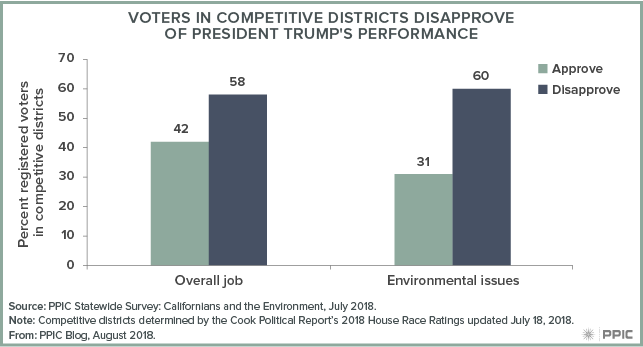
California voters say that they want statewide candidates to push back rather than work with the Trump administration on environmental issues (53% to 40%), and a majority disapprove of the way that President Trump is handling environmental issues (67%). Since the midterm elections are in part a referendum on the president, it is perhaps most significant that a majority of registered voters living in the nine competitive House districts disapprove of President Trump’s handling of environmental issues (60%)—similar to their disapproval of his overall job performance (58%).

Californians’ environmental priorities are high on our list of political wildcards in this important midterm election. Stay tuned as the PPIC Statewide Survey monitors this trend and other topics in our pre-election polling.