Three Water Challenges for Almonds

California is a force of nature when it comes to almonds. The state’s farmers produce virtually the entire US almond crop and dominate the international market. As the market has grown, almonds have become California’s largest single crop—now accounting for about 12% of irrigated acreage, with more than 1.2 million acres harvested in 2016. Availability of water is clearly a major issue for the industry, since the trees must be irrigated throughout the long spring and summer dry season. At a May event on water issues organized by the Almond Board of California, I was asked for some thoughts on the water realities almond growers must grapple with in coming years. Here are three key takeaways.

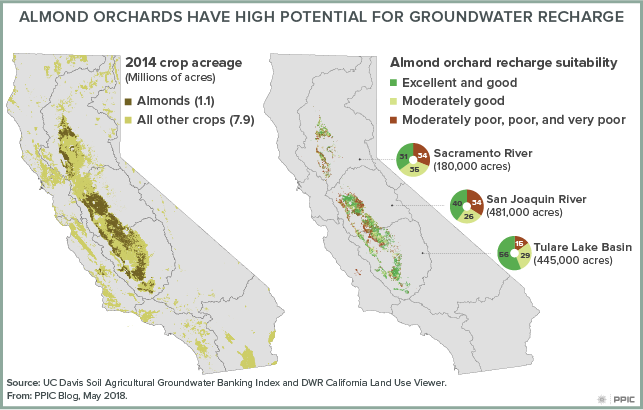
  • Growers in the San Joaquin Valley must address a long-term groundwater deficit. More than 80% of almond acreage is in the San Joaquin Valley (see map). Decades of unchecked pumping in the valley have resulted in a chronic groundwater deficit averaging nearly 2 million acre-feet per year—equivalent to about two Folsom reservoirs. Groundwater sustainability agencies must now devise plans to comply with the state’s 2014 groundwater law by bringing their water supply and use into balance over the next two decades. This means both augmenting supplies and reducing water use. Almond growers—along with others—need to be engaged in this process.
  • Augmenting local supplies can fill some of the gap––and almond growers can help. Up to a quarter of the San Joaquin Valley’s groundwater deficit could be eliminated by replenishing aquifers during high-flow events and wet winters like 2017. Spreading water on farmland is a cost-effective way to capture this water. Almond orchards are good candidates for such a process, given the suitability of much of the land for recharge (see map). Moreover, almond trees are dormant in winter and early spring, when extra water is most often available. Pilot projects and groundwater-recharge research are helping establish best practices and addressing ongoing questions among growers about the impact of winter flooding on almond crops. Almond growers also need to support other types of groundwater banking projects—such as recharge basins—that can help maximize available water supplies.
  • Managing demand will also be essential for reaching sustainability. Water use will need to fall to reduce the groundwater deficit. While this will pose some challenges, the good news is that farmers have been managing water demand for decades in this water-scarce region. Since the early 1980s, irrigated crop acreage in the San Joaquin Valley has hovered around 5 million acres, while the value of valley agriculture has roughly doubled (in today’s dollars). Farmers have responded to water scarcity by investing in crops and practices that generate more dollars per drop. The expansion of crops like almonds—and the corresponding decline in cotton and other field crops that bring in less revenue—reflects this shift. During the recent drought, farmers also used tools such as water trading and selective fallowing of less-productive lands. These same tools can help smooth the transition to balanced groundwater use, given the willingness of  water users who benefit most from using scarce supplies—for instance, those who need to keep orchards thriving during droughts—to compensate others who can use less.

Almonds are expected to remain a top crop in the state, and a leading source of farm revenues, for decades to come. But water stress will be an increasingly important factor for California’s almond growers and for the San Joaquin Valley more generally. The farm sector’s water challenges can’t be addressed farm by farm, or crop by crop. Cooperative approaches—including trading and groundwater recharge—will be essential to a smooth landing for the valley’s almond industry and the regional economy overall.
The Top Two and Turnout in California’s Primary

California voters face many decisions on a long and crowded June 5 primary ballot. None will be more closely watched than the choices made in the top-of-the-ticket governor’s race that will determine the top two candidates in the November election runoff. Six candidates—four Democrats and two Republicans—have been serious contenders in this race. In the May PPIC Survey, Democrat Gavin Newsom continues to lead the pack, with little separation between Republican John Cox and Democrat Antonio Villaraigosa for the coveted second-place finish. It’s a toss-up if the gubernatorial race will include two Democrats or a Democrat and a Republican. Why does this matter so much?

It is likely that a Democratic candidate will prevail—no Republican has won a statewide election since 2006. Since then, the gap in partisan registration has ballooned to 19 points (44% Democrat, 25% Republican; Secretary of State, April 2018). The issue today is turnout. The partisan makeup of this November’s electorate has consequences for the Democrats’ efforts to flip several Republican House seats in competitive California districts (Cook Report, May 10) to gain party control of the US Congress. Without a candidate at the top of the ticket, Republicans have one less reason to vote.

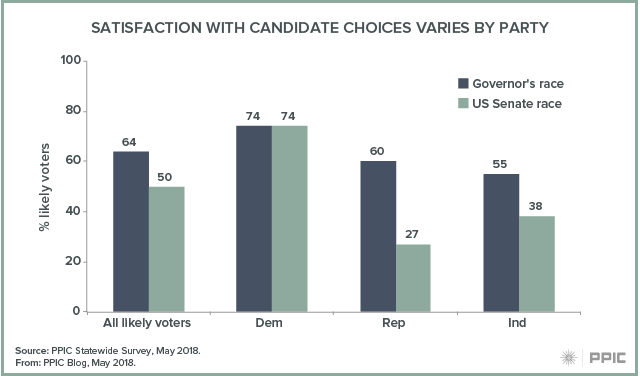
Californians have warmed up to the current gubernatorial contest. The May PPIC Survey finds that likely voters’ interest in news about the gubernatorial candidates has almost doubled since January (30% to 58%). Equal proportions of likely voters across parties are very or fairly closely following election news today (58% Democrats, 61% Republicans, 60% independents). Moreover, likely voters’ satisfaction with the candidate choices has grown since January (54% to 64%)—especially among Republicans, who were the least satisfied earlier this year. Majorities of likely voters across parties are now satisfied with their choices (74% Democrats, 60% Republicans, 55% independents). In addition, more likely voters have found a candidate to support for governor since January (76% to 85%), and by similarly large margins across parties (86% Democrat, 86% Republican, 81% independent) today. Democratic pluralities are favoring Newsom, Republican pluralities are supporting Cox, and independents are dividing their support across two parties and four candidates.

By contrast, we need to look no further than the US Senate primary to foreshadow the impact of a one-party governor’s contest this fall. Democratic US Senator Dianne Feinstein is on the ballot with Democratic California State Senator Kevin de León. There are no major candidates from the Republican ranks in this race. In the May PPIC Survey, likely voters’ satisfaction with senate candidate choices (50%) is much lower than in the governor’s race (64%), with vastly different satisfaction levels across parties (74% Democrat, 27% Republican, 38% independent). More importantly, fewer voters have found a candidate to support in the senate race (64%) than in the governor’s race (85%), and this trend is especially pronounced among the GOP likely voters (87% Democrats, 41% Republicans, 53% independents) today.

The top-two system was created in 2010 to encourage the growing ranks of independent voters to participate in the June primary. Third parties countered that their voters would be shut out of the November election, an outcome that has largely proven true. With the dwindling ranks of Republicans today, another flaw that impacts the two-party system has surfaced—lack of participation from those feeling unrepresented on the ballot. And with deepening partisan divisions in the country, voters cannot be counted on to cross party lines and choose a candidate from outside their ranks. Republicans face an unprecedented obstacle of unknown proportions if a one-party governor’s race depresses their turnout. In the long run, California’s democracy has a bigger problem if many voters are feeling disenfranchised by the top-two primary results and choose not to participate in a statewide election. To fully assess the significance of these issues, PPIC surveys will continue to track voter interest, candidate satisfaction, and ballot choices in this consequential election.

How the Census Affects State Finances

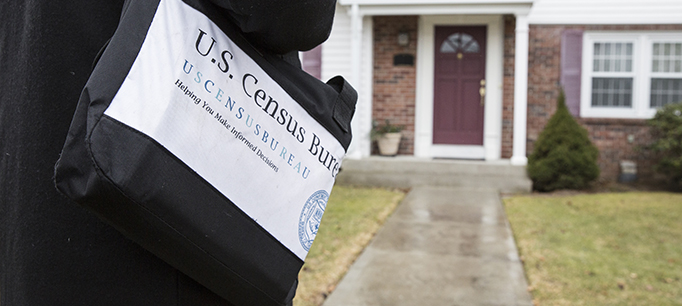
The US Constitution requires a decennial census for the purposes of determining how many seats each state will have in the House of Representatives. Just as critical, a number of federal programs rely on census data to calculate the share of federal dollars distributed to each state. In the case of California, the census-connected funds are big money. Undercounting Californians in the upcoming census could have significant fiscal consequences for the state.

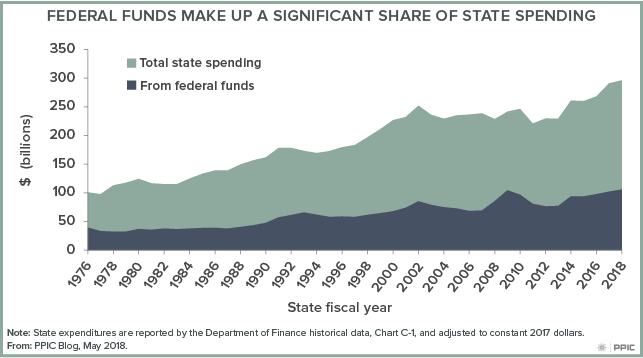
Federal dollars account for more than one-third all state spending (including the general fund, special funds, and bonds). This translates into more than $100 billion in state spending derived from the federal government.

Not all federal programs rely on the census to determine the distribution of dollars, but the vast majority are connected to it in some way. One study estimates that 132 federal programs rely on census data to distribute more than $675 billion. Another estimates the share of census-related funding for the largest programs for each state. For California, that amount was $77 billion, or more than 80 percent of the federal funds the state received in 2015 (the most recent estimate available).

Given the dollars at stake, getting an accurate count of California’s residents is critical—but could be a challenge since large segments of California’s population are historically difficult to count.

But population counts alone do not determine funding, so it is difficult to precisely forecast the impact of an undercount. Compounding the difficulty, the way federal programs use census data to allocate dollars varies, and in some cases, involves other factors such as the relative wealth of the state. For example, a significant share of census-related dollars are determined by a specific federal reimbursement rate. Because California already receives the minimum rate, an undercount would not reduce the amount of federal dollars that the state can count on.

Finally, the use of the census to distribute dollars is, in some cases, a zero-sum-game. For California to avoid “losing” relative to other states, it needs to count as well, or better, than the rest of the country. Other large states—notably Texas and Florida—face similar challenges.

California’s creation of a state committee to ensure an accurate count—along with funding to support such efforts—are crucial to a successful outcome. In fact, a relatively modest investment has the potential to provide enormous returns to the state.

Video: California Primary Preview

In the run-up to California’s June 5 primary, Democrat Gavin Newsom remains the top choice among likely voters in the governor’s race, according to the latest PPIC poll. Republican John Cox is in a close race with Democrat Antonio Villaraigosa to gain the second spot on November’s general election ballot. Senator Dianne Feinstein holds a wide lead over fellow Democrat Kevin de León.

Dean Bonner, PPIC associate survey director, detailed these findings and more at a recent Sacramento briefing.

The survey shows Newsom (25%) leading among likely voters, followed by Cox (19%), Villaraigosa (15%), Republican Travis Allen (11%), and Democrats John Chiang (9%) and Delaine Eastin (6%). Fifteen percent of likely voters are still undecided. Results were similar in an April PPIC poll (26% Newsom, 15% Cox, and 13% Villaraigosa). Cox’s support has more than doubled since the January (7%) PPIC poll.

Other highlights of the survey include:

  • A majority of likely voters (63%) favor Governor Brown’s final budget, and overwhelming majorities like his idea of additional one-time spending on infrastructure, homelessness, and mental health programs.
  • Immigrants are viewed as a benefit to the state by a majority of likely voters (67%) because of their hard work and job skills. The vast majority (80%) favor a way for undocumented immigrants to stay in the US legally—if certain requirements are met.
  • Californians are divided on the motivation of the Russia investigation, but a strong majority of likely voters (74%) think the Russian government tried to influence the outcome of the 2016 presidential election.
  • Californians distrust both the state and federal government—just 18 percent of likely voters say you can trust Washington to do what’s right.

Expanding Groundwater Recharge in San Joaquin Valley Cities

The San Joaquin Valley is ground zero for groundwater management challenges. While agriculture is the region’s predominant water user, its cities are more likely to rely on groundwater as their primary source of water. For this reason, the urban sector will need to play a bigger role in the regional effort to balance groundwater use and replenishment.

Our recent research indicates that cities in the valley lag behind agricultural districts in the intentional recharge of groundwater. That’s primarily because most have limited access to two things necessary for storing more water underground: extra surface water and unpaved land on which to spread it so it can percolate into the ground. But some cities have had success with recharge activities. Here are three methods that can serve as models.

  • Partner with nearby agricultural districts. The city of Tulare relies entirely on groundwater for its potable water supply. It has an agreement with the Tulare Irrigation District (TID) for purchasing surface water, which is delivered to a recharge basin that the city co-owns with TID. The basin’s location allows for the recharged water to flow into the city’s pumping zone, even though the basin itself is not within city boundaries. The cities of Clovis and Fresno have similar recharge partnerships with the Fresno Irrigation District.
  • Partner with off-site groundwater banks. The city of Tracy relies on both surface and groundwater. In years when it doesn’t use its entire surface water allocation, it stores the unused portion in one of Kern County’s formal groundwater banks. Even though Tracy and the water bank are on opposite ends of the valley, a conveyance system allows for easy exchanges of water.
  • Recharge within city boundaries. The city of Bakersfield has rights to Kern River water. The city uses a direct recharge basin located within city boundaries to store some of its Kern River allotment.

Some cities engage in multiple recharging strategies. For example, both Tulare and Fresno operate flood control basins to maximize recharge, and Tracy pumps surplus water directly into a nearby aquifer through an “injection well.”

While these are all innovative models, most are still small-scale in terms of volumes recharged. Given the state’s mandate to balance groundwater use with replenishment by 2040, urban efforts will need to be scaled up as much as possible. Expansion will require better water accounting and basin planning. Cities can raise funds to partner with agricultural districts and undertake recharge projects, but they will need incentives and assurances that they will have access to the stored water.

Another critical step is to map and protect undeveloped urban land that is particularly appropriate for recharge. Cities should take steps to prevent the paving over of suitable soils, and encourage recharge on open space lands not only within city boundaries but also in areas into which they are likely to grow in the future—called their “spheres of influence.” As the figure below shows, suitable soils in these areas are extensive, especially in Kern and the eastern part of the valley.

It’s also important to remember that cities won’t be able to go it alone. In addition to partnerships with agricultural districts, broader local and regional cooperation will be critical for managing groundwater resources in the long run.

New Admission Requirements at the University of California?

The University of California (UC) is considering revising its eligibility standards for admission, focusing on requirements for science education. California changed its K–12 standards in this area five years ago, when the State Board of Education adopted the Next Generation Science Standards (NGSS). UC must decide whether and how to align the NGSS with the a–g requirements—a set of courses students must complete in order to be considered eligible for admission to UC. A change in science requirements was proposed by the UC Board of Admissions and Relations with Schools and was approved by the UC Academic Senate earlier this year.

The NGSS has profound implications for science curriculum and instruction in high schools. Currently, to meet the a–g requirements, students must take two science courses from three core disciplines: biology, chemistry, and physics. But the NGSS includes four science categories: physical sciences; life sciences; earth and space sciences; and engineering, technology, and applications of science.

Changes approved by the UC Academic Senate include increasing the minimum science requirement from two to three years. UC would continue to require two years of work in at least two of three disciplines: biology, chemistry, and physics. Students may take a third course within these disciplines or in other science disciplines identified by the NGSS.

If the UC Regents vote on and approve the recommendations of the UC Academic Senate, the change will take effect in the fall of 2023—meaning that students entering high school in the 2019–20 school year will be subject to the new requirements. (CSU is in the process of updating its science requirements—which are currently similar to those of UC—and may follow UC’s guidelines.)

Some high schools would need to make changes to align their curriculum with the NGSS. One area of concern is the relatively low number of course-offerings in science among small and rural schools. PPIC’s work has shown that not every high school offered the entire a–g sequence in science in 2016–17; small and rural schools were much less likely to do so. Another area of concern is staffing, as a teacher shortage has left California schools struggling with large class sizes for years. Finally, ensuring awareness of these changes will be important. Parents and students should be informed of the new requirements with adequate time and detail to be able to plan accordingly.

Under NGSS, science course sequencing in high school may affect whether and how students meet the proposed a–g requirements. PPIC researchers are examining early implementation of the NGSS in the K-12 system and will discuss findings in an upcoming report. Moving forward, more research is needed to understand the implications of any new a–g requirements for high school graduates’ eligibility for UC and CSU.

Guaranteeing Transfer Admission to the University of California

Improving transfer from community colleges to four-year universities is an important step in meeting the state’s future workforce needs. In April 2018, the California Community College Chancellor’s Office and the University of California (UC) entered an agreement to guarantee admission to community college students who meet certain qualifications. If sufficient funding and space exist, the guarantee could take effect in fall of 2019.

There are already several pathways for community college students to enroll in UC. For example, all but three campuses (Berkeley, Los Angeles, and San Diego) have a guaranteed admission program for students from certain community colleges. UC has also established academic road maps in 21 majors to help prepare students who plan to apply to transfer. However, completing an academic road map does not guarantee admission.

The new plan would guarantee admission for eligible community college students to a UC campus, but not necessarily to their preferred campus. Specifically, it creates a referral pool—a way to redirect students away from full campuses toward campuses with space. This transfer referral pool would be similar to UC’s referral pool for freshmen. At this time only one campus, UC Merced, accepts applicants from the freshman referral pool. In 2017, thousands of eligible students were redirected to UC Merced, but few actually enrolled.

How might a referral pool work for transfer students? Currently, three campuses—Santa Cruz, Riverside, and Merced—are having a particularly difficult time enrolling sufficient numbers of transfer students. These campuses would need to absorb redirected transfer students. However, it’s not certain that redirected students would enroll, even if offered admission. Right now, many transfer applicants decline their offer of admission to these campuses.

To improve transfer pathways for community college students, UC and the state should consider both expanding capacity at high-demand campuses and exploring ways to encourage students to attend other campuses.

Video: Celebrating 100 Years of Women in the California Legislature

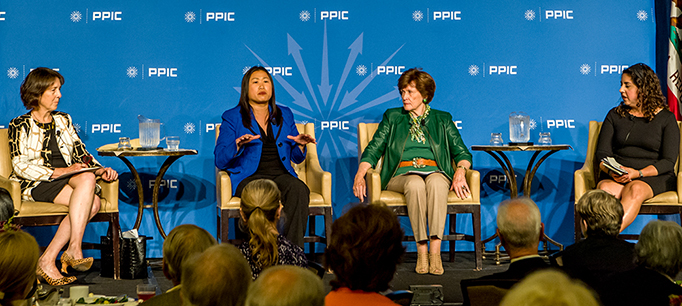
At a recent PPIC event celebrating the centennial year of women in California’s statehouse, female legislators shared stories of how they broke through the political glass ceiling.

The session opened with a conversation between Toni Atkins, the first woman and first openly LGBTQ leader of the state senate, and Mark Baldassare, president and CEO of PPIC. Their talk ranged from the professional to the personal.

Atkins listed her top legislative priorities as emergency services and disaster preparedness. It’s a “new normal” we have to grapple with, she added. Atkins also wants to continue her focus on housing and homelessness, which she called a “humanitarian crisis.”

When Baldassare asked how the #MeToo movement might change the Sacramento culture, Atkins said change “doesn’t happen overnight” but that she wants “more than anything not to lose this moment, because . . . it may not come again for some time.”

Key to Atkins’s leadership style is to listen well and value other points of view. California has a progressive bent, but in today’s political climate, “we’ve left some voices behind,” she said.

This centennial offers a reminder that women remain underrepresented in the legislature. Although they comprise more than half of California’s likely voters (53%), they make up just 23% of its legislators. A panel of lawmakers discussed that imbalance in a conversation moderated by New York Times correspondent Jennifer Medina.

Becky Morgan, a state senator from 1985 to 1993, recalled setting up the first committee on early childhood. She was also the first female legislator to wear pants on the senate floor. It wasn’t an act of protest—it was simply “a cold January morning,” Morgan said, drawing laughter from the audience.

State senator Janet Nguyen recounted her stint as the first woman to chair the Orange County Board of Supervisors and the first to lead its meetings while pregnant—which “shocked” a few supervisors, she said. Despite the daily challenge of balancing work and family, Nguyen said, “I’m not going to give up family or career. I want both!”

All the panelists agreed that gender diversity was essential to effective state leadership. State senator Nancy Skinner agreed that we need more family-friendly policies in the state, but she emphasized that women should also champion issues related to their areas of expertise—in her case, criminal justice reform and climate change. Her view on women serving in the legislature? “It’s just right,” she argued—which led to sustained applause.

The Yuba Accord: A Model for Water Management

Last week a diverse group of stakeholders celebrated the tenth anniversary of the Lower Yuba River Accord—a historic agreement to improve conditions for the river’s endangered fishes, maintain water supplies for cities and farms, and reduce conflict over competing uses for water. Here at the PPIC Water Policy Center we frequently refer to the Yuba Accord as a model for modern water management in California. Here are three reasons why.

  1. Cooperation: The Yuba Accord happened because parties came together to develop an alternative plan in response to a state order calling for more water to support endangered salmon. By leveraging local management tools—including increased use of groundwater on farms during droughts—the accord has kept even more water in the river for fish than the state called for. This is a great example of how negotiated agreements can get broad buy-in and tap on-the-ground knowledge.
  2. Integration: Integrated water management gets better results by examining all the pieces of the water puzzle together to see how solutions to one problem might affect other areas. The Yuba Accord is a very effective example of this. The accord hinges on the flexibility achieved by managing surface water and groundwater as an integrated system to benefit salmon. But the augmented river flows provide additional benefits in Yuba County and beyond. The accord authorizes flows downstream of the Yuba to be traded to agricultural and urban communities farther south who face shortages during dry years. Moreover, the revenue generated by water trades has helped fund flood protection upgrades in Yuba County—an area facing high flood risk.
  3. Planning ahead: The accord demonstrates the advantages of planning for different hydrologic conditions. Careful work went into deciding how surface water and groundwater would be managed in wet and dry years. This meant that during the 2012–16 drought the Yuba was one of few watersheds in the state that was prepared to weather the extended dry conditions. California needs more such watershed-level plans for managing water for ecosystems before, during, and after droughts.

To be sure, Yuba County stakeholders started out with some advantages: in addition to relatively abundant water supplies, the county has a governance structure that makes integrated water management easier to implement. The Yuba County Water Agency (YCWA) is a county-wide special district whose board consists of county supervisors—local leaders for all county matters, not just for water. YCWA is responsible for both surface water delivery and flood management, and its boundaries overlap with the local groundwater basin. YCWA also had some very committed leaders who wanted to find a creative alternative to a protracted legal battle over flow regulations.

Even so, other California watersheds could adopt the accord’s focus on integrated, cooperative planning. One near-term opportunity lies in the implementation of the Sustainable Groundwater Management Act (SGMA), a state law that requires local water districts to bring their basins into balance but leaves it to the locals to decide how to achieve that goal. Another opportunity lies in improving conditions for fish and wildlife in Central Valley rivers as part of the update to the Water Quality Control Plan for the Bay–Delta. The State Water Board is proposing regulations to increase river flows, but is also inviting parties to propose alternatives that take a more holistic approach. This offers locals a chance to leverage the new groundwater management authorities under SGMA to integrate the management of groundwater and surface water. These kinds of pragmatic, consensus-based approaches can generate long-term solutions to some of the toughest challenges in California water.

Watch a short video about the accord.

Do Californians Support State Action on Immigration?

California became the nation’s first sanctuary state in January, when Governor Jerry Brown signed legislation (SB 54) that limits cooperation by local law enforcement with federal immigration authorities. In March, the US Justice Department announced that it was suing California over three immigration-related laws—including SB 54. Since then, six counties—including San Diego and Orange—and at least 13 cities have voiced opposition to the sanctuary laws, either by passing resolutions or by joining the Justice Department’s lawsuit against California.

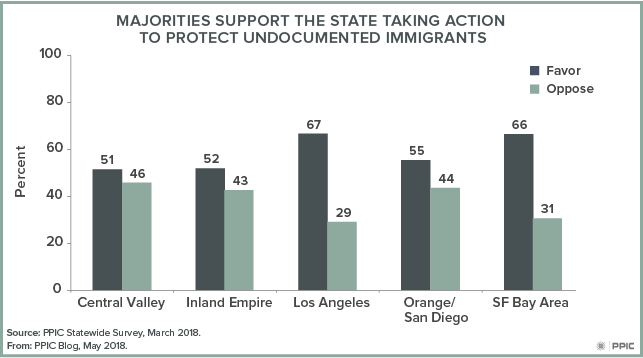
A solid majority of Californians (61%) support the state taking action to protect undocumented immigrants. But there is a stark partisan divide: the March PPIC Statewide Survey found eight in ten Democrats in favor of and eight in ten Republicans opposed to the state taking action. It is notable that there is majority support across the state’s regions. This includes 55% support among residents in Orange and San Diego Counties, home to a majority of the cities opposing the sanctuary laws. About half of residents in the Central Valley and the Inland Empire favor the state taking action. And support is even higher in Los Angeles and the San Francisco Bay Area, where it hovers around two-thirds. There are some differences between coastal (64%) and inland (52%) residents.

Across demographic groups, there is considerable support for state action on this issue—in fact majority support drops below 50% only among whites (47%). Support is highest among Latinos (76%), immigrant residents (73%), those with a high school degree or less (71%), Californians age 18 to 34 (67%), and those living in households making less than $40,000 (67%).

While the courts will ultimately decide the fate of the federal lawsuit, two things are clear: 1) California will continue to chart its own course on issues its leaders care about, and 2) immigration continues to be a topic that divides partisans but unites many other Californians across the state. Stay tuned to PPIC as the Statewide Survey will continue to monitor the opinions of Californians on this important policy issue.