Managing a Non-Native Delta Ecosystem

The Sacramento–San Joaquin Delta has more non-native species than native ones, and its estuary is considered the most invaded in the world. We talked to Jim Cloern—an emeritus scientist with the US Geological Survey and an adjunct fellow at the PPIC Water Policy Center—about this challenge.

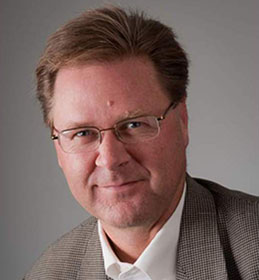
photo – Jim Cloern

PPIC: How have non-native species changed the Delta?

Jim Cloern: The plant and animal communities are very different than they were 50 years ago. There are more than 200 non-native species of animals and plants in the Bay and Delta; all were introduced by people, many in the last half century. Some of these introduced species are relatively low in abundance, but some have emerged as “keystone species.” That means they now play a prominent role in the ecosystem, either by changing processes like food production for fish or by reshaping biological communities.

Probably the best-known example is a non-native clam indigenous to Asia that was first discovered in Suisun Bay in 1986. It was most likely carried across the Pacific in the ballast water of a cargo ship. Prior to this there weren’t any native clams in that part of the estuary; with no competitors, its population exploded. The clams caused a major restructuring of biological communities with their fast consumption of phytoplankton—the food supply for zooplankton, which in turn are an essential food source for young fish. After the clams took off, production at the base of the food web decreased by a factor of five—a major shock to any ecosystem. This has been a contributing factor to the decline of native fish since the 1980s.

There are many other examples of non-native species that have disturbed the Delta. The clam is just the most striking because the changes happened so fast—and have persisted for more than three decades.

Many species were introduced intentionally—for example, the striped bass and large-mouth bass, both of which are now popular sport fisheries. Both prey upon smaller species of fish, including some we’re trying to protect, such as salmon. As juvenile Chinook salmon and steelhead migrate through the Delta to the ocean, they’re preyed upon by these introduced fish species.

Some non-native aquatic plants have caused significant harm to habitat. One is the water hyacinth. Anyone who boats in the Delta in summer runs into sloughs clogged with this floating water plant. It also blocks light below the surface, limiting phytoplankton production. Various efforts have been tried to control it, but they haven’t been effective. So the state now uses herbicides. We don’t know the environmental consequences of spraying these chemicals across the Delta.

Two more problematic non-native species are on the horizon: the freshwater quagga mussel and the nutria, a large rodent from South America. The quagga mussel was introduced in eastern waterways in the 19th century and has been making its way across the country. It’s now in Southern California. As with the clam, it outcompetes zooplankton for their phytoplankton food resource, disrupting food webs that support fish.

Nutria was farmed in the US for fur, and is a major problem in coastal Louisiana and the Chesapeake Bay. It poses a major risk to the Delta—not only for the ecological disturbance it creates, but also because its active burrowing threatens Delta levees already at risk from large storms.

PPIC: Describe how introduced species are affecting management of the Delta.

JC: We respond to ecological disturbance from introduced species with protective regulations and policies. For example, the state has begun a program to inspect boat hulls to make sure they don’t carry the mussel into new waterways. And the clam problem helped motivate California’s Marine Invasive Species Act, which directs commercial ships to either treat ballast water to kill species in it or discharge ballast water at sea. However, the state’s Marine Environmental Protection Division recently reported that the federal government intends to preempt state action on this issue.

But even with new policy efforts, the reality is that non-native species are making it harder to manage at-risk native species and ecosystems already challenged by harmful algal blooms, water diversions, habitat loss, and pollution from nitrogen and other nutrients.

PPIC: What should we do as next steps?

JC: Once a non-native species becomes established it’s very hard to eradicate. So we must try to prevent the introduction of new ones. And once they’ve been found, it’s critical to take urgent action to stop them from becoming established. A few decades ago we were caught off guard by the fast spread and large impacts of species introductions. We’ve learned how critical it is to act quickly, and California is now trying to actively prevent the spread of the quagga mussel, nutria, and other species.

The grand challenge of sustaining native species has turned out to be enormously difficult. That’s because their population losses are the result of many stressors—changing climate, habitat loss, pollution, non-native species, and water diversions. Success requires solutions built from a holistic, ecosystem-based perspective that considers ecological disturbance from introduced species in this broader context.

Two California Leaders Join PPIC Board of Directors

[vc_row][vc_column][vc_column_text]PPIC welcomed two dynamic California leaders to its board yesterday. Each has made exceptional contributions to our state. Together, they bring a wealth of leadership experience, a strong record of public service, and a deep understanding of our unique state. They will be invaluable assets to PPIC as we work to shape a better future for California.

Photo of Karen Skelton

Karen Skelton is founder and president of Skelton Strategies, a boutique political and strategic consulting firm. For more than 30 years, she has worked within the private and public sectors to design campaigns that require political, legal, and communications skills to shape policy. She has experience in a range of subject matters, including a passion for policies focused on climate change, economic equality, and transportation.

Karen has managed some of the most complex and entrepreneurial projects in the nation for presidents, vice presidents, governors, CEOs, and foundations. For almost a decade, she was CEO of The Shriver Reports, a nonprofit media initiative examining seismic societal shifts currently affecting American women and families. She spent about a decade in Washington, DC, working in the Clinton/Gore administration at the White House and the US Departments of Justice and Transportation, and another decade managing a national public affairs firm, building it from scratch with a DC-based partner into a multimillion-dollar business. She holds a BA in English from UCLA, a master’s degree from Harvard’s Kennedy School of Government, and a JD from the UC Berkeley Law School.

Photo of Helen Iris Torres

Helen Iris Torres is CEO of Hispanas Organized for Political Equality (HOPE), where she leads one of the state and nation’s most influential Latina organizations. She has been instrumental in the development and implementation of the HOPE Leadership Institute (HLI), a program that prepares Latinas for their next level of civic participation.

Helen currently serves on the California Latino Economic Institute, a group of business leaders formed to advise the California Latino Caucus. She also serves on the community advisory board for Wells Fargo. Previously, she participated in various commissions under Governor Gray Davis, Governor Arnold Schwarzenegger, and Governor Jerry Brown. She is also a sought-after speaker on women’s issues and an advisor to projects such as The Shriver Report: A Woman’s Nation Changes Everything. She is featured in Life Moments for Women, a book supporting the Women’s Foundation of California. She has been recognized by the Los Angeles Dodgers as a “community hero” and by Hispanics in Philanthropy for advocacy work on behalf of Latinas. Her story was part of a California State University oral and public history exhibit titled “Voces de Liberacion: Latinas in Politics in Southern California.”

PPIC also extends heartfelt thanks to two distinguished long-time board members, Ruben Barrales and Donna Lucas, who are stepping down today. Both provided 12 years of outstanding service, offering exceptional oversight, guidance, and support to the institute. Donna served as board chair for three years of her term, while Ruben contributed to key committees. Both continue to serve on the PPIC Statewide Survey Advisory Committee. We will be forever grateful for their extraordinary efforts on behalf of PPIC.

The current chair of the PPIC board is Steven Merksamer, senior partner in the Northern California law firm of Nielsen Merksamer Parrinello Gross & Leoni LLP. The other board members are myself; María Blanco, executive director of the University of California Immigrant Legal Services Center; Louise Henry Bryson, chair emerita of the Board of Trustees of the J. Paul Getty Trust; A. Marisa Chun, partner at Crowell & Morning LLP; Chet Hewitt, president & CEO of the Sierra Health Foundation; Phil Isenberg, former chair of the Delta Stewardship Council; Mas Masumoto, author and farmer; Leon E. Panetta, chairman of the Panetta Institute for Public Policy; Gerald L. Parsky, chairman of the Aurora Capital Group; Kim Polese, chairman of ClearStreet, Inc.; and Gaddi H. Vasquez, retired senior vice president of government affairs for Edison International and Southern California Edison.[/vc_column_text][/vc_column][/vc_row]

How Are School Districts Spending Their LCFF Dollars?

Since the enactment of the Local Control Funding Formula (LCFF) in 2013–14, funding for K–12 education has risen to record highs. Much of the increase is due to the improved state economy, which has seen nearly a decade of continuous growth and led to dramatic expansions in the state budget. Even so, the LCFF has significantly altered the funding landscape, with the intention of providing more resources to the districts, schools, and students who need them most. Six years in, what can we say about how this system is faring?

Under the LCFF, districts with more high-need students (those who are low income, English Learners, homeless, or foster youth) have seen larger funding increases. Between 2013–14 and 2017–18, high-need districts (those with student populations that are at least 55% high need) increased student spending more than $500 more per-pupil than did lower-need districts (where fewer than 30% of students are high need). Districts with especially large shares of high-need students (80% or 90%) saw an even greater funding increase under the new funding formula.

Are higher-need districts spending differently than lower-need districts? We can address this question by comparing the changes in spending between 2012–13—the year prior to LCFF’s enactment—and 2017–18, the most recent year for which K–12 financial data is available.

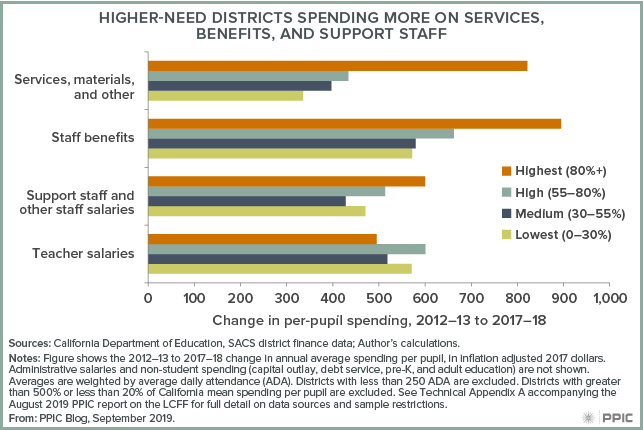
The data reveal two patterns of note. First, despite greater total increases, spending on teacher salaries actually grew more in lowest-need than in the highest-need districts: $570 per student in the lowest-need districts (where fewer than 30% of students are high need) vs $495 in the highest-need districts (where more than 80% of students are high need). Higher-need districts hired more teachers and saw greater reductions in teacher-pupil teacher ratios. However, a greater reliance on novice teachers (whose salaries are lower) reduced the overall spending increase among these districts. Benefits spending also increased by much more in higher-need districts, mainly due to the greater increases in staffing levels.

Second, higher-need districts have been spending more on support staff and other non-teaching staff. They have also spent more on services, materials, and other student spending (excluding capital outlay, debt service, pre-K, and adult education): these expenditures increased by $822 per student in the highest need districts, as opposed to $336 in the lowest need districts. Higher-need districts are most likely attempting to address the additional challenges that higher-need students face outside the classroom. The hope is that these additional services and support staff will translate into improvements in academic performance that will narrow achievement gaps. Research on similar reforms in other states suggests that this approach will eventually pay off.

figure - Higher-need Districts Spending More on Services, Benefits, and Support Staff

Currently, however, concerns are growing about whether additional funding is reaching the highest-need students within districts. Because districts are not required to report their school-level spending publicly, it is difficult to assess how this funding is allocated within a district. However, public staff records and salary schedules do allow us to examine differences in teacher spending across schools in the same district. Such comparisons show that districts tend to spend more on their highest-need schools but that the difference is modest.

Fortunately, federal requirements will soon make more comprehensive school-level spending data available. While we don’t yet know how accurate and comparable it will be, this data will bring new and much-needed transparency to our K–12 finance system.

The Russian River: Managing at the Watershed Level

This is part of a series on issues facing California’s rivers.

Water managers across the state face new and more extreme challenges as the climate warms—from balancing the sometimes conflicting needs of urban, agricultural, and environmental water users to reducing risks from fires, floods, and droughts. We talked to Grant Davis, general manager of the Sonoma County Water Agency, about how his agency is approaching these challenges comprehensively, at the scale of the entire watershed.

photo - Grant Davis

PPIC: In your experience, what does it mean to manage at the watershed level?

Grant Davis: At its core, managing the Russian River watershed requires careful consideration of different land uses, stakeholders, water demands, environmental regulations, and ecosystem needs. We have to balance the competing needs of our 600,000 customers, a number of endangered species, recreational users, and a thriving farm community. In practice, we’ve changed our management considerably over the years. For example, we now intentionally release water from our two major reservoirs to improve estuary and fisheries management, while still meeting water supply needs.

In 2008, we began implementing what is known as a “biological opinion” designed to protect three endangered species—coho, Chinook and steelhead. An important element is restoring habitat on Dry Creek, a major tributary below our major drinking water reservoir. The idea is to slow water released from the reservoir to provide refuge for the fish. In the short run, it will likely make water deliveries harder, but it’s key to operating our system sustainably long term. When complete, we’ll have 6 miles of restored habitat out of a 14-mile stretch. It’s a multi-million-dollar effort—and a major undertaking in cooperation. Our agency has worked very closely with the regulating agencies and private landowners, who granted easements that enabled this restoration to occur.

PPIC: How do you use data sources to help you manage this watershed?

GD: We’re establishing information networks that bring multiple benefits. For example, we’re collaborating with the US Geological Survey on an integrated rainfall and stream gage network, which can help us evaluate whether storms might cause flash floods after fires. The rainfall data also helps with ecosystem management. In a changing climate, rainfall data is the primary input for understanding our watershed.

Since the Tubbs fire, we’ve begun working with more parties to leverage our respective data needs. For example, working with emergency responders, we’ve established a network of fire cameras that inform a text alert system. And working with PG&E, we’re looking at installing equipment to forecast atmospheric rivers and fire weather at the same weather stations.

It’s also critical that we use science to better understand atmospheric rivers, which will in turn allow us to better manage reservoirs as the climate warms. These large storms contribute to most flooding in California, and up to 95% of floods in our watershed. And the lack of atmospheric rivers leads to drought. We’re now working with the US Army Corps of Engineers, NOAA (the National Oceanic and Atmospheric Administration), the Scripps Institute of Oceanography, the Department of Water Resources, and other colleagues to study this phenomenon. Together, we’re developing a joint project that uses improved forecasting of atmospheric rivers to better manage water releases from reservoirs. We’ve built a coalition with other water agencies—including those in Orange County, Turlock, and Yuba—that are interested in exploring these same issues in their rivers. Data from the project will help us improve how we manage water supply, floods, and the environment.

PPIC: Talk about how the interaction between surface water and groundwater has affected Russian River water management.

GD: Our watershed is ground zero for efforts to understand the links between groundwater and surface water, and to better manage both together. In 2014, Mark West Creek was selected as one of five priority creeks as part of the California Water Action Plan. The creek goes through a depleted groundwater basin, which has affected its flows. The Department of Fish and Wildlife is now developing recommended flow levels to protect and restore the creek’s critical habitat. The project will also quantify human needs within the watershed.

In places like Mark West Creek, groundwater recharge can play a critical role in addressing the “timing divide” for maintaining freshwater fisheries—because the question is not always whether water is available, but when it’s available. A pilot project in the town of Sonoma will use Russian River surface water in wet winters to recharge the aquifer. We can then pump it when it’s needed in dry summer months for critical uses.

Thanks to Jay Jasperse and Carlos Diaz, both of the Sonoma County Water Agency, for their contributions to this article.

Most Californians Favor Requiring Vaccinations

The United States is currently experiencing its worst measles outbreak in more than 20 years, with more than 1,234 people diagnosed with the disease this year—including 67 cases in California. One of the year’s most contentious bills, Senate Bill (SB) 276 addresses this issue by establishing stronger standardization and oversight of medical exemptions from vaccines. (In 2015, California was the first state to repeal religious and personal belief exemptions.) Approved by the assembly and senate and awaiting the governor’s signature, the bill has attracted numerous protests in Sacramento. With public health concerns on one hand and parental choice on the other, how do Californians view vaccinations?

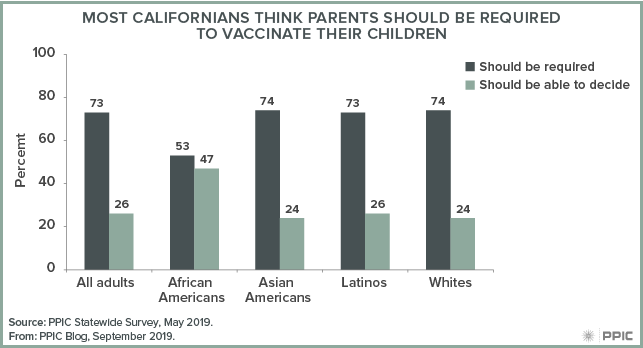
In PPIC’s May Statewide Survey, an overwhelming majority of Californians (73%) said parents should be required to vaccinate their children for diseases like measles, mumps, and rubella. This view is held by at least seven in ten across genders, political parties, and those with and without children in the household. Majorities across demographic groups and regions say vaccinations should be required, as do about three in four Asian Americans, whites, and Latinos—compared to 53 percent of African Americans.

figure - Most Californians Think Parents Should Be Required To Vaccinate Their Children

Vaccine safety has been an ongoing matter of concern, despite assurances from the scientific community. Today, nearly all Californians say that the vaccines given to children are safe (62% very, 27% somewhat). The share that say vaccines are very safe is held by strong majorities across parties, as well as majorities across regions and demographic groups. Notably, among Californians who say parents should be able to decide whether or not to vaccinate their children, 73% say vaccines are safe.

At the same time, eight in ten residents are concerned that measles outbreaks will become more widespread (43% very, 36% somewhat). This view is held by majorities of Californians, although the share who say they are very concerned is higher among older Californians than younger Californians (48% to 34%) and among women than men (48% to 38%).

Even as most Californians support vaccination requirements—and worry about public heath—the discussion around SB 276 remains volatile. PPIC will continue to monitor public opinion as this important issue unfolds.

Predicting California’s Economic Health

After a record expansion, recent signs suggest the nation’s economy may be softening. Unusual patterns in the bond market, signs of slower growth overseas, and the uncertainty of the ongoing trade conflict with China have all raised fears that a downturn may be on the horizon. Yet it is still unclear whether the country is actually headed for a recession. Moreover, all these signs focus on the United States as a whole (or even the whole world). It would be helpful to have more signs for the California economy in particular.

The PPIC Statewide Survey can offer one such sign. The survey has amassed an enormous amount of data on Californians’ views of the economy. For more than 20 years, it has asked survey participants whether they think California will have good or bad economic times in the next 12 months. This question was adapted from the University of Michigan Index of Consumer Sentiment and has been asked of everyone: rich and poor, politically engaged and disaffected, citizen and non-citizen.

Given the broad scope of the survey, in the aggregate these respondents may be good at predicting the direction of the economy. They see what everyone else sees on the news, but they can also report on their own private circumstances and those of close friends and relatives. This might pick up on information that has not yet emerged in official statistics. Indeed, when we look at survey responses alongside recent recessions, an interesting pattern emerges.

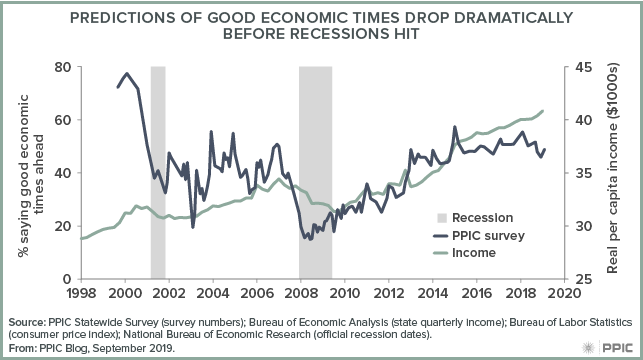
The figure below shows the share of survey respondents who have predicted good economic times for California, and plots it against the state’s per capita income and the periods officially labeled recessions. PPIC respondents appear to have anticipated the last two downturns. The share expecting a good economy plunged a few months in advance of each recession and a slide in state incomes. The drop happened a couple months before the 2001 recession, but as much as nine months before the Great Recession.

figure - Predictions of Good Economic Times Drop Dramatically Before Recession Hit

What do the numbers tell us today? The last few surveys have seen a slight drop in the share expecting good times, but the shift hasn’t yet matched the magnitude seen before the last two recessions. At this point the trend is ambiguous, but well worth watching. It can supplement other California-specific information such as the State Fiscal Health Index from the Legislative Analyst’s Office, but a few months earlier. A sharp and sustained drop in Californians’ optimism about the economy may signal dark storm clouds on the horizon.

Integrating California’s Education Data

[vc_row][vc_column][vc_column_text]California needs an integrated data system that connects pieces of the education pipeline that are currently maintained separately.  An integrated system could perform a variety of critical functions and reach a diverse audience of stakeholders. For example, it could provide feedback to educational institutions on student outcomes, even after students graduate. It could also encourage better planning and coordination between educational sectors, increase the state’s ability to evaluate educational programs and policies, and provide students and families with better information about successful educational and workforce pathways.

The state has recently invested $10 million toward planning for this type of system, establishing the California Cradle to Career Data Systems Working Group to “recommend data system structural components, processes, and options” and to “advise ongoing efforts to develop, administer, and enhance the data system” (per Senate Bill 75).

The Public Policy Institute of California has also been focused on this issue, facilitating a group of research and policy organizations interested in the establishment of an integrated student data system in the state. Known as the California Education Data Collaborative, this group has met regularly throughout this year to discuss the opportunities and challenges associated with advancing education through connected data.[/vc_column_text][/vc_column][/vc_row][vc_row][vc_column width=”1/2″][vc_column_text]

The collaborative’s activities are designed to build knowledge and skills among diverse stakeholders involved in improving access, equity, and success across California’s educational systems. As a collaborative, we have engaged with national experts, leaders in successful data systems from other states, policymakers from California, and those with experience in working for an integrated data system in California.

As the state’s California Cradle to Career Data Systems Working Group takes shape, the collaborative is working to:

  • Engage with stakeholders—including students, parents, educators, and institutions—about how to implement a data system that best serves them.
  • Connect with policymakers to ensure that the data system answers critical questions about policies and programs to foster student success.
  • Provide research and advice on how to construct a system that will improve California’s education systems.
  • Examine issues of privacy and security to ensure confidentiality of student records.

[/vc_column_text][/vc_column][vc_column width=”1/2″][vc_column_text css=”.vc_custom_1567624867972{padding-top: 20px !important;padding-right: 20px !important;padding-bottom: 20px !important;padding-left: 30px !important;background-color: #384763 !important;border-radius: 4px !important;}”]

PPIC’s California Education Data Collaborative

California Competes
California College Guidance Initiative
California EDGE Coalition
California Policy Lab
Cal-PASS Plus
The Campaign for College Opportunity
Children Now
CORE Districts
Education Insights Center
The Education Trust- West
First 5 LA
Policy Analysis for California Education
Public Advocates
Public Policy Institute of California
Strategic Education Services
The Institute for College Access and Success
WestEd
[/vc_column_text][/vc_column][/vc_row][vc_row][vc_column][vc_column_text]Establishing an integrated, longitudinal student data system will take a multifaceted, sustained approach. In the long run, the value of this system will lie in the policy questions that can be asked—and answered with confidence—and the ability of practitioners, students, and families to access information that helps them make informed choices. To assess reforms accurately and comprehensively will require strong partnerships, clear long-term planning, identified goals—and good data.[/vc_column_text][/vc_column][/vc_row]

A California Dream: Less Plastic in the Ocean

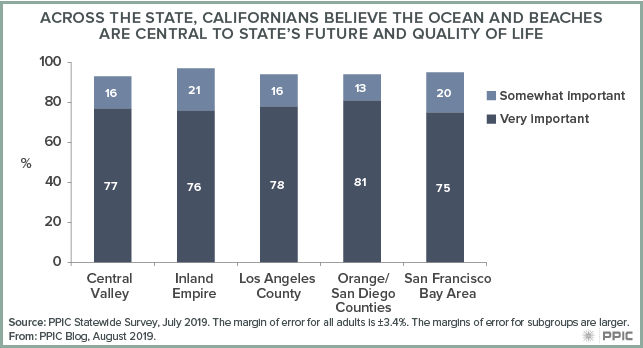
Friday is National Beach Day—an easy day to celebrate in California. The Golden State’s love of beaches is legendary, and as it happens it’s a legend backed by data. The latest PPIC environment survey found that three in four Californians (77%) say the condition of the ocean and beaches is very important to the state’s future economy and quality of life.

figure - Life

Californians are very concerned about a number of threats to their marine environment—including sea level rise, overfishing, and plastic pollution. Overwhelming majorities view plastic and marine debris as a big problem (72%) or somewhat of a problem (18%). Across age, education, income, and racial/ethnic groups, solid majorities say this is a big problem.

figure - Most Californians Say Plastic and Marine Debris along the Coast Closest to Them Are a Problem

The debris comes from diffuse sources. The California Coastal Commission reports that 80% of marine debris comes from land-based sources, such as litter that washes from land to the sea. Rain carries plastic litter of all sizes into the ocean through urban creeks and storm drains.

A growing concern is microplastics, debris that is too small to be caught by existing filters at wastewater treatment plants. This debris can come from personal care products rinsed down drains and synthetic fibers from laundered clothing. It can also come from larger pieces of plastic that end up in the ocean and break down. The most notorious example of this is the Great Pacific Garbage Patch, the eastern part of which is between California and Hawaii.

The problem is particularly acute in California. The San Francisco Estuary Institute reports that San Francisco Bay appears to have more microplastic pollution than other major water bodies in the US. A study by the Monterey Bay Aquarium Research Institute found that Monterey Bay also has high concentrations of microplastics. And scientists are now reporting that microplastics have been detected in Lake Tahoe for the first time, demonstrating the reach of the problem. Plastic is a problem across California’s waters.

Legislators are taking notice, with several bills currently aimed at tackling this issue. The goals are ambitious—for example, Senator Ben Allen and Assemblywomen Lorena Gonzales, both representing coastal areas of the state, have proposed bills that would slash single-use plastic waste in California by 75% by 2030.

While the outcome of such efforts remain to be seen, Californians’ concern about this problem—and their love of the ocean—is sure to drive momentum in the search for solutions.


Democrats View Environmental Policy as Critical in Upcoming Primary

Climate change is becoming a defining issue for voters in next year’s presidential election. According to PPIC’s latest statewide survey on the environment, record-high shares of Californians are concerned about the impacts of global warming, overwhelming majorities disapprove of the way President Trump is handling environmental issues, and most likely voters say presidential candidates’ positions on the environment are important in determining their vote next year.

With California’s presidential primary a little more than six months away, eight in ten likely voters say that the candidates’ positions on the environment are important (44% very, 36% somewhat) in determining their vote. Democratic likely voters (64%) are far more likely than independents (34%) and Republicans (20%) to say candidates’ positions on the environment are very important. In addition to partisan divisions, there are significant generational differences—even within parties, Democratic likely voters age 18 to 44 (76%) are much more likely than those age 45 and older (58%) to say candidates’ environmental positions are very important.

With the environment critical for many Democrats, especially younger voters, whom do they support in the 2020 presidential primary? Among likely voters who are registered Democrats or are Democratic-leaning independents, and who say candidates’ environmental positions are very important, support is greatest for Kamala Harris (19%), Elizabeth Warren (18%), Bernie Sanders (12%), and Joe Biden (11%). (Candidates mentioned are those who polled 10% or higher). Notably, nearly a quarter (24%) of those who say the environment is very important are currently undecided. Here, too, there are differences across age groups. Likely voters age 18 to 44 concerned about the environment name Warren (23%), Sanders (20%), and Harris (15%) as their top primary choices, while those age 45 and older name Harris (22%), Biden (16%), and Warren (15%).

When asked about the Green New Deal, a policy proposal in Congress that aims to address climate change and stimulate economic growth, three in four likely voters who are registered Democrats or are Democratic-leaning independents say that candidates’ positions on the proposal are important in determining their vote (35% very, 39% somewhat). Among those who say positions on the Green New Deal are very important, 20% name Harris and Warren, 14% name Sanders, and 10% name Biden as their preferred candidate. Again of note, 20% of voters who say this is very important are undecided. Likely voters age 18 to 44 interested in the Green New Deal support Warren (27%), Sanders (24%), and Harris (15%), while among those age 45 and older support is greatest for Harris (24%), Warren (16%), and Biden (15%).

figure - Candidates’ Environmental Policies Matter to Democratic Likely Voters

These findings suggest that Californians will place high importance on environmental issues when making choices at the ballot in the coming year. With the next Democratic presidential debate and climate crisis town hall less than a month away, PPIC will be closely tracking the role of climate policies and other salient issues.


Video: A Conversation with Assembly Speaker Anthony Rendon

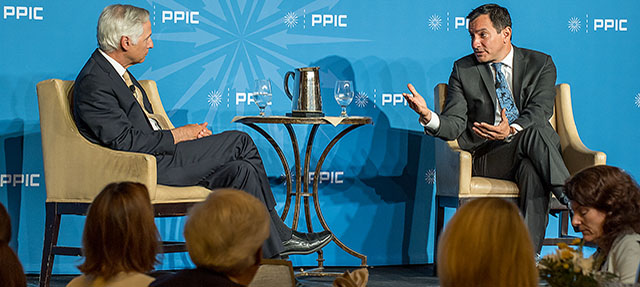
When Anthony Rendon was elected to the California State Assembly in 2012, he thought he would focus on early childhood education. “I came to Sacramento after working in early childhood education for 20 years . . . probably thinking that I would work on that.” However, he continued, “You come here and you realize the extent to which all of these issues impact one another. I think it’s dangerous to isolate any single issues.”

As he noted in his conversation with PPIC’s Mark Baldassare last Thursday, Rendon has focused on many individual measures in this legislative session, including a recently signed bill to modify the criteria for police use of deadly force and a bill to address predatory lending. In the wake of the Gilroy shooting, he has also prioritized a package of gun control bills. He sees these measures as part of a broader focus on improving opportunity for all Californians.

Rendon became Speaker in 2016, when Jerry Brown was governor. At first, he found working with Brown to be “a little frustrating,” but “eventually, we did a lot together. . . . There was a very narrow focus, two or three things—criminal justice reform, climate change, but that was about it. Those are still the things he cares about.” Governor Newsom focuses on a wider range of issues. And, Rendon said, “He’s also more sort of open-ended. He’ll come in and say, ‘Hey, housing, what do you think?’”

One of the issues Newsom cares about is early childhood education—which is still a major priority for Rendon. While Brown “helped us to start down the path” to reinvesting in this area, “now we have a governor who believes that . . . it has a positive impact on families and communities and children.” Newsom’s belief translated into significant funding increases for early childhood education in this year’s budget. “The budget was phenomenal,” said Rendon. Early childhood education is particularly important, in his view, because it’s “not trying to fix something that’s already broken. It’s a way of addressing issues early on, it’s a way of breaking the cycle of poverty.”

Although the Democratic Party controls both the governor’s office and the legislature, Rendon believes it’s important to work with Republicans whenever possible. He sees some common ground on issues such as climate change and education—“the real issues that really impact Californians.” More generally, it is important that state leaders represent all Californians: “I want to be able to tell people . . . ‘I’m working for you.’”