Preparing California’s Rivers for a Changing Climate

This is part of a series on issues facing California’s rivers.

California’s rivers and streams have experienced enormous changes over the past 150 years, and a warming climate brings new challenges. We talked to Ted Grantham—a river scientist at UC Berkeley and a member of the PPIC Water Policy Center research network—about the state of the state’s rivers. Grantham was recently appointed as the first PPIC CalTrout Ecosystem Fellow. Thanks to the donors that helped us launch this program: Gary Arabian, the Morgan Family Foundation, Nick Graves, John Osterweis, and the Rosenberg Ach Foundation.
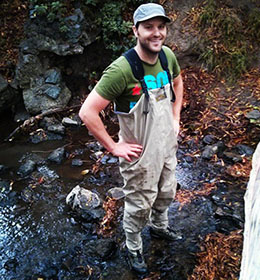
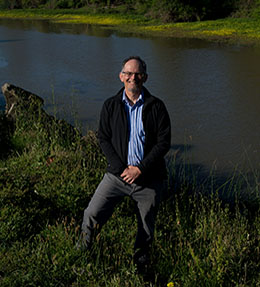
photo - Ted Grantham

PPIC: Talk about the changes affecting California’s rivers and streams.

Ted Grantham: California’s rivers and streams have experienced so much change since European settlement that they’re considered “novel ecosystems.” Gold mining and logging brought a massive amount of sediment into rivers. Riparian forests that lined Central Valley rivers and extensive wetlands on the valley floor have mostly been converted to farming. Non-native species have been introduced to most of California’s rivers, lakes, and estuaries, which prey upon or compete with native species. Urban rivers across the state have been channelized. And essentially every major river and stream in the state is impacted by a dam. Dams aren’t just barriers to migratory fish, they also alter downstream flows.

We’ve also prevented rivers from being able to move. Rivers are not static features; when given the opportunity, they will dynamically respond to changes in climate. This dynamism is inherent to how rivers work—it’s how habitat is created and maintained for many species. And it’s what makes these systems resilient over time.

Given all these fundamental changes, it’s remarkable that most of the state’s native fish species are still with us, although many are at risk of extinction.

PPIC: How are the state’s rivers expected to respond to climate change?

TG: The most direct change is increasing temperatures. Our rivers and streams will continue to heat up in a warming climate. Even if average precipitation stays the same, we’ll also experience more extremes, with both drought years and wet years more likely to occur. While increasing floods pose risks to some river ecosystems, it’s drought we’re most concerned about. Drought not only reduces the amount of water available for the environment, it also intensifies competition with other water users, making it harder to protect freshwater ecosystems.

Climate change is particularly problematic for cold-water fish such as salmon. In the short term, large dams have the potential to limit warming to some degree because they hold reserves of cold water. For example, Shasta Dam is managed to sustain salmon populations downstream through cold-water releases. But if water gets too warm over time, our ability to sustain cold-water reserves in the reservoir will decline. In the long term, redesigning dams to allow for fish passage or strategically removing dams will give salmon access to cold water in higher elevation streams.

PPIC: How can we prepare rivers for a changing climate?

TG: There are several promising management strategies that are gaining traction and could help build climate resilience in our rivers. Two important ones are securing environmental flows and restoring floodplains.

“Environmental flows” refers to the quantity, quality, and timing of water needed to maintain healthy rivers and ecosystem services that people rely on. In the past, little consideration was given to water needs of the environment. But that is changing and we’re seeing a growing effort to establish legally protected water allocations for environmental benefits. For example, I’m currently involved in the California Environmental Flows Framework, a program to support the development of environmental flow standards in rivers and streams throughout the state.

We’re also seeing more interest in multi-benefit approaches to floodplain management. Most of California’s rivers are disconnected from their floodplains, which have been converted to agriculture and urban uses. This has had huge impacts on fish populations and other species. As the likelihood of extreme floods increases with climate change, reconnecting floodplains is a cost-effective way to reduce flood risk. What’s exciting is that floodplain restoration can be compatible with agriculture and can also provide productive habitats. For example, the Yolo Bypass is primarily managed to protect Sacramento from flooding, but it also supports seasonal agriculture and habitat for birds and fish. Bringing water back to our floodplains can even help replenish groundwater, which is a critical water source in drought years.

The Associate Degree for Transfer May Help CSU Meet 2025 Goals

Students enrolling at the California State University (CSU) as a part of the Associate Degree for Transfer program (ADT) make up a growing share of all CSU transfers—and they are graduating more quickly than other transfer students. The program awards associate degrees and guarantees admission to a CSU campus to community college students who earn at least 60 of the 120 units needed for a bachelor’s degree in a specific major. The ADT aims to cut the amount of time-and red tape it takes to transfer to CSU and graduate with a bachelor’s degree.

Since its inception in 2011, the program has grown rapidly. In 2018, 41% of community college transfers to CSU had an associate degree for transfer, though not all of them started out on an ADT pathway. The number of students who do enter CSU on an ADT pathway has increased tenfold, from 1,089 in 2013 to 10,917 in 2018, and ADT pathway enrollees now account for about one in five transfers to CSU. Currently, the program encompasses more than 30 majors, though offerings vary by community college and CSU campus.

While students who transfer to CSU are generally very likely to graduate, the three-year graduation rate for ADT transfers are 10 percentage points higher than the rate for all transfer students (79% vs. 69%). But about half of students enrolling In an ADT pathway graduate in just two years, which is 16 percentage points better than the overall average for transfers (35%). This suggests that reducing students’ time to degree might be the program’s most notable advantage.

figure - Associate Degree for Transfer (ADT) Students Graduate More Quickly Than Their Peers

The CSU Graduation Initiative 2025 aims to bring two-year graduation rates up to 45% by 2025. Recent experience indicates that the expansion of the ADT could prove helpful: CSU’s two-year graduation rate increased from 31% to 35% from 2013 to 2015, as the share of students on an ADT pathway went from 2% to 12%. Given that one in five transfer students in 2018 were on an ADT pathway, we could see a record number of transfer students graduating in just two years, saving themselves time and money and helping CSU make progress toward its goal.


Video: School Resources and the Local Control Funding Formula

The Local Control Funding Formula (LCFF) was enacted in 2013-14 with three major goals: to simplify California’s K–12 school finance system, increase local control over spending, and provide additional funding to districts with large shares of high-need students—those who are low income, English Learners, homeless, and/or foster youth. At a lunchtime event in Sacramento last Thursday, PPIC researcher Julien Lafortune shared key findings from a new report that looks at increased spending under the LCFF. Then, a panel of experts offered state and local perspectives on the successes and challenges of directing funding to high-need students.

The PPIC report offers new statewide evidence on how school resources have been affected by LCFF; it also examines the extent to which these resources are reaching the highest-need students. It finds that LCFF funding is, for the most part, reaching the high-need students for whom it was intended. But the funding formula imperfectly targets high-need students in lower-need districts.

Kent Kern, superintendent of schools for the San Juan Unified School District, highlighted the challenges of serving high-need students in a district with wide disparities across schools. At 54.5%, his district’s share of high-need students is just below the LCFF’s “high need” funding threshold; however, 19 of its 64 schools have shares of high-need students that are 80% or above. “One of my schools that’s actually at the 99th percentile is a mile away from a school in another district. If we received the same funding as that district got, [our] school would be generating $1.4 million more.”

Not surprisingly, Kern would welcome a change to the LCFF that could benefit the high-need students in his district: “I think there would be some threshold that would allow schools with high-need concentrations to get more money.”

From a statewide perspective, however, the LCFF’s district-level approach is important. Michael Kirst, professor emeritus at Stanford and a key LCFF architect, emphasized the importance of providing additional funding to districts with the highest concentrations of need, to help them address particularly difficult educational challenges: “I would continue to support the theory of concentration, though I realize there are tradeoffs.” Samantha Tran, senior managing director at Children Now, pointed out that when the LCFF was being developed, many stakeholders were concerned that a school-level funding model could create perverse incentives: “If a border line could be drawn that allows for deeper concentration that draws down more state dollars . . . that is not the policy we want in place. We don’t want to perpetuate segregation.”

Asked what they would change about the LCFF, Kirst and Tran agreed on the need for more money as well as greater transparency on spending. Kirst noted that “it takes more than money” to retain teachers and improve student outcomes, but there are clear links between spending and achievement. And Tran said that while she has “no interest in bean counting,” the state needs a clearer understanding of trends in spending and outcomes.

From both the state and the local perspective, the LCFF has been successful in focusing attention on high-need students. As Tran put it, “We’re actually having a conversation about high-need schools . . . that’s a success.” One of the biggest challenges, from Kern’s perspective, is that people expect “too much change too fast. . . . I think we just need to stay the course.”


New Federal Data Sheds Light on Student Debt in California

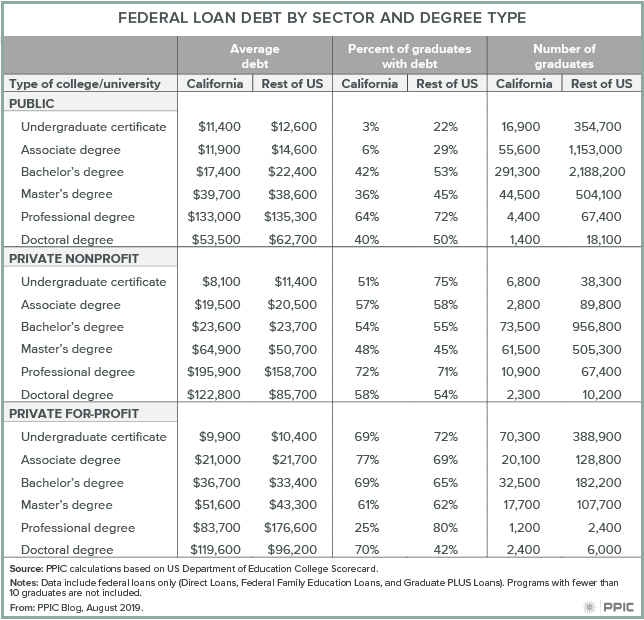
For the first time ever, the federal government has released data on loan debt for college graduates by type of degree and field of study. The data includes federal loans from three programs (Direct Loans, Federal Family Education Loans, and Graduate PLUS Loans) for students graduating in 2014–15 and 2015–16. This release is especially timely in light of national discussions about the cost of college–with some Democratic presidential candidates arguing for debt-free college and loan forgiveness. In just those two academic years, more than 300,000 Californians graduated from college (with degrees ranging from PhDs to vocational certificates) with debt. The total amount of federal debt among those graduates exceeded $10 billion.

Some of the findings from the recently released data are not surprising. For example, undergraduates at public colleges and universities in California are less likely to take on debt than their peers in the rest of the country. And when students in California do take on debt, the amounts tend to be lower. Federal loan debt for Californians earning bachelor’s degrees at UC and CSU averages $5,000 less than at public universities in the rest of the country ($17,400 versus $22,400). And undergraduates in California are less likely to take out federal loans (42%) than their peers in the rest of the country (53%). Only 6% of associate degree holders from the state’s community colleges have federal loans, compared to 29% of public community college graduates in the rest of the country. Students at California’s public colleges and universities are also less likely than their counterparts at the state’s private institutions to take on debt, and those who do take out loans graduate with less debt.

Other findings are striking. In California and the rest of the nation, graduate students tend to have far higher loan amounts than undergraduates, with professional degree holders incurring the most debt—generally well over $100,000. The most common professional degrees are in law, medicine, and dentistry. Graduates of professional schools at private nonprofits in California incur the most federal loan debt—almost $200,000. In general, graduate students at California’s public universities are less likely to take on debt, and their loan amounts are lower than those for students at private colleges. Even so, graduate students at public institutions are incurring large amounts of debt.

table - Federal Loan Debt by Sector and Degree Type

Large debt levels among graduate students reflect higher tuition for many programs. For example, tuition and fees at UC Berkeley’s law school are almost $60,000 for 2019–20, compared to less than $20,000 for academic graduate programs such as English. High demand for many graduate professional programs coupled with expectations of earnings premiums account for both the higher tuition and students’ willingness to take on debt.

Policies to address student debt must be mindful of which students take on debt, the range of institutions and areas of study, and the ability of students to pay back their debt. These are critical concerns in putting college graduates on the path to economic mobility and long-term financial security.

Californians Favor Stronger Efforts to Reduce Greenhouse Gas Emissions

Last month, California officials reached a groundbreaking deal with four major auto manufacturers to toughen greenhouse gas emissions. According to PPIC’s latest survey, an overwhelming majority of Californians (75% adults, 76% likely voters) favor requiring all automakers to reduce the emissions of greenhouse gases from new cars. Californians express strong support for other efforts to reduce emissions as well.

The new emissions standards are more stringent than those proposed by the Trump administration and counter the administration’s efforts to restrict states’ ability to set emissions guidelines. Under the agreement, automakers will increase the fuel economy of their new vehicles by improving fuel efficiency and selling more electric vehicles and hybrids. While the stricter standards only apply to California, the automakers said the agreement is meant to show general support for a national emissions standard.

While most Californians favor requiring automakers to reduce emissions from new cars, support is slightly lower than it was when we first asked this question in 2002 (81% adults, 79% likely voters). Today, Democrats (90%) are much more likely than independents (73%) and Republicans (49%) to favor this policy. Strong majorities (at least seven in ten) across regions and demographic groups are in favor.

A strong majority of Californians (74%, 68% likely voters) also express support for encouraging local governments to change land use and transportation planning so that people can drive less. Support has declined somewhat since this question was first asked in July 2008 (81% adults, 79% likely voters). Today, Democrats (87%) are nearly twice as likely as Republicans (45%) to favor the proposal, and three in four (75%) independents express support. Majorities across racial/ethnic groups are in favor, but Asian Americans, Latinos, and African Americans express the highest levels of support. Strong majorities across regions favor the proposal.

figure - Strong Majorities across Racial/Ethnic Groups Favor Efforts to Reduce Emissions

While three in four Californians favor these specific policy approaches, slightly fewer adults (67%) and likely voters (63%) support Senate Bill 32, the state law requiring California to reduce its greenhouse gas emissions to 40% below 1990 levels by 2030. Although partisans are deeply divided, majorities across regions and demographic groups are in favor, with Asian Americans (77%), San Francisco Bay Area residents (76%), and college graduates (76%) expressing the strongest support.

figure - Partisans are Divided on the Reduction of Greenhouse Gas Emissions Required by SB 32

Earlier this year, Senator Scott Wiener introduced legislation (Senate Bill 50) that would require local governments to change zoning for new developments from single-family to multi-family housing near transit and jobs centers—one goal of the bill is to encourage less driving. In our May survey, 62% of Californians (57% likely voters) favored this proposal. Although the bill failed to advance out of a key committee, it is likely to be reconsidered in the 2020 legislative session.

As California’s leaders continue to pursue a variety of climate change and energy policies, PPIC will monitor emerging legislation on greenhouse gas emissions as well as the views of Californians on these proposals.

Video: Californians and the Environment

In the wake of the devastating wildfires over the past few years, a record-high share of Californians are very concerned about wildfires becoming more severe as a result of global warming, and majorities support the newly established wildfire insurance fund. At a lunchtime briefing in Sacramento last Thursday, PPIC researcher Alyssa Dykman outlined these and other key findings from the latest statewide survey.

Eight in ten likely voters see environmental issues as very important in the 2020 presidential election. With the California presidential primary seven months away, Kamala Harris (19%), Elizabeth Warren (15%), Bernie Sanders (12%), and Joe Biden (11%) have the highest levels of support among Democratic and Democratic-leaning likely voters; a quarter of these voters are unsure about how they will vote.

More than half of Californians see the state’s leadership on climate change as very important, and majorities support state and federal efforts to address climate change—from renewable energy to land-use and transportation planning that reduces greenhouse gas emissions.

Other survey highlights:

  • Two in three Californians oppose allowing more oil drilling off the coast; seven in ten support offshore wind power and wave energy projects.
  • Majorities view pollution of drinking water as a more serious problem in low-income communities and support the state’s creation of a clean drinking water fund.
  • Many Californians value ocean and beach conditions and say plastics and marine debris are a big problem.
  • There are wide partisan differences on climate change and what the state should do about it.


Record-High Share of Californians Worried about Climate-Fueled Wildfires

Two devastating wildfire seasons have put Californians on edge about future fire risk. Their concern is reflected in PPIC’s latest Californians and the Environment survey.

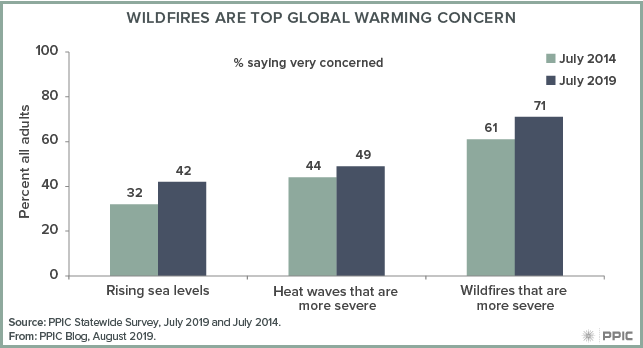
A record-high share of Californians (71%) report that they are concerned about wildfires becoming more severe as a result of global warming. This is an increase of 15 points since 2011 and 9 points since 2018. Concern over climate-fueled wildfires is significantly higher than concern about other potential global-warming impacts—this year it’s 29 points higher than concern over rising seas, and 22 points more than concern over worsening heat waves.

figure - Wildfires Are Top Global Warming Concern

About six in ten Californians (63%) say that global warming has contributed to recent wildfires, a share that has remained steady in recent years. Today, residents of Los Angeles (71%) and the San Francisco Bay Area (69%) are the most likely to hold this view.

Overwhelming majorities of Democrats (85%) and independents (70%), and about half of Republicans (45%), say they are very concerned about more-severe wildfires. Women (77%) are more likely than men (65%)—and young Californians (78% age 18 to 34) are more likely than older residents (66% age 55 and older)—to hold this view.

Back-to-back years of destructive wildfires brought attention to a lack of funding for post-fire recovery, especially following the Camp Fire, when PG&E faced record-high wildfire liabilities and filed for bankruptcy protection. Governor Newsom recently signed into law a $21 billion wildfire fund that will reimburse investor-owned utilities for payments they make to victims of wildfires caused by their equipment. The fund will be paid for evenly by utility investors and ratepayers.

PPIC’s survey found that the governor’s wildfire fund is favored by a majority of Californians (57%). Support is much higher in the San Francisco Bay Area (67%) than elsewhere. The plan is also popular among minority groups, with 73% of African Americans and 68% of Latinos in favor, compared to Asian Americans (55%) and whites (49%).

Post-fire recovery funding does not address the need to reduce wildfire risk factors, however. Our report Improving the Health of California’s Headwater Forests outlines reforms to ensure long-term forest health is a top priority for guiding agency rules, policies, and management practices in one of the more fire-prone areas of the state. It also describes ways to make the most of available funds for forest treatment needs.

The state has been taking steps in recent years to manage wildfire risks. In 2018 the legislature appropriated $1 billion for fire prevention and fuel reduction activities over five years. In April, the governor declared a state of emergency throughout the end of this fire season to spur proactive forest management, especially near high-risk communities.

This year’s state budget allocated significant financial resources to mitigate the funding gap in forest management as well. And the state just added 393 more firefighters to its ranks. Changes at the federal level in 2018 are also helping to reduce wildfire risk on federal lands. These changes give California a chance to increase the pace and scale of ongoing wildfire risk-reduction efforts and to prepare for a new wildfire reality.


Proposed Changes in Admission Requirements at CSU

For the first time in over 15 years, California State University (CSU) and the University of California (UC) may have different course requirements for admission. CSU is currently considering changing its three-year high school math requirement to a quantitative reasoning requirement of four years that broadens the list of eligible courses.

The proposed change—scheduled for a November vote by the CSU Board of Trustees—would create a difference from UC’s three-year requirement, meaning that some students who would qualify for UC may not qualify for CSU. Both CSU and UC have historically defined their math requirements around algebra, geometry, and advanced algebra, as well as any advanced courses (e.g., pre-calculus and calculus) that require these subjects as prerequisites. Under the proposed change, students could continue with the traditional math sequence or take applied courses in the fourth year, including personal finance, laboratory science, computer science, or statistics. The new requirement would first apply to the high school graduating class of 2026.

The goal of the change is to better prepare students for success at CSU and to enable more students to pursue STEM majors once they enter college. But critics cite access and equity concerns, arguing that the changes may disproportionately affect low-income students in districts that are struggling to hire enough math teachers. CSU, which trains a large share of California’s K–12 teachers, has recently announced an expansion of its Mathematics and Science Teacher Initiative to increase the number of new math and science teachers.

CSU and UC have had the same course requirements since 2003, when UC adopted CSU’s visual and performing arts requirement, thus fulfilling “the long-sought goal of giving UC and the California State University a common set of subject requirements” (2000-05-24 Notice of the Meeting, Assembly of the UC Academic Senate).

The proposed change could cause confusion for students who may want to apply to more than one system. Complicating the issue, UC is currently considering adding another year to its science requirement but has not yet scheduled a vote by the UC Board of Regents.

Students in California would benefit from clearly organized admission requirements, but the state lacks an entity that could help K–12 and the higher education systems coordinate these requirements. A higher education coordinating body could provide expertise around this decision, clarify its goals, and help determine whether the proposed requirement is the best approach to meet those goals.

New Housing Permits Decline Statewide

The first half of 2019 saw a substantial decline in the number of new housing units authorized by building permits. This has heightened concern about the state’s housing crisis and cast doubt on whether Governor Newsom’s goal of adding 3.5 million new housing units by 2025 can be met. More importantly, it underlines the need for a deeper understanding of housing markets and what if any action can be taken at state and local levels to move the needle.

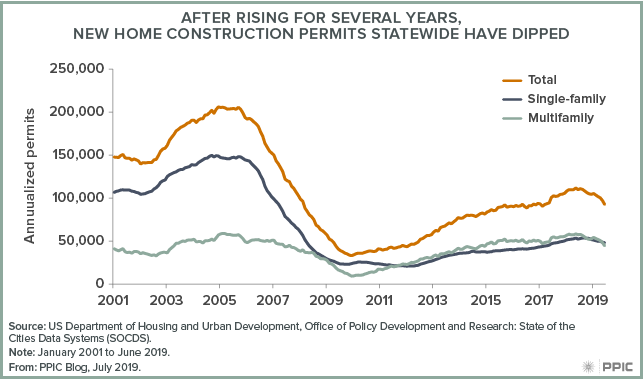
New construction has been falling short of demand for many years. Estimates from Beacon Economics put the backlog at about 2.3 million housing units in 2017. In 2018, only 104,000 residential permits were issued—this was well below the pre-recession permitting peak and left the state far below the number of new homes needed.

According to state housing officials, California needs an average of 180,000 new homes every year to make up for current deficits and accommodate future population growth. This number is not unattainable: an average of 200,000 units were permitted each year from 2003 to 2005. However, today the statewide numbers are moving in the wrong direction. In June 2019, residential permits were down 38% compared to June 2018. On an annualized basis, permits were down 16%, totaling about 93,000. Permits for multi-family units decreased even more sharply, by 23%; only 44,400 were issued.

figure - After Rising for Several Years, New Home Construction Permits Statewide have Dipped

Housing markets and new construction vary widely across the state. In San Mateo, San Diego, Ventura, and Alameda Counties, the number of permits decreased by at least 30%. Meanwhile, in San Francisco and Sonoma Counties permits increased by 66% and 47%, respectively. Part of the increase in Sonoma County is related to the replacement of homes lost during the 2017 wildfire.

This year’s state budget includes $1.75 billion for the construction of new homes, reflecting the fact that Governor Newson has made housing a high priority. A large boost in production will likely also require local land-use and zoning policies change. For example, research has shown that more multi-family housing is needed to address the affordability crisis in the state—but, in many localities, zoning restrictions make it very difficult to increase this type of housing. State-level action in this area has been highly contentious, as it often comes into conflict with local control. For example, Senate Bill 50, which would eliminate some zoning restrictions near major transit lines and job centers, unleashed a great deal of controversy and is now on hold until next year.

Zoning reform is one step toward the goal of increasing housing production, but it is probably not sufficient. Tying financial incentives directly to housing production is a potentially effective state strategy. Moving forward, sustained cooperation among state and local governments and also private developers is critical to addressing California’s housing challenges.


The Yolo Bypass: It’s a Floodplain! It’s Farmland! It’s an Ecosystem!

This is part of a series on issues facing California’s rivers.

California’s biggest river—the Sacramento—needs a lot of room to spread in big water years. A floodplain project called the Yolo Bypass allows it to flood naturally, while also providing habitat for waterbirds, fish, and other aquatic species. We talked to Ted Sommer, lead scientist for the Department of Water Resources (DWR), about this versatile landscape.

photo - Ted Sommer

PPIC: What is the Yolo Bypass, and what does it do?

Ted Sommer: It’s California’s primary floodplain. The Sacramento River drains a massive portion of the state, and the bypass gives it a large area—about 60,000 acres—to spill in high flood events. Then it drains safely back into the river and the Delta. You can see the bypass from highway 80 heading into Sacramento—it often looks like an inland sea in winter. It stayed flooded this year for months on end. If not for that floodplain a lot of people’s back yards would have been flooded in Sacramento. It’s a unique and effective part of the state’s flood management system.

The bypass also provides other benefits. Although its primary purpose is for flood management, it’s used extensively for agriculture. And it’s also managed heavily for wildlife. Its seasonal wetlands provide great bird habitat. And when flooded it serves as a nursery area for young fish in the Delta and good habitat for salmon migrating downriver to the bay. It’s a great example of balancing ecosystem benefits with other needs.

PPIC: What are some of the challenges in managing this landscape?

TS: One reason we started working on the bypass was the finding that a lot of key species do really well in wet years. So we started looking at this habitat that usually only gets flooded in wet years. Over 20 years of research on the bypass, we learned a lot about its role as a fish nursery.

In wet years this floodplain provides better habitat and more food for fish. But because it was designed as a floodway, the water shuts off quickly at the end of the wet season, and fish can get stranded or forced out of this habitat before they can get all the benefits from it.

We also found that the bypass is also a superhighway for many migrating adult fish—sturgeon, adult salmon, and others. The problem is that it is a dead-end in dry years. Even in wet years, as it starts to dry up, fish can get stranded as they move upstream in receding floodwaters.

Based on these areas of research, we’ve identified three priorities. The first is to improve fish passage. We’ve created a fish collection area in the bypass so we can help them get where they need to go in drier conditions. We also built a sophisticated fish ladder for fish migrating upstream during wetter years.

The second priority is improving connectivity between the river and its floodplain. A proposed notch in the top of the bypass would help extend the duration of flooding, giving baby fish more time in the nursery habitat. We hope to move forward with this project in the next several years.

The last improvement is to enable the floodplain to act as a foodbank beyond wet times. In recent years we’ve been working with water users, particularly rice farmers, to get pulses of water in summer and fall to move plankton downstream. Much of this water has already been used to grow rice and is returning to the system. Local farmers and water users have been great partners in this project.

PPIC: Is this model replicable elsewhere?

TS: Yes! Locally, the success of Yolo Bypass has helped fuel interest in restoring floodplain habitat in both the Sacramento and San Joaquin valleys. And it’s inspired people around the state and beyond to consider creating floodplains as part of their flood and ecosystem management strategies. People come from all over the world to visit the bypass. As the climate changes, such places can help manage flooding from extreme events while also providing many other beneficial uses.