The Mood of California Voters and the 2020 Election Cycle

This post is excerpted from my speech at the Sacramento Seminar on October 4, 2019 in San Francisco.

Pollsters often say that a public opinion survey is a snapshot in time. The latest PPIC Statewide Survey was conducted in the days after the California Legislature finished its work in 2019 and while startling news was breaking that the president called a foreign leader for a political favor—which has resulted in the launch of an impeachment inquiry. The mood of California voters in this timely survey—especially their level of unhappiness and anxiety—is noteworthy because of its far-reaching implications for the March primary and the November election.

Let’s start with President Trump’s approval rating, which now stands at 35% among California likely voters. This is unchanged from the last reading in our July survey and has been remarkably stable over time. Today, 83% of Republicans approve of his job performance, compared to just 38% of independents and only 7% of Democrats. Given its partisan makeup, California is a reliably blue state on the Electoral College map. Still, low approval ratings for the president will increase turnout, influence the Democratic presidential primary choice, and affect all of the legislative races next year.

Meanwhile, approval ratings for Congress remain low even in the wake of Democratic control of the US House of Representatives. Today, just 24% of California likely voters approve of the way that Congress is doing its job. This is unchanged from the start of the year—as well as from a year ago when Republicans controlled the House. In California, likely voters across party lines give low approval ratings to Congress. If this trend continues, incumbents will have to work harder to keep their seats in 2020.

Closer to home, Governor Newsom and the legislature are getting mixed reviews in their first year of making policy together. Among likely voters, 43% approve and 44% disapprove of the governor, while 38% approve and 51% disapprove of the legislature. Since the beginning of the year, disapproval has increased significantly for the governor (+15 points) and the legislature (+8 points). Today, more than six in ten Democrats approve of the job that the governor and legislature are doing, compared to fewer than four in ten independents, and less than two in ten Republicans. If their ratings remain in the doldrums, the governor and legislators will have little sway over Californians’ ballot choices next year.

figure - Approval Ratings of State Elected Officials

Equally important, California’s likely voters are in a negative frame of mind about the state of their state—even in the midst of low unemployment and budget surpluses. Fifty-four percent say that things in California are going in the wrong direction (41% say right direction). When asked about economic conditions in California for the next 12 months, a similar 54% expect bad times (37% say good times). Pluralities across party lines are now expecting bad economic times in the next 12 months—a timeframe that includes most of the 2020 election campaign season.

figure - Likely Voters Expect Bad Economic Times in the Next 12 Months

State bonds and tax measures will face headwinds if this level of economic unease continues. This is already evident in the modest support for the $15 billion school bond (54%) and the split-roll property tax initiative (47%) in our recent survey.

figure - Modest Support for Likely 2020 State Ballot Measures

Digging deeper into the survey, more than six in 10 likely voters worry about being able to afford the cost of their health care, six in ten are concerned about the threat of a mass shooting where they live, half are worried about experiencing natural disasters such as wildfires, and four in ten worry about someone they know being deported. Candidates’ promises and plans to address these fears will likely impact the standing of current frontrunners Joe Biden, Bernie Sanders, and Elizabeth Warren—and their challengers—in a Democratic presidential primary which is very much up for grabs, as our recent survey shows.

How will voters’ views change over the next 12 months? Clearly, the political wildcard is the impeachment inquiry and how it will impact perceptions of the president, Congress, and the major parties. Uncertainty about the economy is another unknown factor. In the short run, the impeachment inquiry is likely to increase polarization, lead to more political gridlock in Washington, and heighten expectations for the governor and legislature to do more to solve the problems facing California.

PPIC Statewide Surveys will continue to monitor the broader political and economic attitudes, as well as voters’ preferences for presidential candidates and ballot measures, throughout what will be a consequential 2020 election.
How the USDA Helps California Farmers Steward Water and Land

The US Department of Agriculture (USDA) is the largest federal agency in charge of food and farm policy in the US. But the agency also has a lesser known role: it runs a large portfolio of programs to promote conservation of soils, water, and wildlife habitat on farms.

California gets on average $150 million a year from the USDA’s suite of resource stewardship programs. The programs are operated by two of the nineteen agencies within the USDA: the Farm Service Agency (FSA) and the Natural Resource Conservation Service (NRCS).

USDA’s conservation programs can be broadly grouped into three categories: (1) temporary land retirement programs, (2) longer-term or permanent “easement” programs to protect farmland, and (3) working land programs that focus on resource stewardship of lands in agricultural production. NRCS also provides technical assistance to support these efforts.

The temporary land retirement programs are underutilized in California. These programs pay landowners to take land out of production to implement conservation practices, such as planting cover crops to improve soil quality. These programs accounted for 3% of the USDA resource stewardship funding in California from 2012–17, versus 32% nationally. Low enrollment in these programs in California reflects a variety of factors, including low payments and high land values for irrigated cropland in the state.

Landowners who enroll in longer-term or permanent easement programs retain legal title but commit the land to a specific use—for instance, converting croplands to wetlands—or commit to prevent commercial development on farmland. These programs also account for a small share of the USDA stewardship portfolio. Nonetheless, USDA easements support important conservation efforts across the state. For instance, NRCS was a major partner in the restoration of Dos Rios Ranch, a project adjacent to the San Joaquin National Wildlife Refuge that converted agricultural lands to habitat and helped an endangered species, the riparian brush rabbit, make a comeback.

Working land programs are especially popular in California, accounting for almost 70% of USDA agricultural conservation funding in recent years. The majority of these funds have been used to install more efficient irrigation systems and replace old diesel engines on farms to protect air quality. Programs also support a variety of other activities, including managing manure on dairies to protect water quality or installing hedgerows to create habitat for pollinators on farms.

Generally speaking, the USDA conservation programs support conservation practices on a farm-by-farm basis. But to realize broader benefits, investments often need to be on a larger scale. The Regional Conservation Partnership Program (RCPP)—introduced in 2014—encourages landowners to join forces on resource concerns. To date, RCPP has funded 21 projects in California, including helping rice producers extend their watering season to support migratory birds and supporting development of a traditional land management plan by the Yurok Tribe.

There is considerable potential to use USDA’s stewardship programs in new ways to help address changes on the horizon for California’s agriculture. Across the state, farms face growing requirements to address water scarcity and quality problems. Ending the long-term overuse of groundwater is a huge challenge. In the San Joaquin Valley, closing the gap will likely involve idling some cropland. It will also require finding cost-effective ways to recharge groundwater basins.

To assist in these efforts, working lands programs could support on-farm recharge as well as management practices to prevent dust, pests, and weeds on fallowed lands. Temporary land retirement programs could fund multiple-benefit management of lands that are transitioning out of irrigation, supporting efforts to conserve water, recharge groundwater, improve soil health, and restore habitat.

The 2018 Farm Bill increased the USDA’s capacity to provide this help. Funding for the largest working lands program in the valley has been increased, and it is now available to support projects by local water management agencies as well as individual farmers. Funding has tripled for the innovative RCPP program, which leverages public and private dollars to tackle regional conservation challenges. And throughout the farm bill, conservation programs now cover soil health and carbon sequestration as targeted outcomes.

By working together with the USDA, the state’s farmers and their local and state partners could make better use of these programs and address new challenges at hand.

figure - USDA’s Working Lands Programs Are Popular in California, but Temporary Land Retirement Programs Are Underused

Video: Key Factors in Arrest Trends and Differences in California’s Counties

Police officers make more than a million arrests per year in California. Arrests to enforce laws and protect public safety can have wide-ranging consequences for individuals and communities, and there have long been concerns about racial disparities. But little is known about the factors that contribute to arrest trends across the state. At a recent event in Sacramento, PPIC researcher Brandon Martin outlined major findings from a new report on arrests, and a panel of experts offered state and local perspectives.

Martin pointed out that arrest rates have fallen significantly over the past few decades, largely in tandem with declining crime rates. He also noted that arrest rates are higher in relatively poor counties, while racial disparities are largest in more affluent counties. These and other findings add up to a broad view of arrests that can inform efforts to reduce overall rates and racial disparities.

Shirley Weber, who represents California’s 79th Assembly District, said that the racial disparity findings are not new to the African American community. She noted that African Americans who commit offenses are “more likely to be arrested and incarcerated . . . rather than just being picked up and talked to,” and that confrontations that lead to uses of force are also more likely. These disparities have significant effects on employment and family stability, among other things.

Edgar Boyd, pastor of First African Methodist Episcopal Church in Los Angeles, emphasized the need for police and communities to reduce disparities: “When you look at . . . the conflict that exists between communities and law enforcement across the state, you’ll find that there’s a possibility of less negative impact, if it’s worked on.” Tod Sockman, chief of police for the city of Galt, agreed: “Law enforcement spends a lot of time doing community outreach. I think that’s key to everything we’re doing.”

The panelists also agreed that while local efforts are critical, the state has an important role to play in monitoring disparities. Weber—who championed Assembly Bill (AB) 392, a measure that sets statewide standards for police use of force—said that it would be irresponsible for state lawmakers to view criminal justice challenges as local matters. After AB 392 passed, a number of police officers told her that they were pleased because “they had ideas of working to de-escalate . . . and now this bill says we gotta do it, and so they can blame it on me. And that’s OK! Because sometimes there are things at the local level that prevent you from moving in a direction.”

Recent criminal justice reforms have led to further reductions in arrest rates, seemingly without a major impact on public safety. But there is still room for improvement. Sockman pointed to increases in theft and the continuing challenge of addressing addiction and mental illness, and Weber noted the difficulty of changing course after decades of reliance on incarceration.

Boyd, who serves on the state’s Racial and Identity Profiling Advisory Board, made the case for ongoing dialogue: “Our work on this, our dialogue together . . . is all important. Every one of us has a role and a responsibility in that.”

Video: 2020 Election Preview

Now that California’s presidential primary has been moved from June to March, how might the state’s electorate influence the 2020 election, and how are the major parties engaging with voters? At a lunchtime event in Sacramento last week, PPIC president Mark Baldassare provided an overview of voter participation in California and KQED’s Marisa Lagos moderated a lively, wide-ranging discussion of the upcoming election season.

Lagos, who covers California politics and government for KQED, noted that California has long been a “piggy bank” for presidential candidates in both parties. She asked whether the earlier primary date will increase the state’s influence. “Guess what? You’re still the piggy bank!” joked Tamara Keith, White House correspondent for National Public Radio.

More seriously, Keith noted that it isn’t clear whether “California will come into the process soon enough to make a difference or whether things will have started settling out after Iowa and New Hampshire.” She added that because it takes weeks for the state to count its absentee ballots, “there’s a chance that the race will have already advanced a lot by the time California’s results are fully in.”

Rusty Hicks, chair of the California Democratic Party, said that the earlier primary date offers opportunities for presidential candidates to engage voters across the state. “You have top-tier candidates going to the northern rural parts of the state. They’re going to the Central Valley, they’re going to the Inland Empire.” In his view, this is “a real opportunity to showcase the state . . . it’s more than the Bay Area and Los Angeles.”

From the Republican perspective, the early presidential primary doesn’t make a big difference. But Jessica Patterson, chair of the California Republican Party, sees opportunities on the state level. “We have the opportunity to change the entire makeup of the building across the street.” The party is focused on “making sure we’re engaged in communities . . . to talk about the things that are important to them, and really focus on fixing our state.”

While their perspectives differed in many ways, both Patterson and Hicks stressed the importance of working together to empower and represent all Californians. “I think we all have an interest in ensuring that we have an engaged and empowered electorate,” said Hicks. Patterson agreed, adding that “it’s better for all of us when we find ways that we can work together.”


Video: Career Education and Economic Mobility in California

[vc_row][vc_column][vc_column_text]

Career education, also known as vocational education or career technical education (CTE), prepares a wide range of Californians for employment and economic advancement. Community colleges are a major provider of career education in California, offering short- and long-term certificates along with associate degrees across a variety of fields of study.

In this video, senior research associate Shannon McConville discusses the importance of career education for California and what new PPIC research says about its economic benefits. Career education credentials can provide substantial earnings gains and also helps create a strong California workforce over the long term.

[/vc_column_text][/vc_column][/vc_row][vc_row visibility=”hidden-phone”][vc_column][vc_video link=”https://youtu.be/5qmlPVWwiEw” el_width=”70″ align=”center”][/vc_column][/vc_row][vc_row visibility=”visible-phone”][vc_column][vc_video link=”https://youtu.be/5qmlPVWwiEw”][/vc_column][/vc_row][vc_row][vc_column][/vc_column][/vc_row]

Water Policy Priorities for a Changing California

How will climate change affect California water management, and what steps should the state take to prepare for these changes? The PPIC Water Policy Center was asked by the Newsom administration to submit formal comments outlining key water policy priorities for the state—and ways to integrate actions across state agencies to implement these priorities. Our recommendations will inform the administration’s preparation of a water resilience portfolio. We address two key areas where the state can play a leading role—modernizing the water grid and protecting freshwater ecosystems.

California’s “water grid”—the network of reservoirs, aquifers, rivers, and water conveyance and flood control infrastructure that connects much of the state—was built for a climate that no longer exists. Yet it is the most important asset the state has for addressing changing conditions, both statewide and within regions. A modernized water grid, coupled with more flexible management, can reduce the cost of future droughts, improve how we manage flood risk, and help protect freshwater ecosystems. The state has made important advances in assessing and improving its water supply infrastructure, but it still lacks a comprehensive program to address storage, conveyance, and operational challenges in the next few decades.

California’s freshwater ecosystems present special challenges. The state’s native biodiversity continues to decline, despite decades of effort to improve conditions. Problems encountered during the 2012−16 drought—high water temperatures, low flows, insufficient cold water stored in reservoirs, and degraded habitat—will all likely worsen as droughts become more intense. Management of cold-water-dependent species—including salmon, trout, and some resident fishes such as Delta smelt—will continue to pose a significant challenge for water managers and regulators as conditions warm. Changing habitat conditions could make it impossible for some species to remain viable in their historic locations. And conflicts between the need to protect native species and land and water management activities are likely to increase. Here, too, some promising actions have been taken, but more needs to be done to prepare for coming changes.

Tackling these complex challenges with an integrated water resilience portfolio is a bold step, and one that has the potential to make California a leader in climate adaptation. You can read our recommendations to the administration here.

Californians Support Actions to Address Climate Change

Today, world leaders converge in New York City for the United Nations Climate Action Summit. The summit comes at a time when the federal government is moving in a different direction than California in the area of climate change and energy policy. Just last week, the Trump administration announced it would rescind the state’s authority to set its own vehicle emission standards—a decision challenged on Friday in a lawsuit filed by California and 22 other states.

Over the past two decades, California has taken a multifaceted approach to reduce greenhouse gas (GHG) emissions, and Californians have consistently shown strong support for the state’s recent actions.

To reduce emissions from the transportation sector—the largest emitter, with 41% of the state’s GHG emissions in 2017—California expanded its vehicle pollution standards to cover smog-forming pollutants and GHG emissions. Other policies include low-carbon fuel standards, a major effort to ramp up electric vehicles, and integrating land-use and transportation investments.

California has also committed to decarbonizing the electricity sector. In 2018, then-governor Jerry Brown issued an executive order that calls for California to provide 100% of its electricity from renewable and carbon-free sources by 2045, and at least 60% by 2030. The state is on its way to meeting this goal, with about a third of electricity provided by renewable sources in 2017.

California was also the first state to enact a cap-and-trade program to reduce GHG emissions, which allows businesses to trade emissions permits. This program now covers 85% of the state’s GHG emissions.

New policies that target the reduction of carbon, methane, and other harmful GHGs are underway. Since carbon dioxide can be removed from the atmosphere by plants and stored in vegetation, soils, and the ocean, the state is developing a strategy to use integrated land-use approaches. These approaches will produce the environmental and economic benefits that traditionally come from natural and working lands, while offering potential carbon storage.

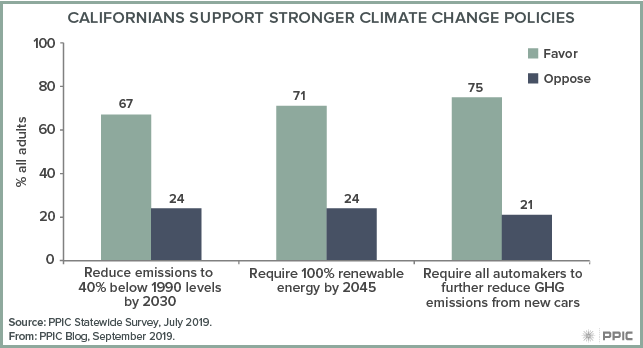
Californians have consistently expressed support for strong climate change policies. A recent PPIC Statewide Survey found 71% of California adults are in favor of the state’s 100% renewable energy goal, including more than six in ten across regions and demographic groups. Two in three residents are in favor of the state law (Senate Bill 32) that requires California to reduce its GHG emissions to 40% below 1990 levels by 2030. Overwhelming majorities of Californians are also in favor of requiring automakers to further reduce greenhouse gas emissions from new cars.

figure - Californians Support Stronger Climate Change Policies

This support will be critical in the state’s ongoing efforts to reduce emissions. In addition, adapting to the new realities brought on by climate change will be essential. Despite California’s goals and policies, some of the effects of a changing climate are already underway—and would persist even if all global emissions ended today. PPIC will continue to track California’s climate change policies and proposals, as well as residents’ opinions about this important issue.

Should Applying for College Financial Aid Be a High School Requirement?

A majority (58%) of Californians consider affordability at the state’s public colleges and universities a big problem, according to a 2018 PPIC Statewide Survey. Requiring all high school students to apply for financial aid could help more students pay for college.

Currently, around 60% of high school students in California complete the federal application for financial aid (FAFSA)—a student’s gateway to receiving federal grants and loans, as well as state aid. The remainder of students are unlikely to receive aid, even though there’s evidence that many of them would probably have qualified.

Requiring students to apply for aid may result in greater numbers of high school graduates enrolling in college, which could increase California’s college-going rate of 64% (2017–18). Earlier this year, a bill was introduced in the California Legislature that would require students to complete a financial aid application before graduating from high school.

Louisiana was the first state to have such a requirement, starting in 2017–18. The state saw FAFSA completion rates increase from 48% to 84% between 2015 and 2018, and college-going numbers increased by 12.6% (from 22,200 to 25,000) in the same time frame. Texas and Illinois are following suit, with the requirement taking effect in those states in fall 2019 and fall 2020, respectively.

California needs more college graduates to meet the increasing demand for highly skilled workers—and the proposed bill could make a difference if it increases access to college, especially for lower-income students. In addition, better financial support during college can reduce students’ debt load and might help more students complete their programs. Improved access to college and higher graduation rates would set more students up for success in the workforce and benefit the state’s economy.

Californians Favor Funds for School Construction

With little time to spare, the legislature last week passed a $15 billion school construction bond. A signature from Governor Newsom will place the bond measure—called the Public Preschool, K–12, and College Health and Safety Bond Act of 2020—on the March 2020 primary ballot. Given Californians’ general support for funding education, how do they feel about bond measures for school construction projects?

It’s important to note that the PPIC Statewide Survey has not yet asked Californians about this particular measure, which would provide funding across K–12 and higher education systems. However, we have consistently found that Californians are supportive of bonds for each system individually. (We did not ask about specific dollar amounts.)

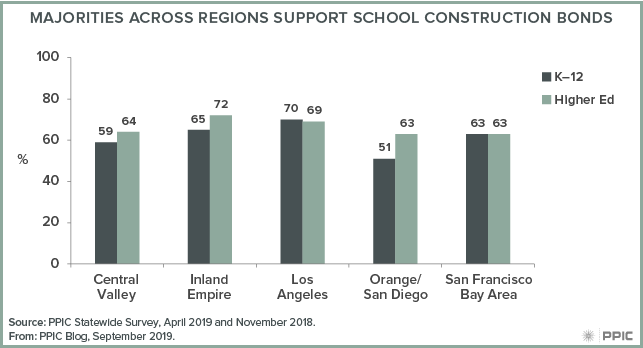
In our April survey, about six in ten adults (62%) and likely voters (57%) said they would vote yes on a bond for K–12 school construction projects, while in November 2018 two in three adults (66%) and about six in ten likely voters (57%) supported a bond to pay for construction projects in California’s public higher education system. In both surveys, there was majority support across regions and demographic groups—except among whites (47%) for the K–12 bond. For both types of bonds, support was lower among whites than other racial/ethnic groups, and support decreased as age and income levels rose.

figure - Majorities across Regions Support School Construction Bonds

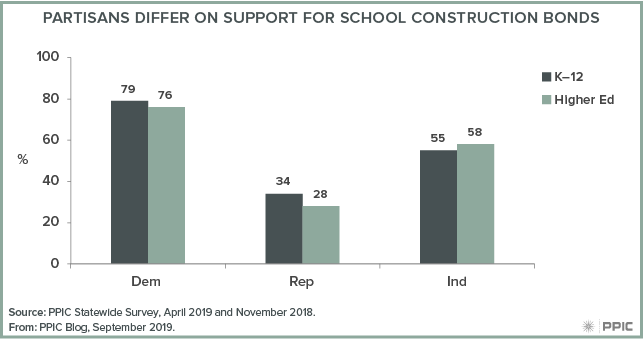
Despite this widespread support for these bonds, we found a significant partisan divide. For both bond questions an overwhelming majority of Democrats as well as smaller majorities of independents have been in favor; far fewer Republicans have been.

figure - Partisans Differ on Support for School Construction Bonds

With California set to play a prominent role in the March Democratic presidential primary—potentially drawing large numbers of Democratic voters—this partisan divide could play a role in passing the bond.

We still don’t know how Californians will perceive this particular bond—in terms of the dollar amount or the joint funding of K–12 and higher education. Stay tuned for more from the PPIC Statewide Survey as we will track support for this bond, as well as many other important 2020 election issues.

Californians and the 2020 Election

This post is excerpted from my opening remarks at PPIC’s annual Sutton Family Speaker Series event, “2020 Election Preview earlier today, in Sacramento.

All eyes will be on California when voters make their choices in the upcoming presidential primary on March 3. Last year, California experienced a surge in voter registration and voting. On the heels of record low turnout in 2014, the 2018 election had the highest turnout for a midterm in California since 1982. Still, PPIC colleagues report that turnout is low compared to other states.

To help make sense of the state’s voting patterns, PPIC has just released a new report titled California’s Exclusive Electorate: A New Look at Who Votes and Why It Matters, which analyzes data from the last nine waves of PPIC Statewide Surveys and includes responses from nearly 15,200 California adults. These latest findings, built on a PPIC study that was first published in 2006 and then updated in 2016, help us to set the context for this 2020 election preview event. While much is changing in the electorate, many patterns stubbornly persist.

Growth in political participation has been strong in the wake of significant changes in our state’s election laws and because we live in such interesting times for national politics. However, it is noteworthy that about 5 million California adults are not eligible to vote, while about 5 million eligible adults are not registered and about 7 million registered voters did not cast a ballot in November 2018. If past trends are any indication, only about half of California’s approximately 31 million adults will vote in the November 2020 general election, and far fewer will cast ballots in the March 2020 primary.

Importantly, the demographic makeup of the electorate is not representative of the people of California. Voters in California tend to be white, affluent, college educated, and homeowners. Nonvoters are more likely to be younger, Latino, renters, lower income, less educated, and to self-identify as the “have nots” in society. While some gaps have narrowed, a wide gulf remains between voters and nonvoters.

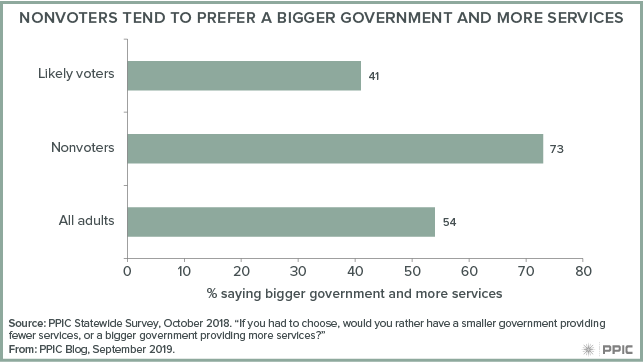
Because of their stark differences, voters and nonvoters are not aligned in their views of the role of government. For instance, only 41 percent of likely voters prefer a bigger government that provides more services, while 73 percent of nonvoters and 54 percent of all adults do so. Preferences vary in similar ways when asked if the government should be doing more to reduce the gap between the rich and the poor, or if the government should do more to make sure that all people have an equal opportunity to get ahead.

figure - Nonvoters Tend To Prefer a Bigger Government and More Services

What would change if more nonvoters turn out for the March primary and November election? Presidential candidates who favor a more expansive government role would get a boost, and so would proponents of state bond measures and citizens’ initiatives to raise taxes on the wealthy. President Trump’s approval rating here is much lower among nonvoters than likely voters (24% to 38%) and, thus, a higher turnout would also help the Democratic candidates in competitive US House races—as it did in 2018.

Expanding the electorate might also inject some idealism into the cynicism and divisiveness of politics today. Nonvoters are more optimistic about the prospect that Americans of different political views can still come together and work out their differences. California still has a long way to go, but the movement toward a more representative electorate that we are starting to see is a step in the right direction for a state that calls on voters to make decisions that impact all of its residents.

In the meantime, PPIC Statewide Surveys will continue to poll all adults so that elected officials can take into account the needs and wants of all of the people they were elected to represent, and not only the likely voters, in a consequential 2020 election year.