How Community College Reforms Could Help English Learners

[vc_row][vc_column][vc_column_text]Due in large part to their mission of access and affordability, community colleges play a key role in educating immigrant students, especially those who are English Learners. In 2016–17, more than 58,000 first-time community college students in California enrolled in English as a Second Language (ESL) courses.

For many students, taking ESL courses may be linked to the desire to improve their socioeconomic prospects. Indeed, community college students who earn a credential or transfer to get a four-year degree are well positioned to climb the economic ladder. In an economy that increasingly demands skilled workers, there is tremendous untapped potential in increasing the educational attainment—and economic trajectories—of ESL students.

California’s community colleges have undertaken several reforms that aim to improve student success and close equity gaps. These reforms—spurred by AB 705 and the new Guided Pathways framework—present a ripe opportunity to help more ESL students get on the path to completing college composition, a requirement to earn a college credential or transfer.

These initiatives are primarily focused on addressing the needs of students who intend to pursue a degree or transfer. However, our most recent research finds that about two-thirds of ESL students (66%) are not on track to do so—and may consequently be left out of the reforms. (We consider students on track if they take any ESL course required to access college composition and at least one course other than ESL or English.)

ESL students who are not on track are more likely to come from historically underrepresented groups. For instance, we find that compared to students taking ESL courses needed for college composition, those not taking these courses are more likely to be older and Latino. They are also more likely to have unknown citizenship status (a possible signal of being undocumented) and to have not graduated high school.
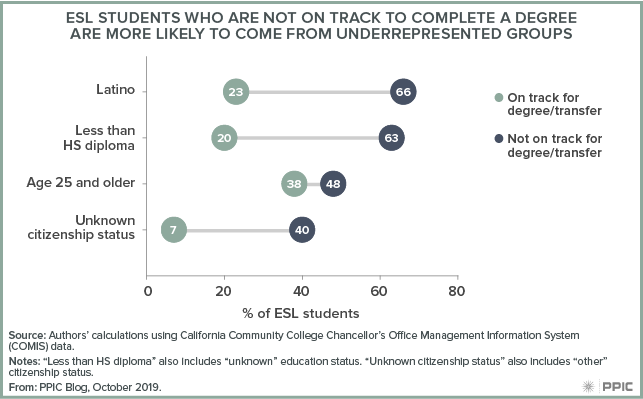
figure - ESL Students Who Are Not on Track To Complete a Degree Are More Likely To Come from Underrepresented Groups

As colleges across the state reform their ESL sequences and programs of study, it will be critical to ensure that all students have the opportunity to earn a degree or transfer. The two-thirds of ESL students currently not on track to do so are the most vulnerable. These students have already taken the major step of enrolling in college. To improve their likelihood of advancing, colleges could provide clearer and more effective ESL sequences and degree and transfer pathways, as well as stronger student supports, including advising, placement, and information about available degrees and certificates.

Some colleges are already working on these issues. Initiatives like the Guided Pathways ESL Milestone certificates at Cypress College—the result of AB 705 and Guided Pathways efforts—present a unique example of how colleges can structure ESL programs and certificates to help English Learners get on a pathway toward a college credential.

Finally, it is important to acknowledge that there are some ESL students who take ESL coursework for reasons unrelated to a degree. As colleges redesign their ESL programs, working alongside non-credit ESL programs, adult education schools, and community-based ESL programs could help ensure that colleges are keeping the diverse needs of ESL students in mind.[/vc_column_text][/vc_column][/vc_row]

Video: Water and the Future of the San Joaquin Valley

The San Joaquin Valley is at a critical juncture in determining its water future. California’s largest agricultural region is ground zero for many of the state’s most difficult water management problems, including groundwater overdraft, drinking water contamination, and declines in habitat and native species.

A state mandate to bring groundwater use to sustainable levels will have a broad impact on valley agriculture and the regional economy in coming years, likely including some permanent idling of farmland.

The PPIC Water Policy Center assembled a group of regional experts last week for a half-day public event at Fresno State to discuss three overarching challenges: balancing the valley’s water supplies and demands, addressing water quality problems, and planning for beneficial water and land use transitions.

Ellen Hanak, director of the PPIC Water Policy Center, launched the day’s discussions with a summary of the valley’s water-related challenges and approaches that could help address them. “The valley faces unprecedented challenges and a lot of change,” she said. Drawing from a new PPIC report on the valley’s water future, she noted that an all-hands-on-deck approach will be needed as the scope of the problems can’t be addressed farm by farm. “The most promising approaches are those that increase flexibility, provide incentives to encourage folks to make decisions that are beneficial, and can be done cooperatively.”

The first panel focused on ways to balance supply and demand in the face of an annual groundwater deficit of nearly 2 million acre-feet a year. Some of the approaches discussed included assessing opportunities to use infrastructure and farmland to augment groundwater recharge, crediting landowners for helping to recharge aquifers, and providing flexibility to farmers—for instance with water trading—so they can avoid fallowing the most profitable crops.

“The goal is to put as many tools into the hands of the landowners to give them the opportunity to manage [groundwater sustainability] to the best of their ability,” said Eric Averett of the Rosedale-Rio Bravo Water Storage District.

The second panel tackled the complex and pressing groundwater quality issues the valley faces—from resolving safe drinking water problems in poor rural communities to addressing ongoing nitrate and salt contamination of groundwater and soils. Key challenges include finding ways to pay for safe drinking water for affected communities; identifying cost-effective approaches to reduce nitrate contamination, especially on farmlands managed by dairies; and ensuring that flooding farmland to recharge basins doesn’t harm groundwater quality.

The final panel explored ways to manage fallowed land to get multiple benefits for people and nature. “We can think about ways to manage recharge basins to create wildlife habitat,” said Nat Seavy of Point Blue Conservation Science, one of the authors of the PPIC report. “There are opportunities to restore retired land and create habitat for San Joaquin desert species, and we can restore floodplains in a way that provides flood benefits for people.”

A common theme to the day’s discussions was finding ways that local stakeholders can work together on these difficult problems. As Hanak noted, “The leadership on this has to come from the valley. State and federal support can help, but folks in the valley will need to drive the change.”

We invite you to watch the videos from this event and hope you find the discussions helpful:

Serving California’s Diverse College Students

As part of his cradle-to-career initiative, Governor Newsom has emphasized higher education as a key means of expanding Californians’ social and economic opportunities. From proposing more higher education funding in this year’s budget to supporting two years of free tuition for first-time community college students, many of his initiatives are focused on making college accessible and affordable to more of the state’s residents. For these initiatives to succeed, it will be essential to enroll a broad array of students—in particular, those who have been historically underserved in higher education–and to ensure that more students successfully complete college.

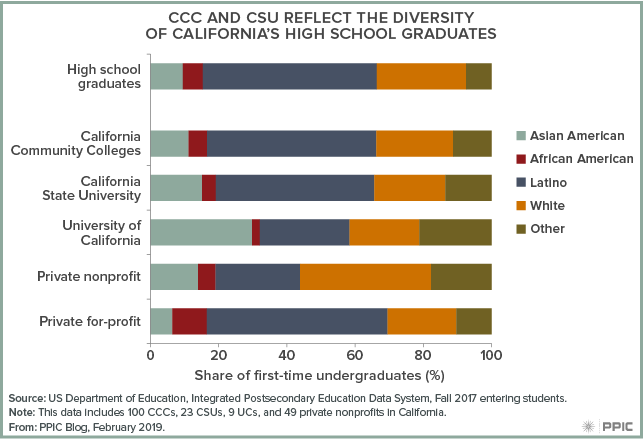
The good news is that the state is enrolling a diverse set of students, especially at the two largest systems, California State University (CSU) and the California community colleges (CCC). Overall, these two systems closely reflect the racial and ethnic make-up of California’s high school population—which is critical given that these two systems are key entry points for African American, Latino, low-income, and first generation college students. UC and private nonprofit colleges in California serve diverse populations, including more first generation and low-income students than their peer institutions in the rest of the country, but they do not reflect the full ethnic diversity of the state’s high school graduates.

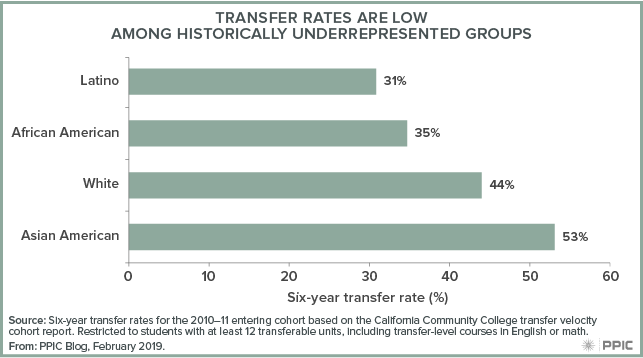
More challenging is helping students to successfully complete a four-year degree. Graduation rates are very high at UC and at most private nonprofit colleges. At CSU, graduation rates have improved dramatically, but even so about 40% of students do not earn a degree within six years. Most students who enter community colleges with the intent to transfer to a four-year college never do so. Transfer rates are especially low for African American and Latino students.

Both CSU and CCC have launched new policies and programs that hold the promise of improving transfer and reducing inequities. For example, community college reforms in developmental—also known as remedial—education will lead to substantial increases in the share of students taking college-level courses in English and math. The Associate Degree for Transfer (ADT) program is making the transition to California State Universities much more straightforward. And the new Guided Pathways initiative provides support services and clear course-taking patterns to community college students to promote success.

These are important steps in the right direction. Renewed interest in Sacramento regarding higher education will help. And Californians are well aware of the stakes. A majority of adults in California (56%) say a four-year college degree is very important for economic and financial success in today’s economy, and 75% believe California’s higher education system is very important to the quality of life and economic vitality of the state.

Commentary: A Balancing Act for the Water-Stressed San Joaquin Valley

This commentary was published in the Fresno Bee on February 21, 2019.

The San Joaquin Valley is on the brink of a major transition as it seeks to balance its groundwater accounts. California’s largest farming region has the state’s biggest groundwater deficit—almost 2 million acre-feet per year by our estimates. To put it in context, that’s about one Don Pedro Reservoir’s worth of water a year.

Read the full commentary on fresnobee.com.

Commentary: Delta Interests Should Seize the Opportunity to Cease Water Fights

This commentary was published in CALmatters on February 21, 2019.

The Sacramento–San Joaquin Delta is a major source of water for cities and farms across the state, and a major source of water conflict.

In a Sacramento Bee editorial two years ago, we and our colleague Brian Gray promoted a grand compromise for the Delta. We suggested that the three broad interests fighting about its future—water users, environmental groups, and Delta residents—give up something in order to reduce conflict and make progress. During his first state of the state address, Gov. Gavin Newsom opened the door to just such a compromise.

Three interrelated issues in the Delta are in tension and need resolution:

  • First, the reliability and quality of its water are in decline. More than 25 million Californians and 3 million acres of farmland rely on the Delta for a portion of their water supply.
  • Second, ecosystems in its watershed are changing, harming fisheries and threatening extinction of some native species.
  • Finally, many of the 1,100 miles of fragile levees that protect people’s farms and homes are in need of costly upgrades.

Climate change and rising sea levels are making all of these problems worse.

Gov. Jerry Brown’s WaterFix program aimed to solve the supply problem by building two large tunnels underneath the Delta to route Sacramento River water to Bay Area and Southern California cities and San Joaquin Valley farms.

The project’s size, and its potential for ecological harm if mismanaged, made it untenable to most Delta residents and environmental groups. It also was very costly, with uncertain financing prospects. A stalemate developed in which none of these interrelated issues—water supply, ecosystems, levees—could be adequately addressed.

Gov. Newsom has changed that equation by proposing to build one tunnel, not two.

A single tunnel would perform almost as well as two tunnels, particularly when operated in tandem with the existing pumps in the south Delta. It would cost substantially less. And it would give assurances to environmental groups and Delta residents that the project would not create the large impacts many fear.

Environmental groups should take this opportunity to sign on to a new approach for managing the Delta.

This would involve focusing less on the volume of flows dedicated to protecting endangered species and more on how flows and habitat—managed together—can improve ecosystem conditions.

Doing this well will require major commitments to habitat restoration from the state and water users. It will also require new approaches to managing environmental water.

We recommend establishing ecosystem water budgets that can be stored, traded, and flexibly allocated. This makes the environment a partner in water management rather than merely a constraint. Reliable funding, good governance, and robust scientific support will be essential components of this package.

There’s an opportunity for the new governor to move forward on the ecosystem issue as well. The State Water Board is revising its Water Quality Control Plan for the Delta.

Governors Brown and Newsom have stated their desire that water users and environmental groups develop negotiated agreements as an alternative to new environmental flow regulations from the board.

Done well, such agreements have the potential to create flexible allocations of water for the Delta ecosystem. The clock is ticking. Getting these negotiations completed is critical to resolving the Delta’s problems.

The administration also must address the future of the Delta’s fragile levees. Some are essential for managing water quality, and all are under threat from climate change, sinking land, and earthquakes. There is an opportunity to build upon the recently completed Central Valley Flood Plan and the Delta Stewardship Council’s efforts to prioritize investments in levees. A comprehensive, reliably funded plan that accounts for the multiple threats to levees is sorely needed.

In California’s complicated water wars, some may consider “compromise” synonymous with surrender. But those who insist on fighting will only be rewarded with more fights. Progress happens when parties give up something to get what they really need. By proposing to build one tunnel instead of two, Governor Newsom has opened the door for a grand compromise in the Delta. The Delta’s many interests should seize this opportunity.

A Snapshot of Homelessness in California

In late January communities around the country conducted a point-in-time count of their homeless populations. Federally mandated by the US Department of Housing and Urban Development, these estimates help local, state, and federal governments allocate resources and track progress toward the goal of ending homelessness.

Last year’s count revealed that about 130,000 Californians were homeless—nearly a quarter of the national total. California’s rate of homelessness, 33 per 10,000 residents, was among the highest in the country.

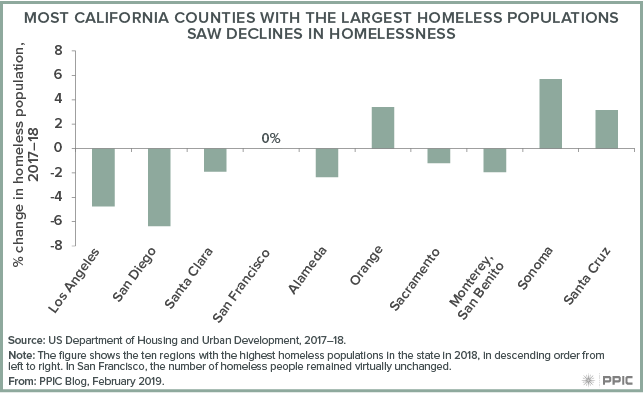
After rising 14% from 2016 to 2017, the total number of homeless Californians declined slightly (by 1%) from 2017 to 2018. Homelessness decreased in many of California’s major urban areas, including in four of the five counties with the largest homeless populations: Los Angeles, San Diego, Santa Clara, and Alameda.

However, even with these decreases homelessness remains a huge problem. Los Angeles County alone recorded nearly 50,000 homeless people. The other nine counties with the largest homeless populations reported between 2,300 and 8,600 people experiencing homelessness. And many areas across the state saw increases in the number of homeless people.

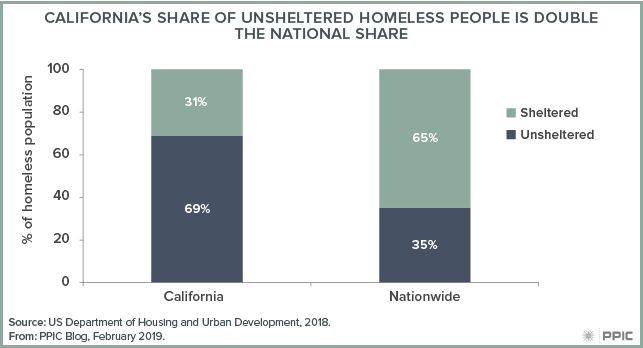
The vast majority of homeless Californians (69%) were unsheltered, meaning they were living in streets, parks, or other locations not meant for human habitation—the highest rate in the nation. Among homeless veterans, California has the nation’s highest share that are unsheltered (67%); and among homeless youth, the share that are unsheltered (80%) ranks second highest.

Homelessness is already on many policymakers’ radar. Governor Newsom’s proposed budget would allocate $500 million in one-time grant funding for emergency homeless shelters and navigation centers, and $25 million ongoing to assist eligible homeless individuals in applying for disability benefits. Localities are also trying a range of approaches to expand affordable housing and increase services for the homeless. For example, voters in Los Angeles, Berkeley, Santa Rosa, and Emeryville recently passed local bonds to fund housing projects and assistance for low- and middle-income households and people experiencing homelessness. Coordinating investments, policies, and programs across federal, state, and local levels will be key to reducing homelessness throughout the state.

Video: Californians and Their Government

As efforts are gearing up in Sacramento to craft a new state budget, a majority of Californians say they approve of Governor Gavin Newsom’s proposed spending plan. Californians also express optimism about the general direction of the state. These and other key findings of the latest PPIC Statewide Survey were outlined by Alyssa Dykman at a Sacramento briefing last week.

The governor’s budget proposal, which calls for increased funds for education and health and human services, garners support from 70% of California adults. More than three-quarters approve of two key components of the proposal: 77% favor allocating $1.8 billion to expand pre-kindergarten and early childhood programs and facilities, and 78% support an $832 million funding increase for public colleges and universities.

The survey also asked whether Californians believe the state is going in the right direction. A majority of adults (55%) approve of where California is headed. This contrasts with less than a third (30%) saying things are going in the right direction for the country. In addition, a record-low 25% of Californians say that President Trump and Congress will be able to work together and accomplish a lot this year.

Other survey highlights:

  • Asked what the most important issue is for the governor and legislature to address in the coming year, more Californians name immigration and illegal immigration (15% adults) than any other issue.
  • Most Californians (67%) are optimistic that Governor Newsom and the legislature will be able to work together and accomplish a lot in the next year.
  • A strong majority of California adults (64%) say President Trump and Republicans in Congress were primarily responsible for the recent partial shutdown of the federal government. Only 24% say Democrats in Congress were responsible.
  • Only about a quarter of Californians (27%) say the situation with illegal immigration across the US-Mexico border is a crisis.

Connecting the Drops in Watershed Management

The interrelated nature of water issues has given rise to a management approach that integrates flood control, environmental water, and water supply. The Yuba Water Agency manages its watershed in this kind of coordinated manner. We talked to Curt Aikens, the agency’s general manager, about the lessons they’ve learned from this “integrated management” approach.

PPIC: Your agency manages the watershed for hydropower, water supply, flood control, and ecosystem health. What are some key elements to making it all work together?

Curt Aikens: I think the most critical elements to making this work for us are employing science and broad collaboration to sustainably manage all of the resources.

We try to make the most of every drop of water we touch—this infographic highlights how we do that. Our water provides recreation, carbon-free electricity, habitat for fish and wildlife, and a sustainable water supply for farmers and the 80% of our population that relies on groundwater for drinking water. In drought years, we transfer water to the state for use in the Central Valley and Southern California. We use the proceeds from those transfers and from hydropower sales to invest in reducing flood risk in Yuba County and other environmental, water supply, and public safety projects.

In managing this integrated system, we’re fortunate that our agency’s boundary fully contains our groundwater basins and most of the Yuba River watershed. The river flows right down the middle of the county.

We worked hard to get where we are today. In the 1990s we were involved in a contentious debate with conservation groups and state agencies over environmental flow requirements for the Lower Yuba River to support salmon and steelhead trout. To resolve the situation, we developed a collaborative, science-based settlement called the Yuba Accord. This agreement, which improved salmon and steelhead habitat, is a foundation for our success, because it helped us solve a number of problems collaboratively.

We try to ensure that everything we do has multiple benefits and comes from a strong collaborative effort. The Feather River Setback Levee is a great example of that. After Yuba County flooded in 1997, we commissioned a comprehensive flood study that presented half a dozen options to reduce future risk. Working with local conservation groups, we eventually settled on a program to set the levees back and strengthen them. This significantly lowered flood risk while producing ecological benefits for the river. The community gained a new, stronger levee, a significantly lower flood risk, and real ecological benefits.

PPIC: Is it harder to address multiple problems with one project?

CA: Today, it’s actually harder to implement a project with a single purpose. We live in a world with multiple interests, and we’ve found that multipurpose projects are a much better way to get things done. The Yuba River has more human impacts than most other rivers in the state. So we try to get ecosystem benefits out of most of our projects, whether it’s improving fishery habitat in our flood control work or strengthening water supply management through a project to build forest health.

Collaborative, science-based initiatives cost more and take more time upfront, but in the end you can get better results and more durable, sustainable solutions.

PPIC: Can this approach work well for water agencies that share a watershed with other entities or have other complicating factors in how they manage their system?

CA:  I think it absolutely can. There are many examples of multiple jurisdictions working together to resolve common water or natural-resource challenges. For example, the work being done on the voluntary settlement agreements in the Bay-Delta has brought together a really diverse group of conservation and water interests working toward an innovative solution. This approach is collaborative and science based. It also presents the opportunity for fish and wildlife habitat creation, new flows to support fish, and funding to help finance these activities.

Collaborative agreements, rather than a mandated regulatory approach, offer much greater promise for California’s environment and economic stability. This is exactly our experience with the Yuba Accord.  Continued leadership from Governor Newsom and his administration can help California create a sustainable solution for the entire Bay-Delta watershed.

Proposed Budget Prioritizes College Students in Need

Governor Newsom’s January budget proposal includes $1 billion in new funding for higher education. Much has been made of his plan to cover two years of tuition for first-time, full-time community college students. But that is just one aspect of an overall approach that provides extensive support to a wide variety of students.

Newsom’s proposal increases by nearly 15% the number of “competitive” Cal Grants—a distinct type of support available to students who do not qualify for entitlement grants. Recipients of competitive Cal Grants are often older, non-traditional students. Further, all Cal Grant recipients who have dependent children would receive an additional $6,000 to help with non-tuition related costs. In addition, Newsom’s budget allocates nearly $50 million to programs that address housing and student hunger—and those that provide legal services for undocumented students, staff, and faculty.

The governor’s focus on affordability aligns with Californians’ concerns regarding higher education. According to the latest PPIC survey on Californians and higher education, 58% of all adults noted that affordability was a big problem for California’s public higher education systems; just 14% said that it was not much of a problem. Most Californians also said that higher education should be a high priority for the new governor. This budget proposal suggests that Governor Newsom is listening.

Colorado Drought Deal Close, But Not Done

Last week Arizona and California missed a deadline to submit final plans for how they will manage water shortages in the Colorado River Basin over the coming decades to prevent Lake Mead levels from dropping so low that water cannot be released from the dam. The other five states that share the river’s waters have already submitted their drought contingency plans. We talked to John Fleck—director of the University of New Mexico’s Water Resources Program and a member of the PPIC Water Policy Center research network—about the situation.

photo of John Fleck

PPIC: What is the drought contingency plan intended to do?

John Fleck: The key problem on the Colorado is that the basin’s water is over-allocated. It was really wet in 1920 when the allocation rules for the river were developed. So the rules allocated extremely large water shares to the “lower basin states”—California, Arizona, and Nevada—that hydrologic reality can’t support. We’ve been struggling ever since to come to terms with that reality.

The drought contingency plan is a voluntary program involving the lower basin states to decrease their use of the river’s water in an attempt to reduce the over-allocation problem. There’s an overall agreement describing the conditions that would require each state to use less water. Then each state has to have its own separate internal set of agreements on how to share those cuts.

There are a couple of different ways you can approach this over-allocation problem. The federal government can just reduce everyone’s allocation. Or you can have the water users themselves acknowledge the problem and agree to a voluntary, collaborative approach. The latter approach is far more likely to succeed, so I definitely think this was the better way to go.

Even though the lower basin states are close to having final plans, federal officials have said that “close isn’t done.” The states now have until March 4 to submit their final plans. No one wants to have an imposed federal solution—and I don’t think we’ll end up there—but it’d be better than doing nothing. The threat alone might push people to finish up.

PPIC: What are some important steps the states have agreed to?

JF: The agreements reduce water use in the lower basin by 1.5 million acre-feet per year; it’s a very big deal. Arizona has now agreed to a plan that could eventually reduce the Central Arizona Project’s flow of Colorado River water into the valleys of Tucson and Phoenix by nearly half of current levels. They did this voluntarily, without any litigation. That’s real progress. And Imperial Irrigation District (IID)—the biggest agricultural user of California’s allocation of Colorado River water—has already given up 500,000 acre-feet a year, which is a huge amount of water.

One of the complications of reductions in Colorado River water is the drying of the Salton Sea, which relies principally on runoff from farms in IID. California promised to mitigate the public health and environmental problems associated with the shrinking of the sea, particularly the air quality impact on poor communities. Solving this problem is a work in progress made more challenging by reductions in Colorado River water.

PPIC: Do you think the states’ plans go far enough, given the warming climate?

JF: We can’t be sure, because we don’t know how much impact climate change will have, on what time scales. Since we don’t really know where the bottom is for the Colorado River, hydrologically speaking, we don’t how far we’re going to have to go with water cutbacks in the long run. Drought planning is a really important step to prepare for a climate-challenged future—it creates a framework for deeper cuts.

It’s important to see the drought contingency planning as the latest development in the evolution of long-term management of the river’s waters. There are a bunch of unresolved problems—both hydrologic and institutional―and a lot of work remains to be done, but we can’t solve all these problems at once. Though drought planning is an incredibly important step, it’s certainly not the last one.

Fleck is a co-author (with Eric Kuhn) of the upcoming book Science Be Dammed: How Ignoring Inconvenient Science Drained the Colorado River, to be published this fall by the University of Arizona Press.