More Students Than Ever Ready for UC and CSU

Governor Newsom’s budget proposal assumes enrollment growth at the University of California (UC) and California State University (CSU). But these two systems are seeking to expand even more to accommodate increasing demand, as more California students than ever graduate high school prepared for college.

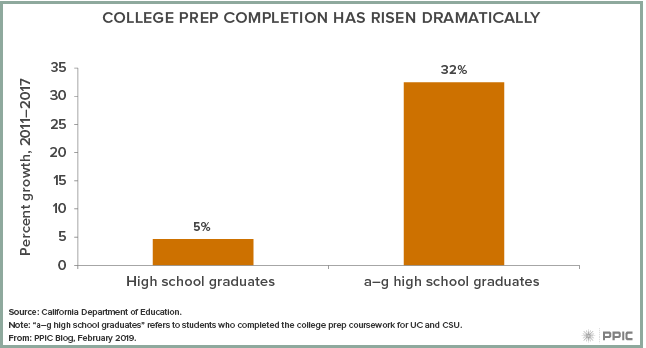
Between 2011 and 2017, the state saw a dramatic increase of more than 49,000 students (a 32% increase) completing college prep coursework, despite there being only 19,000 more high school graduates (a 5% increase).

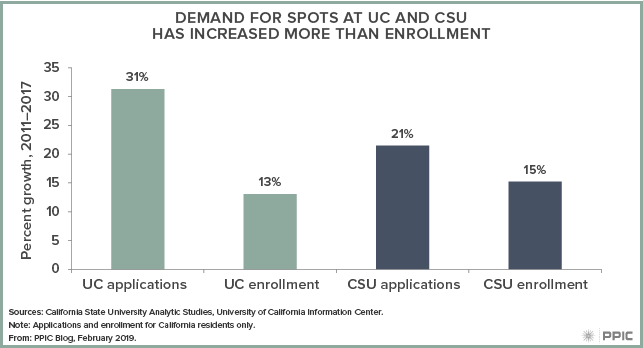
Applications to UC and CSU have grown substantially as well. Since 2011, UC applications from California high school graduates are up 31%, and applications to CSU are up 21%.

UC and CSU have been able to accommodate some of that increased demand, but not all of it. Since 2011, UC and CSU enrollment has grown much faster, at 13% and 15%, respectively, than the increase in all high school graduates. But enrollment growth was much smaller than the increase in applications and the number of high school graduates completing college prep courses.

Allowing more students who are academically prepared to start at a four-year college is a good policy choice. Studies show that students who start at a four-year college are more likely to graduate than if they start at a community college. And attending a public school in California leaves students in less debt on average than attending a private college or paying nonresident tuition in other states. Policymakers and institutional leaders will need to think strategically about how to accommodate the growing number of high school graduates who are now prepared for UC and CSU.

Video: A Conversation with California’s Legislative Leadership

When Toni Atkins, President Pro Tem of the California State Senate, sat down to talk with PPIC president Mark Baldassare last week, she brought along a list of pressing issues. Asked to name the top two issues facing the state, she led off with housing: “The growing crisis around the lack of housing supply for all levels of Californians is one of our most critical issues.” Next came climate change and its effects across California. And then she added a third issue: water sustainability. In reality, she said, “there is always a list of issues and challenges that we are working on in California.”

Despite this long list, Atkins was optimistic about the legislature’s chances of working productively with Governor Newsom. “It’s early, but I would say that what I appreciate and enjoy about Governor Newsom is he really is a policy wonk at heart.” She added that while Jerry Brown and Gavin Newsom share many priorities, the two have very different styles. “Jerry Brown proposed a budget and he only wanted a few things,” while Governor Newsom “has thrown everything out there.”

After noting that it will be interesting to see how the legislature approaches this year’s budget process, Atkins highlighted the governor’s focus on homelessness and mental health issues and his commitment to early childhood education—which, she added, has been “a huge driving issue for the legislative women’s caucus.” She expressed particular interest in the governor’s proposal to “take juvenile justice offenders out of CDCR—the California Department of Corrections and Rehabilitation—and into more of a health/social services arena.”

Shifting from the state budget process to the ongoing drama over the budget—and border wall—at the federal level, Baldassare asked Atkins about the state government’s response to what is happening in Washington, DC. “You know, I’m so glad to be in California,” she replied. Citing the state’s diversity and the policies that foster it, she said that “to have that attacked in many ways at the federal level means all of a sudden you’ve got California really promoting state’s rights, to protect our policies, our values, and things that we hold dear.”

Atkins tended to be optimistic about even the thorniest issues—such as forestry management, building more housing, and water sustainability. Speaking about the cluster of issues related to climate change, she said, “Maybe the result of these catastrophic fires, and floods, and mudslides—maybe that is the way we’re now able to have a conversation we couldn’t have five years ago, before it was a crisis.” But she added that in order to move an agenda forward, “you’ve got to still have all the stakeholders at the table.”

More generally, Atkins stressed the importance of representing all Californians, regardless of party: “I think we have work to do together.”

Video: Academic Progress for English Learners

More than 40 percent of students in California’s public K–12 system speak a language other than English at home. Almost half of these students are considered English Learners (ELs), in need of language and academic support to succeed in school. In middle and high school, ELs face the dual challenge of attaining fluency in English and working toward a high school diploma.

At a lunchtime briefing in Sacramento last week, Laura Hill—a senior research fellow at PPIC—and Megan Hopkins—an assistant professor at UC San Diego—outlined the findings of a new report on two distinct types of EL students: long-term ELs, who have been in US schools for several years without being reclassified as fluent in English, and late-arriving ELs, who first enroll in the district in grade 6 or higher. The authors looked at the impact of a school’s language environment on academic progress and examined trends in English language development (ELD) courses.

The report focused on the state’s two largest school districts, Los Angeles Unified School District (LAUSD) and San Diego Unified School District (SDUSD). Together, they enroll about 14% of the state’s EL population—and about 4% of the EL population in schools nationwide. As Laura Hill put it, “It’s a big deal to be able to study in these two districts.”

How might the language mix among students at a school be associated with academic outcomes—both for both fluent English speakers and for ELs? The report finds that the academic outcomes of native or initially fluent English speakers was not related to the percentage of EL students at a school. The evidence is mixed on the relationship between the percentage of ELs in a school and the academic performance of ELs.

Megan Hopkins outlined key findings on ELD courses. She noted that in recent years the rate of EL students receiving ELD instruction has declined in Los Angeles and risen somewhat in San Diego. These trends may be influenced by district-level factors; they are important because, in both SDUSD and LAUSD, long-term ELs who do not have ELD instruction experience slower growth on statewide English language arts tests. These findings suggest that efforts should be made to support ongoing ELD and other language supports, but Hopkins noted that ensuring access to core academic content is also important.

More generally, this study underlines the importance of understanding the factors that contribute to the progress and struggles of California’s large EL population—so that schools can help all ELs advance linguistically and academically.

How Climate Change Drives Disaster Cascades

California has had a devastating series of natural disasters recent years, prompting questions about the role of climate change in worsening fires, droughts, and floods. We talked to Amir AghaKouchak—an associate professor of civil and environmental engineering at UC Irvine―about how a warming climate is affecting natural hazards.
PPIC: Can you talk about how climate change is causing chains of extreme events?

Amir AghaKouchak: Climate warming can compound hazardous events. For example, this sequence of events led to devastating compound impacts in California: (1) severe drought in 2012‒16 weakened or killed many trees and vegetation; (2) record winter precipitation in 2017 caused epic growth of fine fuels like grass; (3) a warm, dry spring and summer dried out vegetation, leading to record-low moisture levels in this vegetation, (4) Diablo winds in Northern California and Santa Ana winds in Southern California set records for low humidity and sustained wind velocities; (5) record-setting fires occurred (e.g., the Thomas Fire in December 2017); and  (6) intense rainfall near Santa Barbara in January 2018 created the most deadly debris flows in history.

Cascading events are a special form of compound events. Sometimes the drivers involved in a cascading event are physically independent (e.g., a wildfire in summer and a rainfall event that winter), but they are linked through their impacts. The Thomas fire in Southern California didn’t cause the related mudslide. But the order of these events—they were about a month apart—had an extreme impact. Models show that a warming climate will bring more wildfires to California, which means a higher chance of future mudslides and debris flows.

We know, for example, that drought and heat waves are connected. It’s widely acknowledged that California’s climate is warming. But what’s striking is that our droughts appear to be warming much faster than the overall average. Heat waves often have atmospheric origins, but they can also be worsened by dry conditions. The way soil cools down is similar to what our bodies do—we sweat and are cooled by its evaporation. The land’s surface cools the same way. But when there’s little or no moisture for evaporation, the sun’s radiation warms the surface and intensifies heat waves. A hotter future will bring drier soil, which can lead to more intense heat waves.

PPIC: What can be done to better manage future extreme events?

AA: Historically, we have usually ignored the relationships among the variables used to assess risk. For example, US Geological Survey guidelines for flood risks in coastal areas do not consider the dynamics of the oceans. Sea level rise brings a greater chance of flooding in coastal areas due to higher tide and surge baselines. We need to develop methods that allow us to do more comprehensive risk analysis for floods, wildfires, mudslides, etc. On the science side, we need better methods to analyze the risks of related events. More public education and outreach about these types of events are also very important. Moderate rainfall may not worry you, but if it’s after a wildfire it could lead to extreme risks. We need to make sure people understand that moderate events can potentially lead to an extreme disaster cascade.

PPIC: What are some changes we should start making now to boost resilience for these “disaster cascades”?

AA: Policy change isn’t easy. But California is very progressive and has even formed a committee, which I’m a member of, to assess how climate change information can be used for improving engineering design and management of infrastructure. Our report identifies gaps and challenges, and offers nine major recommendations for making the state’s infrastructure “climate safe.” For example, we call for updating design and maintenance codes to enhance resilience. We also recommend funding collaborative efforts between state infrastructure agencies and climate scientists to develop tools for improving resilience.

Addressing these gaps won’t be easy. The good news is that the working group has had representation from all the major state agencies―including the Department of Water Resources, Caltrans, and the California Energy Commission. The agencies are interested in working together to improve resilience down the road. This is a very promising sign for the future.

Will the Governor’s Budget Reduce the Heat on School Districts?

Last week Los Angeles district leaders reached a deal with public school teachers to end the city’s first teachers’ strike in 30 years, agreeing to higher teacher salaries, smaller class sizes, and more support staff. The strike was the culmination of long-brewing tensions over the amount and allocation of funds in California’s largest school district. Many other districts in the state are facing similar challenges, as the demand for resources grows faster than the available dollars.

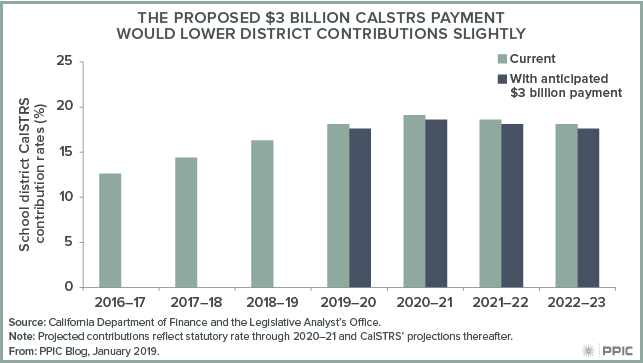
Earlier this month, the governor’s first budget proposal acknowledged some of these broader difficulties. The 2019–20 spending plan proposes $3 billion in one-time payment to CalSTRS, the main teachers’ retirement system, on behalf of schools (separate from the General Fund K–12 spending determined by Proposition 98). The proposal also includes $1.1 billion to pay down a portion of the state’s share of the estimated CalSTRS liability.

The proposed $3 billion CalSTRS payment could take some financial pressure off school districts. Funding for schools is determined by two main formulas. First, total statewide funding is determined by applying a formula (Proposition 98) to the expected revenue from state and local property taxes. Then, another formula (the Local Control Funding Formula) is used to determine the bulk of the dollars available to individual school districts.

Distributing resources in this manner means local school districts, even one as large as Los Angeles, have limited control over the total amount of dollars they have to work with. But the demand for those dollars is constantly going up as districts find themselves paying more—overall and in particular areas such as special education services, health care premiums, and pensions. Pensions are especially challenging, as legislation passed in 2014 mandated that school districts’ share of teacher pension contributions would rise from 8% (2013) of their teacher payrolls to 19% by 2020. This increase will drive annual pension contributions to more than $1,000 per student in most local school districts.

How much relief might the governor’s proposed payment provide? The answer is some, but not much. The governor’s budget document states that the payment “will reduce the out-year contribution rate by half a percentage point.” Given that number, the expected relief amounts to an annual savings of around $25 per student. In large districts such as Los Angeles, this adds up to tens of millions of dollars annually, but districts with lower enrollment numbers will see more modest financial gains.

The CalSTRS payment proposal is a departure from prior state budgets. First, it represents an acknowledgment that, despite recent increases in total education spending, school districts still face fiscal challenges. Second, it proposes to direct non–Proposition 98 funds, making it a de facto increase in total K–12 resources. School district administrators are likely to appreciate both. However, the proposal still needs the legislature’s approval, and it’s not clear whether it would significantly relieve fiscal pressures on districts.

Whether the one-time CalSTRS payment represents a shift in future policy remains to be seen. If it is in fact only a one-time payment, the impact on the resources available to schools will be welcome but modest. It may, however, signal a different approach to education funding in the long run—something that would be worth watching.

Many of California’s Highly Educated Workers Are Retiring

As California’s population ages, record numbers of people are now going into retirement. Because so many of these recent retirees are highly educated, this trend has important implications for workforce needs in the state. Replacing these highly educated retirees will require large increases in college enrollment and completion among young Californians.

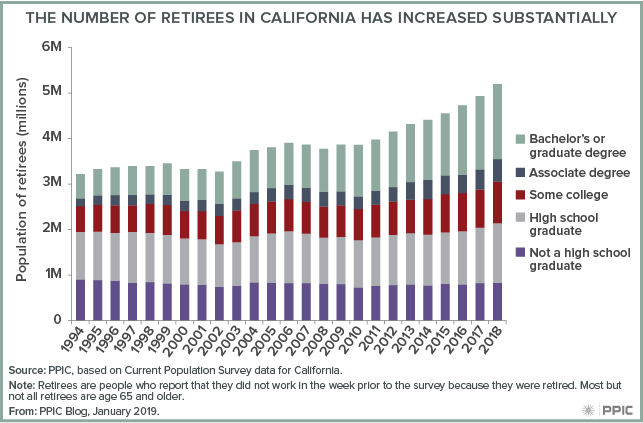
The number of retirees in California has grown dramatically over the past 10 years. Their total numbers grew from 3.8 million in 2008 to 5.2 million in 2018, a 38% increase—far higher than the state’s overall population growth of 8% during this same period. This rapid growth in retirees is a consequence of the aging baby boom, the very large cohort of people born between 1946 and 1964. During that post-war era, new social norms meant that the typical family had three or four children. The leading edge of the baby boom reached age 65 in 2011. Because the tail end of the baby boom is larger than the leading edge (in California, the birth rate peaked in 1957 and the number of births peaked in 1961), the number of retirees will continue to grow strongly for the next decade. The tail end of the baby boom will reach age 65 in 2029.

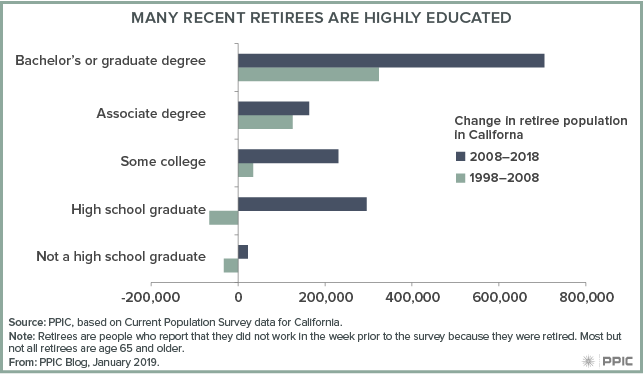
Children born during the baby boom ended up far better educated than their parents. Policies such as the GI Bill, along with public investments in California’s public higher education system, allowed for relatively inexpensive, widespread access to college. Today, the number of retirees with a bachelor’s or graduate degree is larger than ever. Between 2008 and 2018, this group increased by more than 700,000 and made up a majority of the net increase in the retiree population.

The retirement of so many highly educated workers is unprecedented and poses a tremendous challenge for California. Every year, the number of new retirees with a bachelor’s degree (more than 70,000 per year in the last decade) exceeds the number of bachelor’s degrees awarded by the entire University of California system (55,000 in academic year 2017–18). Without producing more college graduates, California could see a shortfall of 1.1 million highly educated workers by 2030.

The good news is that the state and its higher education institutions are making progress by increasing enrollment, graduation rates, and degrees awarded. These advances have been made possible at least partly because of renewed funding from the state. With the additional funding for higher education in the governor’s proposed budget, California’s higher education system will be better positioned to take on the workforce challenges posed by the retirement of the baby boom.

Governor’s Budget Targets Safe Drinking Water, Wildfires, Healthy Soils

Governor Newsom’s first proposed state budget, released earlier this month, addresses several critical water and natural resource management challenges. Here are highlights from his plans to mitigate problems with safe drinking water, improve forest health and reduce the risk of wildfires, and encourage healthy soils to reduce greenhouse gas emissions and increase drought resilience.

Safe and affordable drinking water: The governor’s budget proposal revives last year’s failed legislative proposal to tap urban water customers, agricultural fertilizer users, and dairies to pay for safe drinking water projects in small, disadvantaged communities with water quality challenges.

The proposed budget also includes a one-time capital investment of $168.5 million (compared to $93 million enacted in the previous budget) to fund safe drinking water and wastewater infrastructure projects in disadvantaged communities. The funds will come from Proposition 68—a $4 billion bond approved by voters in June 2018 for investments in water, parks, the environment, and flood protection. The proposed spending represents the remaining two-thirds of the $250 million in Proposition 68 funds for safe drinking water projects.

In addition, the governor proposes allocating $10 million from the General Fund for a State Water Board program that provides technical, operational, and managerial assistance to water systems serving disadvantaged communities. This funding will be used to implement the Board’s relatively new authority to hire third-party administrators to help water systems comply with safe drinking water standards—including tasks such as project planning and grant procurement. This authority was granted by SB 552 in 2016.

The budget also allocates $10 million from the General Fund for water supply emergencies in disadvantaged communities. During the latest drought, more than 2,500 domestic wells ran dry and nearly 150 small water systems requested emergency support. Many rural, disadvantaged communities still do not have reliable supplies, and these funds could provide emergency drinking water, extend water service lines, and repair groundwater wells.

Forests and wildfires: The budget calls for $415 million for programs to improve the health of forests and fight wildfires. Of this sum, $200 million will be sourced from the Greenhouse Gas Reduction Fund (GGRF). This is consistent with a legislative requirement from last year to spend $1 billion from the GGRF over five years for forest health, fire prevention, and fuel reduction activities. These funds will largely be allocated to Cal Fire’s grant programs for forest management projects on private and federal forest lands. The remaining half of the $415 million in proposed spending will go toward upgrading firefighting equipment and increasing firefighting capacity.

Healthy soils: The budget allocates $18 million to the California Department of Food and Agriculture to expand the Healthy Soils Initiative—a $3 million increase from its 2018 budget. Funded by the state’s cap-and-trade revenues, the program incentivizes farmers to adopt sustainable practices and increase their soils’ capacity to sequester more carbon. Activities might include installing riparian forest buffer, composting, and planting cover crops and wind barriers. Such practices can also improve crop yields, drought and flood tolerance, and air and water quality. The funding is projected to enable the sequestration of 5.3 million tons of CO2 on 500,000 acres by 2030, which is equivalent to nearly 2% of California’s annual emissions in 2016.

The proposed budget will be revised by May—and ultimately finalized and passed by the legislature in June.

One Step Closer to a Statewide Educational Data System

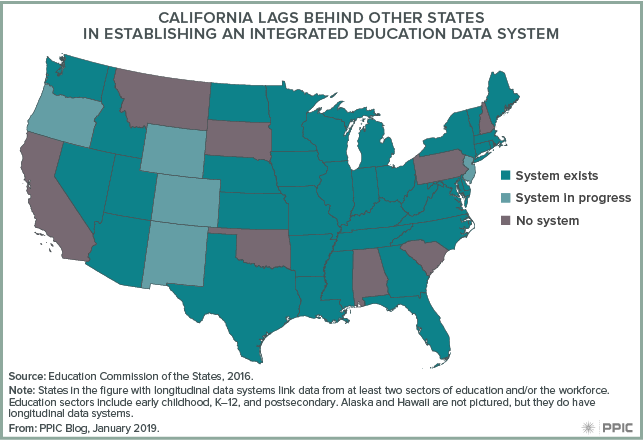
Governor Newsom’s recently proposed budget includes $10 million in one-time funding for the planning, creation, and implementation of a statewide longitudinal data system—including early childhood education, K–12, higher education, the workforce, and health and human services. As we wrote in a recent PPIC report, this idea holds a lot of promise. An integrated data system could allow for improved feedback for educational institutions, more efficient use of public funds, and better evaluation and coordination for the state. The idea also has support in the state senate, where Senators Glazer and Allen proposed a similar system (SB 2) last December.

Each public education system—K–12, the community colleges, California State University, and the University of California—already recognizes the importance of data. They all collect, store, and analyze data on students within their respective systems to improve instruction and outcomes. However, few connections are ever made between educational sectors. Even though a high school senior may graduate from a K–12 school, attend a community college, and then transfer to a UC, data isn’t shared across those systems in any systematic way. So each system has no idea if students are successful in the next stage of their academic career. California is one of the few states that does not follow students across sectors.

The governor’s budget summary also suggests that the data system could be used to improve K–12 measures of career and college readiness. Current measures are based on high school test scores and high school course-taking. But connecting K–12 data to higher education and employment data could lead to more meaningful measures of whether students are able to take and succeed in college-level courses, or whether they work in a job with a living wage.

With the Newsom administration’s support, California may be closer than ever to establishing a data system that can answer key questions about how students move along the educational pipeline. Creation and implementation will involve security, privacy, and governance challenges, but California has 42 other states that can serve as models. This is a much-needed first step in helping the state develop effective policy solutions that will improve students’ progress through school and into the workforce.

Californians’ Priorities for Their New Leaders

California enters 2019 with Democratic super-majorities in both chambers of the state legislature and a Democratic governor replacing another for the first time in more than a century. What do Californians want state leaders to prioritize? Although the state is projected to have a budget surplus of $21 billion, many are pessimistic about the state’s short- and long-term economic prospects. These economic concerns are possibly linked to Californians’ policy and spending preferences, and they are likely to inform their attitudes toward the governor’s recently released budget proposal for the next fiscal year.

According to the December 2018 PPIC Statewide Survey, fewer than half of Californians (46%) say the state will have good times financially in the next 12 months. The share of adults holding this view hasn’t been this low since October 2014 (45%).

About one in three (32%) also say California will be a worse place to live in 2025, and 50 percent think children growing up in the state today will be worse off financially than their parents.

When asked what the state government’s most important priority should be in planning for California’s future, 39% of residents say it should be improving jobs and the economy. In the shorter term, what issues should state leaders prioritize in the coming year? Findings from the December survey offer some possible answers.

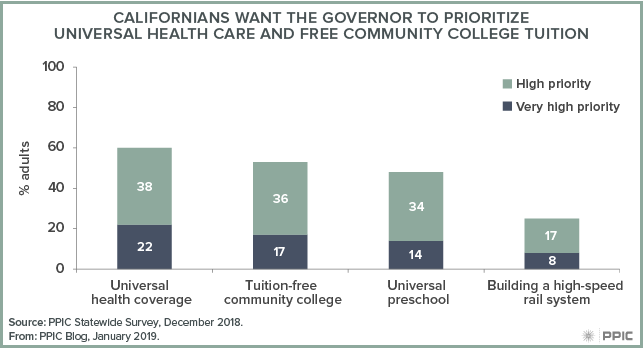
When asked what they would prefer to do with a projected budget surplus, a majority of Californians (57%) say they’d like to increase state funding for education and health and human services. When asked about several potential policies—most of which Governor Newsom highlighted during his campaign—majorities of adults say universal health coverage (60%) and tuition-free community college (53%) should be top priorities for new state funding. Fewer than half (48%) say the same about universal preschool, and one in four (25%) want to prioritize high-speed rail.

These findings underscore Californians’ preferences for programs that can help reduce economic uncertainty. They also indicate that Californians’ priorities are aligned with Governor Newsom’s budget proposal for the next fiscal year. The governor’s budget includes funding for an expansion of Medi-Cal coverage to young adults regardless of immigration status, a second tuition-free year at community college, and steps toward universal preschool for income-eligible four-year old children.

Over the next five months, as the governor and state lawmakers work toward a final budget, Californians will have the opportunity to voice their opinions. Stay tuned to the PPIC Statewide Survey as we track Californians’ attitudes toward new leaders and key policy issues.

A Momentous Water Year

California was bookended by extreme events last year―from the Southern California mudslides in January to the disastrous wildfires north and south in November, and in between, a bout of record-breaking heat in Los Angeles. These events are all connected to policy challenges that California water managers and decision makers are grappling with—issues that are front and center in our work at the PPIC Water Policy Center.

  • Climate change is bringing multiple climate pressures that affect the state’s water supplies and complicate water management. We assembled a team of 30 experts in climate science, hydrology, ecology, engineering, economics, and law to review the weak points in the state’s water system and recommend actions to build its climate resilience. Our new report―published as Governor Brown’s Global Action Climate Summit kicked off in September―provided an accessible analysis of how climate change will affect droughts and summarized reforms needed to better manage future droughts and adapt the state water system to a more volatile climate. Next up is a research project on how to manage wastewater as the climate changes.
  • Two years of tragic, extreme fires stirred debate on how best to address this growing risk, and productive change is already underway. Our ongoing work has guided the development of significant reforms to improve forest health and reduce wildfire risk. Governor Brown directed state agencies to increase forest management in accordance with some of our recommendations. And a new law reflects a number of our suggested reforms to help headwater landowners better manage their forests. New federal and local policy changes will also help. We’ve begun a deeper dive into the benefits—and beneficiaries—of improved forest management as a next step to identifying durable funding solutions.
  • The San Joaquin Valley―California’s largest agricultural region—faces major challenges in managing its groundwater, a critical drought reserve. Our research on recharging groundwater basins laid out key problems that must be addressed to capture more water for underground storage and described what can be done to advance recharge efforts. Next month we’ll release a comprehensive review of solutions to the San Joaquin Valley’s many water and land management challenges that will help the valley continue on a prosperous path for the next century.
  • We hosted a large public event in November to identify water priorities for the new governor. A group of 16 experts discussed how the Newsom administration can promote water policies and practices that benefit the state’s people, economy, and environment. We also updated and expanded our policy briefing kit, California’s Water, to inform newly elected leaders on key water issues—including a new brief on providing safe drinking water. We look forward to working with the new administration to develop meaningful, lasting, forward-looking water policies.

As we move into our fifth year, the PPIC Water Policy Center looks forward to being part of the effort to find creative and collaborative solutions to California’s most difficult and pressing water challenges. And as always, we thank our supporters who enable this important work.

With best wishes for 2019,

Ellen Hanak

P.S. You can sign up for our weekly blog post. And you can learn more about how to support the center’s work.