COVID-19 and Crime in Major California Cities

Public safety is one of many areas of life being affected by the COVID-19 pandemic. Now that most Californians are staying home in response to the statewide shelter-in-place order, the overall number of reported crimes is declining in four of the state’s largest cities. But there is also evidence of an uptick in some types of crime.

We examined the daily reported crime numbers for two large Southern California cities and two Bay Area cities: Los Angeles, San Diego, San Francisco, and Oakland. It is important to note that while these cities make their data quickly available for analysis, the numbers are preliminary: law enforcement agencies update and review the data before submitting them to DOJ as official statistics. Also, we do not yet have data on other cities or rural areas across the state. And, finally, it is possible that our highly unusual circumstances are affecting the extent to which crime is reported.

Comparing the average weekly number of reported crimes in February to the number reported for the last week in March shows an overall drop from about 6,150 to 3,620—a decrease of 41%. Declines have been particularly large in the two Bay Area cities: about 69% in Oakland and around 55% in San Francisco. Crime reports began to fall in all four cities a few weeks before shelter-in-place orders were issued for the Bay Area (March 16) and the state (March 19)—after employers started urging their workers to stay home.

Property crime accounts for roughly 80% of the overall decrease: reports fell from a weekly average of 4,270 in February to 2,270 in the last week of March (a drop of about 47%). This trend was driven by a decline in larceny reports, particularly car break-ins. The drop in larcenies, which are most striking in the Bay Area, could quite possibly be largely attributable to the absence of tourists.

figure - San Francisco's Drop in Reported Property Crimes Stands Out

Overall reports of violent crime dropped from a weekly average of about 1,880 in February to about 1,360 in the last week of March—a 28% decrease. Oakland experienced the most dramatic drop—from about 200 to 70. The number of reported assaults dropped from 1,430 to around 1,100 (22%). The overall decrease in robberies—from about 350 to 260—was driven largely by the Bay Area.
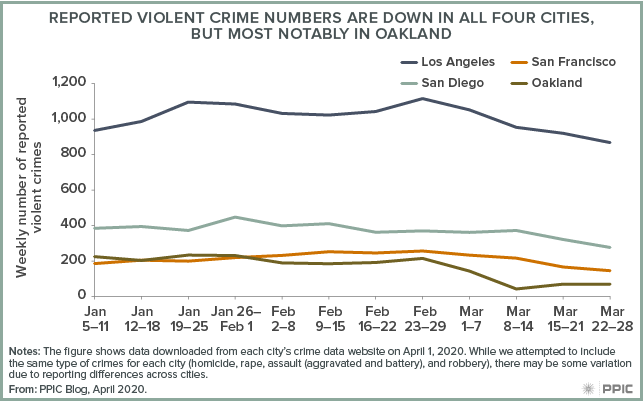
figure - Reported Violent Crime Numbers are Down in All Four Cities, But Most Notably in Oakland

There are some notable exceptions to this downward trend. While reports of domestic violence are down overall for the four cities, Los Angeles saw an uptick in the last two weeks of March, and the weekly number of reported robberies in San Diego were also up somewhat. More broadly, a slight increase in reported commercial burglaries across all four cities suggests that burglars may be shifting from residential to commercial targets now that so many people are at home at all times of day.

It is too soon to draw firm conclusions about recent trends, but it will be important to track and monitor crime data so that we can identify vulnerabilities in our communities and determine whether new approaches are needed to maintain public safety in these challenging times.

Groundwater Sustainability Planning Undeterred by COVID-19

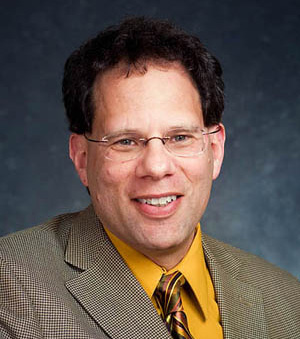
COVID-19 has forced many of us to find creative ways of working together while sheltering in place. For California’s new groundwater sustainability agencies (GSAs), that means bringing together diverse groups of stakeholders in virtual forums to develop and implement state-mandated groundwater sustainability plans. We talked to Dave Ceppos—who, as managing senior mediator at Sacramento State’s Consensus and Collaboration Program, is working with many GSAs—about how the pandemic is affecting the complex public outreach process required by the Sustainable Groundwater Management Act (SGMA).

Photo - Dave CepposPPIC: Talk about how the pandemic lockdown is affecting the groundwater sustainability planning process.
DAVE CEPPOS: Unlike other public engagement laws and regulations, SGMA requires a dialogue between a GSA’s leadership and affected stakeholders. Planning and decision making need to take into account not only technical information about local groundwater basins, but also social information about water uses and needs. The GSAs have to show they’ve gotten input from water users, and that they’ve considered the impacts of their decisions on the local community. These conversations are hard and nuanced—basically, the GSAs are new regulatory agencies, the groundwater gods for their local area, and that’s a big change. Sheltering in place has made these complex conversations harder. I think GSAs are just getting their heads around the magnitude of the work they have to do under these new conditions, but they are rising rapidly to the challenge.

PPIC: How is the GSA community responding to limitations on public gatherings?

DC: In the past three weeks we’ve seen a pause in some places—the postponement of meetings that were coming up too fast to reconfigure to an online format, for example. But generally, work is continuing, and they’re taking it very seriously. My staff has already done probably six virtual SGMA public meetings. In the basins where plans are still under development, there is an outlying question about a possible need for an extension beyond the January 2022 deadline if the lockdown continues for a significant period of time, but for now it’s business as usual.

The governor’s recent executive orders relaxing some rules about how public meetings are held have been extraordinarily helpful—without them our work would be almost impossible. Meetings are continuing virtually. The agencies we’re working with are fully committed on publicizing meetings and putting out public messaging, but they’re not being hamstrung by Brown Act requirements about having to hold meetings in public places.

PPIC: SGMA involves many players from diverse groups, living in rural areas that may not have adequate online infrastructure for virtual participation. What’s being done to ensure that public participation is inclusive and fair?

DC: Every GSA that I know of is doing their best in terms of their obligation and their commitment to actively engage with the public. That said, not everyone has access to the internet. Not everyone can get information online, or can print agenda packets, which can be mammoth. We have farmers who attend midday meetings by calling in from their trucks—they can’t toggle through those packages or watch an online Powerpoint presentation from their phones. This is a daunting process involving a lot of complex information.

The reality is that even before this current crisis, our society had moved to a digital world that has left some people behind. In conversations we’re having with agencies, there’s typically an immediate rush to the online tools with the most bells and whistles. But for a facilitator, the first question we ask is, “what do we need to accomplish in a particular meeting?” Then we try to find the tools and methods to do that. To facilitate SGMA dialogues, we know that some people call in and can’t use online resources. We seek to create equity in virtual discussions by toggling back and forth between people in the virtual room and those sitting in trucks and kitchens who need to weigh in over the phone. When it comes to fostering inclusive dialogue, it’s not the bells and whistles that do it—it’s structuring meetings and using facilitation methods to make sure equity is maintained.

This is a challenging time, but we will get through it. Facilitators call it “change management,” which is all about helping people through a new condition by setting new expectations and behaviors. The good news is we humans are excellent at this, and we’re doing it already. Whether we need to manage this change for six weeks or six months, we’ll prevail and continue with this important work.

Note: On April 8, Dave Ceppos will lead a webinar by the Groundwater Resources Association of California, “How to Engage in a Socially Distanced World.”

What’s the Plan to End Groundwater Overdraft in the San Joaquin Valley?

In the midst of the COVID-19 crisis, work on managing groundwater for long-term sustainability continues, as required by California’s landmark Sustainable Groundwater Management Act (SGMA). In January, water users in 21 critically overdrafted basins delivered their groundwater sustainability plans to the state Department of Water Resources. In this series, we examine the 36 plans submitted for 11 critically overdrafted basins in the San Joaquin Valley—California’s largest farming region. PPIC has done extensive work on what SGMA means for this region, where excess pumping is a major challenge. This post examines how the plans propose to end overdraft.

What are the options for ending overdraft?
SGMA requires water users to bring their groundwater basins into long-term balance over the next two decades. Although there are no easy solutions, the math is simple: bringing these basins into balance will require expanding water supplies, reducing water demands, or a combination of these two approaches.

Our in-depth study of water solutions for the San Joaquin Valley found that about a quarter of the region’s 1.8 million acre-feet (maf) of annual overdraft could be filled with new supplies at a cost that local water users can afford. Among supply options, by far the most promising approach is expanding groundwater recharge: storing more of the runoff from large storms in underground aquifers. Filling the remaining three-quarters of the gap will likely require demand reductions. Since agriculture is the predominant water user, this will entail taking some farmland—at least 500,000 acres—out of production. Giving farmers the flexibility to trade water—so it can be used on the most productive lands—can reduce the costs of ending overdraft by two-thirds.

What do the new groundwater sustainability plans propose to do?
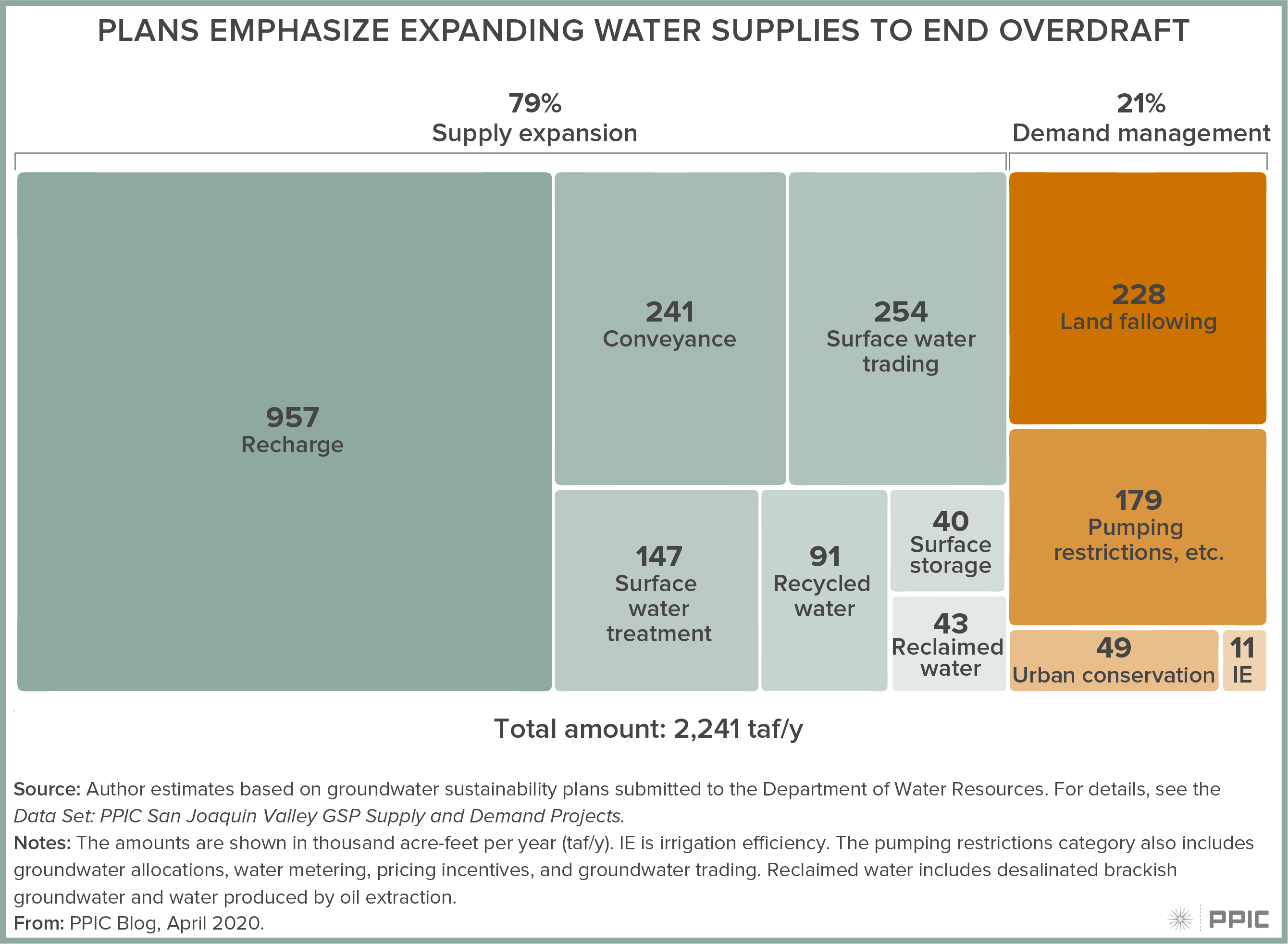
As the figure below shows, the plans consider a range of projects on both the supply and demand sides. Together, these projects would yield roughly 2.2 maf per year—in principle, enough to end regional overdraft. However, the plans invert our estimates: they assume that new supplies will account for more than three-quarters of the total, while demand management will save less than one-quarter. In line with our analysis, the single biggest new supply is recharging groundwater basins with more floodwater: the plans target roughly 1 million acre-feet annually, primarily through many small, local projects. Big infrastructure investments—such as new surface reservoirs and regional aqueducts and canals—are largely left out.

figure - Plans Emphasize Expanding Water Supplies to End Overdraft


Are the goals for expanding supplies realistic?
Probably not. When it comes to recharge, water users will be competing for floodwater that can be feasibly captured—likely a much smaller volume than the total envisaged by the plans. Although that total might be physically available for recharge, there are serious capacity constraints to getting it underground. A central challenge is moving very large volumes of water to storage sites quickly. Addressing this challenge is likely to require regional investments in conveyance, and greater efforts to coordinate the management of surface and groundwater storage infrastructure in order to expand their combined impact. Even then, it is probably not feasible to capture all available water in very wet years.

There are also limitations for the other supply options. Most surface storage and surface water treatment projects will be looking to capture the same high flow water as recharge projects—heightening the competition for these supplies. And most surface water trading and recycled water projects will shift available supplies from some water users to others within the region, rather than causing an overall increase in regional supplies.

What about the plans for reducing demand?
For the most part, the plans fall short on their analysis of demand management. Since reducing water use in this region largely means reducing the amount of irrigated cropland, there’s been reluctance to seriously consider the demand side at this early stage of SGMA implementation. But it’s encouraging that at least some plans are starting to look at such options. Several plans propose tools for managing demand flexibly—for example, groundwater trading, fees tied to volumes pumped, and monetary incentives for land fallowing.

What’s next?
These new plans are an early step on the path toward groundwater sustainability. As implementation gets under way, early actions—such as piloting new approaches to manage demand flexibly and coordinating on smart and affordable supply investments—can lay the foundation for long-term success.

Note: The underlying data and additional notes on supply and demand options identified in these plans can be found in Data Set: PPIC San Joaquin Valley GSP Supply and Demand Projects.

Challenging Times for California

This is a time of global crisis. We are all living through a fast-moving, large-scale disaster that is having extraordinary public health and economic consequences. Here in California, public leaders and private industries took early action to mitigate the effects of COVID-19, putting policies in place to flatten the curve sooner than any other state. And while the full extent of the pandemic has yet to be realized, Californians should feel proud of our state’s ability to assess and respond rapidly to counteract this generational challenge.

The pandemic is touching every aspect of life today. Students, agricultural workers, health care practitioners—all Californians are struggling to adjust to enormous changes in their responsibilities and daily routines. At PPIC, we are thinking about the effects on our state’s most vulnerable populations: seniors living in areas with sparse medical care, children receiving free or reduced price lunches, essential workers struggling to stay above the poverty line.

We are also deeply concerned with what lies ahead. How will our economy—just recently in the longest growth cycle ever recorded—respond in the long term? How can the state improve opportunities for those hardest hit by this crisis? What can we observe, measure, and propose that will help California to rebuild itself efficiently, effectively, and equitably?

PPIC will be delving into these questions as this crisis plays out. For now, in these fluid and rapidly changing times, we are focused on bringing critical facts and information to the table—assessing the state’s economy, people, communities, and environment. Our blog series on COVID-19 provides wide-ranging analyses across key policy areas, from education to health care, from criminal justice to water policy. And the PPIC Statewide Survey will be offering perspectives on the pandemic and the economy from Californians across the state.

For 25 years, PPIC has worked hard to inform and improve public policy in California. 2020 may be one of our most challenging years yet, but we are ready and able to meet that challenge.

For PPIC’s full series on the coronavirus and California, visit our COVID-19 page.

How COVID-19 Closures May Disrupt Student Learning

All but one of California’s K–12 schools have closed in response to the COVID-19 pandemic, causing massive disruptions for the state’s 6.2 million students. This week, Governor Gavin Newsom announced that closures are expected to continue through the end of the school year, although the final decision rests with local officials.

School is technically still in session, but distance learning is unlikely to fully compensate for lost time. Assuming schools remain closed through the school year, how detrimental will this be to student learning?

First, learning time matters. In studies measuring how students performed based on differences in when they took exams, even a few days can have a large impact. We also know that missing school reduces academic performance and that chronic absenteeism is particularly damaging, tied to a variety of outcomes such as achievement, socio-emotional development, and dropout. However, the impact of missing school under normal, predictable conditions is less relevant to our current situation.

Disruption from weather-related closures may be a better gauge for how COVID-19 closures could impact students. Roughly 1.2 million K-12 students in California were affected by emergency closures last year, mainly due to wildfires and other weather-related events. According to data from Maryland, schools fare worse on state exams in years with more weather-related closures, despite these closures accounting for only a week of instruction on average.

However, when we consider the impact of individual student absences versus school-wide closures, the effects of closures are negligible. Educators may find it easier to compensate for school-wide closures by adjusting or delaying lesson plans. While this suggests a reason for optimism, mitigating entire months of lost instructional time will require more than reorganizing lesson plans.

Additional insights come from the long documented phenomenon known as “summer learning loss”: the typical student loses about one month’s worth of learning over the course of a summer. Importantly, summer losses tend to be larger for disadvantaged students who have access to fewer resources and learning opportunities while away from school.

This means that achievement gaps tend to grow during the summer, reversing gains achieved during the year. This is worrisome: if schools remain closed for the remainder of the school year, we may face an even larger “spring and summer” loss.

Notably, these effects would be on top of any effects from having fewer instructional days. Distance learning may help mitigate losses, but the state’s most disadvantaged students may fall even further behind because of inequities in access to computer equipment and internet connectivity.

Continued support for distance learning programs will be crucial as closures continue, as will efforts to give students better access to better online learning. Google’s plan to provide free Wi-Fi and laptops to thousands of students is a step in the right direction.

Policymakers could also consider options to recover lost time over the summer or in the following year, as evidence shows programs that offer more learning time—during the school year or the summer—can benefit students. While this strategy would be difficult and costly to achieve, the severity of the COVID-19 disruption to student learning may justify extraordinary options.

Counting Californians and Holding Elections in a Pandemic

Today is Census Day, the day to count everyone living in the country in 2020. It’s not the deadline for responses—you have until August 14 to complete your census form—just the “anchor day” for counting those living in your household. We talked to California Secretary of State Alex Padilla about the challenges the COVID-19 pandemic brings to counting Californians—and for holding elections in November.

Photo - Alex PadillaPPIC: What challenges does the pandemic bring to conducting the census?
ALEX PADILLA: Ensuring a fair and accurate count is tough under normal circumstances, and it’s made more challenging by this global health pandemic. A lot of the state and local strategies for engaging the public on the census have had to be modified or replaced with ones that are more effective when people are staying at home. The good news is, this is the first time it’s been possible to do the census online, as well as by phone or paper. We’re seeing people get more creative at staying in touch while keeping their distance, whether through video chats with their coworkers or using teleconferencing to stay in touch with family and friends. We can also use these methods to remind everyone to do the census.

It’s really important to remember that participation in the census is how we ensure our communities receive their fair share of federal dollars for critical needs such as public health, education, public safety, housing, and infrastructure. This message is really striking a chord right now.

PPIC: As they shelter in place, what can Californians do to help ensure an accurate census count?

AP: Every Californian should participate in the census, but also remind people they’re in touch with to do so. Assuring a complete and fair count depends on everyone doing the census. It’s not just a count of adults or voters or citizens; it’s for everybody living here.

California has an especially high number of hard-to-count populations—for example, communities of color, young people, and immigrant families and communities. More than 70% of Californians fit into a hard-to-count category. It already takes extra effort to ensure participation by these groups. The pandemic is not making the job any easier—at a time when the job is more important than ever for ensuring the state gets its share of federal funding for critical needs over the next decade.

Based on the prior census 10 years ago, California’s most undercounted population were kids under five years old. My youngest just turned five, and especially now with all the kids at home, it’s hard to imagine forgetting to include him as he’s the loudest member of our household! Today, kids who weren’t counted in 2010 are now teens who’ve been in school for years, but their schools haven’t been getting their full share of federal education dollars. It’s a very tangible way to think about it, and it shows the importance of the census for our quality of life.

There are many options for participating in the census. Go online or call in today. Once you’ve submitted your information, help us by spreading the word with neighbors you’re checking in on and friends and family.

PPIC: Talk about the administration of the upcoming election.

AP: To put it in context, we should recognize that throughout the nation’s history, Americans have gone to the polls—in times of war, during the Great Depression, and even during the deadly 1918 flu pandemic. So it’s not a matter of if or when we’ll hold the election. We have a date: it’s Tuesday, November 3. It’s a matter of how we hold the election in a way that is accessible, secure, and healthy for everyone—voters, elections personnel, poll workers. Many things California has championed to get more people voting really make a lot of sense in an era of public distancing. You can register to vote online. Voting by mail and in-person early voting are good ways to avoid crowds. We’re diligently working on expanding those opportunities.

Interactive: Many Californians Live in or Near Poverty

[vc_row][vc_column][vc_column_text]More than 7 million Californians are “near poor”: out of poverty, but within 1.5 times the poverty line, according to the California Poverty Measure. The near-poor population is slightly larger than the poor population, and many could be pushed into poverty by small expenses.

In California, a near-poor family of four who rents has annual resources that range between $32,500 and $48,800. Adults with less education and fewer work hours, renters, African Americans, and Latinos often have the highest poverty and near-poverty rates. Disparities that persist across poor and near-poor groups are reminders that the poverty threshold is not a hard line where economic hardship ends.

Among adults, full-time work does not remove the risk of poverty: 21% of people ages 25–64 working full-time, full-year jobs are in or near poverty. These full-time workers are more likely to live in near poverty (13.9%) than in poverty (7.1%). At the same time, adults in less than full-time jobs live in near poverty at about the same rate (19.7%) as those with no work (20.9%). But they are less likely to live in poverty (22.3%) than those with no work (32%).[/vc_column_text][/vc_column][/vc_row][vc_row max_width=”80″ visibility=”visible-desktop”][vc_column][vc_column_text]

[infogram id=”1p9yd5nm9kxnddf7zryd5dqnp1b3xnwkjnq?live”]

[/vc_column_text][/vc_column][/vc_row][vc_row max_width=”80″ visibility=”visible-tablet-landscape”][vc_column][vc_column_text]

[infogram id=”1p9yd5nm9kxnddf7zryd5dqnp1b3xnwkjnq?live”]

[/vc_column_text][/vc_column][/vc_row][vc_row visibility=”visible-tablet-portrait”][vc_column][vc_column_text]

[infogram id=”1p9yd5nm9kxnddf7zryd5dqnp1b3xnwkjnq?live”]

[/vc_column_text][/vc_column][/vc_row][vc_row visibility=”visible-phone”][vc_column][vc_column_text]

[infogram id=”1p9yd5nm9kxnddf7zryd5dqnp1b3xnwkjnq?live”]

[/vc_column_text][/vc_column][/vc_row][vc_row][vc_column][vc_column_text]Resources from social safety net programs play a substantial role in moving people out of poverty—2.7 million more Californians would be poor if not for the social safety net. However, many of those moved out of poverty nonetheless live in near poverty, as broader factors like the cost of housing and available jobs play key roles in the resources they have on hand.

As California policymakers address poverty through tax credits, safety net programs, and housing policies, near-poverty rates provide another view into the state’s lowest-income populations. Reducing poverty in California will require attention to how families can be lifted out of poverty and also positioned for long-term economic security.[/vc_column_text][/vc_column][/vc_row]

Making Progress on Connecting Student Data across California

California students may fall through cracks in the state’s public education system because K–12 data and college data are not connected. For example, the state and its public universities are currently unaware of students who do not apply to UC or CSU despite being eligible, making it impossible to encourage these students to apply. Connecting education data can help California recognize and improve key transitions in student progress.

The current data system is fragmented across institutions, leaving California as one of eight states without a modernized approach to tracking its educational pipeline. By passing the 2019 California Cradle-to-Career Data System Act, the state is taking action toward linking education data across its many sectors.

As a first step, California has appointed a workgroup that will recommend a framework to the legislature and the Department of Finance within a year. This workgroup will determine relevant data elements to include—variables such as graduation, eligibility, and enrollment—along with when and how to combine data, where to store results, and who governs access to data.

So far the process has been inclusive and transparent, with representatives from all sectors of education, advocacy groups, researchers, technology experts, lawyers, and others stepping forward to serve on committees and advisory groups. Many member organizations of the California Education Data Collaborative, an organization convened by PPIC, are serving in advisory groups. Advisory group meetings are open to the public, and people can find information, meeting materials, and notes on the California Data System website. Public comments are encouraged at all meetings and on the website.

On January 16, PPIC attended its first meeting with the Policy and Analytics Advisory Group, where we discussed use cases around research and accountability, such as analyzing how financial aid offers to high school students impact college outcomes. The advisory group also agreed on a critical first step for the state: evaluation and analysis of student pathways from school to work. Advice from this advisory group and others will help the state’s workgroup make recommendations on January 30 to determine the scope and first phase of the data system.

PPIC will continue to participate in the advisory group and monitor the monthly workgroup meetings; notes and materials will be posted at California Data System, and we will update progress on this blog.

Interactive: Californians’ Views on Homelessness

[vc_row][vc_column][vc_column_text]Homelessness is a growing concern in California, where nearly a quarter of the nation’s homeless population lives. The crisis comes amid sky-high housing costs and widening income inequality. PPIC’s latest survey explores residents’ perceptions of homelessness in their part of the state.

Eighty-five percent of Californians say they are concerned about the presence of homeless people in their local community, including 58 percent who are very concerned. Majorities across regions and demographic groups say they are very concerned about this issue.

In addition, about six in ten Californians (58%) say the presence of homeless people has increased in their local community over the past year. Four in ten say it has stayed the same, while only 3% say it has decreased.

The chart below allows you to take a closer look at how different Californians view this issue. Across regions, Los Angeles (63%) residents are the most likely to say the presence of homeless people has increased. This is in line with recent data showing Los Angeles County saw a spike in homelessness in 2019. African Americans (73%) and residents with annual household incomes under $40,000 (61%) are also especially likely to report an increase in homelessness in their community. Very small shares of Californians report a decrease in the presence of homeless people.[/vc_column_text][/vc_column][/vc_row][vc_row max_width=”80″ visibility=”visible-desktop”][vc_column][vc_column_text][infogram id=”1p0621pw3w90yltegez9kvk6xdanq1qd6ey?live”][/vc_column_text][/vc_column][/vc_row][vc_row max_width=”80″ visibility=”visible-tablet-landscape”][vc_column][vc_column_text][infogram id=”1p0621pw3w90yltegez9kvk6xdanq1qd6ey?live”][/vc_column_text][/vc_column][/vc_row][vc_row visibility=”visible-tablet-portrait”][vc_column][vc_column_text][infogram id=”1p0621pw3w90yltegez9kvk6xdanq1qd6ey?live”][/vc_column_text][/vc_column][/vc_row][vc_row visibility=”visible-phone”][vc_column][vc_column_text][infogram id=”1p0621pw3w90yltegez9kvk6xdanq1qd6ey?live”][/vc_column_text][/vc_column][/vc_row][vc_row][vc_column][vc_column_text]Given the complexity of the homelessness crisis, the governor and state legislature must think of creative and sustainable solutions. One possible approach is a law that would require local governments to construct enough shelter beds so that any homeless person requesting to come indoors could do so. When asked about this proposal, an overwhelming majority of Californians (76% adults, 70% likely voters) are in favor. There is support for the policy across parties, regions, and demographic groups.[/vc_column_text][/vc_column][/vc_row][vc_row max_width=”80″ visibility=”visible-desktop”][vc_column][vc_column_text][infogram id=”1prd6drdjkx025ig27z3kwz276smgp3jj2r?live”][/vc_column_text][/vc_column][/vc_row][vc_row max_width=”80″ visibility=”visible-tablet-landscape”][vc_column][vc_column_text][infogram id=”1prd6drdjkx025ig27z3kwz276smgp3jj2r?live”][/vc_column_text][/vc_column][/vc_row][vc_row visibility=”visible-tablet-portrait”][vc_column][vc_column_text][infogram id=”1prd6drdjkx025ig27z3kwz276smgp3jj2r?live”][/vc_column_text][/vc_column][/vc_row][vc_row visibility=”visible-phone”][vc_column][vc_column_text][infogram id=”1prd6drdjkx025ig27z3kwz276smgp3jj2r?live”][/vc_column_text][/vc_column][/vc_row][vc_row][vc_column][vc_column_text]As state policymakers work on their policy agendas for the next year, we will continue to monitor Californians’ views on homelessness and related policies closely.[/vc_column_text][/vc_column][/vc_row]

Taking on Tough Challenges at the State Water Board

The State Water Board is central to addressing many of California’s major water challenges, including protecting water quality for drinking and for the environment, addressing drought and water conservation, and managing the allocation of surface water. We talked to Sean Maguire, a civil engineer who was appointed to the board by former governor Brown in December 2018, about priority issues.

Photo of Sean MaguirePPIC: What are the big challenges the board is grappling with right now?

Sean Maguire: At the top of our list is the Bay Delta water quality control plan. The plan, which covers the Sacramento–San Joaquin watershed and Delta, must ensure a reliable water supply and protect the basin’s fisheries and ecosystems. We’re working through a process that is very complex and has a lot of moving pieces—and right now it’s unclear if we’re on track to meet all of these goals. But it’s exciting to think there is a stakeholder-devised solution at hand—the voluntary agreement process—which would set out a plan to manage multiple rivers in a coordinated way, coupled with large-scale habitat restoration and science programs. There is still a long ways to go, but I have hope that voluntary agreements will prove to be the best path forward.

At the same time, we’re preparing for climate change. It’s clear that going forward we have to be incredibly efficient in our water management. The last drought resulted in legislation to establish indoor and outdoor water use efficiency targets and to require urban suppliers to develop stronger drought contingency plans. Many small water systems rely on a single source—most often groundwater—and we’re helping them find opportunities to connect to larger communities and identify new supplies. This is where water portfolios can help build resilience to drought and get us ready for a changing climate.

And finally, the most exciting news is the establishment of the Safe and Affordable Drinking Water Fund earlier this year. California has 7,000 water systems and hundreds of thousands of residents using domestic wells—a situation that presents a lot of challenges because many struggle to meet drinking water standards. The fund is a high priority for us, and we’re committed to coming up with a plan and policies to implement it, while also working on projects that can get started right away.

PPIC: Talk about contamination challenges.

SG: Water contamination is a huge challenge for the whole state. There are so many different sources, and many contaminants of emerging concern. The board is at the beginning of tackling PFAS contamination. This is a class of “forever chemicals” used in a wide range of products—for example, nonstick coatings, water repellants, take-out containers, and fire retardants. We’re moving quickly to better understand the risk by requiring testing wells in close to possible source sites (such as defense facilities, landfills, and airports), and also requiring those facilities to test local groundwater. We are also working to understand the human health effects, which will take some time.

PPIC: What gives you hope?

SG: In the past year, there’s been incredible collaboration surrounding really controversial water issues that have lingered for decades. I’m very hopeful about the stakeholder-informed solutions that are arising out of these processes. In addition to the Bay Delta process, we now have a strong wetlands policy—a collaborative solution that was a decade in the making. We have another stakeholder plan to address legacy pollution from farming and other discharges in the Central Valley. I hope we can repeat this type of collaboration with other issues and in other watersheds across the state. I have a lot of hope for the groundwater sustainability plans that are being developed now in the state’s overdrafted basins. And I believe the governor’s upcoming water resilience portfolio will give us a roadmap to help California prepare for the climate changes to come.

The state has a lot of complex water problems, and we can’t untangle them all with one brilliant policy change. But we’re making progress on many difficult issues, and I’m committed to keeping up the momentum.