In Memoriam: Dave Cogdill

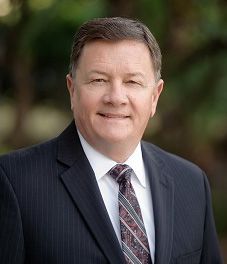
Dave CogdillFormer state senator Dave Cogdill’s death this week at 66 leaves us saddened for his family and friends and appreciative of the many ways he served California as a public servant and policy leader. Among his many efforts to address the state’s various policy challenges, Dave was a valued friend and trusted advisor to PPIC and a respected member of the PPIC Water Policy Center’s advisory council. We will greatly miss his contributions.

Dave served three terms in the state Assembly and was the Senate Republican leader from 2008–09. He also served as commissioner on the California Water Commission, assessor for Stanislaus County, chairman of the Maddy Institute at Fresno State University, and most recently as president and chief executive officer of the California Building Industry Association (CBIA).

Dave wasn’t afraid of taking on tough issues or working across the aisle. In 2010, he was awarded the Profile in Courage Award from the John F. Kennedy Library Foundation for his work on the 2009 California budget crisis. He took on the daunting issue of water with diligence and determination, playing a key role in the passage of a bipartisan package of reforms in 2009 that included the Delta Reform Act, bills to improve water use measurement and efficiency, and a water bond to support various programs, including new water storage.

“Dave negotiated some of California’s biggest water legislation ever, over two administrations,” said Deborah Gonzalez, PPIC’s director of government affairs, who worked with Dave on various policy initiatives over the years. “Water bonds are hard to negotiate under any circumstances, but he carried this one through two different governors and in true bipartisan fashion. He was instrumental in getting it passed.” The water bond that Dave helped craft was ultimately approved by voters in November 2014. Applications for state matching grants for storage projects—a priority for Dave—are due to the California Water Commission this August, with decisions due early in 2018.

At CBIA he took on the challenge of expanding housing supply to meet the needs of a growing state and made a strong effort to ensure that California’s new homes would be as water efficient as possible.

We’re thankful we had the opportunity to work with Dave.

Learn more

Read our interview with Dave on making homes more water efficient.
Read an obituary of Dave Cogdill in the Fresno Bee.

Proposition 57’s Impact on Prisons

Proposition 57 creates opportunities for the release of thousands of state prisoners through the expansion of parole eligibility and good conduct and programming credits. When 64% of voters approved the measure in November 2016, there were few details about how it would be implemented. During the 2017–18 budget process, the California Department of Corrections and Rehabilitation (CDCR) outlined implementation plans and population estimates, and now we have a better sense of the potential impact of this measure on the prison population.

Proposition 57 will significantly reduce the number of prison inmates—and, in combination with other statewide criminal justice reforms over the past six years, it will enable the system to keep its inmate population below the court-ordered cap of 137.5% of design capacity. Overall, Proposition 57 is expected to reduce the population by more than 2,600 inmates in 2017‒18, with a net cost savings of nearly $40 million. Long-term estimates put the population impact at 11,500 by 2020–21, for an annual savings of more than $180 million.

CDCR’s new parole regulations exclude prisoners who are serving a term for a violent felony (as defined by Penal Code 667.5), required to register as sex offenders under Penal Code 290, serving life sentences, or on death row. Eligible offenders receive parole consideration after serving full sentences for their primary offenses (their longest sentences). These offenders are no longer required to serve sentence enhancements for gang activity or prior prison terms. The state estimates that this new process—which went into effect on July 1—will reduce the prison population by almost 500 offenders in fiscal year 2017–18.

CDCR has also created additional educational and rehabilitative programming and increased the amount of credits inmates can earn for both good behavior and program completion. For example, in 2015 there were 95 career technical education programs (including training in auto repair, home construction and maintenance, and office technology); now there are 197 programs, with new classes in almost every career tech area.

Good behavior credits were expanded for almost all eligible inmates on May 1, 2017. The expanded programming credits will take effect August 1, 2017. The state estimates that these additional credit earning opportunities will reduce the prison population by more than 2,100 in the 2017–18 fiscal year.

State officials believe that Proposition 57 will allow them to keep the prison population below the cap while maintaining public safety. In addition to monitoring Proposition 57’s effect on public safety, recidivism, and costs, corrections officials and policymakers should pay close attention to the supply, demand, and—most importantly—effectiveness of the education and rehabilitation programs offered to inmates to ensure that the measure’s goals are realized.

Video: Building Bay Area Drought Resilience

As water supplies dwindled statewide during the recent drought, Bay Area cities struggled with the consequences—including dying trees and landscaping and reduced revenues to run water systems. But overall, Bay Area water districts weathered the drought remarkably well, according to local water experts—in part, thanks to planning, cooperative efforts among neighboring water suppliers, and enthusiastic conservation on the part of their customers.

These were some of the observations from experts gathered at a recent event at PPIC’s San Francisco headquarters. Speakers included John Marchand, the mayor of Livermore, in conversation with Ellen Hanak, director of the PPIC Water Policy Center. A panel discussion moderated by KQED public radio’s Lauren Sommer followed. Panelists were Alexander Coate of the East Bay Municipal Utility District, Peter Drekmeier of the Tuolumne River Trust, Ken Jenkins of California Water Service, and Steven Ritchie of the San Francisco Public Utilities Commission.

“There are two components to drought resilience,” said Hanak in her introductory presentation. “One is having supply investments that reduce the risk of extreme shortages, and the other is the ability to manage demand in the short term.”

Speakers discussed a range of supply and demand tactics they used to build resilience in their cities and additional ways to prepare for droughts. Topics ranged from the use of treated wastewater for recharging groundwater basins and potable uses; the use of different financial mechanisms to maintain revenue as water sales dipped; and unintended consequences that arose, such as the potentially permanent loss of street trees and other landscaping as water conservation took hold.

Some essential takeaways included:

  • Regional diversification of water supply is key to getting through dry times.
  • Mandated conservation from the state was a blunt instrument; targets based on utilities’ local water conservation plans are more appropriate for such decisions.
  • Planning for “conservation rates” is essential for water districts’ fiscal resilience and maintenance of reserves to pay for fixed costs.
  • Aquatic ecosystems took a hit during the drought. Even though Bay Area cities embraced water conservation throughout the drought, flows to the Tuolumne River and Delta were inadequate. Addressing this before the next drought hits is key to maintain ecosystem health and at-risk species.

Learn more

Read the report Building Drought Resilience in California’s Cities and Suburbs (June 2017)
Read California’s Water: Water for Cities (from the California’s Water briefing kit, October 2016)
Visit the PPIC Water Policy Center’s drought resource page

UC’s Experiment in Measuring Costs

When it comes to government budgets, the focus is usually on who gets how much. But that’s only part of the story of the California state budget, which usually includes a host of provisions that specify how the money is to be used. This year’s budget is no exception—and one relatively obscure provision could help University of California (UC) campuses optimize their budgetary decision-making.

A lot of attention has been paid to the budget provision that withholds $50 million from UC until the university’s Office of the President (UCOP) implements the recommendations contained in an unflattering state audit. Our focus, however, is on another, little-noticed provision that requires UCOP to complete an experiment in “activity-based costing”—a detailed way of tracking and measuring university expenditures.

As we noted in a recent report, it is challenging to track dollars as they flow through higher education systems. Public universities typically have multiple funding sources and several missions and activities, all of which combine to create an intricate web of dollars. Activity-based costing focuses on an institution’s expenditures to identify where money is going. In a pilot program at UC Riverside, administrators have combined data on students, faculty, courses, and finances to create a detailed picture of the costs associated with instruction. The information enables administrators to estimate costs at various levels—from how much it spends to run a department down to the cost of teaching a single class section. The enacted budget requires UCOP to expand UC Riverside’s activity-based costing to three departments on each of two additional campuses.

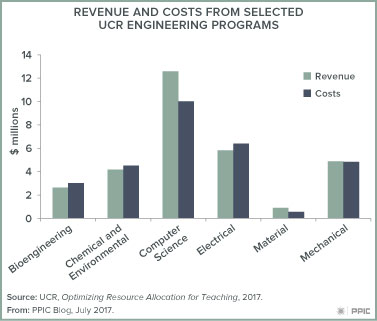
Activity-based costing has the potential to inform conversations among campus administrators about the trade-offs involved in using resources to improve student outcomes. For example, the conventional wisdom is that it is expensive to increase enrollment in STEM (science, technology, engineering, and math) programs. By applying activity-based costing, UCR budget and planning officials found that expanding the biology and computer science departments would not necessarily be costly. Because of the size of enrollment and the way courses are taught and faculty are assigned, the revenue generated by those departments exceeds the cost of expansion. The cost of expanding programs in electrical engineering and bioengineering, on the other hand, is currently higher than the revenue generated from enrollment.

The takeaway is that if administrators feel that expanding the electrical engineering program is a priority, they should pursue it knowing that they will need to find additional sources of revenue.

The UCR pilot has also enabled the university to understand the costs of instruction at a high level of detail. Our report calculated the changes in the cost per degree over time for both the UC and California State University systems. UCR was able to break down the cost per degree by type. For example, producing an engineering degree costs, on average, 16% more than a degree in social science. The cost of a humanities degree falls between the two. A significant portion of that cost difference could be attributed to the fact that it takes longer for engineering students to complete their degree requirements.

Activity-based costing isn’t a substitute for goal-setting and planning. It is a tool that can help an institution better align its resources with its goals. Another takeaway from the UCR pilot is that implementing activity-based costing is a complicated endeavor that requires a broad commitment from the institution. The process of expanding this pilot—and what administrators learn from it—bears watching.

Learn more

Video: California’s Voter Turnout Challenge

California has a voter turnout problem with two distinct elements. Registration is falling compared to other states, and turnout among those who are registered in midterm elections is down. A new PPIC report examines the state’s challenge and suggests some solutions. Report author and PPIC research fellow Eric McGhee presented it at a briefing in Sacramento last week. He found that each element of the state’s turnout has a different origin in the state’s demographics:

  • Registration. The composition of California’s electorate has been changing quickly. Latino and Asian American communities have become eligible to vote at faster rates in California than in other states. But these groups register to vote at lower rates than other Californians, leading to an overall decline in California’s registration rate relative to other states.
  • Turnout. One group of the state’s registered voters has become less likely to turn out in midterm elections: young people. The issue here is one of consistency, McGhee said. “Young people are showing up for presidential elections—they’re just not voting in the following midterm,” he said.

What are the solutions? McGhee said that while the state has passed a number of laws to ease voter registration, changes to the process will not necessarily solve the problem. He said these reforms will need to be coupled with aggressive outreach targeting each group—Latinos, Asian Americans, and young voters—to inspire them to participate in elections.

Read the report California’s Missing Voters: Who is Not Voting and Why.

The Search for Sustainability in the Colorado River Basin

The Colorado River is a crucial water source for seven states (Wyoming, Colorado, Utah, New Mexico, Arizona, Nevada, and California) and Mexico, and like many shared rivers has its share of challenges. We talked to Doug Kenney—director of the Western Water Policy Program at the University of Colorado and a member of the PPIC Water Policy Center research network―about balancing priorities in managing the river.

PPIC: What’s the basin’s biggest challenge currently?

DOUG KENNEY: That depends on what part of the basin you’re in and what sector you work in. There’s no shortage of things to worry about. Right now, most would probably say it’s the effort to maintain the levels of water stored in the big reservoirs, Lake Mead and Lake Powell. Those reservoirs provide a lot of benefits—drought protection, recreation, and hydropower—but only if they have enough water in them. They’re about half full right now, which is about as low as they can go before mandatory cuts in water deliveries—or curtailments—kick in. It’s a math problem, essentially—managing water coming in versus what’s going out. So far in this century, people have pulled more water out than consistently flows in. Obviously, that has to change.

The more chronic issue is that the Colorado has been treated more like a plumbing system than a river, so there’s been a lot of environmental damage to the river. The big environmental concerns in the basin are a result of reduced flows and some water quality issues, such as high salinity, loss of valuable sediments, and increased water temperatures. The real challenge is to remind people we’re talking about a river—the most important ecological resource of the southwest United States.

PPIC: What efforts are underway to address the problems?

DK: The big effort at the moment in the Lower Basin is called drought contingency planning, which would help stabilize (and ultimately increase) the amount of water stored in Lake Mead. The negotiations among California, Arizona, and Nevada have gone remarkably well in this regard, although each state still has internal challenges to work through. For example, Arizona is concerned about looming curtailments of their water supply, while in California the big sticking point is the Salton Sea. The sea has become a critical issue as successful efforts to use water more efficiently in Southern California agriculture have reduced inflows, resulting in a host of environmental and public health issues. In both of the situations, the underlying desire is to protect water supplies for urban users in a way that doesn’t impose undue burdens on agricultural regions.

Another issue worth watching is the 2012 agreement between the US and Mexico that laid out cooperative efforts to manage the river. The agreement expires at the end of this year, and a new one is needed to maintain positive momentum and cooperation. Key issues between the US and Mexico include restoring the river’s delta ecosystem, enabling Mexico to store water in Lake Mead, and sharing water shortages during drought. While cooperation on the Colorado between the US and Mexico has gotten dramatically better in the past decade, people are worried that the tensions arising from the current political environment at the national level could spill over to the negotiations. But so far, the two sides are still talking, and people still seem pretty optimistic about reaching an agreement.

PPIC: How do upstream states view California’s efforts to manage its Colorado River supplies?

DK: Everyone in the basin pays attention to what’s going on in California. California has the largest and arguably the most legally secure allocation of Colorado River water rights. California’s dependence on the river is shaped by many factors, including other water issues within the state. For example, the project to build tunnels under the Sacramento-San Joaquin Delta—if it progresses—would go a long way to create some room for compromise and creativity on how Southern California uses its Colorado River supplies. With every passing year it becomes more difficult to talk about the Delta and the Colorado as separate challenges. Everything is connected to everything else.

PPIC: How is climate change affecting the river basin?

DK: We’re already experiencing big climate-related changes in the basin. It’s already nearly 2 degrees Fahrenheit hotter this century compared to last, and by 2050 it will be closer to 5 degrees hotter. That results in higher evaporation rates, increased water demands, and reduced stream flows. Climate change is water change, and more heat works against all our water management goals. During this drought, precipitation has dropped only slightly but stream flows are way down, partly because it’s hotter. And that will continue―this is the part of climate projections we’re most certain of. Continued warming and the related reduction of stream flows is a huge problem.

Water management is traditionally based on the premise that the future will look like the past, but that’s not a safe assumption anymore. Our physical infrastructure isn’t ideally suited to the projected future hydrology. There’s a similar problem with our institutional infrastructure. We have a pretty sophisticated management regime that is increasingly out of step with evolving conditions. The good news is that key players in the basin now understand that the climate is affecting everything they do, and that they have to cooperate to find solutions to tough problems. People in the basin are committed to putting in the work, but there’s still a lot more to be done.

Learn more

Read California’s Water: The Colorado River (from the California’s Water briefing kit, October 2016)
Watch our 4-minute video “Colorado River”
Visit the PPIC Water Policy Center

College Graduates Have Higher Net Worth

Compared to less educated adults, college graduates generally see much stronger labor market outcomes, including greater labor force participation, more employment, and higher wages. This holds true across every demographic group—age, gender, ethnicity, and nativity. These differences are well-measured and well-documented.

But what about wealth? Wealth is one of the most important indicators of economic well-being, but it is difficult to measure and therefore information on wealth is much less widely available. Using recently released data from the US Census Bureau’s Survey of Income and Program Participation (SIPP), PPIC has developed new estimates of wealth for Californians. We focus on household net worth, the difference in value between all assets (including retirement accounts, savings accounts, investments, and real estate) and all liabilities (including mortgages, loans, and credit card debt).

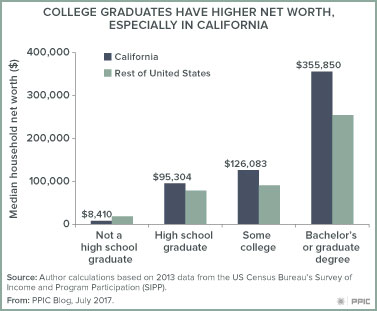
The estimates show that Californians are wealthier than adults in the rest of the nation. In 2013, median household net worth among adults age 25 and over was $135,000 in California compared to $105,000 in the rest of the United States. While many have expressed growing concern about income inequality, the distribution of wealth is even more uneven—a fact that is especially apparent when we examine wealth by educational attainment. In California, median household net worth is almost four times higher for adults with at least a bachelor’s degree ($356,000) than for high school graduates ($95,000). (In the rest of the nation, the difference is slightly more than threefold.) One in four college graduates in California is a millionaire, compared to one in fourteen high school graduates.

For most people, wealth accumulates over time. As college graduates consistently earn relatively high incomes year after year, their wealth grows. One in five young college graduates (age 25–34) in California has negative net worth—meaning they have more debt, including student loan debt, than assets. But over time, debt recedes and wealth increases. Among college graduates who recently retired (those age 65–74) in California, half are millionaires.


Higher education has long been key to economic progress for individuals and for the state. In future research, PPIC will explore the role of higher education in promoting social and economic mobility. Ensuring that higher education continues to put people on the path toward economic well-being is a central policy issue.

Learn more

Read Higher Education in California: Addressing California’s Skills Gap
Visit the PPIC Higher Education Center

Next Steps in Implementing California Marijuana Law

Despite uncertainty at the federal level, California is making steady progress toward creating a system to regulate the legal use of marijuana. In many ways, the most interesting activity in marijuana policy is taking place at the local level, as counties and towns wrestle with how to define the role of the industry in their communities.

This year’s state budget includes a trailer bill designed to address a number of implementation issues raised by the passage of the Medical Cannabis Regulation and Safety Act in 2015 and Proposition 64 last fall. The biggest challenge was reconciling the two laws to create a single regulatory framework for both medical and recreational marijuana, a recommendation put forth in a recent PPIC report. The trailer bill also includes other provisions that aim to clarify and fill in details around implementation. For example, the bill:

  • Enhances environmental protections and specifies organic standards.
  • Makes it possible for smaller growers to form co-ops to enable them to compete with larger producers.
  • Allows for the designation of appellations, similar to the wine industry.
  • Supports a study of driving under the influence and creates a task force to make recommendations about enforcement. It also creates a new “open container” definition for cannabis and driving, making it an offense (with a $100 fine) to have in a car marijuana that is loose or in a container that is open or has a broken seal.
  • Establishes a method to collect the cultivation and excise taxes imposed by Proposition 64.

Although Californians have supported the legalization of both medical and recreational marijuana, possession of the substance remains illegal under federal law. In past years, Congress has passed legislation that makes enforcement of federal marijuana law a low priority. However, Attorney General Jeff Sessions, who has opposed relaxing restrictions on marijuana, has reportedly sent a letter to Congress asking that it rescind that directive. Like so many federal-state issues at that moment, it is very difficult to predict future decisions concerning enforcement of federal marijuana law.

The relationship between the state and local jurisdictions is clearer. One section of the trailer bill reaffirmed that the new regulatory structure does not limit the authority of cities, towns, and counties. But the clarity of that relationship doesn’t mean that there isn’t controversy. Conflicts have emerged within communities as they try to balance different local interests.

For example, Proposition 64 allowed for the cultivation of up to six plants per individual. In January, the city of Fontana passed an ordinance requiring any resident who wanted to grow up to six plants purchase a $411 permit. Getting a permit required that the applicant have no prior drug convictions or overdue fines. The ACLU (American Civil Liberties Union) and the advocacy group Drug Policy Alliance have joined together to file a lawsuit claiming the ordinance is too restrictive.

Calaveras County also illustrates the challenges of implementing marijuana regulations at the local level. At the same time that Proposition 64 received support statewide, 67% of Calaveras voters approved a county tax on marijuana production. The tax vote appeared to signal the county’s support for the marijuana industry. This past spring, however, after four of the five seats on the county board turned over, that body began considering a ban on commercial cultivation. With more than 1,000 registered growers (who each paid $5,000 in fees to operate) in a county of 45,000 people, the proposed ban is controversial.

Findings from the PPIC Statewide Survey support the idea that cannabis becomes divisive when the issue moves closer to home. When asked about the federal role, 60% of California adults and 66% of likely voters in our May survey said that the federal government should not enforce federal marijuana law in states that have decided to allow marijuana use. And though a majority of California adults (56%) say marijuana should be legal, state residents are divided when it comes to retail sales of marijuana in their communities. While 48% favor retail sales of recreational marijuana in their city or community, a similar proportion (47%) are opposed. Regionally, opposition to retail sales is highest in Orange/San Diego Counties (53% oppose). As cities across the state determine the regulatory standards for marijuana sales, they may find divergent views within their communities.

Federal, state, and local governments all have a say in marijuana regulation. It is clear from the issues yet to be resolved that the statewide election was just the beginning of a complex process to build the regulated, legal market for cannabis that California voters supported.

Regional Action to Boost College Success

California needs 1.1 million more workers with bachelor’s degrees by 2030 to keep up with economic demand, PPIC research has found. Three regions will play an especially critical role in addressing this challenge: Los Angeles County, the Inland Empire, and the San Joaquin Valley.

Improving college enrollment and graduation rates in these regions could help close more than half of this projected statewide skills gap, according to a new PPIC report, Meeting California’s Need for College Graduates: A Regional Perspective. It analyzes the challenges ahead and recommends ways to meet them. At a Sacramento event, report coauthor Kevin Cook summarized the findings and a panel of experts described promising initiatives already underway in these regions. Report coauthor Hans Johnson, director of the PPIC Higher Education Center, moderated the panel discussion.

Panelist Benjamin Duran, executive director of the Central Valley Higher Education Consortium, said his group has created a partnership of public and private colleges and universities, as well as community college districts, from Kern through San Joaquin Counties. One of the consortium’s projects involves improving remedial education, which has traditionally consisted of non-transferable classes that delay—and all too often end—students’ college careers. Under the newer approach championed by the consortium, students deemed underprepared for college work are able to enroll in college-level courses right away but also get supplementary support.

The Central Valley consortium is also working to encourage more students—particularly those in the community colleges—to take 15 units per semester or 30 per year so that more of them graduate on time. “When you’re able to go to school full time, the research is showing that you’re far less likely to drop out—you’re going to finish quicker,” Duran said.

Alma Salazar, senior vice president of the Center for Education Excellence and Talent Development at the Los Angeles Area Chamber of Commerce, said, “We do what all great organizations do—we take someone else’s idea and try to make it better.” The result, she said, is the L.A. Compact, modeled after an effort in Boston. It is a collaboration among area organizations, educational institutions, unions, and local government leaders. The focus is on three goals:

  • All students graduate from high school;
  • All students have access to and are prepared for success in college; and
  • All students have access to pathways to sustainable jobs and careers.

Ken O’Donnell, associate vice president of the Student Success Program Integration and Assessment at California State University, Dominguez Hills, talked about his campus’s success in improving its six-year graduation rate from about 30% to 42% in a few years. O’Donnell echoed the PPIC report, which finds that improving success rates for those already in college will have the greatest impact on the statewide skills gap. “You’ve already improved capacity without adding a single additional seat,” he said.


Learn more

Read the report Meeting California’s Need for College Graduates: A Regional Perspective
Visit the PPIC Higher Education Center

The Changing Face of California’s Water Leadership

California’s water managers face many challenges—from a changing climate to a growing population. We spoke with Celeste Cantú, chair of the PPIC Water Policy Advisory Council. Cantú served for more than a decade as general manager of the Santa Ana Watershed Project Authority and is stepping down this month. She talked about how the profession must change to better address these issues.

PPIC: What does it mean to be a “water leader” in California today?

Celeste Cantú: Currently, our water leaders primarily draw from an engineering skill set; their goal has been to manage discrete problems with precisely targeted solutions. That approach has proven to be too piecemeal for the water challenges we face today. Going forward, water leaders will need to be change agents. Water leaders will need to step out of their silos and see how their work fits into the larger context of the watershed, and think about upstream and downstream impacts. They’ll need “soft skills” such as conflict management in addition to technical expertise, because key to addressing 21st century water problems will be the ability to collaborate and develop solutions that benefit the larger system or watershed.

How we think about water is also changing. For most of the 20th century we managed water as if it were fuel you burned until it was gone. But water constantly circulates. Every drop delivered goes somewhere else when we’re done with it—usually, it’s treated and returned to a river, where someone downstream is likely to use that drop again. Historically, we water managers haven’t seen ourselves as interacting in that cycle―we see ourselves more in the context of our discipline or local agency. By thinking about the entire water cycle, we can manage the drop to get more beneficial uses from it. We get as many as 10 or 20 uses in the Santa Ana watershed before we release it to the ocean. It’s been said that a drop of water in the Santa Ana River is the hardest working drop in California! Collaborating across boundaries to get more uses from that water drop is the defining challenge of a successful 21st century water strategy.

PPIC: How have the state’s water challenges changed?

CC: I’ve seen an upward spiral of progress over the course of my career. Early on, we mostly were thinking about how to reduce pollution from particular sources. After getting that pretty much taken care of, we moved on to addressing more diffuse pollution that doesn’t come from one place. We’ve made progress but still have quite a ways to go. I’ve also seen an evolution toward integrated water management, an important strategy that addresses multiple water issues more efficiently and synergistically. It means the water supply agencies work with the stormwater agencies and water quality people to get more functionality out of that water drop. We’ve made progress on this as well. Finally, thanks to California’s leadership, we have a much better understanding how much water we use and how to conserve it.

PPIC: Will the next generation of water leaders face new water challenges?

CC: They absolutely will, due to climate change, but they also come much better prepared to address these challenges. They bring a greater understanding of the linked qualities that exist in nature and which define water resource management. They come better prepared for collaboration and not only solving problems but creating a new vision of resiliency. I am optimistic, and committed to sharing knowledge with the new leadership. After I retire this month I’ll be working with Water Education for Latino Leaders (WELL), which helps cultivate water leaders among elected officials working in Latino communities.

The incoming generation of water leaders is much more diverse. California needs water leaders who reflect our demographics, or they will lack standing or legitimacy. We’ll need to make some difficult choices and substantial investments in water in the future. Since we don’t have sufficient revenue streams, water managers will have to have trusting relationships with their ratepayers. People from the community are better able to develop those relationships.

Learn more

Explore the California’s Water briefing kit
Visit the PPIC Water Policy Center’s water supply page