Video: Californians Concerned about Cost but Give State’s Colleges Good Grades

Many Californians say the state’s public higher education system is going in the wrong direction, a new PPIC Statewide Survey shows. But they are more likely to say they are concerned about affordability than about the quality of the state’s colleges and universities. Just 18% of all adults say quality is a big problem, compared to 56% who call affordability a big problem.

Researcher Lunna Lopes presented the findings of PPIC’s annual survey on higher education to a Sacramento audience last week.

Among the survey findings underscoring Californians’ concerns about college affordability: 75% say the cost of college keeps students who are qualified and motivated from attending, 79% say students have to borrow too much money to pay for college, and 85% say colleges and universities should do more to make sure that all students have affordable housing options.

In contrast to Californians’ views on costs, solid majorities of residents give excellent or good ratings to the state’s community colleges, California State University, and the University of California.

Californians are divided on whether a college education is necessary to succeed in today’s work world, with half saying it is and 48% saying there are many ways to succeed without college. There are strong differences among demographic groups on this question. Two-thirds of Latinos say college is necessary, compared to just 35 percent of whites. And 59% of Californians with household incomes of $40,000 or less say college is necessary, compared to 42% of those whose incomes are $80,000 or more.

Despite this divide over whether college is necessary for success, 80% of Californians say the public higher education system is very important to the future quality of life and economic vitality of the state.

Videos: Priorities for California’s Water

This past year brought drought-busting rain and snow and severe wildfires—extremes that tested California’s systems for managing water supply and the natural environment and foreshadow conditions of a changing climate. In light of these challenges, a PPIC Water Policy Center event in Sacramento last week brought together experts to discuss ways forward in three areas: legislative priorities for cities, farms, and rural communities; partnerships that improve the health of ecosystems; and decisions for the Colorado River and Sacramento–San Joaquin Delta.

Ellen Hanak, director of the PPIC Water Policy Center, began the program by summarizing priorities for California water outlined in a new PPIC report. These include California’s ability to recharge aquifers, maintain dams and levees, manage headwater forests and aquatic ecosystems, and provide safe drinking water to rural communities.

The first panel examined a host of proposed, passed, and pending water bills, covering topics as diverse as funding water infrastructure, improving water-use reporting, and addressing safe drinking water problems.

The lack of safe drinking water in disadvantaged communities prompted a lively conversation on how to pay for a lasting solution to the problem. Laurel Firestone, codirector of the Community Water Center, noted that while California has passed a resolution declaring a human right to water, the state’s drinking water crisis—which she said dwarfs that of Flint, Michigan—will take a more concerted effort to resolve.

One possible funding solution the panel discussed is a tax on fertilizers to pay for cleaning up groundwater contaminated by nitrate, which can cause health problems. “This is a legacy problem that stems from the over-application of nitrogen fertilizer for many, many decades,” said Dave Puglia, executive vice president of Western Growers.

The second panel tackled a problem even longer in the making: the crisis in California’s aquatic ecosystems. “We spent 150 years fundamentally changing the ecosystem… We’ve spent about 40 years actively failing to do something about it,” noted Lewis Bair, a water resource engineer with Reclamation District No. 108. “Our system is so modified, and there’s so much work to do, it will probably take a generation to make significant change.” The panelists discussed innovative projects and partnerships that are providing multiple benefits while also improving habitat for aquatic species—and how to scale them up to get broader effects at the ecosystem level.

The final panel looked at two watersheds that have outsized importance to California’s water supply: the Sacramento–San Joaquin Delta and the Colorado River. While the multi-state effort to improve management of the Colorado River has become a model of cooperation, efforts to make progress in the Delta have been more contentious.

Much of the conversation focused on WaterFix, the state’s proposal to modernize the Delta’s water export infrastructure with a pair of tunnels. Grant Davis, the new director of the California Department of Water Resources, called the Delta “the heart of the state’s water supply delivery,” and said that “the status quo will take us into unreliability and ultimately a crisis—and no one wants to manage water in a crisis.” The conversation turned to the long and difficult history of trying to resolve water conflict in the Delta, the need for reliable water supplies for agriculture, and the costs of the tunnels project.

We invite you to watch the videos from this event and hope you find the discussions illuminating and useful:


Learn more

Visit the Policy Priorities for California’s Water YouTube playlist
Visit the PPIC Water Policy Center

California’s Partisan Divide on Higher Education

New national polling shows a big divide has opened up between Democrats and Republicans on higher education. A Pew Research Center poll taken in June shows that a majority of Republicans and those who lean Republican (58%) think colleges and universities have a negative effect on the way things are going in the country, while a vast majority of Democrats and those who lean Democrat (72%) think colleges and universities have a positive impact. This is a big change from two years ago, when majorities in both parties said higher education institutions had a positive impact on the direction of the nation.

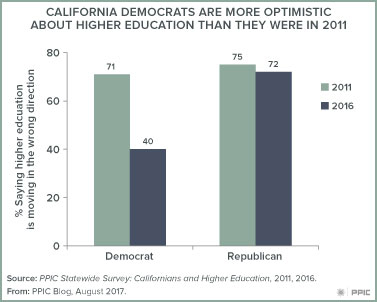
Is there a similar partisan divide over higher education in California? The PPIC Statewide Survey found a similar divergence over the past few years when we asked a different question: Is the state’s public higher education system generally going in the right or wrong direction? In 2016, California Republicans were far more likely than Democrats to say the system is headed in the wrong direction. This marked a change in the five years since we’d last asked this question. When we asked the question in 2011—toward the end of the recession and after large tuition increases—Californians in both parties overwhelmingly said higher education was moving in the wrong direction. Unlike national polling, which shows a shift in Republican opinion, PPIC surveys show a shift in the opinions of Democrats, who have become more positive, while Republicans have remained about the same.

Californians’ responses to other survey questions about higher education point to longer-term partisan divisions. Republicans have generally been more likely than Democrats to say that the overall quality of education in California’s public colleges and universities is a big problem or somewhat of a problem. Views about the direction and overall quality of public higher education are reflected in attitudes about California’s three public higher education systems. Currently about half of Republicans say that each of the systems—community colleges, California State University, and University of California—are doing an excellent or good job. More Democrats—about three-fourths—express this view.

Partisans have also historically differed on higher education funding. Compared to Republicans, Democrats are more likely to say that higher education does not receive enough funding, and Democrats are generally willing to pay higher taxes to support higher education.

Interestingly, there is some evidence that Californians’ views about the importance of college for individual success differ along party lines. A majority of Democrats (68%) say a college education is necessary for a person to be successful in today’s working world, while a majority of Republicans (72%) say there are other pathways to success. It is also true, however, that Californians in both parties have become more optimistic about the chances of success without a college degree since 2011—when the state was recovering from recession.

Finally, there are some areas of agreement. We find that members of both parties generally think that college affordability is a problem and students have to borrow too much money. Perhaps most significant is our finding that overwhelming majorities of both Republicans and Democrats say that the state’s system of higher education is important to California’s economic future and quality of life.

Learn more

Visit the PPIC Higher Education Center

UC Admissions: What the Numbers Mean

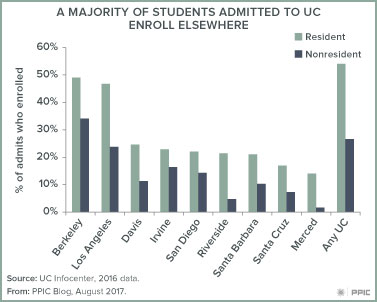
The University of California’s recently released admissions data shows that about 62% of all applicants were admitted to the system for fall 2017. There are big differences among campuses: admission rates range from 16% at UCLA to 72% at UC Merced. And UC expects that less than half of admitted students will enroll.

Figure 2: A Majority of Students Admitted to UC Enroll ElsewhereThe proportion of admitted students who enroll is called the yield rate. The yield rate is a product many factors, including which campuses students are admitted to and whether they are California residents. UC’s systemwide yield rate was around 45% last year; at each campus, the yield rate for nonresidents (27%) is much lower than that for residents (54%). The Berkeley and LA campuses have the highest yield rates, with almost half of their admitted students enrolling. Only about one in five admitted students enroll at the other campuses.

Where do students who decide not to go to the UC campus(es) that admitted them end up enrolling? UC generally faces competition from private schools in California and public and private universities in other states. Students also choose to go to a local CSU or plan to start at a community college, and low yield rates at some campuses are a byproduct of competition among UC schools. The average UC applicant for fall 2016 applied to four UC campuses, and the average admitted student was admitted to 2.3 campuses.

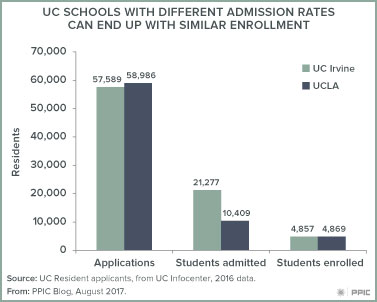
A UC school with higher admissions rates isn’t necessarily serving a larger number of Californians. The LA and Irvine campuses are about 50 miles away from one another and receive about the same number of resident applications. In 2016 UC Irvine admitted more than twice as many California residents (37% of applicants) as UCLA (18%). However, students admitted to UCLA are about twice as likely to enroll there, which leaves the two campuses with about the same number of entering students.

Figure 2: UC Schools with Different Admission Rates Can End Up With Similar Enrollment

The story is similar for nonresidents. Because UC’s yield rate for nonresidents is about half the yield rate for residents, a larger share of nonresidents are admitted: in 2016, nonresidents made up 33% of admitted applicants but only 19% of enrollees.

Campuses generally have state support and classroom space for a certain number of students and use their knowledge of yield rates to reach that target. Campuses with lower yield rates make many more admission offers, and all campuses make offers to more nonresidents than they plan to enroll.

That admissions strategy can be a problem for less competitive institutions. It is impossible, after all, to know if any given student will decide to enroll, and a small change in the yield rate can have big consequences. For example, while UC Irvine’s yield rate was 23%, a small jump to 25% would have resulted in more than 400 additional enrollees. Officials at Irvine maintain that over-enrollment was not the reason for their decision last month to rescind offers of admission to about 500 students (the campus has since readmitted many of those students). However, it is easy to see how high-stakes admissions decisions based in part on predictions of applicant behavior could quickly lead to either over- or under-enrollment.

Learn more

Visit the PPIC Higher Education Center

New Water Official’s Views on Salton Sea, Other Priorities

California’s State Water Board has a broad mandate to oversee our complex water system and balance all beneficial uses of water. Joaquin Esquivel―the newest member of the board and a member of the PPIC Water Policy Center’s advisory council―brings broad experience working on state and federal water issues, and personal and professional experience with the challenges of the Salton Sea. We talked with him about his priorities for California’s water issues.

PPIC: You’ll be engaged with the board’s effort to reduce environmental and public health problems at the Salton Sea. Why is this issue important?

JOAQUIN ESQUIVEL: The health and viability of the sea is important in many ways. It’s important to the health of our families and communities throughout the Imperial and Coachella Valleys. Many people who live there already struggle with poor environmental quality. It’s critical to the Pacific Flyway and the more than 400 bird species that use the sea. It’s key to the economies of surrounding communities, which could take an estimated $29–70 billion hit over the next few decades if the sea declines unchecked. And it’s important to California’s water future.

People sometimes forget how much water California gets from the Colorado River, which was significant to Southern California’s resiliency during the recent drought. There is a deep and abiding connection between the sea’s success and our success at better managing the Colorado River, which itself has been stressed by drought.

The issues facing the sea are not unlike other big challenges we face in many other watersheds in California: overlapping public health, economic, and ecosystem needs; limited resources; legacy challenges; and insufficient funding for the scope of work that needs to be undertaken.

Resolving the Salton Sea’s issues requires a tremendous amount of cooperation. The good news is that we’re at the right moment for decisive action. The California Natural Resources Agency has developed a common vision and plan with stakeholders on projects we need to undertake immediately and over the next 10 years.

PPIC: What are you most optimistic about regarding California’s water issues? And what are you most concerned about?

JE: I’m excited by the fact that the drought really focused Californians on water and brought forward communities, voices, and leaders with a passion to break through the old fights and work together to tackle the state’s most difficult water challenges. The drought has created incredible opportunities for collaboration. For example, we’re seeing collaborative efforts in the Central Valley to find solutions to the lack of safe drinking water in some of our poorest and most disadvantaged communities. There’s growing understanding of the importance of expanding and maintaining watershed health, along with growing partnerships between farmers—our greatest assets as stewards of our land—academia, and NGOs to rebuild and strengthen the resilience of our ecosystems. I’m excited that there’s a new generation of engagement on water policy, and it couldn’t come at a better time.

What keeps me up at night is the huge amount of work that needs to be done to resolve our greatest challenges and always feeling that we don’t have the dollars we need to undertake it all. Inadequate funding is always going to be a challenge, so we need to figure out how to better align local, state, and federal dollars, policies, and priorities. It’s really important that we solve the problem of underfunding our water systems and the ecosystems that underpin them.

PPIC: Talk about the governor’s new joint project with the governor of Maryland to develop a “water policy learning network” for other governors.

JE: The National Governors Association staff had been hearing from its members that states were interested in learning about managing water resources, and they approached Governor Brown and Governor Larry Hogan about co-chairing an initiative. I was fortunate to have been tapped as the advisory group co-chair, along with Maryland’s secretary of the environment. The first of two Water Policy Institutes was held earlier this week in Maryland. The second will be held next year in California. The initiative is an opportunity for states to share and discuss best practices in the management of water resources. While it will be useful to share the ways in which California has been a leader on conservation, recycling, and integrated water management, this is also an opportunity for us to learn from other states. We’re right to feel proud of the leadership California has shown on water, but we still have a long way to go in many respects. This initiative is the ideal opportunity to learn from the wealth of experience in other states.

Learn more

Read “Remaking the Salton Sea” (PPIC Blog, April 6, 2017)
Read California’s Water: The Colorado River (from the California’s Water briefing kit, October 2016)
Visit the PPIC Water Policy Center

CSU Ends Remedial Courses

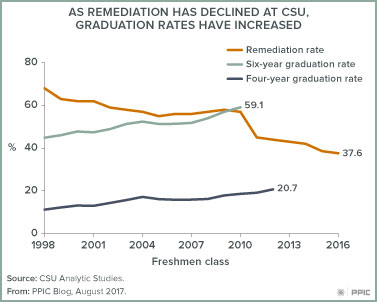
Last fall, more than one in three students starting as freshmen at the California State University (CSU) system had to take a remedial course in either English or math before they could take college-level courses in those subjects. These remedial courses generally cover material from high school and don’t count toward a degree—even though they cost the same amount and require as much class time as a college course. But this situation is about to change. Starting in 2018, all CSU freshmen will be placed in college-level courses. Those who are underprepared will receive some kind of extra support.

This is the most recent in a series of CSU reforms intended to place freshmen students into college-level courses. In 2004, the Early Assessment Program (EAP) began giving 11th graders an indication of their readiness for CSU and identified the courses they would need to complete their senior year to avoid remediation. More recently, incoming students who were required to take remediation were enrolled in Early Start, which used summer courses to prepare students for college coursework in the fall. The elimination of all remedial courses is a big change: while previous programs aimed to prepare students for college-level work before their freshmen year, CSU will now focus on helping students complete college-level work regardless of their preparation.

This policy change comes as CSU embarks on its new graduation initiative, whose goal is to raise graduation rates and close achievement gaps by 2025. What kind of impact might the elimination of remedial courses have on college completion? Students who require remediation in one or more subjects are about half as likely to graduate within four years as their peers who are ready for college-level work. The share of CSU students identified as needing remediation has been dropping for some time, and as remediation rates have fallen, six-year and four-year graduation rates have increased.

The general decline in remediation indicates that students have become better prepared over time, either in K–12 or through programs like Early Start. Though eliminating remediation will not affect how prepared students are when they start college, there is still reason to believe CSU could see an increase in graduation rates. As PPIC’s study of community college remediation showed, long remedial course sequences leave students many points of exit and can be barriers to success. Indeed, about 13% of CSU students who entered remediation in 2015 failed to complete remediation and were not at the university by their second year. With the end of remediation at CSU, students will have fewer potential exit points, they will be able to earn more college credits in their first year, and many may experience more success in college-level courses due to additional support. These potential benefits could help more students graduate and shorten their time to degree.

In addition to eliminating remediation, CSU is making changes to the Early Start program and course placement policies to further prepare students and help them find the right classes. These changes could help narrow the graduation gap between races. In 2016, only about 18% of white CSU students required some form of remediation, while about half of Latino and about 60% of African American students needed remediation in at least one subject. If these new policies do increase graduation rates, many traditionally underserved students may benefit.

Learn more

Visit the PPIC Higher Education Center
Read the PPIC report Preparing Students for Success in California’s Community Colleges

Is College Worth it? What Graduates Say

As college registration deadlines approach, thousands of Californians are making important decisions to invest in their education and long-term career prospects. The vast majority of parents (85%) hope their child earns at least a bachelor’s degree, according to the PPIC Statewide Survey. But how do graduates see it? And how well-informed are their decisions?

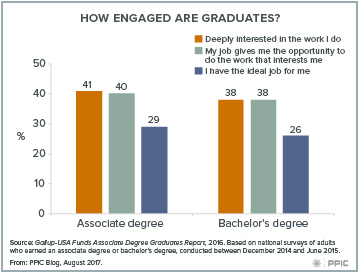
The good news is that most people who earn degrees believe their investment was worth it. According to national survey data, 71% of those who earned an associate degree and 73% of those with a bachelor’s degree agree their education was worth the cost. Going beyond the economic value, a large share also find engagement in the work they do. In fact, a sizeable share of associate- and bachelor’s-degree holders report deep interest in their work (41% and 38%, respectively) or say that they have the ideal job (29% and 26%, respectively).

Although having an “ideal job” may be a very high bar to achieve, these results suggest that a majority of degree earners are not terribly satisfied or engaged with their work. Indeed, in a wider-ranging national survey conducted recently, a majority of college graduates indicate that they would change their degree, their college, or their major if they could do it again. Among associate-degree holders, 23% would seek a different degree—more than double the share of bachelor’s-degree holders who say the same. But graduates with bachelor’s degrees are not entirely satisfied with their choices either: 40% would study a different major (compared to 36% among associate-degree holders). And the survey finds curiously similar responses regardless of a person’s income level. Though higher-income Americans are slightly less likely to regret their college choices, a large fraction of them (35–45% for those with income over $100,000) would still make a different choice.

These results confirm that while college pays off, there is room to improve how well-informed prospective students are about their colleges, majors, and degrees. On this blog, we’ve written about the economic value of college credentials and how it varies across fields of study. We’ve also highlighted the need for data to inform student choices, given the sizeable financial commitment entailed.

Among the state’s public colleges and universities, California’s community colleges are ahead of the curve in providing information online about institutional performance, future salary, and more. Other institutions should follow suit. However, the survey results above suggest it is perhaps equally important to design courses and programs that ensure students can efficiently and effectively identify the degrees and majors best suited to them. Indeed, this is one of the tenets of the guided pathways movement taking place at community colleges across the country and in California. To inform and improve the college decisions of Californians, it is critical that these practices expand beyond community colleges, so that K–12 schools and four-year universities are also working to ensure students have comprehensive information when choosing their pathway into a career.

Learn more

Visit the PPIC Higher Education Center

Bringing Order to Groundwater Management

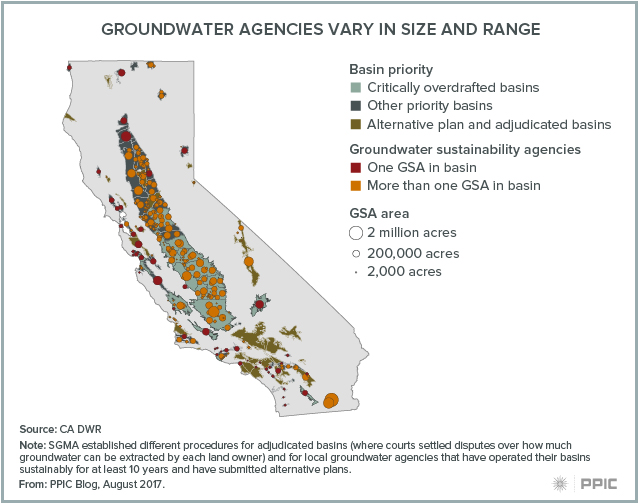
California’s water management is a complex stew with many cooks. At the local level, hundreds of irrigation districts and urban water agencies and a few thousand small drinking water suppliers are responsible for a wide variety of water-related issues. And it just got more complex: as of June 30, more than 250 newly formed Groundwater Sustainability Agencies (GSAs) were added to the mix.

The 2014 Sustainable Groundwater Management Act (SGMA) directed local agencies to develop institutions, plans, and implementation strategies to sustainably manage their groundwater resources for the long run. As a result, more than 250 local agencies have formed GSAs in 140 “priority basins” (those that account for most of California’s groundwater use). More than 70 percent of the new GSAs are in the San Joaquin Valley and the Sacramento Valley—regions whose large groundwater basins supply farms, cities, and small rural communities.

A variety of parties can form GSAs, though most are made up of local agencies such as counties, cities, and irrigation districts. A GSA can also be formed by a single entity, such an irrigation district—Westlands Water District has formed one. It can be formed by groups of agencies, as is the case with the Merced Subbasin GSA, which includes six public agencies with water management or land use authority. These parties vary widely in their interests and experience in groundwater management.

The first task of the GSAs will be to develop groundwater sustainability plans for their basins. In basins with multiple GSAs, the agencies will either have to create a common plan or have an agreement to coordinate plans. This is no small task, given the number of agencies and their institutional diversity. Anticipating some of these complexities, the Department of Water Resources has already published a set of documents to guide plan development.

Although GSAs and their local partners will have the lead responsibility for developing and implementing groundwater sustainability plans, the state can play a pivotal supportive role. Given the varying technical and institutional capacity at the local scale and the challenges of coordinating different plans, a number of tools could help GSAs implement effective programs in ways that reduce conflict and foster success.

Developing common accounting standards is a top priority. GSAs must speak the same language to ensure consistency in groundwater budgets across agencies and basins. Statewide standards are needed on matters such as units used and frequency of measurement to enable comparability, auditability, and consistent analysis and management. Accounting templates and modeling standards could help guide this process. The Department of Water Resources has developed online reporting standards for other water sectors—such as the templates for submitting Urban Water Management Plans that standardize basic information agencies must submit—which might be a good model to follow. This might also help bridge some chronic water data gaps that have made it more difficult to manage California’s water.

The state could also provide technical guidance on developing local monitoring and enforcement regulations, which will be key to implementing the plans. Critically overdrafted basins—where long-term pumping has exceeded the rate of replenishment—will need to develop strategies to increase recharge and reduce pumping. Doing this well will require measuring groundwater extraction, setting overall pumping limits, and establishing pumping allocations. These tasks will help to establish a water budget, and are also essential to implementing innovative mechanisms such as incentives for recharge, storing groundwater for later use, and trading, which can add flexibility in groundwater management. Making these tools available for every agency, no matter its size and capabilities, will help ease the transition to sustainable management with minimal economic disruptions.

Getting to groundwater sustainability might be the most challenging issue in California’s water management for the foreseeable future. But it also provides opportunities to overcome some chronic water management gaps and encourage stakeholders to work cooperatively in a basin-scale approach. Local leadership is key to defining the proper solutions for each basin. But state guidance will also be essential to coordinate efforts and to promote innovation and knowledge sharing across the intricate landscape of agencies.

Learn more

Read the report Accounting for California’s Water (July 2016)
Read the report Water Stress and a Changing San Joaquin Valley (March 2017)
Read “Groundwater in California” (PPIC fact sheet, May 2017)
Visit the PPIC Water Policy Center
Video: Californians and Climate Change

When it comes to climate change policy, California and the federal government are on distinctly different paths. PPIC’s annual Californians and the Environment survey finds that there is a broad consensus in favor of the direction chosen by the state.

David Kordus of the PPIC survey team presented the survey to a Sacramento audience last week. Among the key findings he described:

  • Impact of global warming: A majority of Californians (66%) think global warming is already having an effect, and most think warming is a very serious threat to California’s future economy and quality of life.
  • Goals of state climate policies: A strong majority (72%) favor the law that requires the state to reduce greenhouse gas emissions to 40 percent below 1990 levels by the year 2030. A similar majority favor proposed legislation that would require 100% of electricity to come from renewable sources by 2045.
  • Economic effects: Just 22% of Californians think the state’s actions to address global warming will result in fewer jobs. But many do expect to pay a price: 54% expect to pay more for gas.
  • Leadership: Most state residents say it’s very important that California act as a world leader in the fight against climate change, and 71% oppose President Trump’s withdrawal from the Paris climate accord. Californians give the president and Congress low ratings for their handling of environmental issues—22% and 26%, respectively. Approval ratings are much higher for Governor Brown and the state legislature—51% for each. State leaders’ ratings on environmental issues have risen sharply since the governor took office in 2011.
Learn more

Read the full survey, PPIC Statewide Survey: Californians and the Environment
Find out more about the PPIC Statewide Survey

Federal Policy Shift on Private For-Profit Schools

The US Department of Education is moving toward changing two regulations designed to protect students at private for-profit institutions. The regulations were revised or instituted by the Obama administration in response to allegations of fraud and predatory practices, as well as low graduation rates and high levels of student debt. Secretary Betsy DeVos says they are burdensome for institutions.

The regulations cover more than 250 private for-profit institutions in California; they affect about 245,000 current students and tens of thousands of former students.

DeVos is establishing rulemaking committees to review both regulations:

  • The Borrower Defense to Repayment (BDR) allows victims of misleading and predatory practices to apply for federal loan forgiveness. California attorney general Xavier Becerra says that about 38,000 Californians who took out loans to attend Corinthian Colleges (which shut down in 2015) are eligible to file claims. DeVos stated that approved BDR claims will be paid and pending ones will be processed while the regulation is under review. However, it’s unclear if students can still apply for loan forgiveness.
  • The Gainful Employment (GE) regulation is designed to help students avoid low-performing schools. It requires institutions to provide students with information on graduation rates, average earnings of graduates, and average federal student loan debt. The most important aspect of the regulation is the federal student aid qualification component, which stipulates that loan payments for graduates of postsecondary programs should not exceed 8% of annual earnings or 20% of discretionary income. Programs that do not meet these standards risk losing the ability to participate in federal student aid programs. According to Federal Student Aid data, in 2015 only 58% of programs at Californian for-profit institutions met the 8% benchmark, compared to 97% of programs at public and private not-for-profit institutions. The share of for-profits passing the discretionary income test is even lower, at 34% (public and not-for-profit schools have a passing rate of 82%). It is unclear if the GE regulations will be enforced while the committee reviews the regulation over the next two years.

While the federal government is taking steps to pull back on the regulation of for-profit institutions, California is moving in the opposite direction. In order for students at higher education institutions to qualify for Cal Grants, the institutions must meet minimum standards for graduation and loan default rates. In 2014, 137 institutions—almost all of them private for-profits—failed to meet California’s standards. In 2017, however, only 10 failed, which suggests that the policy might be working. Furthermore, California has joined 17 other states in suing DeVos over her decision.

As the Department of Education reviews these regulations, it should evaluate the effect the changes could have on student debt and loan default rates. In the meantime, keeping the current regulations in place would protect students from low-performing schools and help them avoid programs that may lead to high levels of debt and low-paying jobs.

Learn more