Video: Managing Drought in a Changing Climate

As San Francisco began welcoming visitors arriving for this week’s Global Action Climate Summit, the PPIC Water Policy Center hosted an event on the impact of climate change on California’s water system.

The Monday event brought together a panel of experts to discuss reforms that could improve resilience and galvanize action to prepare for future droughts. The panelists were Maria Herrera, who works on water issues for Self-Help Enterprises and is a member of the California Water Commission; Felicia Marcus, chair of the State Water Board; Cannon Michael, president of Bowles Farming Company; and Tim Ramirez, a member of the Central Valley Flood Protection Board. The panel was moderated by Greg Dalton, founder and host of Climate One.

Ellen Hanak, director of the center, kicked off the evening with a summary of new research by PPIC on managing drought in a changing climate. After noting that California is already seeing changes from a warming climate, she said that “a lot of things we’re recommending are going to be very important and very useful as soon as we can do them.” She reviewed the report’s four main suggested areas of reform: plan ahead, modernize the water grid, update water allocation rules, and find the money to pay for these reforms. “It’s a plan that would be great for the next governor,” she said.

Dalton launched the panel discussion with a question about the need to modernize the state’s water grid—the network of above- and below-ground storage and conveyance systems that connects most water uses in the state. Ramirez said that the conveyance system needs updating because it is “totally insufficient for the precipitation we have now.” For example, the San Joaquin River system “was plumbed for snowmelt―very predictable, slow runoff―but that’s not what happens anymore.” He discussed the need for expanded floodplain capacity to help absorb floods.

Marcus said, “The answer is to maximize every drop—figuring out how every molecule of water … can be used over and over again and used for multiple things.” She said improved information and modernizing our thinking about infrastructure are steps toward achieving this goal.

Herrera noted that disadvantaged rural communities, which are most likely to face drought-related water shortages, find it difficult to engage in discussions about the water system. She called for ensuring that local communities are included in decision making about water grid upgrades, and added that they should have a say in “where to place storage, how water that is stored gets used and allocated, and for what benefits.”

Other topics of discussion included addressing growing wildfire risk; ensuring safe, reliable drinking water for the most vulnerable communities; advice for the next governor on managing climate volatility (Marcus: “the key is to pick up the baton and run with it.… [Water] is an issue on which leadership can make a difference on so many things”), and ways to reduce conflict over water.

Cannon Michael seconded the need for leadership to tackle climate change—and urged all Californians to heed that call. “We need to think about the California we have, what an amazing state this is, and lead from that. We’ve got to push past the voices that are trying to drag us apart, and work on solutions from the middle. We can solve any problem that we all put our minds together on.”

Steven Merksamer Named Chair of PPIC Board

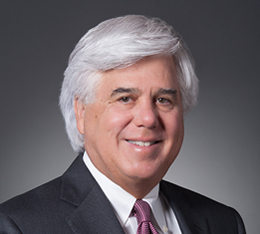
I am very pleased to share the news that PPIC’s board of directors elected attorney Steven Merksamer, a leading expert in government and administrative law and the initiative and referendum process, chair at our annual meeting yesterday. Steve’s distinguished record of public service and deep knowledge of the forces shaping our state make him an ideal leader for PPIC at this important time. He will take over from acclaimed author and farmer Mas Masumoto, who will remain on the board. On behalf of the board and staff, I want to thank Mas for his extraordinary leadership.

Photo of Steven MerksamerSteve joined PPIC’s board of directors in 2009. He is the senior partner in the Northern California law firm of Nielsen, Merksamer, Parrinello, Gross & Leoni, LLP. He served as the chief of staff to Governor George Deukmejian, a position he held from 1982 to 1987. Before that, he was the special assistant attorney general of the State of California, serving as the attorney general’s senior counselor and policy advisor. He has also served as a California deputy attorney general, assistant to the lieutenant governor of California, and assistant to the Speaker of the California State Assembly.

Notably, Steve chaired and directed the transition between the Brown and Deukmejian administrations. He will be an important advisor to me and my colleagues as we seek to provide essential facts and analysis to California’s decision makers during a significant gubernatorial transition.

Steve is currently a member of the board of directors of the California Chamber of Commerce and a trustee of the Stevenson School.  He is an honors graduate of Claremont McKenna College, and received his law degree from the University of the Pacific, McGeorge School of Law.

The other members of the board are myself; Ruben Barrales, president and CEO of GROW Elect; María Blanco, executive director of the Immigrant Legal Services Center at the University of California; Louise Henry Bryson, chair emerita of the Board of Trustees of the J. Paul Getty Trust; A. Marisa Chun, partner at McDermott Will & Emery LLP; Chet Hewitt, president & CEO of the Sierra Health Foundation; Phil Isenberg, former chair of the Delta Stewardship Council; Donna Lucas, chief executive officer of Lucas Public Affairs; Mas Masumoto, author and farmer; Leon E. Panetta, chairman of the Panetta Institute for Public Policy; Gerald L. Parsky, chairman of the Aurora Capital Group; Kim Polese, chair of ClearStreet, Inc.; and Gaddi H. Vasquez, senior vice president of government affairs for Edison International and Southern California Edison.

Video: Remedial Education Reform in Community College

Since the passage of Assembly Bill (AB) 705, California community colleges have been transforming their approach to remedial—or developmental—education. AB 705 requires community colleges to maximize the probability of their students completing transfer-level courses in the one-year time frame. To comply with AB 705, colleges are revising the way they assess student readiness for college-level courses—giving priority to high school GPA rather than tests. They are also changing course offerings and classroom approaches. How will the reforms affect student outcomes, and how are colleges dealing with the challenges of implementation?

At an event in Sacramento last week, PPIC researcher Marisol Cuellar Mejia outlined the findings of a new report that sheds light on AB 705’s potential impact by looking at the efforts of “early implementers”—colleges that began experimenting with reforms before AB 705 was signed into law. A panel of experts then offered a range of perspectives on AB 705 implementation.

Roanna Bennie, interim president of Las Positas College—an early implementer—noted that only a small fraction of students who start at the beginning of a traditional, multi-course math remediation pathway end up taking transfer-level courses. “It’s the data that’s been really influencing our campus to take measures,” she added. But she also said that her college is wrestling with full-scale implementation. The challenges include covering the cost of additional courses, getting input from faculty and other staff across campus, and helping students adjust to the changes.

Laura Metune, vice chancellor for external relations in the California Community Colleges Chancellor’s Office, emphasized the importance of professional development for both faculty and staff: “Everybody needs to understand what these changes are that we’re asking for, the research behind them, and what their individual roles are in helping them be successful.”

What comes next? As Katie Hern, an English instructor at Chabot College who co-founded the California Acceleration Project, put it: “The debate up until now has been whether to make these changes. That debate is over—the legislature settled that one. Now we have to make these changes and now we get to really study how to do it as effectively as possible.”

Strong Support for California’s Climate Leadership

From September 12 to 14, Governor Jerry Brown will co-chair the Global Climate Action Summit in San Francisco. This gathering of world leaders will review achievements to date and discuss next steps in meeting the international goals established to reduce greenhouse gas emissions. How do Californians feel about their state playing such a prominent role in the global warming policy arena?

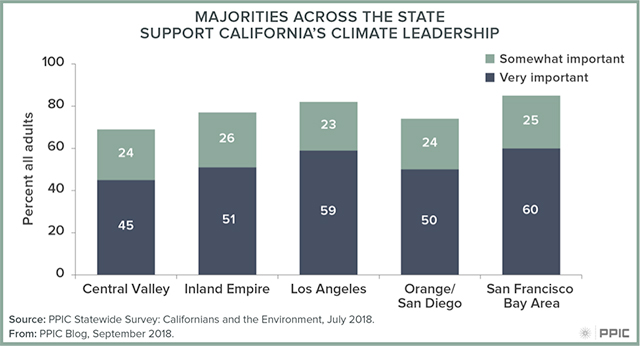
In the July PPIC Statewide Survey, a majority of California adults told us that California’s climate change leadership around the world is very (54%) or somewhat (24%) important to them; findings are similar among likely voters (51% very, 22% somewhat). Last July, after the Trump Administration’s decision to exit the Paris Agreement on climate change, a similar proportion of adults (58% very, 23% somewhat) and likely voters (52% very, 20% somewhat) said the state’s leadership was important. Today, overwhelming majorities of Democrats (95%) and independents (78%) and 41% of Republicans say it is important that California acts as a leader around the world. Majorities across age, education, gender, income, racial/ethnic groups, and regions of the state say this is important. Six in ten or more Latinos (68%) and African Americans (65%), Democrats (67%), San Francisco Bay Area residents (60%), and those with children under 18 (60%) say this is “very” important.

blog figure: Majorities across the state support California's climate leadership

These views are aligned with Californians’ willingness for the state to determine its own destiny in this policy arena. In the July survey, majorities of Californians (65% adults, 62% likely voters) favor having the state government make its own policies, separate from the federal government, to address the issue of global warming. Since we first asked this question in July 2005—throughout changes in presidents, governors, and party leadership in Washington, DC and Sacramento—more than half of Californians have favored state action on this issue.

blog figure: Majorities of Californians favor state action on global warming

Today, solid majorities of Democrats (82%) and independents (61%) and 29% of Republicans favor the state government making its own global warming policies. Majorities across age, education, gender, income, racial/ethnic groups, and regions of the state are in favor. Seven in ten or more are in favor among residents in Los Angeles (73%) and the San Francisco Bay Area (73%), Asian Americans (71%) and Latinos (70%), those under age 35 (75%), and college graduates (73%). Majority support has also been consistent for state policies (i.e., AB 32, SB 32) aimed at reducing greenhouse gas emissions.

What explains this California “exceptionalism” when it comes to climate change actions? In the July PPIC survey, two in three Californians (67% adults, 69% likely voters) say the effects of global warming have already begun. In thinking about the possible impacts of global warming in California, most residents express concerns about more severe wildfires (62% very, 23% somewhat), ocean warming (50% very, 28% somewhat), and rising sea levels (45% very, 29% somewhat). More than eight in ten Californians say that the issue of global warming is personally important to them (28% extremely, 34% very, 20% somewhat). These findings suggest that recent weather events—combined with a growing body of scientific evidence on climate change—have tapped into the long tradition of environmental stewardship in California.

This global meeting occurs at a critical moment for the state. PPIC is hosting related events and, along with many Californians, we look forward to learning more about what Governor Brown called “the existential threat of climate change” in convening this summit.

Make California’s Water Grid Climate-Ready

Next week people from around the globe will gather at the Global Climate Action Summit in San Francisco to explore solutions to climate change. California has long played a leadership role in reducing climate emissions. But the state has a crucial weakness in its climate readiness: its vast water system. Modernizing California’s “water grid”―the linked network of above- and below-ground storage and conveyance systems that connects most water use in the state―can help reduce the costs and impacts of a changing climate.

The PPIC Water Policy Center put together a team of experts in climate science, hydrology, ecology, engineering, economics, and law to review the weak points in California’s water system and recommend actions to build the system’s climate resilience. The focus of the work was on managing water scarcity, using lessons learned from California’s most recent drought.

We found that five climate pressures will seriously impact the state’s water system: warming temperatures, shrinking snowpack, shorter and more intense wet seasons, more volatile precipitation patterns, and rising seas.

During drought, California relies heavily on its water grid to manage supplies. This system will become even more important for managing more intense droughts of the future. Yet elements of this grid are in trouble, and climate pressures will make it harder to manage competing demands—particularly the need to store more water for drought while also capturing high flows to reduce flood risk, while also protecting freshwater ecosystems.

California’s climate is changing and drought intensity is increasing. Adapting to and preparing for change will require a more robust, better-integrated water grid. This should be a top priority for the next governor.

To make the grid climate-ready, the new administration should undertake a thorough assessment of weaknesses in the state’s storage and conveyance system—including important canals and aqueducts that help recharge groundwater, deliver surface water, and manage floods―and launch a major upgrade of this network.

The state’s many underground basins have a much large capacity for storage than surface reservoirs and will become much more important as a drought reserve. Strategic investments are needed to help California store water more effectively and take better advantage of opportunities to trade and share it—an important way to reduce the social, economic, and environmental costs of using less.

Adapting to a more volatile climate—including more intense winter storms—will also require more operational flexibility to enable storage and conveyance facilities to work together as an integrated water supply and flood management system. Investments will be needed to update hydrological assumptions for reservoirs, and improve water accounting in all sectors, including groundwater recharge and use.

This water infrastructure revolution won’t just be technically challenging: it will also require finding reliable funding to pay for necessary investments. Californians will need to look beyond general obligation bonds and develop long-term funding sources to adapt the water grid to a changing climate.

Strong leadership from state and local institutions has guided the development of the water system that California relies on today. Despite its many problems, this system has mostly served the state well, even in the face of occasional severe drought. Leadership—an essential ingredient for continued progress in water management—is a key requirement to prepare for droughts of the future.

How Changes in Immigration Affect California’s Workforce

[vc_row][vc_column][vc_column_text]Immigrants are essential to California’s workforce. In the past two decades, as labor market needs have shifted, the composition of recent immigrants (those arriving in the last five years) has changed dramatically. Today, recent immigrants to California are much more likely to hold a bachelor’s or more advanced degree than in the past—and in fact are now more likely than US-born Californians to do so.

While the number of recent immigrants to California fell by 24% between 2000 and 2016, the number of highly educated immigrants rose by 41%. In 2016, about half of recent immigrants held at least a bachelor’s degree. Highly educated immigrants work in every major industry in the state and comprise about 30% of the highly educated workforce.

These changes in educational attainment coincide with other shifts in immigration patterns. A large portion of the decline in immigration to California can be attributed to the falling numbers of immigrants arriving from Mexico. In 2000, over half a million recent immigrants came from Mexico. By 2016, that number fell by more than 70% to less than 150,000 people.

Now, China has slightly edged out Mexico as the leading country of origin, and these top two countries are followed by India, the Philippines, and Vietnam. Immigrants from China and India tend to be highly educated: in 2016, 47% of recent immigrants from China—and around 80% of recent immigrants from India—had at least a bachelor’s degree. The interactive below allows you to further explore changes in education levels over time among recent immigrants overall and from these five countries.

The sharp increase in highly educated immigrants and the decline in less-educated immigrants reflect the changing labor market in California. Unemployment rates for workers with at least a bachelor’s degree (3.3%) are about half those of less-educated workers (6.5%). With California expected to face a shortfall of 1.1 million college graduates by 2030, highly educated immigrants are a key component to helping the state address the workforce skills gap.[/vc_column_text][/vc_column][/vc_row][vc_row][vc_column][vc_raw_html]JTNDZGl2JTIwY2xhc3MlM0QlMjd0YWJsZWF1UGxhY2Vob2xkZXIlMjclMjBpZCUzRCUyN3ZpejE1Mjc4Nzg3ODgxNDYlMjclMjBzdHlsZSUzRCUyN3Bvc2l0aW9uJTNBJTIwcmVsYXRpdmUlMjclM0UlMEElMDklM0Nub3NjcmlwdCUzRSUwQSUwOSUzQ2ElMjBocmVmJTNEJTI3JTIzJTI3JTNFJTNDaW1nJTIwYWx0JTNEJTI3RURVQ0FUSU9OJTIwTEVWRUxTJTIwVkFSWSUyMEFDUk9TUyUyMElNTUlHUkFOVCUyMEdST1VQUyUyMCUyNyUyMHNyYyUzRCUyN2h0dHBzJTNBJTI2JTIzNDclM0IlMjYlMjM0NyUzQnB1YmxpYy50YWJsZWF1LmNvbSUyNiUyMzQ3JTNCc3RhdGljJTI2JTIzNDclM0JpbWFnZXMlMjYlMjM0NyUzQkNhJTI2JTIzNDclM0JDYWxpZm9ybmlhc2ltbWlncmFudHNhbmRlZHVjYXRpb25sZXZlbHNfMCUyNiUyMzQ3JTNCSW1taWdyYW50c2luQ2FsaWZvcm5pYWJ5ZWR1Y2F0aW9uYW5kY291bnRyeW9mb3JpZ2luJTI2JTIzNDclM0IxX3Jzcy5wbmclMjclMjBzdHlsZSUzRCUyN2JvcmRlciUzQSUyMG5vbmUlMjclMjAlMkYlM0UlM0MlMkZhJTNFJTBBJTA5JTNDJTJGbm9zY3JpcHQlM0UlMEElMDklM0NvYmplY3QlMjBjbGFzcyUzRCUyN3RhYmxlYXVWaXolMjclMjAlMjBzdHlsZSUzRCUyN2Rpc3BsYXklM0Fub25lJTNCJTI3JTNFJTBBJTA5JTA5JTNDcGFyYW0lMjBuYW1lJTNEJTI3aG9zdF91cmwlMjclMjB2YWx1ZSUzRCUyN2h0dHBzJTI1M0ElMjUyRiUyNTJGcHVibGljLnRhYmxlYXUuY29tJTI1MkYlMjclMjAlMkYlM0UlMEElMDklMDklM0NwYXJhbSUyMG5hbWUlM0QlMjdlbWJlZF9jb2RlX3ZlcnNpb24lMjclMjB2YWx1ZSUzRCUyNzMlMjclMjAlMkYlM0UlMEElMDklMDklM0NwYXJhbSUyMG5hbWUlM0QlMjdzaXRlX3Jvb3QlMjclMjB2YWx1ZSUzRCUyNyUyNyUyMCUyRiUzRSUwQSUwOSUwOSUzQ3BhcmFtJTIwbmFtZSUzRCUyN25hbWUlMjclMjB2YWx1ZSUzRCUyN0NhbGlmb3JuaWFzaW1taWdyYW50c2FuZGVkdWNhdGlvbmxldmVsc18wJTI2JTIzNDclM0JJbW1pZ3JhbnRzaW5DYWxpZm9ybmlhYnllZHVjYXRpb25hbmRjb3VudHJ5b2ZvcmlnaW4lMjclMjAlMkYlM0UlMEElMDklMDklM0NwYXJhbSUyMG5hbWUlM0QlMjd0YWJzJTI3JTIwdmFsdWUlM0QlMjdubyUyNyUyMCUyRiUzRSUwQSUwOSUwOSUzQ3BhcmFtJTIwbmFtZSUzRCUyN3Rvb2xiYXIlMjclMjB2YWx1ZSUzRCUyN25vJTI3JTIwJTJGJTNFJTBBJTA5JTA5JTNDcGFyYW0lMjBuYW1lJTNEJTI3c3RhdGljX2ltYWdlJTI3JTIwdmFsdWUlM0QlMjdodHRwcyUzQSUyNiUyMzQ3JTNCJTI2JTIzNDclM0JwdWJsaWMudGFibGVhdS5jb20lMjYlMjM0NyUzQnN0YXRpYyUyNiUyMzQ3JTNCaW1hZ2VzJTI2JTIzNDclM0JDYSUyNiUyMzQ3JTNCQ2FsaWZvcm5pYXNpbW1pZ3JhbnRzYW5kZWR1Y2F0aW9ubGV2ZWxzXzAlMjYlMjM0NyUzQkltbWlncmFudHNpbkNhbGlmb3JuaWFieWVkdWNhdGlvbmFuZGNvdW50cnlvZm9yaWdpbiUyNiUyMzQ3JTNCMS5wbmclMjclMjAlMkYlM0UlMEElMDklMDklM0NwYXJhbSUyMG5hbWUlM0QlMjdhbmltYXRlX3RyYW5zaXRpb24lMjclMjB2YWx1ZSUzRCUyN3llcyUyNyUyMCUyRiUzRSUwQSUwOSUwOSUzQ3BhcmFtJTIwbmFtZSUzRCUyN2Rpc3BsYXlfc3RhdGljX2ltYWdlJTI3JTIwdmFsdWUlM0QlMjd5ZXMlMjclMjAlMkYlM0UlMEElMDklMDklM0NwYXJhbSUyMG5hbWUlM0QlMjdkaXNwbGF5X3NwaW5uZXIlMjclMjB2YWx1ZSUzRCUyN3llcyUyNyUyMCUyRiUzRSUwQSUwOSUwOSUzQ3BhcmFtJTIwbmFtZSUzRCUyN2Rpc3BsYXlfb3ZlcmxheSUyNyUyMHZhbHVlJTNEJTI3eWVzJTI3JTIwJTJGJTNFJTBBJTA5JTA5JTNDcGFyYW0lMjBuYW1lJTNEJTI3ZGlzcGxheV9jb3VudCUyNyUyMHZhbHVlJTNEJTI3eWVzJTI3JTIwJTJGJTNFJTBBJTA5JTNDJTJGb2JqZWN0JTNFJTBBJTNDJTJGZGl2JTNFJTBBJTNDc2NyaXB0JTIwdHlwZSUzRCUyN3RleHQlMkZqYXZhc2NyaXB0JTI3JTNFJTBBJTIwJTIwJTIwJTIwJTIwJTIwJTIwJTIwJTIwJTIwJTIwJTIwJTIwJTIwJTIwJTIwJTIwJTIwJTIwJTIwdmFyJTIwZGl2RWxlbWVudCUyMCUzRCUyMGRvY3VtZW50LmdldEVsZW1lbnRCeUlkJTI4JTI3dml6MTUyNzg3ODc4ODE0NiUyNyUyOSUzQiUwQSUyMCUyMCUyMCUyMCUyMCUyMCUyMCUyMCUyMCUyMCUyMCUyMCUyMCUyMCUyMCUyMCUyMCUyMCUyMCUyMHZhciUyMHZpekVsZW1lbnQlMjAlM0QlMjBkaXZFbGVtZW50LmdldEVsZW1lbnRzQnlUYWdOYW1lJTI4JTI3b2JqZWN0JTI3JTI5JTVCMCU1RCUzQiUwQSUyMCUyMCUyMCUyMCUyMCUyMCUyMCUyMCUyMCUyMCUyMCUyMCUyMCUyMCUyMCUyMCUyMCUyMCUyMCUyMGlmJTIwJTI4JTIwZGl2RWxlbWVudC5vZmZzZXRXaWR0aCUyMCUzRSUyMDcwMCUyMCUyOSUyMCU3QiUyMCUwQSUwOSUwOSUwOSUwOSUwOSUwOXZpekVsZW1lbnQuc3R5bGUud2lkdGglM0QlMjc2NTBweCUyNyUzQnZpekVsZW1lbnQuc3R5bGUuaGVpZ2h0JTNEJTI3NjAwcHglMjclM0IlMEElMDklMDklMDklMDklMDklN0QlMjBlbHNlJTIwaWYlMjAlMjglMjBkaXZFbGVtZW50Lm9mZnNldFdpZHRoJTIwJTNFJTIwNTAwJTIwJTI5JTIwJTdCJTBBJTA5JTA5JTA5JTA5JTA5JTA5dml6RWxlbWVudC5zdHlsZS53aWR0aCUzRCUyNzUwMHB4JTI3JTNCdml6RWxlbWVudC5zdHlsZS5oZWlnaHQlM0QlMjc3MzBweCUyNyUzQiUwQSUwOSUwOSUwOSUwOSUwOSU3RCUyMGVsc2UlMjAlN0IlMEElMDklMDklMDklMDklMDklMDl2aXpFbGVtZW50LnN0eWxlLndpZHRoJTNEJTI3MTAwJTI1JTI3JTNCdml6RWxlbWVudC5zdHlsZS5oZWlnaHQlM0QlMjc3MzBweCUyNyUzQiUwQSUwOSUwOSUwOSUwOSUwOSU3RCUwQSUwOSUwOSUwOSUwOSUwOXZhciUyMHNjcmlwdEVsZW1lbnQlMjAlM0QlMjBkb2N1bWVudC5jcmVhdGVFbGVtZW50JTI4JTI3c2NyaXB0JTI3JTI5JTNCJTBBJTA5JTA5JTA5JTA5JTA5c2NyaXB0RWxlbWVudC5zcmMlMjAlM0QlMjAlMjdodHRwcyUzQSUyRiUyRnB1YmxpYy50YWJsZWF1LmNvbSUyRmphdmFzY3JpcHRzJTJGYXBpJTJGdml6X3YxLmpzJTI3JTNCJTBBJTA5JTA5JTA5JTA5JTA5dml6RWxlbWVudC5wYXJlbnROb2RlLmluc2VydEJlZm9yZSUyOHNjcmlwdEVsZW1lbnQlMkMlMjB2aXpFbGVtZW50JTI5JTNCJTBBJTNDJTJGc2NyaXB0JTNF[/vc_raw_html][/vc_column][/vc_row]

How Much Water Is Available for Groundwater Recharge?

The wet winter of 2017 brought an opportunity to test groundwater recharge—the intentional spreading of water on fields to percolate into the aquifer—as a tool for restoring groundwater levels and helping basins comply with the Sustainable Groundwater Management Act (SGMA). This is especially important in the San Joaquin Valley, which has the biggest imbalance between groundwater pumping and replenishment in the state.

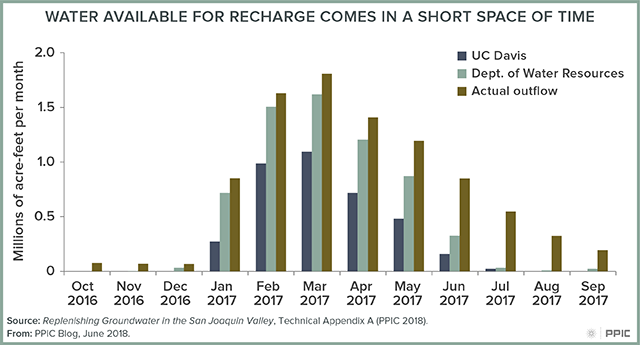
A key question for many valley water managers is how much water will be available for recharge in the long term. By law, only river flows in excess of what is required for environmental purposes and to supply existing water-right holders are available for recharge. A recent report by the PPIC Water Policy Center estimated how much water would be available in the San Joaquin Valley over the long term. Two earlier studies—one by two scientists at UC Davis and the other by the Department of Water Resources—estimated a maximum of about half a million acre-feet on average, which is about a quarter of the valley’s estimated deficit. The PPIC study updated these estimates in the context of current conditions and concluded that an average of more than a million acre-feet of San Joaquin River flows may be available.

There are two big challenges to getting more water into underground storage in the valley:

  • Most water for recharge becomes available during short periods. These periods usually coincide with floods, when recharge infrastructure—such as canals, pipelines, and recharge basins—is already working at full capacity. In 2017, for example, more than half of the available water would need to be diverted in February and March, with diversions above 30,000 acre-feet on most days (see figure). To put that into perspective, the California Aqueduct—the state’s largest conveyance system—has a maximum capacity of 26,000 acre-feet per day. While such daily volumes are lower than the overall volume of water moved in the valley during the summer irrigation season, seasonal floods are concentrated in relatively few areas where conveyance limits are likely to be a challenge.
  • Most of the available flows are in the northern half of the valley, while most of the overdrafted basins are in the drier south. This highlights the need to evaluate the capacity of large system-level water conveyance systems, such as the Friant-Kern Canal and the California Aqueduct, to move more water from north to south for recharge purposes.

The State Water Board—which oversees surface water rights—has the last word on this issue. Given the nature of California’s “flashy” river systems—in which very high flows develop rapidly during the winter and spring—the board will need to develop a simple, quick way to determine when river flows exceed water required for the environment and water-right holders.

We can’t count on groundwater recharge to singlehandedly end overdraft in the valley, but efforts to expand recharge in wet years will be helpful. The most pressing issues are to determine how much water is legally available and how best to put this water into the ground. Assessing the infrastructure needed for capturing flows during floods is an essential piece of this puzzle.

Blog figure: Water Available for Recharge Comes in a Short Space of Time


Image above courtesy of Jonathan Parker, Kern Water Bank Authority

The State of Groundwater Recharge in the San Joaquin Valley

When strong winter rains finally ended the recent five-year drought, many water districts seized the opportunity to recharge depleted aquifers. How did they do, and what barriers did they face? A public forum brought more than 30 experts together to discuss the benefits, opportunities, and barriers to groundwater recharge. The event was hosted by the California State Board of Food and Agriculture and the state Department of Water Resources.

My presentation focused on recharge in the San Joaquin Valley—a region that is home to more than four million people, half the state’s agricultural output, and most of its critically overdrafted groundwater basins, where pumping exceeds replenishment. Consequences include dry wells, sinking lands, and reduced supplies to weather future droughts.

As part of our ongoing work to explore practical and effective solutions to the region’s water challenges, the PPIC Water Policy Center recently surveyed local water districts about their groundwater recharge efforts. Although such efforts have been underway for decades in some parts of the valley, the state’s 2014 groundwater law has increased interest in using recharge to bring basins into long-term balance.

About 75% of respondents to our survey said they were actively recharging this year. Large water districts with formal recharge programs are doing the lion’s share of recharge, but there’s lots of interest from smaller agencies in getting in on the act.

Agricultural districts are already employing a broad mix of recharge tools, and many see potential for expansion. In contrast, urban districts—most of which rely heavily on groundwater—are much less active. The most widespread methods—used by two-thirds of agricultural districts surveyed—include allowing water to seep through unlined canals and irrigating crops with surface water instead of groundwater, which enables basins to recharge naturally (a method known as “in-lieu” recharge). Other popular options—used by half of agricultural districts—include directing water to dedicated “recharge basins” and applying extra water on irrigated cropland. Some districts also spread water on fallowed land and open space. Of these tools, recharge basins are being used most intensively, storing more than half of total recharge reported (roughly four maf). One caveat to this last finding is that many districts have been using some popular methods (cropland irrigation, in-lieu recharge, and unlined canals) without formally accounting for how much recharge occurs.

Kern County is “recharge central,” accounting for more than half of total recharge volumes reported. It is also the hub of recharge partnership programs that enable water users to store water off-site, by districts that have especially good recharge conditions.

Survey respondents also noted the biggest barriers for their districts. Perhaps reflecting the very large volumes of surface water available this year, respondents were much more likely to flag problems related to infrastructure (72% of respondents) than to regulatory issues (30%). Infrastructure challenges included capacity constraints in several areas: recharge basins, “system” conveyance to get water to the district (e.g., through the Friant-Kern Canal or the California Aqueduct), and conveyance within the district to deliver water to good recharge lands. Many respondents also noted problems with the timing of water availability—a big issue in this very wet year, when storms brought large amounts of water all at once. Other constraints include challenges of expanding recharge on croplands because of farm-related issues (42%)—including unsuitable irrigation systems and uncertainties about the impacts on crop health—and difficulties raising funds for recharge projects (23%).

Survey findings also highlight the opportunities to expand recharge to help close the valley’s water deficit. In particular, the new groundwater sustainability agencies will need to develop better water accounting—which can help improve incentives and funding opportunities for recharge. And as water districts and water users work together to develop basin-wide sustainability plans, there’s potential to develop joint programs between surface water “haves” and “have nots.” Importantly, this includes opportunities to involve more cities and towns in groundwater banking projects and to encourage partnerships to expand off-site recharge.

For more details on these preliminary findings, see the slides linked below. And stay tuned for a report with complete survey findings in early 2018.

In Memoriam: Arjay Miller

Photo of Arjay Miller

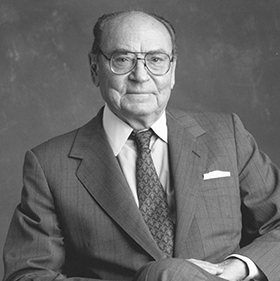
With the passing of Arjay Miller last week at 101, our nation lost a giant. Arjay defined the Greatest Generation and built a life and legacy through his service to others. Organizations across the United States—PPIC among them—owe an enormous debt of gratitude to this visionary and determined leader. It is our obligation now to fulfill that vision of leadership—private and public—for the common good.

Along with William Hewlett and Roger Heyns, Arjay co-founded PPIC in 1994. He served as the chair of PPIC’s board of directors from 1995 to 1998 and remained a member of the board until 2006. In 2000, he and his wife gave a generous gift to PPIC to create the Arjay and Frances Fearing Miller Chair in Public Policy. He was responsible for helping to secure a solid financial foundation for PPIC and for establishing many of the principles and policies that guide us to this day. Why focus on California, rather than the nation? “The rest of the country follows us,” he said at the time, citing issues ranging from clean air to affirmative action. His prescience was a gift to the people of California.

Arjay’s resume is the stuff of legend. He was one of the ten “whiz kids” who left the Pentagon after World War II and played a major role in reversing the fortunes of the Ford Motor Company. He was president of Ford from 1963 to 1968 and vice chair until 1969, when he was appointed dean of the Stanford Graduate School of Business. There, he established the Public Management Program that has trained thousands of public sector managers and has also educated private sector leaders about public needs. Explaining his desire to instill public service values in the MBA worldview, he said, “Making money is the easy part. Making the world a better place in which to live is the hard part.” He served as dean for ten years. Under his guidance, the business school appointed its first women and ethnic minority faculty members and greatly magnified its prestige.

Arjay’s civic achievements are enduring. He was also the founding chairman of the board, and a life trustee, of the Urban Institute. He was an honorary trustee of the Brookings Institution; a board member of the Mellon Foundation, the William and Flora Hewlett Foundation, and SRI International; and a chairman of the Bay Area Council. Over the years, he also served on the boards of numerous corporations, including Ford, the Washington Post Company, Wells Fargo Bank, Levi Strauss & Company, and Burlington Northern.

Our thoughts and deepest sympathies go out to Arjay’s children, Ken and Ann, and the entire family. On a personal note, I feel deeply fortunate to hold the Arjay and Frances Fearing Miller Chair in Public Policy at PPIC and to have spent time with Arjay and his family over the years. I have been the lucky beneficiary of his storytelling—life lessons delivered with trademark modesty and wicked humor. He has been a friend, mentor, and trusted advisor to me.

During Arjay’s last visit to PPIC in April of this year, he celebrated the success of the institute he helped build and asked us to do more. We intend to honor his request.

New Laws Expand Criminal Justice Reforms

Governor Jerry Brown recently signed a number of bills that extend the state’s efforts to reform California’s adult and juvenile criminal justice system. This legislative package supplements previous reforms; several of the new laws could further reduce the state’s prison population, which remains subject to a court-ordered population target. The bills cover issues at all levels, including arrest, conviction, incarceration, and parole.

Arrest and conviction

  • SB 395 strengthens protections for arrested minors under the age of 16 by requiring that they confer with an attorney prior to waiving their Miranda rights and being interrogated by police. AB 529 allows juveniles to have their records sealed if they are not convicted. SB 312 allows juvenile offenders convicted of serious or violent offenses committed after the age of 14 to have their records sealed.
  • SB 393 allows adults to request that the court seal their records if they are arrested but not convicted.

Sentence enhancements

  • Sentence enhancements allow prosecutors to seek additional prison time in certain circumstances—such as the use of a firearm or gang involvement. The number of enhancements has increased dramatically over the past 30 years. SB 180 eliminates the three-year sentence enhancement for certain circumstances related to selling drugs, though it leaves in place the enhancement for using minors in the sale of illegal drugs. SB 620 allows judges the discretion to dismiss or strike sentence enhancements for offenders who are in possession of a firearm while committing a crime.

Parole

  • AB 1308 and SB 394 raise the age limit for youth parole from 23 to 25, and grant the possibility of parole for juvenile offenders serving life sentences after they serve at least 25 years.
  • AB 1448 allows certain offenders older than 60 who have been incarcerated for more than 25 years to be released to parole. It is worth noting that AB 1448 codifies a practice that has been helping the state reduce overcrowding: a total of 557 offenders were released under this program between February 2014 and August 2017.

Impact of supervision on juveniles and families

  • SB 625 reinstates honorable discharges for juvenile offenders who have “proven their ability to desist from criminal behavior.” An honorable discharge removes long-term penalties, such as the ban on juvenile offenders working as police officers.
  • SB 190 limits the financial liability of families for the housing, transport, or supervision of juvenile offenders.

The goal of these laws is to improve offender outcomes by emphasizing rehabilitation and reentry to the community—and possibly reducing pressure on the state budget. State lawmakers believe these bills are grounded in evidence-based practices. For example, the reduction of long-term penalties for juveniles and young adults is grounded in neuroscientific evidence that decision-making ability does not mature fully until the mid-20s.

Two bills that aim to reform the state’s bail system, AB 42 and SB 10, did not reach the governor’s desk this legislative year. However, the debate over bail reform will most likely continue in 2018. Advocates for reform believe that evidence-based practices that base pre-trial release decisions on an offender’s likelihood of appearing in court or reoffending—not his or her financial means—could significantly reduce the number of pre-trial offenders held in county jails. Opponents believe that the current bail system is the best way to make pre-trial release decisions while protecting public safety.