Video: Emergency Department Use in California

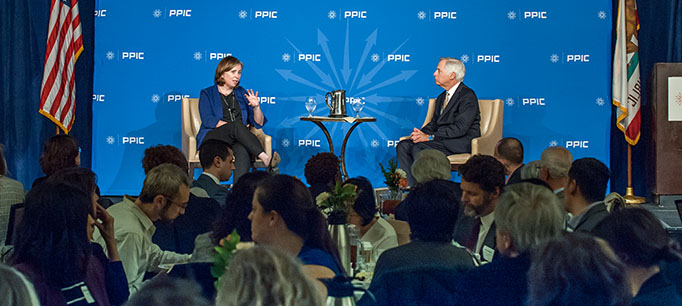
Hospital emergency departments (EDs) are an important part of California’s health care system. They are sometimes called the safety net of the safety net because they provide care to all comers. Policymakers, health plans, and health providers have long focused on ED use, partly because it serves as a proxy for lack of access to other, less costly forms of health care. So how has the expansion of insurance coverage under the Affordable Care Act (ACA) affected ED use in California? At an event last week in Sacramento, PPIC researcher Shannon McConville outlined a new PPIC report that addresses this question, and a panel of experts offered their perspectives on recent ED trends.

While many predicted that coverage expansion would reduce ED use by providing access to other kinds of medical care, such as primary care physicians, some worried that because insurance coverage typically reduces patients’ out-of-pocket costs, the ACA would increase ED use. The good news is that the PPIC report estimates that ED use rates would be higher in the absence of the ACA. But ED use statewide has been increasing for the past decade. To get a sense of how recent trends in ED use are being experienced and addressed around the state, PPIC convened a panel of experts.

All of the panelists highlighted the importance of finding out why people are using EDs. Some frequent ED users may not know about other ways to get medical care, while others may have behavioral or mental health issues that could be addressed more effectively by other kinds of care—from housing assistance to substance abuse programs. As Sara Kate Levin, medical director for Contra Costa Health Services, put it, “What are the unmet social needs that are driving a lot of this high utilization?”

But filling information gaps and addressing behavioral and mental health issues does not solve all ED use problems. In many areas, there is a scarcity of primary care doctors and urgent care clinics, and many patients cannot take time off to go to medical appointments during the workday. Moreover, primary care doctors sometimes refer their privately insured patients to EDs, in part so they won’t have to wait for tests.

This range of issues points to what Renee Hsia, an ED physician at Zuckerberg San Francisco General Hospital and a professor of emergency medicine and health policy, called “the elephant in the room”: because the United States has “a very market-based approach to health care,” there are two very different stories about ED use. On the one hand, EDs in affluent areas broadcast their availability and convenience. On the other hand, there are long waits for treatment at EDs serving low-income areas. “In some areas, your ER is a revenue center . . . and in some places, where you don’t have paying patients, your ER is a cost center.”

Jennifer Rasmussen, vice president of health care services at Molina Healthcare of California, highlighted the geographical differences across the state that make it difficult to find “one size fits all” solutions. She pointed out that Molina serves Imperial and San Bernardino Counties, “a vast geography” with fewer social services than a dense urban area has to offer. In other words, “a solution for Imperial County is not going to be the same as a solution for San Francisco.”

2020 Census: Will All of California’s Children Be Counted?

This post is part of a series examining challenges involved in the 2020 Census and what’s at stake for California. Click here to see our full coverage.

As the country gears up for the 2020 Census, one big challenge will be ensuring a complete and accurate count of young children. Nationwide, the 2010 Census missed nearly a million children under five years old, including about 210,000 young Californians, according to Census Bureau estimates.

This undercount—which has worsened in the past few decades—has consequences for political representation at the federal, state, and local levels. An inaccurate census could also affect federal funding for educational and health programs. For example, the distribution of Head Start funds depends in part on census counts to determine the number of young children living in poverty.

Young children were undercounted by 4.6% in 2010, the worst undercount across all age groups. In contrast, people in their late teens and early twenties, as well as those over age 50, were overcounted—meaning people in these age groups were often erroneously included in multiple households.

figure - Young Children Were the Age Group Least Likely To Be Counted Accurately in the 2010 Census

The count of young children in California was even less accurate: 7.7% of Californians ages 0–4 were undercounted in the 2010 Census, the third-highest rate in the nation. In follow-up research, the Census Bureau has found that households in Monterey County, much of the Central Valley, Los Angeles County, the Inland Empire, and Imperial County were especially likely to indicate confusion over whether to include young children when completing their census questionnaires.

Multiple reasons account for why young children are often missed in the census. Families may forget to include newborns or children who split their time between two homes. Young children in low-income families and those with young or single parents are especially at risk of being undercounted.

Young children are also more likely than other age groups to live in households with multiple generations, unmarried partners, nonrelatives, or extended family—which can lead to confusion over who should be included in the census form. African American, Latino, and Native American children are much more likely than white children to live in households with these kinds of “complex” living arrangements, which have probably become more common in California because of the housing crisis.

figure - Young Children Are Much More Likely To Be in Families with “Complex” Living Arrangements

In preparation for the 2020 Census, the Census Bureau has taken several steps to improve its count of young children. These include adjusting the wording on the census form to clarify that everyone living in the household should be included, as well as undertaking advertising and education campaigns about the importance of counting all children.

California has committed $100 million for census outreach, and the governor has proposed an additional $54 million for the next fiscal year. The California Complete Count Committee, which is spearheading the state’s efforts, has allocated these funds to the state’s hard-to-count communities, with options for many other organizations to receive funding. Given what we know about the historical difficulties of counting young children, it will be particularly important for community organizations and agencies working with young children and families to be involved with outreach efforts.

Video: Californians and Their Government

Californians are increasingly concerned about the cost of housing—a record-high share see affordability as a big problem in their region, and a majority support Governor Newsom’s proposal to put $1.8 billion toward increasing housing production. Dean Bonner outlined these and other key findings of the latest PPIC Statewide Survey at a Sacramento briefing last week.

This month’s survey gauges views on statewide challenges and the governor’s proposals for addressing them. For example, in the wake of last year’s historically destructive wildfires, an overwhelming majority of Californians support the governor’s plan to spend $415 million on wildfire preparedness and forest management. About two-thirds say the gap between rich and poor is widening in their part of the state, and a solid majority favor the governor’s proposal to allocate a billion to expand eligibility for the earned income tax credit.

Other survey highlights:

  • Slim majorities support the governor’s plan to scale back two major infrastructure projects: high-speed rail and the Sacramento–San Joaquin tunnels.
  • When asked whether the penalty for first-degree murder should be death or imprisonment for life with no chance of parole, a record-high 62% of Californians choose life imprisonment.
  • An overwhelming majority oppose President Trump’s declaration of a national emergency over the border wall—but support for the declaration is much higher among Republicans.
  • A majority of residents have a favorable view of the Affordable Care Act and most say that Covered California, the state’s health insurance exchange, has been working well.

A Closer Look at Women’s Arrest Rates

Historically, men have been arrested at much higher rates than women in California. However, a recent PPIC report found that while arrest rates declined for both men and women, they dropped significantly more for men than for women (57% and 13%, respectively) between 1980 and 2016. A closer look at gender breakdowns underscores some differences in arrest offenses of men and women—and suggests that they may be differently affected by criminal justice reforms.

Women are still arrested at significantly lower rates than men (1,603 arrests per 100,000 female residents in 2016, compared to 5,270 arrests per 100,000 male residents), but they now represent a larger share of total arrests statewide than they did in 1980, up from about 13% to almost 24%. A closer look reveals they also tend to be arrested for different types of offenses. Relative to their overall share of arrests, women represented a disproportionate share of arrests for property offenses (32%), compared to 23% of arrests for violent offenses and 22% for drug offenses. In stark contrast, women only make up about 7% of felony weapons arrests.

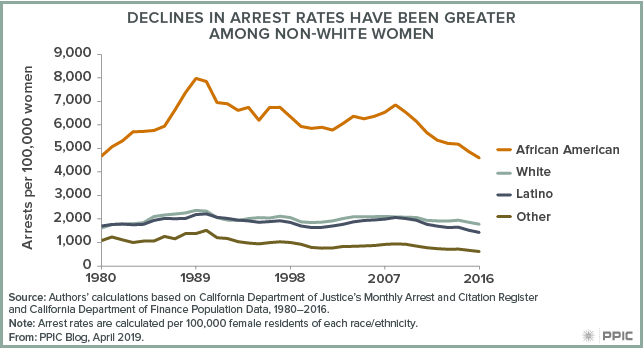
A look at trends in female arrest rates by race/ethnicity shows a decline for women of all races, with greater declines among non-white women. Between 1989—when overall arrest rates peaked—and 2016, arrest rates fell more dramatically for men than for women across all races/ethnicities, but the size of the gender gap varied:

  • Arrest rates for white women fell 25%, while arrest rates for white men fell 55%.
  • Arrest rates among Latino women declined by 35%, while rates for Latino men fell 68%.
  • Rates for African American women fell 42%, while rates for African American men fell 58%.

figure - Declines in Arrest Rates Have Been Greater Among Non-white Women

These differing trends are mostly driven by misdemeanor arrest rates, which have declined much more dramatically among men than among women. In 1980, women represented 14% of misdemeanor arrests, but in 2016 this share jumped to 25%, in part due to an increase in female arrest rates for misdemeanor assault and battery offenses. The female share of felony arrests also increased, up from roughly 12% in 1980 to almost 20% in 2016.

While many factors likely contribute to these trends, California’s criminal justice reforms—which have largely focused on property and drug offenses—are likely to have played a role, with different effects on arrests of men and women. Not surprisingly, given gender differences in arrest offenses, the data supports this. For instance, after Proposition 47 reclassified several drug and property offenses from felonies to misdemeanors in November 2014, the female arrest rate for drug offenses declined by 14% and the rate for property offenses fell by 22%, compared to 7% and 10% declines among men. Policymakers would do well to monitor arrest rates for men and women and keep them in mind when considering the impact of criminal justice reforms.

Video: Preparing California for Census 2020

Is California ready for the 2020 Census? PPIC convened a group of experts last week for a progress report on preparations for the decennial population count, which begins next April 1. PPIC president Mark Baldassare started off by asking California secretary of state Alex Padilla to outline what is at stake.

Padilla offered a “quick civics lesson,” explaining that the census helps determine the amount of federal funding that goes to each state, as well as each state’s overall number of congressional seats and its configuration of legislative districts. If there’s an undercount in California, the state could lose billions of dollars over the next decade.

Are we ready? “Not yet,” Padilla answered. But he added that California is “a little ahead of the curve,” with the highest level of state investment in outreach and preparation in the nation. In addition to longstanding challenges—for example, California has 30% of the recognized “hard to count” communities nationwide—the state faces some new issues, such as inadequate federal funding, cybersecurity issues, a rule that bars legal permanent residents from working as canvassers, and the possible inclusion of a question about citizenship.

How is the state preparing? Marc Berman, a state assemblymember and chair of the Assembly Select Committee on the Census, outlined three major areas of focus: adequate funding, coordination of efforts, and collaboration by state and local government as well as community-based, philanthropic, and business organizations. “We are better prepared than we ever have been before,” he added.

Ditas Katague, director of California Complete Count, offered a wealth of detail on the progress her office has made—opening five field offices, dividing the state into ten regions based on hard-to-count populations, and working with community groups and media in these regions.

Non-governmental groups are playing a key role. Melina Sanchez, the program officer for civic participation initiatives at the James Irvine Foundation, outlined the two overarching goals of a recently convened statewide philanthropic roundtable: to help California reach its hardest-to-count populations and to use the census as a movement-building opportunity for historically underrepresented groups. For Sanchez, it is important to “flip the narrative” so that it’s not about people’s fear of participating in the census but is instead a story about “folks feeling the empowerment of standing up despite all the barriers.”

Sarah Bohn, PPIC’s director of research, highlighted the need to counteract widespread mistrust of government, concerns about privacy and misuse of data, and mistaken ideas about the purpose of the census. A key way to motivate most people, she added, is to make sure they know that their community benefits from an accurate count: “Understanding the funding that goes to your community . . . really seems to encourage participation.”

What would a successful census look like? Katague summed it up: “No undercount, no loss of a congressional seat, no disinformation snafus”—and, on the positive side, increased civic engagement.

2020 Census: Hurdles Remain as the Count Nears

This post is part of a series examining challenges involved in the 2020 Census and what’s at stake for California. Click here to see our full coverage.

Described as the largest peacetime operation undertaken by the federal government, the census is used for everything from allocating congressional seats to redrawing voting districts to distributing billions of dollars in federal funding. Many Californians are at risk of being undercounted, and an inaccurate count could have far-reaching implications.

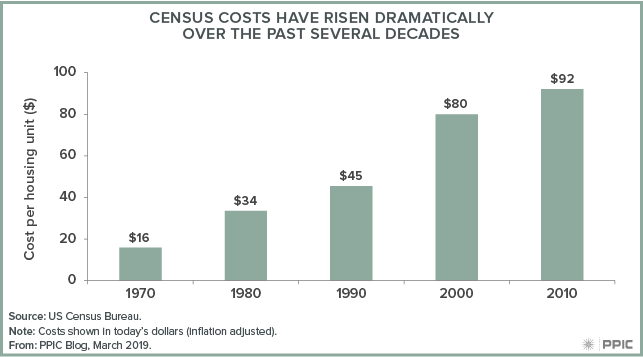
Following decades of escalating costs, the Census Bureau has made significant changes to modernize the census, in hopes of keeping costs similar to what they were in 2010 ($92 per household). For the first time, most households will be invited to respond online, and newly developed tools will help manage field operations. These changes should reduce the staffing levels and infrastructure necessary to conduct the census.

Census Costs Have Risen Dramatically Over the Past Several Decades

But new approaches also create new risks. The US Government Accountability Office has designated the 2020 Census at high risk of failure, citing capacity and planning issues and the fact that the testing of new systems has been scaled back. Several field tests were cancelled in 2017, and the full end-to-end test, which is designed to approximate actual census operations, took place in only one location rather than three, as originally planned. Recently, the NAACP released documents suggesting that chronic underfunding and understaffing at the Census Bureau have negatively affected census preparations.

As of December 2018, the Census Bureau had identified almost 1,100 security weaknesses in its IT systems that still needed to be addressed. Possible threats include disruptions to the website platform, malware from respondents’ personal devices, and impersonation of the Census Bureau. The bureau maintains that it is fully vetting new processes—including working with industry and the Department of Homeland Security to identify and protect against IT threats.

Another big uncertainty concerns the federal administration’s plans to add a citizenship question. Several lawsuits have challenged this decision, and the Supreme Court is scheduled to make a ruling by the end of June on whether the question can be included. Regardless of the ruling, census responses are confidential and, under federal law, the Census Bureau cannot share any personally identifiable information, even with other government agencies. However, combined with federal government rhetoric and actions around deportation, a citizenship question may lower response rates among California’s 10 million immigrants, especially households with undocumented members.

Last year’s end-to-end test did not include a citizenship question. But this July, the Census Bureau will conduct a nationally representative test that should shed light on the question’s potential impact on response rates. Results will help shape the bureau’s outreach strategy and determine if more census workers are needed to follow up with households that don’t respond.

In the meantime, what can California do to ensure an accurate count next year? The state has already invested more in census outreach than any other: $100 million for 2018–19, with an additional $54 million proposed for 2019–20. State and local governments and organizations all have a role to play. Building awareness about the role of the census in determining funding for local public services will go a long way toward motivating Californians to respond, as will assuring residents that their data will be safe and secure.

To discuss what’s needed as California prepares for the 2020 Census, PPIC will be hosting an event on Monday, March 25 in Sacramento with Secretary of State Alex Padilla and other distinguished leaders and experts. Those who cannot attend in person are welcome to join the live webcast, or visit our website later to watch a video of the event.

Californians’ Views of Immigration Policy—Now and Then

From building a border wall to declaring a crisis at the border, immigration policy proposals from the Trump Administration continue to provoke controversy and stir national debate. How do Californians—who live with the nation’s highest share of immigrants—view such proposals? And more broadly, how have their views of immigration policy changed over time?

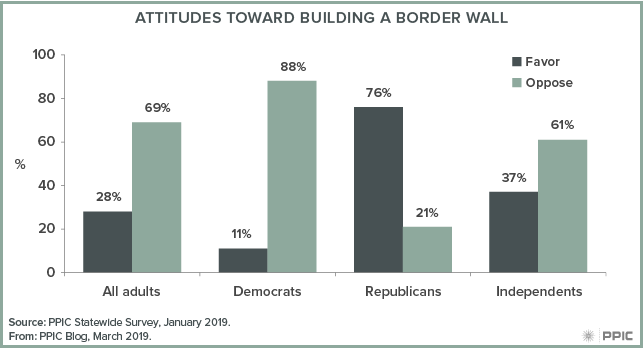
When it comes to a border wall, Californians’ views are decidedly different than those of adults nationwide. Fewer than three in ten Californians (28%) supported building a wall along the entire border with Mexico in our January survey, but twice as many American adults (56%) were in favor of this proposal in a January CNN survey.

However, the wall is a highly partisan issue in California. Support among California Republicans is quite notable, with 76% in favor. Among other partisans—and across regions and demographic groups—support fails to eclipse 40%.

figure - Attitudes Toward Building a Border Wall

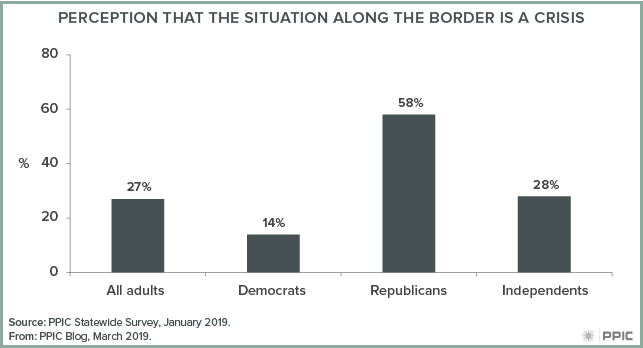
There’s more agreement between Californians and other Americans regarding the situation at the border. Relatively few Californians in our January survey or adults nationwide in a January ABC/Washington Post survey call the situation at the US-Mexico border a “crisis” (27% California, 24% nationwide).

Again, there are stark partisan differences over this topic in California. Republicans (58%) are far more likely than Democrats (14%) and independents (28%) to call the border situation a crisis. Across regions and demographic groups, one in three—or fewer—say this.

figure - Perception that the Situation Along the Border Is a Crisis

Californians’ views of immigration policy have changed a great deal since the passage of Proposition 187 nearly 25 years ago. Supported by 58% of the vote, Prop 187 sought to make undocumented immigrants ineligible for public benefits. Blocked by a federal judge, the measure was never enforced.

Today, 58% of Californians support California’s state and local governments in making their own policies and taking their own actions—separate from the federal government—to protect the legal rights of undocumented immigrants in California.

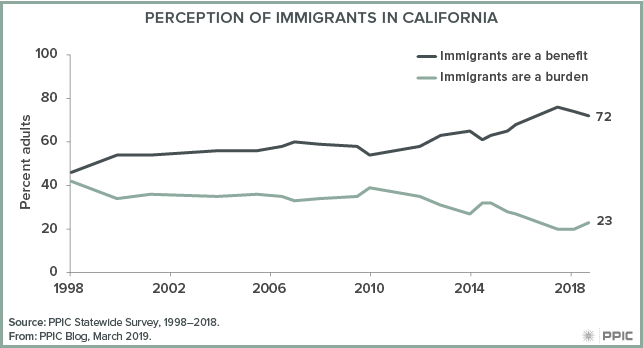
Not only have Californians’ views of immigration policy changed over time, so have their perceptions of immigrants. While state residents have generally held positive views of immigrants, in recent years these perceptions have become much more positive.

figure - Perception of Immigrants in California

Since the PPIC Statewide Survey last talked to Californians, President Trump has declared a national emergency as he seeks funds to build the wall, while California—along with other states—has sued the federal government over this claim. As California and the Trump Administration continue to spar over immigration policy, stay tuned while we track Californians’ perceptions and policy preferences related to this issue.

Video: A Conversation with Chief of Staff Ann O’Leary

As the Newsom administration lays out its initial plans, PPIC invited chief of staff Ann O’Leary to discuss some of the governor’s top priorities. In a wide-ranging discussion with PPIC president Mark Baldassare last week, O’Leary identified the “cost crisis” in California as one of the main challenges that Governor Newsom plans to address.

“By ‘cost crisis,’ I mean how do we make sure that people in California can have affordability and the opportunity to really take advantage of the California dream?” O’Leary said. “I think too many people in California are really seeing that slip away. They’re not able to afford homes, they’re not able to afford child care, and they’re not able to pay for college for their children as they grow older.”

O’Leary pointed out that confronting this cost crisis would take many forms, such as taking on health care affordability, investing in “cradle to career” education, and addressing housing production and rising rents.

She underscored that the governor’s first proposed budget reflects his vision for promoting affordability and opportunity while ensuring the state’s long-term financial stability. Newsom’s plan includes a mix of one-time and ongoing funding as well as a robust rainy day fund, but “we also go further than that. We have a reserve fund for the safety net, and we also look at how we could use some of the surplus to pay down pension liabilities.”

The governor has also focused on other key challenges—for example, responding to wildfires and tackling the unmet need for safe drinking water in many parts of the state.

On wildfires, O’Leary noted that the governor wants to “make sure that we’re continuing with those recovery efforts to help communities that have been harmed, but also to prepare for future wildfires.” On drinking water, O’Leary said that the governor has already worked with the legislature to provide $20 million in emergency funding to address this issue.

Navigating the PG&E bankruptcy filing is another immediate priority. O’Leary said that over the next 60 days the governor’s team would be creating a roadmap for the state to “protect wildfire victims, protect employees who are out there every day trying to make sure we’re safe, and make sure fundamentally that we have safe and affordable power and that we’re meeting our clean-energy goals.”

O’Leary also discussed the federal-state relationship and how the governor plans to manage it. While pointing out that the state and federal governments need to work together as much as possible, O’Leary also underscored that California must stand up for its values when fundamental disagreements exist, especially on issues such as immigration and family planning. “These are differences of opinion. And it’s a needle we have to thread, but we’re going to do our best.”

Serving California’s Diverse College Students

As part of his cradle-to-career initiative, Governor Newsom has emphasized higher education as a key means of expanding Californians’ social and economic opportunities. From proposing more higher education funding in this year’s budget to supporting two years of free tuition for first-time community college students, many of his initiatives are focused on making college accessible and affordable to more of the state’s residents. For these initiatives to succeed, it will be essential to enroll a broad array of students—in particular, those who have been historically underserved in higher education–and to ensure that more students successfully complete college.

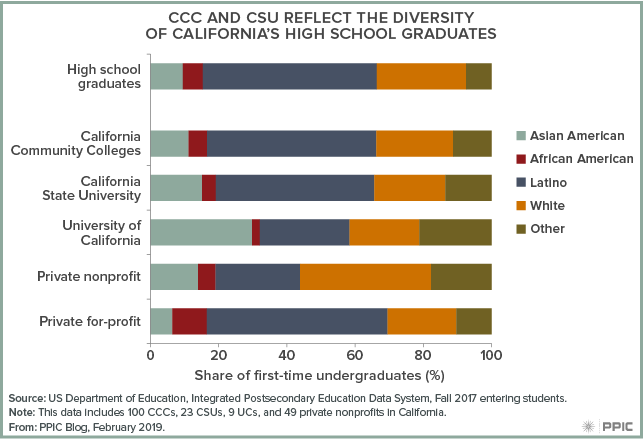
The good news is that the state is enrolling a diverse set of students, especially at the two largest systems, California State University (CSU) and the California community colleges (CCC). Overall, these two systems closely reflect the racial and ethnic make-up of California’s high school population—which is critical given that these two systems are key entry points for African American, Latino, low-income, and first generation college students. UC and private nonprofit colleges in California serve diverse populations, including more first generation and low-income students than their peer institutions in the rest of the country, but they do not reflect the full ethnic diversity of the state’s high school graduates.

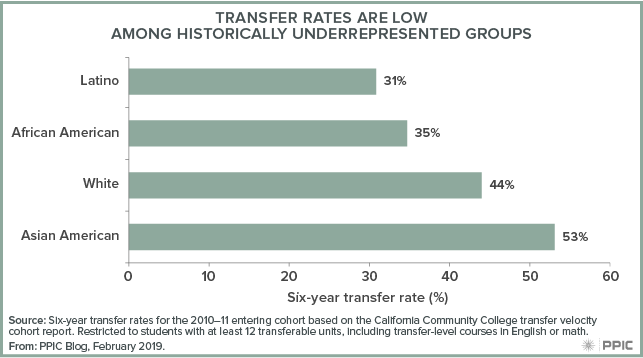
More challenging is helping students to successfully complete a four-year degree. Graduation rates are very high at UC and at most private nonprofit colleges. At CSU, graduation rates have improved dramatically, but even so about 40% of students do not earn a degree within six years. Most students who enter community colleges with the intent to transfer to a four-year college never do so. Transfer rates are especially low for African American and Latino students.

Both CSU and CCC have launched new policies and programs that hold the promise of improving transfer and reducing inequities. For example, community college reforms in developmental—also known as remedial—education will lead to substantial increases in the share of students taking college-level courses in English and math. The Associate Degree for Transfer (ADT) program is making the transition to California State Universities much more straightforward. And the new Guided Pathways initiative provides support services and clear course-taking patterns to community college students to promote success.

These are important steps in the right direction. Renewed interest in Sacramento regarding higher education will help. And Californians are well aware of the stakes. A majority of adults in California (56%) say a four-year college degree is very important for economic and financial success in today’s economy, and 75% believe California’s higher education system is very important to the quality of life and economic vitality of the state.

A Snapshot of Homelessness in California

In late January communities around the country conducted a point-in-time count of their homeless populations. Federally mandated by the US Department of Housing and Urban Development, these estimates help local, state, and federal governments allocate resources and track progress toward the goal of ending homelessness.

Last year’s count revealed that about 130,000 Californians were homeless—nearly a quarter of the national total. California’s rate of homelessness, 33 per 10,000 residents, was among the highest in the country.

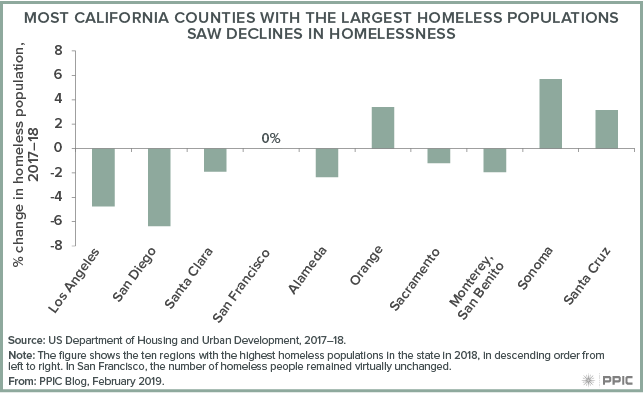
After rising 14% from 2016 to 2017, the total number of homeless Californians declined slightly (by 1%) from 2017 to 2018. Homelessness decreased in many of California’s major urban areas, including in four of the five counties with the largest homeless populations: Los Angeles, San Diego, Santa Clara, and Alameda.

However, even with these decreases homelessness remains a huge problem. Los Angeles County alone recorded nearly 50,000 homeless people. The other nine counties with the largest homeless populations reported between 2,300 and 8,600 people experiencing homelessness. And many areas across the state saw increases in the number of homeless people.

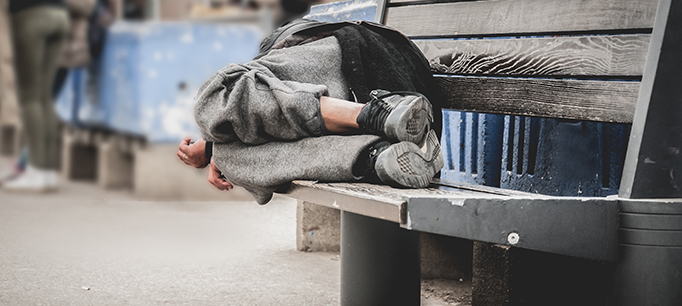
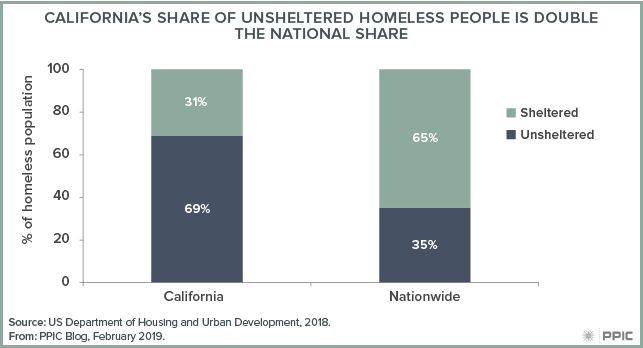
The vast majority of homeless Californians (69%) were unsheltered, meaning they were living in streets, parks, or other locations not meant for human habitation—the highest rate in the nation. Among homeless veterans, California has the nation’s highest share that are unsheltered (67%); and among homeless youth, the share that are unsheltered (80%) ranks second highest.

Homelessness is already on many policymakers’ radar. Governor Newsom’s proposed budget would allocate $500 million in one-time grant funding for emergency homeless shelters and navigation centers, and $25 million ongoing to assist eligible homeless individuals in applying for disability benefits. Localities are also trying a range of approaches to expand affordable housing and increase services for the homeless. For example, voters in Los Angeles, Berkeley, Santa Rosa, and Emeryville recently passed local bonds to fund housing projects and assistance for low- and middle-income households and people experiencing homelessness. Coordinating investments, policies, and programs across federal, state, and local levels will be key to reducing homelessness throughout the state.