Video: Mobilizing the Inland Empire for the Census—and for the Future

As California’s diverse regions prepare for the 2020 Census, community-based organizations and local leaders are playing key roles. An event last week in Riverside offered insights on the Inland Empire’s outreach strategies for the Census and beyond. Cosponsored by PPIC and the Center for Social Innovation at the University of California, Riverside, the event featured a panel of state and local experts.

The discussion was moderated by Michelle Decker, president and CEO of the Community Foundation. She began by asking Eric McGhee, PPIC senior fellow, to explain the importance of an accurate census count in California. The census helps determine the distribution of federal funding to the states; gathers information about the population that is valuable to policymakers and businesses alike; and is the basis for reapportionment and redistricting. As McGhee pointed out, an undercount of California’s population could be costly in all of these areas.

McGhee noted that California has large shares of “the kinds of groups that tend to be undercounted—Asian Americans, African Americans, Latinos, renters, very young children, noncitizens.” Finally, he outlined concerns about inadequate funding, which has prevented a thorough testing of the process, and the climate of fear in immigrant communities, which could result in lower response rates even if the Supreme Court rules against the inclusion of a question on citizenship later this month.

But there is some good news: “It wouldn’t take that much for California to overcome some of these challenges,” McGhee said. California is arguably more mobilized than any other state, and the Inland Empire is one of the state’s most mobilized regions.

Deborah Phares, Census 2020 project manager at the Community Foundation, sees the census as a great opportunity for policymakers and organizations across Riverside and San Bernardino Counties. The region’s collaborative efforts were galvanized by a state request for information about innovative census outreach strategies. “We decided that we were going to pursue and support and advocate for allocation of resources based on need,” said Phares, adding that the regional plan is designed to avoid overlapping efforts and to integrate data so that organizations could work together “in a very deep way.”

Karthick Ramakrishnan, founding director of the Center for Social Innovation, underscored the significance of a two-county approach to census outreach that draws from a wide range of communities-—geographic sub-regions and demographic groups. “I think the kind of work that’s happening in the Inland Empire is the envy of the rest of the country. . . .We’re building some pretty amazing tools that will stand the test of time.”

Kathleen Kelly Janus, the newly appointed senior advisor on social innovation in the Governor’s Office, agreed: “I think there’s a huge opportunity to invest in capacity building through all these census dollars that are coming in.” She added that the cross-sector approach involving foundations, community-based organizations, policymakers, and other groups “is a model that we can use not just for the census but for all of these other issues that Governor Newsom wants to address.”

 

Skills-based Immigration and California’s Workforce

[vc_row][vc_column][vc_column_text]The White House recently issued a summary of an immigration plan that would shift the nation’s largely family-based immigration system toward a skills-based approach that would probably prioritize immigrants with higher levels of formal education. Given that the education levels of new immigrants are already on the rise, what impact might a skills-based system have on in California, the state with the largest immigrant population?

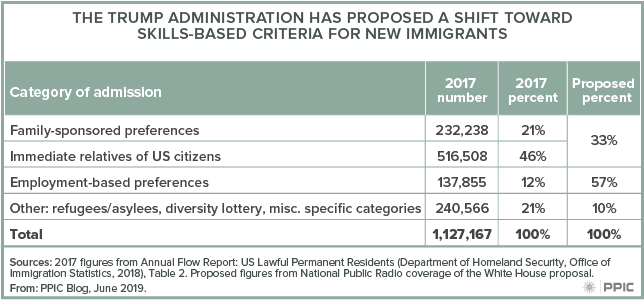
The proposed new system would increase the percentage of skills-based legal immigrants from 12% to 57%, leaving the total number of immigrants at 1.1 million per year.

table - The Trump Administration Has Proposed a Shift Toward Skills-based Criteria for New Immigrants

In recent years, about two-thirds of immigrants with lawful permanent residence status (or “Green Cards”) have been admitted to the US through family-based preferences. The proposed new system would reduce this by half, to 33%. The White House statement emphasizes that priority would still be given to immediate family members of both US citizens and lawful permanent residents.

Past PPIC research suggests that family-preference immigrants have historically been high- and low-skilled. And California’s economy relies on immigrants at both ends of the educational spectrum. Nearly a third of the state’s working-age immigrants lack a high school diploma, and they make up a large portion of the workforce in industries requiring less formal education. However, the foreign-born now constitute 31% of California workers who have at least a BA, and they are overrepresented in high-skill industries like technology and health care.

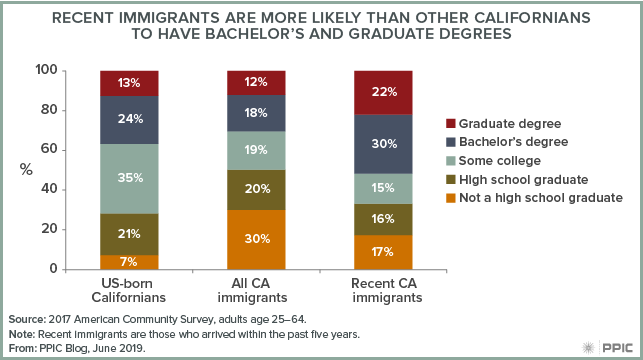
Recent PPIC research finds that new immigrants in California are increasingly well-educated. In 2017, a slight majority (52%) of the state’s working-age immigrants with fewer than five years in the US had a bachelor’s or graduate degree, compared to only 22% in 1990. Only 17% had not graduated from high school, down from 47% in 1990. Indeed, recently arrived immigrants are more likely than US-born Californians to have college or graduate degrees.

figure - Recent Immigrants Are More Likely than Other Californians to Have Bachelor’s and Graduate Degrees

It is impossible to know exactly how a skills-based immigration system would affect California. But given the trend toward higher education levels among new immigrants and state economy’s reliance on both high- and low-skilled workers, a shift toward such a system might not be necessary to meet California’s workforce needs.[/vc_column_text][/vc_column][/vc_row][vc_row][vc_column][/vc_column][/vc_row]

Video: Californians and Their Government

Less than a year before California’s presidential primary, likely voters who are Democrats or who lean Democratic are divided on strategy: is it more important for the party to nominate the candidate who seems mostly likely to defeat President Trump or the candidate whose positions align most closely their views? But almost all Californians see voting in the 2020 elections as very important. At a lunchtime briefing in Sacramento last Thursday, PPIC researcher Dean Bonner outlined these and other key findings from the latest statewide survey.

Two in three California likely voters say they will definitely or probably choose a candidate other than Trump. There is a huge partisan divide on this question: 93% of Democrats and 66% of independents would definitely or probably vote for another candidate if the election were held today, while 82% of Republicans would definitely or probably vote for Trump.

Most Californians say that the investigation by special counsel Robert Mueller did not clear the president of wrongdoing, and Californians are more likely that the nation as a whole to say impeachment proceedings should begin. But here, too, there is a partisan divide: 66% of Democrats say Congress should begin the process, compared to only 39% of independents and 9% of Republicans.

Other survey highlights:

  • A majority of Californians say their housing costs cause a financial strain; six in ten favor the governor’s plan to allocate $1 billion to address homelessness, and similar shares favor proposed new rules intended to create more affordable housing.
  • Three-quarters of Californians see participation in the 2020 Census as very important—but most have concerns about confidentiality.
  • An overwhelming majority are concerned about rising electricity bills in the wake of the PG&E bankruptcy.
  • Californians are concerned that the recent outbreak of measles could spread; most believe that vaccines are very safe and an overwhelming majority say vaccination against measles and other diseases should be required.

California 2020: Census and Elections Are Important to Californians

The 2020 Census is fast approaching. With political representation and billions in federal funds on the line, the importance of an accurate count cannot be overstated. Californians recognize this, according to our latest survey—but many have concerns about the confidentiality of the information they provide. Even more Californians say that the 2020 elections are important. Both are critical to the future of the state.

California has invested substantially in raising awareness and preparing local communities for what will be a monumental census effort. Governor Gavin Newsom has proposed adding another $54 million toward state census activities, on top of a previous allocation that was just north of $100 million. These funds—along with a sustained effort at building partnerships around the state—are meant to counter California’s particular vulnerabilities when it comes to ensuring an accurate census: large shares of immigrants and other hard-to-count populations.

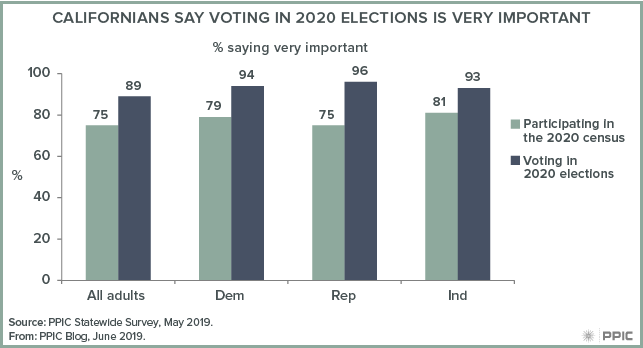
With so much at stake, participation in the census is critical. Are Californians aware of the importance of being counted? Currently, three-quarters of all adults (75%) say it is very important to participate in the 2020 Census. Overwhelming majorities agree across regions, political parties, and all demographic groups—from age, income, and education level to racial/ethnic and citizenship status groups. Naturalized citizens are the most likely to say that participation in the census is very important (80%).

Later this month, the US Supreme Court is expected to rule on the legality of adding a question about citizenship status to the 2020 Census, as the Trump administration has proposed. This question has not been asked on the decennial census since 1950, and opponents argue that it would depress the count among immigrants who might be fearful about revealing their status.

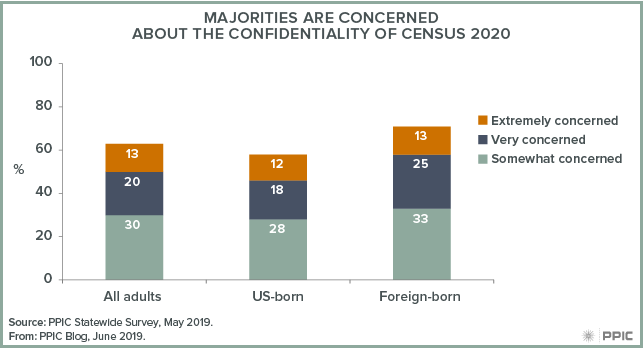
A solid majority of Californians (63%) are concerned that the Census Bureau will not keep 2020 Census answers confidential. This concern is highest among Latinos (74%) and African Americans (70%), followed by Asian Americans (64%) and whites (52%). US-born Californians (58%) are less likely than foreign-born residents (71%) to say that confidentiality is a concern.

figure - Majorities Are Concerned about the Confidentiality of Census 2020

The upcoming census will coincide with another pivotal event—the 2020 presidential election. Election outcomes will have additional lasting effects this cycle, as state legislators (or redistricting commissions) will use the new 2020 Census data to redraw district lines that will last a decade. Today, nearly all Californians recognize the importance of voting next year.

While three in four say it is very important to participate in the census, even more—nine in ten—say that it is very important to vote in the 2020 elections. More than nine in ten across political parties hold this view, as do more than eight in ten across regions and demographic groups.

figure - Californians Say Voting in 2020 Elections Is Very Important

With a presidential primary in California next March and the census in April, Californians are heading toward a consequential season—for the state and the nation. Efforts to boost participation in both of these essential civic events will be critical to ensuring that all Californians are heard—and counted.

2020 Census: Counting California’s Homeless Population

This post is part of a series examining challenges involved in the 2020 Census and what’s at stake for California. 

Accurately counting the homeless population is notoriously difficult. People experiencing homelessness can be hard to find—they tend to move around a lot, and at any given time, they might be in a shelter, in a car, outdoors, or couch surfing with family and friends. They may also conceal their living arrangements for privacy reasons or to avoid law enforcement.

The issue is particularly urgent for California as the 2020 Census approaches. California has the most homeless individuals of any state, with 130,000 people living in shelters or outdoors, according to estimates from January 2018. Since this count doesn’t include people staying temporarily with family or friends, it’s almost certainly an underestimate.

Undercounting homeless Californians could affect political representation and lead to reduced federal funding for low-income and homeless families, especially in urban areas with large homeless populations. In addition to determining congressional seats, the census is used to allocate billions of federal dollars for health care, education, and housing programs, including Section 8 housing vouchers for low-income families.

The goal of the census is to count all residents “in the right place,” meaning where they usually live and sleep. People who are couch surfing without a permanent place to live should be included in the household where they’re staying on Census Day (April 1, 2020).

What about people staying in shelters, living outdoors, and residing in other temporary locations? The census bureau has two approaches:

  • Census workers will interview and record responses from people experiencing homelessness at service-based locations or outdoors. These sites include emergency and transitional shelters, soup kitchens, mobile food vans, and targeted outdoor locations (e.g., under bridges, in parking lots, in encampments). This effort will take place from March 30 to April 1, 2020. Census workers in 2010 counted nearly 28,000 Californians in homeless shelters and about 64,000 Californians at other service-based locations and outdoors.
  • Census workers will go to “transitory” locations to collect responses from people who don’t have a usual home elsewhere. These locations include RV parks, motels, campgrounds, racetracks, circuses, carnivals, and marinas. This effort will take place from April 9 to May 4, 2020. Census workers in 2010 collected data from nearly 24,000 transitory locations in California.

The Census Bureau works with local partners to identify service-based and outdoor locations. Input on the latter is particularly important, as California has high shares of homeless individuals who are not living in shelters. The bureau’s new construction program allows governments to submit addresses for new shelters and transitory locations that are expected to be completed by April 1, 2020.

Getting input from local officials and on-the-ground organizations will be critical. They likely have the most up-to-date information about service-based and outdoor locations in their communities, as well as on those who have been displaced due to fire or other disasters. Individuals with experience working directly with the homeless population may also consider applying to be census workers—speaking with a trusted person from the community can help encourage participation among those who might otherwise distrust government officials.

Together, these efforts could go a long way toward motivating homeless individuals to participate in the census, while also ensuring that census workers have accurate information about where to count these Californians.

Health Care Access for California’s Immigrants

Governor Newsom is proposing to expand access to Medi-Cal—the state’s Medicaid program—for low-income young adults up to age 26, regardless of their immigration status. This could help a vulnerable segment of the immigrant population. Californians are signaling broad support.

Overall, immigrants make up about 27% of the state’s population and are less likely to have health insurance than US-born Californians. Immigrants are also less likely to have private insurance, partly due to differences in employment industries and income.

Figure - Health Care Coverage Rates are Lower For California Immigrants in All Age Groups

Documented immigrants—including those with green cards and visas—may qualify for Medi-Cal without being subject to the five-year waiting period required by federal law. They can also purchase private health plans through Covered California, the health insurance exchange that was created as part of the Affordable Care Act (ACA). However, most recently-arrived elderly immigrants are not eligible for Medicare because they have not paid Medicare taxes over a long enough period.

California offers a patchwork of health care options for undocumented immigrants, who are not covered by the ACA. For instance, low-income children and pregnant residents are eligible for Medi-Cal regardless of immigration status, and some counties include undocumented immigrants in programs for those who cannot afford medical care. Additional options for undocumented immigrants include community clinics, rural health clinics, emergency rooms, or a limited version of Medi-Cal for medical emergencies.

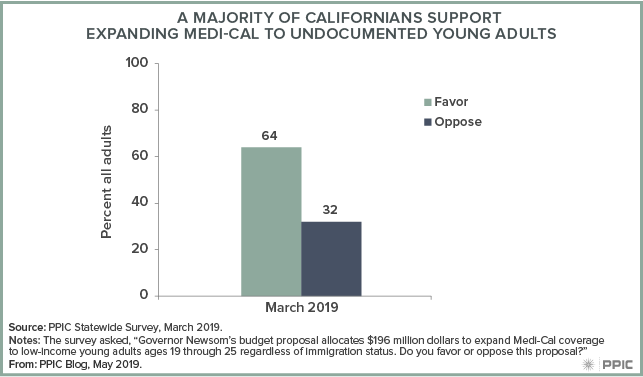
Californians support health care access for undocumented immigrants. In a 2015 PPIC Statewide Survey, a slim majority of Californians (54%) supported the idea of providing health care coverage to undocumented immigrants. In March 2019, about two-thirds (64%) expressed support for the governor’s proposed expansion of Medi-Cal coverage to low-income young adults, including those who are undocumented.

Figure - A Majority of Californians Support Expanding Medi-Cal to Undocumented Young Adults

The governor’s May budget revision delays implementation of the expansion, but it would still have an impact: by providing coverage to approximately 90,000 undocumented young adults in the first year, it could help make the health care landscape less complicated for an important share of California’s immigrant population.

California’s Digital Divide and the 2020 Census

The 2020 Census will be the first decennial census with a fully online component. Rather than mailing forms to every household, the US Census Bureau will instead send out postcards asking households to take the census online, hoping to achieve a 55% online response rate. Then, as in years past, census workers will visit those who did not respond and conduct in-person interviews.

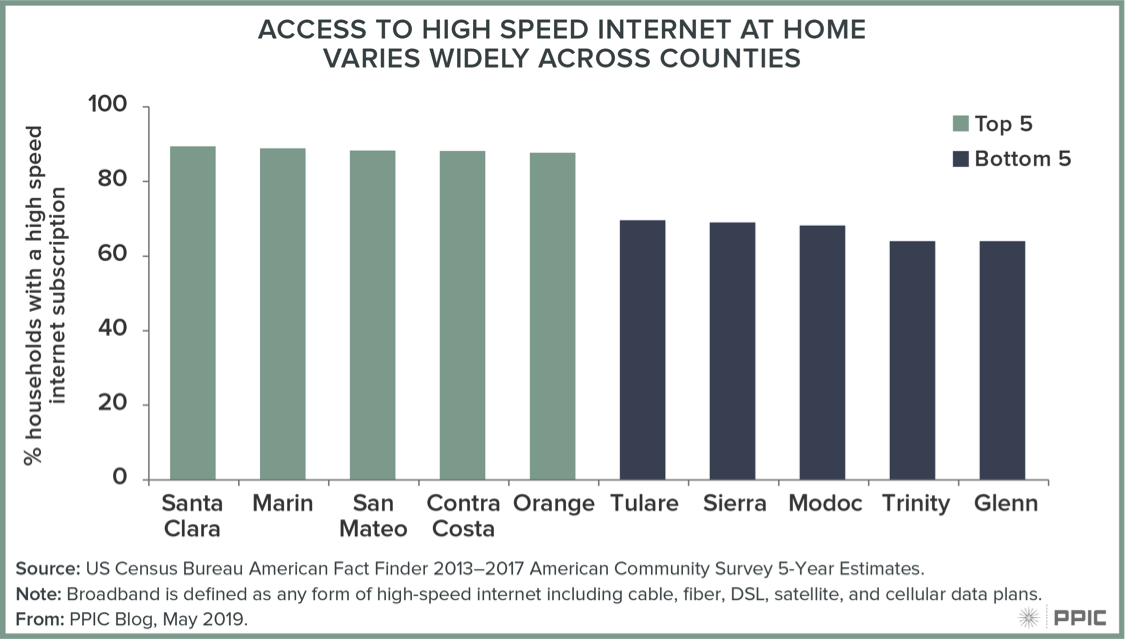
California’s size and diversity present unique challenges to this effort. One significant challenge lies in how many households report having reliable high speed internet—essential to completing the census online.

The contrasts across counties are stark. For example, according to the most recent estimates, more than 89% of households in Santa Clara County report having high speed access at home. In contrast, in Trinity, Glenn, Modoc, Sierra, Tulare, and Imperial Counties, more than 30% of households say they do not.

What’s more, these estimates actually understate the disparity. In the counties of Colusa, Sierra, Yuba, Tulare, and Plumas more than 15% of households report having high speed internet only through their cell phone data plans and no other source, and in 11 other counties at least 10% of households report the same.

Figure - Access to High Speed Internet at Home Varies Widely Across Counties

Of further concern is that these counties are the very ones that have been identified as being hard to count. In addition to sparse internet access, communities may be hard to count because they contain higher rates of historically undercounted groups, such as noncitizens and African Americans, or because large shares of their residents rent rather than own their households.

These challenges are real, but California is working hard to overcome them. State agencies were allocated over $100 million in 2018-19—with another $54 million proposed—so they may partner with the Census Bureau to help identify hard to count communities, encourage participation, and better ensure an accurate count of all Californians.

Video: English as a Second Language in California Community Colleges

While the educational goals of students who enroll in ESL courses at California’s community colleges may vary, the economic benefits of effective ESL programs are clear: English proficiency can facilitate social and economic mobility for non-native speakers. But little is known about ESL programs across the state, or about the trajectories of ESL students. Now that a new law—Assembly Bill (AB) 705—is motivating colleges across the state to assess and reform their ESL programs, we need to better understand the ESL student population and the programs that serve them.

At an event in Sacramento earlier this week, PPIC researcher Bonnie Brooks outlined the findings of a new report on ESL in the community colleges and a panel of experts discussed AB 705’s impact on ESL in the community college system.

Kathryn Wada, who has taught ESL for 30 years at Cypress College, noted that the fact that AB 705 distinguishes ESL from developmental (or remedial) English and recognizes that ESL students are working toward proficiency in a foreign language is “huge for our field.”

AB 705 requires colleges to reform “credit” ESL programs—which offer credit-bearing courses for which students pay tuition—so that they do not deter or delay educational progress. By fall 2020, colleges must implement policies that maximize the chances that students complete a transfer-level English course within three years.

A look at the length of ESL course sequences across the system indicates that students at many colleges could, theoretically, complete transfer-level English in three years. In reality, however, most students don’t get this far. As Brooks noted, simply offering a sequence that is short enough to allow students to get through transfer-level English in three years “isn’t necessarily enough to maximize the probability of completion.”

Fortunately, many colleges are taking new approaches to ESL instruction that do increase the likelihood of completion. Courses that take an integrated approach—teaching more than one English skill at a time—and policies that allow students to move directly from ESL to transfer-level English instead of requiring them to enroll in developmental courses are likely to be key to fulfilling AB 705’s mandate. And, as Wada noted, new policies that make credits from advanced ESL courses transferable to UC and CSU moves credit ESL programs beyond the goals of AB 705: “If students are able to fulfill CSU and UC general education requirements directly with ESL courses . . . that’s huge.”

These new instructional approaches usher in a new era for ESL students. As Alice Perez, vice chancellor of academic affairs in the California Community Colleges Chancellor’s Office noted, “Many of our faculty and our institutions are set up to receive students assuming a major deficit: ‘You’re not college ready, and this placement test shows us this.’” Melissa Reeve, an English and ESL professor at Solano College, echoed Perez’s call for a “mindset shift,” citing the importance of “all of us having a belief in our students and what they are able to do, and sharing that with them in every facet of what we do.”

Immigrants Are Key to California’s Health Workforce

Governor Newsom’s proposed budget includes more than $85 million to train health care workers—a reflection of the state’s anticipated need to fill over 107,000 new health care jobs every year between 2016 and 2026. This projected increase is due to a growing and aging population, as well as greater access to care under the Affordable Care Act. California’s immigrant population will be an important source of workers in this sector.

In California, nearly one in three health care workers is foreign born, compared to one in six nationwide. This is partly because of the high share of immigrants among California’s working-age population. While immigrants make up about a quarter of all Californians, they are almost a third of working-age Californians—with even higher shares of immigrants among those with less than a high school diploma (49%) or those holding a graduate or professional degree (36%).

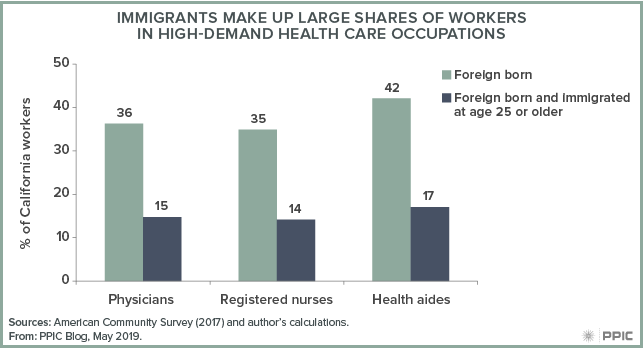
Immigrants also make up a large proportion of California workers in high-demand health care occupations, such as primary care providers (who are particularly needed in rural areas), nurses, and health aides. In 2017, 36% of the state’s physicians and 35% of registered nurses were foreign born. Forty-two percent of California’s nursing, psychiatric, and home health aides were foreign born.

figure - Immigrants Make Up Large Shares of Workers in High-demand Health Care Occupations

As California considers how to train people for these jobs, programs that account for the diversity of immigrants’ educational backgrounds will be important. Many highly skilled immigrant health workers were age 25 or older when they arrived in the country, suggesting that they may have had at least some training abroad. To help foreign-trained health professionals, some California universities already have programs to guide them through the steps necessary to enter the state’s health workforce. Training programs for support roles in health that require less than a four-year college degree are another opportunity that could encourage lower-skilled immigrants to enter the health sector.

Immigrants can also benefit the health workforce in other ways. For example, health care workers who speak languages other than English, as many immigrant workers do, can be a resource for low-income patients facing linguistic barriers to health care access. In the coming years, meeting California’s health care workforce needs will require multiple strategies—but engaging the state’s immigrant population can be a part of the solution.

Interactive: Will Housing Costs Drive Californians Away?

[vc_row][vc_column][vc_column_text]Home values and rental markets in California are among the most expensive in the nation, and supply shortages continue to put upward pressure on housing prices. Over the last decade, the state averaged fewer than 80,000 new homes annually—far below the estimated need of 180,000 additional units each year, according to a recent report from the California Department of Housing and Community Development.

In our March survey, we found that a record-high share of Californians (68%) believe that housing affordability is a big problem in their region, and 47% are seriously considering moving away from the part of the state they live in now due to housing costs.

The interactive below allows you to take a closer look at how interest in moving due to housing costs varies across demographic groups. For example, Los Angeles County residents (39%) are the most likely to say housing costs have made them seriously consider moving out of the state, with another 13% saying they’re considering moving elsewhere in California. Overall, half of coastal residents say they’re seriously thinking about moving away from where they live now.

Young adults are also much more likely to have considered moving than older residents. More than half (56%) of young adults age 18–34 have seriously thought about moving due to housing costs—including four in ten who have considered leaving the state—compared to 38% of adults over 55.

We hope this interactive sheds light on Californians’ perceptions of housing costs. As the new governor and state legislature work on their policy agendas for the year, the PPIC survey team will continue to monitor the issue of housing closely.[/vc_column_text][/vc_column][/vc_row][vc_row][vc_column][vc_raw_html]JTNDZGl2JTIwY2xhc3MlM0QlMjd0YWJsZWF1UGxhY2Vob2xkZXIlMjclMjBpZCUzRCUyN3ZpejE1NTU3MDc3NzcyNTUlMjclMjBzdHlsZSUzRCUyN3Bvc2l0aW9uJTNBJTIwcmVsYXRpdmUlMjclM0UlM0Nub3NjcmlwdCUzRSUzQ2ElMjBocmVmJTNEJTI3aHR0cHMlM0ElMjYlMjM0NyUzQiUyNiUyMzQ3JTNCd3d3LnBwaWMub3JnJTI2JTIzNDclM0JibG9nJTI2JTIzNDclM0JpbnRlcmFjdGl2ZS13aWxsLWhvdXNpbmctY29zdHMtZHJpdmUtY2FsaWZvcm5pYW5zLWF3YXklMjclM0UlM0NpbWclMjBhbHQlM0QlMjclMjAlMjclMjBzcmMlM0QlMjdodHRwcyUzQSUyNiUyMzQ3JTNCJTI2JTIzNDclM0JwdWJsaWMudGFibGVhdS5jb20lMjYlMjM0NyUzQnN0YXRpYyUyNiUyMzQ3JTNCaW1hZ2VzJTI2JTIzNDclM0JNYSUyNiUyMzQ3JTNCTWFueUNhbGlmb3JuaWFuc0FyZVRoaW5raW5nb2ZNb3ZpbmdkdWV0b0hvdXNpbmdDb3N0cyUyNiUyMzQ3JTNCQ3Jvc3N0YWJzJTI2JTIzNDclM0IxX3Jzcy5wbmclMjclMjBzdHlsZSUzRCUyN2JvcmRlciUzQSUyMG5vbmUlMjclMjAlMkYlM0UlM0MlMkZhJTNFJTNDJTJGbm9zY3JpcHQlM0UlM0NvYmplY3QlMjBjbGFzcyUzRCUyN3RhYmxlYXVWaXolMjclMjAlMjBzdHlsZSUzRCUyN2Rpc3BsYXklM0Fub25lJTNCJTI3JTNFJTNDcGFyYW0lMjBuYW1lJTNEJTI3aG9zdF91cmwlMjclMjB2YWx1ZSUzRCUyN2h0dHBzJTI1M0ElMjUyRiUyNTJGcHVibGljLnRhYmxlYXUuY29tJTI1MkYlMjclMjAlMkYlM0UlMjAlM0NwYXJhbSUyMG5hbWUlM0QlMjdlbWJlZF9jb2RlX3ZlcnNpb24lMjclMjB2YWx1ZSUzRCUyNzMlMjclMjAlMkYlM0UlMjAlM0NwYXJhbSUyMG5hbWUlM0QlMjdzaXRlX3Jvb3QlMjclMjB2YWx1ZSUzRCUyNyUyNyUyMCUyRiUzRSUzQ3BhcmFtJTIwbmFtZSUzRCUyN25hbWUlMjclMjB2YWx1ZSUzRCUyN01hbnlDYWxpZm9ybmlhbnNBcmVUaGlua2luZ29mTW92aW5nZHVldG9Ib3VzaW5nQ29zdHMlMjYlMjM0NyUzQkNyb3NzdGFicyUyNyUyMCUyRiUzRSUzQ3BhcmFtJTIwbmFtZSUzRCUyN3RhYnMlMjclMjB2YWx1ZSUzRCUyN25vJTI3JTIwJTJGJTNFJTNDcGFyYW0lMjBuYW1lJTNEJTI3dG9vbGJhciUyNyUyMHZhbHVlJTNEJTI3bm8lMjclMjAlMkYlM0UlM0NwYXJhbSUyMG5hbWUlM0QlMjdzdGF0aWNfaW1hZ2UlMjclMjB2YWx1ZSUzRCUyN2h0dHBzJTNBJTI2JTIzNDclM0IlMjYlMjM0NyUzQnB1YmxpYy50YWJsZWF1LmNvbSUyNiUyMzQ3JTNCc3RhdGljJTI2JTIzNDclM0JpbWFnZXMlMjYlMjM0NyUzQk1hJTI2JTIzNDclM0JNYW55Q2FsaWZvcm5pYW5zQXJlVGhpbmtpbmdvZk1vdmluZ2R1ZXRvSG91c2luZ0Nvc3RzJTI2JTIzNDclM0JDcm9zc3RhYnMlMjYlMjM0NyUzQjEucG5nJTI3JTIwJTJGJTNFJTIwJTNDcGFyYW0lMjBuYW1lJTNEJTI3YW5pbWF0ZV90cmFuc2l0aW9uJTI3JTIwdmFsdWUlM0QlMjd5ZXMlMjclMjAlMkYlM0UlM0NwYXJhbSUyMG5hbWUlM0QlMjdkaXNwbGF5X3N0YXRpY19pbWFnZSUyNyUyMHZhbHVlJTNEJTI3eWVzJTI3JTIwJTJGJTNFJTNDcGFyYW0lMjBuYW1lJTNEJTI3ZGlzcGxheV9zcGlubmVyJTI3JTIwdmFsdWUlM0QlMjd5ZXMlMjclMjAlMkYlM0UlM0NwYXJhbSUyMG5hbWUlM0QlMjdkaXNwbGF5X292ZXJsYXklMjclMjB2YWx1ZSUzRCUyN3llcyUyNyUyMCUyRiUzRSUzQ3BhcmFtJTIwbmFtZSUzRCUyN2Rpc3BsYXlfY291bnQlMjclMjB2YWx1ZSUzRCUyN3llcyUyNyUyMCUyRiUzRSUzQ3BhcmFtJTIwbmFtZSUzRCUyN2ZpbHRlciUyNyUyMHZhbHVlJTNEJTI3cHVibGlzaCUzRHllcyUyNyUyMCUyRiUzRSUzQyUyRm9iamVjdCUzRSUzQyUyRmRpdiUzRSUyMCUyMCUyMCUyMCUyMCUyMCUyMCUyMCUyMCUyMCUyMCUyMCUyMCUyMCUyMCUyMCUzQ3NjcmlwdCUyMHR5cGUlM0QlMjd0ZXh0JTJGamF2YXNjcmlwdCUyNyUzRSUyMCUyMCUyMCUyMCUyMCUyMCUyMCUyMCUyMCUyMCUyMCUyMCUyMCUyMCUyMCUyMCUyMCUyMCUyMCUyMHZhciUyMGRpdkVsZW1lbnQlMjAlM0QlMjBkb2N1bWVudC5nZXRFbGVtZW50QnlJZCUyOCUyN3ZpejE1NTU3MDc3NzcyNTUlMjclMjklM0IlMjAlMjAlMjAlMjAlMjAlMjAlMjAlMjAlMjAlMjAlMjAlMjAlMjAlMjAlMjAlMjAlMjAlMjAlMjAlMjB2YXIlMjB2aXpFbGVtZW50JTIwJTNEJTIwZGl2RWxlbWVudC5nZXRFbGVtZW50c0J5VGFnTmFtZSUyOCUyN29iamVjdCUyNyUyOSU1QjAlNUQlM0IlMjAlMjAlMjAlMjAlMjAlMjAlMjAlMjAlMjAlMjAlMjAlMjAlMjAlMjAlMjAlMjAlMjAlMjAlMjAlMjBpZiUyMCUyOCUyMGRpdkVsZW1lbnQub2Zmc2V0V2lkdGglMjAlM0UlMjA4MDAlMjAlMjklMjAlN0IlMjB2aXpFbGVtZW50LnN0eWxlLndpZHRoJTNEJTI3MTAwJTI1JTI3JTNCdml6RWxlbWVudC5zdHlsZS5oZWlnaHQlM0QlMjhkaXZFbGVtZW50Lm9mZnNldFdpZHRoJTJBMC43NSUyOSUyQiUyN3B4JTI3JTNCJTdEJTIwZWxzZSUyMGlmJTIwJTI4JTIwZGl2RWxlbWVudC5vZmZzZXRXaWR0aCUyMCUzRSUyMDUwMCUyMCUyOSUyMCU3QiUyMHZpekVsZW1lbnQuc3R5bGUud2lkdGglM0QlMjcxMDAlMjUlMjclM0J2aXpFbGVtZW50LnN0eWxlLmhlaWdodCUzRCUyOGRpdkVsZW1lbnQub2Zmc2V0V2lkdGglMkExLjc3JTI5JTJCJTI3cHglMjclM0IlN0QlMjBlbHNlJTIwJTdCJTIwdml6RWxlbWVudC5zdHlsZS53aWR0aCUzRCUyNzEwMCUyNSUyNyUzQnZpekVsZW1lbnQuc3R5bGUubWluSGVpZ2h0JTNEJTI3NzgwcHglMjclM0J2aXpFbGVtZW50LnN0eWxlLm1heEhlaWdodCUzRCUyOGRpdkVsZW1lbnQub2Zmc2V0V2lkdGglMkExLjc3JTI5JTJCJTI3cHglMjclM0IlN0QlMjAlMjAlMjAlMjAlMjAlMjAlMjAlMjAlMjAlMjAlMjAlMjAlMjAlMjAlMjAlMjAlMjAlMjAlMjAlMjAlMjB2YXIlMjBzY3JpcHRFbGVtZW50JTIwJTNEJTIwZG9jdW1lbnQuY3JlYXRlRWxlbWVudCUyOCUyN3NjcmlwdCUyNyUyOSUzQiUyMCUyMCUyMCUyMCUyMCUyMCUyMCUyMCUyMCUyMCUyMCUyMCUyMCUyMCUyMCUyMCUyMCUyMCUyMCUyMHNjcmlwdEVsZW1lbnQuc3JjJTIwJTNEJTIwJTI3aHR0cHMlM0ElMkYlMkZwdWJsaWMudGFibGVhdS5jb20lMkZqYXZhc2NyaXB0cyUyRmFwaSUyRnZpel92MS5qcyUyNyUzQiUyMCUyMCUyMCUyMCUyMCUyMCUyMCUyMCUyMCUyMCUyMCUyMCUyMCUyMCUyMCUyMCUyMCUyMCUyMCUyMHZpekVsZW1lbnQucGFyZW50Tm9kZS5pbnNlcnRCZWZvcmUlMjhzY3JpcHRFbGVtZW50JTJDJTIwdml6RWxlbWVudCUyOSUzQiUyMCUyMCUyMCUyMCUyMCUyMCUyMCUyMCUyMCUyMCUyMCUyMCUyMCUyMCUyMCUyMCUzQyUyRnNjcmlwdCUzRQ==[/vc_raw_html][/vc_column][/vc_row]