California’s Brain Gain Continues

[vc_row][vc_column][vc_column_text]California’s heyday of rapid population growth—the post-World War II era—was fueled by millions of migrants coming to the state from the rest of the country. Those days are long gone. California’s population continues to grow (through births and international migration), but every year it loses tens of thousands of people to other states. And yet there is one group that California continues to attract: college graduates.

This interstate migration pattern—gaining large numbers of college graduates while losing large numbers of less educated adults—doesn’t happen anywhere else in the country. Over the past five years, California has attracted 162,000 more college graduates (adults with at least a bachelor’s degree) from other states than it has lost. Over the same period, the University of California (UC) awarded about 300,000 bachelor’s degrees at its nine undergraduate campuses. In other words, interstate migration provides California with half as many college graduates as the entire UC system.

figure - California Gains College Graduates While Losing Less Educated Adults

College  graduates  come  to  California  from  all  over,  but  eight  states send California substantially more college graduates than they get in return. Between 2012 and 2017, net gains of college graduates from New York (51,000), Illinois (31,000), Pennsylvania (24,000), New Jersey (20,000), Massachusetts (20,000), Florida (16,000), Michigan (13,000), and Ohio (11,000) totaled more than 186,000. California experienced smaller but still sizable net losses (totaling 80,000) to five states: Texas (29,000), Oregon (16,000), Nevada (13,000), Arizona (12,000), and Washington (10,000).

The new migrants to California tend to be quite young. Indeed, college graduates age 20–29 account for almost all of the net gains. (In contrast, California experiences small net losses of older college graduates.) From a labor market perspective, attracting young college graduates is especially advantageous. Young adults with college degrees are at the start of their careers and provide the state with much-needed highly educated workers.

figure - College Graduates Moving To California Tend To Be Young

In fact, college graduates moving to California are more likely to be employed than those leaving the state. The largest gains are primarily in majors that are in relatively high demand in the labor market, including engineering (33,000), communications (18,000), business (18,000), and computer science (17,000).

The migration of young college graduates to California is a consequence of the state’s growing demand for highly skilled and highly educated workers. But the numbers are not high enough to fully meet the state’s changing needs. Although many college graduates move to California from other states, the most important source of highly educated workers in California are the state’s own colleges and universities. Policies and practices to improve college access and completion in the state will ensure that more Californians are able to help create and benefit from a strong economy.[/vc_column_text][/vc_column][/vc_row]

Video: Career Pathways and Economic Mobility at California’s Community Colleges

About a third of future jobs in California will require more than a high school diploma but less than a bachelor’s degree. By training workers for these jobs, career education—also known as career technical education or vocational training—plays an integral role in meeting California’s workforce needs and improving students’ economic well-being.

At an event in Sacramento last week, PPIC researcher Shannon McConville outlined the findings of a new report on career education and economic mobility, and a panel of experts discussed the implications for students, colleges, and the state as a whole.

McConville noted that completing a career education credential at a California community college confers a 20% wage gain, on average. But economic benefits vary greatly across program areas. For instance, returns to health credentials tend to be substantial, while business and IT credentials yield lower returns.

The panelists began by highlighting current efforts to improve students’ labor market outcomes. Marty Alvarado, executive vice chancellor for educational services at California’s community colleges, explained the system’s “two-pronged approach” to making sure programs connect to in-demand, high-return careers. One area of focus is regional infrastructure, which includes regional labor market centers that provide colleges with data on local industries. The second area includes tools to help students better navigate their program choices, “while also trying to make transparent the earnings projections for students as they move into these career options.”

Supporting students—especially low-income students from underrepresented demographic groups—in completing high-return credentials was another topic of conversation. Alvarado discussed efforts at the community colleges to streamline processes that may be creating “unnecessary barriers for students,” while Assemblymember Autumn Burke emphasized the importance of access to social safety net services so students can focus on their career.

Alma Salazar, senior vice president of the Center for Education Excellence and Talent Development at the Los Angeles Area Chamber of Commerce, noted that all stakeholders need to be involved. “How do we get the system as a whole to take ownership in helping us collectively solve for these problems? . . . It has to go beyond Sacramento. It has to go beyond the system’s leadership. It has to get to the institutional level and the people who work [there], who have to be equally committed.”

While many see the evolving nature of work and increasing automation as challenges, Assemblymember Burke was optimistic about providing a “just transition” for workers who may lose jobs in fast-changing industries. “We can train people for this new economy [and] prepare them now. . . . It’s a shortcoming to worry about losing minimum-wage jobs, because there’s so much opportunity on the other side.”

Reforming California’s Community College System

California’s community colleges have a strong record of providing access to higher education—they enroll more students than any other college system in the country, including large shares from groups that have been historically underrepresented. But improving student outcomes has long been a challenge: fewer than half (48%) of students earn a degree or certificate or transfer to a four-year college. The community college system is implementing a broad range of reforms designed to address these high rates of incompletion. These reforms focus on improving the student experience from initial enrollment to graduation and beyond.

From our perspective, the most dramatic reforms are in developmental (or remedial) education. In the past, a large majority of students entering the community college system have been placed in developmental education courses in English and/or math, and relatively few have gone on to complete transfer level courses. But the passage of Assembly Bill (AB) 705 in 2017 has required colleges to implement assessment and placement procedures, including new curricula that result in more students completing transfer-level courses in English and math within one year of entering. Our work has shown substantial improvements at colleges that have been early implementers of these new procedures. For example, 70% of students who entered directly into transfer-level courses in English with co-requisite support (a form of concurrent remediation) successfully completed the course, compared to 29% of those who began in a prerequisite developmental education course. Full implementation of AB 705 will occur this fall.

Other reforms aim to improve student pathways throughout community college and beyond. For example, the Guided Pathways program is designed to help students navigate through community college by helping them choose programs of study, mapping pathways to their end goals, and ensuring that they stay on those pathways. Another new program, the Associate Degree for Transfer, guarantees admission to a California State University campus in a major aligned to a student’s community college course of study. All of these reforms make equity a primary consideration. The student-centered funding formula links these efforts by tying a portion of district funding to equity and success outcomes, including completion of transfer-level math and English within the first year, certificates or degrees granted, and transfers to four-year universities, among others.

Implementing new programs and policies is not easy, and it will take time to assess the results. But, as PPIC has shown, many of these reforms are showing early promise.

Video: English as a Second Language in California Community Colleges

While the educational goals of students who enroll in ESL courses at California’s community colleges may vary, the economic benefits of effective ESL programs are clear: English proficiency can facilitate social and economic mobility for non-native speakers. But little is known about ESL programs across the state, or about the trajectories of ESL students. Now that a new law—Assembly Bill (AB) 705—is motivating colleges across the state to assess and reform their ESL programs, we need to better understand the ESL student population and the programs that serve them.

At an event in Sacramento earlier this week, PPIC researcher Bonnie Brooks outlined the findings of a new report on ESL in the community colleges and a panel of experts discussed AB 705’s impact on ESL in the community college system.

Kathryn Wada, who has taught ESL for 30 years at Cypress College, noted that the fact that AB 705 distinguishes ESL from developmental (or remedial) English and recognizes that ESL students are working toward proficiency in a foreign language is “huge for our field.”

AB 705 requires colleges to reform “credit” ESL programs—which offer credit-bearing courses for which students pay tuition—so that they do not deter or delay educational progress. By fall 2020, colleges must implement policies that maximize the chances that students complete a transfer-level English course within three years.

A look at the length of ESL course sequences across the system indicates that students at many colleges could, theoretically, complete transfer-level English in three years. In reality, however, most students don’t get this far. As Brooks noted, simply offering a sequence that is short enough to allow students to get through transfer-level English in three years “isn’t necessarily enough to maximize the probability of completion.”

Fortunately, many colleges are taking new approaches to ESL instruction that do increase the likelihood of completion. Courses that take an integrated approach—teaching more than one English skill at a time—and policies that allow students to move directly from ESL to transfer-level English instead of requiring them to enroll in developmental courses are likely to be key to fulfilling AB 705’s mandate. And, as Wada noted, new policies that make credits from advanced ESL courses transferable to UC and CSU moves credit ESL programs beyond the goals of AB 705: “If students are able to fulfill CSU and UC general education requirements directly with ESL courses . . . that’s huge.”

These new instructional approaches usher in a new era for ESL students. As Alice Perez, vice chancellor of academic affairs in the California Community Colleges Chancellor’s Office noted, “Many of our faculty and our institutions are set up to receive students assuming a major deficit: ‘You’re not college ready, and this placement test shows us this.’” Melissa Reeve, an English and ESL professor at Solano College, echoed Perez’s call for a “mindset shift,” citing the importance of “all of us having a belief in our students and what they are able to do, and sharing that with them in every facet of what we do.”

Helping Community College Students Succeed

California’s community colleges are implementing new policies in developmental (or remedial) education that could improve completion of transfer-level courses for tens of thousands of students every year. Recently passed legislation should result in the vast majority of entering community college students bypassing developmental education and enrolling directly into transfer-level courses in English and math. Many of these students will be provided with concurrent remedial support to help them succeed—namely, co-requisite courses, which feature group work to reinforce difficult concepts, just-in-time remediation, and other activities.

These reforms mark a dramatic change from the traditional approach, which required most students to complete developmental English and math before they could take transfer-level courses. In fact, as of the 2017–18 academic year only half of students enrolling in an English course for the first time and about one-third of first-time math students were able enroll in a transfer-level course. Previous PPIC research shows that students who start college in developmental education are significantly less likely to successfully complete transfer-level courses.

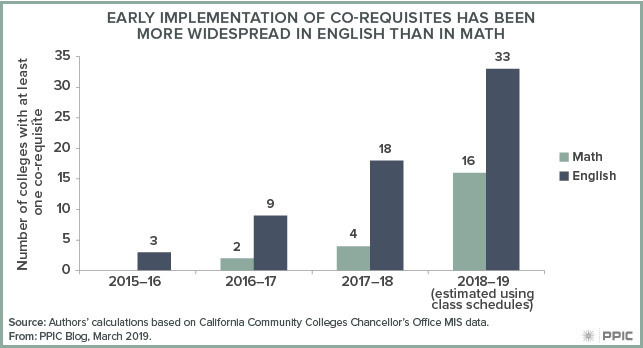
The new policies will be implemented systemwide by fall of 2019, but some colleges began offering co-requisite courses ahead of schedule—as early as 2015–16. Implementation has been faster in English than math: as of 2017–18, 33 of the state’s 115 community colleges were offering English co-requisites, while only 16 offered math co-requisites. This is not surprising, considering that co-requisite support in math must be tailored to the transfer-level courses required for different majors (e.g., statistics, business calculus, pre-calculus, college algebra, math for liberal arts). Between 2016–17 and 2017–18, enrollment in English co-requisites more than doubled (to 8,200), while enrollment in math co-requisites increased 36% (to 1,300).

figure - Early Implementation of Co-requisites Has Been More Widespread in English than in Math

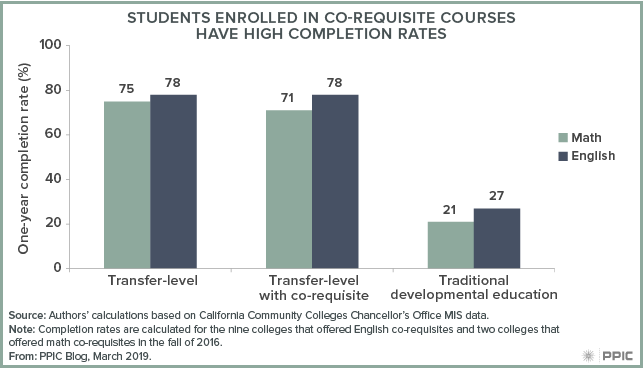
A recent PPIC report found that students enrolled in co-requisite courses are significantly more likely to successfully complete transfer-level courses in math and English than students who started in traditional prerequisite developmental education courses. And they are as likely as those who do not receive co-requisite support to complete transfer-level courses within a year. This is notable because students who take transfer-level courses without co-requisites have been identified as college ready.

figure - Students Enrolled in Co-requisite Courses Have High Completion Rates

The early evidence on co-requisites is promising. As colleges move into the full implementation phase, ongoing research can help them understand what happens as they broaden access to transfer-level courses to a diverse group of students, what types of concurrent support work best, and how co-requisite students perform in subsequent college-level courses.

Serving California’s Diverse College Students

As part of his cradle-to-career initiative, Governor Newsom has emphasized higher education as a key means of expanding Californians’ social and economic opportunities. From proposing more higher education funding in this year’s budget to supporting two years of free tuition for first-time community college students, many of his initiatives are focused on making college accessible and affordable to more of the state’s residents. For these initiatives to succeed, it will be essential to enroll a broad array of students—in particular, those who have been historically underserved in higher education–and to ensure that more students successfully complete college.

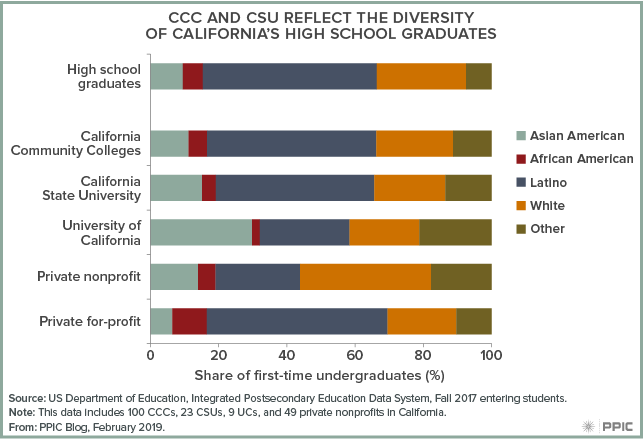
The good news is that the state is enrolling a diverse set of students, especially at the two largest systems, California State University (CSU) and the California community colleges (CCC). Overall, these two systems closely reflect the racial and ethnic make-up of California’s high school population—which is critical given that these two systems are key entry points for African American, Latino, low-income, and first generation college students. UC and private nonprofit colleges in California serve diverse populations, including more first generation and low-income students than their peer institutions in the rest of the country, but they do not reflect the full ethnic diversity of the state’s high school graduates.

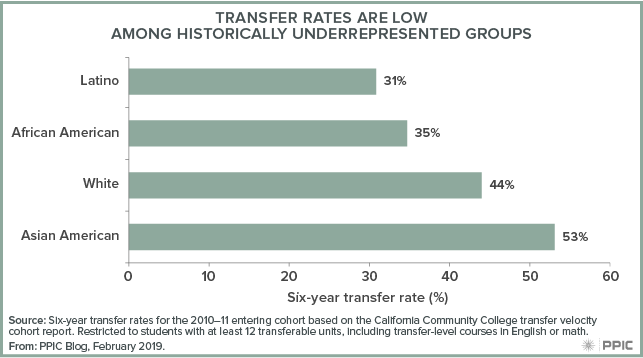
More challenging is helping students to successfully complete a four-year degree. Graduation rates are very high at UC and at most private nonprofit colleges. At CSU, graduation rates have improved dramatically, but even so about 40% of students do not earn a degree within six years. Most students who enter community colleges with the intent to transfer to a four-year college never do so. Transfer rates are especially low for African American and Latino students.

Both CSU and CCC have launched new policies and programs that hold the promise of improving transfer and reducing inequities. For example, community college reforms in developmental—also known as remedial—education will lead to substantial increases in the share of students taking college-level courses in English and math. The Associate Degree for Transfer (ADT) program is making the transition to California State Universities much more straightforward. And the new Guided Pathways initiative provides support services and clear course-taking patterns to community college students to promote success.

These are important steps in the right direction. Renewed interest in Sacramento regarding higher education will help. And Californians are well aware of the stakes. A majority of adults in California (56%) say a four-year college degree is very important for economic and financial success in today’s economy, and 75% believe California’s higher education system is very important to the quality of life and economic vitality of the state.

One Step Closer to a Statewide Educational Data System

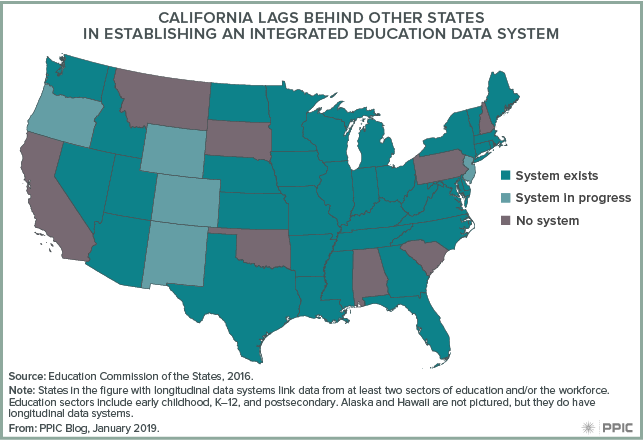
Governor Newsom’s recently proposed budget includes $10 million in one-time funding for the planning, creation, and implementation of a statewide longitudinal data system—including early childhood education, K–12, higher education, the workforce, and health and human services. As we wrote in a recent PPIC report, this idea holds a lot of promise. An integrated data system could allow for improved feedback for educational institutions, more efficient use of public funds, and better evaluation and coordination for the state. The idea also has support in the state senate, where Senators Glazer and Allen proposed a similar system (SB 2) last December.

Each public education system—K–12, the community colleges, California State University, and the University of California—already recognizes the importance of data. They all collect, store, and analyze data on students within their respective systems to improve instruction and outcomes. However, few connections are ever made between educational sectors. Even though a high school senior may graduate from a K–12 school, attend a community college, and then transfer to a UC, data isn’t shared across those systems in any systematic way. So each system has no idea if students are successful in the next stage of their academic career. California is one of the few states that does not follow students across sectors.

The governor’s budget summary also suggests that the data system could be used to improve K–12 measures of career and college readiness. Current measures are based on high school test scores and high school course-taking. But connecting K–12 data to higher education and employment data could lead to more meaningful measures of whether students are able to take and succeed in college-level courses, or whether they work in a job with a living wage.

With the Newsom administration’s support, California may be closer than ever to establishing a data system that can answer key questions about how students move along the educational pipeline. Creation and implementation will involve security, privacy, and governance challenges, but California has 42 other states that can serve as models. This is a much-needed first step in helping the state develop effective policy solutions that will improve students’ progress through school and into the workforce.

Making Career Education Affordable in California

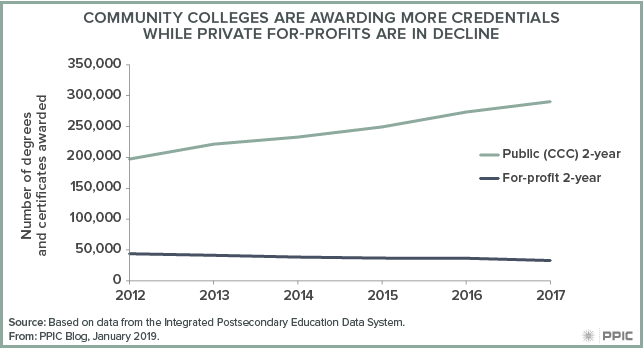
Secretary of Education Betsy DeVos recently announced plans to eliminate rules put in place during the Obama administration that require career-education colleges to show that the credentials they award lead to gainful employment. In California, these rules have helped shift enrollment from expensive for-profit institutions to public community colleges, which offer career education programs at much lower cost. Indeed, California’s community college system is one of the most affordable higher education institutions in the country.

Many are concerned that eliminating gainful employment rules will lead to a loss of accountability and even a resurgence of enrollment in for-profit colleges. Some of those colleges have engaged in predatory recruiting practices, and many have high dropout rates and exorbitant student debt. In California, there are also concerns about a reversal of recent gains in affordable access to higher education—particularly among groups that have historically been underserved.

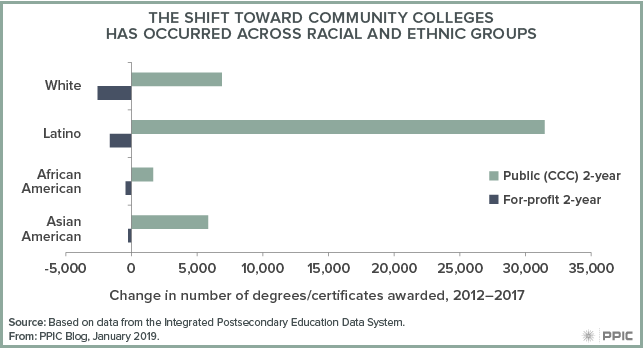
Partly because of the information provided by the gainful employment rules, career education students in California have been increasingly seeking degrees and certificates at the state’s large public community college system rather than at for-profit colleges. Between 2012 and 2017, the number of associate degrees and certificates conferred by for-profit institutions dropped by 25%. In comparison, the state’s community colleges saw an increase of 47%; in 2017, the number of degrees and certificates they awarded was more than eight times the number awarded by for-profit colleges.

Many for-profit institutions have targeted workers looking to get into in-demand fields such as health or family and consumer sciences. These for-profits have marketed options that lead to credentials—known as short-term certificates—that can be earned in less than one year. In 2012, private for-profit colleges awarded almost 21,000 short-term certificates compared to 38,000 awarded at the community colleges. But by 2017 the number of short-term certificates awarded had declined to fewer than 7,000 at for-profit colleges and risen to more than 55,000 at the community colleges. Many of the students who have shifted to the community colleges in recent years are from historically underserved backgrounds (e.g., African American, Latino, older, and low-income students). These students now have opportunities for career education without the hefty price tag attached to programs at for-profit colleges.

The elimination of federal gainful employment rules could have a negative impact on affordable access to career education. However, efforts by California’s community colleges to attract students who might be drawn to for-profit institutions will continue. So too will state rules that make institutions with low graduation rates and high loan default rates ineligible for Cal Grants. These state-level initiatives might not be able to prevent a resurgence of exploitative for-profits, but they could make a difference for many Californians.

Video: Higher Education as a Driver of Economic Mobility

Higher education plays a key role in helping Californians move up the income ladder—but equity gaps are a big challenge. Among young adults born in California, 60% of Asian Americans and 40% of whites have at least a bachelor’s degree, compared to 21% of African Americans and 18% of Latinos. At a Sacramento briefing yesterday, PPIC researcher Sarah Bohn outlined these and other key findings of a new report.

Bohn noted that “higher education is correlated with a host of benefits in today’s society.” Workers with at least a bachelor’s degree earn 73% more than high school graduates. While earnings levels are affected by many factors—including the subject area of a college major, geographic location, and the field of employment—Bohn stressed that “the higher the level of education you have, the greater the economic return that you experience.”

California has historically enjoyed strong economic and education gains. However, while the economy is currently booming, recent trends in educational attainment are not as encouraging. Young adults in California today are only slightly more likely to have graduated from college than older adults. Moreover, graduation rates are lower for low-income residents and underrepresented race/ethnic groups.

These equity gaps are especially troubling because low-income, Latino, and African American students—as well as students who would be the first generation in their families to attend college—make up the vast majority of California’s high school population. The community colleges, UC, and CSU have undertaken serious efforts to narrow these gaps—but, as Bohn noted, all educational sectors, including K–12 schools and private institutions, play an important role.

California’s higher education systems have been implementing policies and programs that are likely to increase college graduation rates among the state’s diverse population. Bohn concluded by highlighting the progress that has been made and outlining additional actions that can help more Californians—particularly underrepresented students—benefit from higher education.

Video: Modernizing California’s Education Data System

California has invested billions of dollars in public education reforms over the past decade, and student outcomes have improved in many areas. But the state can’t answer key questions about student progress because it doesn’t have comprehensive data on important transitions. For example, it can’t easily track student movement between high school and college or from college into the workforce. With new state leadership about to take over in Sacramento, the time may be right for an integrated data system that can help policymakers, educators, and students monitor educational progress and outcomes.

Last week in Sacramento, PPIC researcher Jacob Jackson outlined a new report on the need for such a system and Hans Johnson, director of the PPIC Higher Education Center, moderated a panel discussion about the benefits and challenges of creating one.

As Jackson pointed out, most other states already have integrated education data systems. Colleen Moore, assistant director of the Education Insights Center, added that California “already has four pretty good longitudinal data systems—it’s just that they’re within each of the four education segments and they’re not connected.” As a result, student demographics, coursework, grades, and degrees or certificates can be tracked within each segment but not across segments.

Natasha Collins, principle consultant on education for the Assembly Appropriations Committee, noted that it would not be technically difficult to create a repository that links data and follows student movement through the K–12 system and the three postsecondary systems. “It might make sense to move forward with those core components and then potentially add on other agencies—even things like corrections, or the Department of Rehabilitation—so we can really see student outcomes.” She added, “We could also have information on employment and earnings outcomes at least for students who go to college at some point.”

So why doesn’t California have one? Collins noted that the legislature has considered several bills that would set up a system and recently held a hearing on the topic. Moreover, technical plans to link data across the higher education systems have been drawn up in the past. The panelists agreed that the main barriers are not technical—they are political and logistical.

Lande Ajose, executive director of California Competes, stressed the need for an entity to oversee data collection and access: “The state needs an independent body that would be responsible for collecting, cleaning, analyzing data, and making sure it’s accessible to many other parties.” One stumbling block to creating such a body is determining its scope—should it be simply a secure data repository, or should it have the authority to coordinate segments and/or monitor their accountability?

Laura Metune, vice chancellor for external relations at the California Community Colleges Chancellor’s Office, highlighted another barrier: “One of the challenges has been direction and resources from the state level.” She noted that higher education systems have worked together on data sharing, and her own office shares a lot of data with researchers and the public. But, she added, information sharing requires resources, and “we have a really small staff.”

Ultimately, the panelists put the ball in Governor-Elect Newsom’s court. As Ajose put it, “I really do think that this issue of a data system requires gubernatorial leadership, that the governor has the unique ability to set the stage around what is important within higher education.”