
 In California and across the nation, women have surpassed men in educational attainment. In 2006, for the first time ever, a majority of college graduates in the state were women. By 2014, 52% of California adults ages 18 to 64 with at least a bachelor’s degree were women, up from 45% in 1990. This gender divide in educational attainment is likely to continue to grow because the disparity is especially notable among younger adults: in 2014, 718,000 (55%) of California’s college graduates under 30 were women, compared to only 588,000 men.
Why are women now more likely to earn a college degree than men? The most direct and obvious answer is that women are more likely to be prepared for college, and thus more likely to enroll in college and graduate from college once enrolled. For example, among high school graduates in California, women are more likely to have completed the courses required for admission to the University of California and California State University. In 2014–15, almost half (49%) of female high school graduates completed these college preparatory courses, compared to only 38% of their male peers. This gap has grown since 2004–05, when 39% of female and 31% of male high school graduates completed these college preparatory courses.
 Better academic preparation among women leads to higher college enrollment and graduation rates. According to US Department of Education data, 55% of all undergraduates enrolled in California’s colleges and universities in 2014 were women. And once enrolled, women are more likely to graduate. Six-year bachelor’s degree completion rates in the state were 61% for women and 57% percent for men.
The strong progress that women have made in higher education is good news. Yet inequities remain. Female college graduates earn less than their male peers. Women also have lower rates of employment than men. Policies that promote pay equity, flexible work schedules, and parental leave may help address these issues.
Women are especially underrepresented in important fields such as computer science and engineering—as are African American and Latino men. For California to meet the challenges of the 21st century economy, we need even more women and men—including those from groups traditionally underrepresented in higher education—to earn a college degree.
Visit the PPIC Higher Education Center

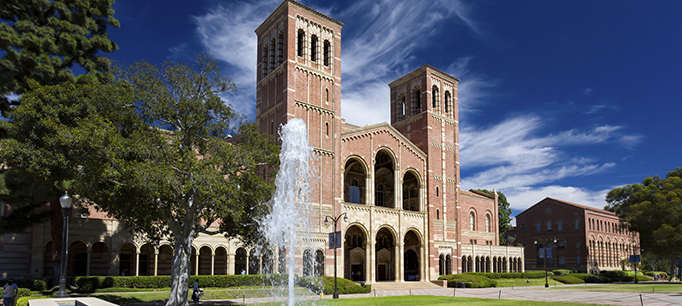
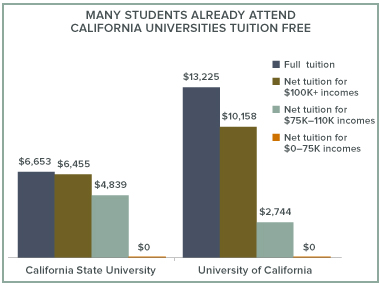 California’s financial aid program, Cal Grants, provides grants (funding that students do not have to pay back) for full tuition for the state’s lowest-income students, as well money toward books and living expenses for some of them. Through a combination of Cal Grants, federal aid, and institutional aid, UC’s Blue and Gold Opportunity plan guarantees free tuition for any family making $80,000 a year or less. CSU has a similar plan, the State University Grant, which bases the amount a family will pay on a number of factors. On average, students who receive financial aid pay no tuition at UC or CSU if their families make $75,000 or less.
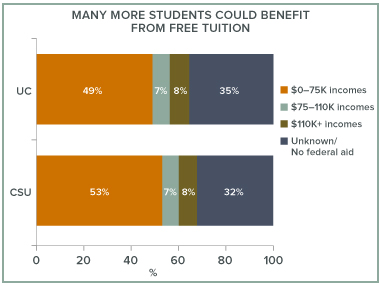 Raising the cap to $110,000—or beyond—would cover at least another 7% of students entering UC (2,300 students) and CSU (3,900 students) in 2014. The average student whose family income is between $75,000 and $110,000 would save about $4,839 at CSU or $2,744 at UC, resulting in more than $25 million in combined tuition savings for those thousands of families.

 These budget allocations reflect a striking shift from California’s budget of forty years ago, when the state spent a larger share on higher education and a much smaller share on corrections. But by the 2008–2009 budget year, allocations to higher education (11.1%) and corrections (10.7%) were almost identical. In the years since, higher education spending has outpaced corrections in relative terms, largely because recent criminal justice reforms have drawn down the number of adults in state custody and on parole. Nonetheless, California spends more on corrections and less on higher education today, in relative terms, than at nearly any point in the past thirty years.
 Since 1980, personal income has grown at vastly different rates across the state. Workers in the Bay Area and Orange County earn substantially more (on an aggregate, per capita basis) than the average Californian. Residents in the Central Valley and Sierras, the Inland Empire, and the far north earn substantially less than the statewide average. These disparities have grown over time. In 1980, per capita regional income ranged from 80% to 111% of statewide per capita income. Today, this range is wider, with the Inland Empire at 66% and the Bay Area at 138% of the statewide average.
 However, the value of post-secondary degrees has been increasing even in occupations that traditionally have not required college education—including the jobs that comprise a larger share of the economy in lower-income regions of the state. So we might expect regional disparities in college degree attainment to be narrower today. But this is not the case.
 Californians with education credentials beyond high school, from an associate’s degree up to a doctoral degree, have lower than average unemployment rates in general – and had smaller spikes in unemployment during the recession. Even workers with just some schooling beyond high school, but less than an associate’s or bachelor’s degree, fare systematically better than those without any college experience. The following figure shows how unemployment varied according to education levels since 2008. These estimates rely on detailed Census Bureau survey data, which is produced with a significant lag, so the most recent information we have pertains to calendar year 2014.
 In 2015, about 38% of California’s high schools (480 total) were high need based on high rates of enrollment for English Learner, low-income, and foster care students. These schools educate about 34% of all high school students in the state. High-need schools also serve higher proportions of students traditionally underrepresented at UC: about 43% of the African American students in the state and about 51% of California’s Latino students.
 On average, students from high-need schools are slightly less likely to enroll in a UC. About 5.4% of all graduates enroll in a UC at a typical high-need school, compared to 6.5% for a typical regular school.
 Unlike almost all OECD countries, California has seen very little generational progress (2 percentage points). In stark contrast, Korea, Poland, and Ireland witnessed gains of 23 or more percentage points in the share of bachelor’s-degree holders among younger adults, relative to older adults. Because educational attainment is the
  What is most worrisome for California is that the lack of generational progress is coupled with a relatively low share (33%) of young adults with college degrees. Connecticut (not shown) has not seen much generational progress either, but even so, over 40% of young adults in that state have a college degree.
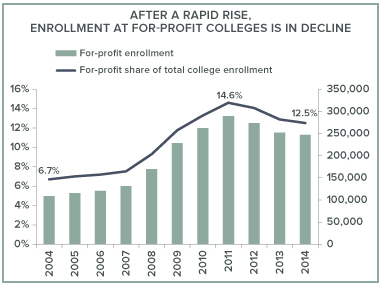 Enrollment at for-profit colleges in California almost tripled between 2004 and 2011, growing from 109,000 students to 289,000 students (as measured by full-time equivalent enrollment). Over the same period, enrollment in other colleges changed very little (increasing only 12%). By 2011, one in seven college students attended a for-profit institution. For-profit colleges enrolled more students than the University of California system and all private nonprofit colleges in the state.