Most Californians Want More Gun Regulation

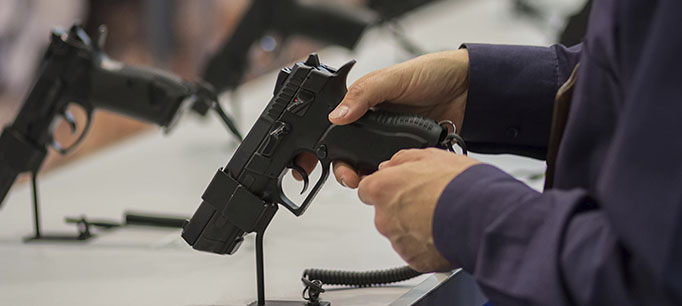
Following the terrorist attack in San Bernardino, we checked in on Californians’ attitudes toward gun laws and found that a solid majority (62%) say the government does not do enough to regulate access to guns. The share of Californians expressing this opinion today is close to the record high in January 2013 (65%), shortly after the mass shooting in Newtown, Connecticut. Since we began asking this question in 2000, majorities have consistently said the government does not do enough.

Since 2000, the federal assault weapons ban has expired and US Supreme Court rulings have expanded Second Amendment protections for individuals. President Obama pushed for legislation to restore the assault weapons ban and expand background checks following the Newtown shooting, but these proposals failed to get through Congress. Earlier this year, the president used executive actions to increase the kinds of gun sales that are subject to background checks and to make the background check system more efficient. While one in four Californians—and a majority of California Republicans—say the president has gone too far in his actions on guns, most Californians say he has either taken the right amount of action (34%) or has not gone far enough (39%).

Californians may have the opportunity to vote on a new package of state gun regulations this fall. One potential ballot initiative would include, among other things, new regulations on ammunition sales. In recent PPIC Statewide Surveys, we’ve asked about the importance of several issues that may appear on the November ballot. Stricter gun regulation is one of only two issues considered to be very important by more than half of likely voters (the other is state bonds for school construction). Supporters of stricter gun laws are far more likely than opponents to say that this issue is very important to them (74% to 29%).

Chart note: Respondents were asked: “Please indicate which statement comes closest to your own view, even if neither is exactly right. The government goes too far in restricting the rights of citizens to own guns; or the government does not do enough to regulate access to guns.”

Public Opinion and Sentencing Reform

Governor Brown has proposed a ballot initiative that would reform prison sentencing in California, increasing parole opportunities for non-violent felons. Our January PPIC Statewide Survey findings show a public opinion environment that may be favorable to the governor’s proposal.

Our survey shows that many Californians believe—incorrectly—that prisons and corrections account for the largest share of state spending. When asked to select the largest spending area of the state budget, California likely voters are most likely to choose prisons and corrections (41%)—this is consistent with our findings over the past several years. In fact, the allocation for prisons and corrections in the governor’s 2016–17 budget proposal ($10.6 billion) comes in behind higher education ($14.6 billion), health and human services ($33.7 billion), and K–12 education ($51.2 billion).

If the governor’s sentencing reform proposal is perceived as a way to reduce spending on prisons and corrections, it could benefit from this overestimation of state corrections spending. The proposal could also benefit from a contrasting opinion: only 3 percent of likely voters say that prisons and corrections should be the highest spending priority.

Californians’ current attitudes toward crime may also bode well for sentencing reform. Just 3 percent of likely voters name crime, gangs, or drugs as the most important issue for the governor and legislature to work on this year. And only 15 percent of likely voters say violence and street crime are a big problem in their communities today—down somewhat from January 2015 (22%). Furthermore, a solid majority of likely voters (63%) say that the criminal justice system is biased against blacks and other minorities, a share that is somewhat larger than it was last January (55%).

Given these attitudes toward crime and the criminal justice system, along with Californians’ desire to see less spending on prisons and corrections, the governor’s proposal for sentencing reform could be well received.

Video: A Conversation with Legislative Leadership

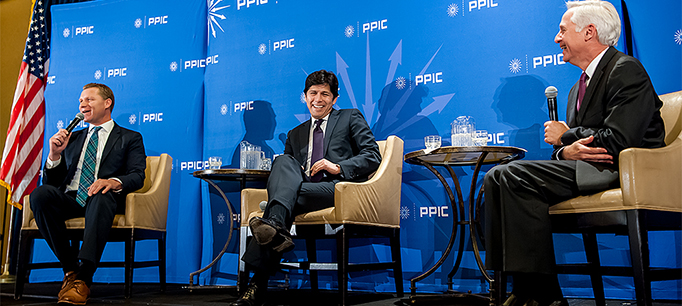
At a PPIC event last week, Kevin de León, senate leader pro tem, and Chad Mayes, the Assembly Republican leader, were asked to name the top three issues the legislature should work on with the governor. Though the leaders come from different sides of the aisle, the list of issues they named before a large Sacramento audience had a lot in common. De León’s priorities began with income inequality between the coastal and inland regions, a “tale of two states.” He also listed water and making targeted investments, particularly in higher education. He went on to list a fourth issue: climate change.

Mayes named water and a lack of water infrastructure, and the many Californians left behind in the state’s economic recovery. His third issue was transportation, the focus of an ongoing special legislative session.

“Everywhere that I go in California,” he said, “I’m stuck in traffic. So we know there’s a problem.”

The leaders’ top issues dovetail with findings from the latest PPIC Statewide Survey in which Californians identify water and the economy as the most important issues for the legislature and governor to work on in 2016. 

Though De León and Mayes named similar priorities, there was much less agreement on solutions. But the two maintained a collaborative tone throughout their conversation, denounced what Mayes termed “demagoguery on the national stage,” and repeated their commitment to working together productively.

De León said the legislature can avoid being mired in bitter national political debates if leaders continue to work cooperatively to “get some real tangible victories for Californians.”

“We’re doing things very differently in the state of California,” he said.

Ideology and California’s Independent Voters

Nearly one in four California voters are registered with “no party preference,” and the share of these voters—commonly known as independents—has more than doubled over the past twenty years. Does the growing number of independent voters mean that California’s electorate is becoming less polarized?

Data from the PPIC Statewide Survey suggests that independent voters do not speak with one voice, and they are not, as a rule, more moderate than partisans. In our 2015 surveys, the overwhelming majority of independents say they lean toward either the Democratic Party (41%) or the Republican Party (30%), and these voters often share the views of the party they lean toward.

For example, independents who say they lean toward the Democratic Party are about as likely as registered Democrats to call themselves politically liberal. Similarly, most Republican-leaning independents and registered Republicans call themselves politically conservative. The only group of independents who stand out as more politically moderate than partisan voters are the ones who lean toward neither party—a majority of these independents call themselves politically middle-of-the-road.

Political differences among independents also show up in responses to survey questions about specific issues. On immigration, Republican-leaning independents line up with registered Republicans in saying that overall, immigrants are a burden to California (55% and 61%), while solid majorities of both Democratic-leaning independents and registered Democrats say immigrants are a benefit to the state (80% and 72%). Regarding the taxation of oil extraction in California, Democratic-leaning independents and registered Democrats are in favor (61% and 55%), while Republican-leaning independents and registered Republicans are opposed (70% and 60%). Finally, majorities of Democratic-leaning independents and registered Democrats would prefer to use state budget surpluses to restore funding for social services (52% and 56%), while majorities of Republican-leaning independents and registered Republicans would prefer to pay down debt and build up reserves (73% and 76%).

These findings show that the 24 percent of California voters who are registered as independents do not all occupy the political center—and that these voters often diverge sharply from one another in their political ideologies and their opinions about specific issues.

Chart Source (TOP): Registration totals for Democrats, Republicans, independents, and other parties are from the California Secretary of State. The shares of independents who lean toward the Democratic Party, Republican Party, or neither party are estimated using PPIC survey data.

Would Making Voting Easier Increase Turnout?

In the wake of record-low turnout in both the primary and general elections in 2014, efforts to improve voter participation are under way. The senate is set to consider one reform—SB 450—that would require county election officials to mail ballots to every registered voter. Voters could return the ballots by mail or drop them off at vote centers that would be open during regular business hours for 28 days before elections. The PPIC Statewide Survey looked at the impact this reform might have on voter turnout.

We asked registered voters who do not always vote how likely they would be to do so in this scenario. Two in three (66%) said they would be very likely to vote. Strong majorities across parties concurred (72% Democrats, 67% independents, 65% Republicans), as did majorities across age, income, and education groups.

But this view is less frequently expressed among groups who are historically less likely to vote: Latinos (60%), voters age 18 to 34 (62%), those with only a high school diploma (59%), and those with household incomes under $40,000 (59%).

Attitudes about government matter as well. Those who say they have a great deal or a fair amount of interest in politics are much more likely than those with little or no interest to say they are very likely to vote (73% to 57%). And 69 percent of those who agree with the statement that voting gives “people like me some say in what government does” said they are very likely to vote. Among those who disagree with that statement, 60 percent said they are very likely to vote.

Overall, nearly half of registered voters who report that they vote part of the time, seldom, or never say this reform would make them very likely to vote (48% compared to 77% of frequent voters). These findings sugges
t that while this reform may not be a cure all, it could encourage Californians who say they don’t always vote to cast ballots more often.

Californians’ Views of Political Outsiders

One of the early surprises in the 2016 presidential election is the strength of polling support for primary candidates who have never held elected office. A recent Pew national survey also found that Americans chose “new ideas and a different approach” by a wide margin over “experience and a proven record” when asked what was more important in a presidential candidate (57% to 36%). What are the political ramifications of this emerging national trend for the 2016 California elections?

Californians have a storied history of choosing political outsiders, electing movie stars Ronald Reagan and Arnold Schwarzenegger as their governors. But in the past five years, career politicians have won by wide margins over political outsiders with business credentials. Voters chose Jerry Brown over Meg Whitman and Barbara Boxer over Carly Fiorina in 2010 and Jerry Brown over Neel Kashkari in 2014.

PPIC’s recent polling does not show a swing toward political outsiders among Californians this year either. When we repeated the Pew survey question in a recent PPIC Statewide Survey, California adults were less likely to say they favor new ideas over experience than their national counterparts (51% to 41%). More importantly, California likely voters are closely divided on new ideas versus experience (46% to 44%).

We also asked our tracking question about which qualification is more important to Californians when voting for statewide elected offices such as governor or US senator: experience in elected office or experience running a business. Today, California likely voters have a slight preference for experience in elected office (49% to 43%). In the past, the electorate has been divided on this issue—for example, during statewide elections in 2010 (44% elected experience, 43% business experience) and 2002 (43% elected experience, 43% business experience), which featured experienced politicians running against business leaders.

In other words, political insiders are more appealing in California today than they were in the state’s past, while the movement toward political outsiders is more limited here than in the nation as a whole. Still, a sizable number of Californians say they prefer political outsiders. Who are they and why might they have this preference? Our polling offers these insights: those who prefer outsiders are more likely to give their elected leaders low job approval ratings, more likely to have negative views of the two-party system, and more likely to be Republican than Democrat.

Majorities of those who prefer new ideas in presidential candidates say they disapprove of President Obama (54%), while majorities who say they favor experience in running a business for gubernatorial and US Senate candidates say they disapprove of Governor Brown (59%). Conversely, solid majorities who chose experience and a proven track record for a presidential candidate say they approve of President Obama (64%), and overwhelming majorities who are looking for experience in elected office for governor and US senator say they approve of Governor Brown (71%).

Negative attitudes toward the two-party system are also part of the profile for those who prefer a political outsider over an experienced officeholder. Just 31 percent of California likely voters say that the Republican and Democratic parties do an adequate job of representing the American people, while 58 percent say that they do such a poor job that a third major party is needed. Majorities across partisan groups today say that a third major party is needed (52% Democrats, 57% Republicans, 69% independents). Solid majorities who prefer new ideas for a presidential candidate (64%) and favor experience running a business for gubernatorial and US Senate candidates (65%) also say that a third major party is needed.

Finally, partisanship is strongly related to preferences for political outsiders. Republicans are much more likely than Democrats to favor new ideas in presidential candidates (61% to 34%) and to favor experience running a business for governor and US senator (71% to 23%). By contrast, Democrats are much more likely than Republicans to favor experience and a proven track record in presidential candidates (56% to 33%) and experience in elected office for governor and US senator (72% to 21%). Independents are more divided, with about half favoring new ideas in presidential candidates (48%) and preferring experience in running a business for governor and US senator (47%).

In sum, we do not find fresh evidence of the national movement toward political outsiders among likely voters in California. This is because of the state’s partisan makeup (43% Democrat, 28% Republican) and approval ratings of President Obama (56%) and Governor Brown (54%) that favor the presidential and US Senate candidates with experience in elected office. If these political trends hold steady next year, then Democratic insiders should continue to have the edge over Republican outsiders in statewide elections.

However, we should not discount the importance of the finding that California’s GOP voters are aligned with most Americans in their strong preference for political outsiders. GOP voters will be swayed by the qualifications of presidential candidates who represent “new ideas and a difference approach” and by US Senate candidates who reflect “experience in running a business.” These preferences could have a profound impact on the election choices of GOP voters in California’s presidential and senate primaries.

Finally, the large and growing number of independent voters (i.e., no-party-preference) is a political wildcard in California. Independent voters account for 24 percent of the state’s electorate today. They overwhelmingly believe that a major third party is needed, and about half prefer a presidential candidate who represents new ideas and statewide candidates with experience running a business.

Most independent voters supported Democratic “insiders” in recent statewide elections, but we know from our surveys that their party leanings can shift in a relatively short period of time. In the 2000s, California’s independent voters aligned with GOP voters and supported Republican “outsider” Arnold Schwarzenegger for governor. The ease with which independent voters are able to change partisan and candidate preferences will add uncertainty to next year’s election, and may lead to surprises in 2016.
Video: PPIC Survey Examines Election Landscape

As California heads into an election year, the PPIC Statewide Survey looks at residents’ views on a broad range of issues that are already flashpoints in the presidential primary races and will likely surface in statewide campaigns next year.

PPIC research associate Lunna Lopes presented the survey’s key findings at a Sacramento briefing last week. She was joined by Mark Baldassare, PPIC president and CEO, for a question and answer session afterward. He noted a link between Californians’ “modestly optimistic view of the economy,” their belief that there is income inequality in the state, and their attitudes about which ballot issues are important. Twice as many residents say that increasing the state minimum wage is very important than say legalizing marijuana is very important.

“In California, the belief that this state is divided into the haves and have-nots—and the feeling among many Californians that they are among the have-nots—are going to be driving forces in the election,” he said. The survey briefing was held just after the mass shooting in San Bernardino, and the briefing touched on Californians’ views about gun laws. PPIC research associate David Kordus provided findings from the September survey on this issue: Compared to adults nationwide, Californians are more likely to favor stricter laws than we have now. Most also say that controlling gun ownership is more important than protecting the right of Americans to own guns.

State Struggles to Enact More Robust Climate Targets

California’s efforts to cut greenhouse gas emissions thus far have made the state a national leader. But the momentum may be slowing. A struggle over recent climate legislation resulted in a less-ambitious version of the Clean Energy and Pollution Reduction Act (SB 350) being signed into law by Governor Brown last week and the deferment of a bill (SB 32) that would have strengthened the state’s 2006 climate law.

The Global Warming Solutions Act of 2006 (AB 32) established the foundation of California’s plan to address climate change by reducing GHG emissions to 1990 levels by 2020. The state is on track to meet the 2020 limit, and now policy efforts are shifting to longer term goals. Emission-reduction targets of 40 percent below 1990 levels by 2030 and 80 percent by 2050 are already set forth in executive orders (former Gov. Schwarzenegger’s S-3-05 and Gov. Brown’s B-30-15) but have not yet been incorporated into law.

SB 350 is seen as a major step toward reducing GHG emissions in the longer term. It mandates that half of the state’s electricity come from renewable resources and that buildings double their energy savings by 2030. But a third piece of the original plan, which proposed to cut petroleum use in cars and trucks by half over the next 15 years, was dropped. Since the transportation sector is a major contributor to GHG emissions (37% in 2013), this is could make it more challenging to meet long term emissions reductions. To make up for the loss, the Air Resources Board adopted a modified version of its Low Carbon Fuel Standard that requires a 10 percent reduction in carbon intensity of transportation fuels by 2020.

The second slowdown was the deferment of SB 32 until at least next year. The bill would amend the California Global Warming Solutions Act of 2006 to include the 2030 and 2050 emission-reduction targets from the executive orders. It failed to pass in the assembly.

Our July PPIC Statewide Survey found that solid majorities of Californians (69% adults, 62% likely voters) favored the proposal to reduce GHG emissions to 80 percent below 1990 levels by 2050. When asked about the original goals of SB 350, 82 percent of adults supported the increase of electrical generation from renewables, 70 percent favored doubling energy efficiency in buildings, and 73 percent supported reducing petroleum use in cars and trucks by 50 percent by 2030. Although Democrats are more likely than Republicans to support these goals, majorities of Republicans support the goals of increasing renewables and energy efficiency. Overwhelming majorities who favor these policies also view global warming as a serious threat to the economy.

The state’s approach to reducing GHG emissions has achieved important results. The mix of policies has resulted in a cleaner economy, while population and GDP have continued to grow. Looking ahead, a study for the California Energy Commission shows that with the mix of technologies and practices proposed by state agencies, emission reductions of 26–38 percent below 1990 levels could be achieved by 2030 at a cost of $8 per household per month (or $14 if commercial and industrial costs are all passed on to households).

California’s multi-faceted approach to combating global warming has placed it in the vanguard of worldwide policies. Yet 2020 is just around the corner, and clear targets to reduce GHG emissions for the longer term still evade us. To remain on the leading edge of global climate regulations, the state will need to adopt more robust and forward-looking policies. It would also be worthwhile to explore a new narrative to reduce the partisan divide on this issue, given Californians’ widespread support for the state’s energy goals.

Learn More

Explore PPIC’s climate change page.


Video: Survey Looks at Taxes and Pensions

As interest groups work to turn their ideas into initiatives for next year’s statewide ballot, the September PPIC Statewide Survey examined Californians’ views in two areas that may be put before voters in 2016: taxes and public employee pension reform.

Mark Baldassare, PPIC president and CEO, and Dean Bonner, associate survey director, presented the findings at a briefing in Sacramento last week.

Among the survey findings:

  • Half of likely voters favor extending the tax increases in Proposition 30 temporarily, but just a third favor making them permanent.
  • There is bipartisan support for raising taxes on cigarette purchases.
  • A majority of likely voters favor changing Proposition 13 to tax commercial properties according to their current market value.
  • Solid majorities of Californians see public pension spending as a problem, and most think voters should weigh in on changes to the system.
  • Most likely voters favor placing new public employees in a defined contribution system, similar to a 401(k) plan, rather than a defined benefits system.

The survey shows that Californians give their state leaders—the governor, legislature, and their own legislators—high approval ratings at the close of the legislative session. Baldassare offered his explanation at the briefing: there was little drama around the budget, the economy’s going well, and very few respondents in the survey mentioned fiscal issues as the most important ones.

Congress, on the other hand fares far less well in Californians’ eyes. Its 17% rating is not only much lower than the ratings likely voters give their state leaders, it is much lower than those of President Obama, Senators Barbara Boxer and Dianne Feinstein, and Californians’ own representative in the US House.

“Congress is a government institution that needs work, according to most Californians,” Baldassare said.

Californians and Congress

The recent announcement of Speaker Boehner’s resignation comes at a time when national approval ratings of the US Congress are in the teens (14% in September Gallup Poll). With the early talk of majority leader Kevin McCarthy stepping into the Speaker position, what are Californians saying about the powerful federal institution that the congressman from Bakersfield is well-positioned to lead?

In the latest PPIC Statewide Survey, we asked Californians to rate eight state and federal elected leaders and legislative bodies—interviewing was completed just before Pope Francis’ speech to Congress and Speaker Boehner’s surprise announcement. California likely voters give their lowest approval by far to the US Congress. Just 17 percent say they approve of the way the US Congress is handling its job.

Surprisingly, there is overwhelming consensus about Congress even in this era of hyper-partisanship. In the recent PPIC Statewide Survey, California likely voters of different political stripes are united in their low approval of Congress. By contrast, other political figures in Washington elicit highly partisan responses—including President Obama, Senator Boxer, and Senator Feinstein. Remarkably, approval among Republican likely voters of President Obama (13%) and Senator Boxer (15%)—both Democrats—is about the same as approval of Congress (17%), while Republican approval of Senator Feinstein (27%) and Governor Brown (29%) is higher than approval of Congress. It’s also noteworthy that Republicans (36%) are less likely than Democrats (62%) and independents (50%) to approve of their own House representatives—this may be related to their low approval of a Congress controlled by their party.

The 53 members of the California House delegation may take some solace in the fact that Californians are much more approving of their own representatives to the US House than of the Congress as a whole. And California’s US senators have approval ratings around 50 percent. Still, the California State Legislature has recovered from several years of low approval ratings while the US Congress has not. Moreover, the members of the California congressional delegation are working in an institution that is mostly seen as not doing its job. This raises doubts about their political futures, especially given the top-two primary—which takes away the certainty that candidates from both major parties will appear on the November ballot—and more competitive elections through independent legislative redistricting.

Low approval ratings of the US Congress have been a consistent feature in PPIC Statewide Surveys throughout this decade. Approval ratings of Congress among California’s likely voters have been in the mid-teens each September since the Republicans (and Speaker Boehner) took control of the House in January 2011. Under Democratic control (and Speaker Nancy Pelosi’s leadership, beginning in January 2007), approval ratings were somewhat higher. This could be partly because the California electorate leans Democratic, but it is worth noting that approval ratings of Congress under Republican leadership 10 years ago were higher than they are today.

Clearly, low approval of Congress is a national phenomenon tied to intense media focus on legislative gridlock and government shutdowns. But Californians do have fundamental policy disagreements with the current Congress that also affect their views of its job performance. Specifically, the recent PPIC Statewide Survey finds that Californians are more likely than people nationwide to express support for immigration reform, abortion rights, and stricter gun laws. The actions of Congress in recent years are at odds with California public opinion in all three of these controversial policy domains.

In the California context, immigration reform stands out as a special case. Sixty-nine percent of California likely voters—compared to 60 percent of adults in a national ABC News/Washington Post Poll in July—say that undocumented immigrants currently living in the United States should be allowed to live and work here legally if they pay a fine and meet other requirements. Moreover, majorities of likely voters across party groups (83% Democrats, 66% independents, 51% Republicans) support a way for undocumented immigrants to stay in the US legally. Importantly, 68 percent of those likely voters disapprove of Congress want there to be a way for undocumented immigrants to stay in the US legally. And among likely voters who support a way for undocumented immigrants to state in the US legally, 77 percent disapprove of Congress.

The next Speaker will face the major challenge—critical to the nation’s future—of restoring public trust and confidence in Congress. Our poll sheds light on the need for Congress to show leadership in addressing the complex problem of immigration, which is surfacing early and often as the defining issue for the Republican presidential candidates. The view from California is that the path to higher approval of Congress runs through immigration reform. It won’t be easy, but there is a way forward for a new leader who seeks to improve perceptions of the way that the Congress handles its job.