Video: Californians Weigh in on Presidential Race

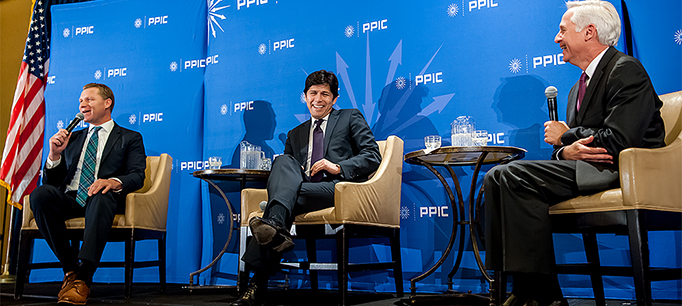
The strong partisan divisions prominent in the nation this election year are also evident in California, the latest PPIC Statewide Survey shows. As the primary nears, Democrats and Republicans are deeply divided in their views about the appropriate role and size of government. Dean Bonner, the PPIC survey’s associate director, presented these and other key survey findings in Sacramento last week.

Bonner noted that preferences among California’s likely voter in the upcoming presidential primary are similar to those seen in many states that have already voted. Among Democratic likely voters—including independents who say they will vote in the Democratic primary—48% support Hillary Clinton and 41% support Bernie Sanders. Most young voters support Sanders and most over age 45 support Clinton. Clinton leads among Latinos, women, and those who describe themselves as politically middle of the road, while Sanders leads among men and voters who describe themselves as very liberal.

Donald Trump leads the Republican field with 38%, followed by Ted Cruz with 27% and John Kasich with 14%. Bonner noted evidence in the survey of discontent with the status quo in the nation—signs that may have fueled the candidacies of “outsiders” in both major parties. A majority of likely voters—63%—say the nation is going in the wrong direction and 47% say the US will have bad times financially in the coming year. And Congress’ job performance gets a very low rating—across party lines. Notably, Republicans are more likely to approve of President Obama (20%) than they are to approve of the Republican-led Congress (11%).

Video: California’s Voter Turnout Problem

Voter turnout in California has been declining—it reached record lows last year, raising concerns about the state’s democratic process. PPIC research fellow Eric McGhee told a Sacramento audience last week that turnout in California has not only dropped in absolute terms but has fallen behind that of other states. While participation in fall presidential elections has been holding steady, turnout is on the decline in midterm elections—when the state elects a governor and other statewide officials—and, to some extent, in presidential primaries.

A big part of the problem is California’s voter registration rate, said McGhee, who coauthored the new report Putting California’s Voter Turnout in Context. It has not changed significantly, though it should have been climbing, as it has in other states.

California has been working hard to make the voting and registration processes as easy as possible, and other policy changes are under discussion. Will they result in higher turnout? They may help, but they aren’t panaceas, McGhee said. Ongoing mobilization efforts will be needed to motivate more people to cast a ballot.

Video: A Conversation with Legislative Leadership

At a PPIC event last week, Kevin de León, senate leader pro tem, and Chad Mayes, the Assembly Republican leader, were asked to name the top three issues the legislature should work on with the governor. Though the leaders come from different sides of the aisle, the list of issues they named before a large Sacramento audience had a lot in common. De León’s priorities began with income inequality between the coastal and inland regions, a “tale of two states.” He also listed water and making targeted investments, particularly in higher education. He went on to list a fourth issue: climate change.

Mayes named water and a lack of water infrastructure, and the many Californians left behind in the state’s economic recovery. His third issue was transportation, the focus of an ongoing special legislative session.

“Everywhere that I go in California,” he said, “I’m stuck in traffic. So we know there’s a problem.”

The leaders’ top issues dovetail with findings from the latest PPIC Statewide Survey in which Californians identify water and the economy as the most important issues for the legislature and governor to work on in 2016. 

Though De León and Mayes named similar priorities, there was much less agreement on solutions. But the two maintained a collaborative tone throughout their conversation, denounced what Mayes termed “demagoguery on the national stage,” and repeated their commitment to working together productively.

De León said the legislature can avoid being mired in bitter national political debates if leaders continue to work cooperatively to “get some real tangible victories for Californians.”

“We’re doing things very differently in the state of California,” he said.

Ideology and California’s Independent Voters

Nearly one in four California voters are registered with “no party preference,” and the share of these voters—commonly known as independents—has more than doubled over the past twenty years. Does the growing number of independent voters mean that California’s electorate is becoming less polarized?

Data from the PPIC Statewide Survey suggests that independent voters do not speak with one voice, and they are not, as a rule, more moderate than partisans. In our 2015 surveys, the overwhelming majority of independents say they lean toward either the Democratic Party (41%) or the Republican Party (30%), and these voters often share the views of the party they lean toward.

For example, independents who say they lean toward the Democratic Party are about as likely as registered Democrats to call themselves politically liberal. Similarly, most Republican-leaning independents and registered Republicans call themselves politically conservative. The only group of independents who stand out as more politically moderate than partisan voters are the ones who lean toward neither party—a majority of these independents call themselves politically middle-of-the-road.

Political differences among independents also show up in responses to survey questions about specific issues. On immigration, Republican-leaning independents line up with registered Republicans in saying that overall, immigrants are a burden to California (55% and 61%), while solid majorities of both Democratic-leaning independents and registered Democrats say immigrants are a benefit to the state (80% and 72%). Regarding the taxation of oil extraction in California, Democratic-leaning independents and registered Democrats are in favor (61% and 55%), while Republican-leaning independents and registered Republicans are opposed (70% and 60%). Finally, majorities of Democratic-leaning independents and registered Democrats would prefer to use state budget surpluses to restore funding for social services (52% and 56%), while majorities of Republican-leaning independents and registered Republicans would prefer to pay down debt and build up reserves (73% and 76%).

These findings show that the 24 percent of California voters who are registered as independents do not all occupy the political center—and that these voters often diverge sharply from one another in their political ideologies and their opinions about specific issues.

Chart Source (TOP): Registration totals for Democrats, Republicans, independents, and other parties are from the California Secretary of State. The shares of independents who lean toward the Democratic Party, Republican Party, or neither party are estimated using PPIC survey data.

Would Making Voting Easier Increase Turnout?

In the wake of record-low turnout in both the primary and general elections in 2014, efforts to improve voter participation are under way. The senate is set to consider one reform—SB 450—that would require county election officials to mail ballots to every registered voter. Voters could return the ballots by mail or drop them off at vote centers that would be open during regular business hours for 28 days before elections. The PPIC Statewide Survey looked at the impact this reform might have on voter turnout.

We asked registered voters who do not always vote how likely they would be to do so in this scenario. Two in three (66%) said they would be very likely to vote. Strong majorities across parties concurred (72% Democrats, 67% independents, 65% Republicans), as did majorities across age, income, and education groups.

But this view is less frequently expressed among groups who are historically less likely to vote: Latinos (60%), voters age 18 to 34 (62%), those with only a high school diploma (59%), and those with household incomes under $40,000 (59%).

Attitudes about government matter as well. Those who say they have a great deal or a fair amount of interest in politics are much more likely than those with little or no interest to say they are very likely to vote (73% to 57%). And 69 percent of those who agree with the statement that voting gives “people like me some say in what government does” said they are very likely to vote. Among those who disagree with that statement, 60 percent said they are very likely to vote.

Overall, nearly half of registered voters who report that they vote part of the time, seldom, or never say this reform would make them very likely to vote (48% compared to 77% of frequent voters). These findings sugges
t that while this reform may not be a cure all, it could encourage Californians who say they don’t always vote to cast ballots more often.

Voter Registration: Not Quite Automatic Yet

The New Motor Voter Act creates a computerized voter registration process for anyone who uses the Department of Motor Vehicles (DMV) to apply for a new driver’s license, renew an old one, or change their address. The law—AB 1461—reduces paperwork and transfers voter registration information electronically from the DMV to the secretary of state. It has the potential to register millions more residents and virtually eliminate one of the most important administrative hurdles to voter participation.

However, the devil is in the details. Whether AB 1461 will result in big increases in registration will depend largely on how the law is implemented. Though the new registration process is sometimes called automatic, it does not actually register anyone by default. At its core, the law simply tells the DMV to transfer information to the secretary of state and then tells the secretary what to do with that information.

Some information is guaranteed to be there. DMV applicants will be required—as they are now—to provide their name, date of birth, address, and the like. If they don’t answer these questions, the process of getting a driver’s license stops.

Other information is less certain. The law adds two pieces of information that together determine whether DMV customers get registered to vote: first, whether they attest that they are eligible to vote, and second, whether they decline to be registered. Customers who attest to eligibility and do not decline will be added to the voter rolls. Yet unlike the other items listed above, applicants don’t currently have to answer either question to get a driver’s license.

Note also the significant difference between the two questions. The eligibility question has the secretary of state looking for a “yes”: DMV customers will not be registered unless they attest to eligibility, which means that any customer who fails to answer the question will not be registered. By contrast, the registration question has the secretary looking for a “no”: customers will be registered unless they do not want to be. That means that those who fail to answer this question will be registered, as long as they also say they are eligible.

It is hard to overstate the importance of this distinction. Research on how people make decisions has consistently demonstrated the power of the default option. People are much more likely to sign up when enrollment is the default option—even when there is an option to decline—than they are when nonparticipation is the default. The option to enroll as an organ donor when getting a driver’s license offers a particularly apt example. Many do not sign up even though it’s not very hard to do, and even if they say they are willing, in principle, to become donors. In one study, 82 percent became donors when they had to opt out explicitly, compared to 42 percent when they had to opt in.

Given this reality, the default option can be critical. If the goal is a large increase in registration, the fact that the eligibility question requires people to opt in should be a cause of concern.

This suggests a solution: the DMV should make a response to the eligibility question a condition for receiving a driver’s license. Some have already called for this approach, which is not as onerous as it may sound. Driver’s license applicants are already required to provide documented proof of legal residence, such as a birth certificate or passport. That’s a much higher hurdle than answering a single question.

In Oregon—which became the first state to adopt automated registration earlier this year—such proof of legal residence is also required, but it’s automatically treated as evidence of eligibility. No additional question is needed. If California were to require a response to its eligibility question, its system would be essentially identical to the one in Oregon on most important dimensions. In fact, by allowing people to opt out up front, the California system would be more transparent and might do a better job of preserving freedom of choice.

The California DMV could go a step further and also require a response on the registration question, thus ensuring that people know they are being registered. There is no reason to think that forcing a choice in this way would limit the law’s impact. The study on organ donor participation mentioned above found that enrollment declined only slightly (from 82% to 79%) when people were asked to make the choice explicitly. It seems fair to expect a similar dynamic with voter registration. Only those firmly opposed to being registered are likely to say “no” to registration, and that group will probably be small.

In short, AB 1461 could result in a legitimately automatic registration system similar to the one in Oregon and many other countries. Such a system would eventually bring the vast majority of eligible unregistered adults onto the voter rolls. But the law’s potential will only be realized if the state truly streamlines the process to make it as easy as possible.

Commentary: California Leads in Voting Reform

When Gov. Jerry Brown recently signed Assembly Bill 1461, the New Motor Voter Act, he ushered in a new chapter of California electoral history. The law seeks to boost California’s recent record-low election turnout rates with a new system of automated registration.

Under existing law, citizens must register to vote before they can cast a ballot. The new law all but eliminates this step by registering anyone who applies for a new driver’s license, renews an old one or updates an address with the DMV, unless they opt out. With the stroke of a pen, California is now at the vanguard of American voting reform.

(Continue reading on sacbee.com.)

Inspiring Civic Engagement

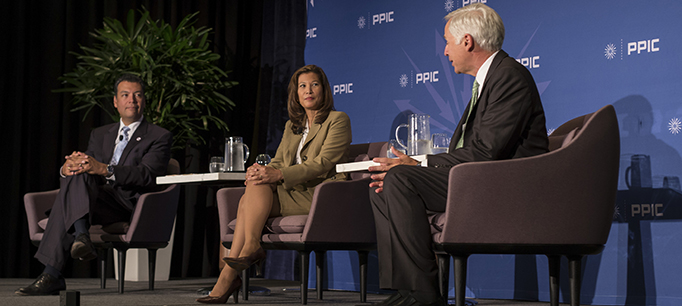
Many eligible Californians don’t register to vote, turnout in statewide elections has reached record lows, and PPIC surveys show many residents are disengaged from state government. What can be done to increase participation in elections and engage residents more broadly in all aspects of civic life? Tani G. Cantil-Sakauye, California’s chief justice, and Alex Padilla, California secretary of state, offered their responses last week in Los Angeles at an event co-sponsored by PPIC and the California Community Foundation.

In a conversation with Mark Baldassare, PPIC president and CEO, both emphasized the contribution schools can—and should—make to civic engagement.

Cantil-Sakauye noted that her teen-agers were taught civics in the second semester of his senior year in high school. “Now, think back where you were mentally in your second semester of senior year,” she told the audience. “Not the best place.”

She described Power of Democracy, a judicial branch initiative that includes Padilla and is an effort to elevate the status of civics education. Rather than focusing on teaching civics as a stand-alone subject, the group helps to integrate it into all school subjects, school projects, and community service. Partnering with Tom Torlakson, state superintendent of public instruction, as well as organizations and school districts, Power of Democracy provides schools the resources to do so, she said.

Padilla and Cantil-Sakauye each described personal experiences that sparked their interest in government and the people who had been influential along the way. Padilla said that after his freshman year at MIT, he returned to Los Angeles and visited his high school government teacher, who told his former student, “You’re 18 years old now. Have you registered to vote?” Then the teacher pulled out a voter registration form from his desk. “He wouldn’t let me leave until I filled it out,” said Padilla. That teacher, Alex Reza, was in the Los Angeles audience at last week’s event.

Cantil-Sakauye said she developed an interest in how decisions are made and who makes them after hearing adults in the Filipino community talk about their frustrations with government. When she was 9 years old, her family lost their home in an eminent domain proceeding. Cantil-Sakauye said her mother went to court and came back feeling “disrespected and humiliated.” Later on, her mother took her to see the pioneering Filipina lawyer, Gloria Megino Ochoa. “My mom threw me an elbow and said, you could do that!”

Local School Funding & the Exclusive Electorate

State funding for K-12 public education has been rising, but 70 percent of public school parents say it is “not enough” in our April PPIC Survey. Are California voters likely to heed these parents’ calls and support local ballot measures for school funding?

It doesn’t look likely. To begin with, likely voters are much less likely (54%) than public school parents to say that the state’s funding for their local schools is not enough. More important, in our recent poll likely voters and public school parents have starkly different views about specific ways to increase funding—local bonds and local parcel taxes—for their local public schools. Specifically:

  • When it comes to local school bonds, 75 percent of public school parents would vote yes if their local school district had a bond measure on the ballot to pay for school construction projects. But only 53 percent of likely voters would do so—lower than the 55 percent required to pass a local school bond.
  • As for funding schools through local parcel taxes, 61 percent of public school parents would vote yes. But just 49 percent of likely voters would. A two-thirds majority yes vote is needed to pass a local parcel tax for schools.
  • What about lowering the majority needed to pass local parcel taxes—from two-thirds to 55 percent? This tax reform is rated as a good idea by 57 percent of public school parents. Only 44 percent of likely voters agree—less than the majority required to make this change.

The poll’s findings reflect the fact that California’s “exclusive electorate” controls the fate of ballot measures for local school funding. Today, many public school parents are nonvoters. And most likely voters are not public school parents. According to a PPIC report, likely voters are disproportionately white and tend to be homeowners, older, college graduates, and affluent.

Latinos, renters, and the younger, less educated, and less affluent are strong supporters of local bonds and local parcel taxes for local schools. They also favor lowering the vote threshold for passing local taxes. But these groups are outnumbered among those who cast ballots in elections.

It’s not impossible to pass local bonds and parcel taxes for school funding. CaliforniaCityFinance.com reported last December that eight in 10 local bonds and 6 in 10 local parcel taxes for local public schools have passed since 2001. But funding advocates have to carefully pick and choose the timing and location of these local school funding measures in deference to the higher vote thresholds required and the propensities of California’s exclusive electorate. A PPIC study concludes that the overall fiscal impact of parcel taxes has been fairly limited statewide.

School funding proponents want a state bond measure on the November 2016 ballot. The presidential election will attract the largest and most diverse electorate. It would take a simple majority vote to pass a state school bond. Our poll finds that 55 percent of likely voters and 77 percent of public school parents would vote yes on a state bond for school construction projects.

Meanwhile, the governor has stated that local voters should be deciding if they want more local school funding and that state voters should not be asked to pass state school bonds. This idea of local control resonates with Californians, who generally distrust the decisions made in Sacramento. But as our survey suggests, likely voters are unwilling to lower the local two-thirds threshold for passing local parcel taxes, leaving it easier to pass school funding measures at the state level than at the local one.

In other words, the state is likely to continue to play an oversized role in local school funding—until the California electorate reflects the will of the people who are relying on local public schools to improve their children’s futures.