California Needs More College Prep Courses

Most California high school graduates are not ready for college. Despite the steady improvements over the past decade, less than half of graduating seniors in the class of 2016 completed the a–g requirements, the set of courses high school students must complete to be eligible for admission to the University of California (UC) or California State University (CSU). The completion rate is substantially lower among Latino (37%), African American (34%), economically disadvantaged (37%), and English Learner (10%) students.

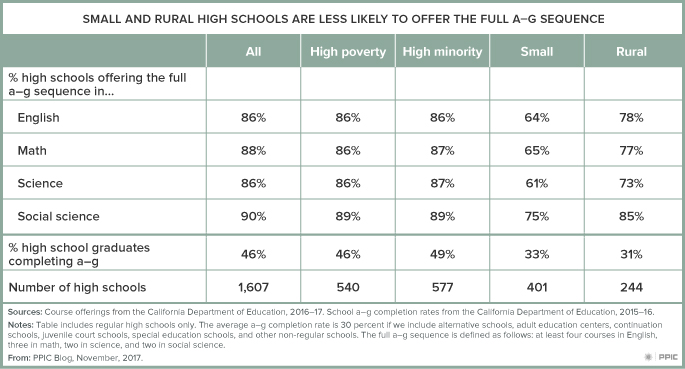
PPIC’s new report looks at the role of several institutional factors that may improve the completion rate, including high school graduation requirements, course placement policies and practices, and academic counseling and advising. But there is another significant barrier: not every high school in California offers the full a–g course sequence.

During the most recent school year (2016–17), 12% of California high schools did not offer the full math sequence, which includes algebra 1, geometry, and algebra 2. Similarly, 14% of high schools did not offer four years of a–g approved English courses. High-poverty schools (where more than 75% of students are eligible for free or reduced-price lunch) and high-minority schools (where more than 75% of students are African American or Latino) were just as likely as schools overall to offer the full sequence. But small schools (those at the bottom 25th percentile of the enrollment distribution) and rural schools were much less likely to do so. Close to 40% of small schools did not offer the full science sequence, which includes two years of approved science courses, and more than a third did not offer the full math or English sequence.

The difference in course offerings has contributed to low a–g completion rates at small and rural schools. For instance, the average a–g completion rate is 46% among all high schools, but only 30% or so among small or rural schools.

College Prep Blog Table

To improve student readiness for college, districts and schools need to increase the number of a–g approved courses. However, some schools may face capacity and resource limitations, such as not having enough qualified teachers. One solution is to establish a regional or statewide virtual school network so students in small or rural schools can enroll in online courses offered by other districts. Several states—including Florida (Florida Virtual Education), Wisconsin (Wisconsin Digital Learning Collaborative), Texas (Texas Virtual School Network), and Georgia (Georgia Virtual School)—have in recent years partnered with school districts to provide academic courses and test prep for all middle and high school students. California’s UC Scout program is a step in the right direction, providing a full set of online a–g courses accessible at no cost to students at participating schools.

College Graduates and California’s Future

The University of California Board of Regents invited Mark Baldassare, PPIC president and CEO, and Hans Johnson, PPIC senior fellow and director of the PPIC Higher Education Center, to present their perspectives on the role of higher education in California’s future, November 16, 2017. Here are their prepared remarks:

Good morning, I am Mark Baldassare, president and CEO of the Public Policy Institute of California (PPIC). I am here with my colleague and PPIC’s higher education center director Hans Johnson to present the institute’s research findings on the need for college graduates in California’s future economy. To kick off this session, I am going to make a few remarks about public opinion to place this issue in perspective.

The November PPIC Statewide Survey points to the importance of this topic for most Californians. Eighty percent of California adults say that the state’s higher education system is very important to the quality of life and economic vitality of the state, and another 14% say it is somewhat important. Strong majorities across political, regional, racial/ethnic, and demographic groups say that the state’s higher education system is very important. In fact, strong majorities of Californians have been saying that higher education is very important to the state’s future since we first asked this question in 2007.

In the context of the 2018 governor’s race, 63% of California adults say that candidate positions on higher education are very important, and another 28% say they are somewhat important to them. Majorities across political, regional, racial/ethnic, and demographic groups hold this view.

When asked about the current workforce, 83% of Californians say that a four-year degree from a college and university prepares someone very well (30%) and somewhat well (53%) for a well-paying job in today’s economy. Fifty percent of Californians think that a college education is necessary for a person to be successful in today’s work world, with majorities of Latinos (67%), Asian Americans (54%), and African Americans (51%) and fewer whites (35%) holding this view. Moreover, about half of Californians, with pluralities across the state’s major regions, say that California will not have the college-educated residents needed for the jobs and skills likely to be in demand 20 years from now.

In sum, the importance of a higher education and the need for college graduates are issues on the minds of many residents today. Hans will provide the demographic and workforce analysis that demonstrates why the state’s higher education system is essential for a better future for all Californians.

PPIC has produced a series of reports on California’s future population and economy. Our report Will California Run Out of College Graduates? provides projections of the demand for and supply of workers across all levels of educational attainment to 2030. Our primary finding is that California faces a shortage of highly educated workers. Specifically, economic projections to 2030 show that about two in five jobs will require at least a bachelor’s degree, while demographic projections suggest only about one in three Californians will have at least a bachelor’s degree. This shortfall equates to 1.1 million workers.


In this presentation, I first describe how California’s population and economy are changing and then identify how the state and its higher education institutions can increase college enrollment and completion to produce more college graduates.

California’s economy increasingly demands highly educated workers

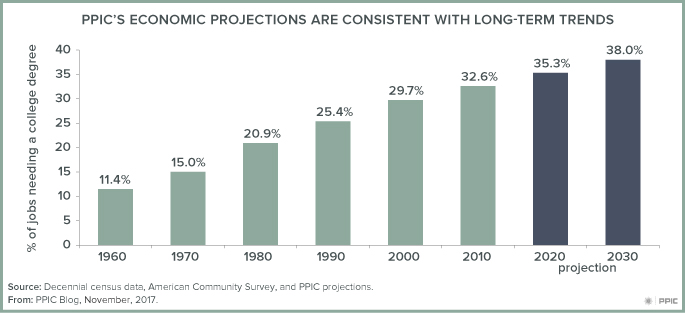
To develop our economic projections, we apply trends in educational attainment levels to occupational projections developed by the California Employment Development Department. We examine changes in labor market demand that are occurring due to shifts both in occupational structure and changes in educational attainment within occupations. Our primary finding is that the state’s economy will continue along a well-established trajectory, with a growing share of jobs requiring at least a bachelor’s degree.

There are two key drivers of increasing demand for college graduates: (1) faster growth in occupations that commonly require a college degree (e.g., computer technology), and (2) increases in demand for highly educated workers within occupations (e.g., nursing). In recent years, most (74%) of the increased demand for highly educated workers has occurred because of faster job growth in occupations that commonly require a college degree. Among occupations with at least 100,000 full-time year-round workers, there have been especially rapid growth rates for software developers (56% increase between 2010 and 2015), computer scientists and systems analysts (42% increase), and managers (35% increase). These and other highly skilled occupations have experienced faster growth than most occupations that require lower levels of education.


That said, the increase in educational attainment within occupations has been significant. For example, the share of registered nurses with a bachelor’s degree has grown from 57% in 2000 to 68% in 2015. From 2010 to 2015, about 26% of the increase in jobs for college graduates was attributable to growing demand for highly educated workers within specific occupations.

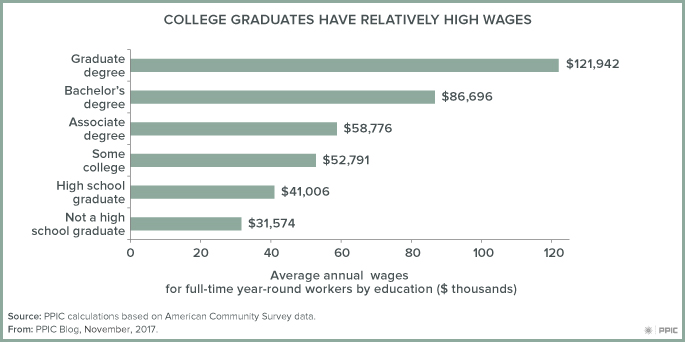
Are college degrees really necessary for these jobs? To answer this question, we examined a number of labor market outcomes. Within and across occupations, we find that workers with bachelor’s degrees have higher labor force participation rates, lower unemployment rates, and higher wages than those without—and that, in general, as educational attainment increases, wages also increase. Overall, the wage premium for college graduates relative to less-educated workers has grown. By 2015, the average annual wage for full-time year-round workers was more than twice as high for workers with a bachelor’s degree than for those with only a high school diploma.
Within each of 51 occupational groupings we see higher wages for college graduates than for high school graduates. Among registered nurses, for example, those with a bachelor’s degree earned 12% more than those with an associate degree.

California’s educational institutions are not keeping up with demand

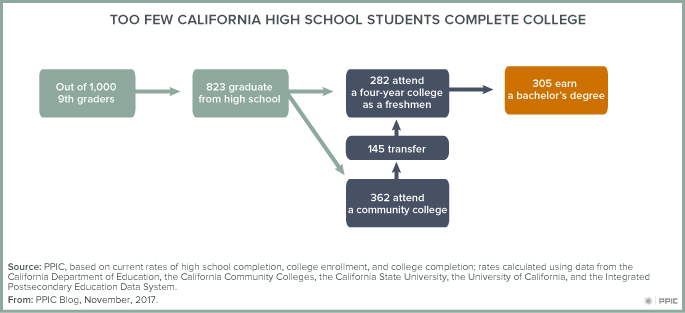
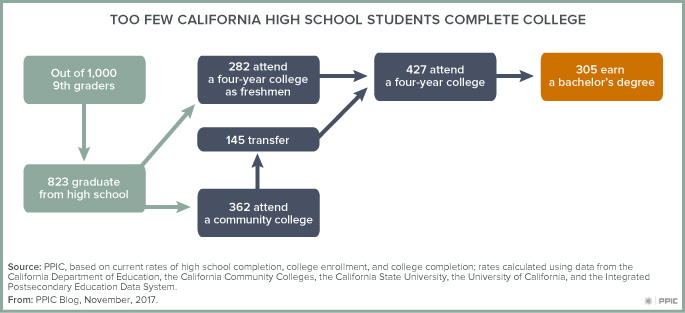
Too few Californians are graduating from college. At current college enrollment and completion rates, only 30.5% of 9th graders in California will eventually earn a bachelor’s degree either in California or elsewhere in the United States. Among all states, California ranks 47th in the share of high school graduates who enroll in four-year colleges and 5th in the share who go to community colleges. Low rates of transfer from community colleges to four-year colleges exacerbate the problem.

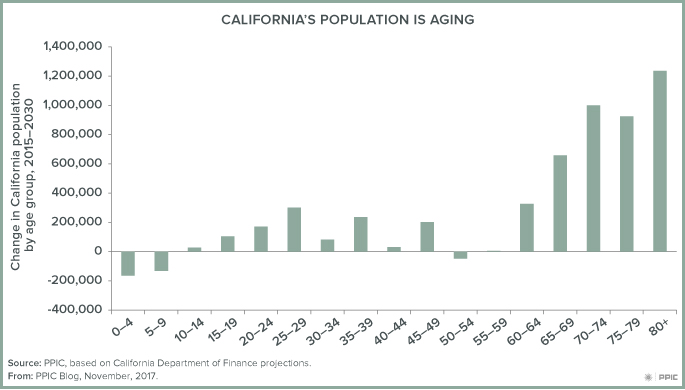
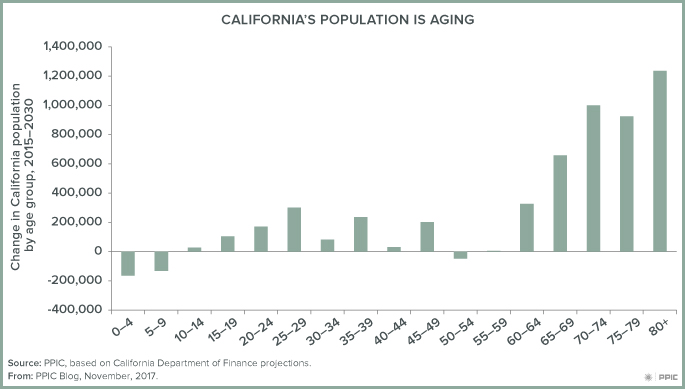
A critical challenge is the retirement of the baby boom generation. Called the “silver tsunami” by some, this is the first time in California’s history that such a large and well-educated group is exiting the labor force. In contrast, the number of young adults in California is projected to increase only modestly.

Not all degrees are equal

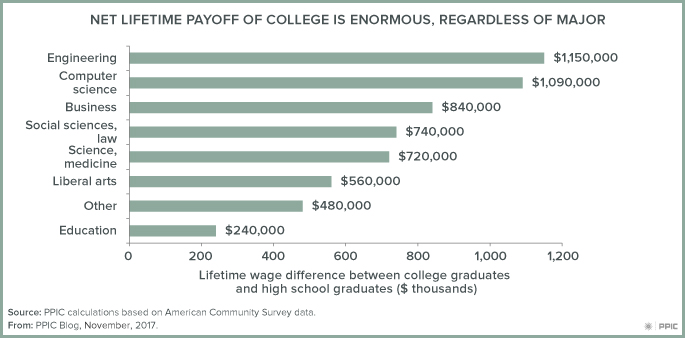
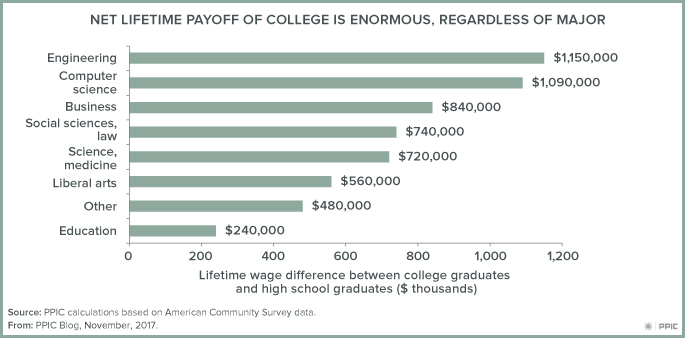
On average, college graduates have very strong labor market outcomes. At any point in time, some college graduates are working in jobs that do not necessarily require a college degree, but over the course of their careers the vast majority of college graduates will move into occupations that reward their educational training. Our estimates show that students who earn bachelor’s degrees in engineering and computer science fare very well in the labor market, but even those with less remunerative majors, such as education and the liberal arts, will earn far more in wages than less-educated workers, even after taking into account all the costs of going to college.

How to close the degree gap

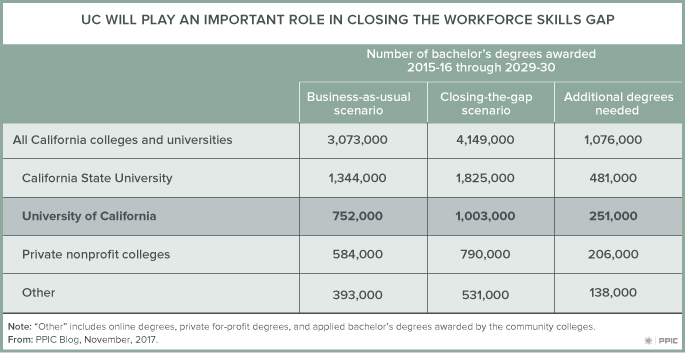
To close the degree gap, California and its higher education institutions need to establish new policies and practices to enroll more students, especially in our four-year colleges and universities, and improve graduation rates among students already in college. In previous testimony, PPIC has identified targets for each of the state’s public systems with respect to admission, transfer (from community colleges to four-year colleges), and improved graduation rates.

The University of California (UC) will play a central role. In our scenario, UC would need to award approximately one-quarter of the additional degrees necessary to close the gap. This is an ambitious target, but the increase over current levels (and over the baseline projection) would not be without precedent. For example, between the 1999–2000 and 2016–17 academic years, the number of bachelor’s degrees awarded by UC increased 62% (from slightly more than 33,000 to almost 54,000). Our closing-the-gap scenario would require UC to award about 81,000 degrees by 2029–30, a 51% increase over current levels.

Improving access and success among groups historically underrepresented in higher education—including low-income students, first-generation college students, Latinos, and African Americans—is essential if we are to close the degree gap. Compared to other public research universities, UC has an impressive record in enrolling low-income and first-generation students.

The California State University (CSU) system and the California Community College system have adopted new goals that are entirely consistent with PPIC’s targets. New initiatives, including remediation reform at the community colleges and at CSU, have the potential to substantially improve student success rates. CSU’s new graduation initiative aims to increase graduation rates and eliminate gaps between groups of students. College preparation among the state’s high school graduates has also increased, with the share of students completing the college preparatory requirements of UC and CSU reaching an all-time high. Strong demand for UC is likely to continue as college preparation continues to improve and the transfer pathway is better articulated. UC has seen consistent increases in graduation rates for many years, and new efforts to improve on-time graduation are likely to continue this trend.

Finding ways to accommodate all these students remains a central challenge, but one we must meet in order to ensure a better future for all Californians.

Video: Californians Concerned about Cost but Give State’s Colleges Good Grades

Many Californians say the state’s public higher education system is going in the wrong direction, a new PPIC Statewide Survey shows. But they are more likely to say they are concerned about affordability than about the quality of the state’s colleges and universities. Just 18% of all adults say quality is a big problem, compared to 56% who call affordability a big problem.

Researcher Lunna Lopes presented the findings of PPIC’s annual survey on higher education to a Sacramento audience last week.

Among the survey findings underscoring Californians’ concerns about college affordability: 75% say the cost of college keeps students who are qualified and motivated from attending, 79% say students have to borrow too much money to pay for college, and 85% say colleges and universities should do more to make sure that all students have affordable housing options.

In contrast to Californians’ views on costs, solid majorities of residents give excellent or good ratings to the state’s community colleges, California State University, and the University of California.

Californians are divided on whether a college education is necessary to succeed in today’s work world, with half saying it is and 48% saying there are many ways to succeed without college. There are strong differences among demographic groups on this question. Two-thirds of Latinos say college is necessary, compared to just 35 percent of whites. And 59% of Californians with household incomes of $40,000 or less say college is necessary, compared to 42% of those whose incomes are $80,000 or more.

Despite this divide over whether college is necessary for success, 80% of Californians say the public higher education system is very important to the future quality of life and economic vitality of the state.

Testimony: The Need for College Graduates in California’s Future Economy

Hans Johnson, director and senior fellow at the PPIC Higher Education Center, testified today, November 1, 2017, before the Assembly Select Committee on the Master Plan for Higher Education in California. The master plan defined a strategy to meet the state’s education needs in 1960—but today, California faces new challenges. The topic of today’s hearing: ensuring that the master plan meets workforce needs.

Here are his prepared remarks.

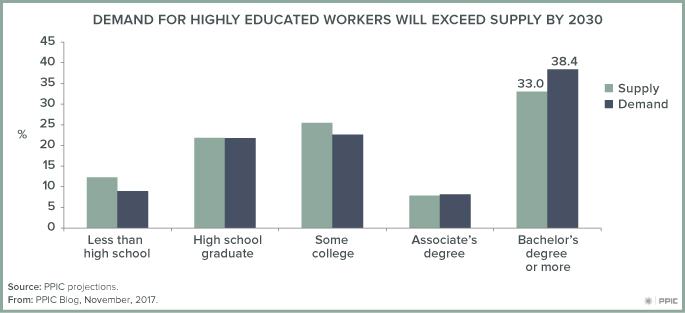
PPIC has produced a series of reports on California’s future population and economy.  Our report Will California Run Out of College Graduates?, provides projections of the demand for and supply of workers by educational attainment to 2030. Our primary finding is that California faces a shortage of highly educated workers. Specifically, economic projections to 2030 show that about two in five jobs will require at least a bachelor’s degree, while demographic projections suggest only about one in three Californians will have at least a bachelor’s degree. This shortfall equates to 1.1 million workers.

figure - Demand for Highly Educated Workers Will Exceed Supply by 2030

In this testimony, I first describe how California’s population and economy are changing, and then identify how the state and its higher education institutions can increase college enrollment and completion to produce more college graduates.

California’s economy is increasingly demanding highly educated workers

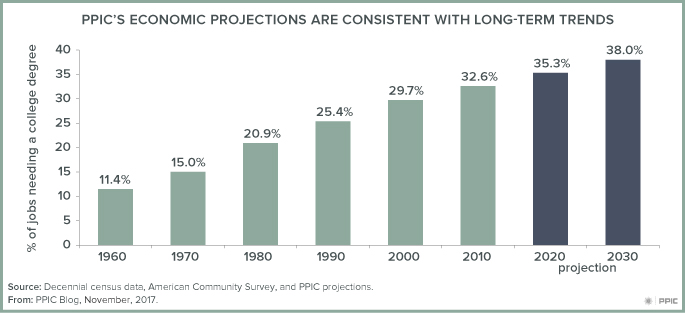
To develop our economic projections, we apply trends in educational attainment levels within occupations to occupational projections developed by the California Employment Development Department. We examine changes in labor market demand that are occurring due to shifts in the distribution of occupations and changes in educational attainment within occupations. Our primary finding is that the state’s economy will continue along a well-established trajectory, with a growing share of jobs requiring at least a bachelor’s degree.

figure - PPIC's Economic Projections Are Consistent with Long-term Trends

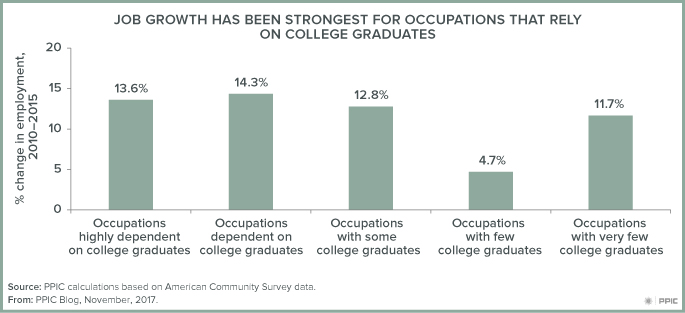
The two key drivers of increasing demand for college graduates are: 1) faster growth in occupations that commonly require a college degree (e.g., computer technology occupations), and 2) increases in demand for highly educated workers within occupations (e.g., nursing).  While both drivers are important, in recent years most of the increased demand (74%) for highly educated workers has occurred because of faster job growth in occupations that commonly require a college degree. Among large occupations (with at least 100,000 full-time year-round workers), those with especially rapid growth rates over the past five years include software developers (56% increase between 2010 and 2015), computer scientists and systems analysts (42% increase), and managers (35% increase). These and other highly skilled occupations have experienced faster growth than most less skilled occupations.

figure - Job Growth Has Been Strongest for Occupations that Rely on College Graduates

The second key driver of demand has been an increase in educational attainment within occupations.  For example, the share of registered nurses with a bachelor’s degree has grown from 57% in 2000 to 68% in 2015.  Altogether, over a five year period (from 2010 to 2015) about 26% of the increase in jobs for college graduates has occurred as demand for highly educated workers has grown within specific occupations.

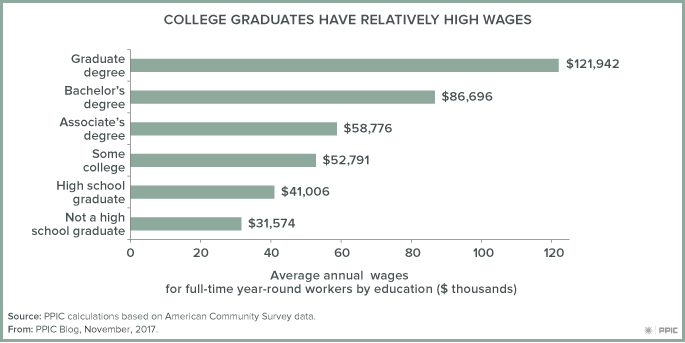
Are college degrees really necessary for these jobs? We examine a number of labor market outcomes to answer this question.  Within and across occupations, we find higher labor force participation rates, lower unemployment rates, and higher wages for workers with a bachelor’s degree than for those without. And in general, as educational attainment increases, wages also increase. Overall, the wage premium for college graduates relative to less educated workers has grown. By 2015, the average annual wage for full-time year-round workers was more than twice as high for workers with a bachelor’s degree than for those with a high school diploma.

figure - College Graduates Have Relatively High Wages

Within each of 51 occupational groupings we see higher wages for college graduates than for high school graduates. Among registered nurses, for example, those with a bachelor’s degree earned 12% more than those with an associate’s degree.

California’s educational institutions are not keeping up with demand

Too few Californians are graduating from college. At current college enrollment and completion rates, only 30.5% of 9th graders in California will eventually earn a bachelor’s degree either in California or elsewhere in the United States.  Compared to other states, California ranks 47th in the share of high school graduates that enroll in four-year colleges and 5th in the share that go to community colleges. Low rates of transfer from community colleges to four-year colleges exacerbates the problem.

figure - Too Few California High School Students Complete College

A critical challenge is the retirement of the large and relatively well-educated baby boom. Called the “silver tsunami” by some, this aging out of the labor force of millions of older adults is the first time in the history of California that such a large and well-educated group is exiting the labor force. In contrast, the number of young adults in California is projected to increase only modestly.

figure - California's Population Is Aging

Not all degrees are equal

On average, college graduates have very strong labor market outcomes. While at any point in time, some college graduates are working in jobs that do not necessarily require a college degree, over the course of their careers the vast majority of college graduates will move into occupations that reward their educational training. Our estimates show that students who earn bachelor’s degree in engineering and computer science fare very well in the labor market, but even those in less remunerative majors such as education and the liberal arts will still earn far more in wages than less educated workers, even after taking into account all the costs of going to college.

figure - Net Lifetime Payoff of College Is Enormous Regardless of Major

How to close the degree gap

To close the gap, California and its higher education institutions will need to establish new policies and practices to enroll more students, especially in our four-year colleges and universities, and ensure greater success of students already in college. In previous testimony, PPIC has identified targets for each of the state’s public systems with respect to admission, transfer (from community colleges to four-year colleges), and improved graduation rates. Improving access and success among groups historically underrepresented in higher education, including low-income students, first-generation college students, Latinos, and African Americans is essential if we are to close the degree gap.

The good news is that new goals adopted by the California State University (CSU) system and the California Community College system are entirely consistent with PPIC’s identified targets. New initiatives, including remediation reform at the community colleges and at CSU, have the potential to substantially increase student success. CSU’s new graduation initiative aims to substantially increase graduation rates and eliminate gaps between groups of students. Strong increases in college preparation among the state’s high school graduates are also a positive sign, with the share of students completing the college preparatory requirements of UC and CSU reaching an all-time high.

Finding ways to accommodate all these students remains a central challenge, but one we must meet in order to ensure a better future for all Californians.
Learn moreVisit the PPIC Higher Education Center

Testimony: Cybersecurity Needs and Higher Education

Hans Johnson, director of the PPIC Higher Education Center and PPIC senior fellow, testified at the Joint Legislative Oversight Hearing on Cybersecurity Education and the Needs of the Workforce before the Assembly Committee on Higher Education in Sacramento today (October 10, 2017). Assemblymember Jose Medina chairs the Higher Education Committee and Assemblymember Jacqui Irwin chairs the Select Committee on Cybersecurity. Here are Johnson’s prepared remarks.

Thank you Chair Medina, Chair Irwin, and committee members.  My name is Hans Johnson, and I am the director of the Higher Education Center at the Public Policy Institute of California. My role today is to provide a brief overview of cybersecurity labor market needs in the state. First, I’ll define cybersecurity occupations, next I’ll provide data on labor market trends, and finally I will discuss educational awards related to cybersecurity. Sources of information and data used in this testimony include the United States Department of Labor, the California Employment Development Department, the United States Census Bureau, and reporting by California colleges and universities to the United States Department of Education.

As an occupation, cybersecurity is identified by the US Department of Labor as “information security analyst” and resides within a broader set of computer and mathematical occupations. In this testimony, I will focus on the information security (IS) analyst occupation. However, it is important to note that other computer and information technology occupations include individuals who work at least partly on security issues. According to the US Department of Labor: “Information security analysts plan and carry out security measures to protect an organization’s computer networks and systems. Their responsibilities are continually expanding as the number of cyber attacks increases.”

The IS analyst occupation is a high wage, high demand occupation. It is growing but still relatively small. Increasingly, employers are hiring workers with at least a bachelor’s degree to fill IS analyst jobs, but a notable share of jobs are still filled by workers with less than a four-year degree.  California colleges and universities have substantially increased the capacity of their institutions to award degrees in computer science and related fields. Even so, unemployment rates remain very low—an indication that employers could be having a hard time finding workers.

In California, EDD estimates the state was home to about 8,000 IS analysts in 2014, with that number projected to increase to 10,100 by 2024, a growth rate (26%) slower than other computer occupations (29%) but much faster than the state’s overall employment growth rate (15%). Still, it is important to note that IS analysts make up less than 1% of employment in computer occupations in California and less than 2% in the nation (see chart below). IS analysts work in a broad range of industries, including technology, banks, higher education, insurance, and health.

EDD estimates that IS analysts in California had a median wage of $53 per hour in the first quarter of 2017, which amounts to $110,000 on a full-time annual basis. Nationwide, the unemployment rate for IS analysts has been around 2% for several years now (based on my analysis of American Community Survey data from 2012 through 2015), with similarly low unemployment rates in California. Unemployment rates that low are a sign of high labor market demand.


Of critical concern for workers, and for these committees, are the education and training requirements for IS analysts. According to the U.S. Department of Labor:

Information security analysts usually need at least a bachelor’s degree in computer science, programming, or a related field. As information security continues to develop as a career field, many schools are responding with information security programs for prospective job seekers. These programs may become a common path for entry into the occupation. Currently, a well-rounded computer education is preferred.

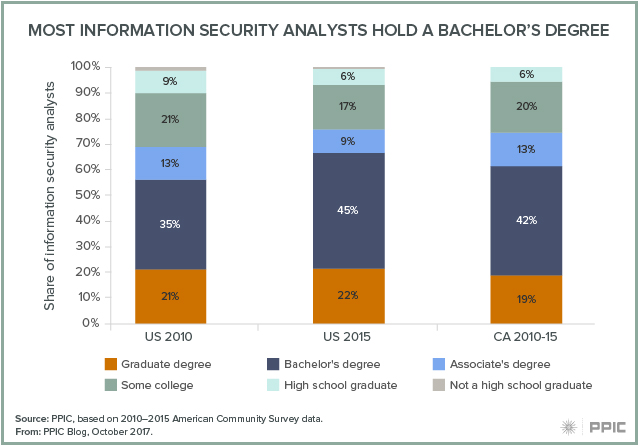
The number of IS analysts has increased nationwide in the last five years and so has their educational attainment. In the US, 67% of IS analysts had at least a bachelor’s degree in 2015 compared to 56% in 2010. In California, about two-thirds of analysts have at least a bachelor’s degree. The share of IS analysts in the US with an associate’s degree has declined from about 15% to less than 10%. The vast majority with a bachelor’s degree majored in one of three fields: computer science (including information systems), engineering (including electrical engineering and computer engineering), and business (including management information systems). In California, annual average earnings for IS analysts with a bachelor’s degree are about 70% higher than for those with some college or an associate’s degree, who in turn earn about 20% more than those with only a high school diploma. Unemployment rates are low for IS analysts, especially those who have some postsecondary education and those who have a bachelor’s or graduate degree.


California is home to dozens of colleges and universities that offer degrees in computer and information sciences. The state’s universities, especially the University of California, have quickly responded to the strong demand for these degrees (see chart below). The total number of bachelor’s degrees awarded increased from less than 3,000 in 2010 to 6,000 by 2016, with UC and CSU accounting for 65% of the total in 2016. The most common major is computer science, followed by computer and information science.


California’s community colleges also offer postsecondary training in computer and information sciences, ranging from short-term certificate programs to associate’s degrees. Importantly, they also provide lower division courses necessary for transfer to a four-year college or university. The total number of associate’s degrees in computer and information sciences and support services doubled between 2010 and 2016, from 719 to 1,490. The number of short-term certificates (completed in less than one academic year) increased from 1,605 in 2010 to 1,838 in 2016, and the number of longer-term certificates (completed in at least one but less than two academic years) increased from 225 to 321. In all, the number of postsecondary awards totaled more than 3,600 by 2016. PPIC is currently developing research that explores information technology awards at the community colleges and is working with the Employment Development Department and the Chancellor’s Office of the California Community Colleges to secure access to student and wage data.

In thinking through the roles of the different segments of higher education in California, it is important to keep in mind that the segments are designed to work as a system. The strong demand, both on the part of students and employers, in technology fields should be met by each institution and by the segments working together. For example, improving transfer from community colleges to UC and CSU in technology fields through better articulation—including Associate Degrees for Transfer—is necessary if students are going to fully realize the economic benefits of these fields. Moreover, cybersecurity occupations are but one part of a larger technology sector. Developing a larger industry-wide and cross-system approach to meeting demand is necessary. Innovations—such as locating some CSU bachelor’s degree programs at community college campuses—offer the promise of reaching more students, including those underrepresented at our four-year colleges. California can best serve the growing number of students who want to pursue technology jobs by taking advantage of the strengths of each segment of its public higher education system—and helping those segments work together to meet the economic need for these highly skilled workers.

Learn moreVisit the PPIC Higher Education Center

California’s Dream Act

As the federal government moves to end the Deferred Action for Childhood Arrivals (DACA) program, California is continuing to support the higher education aspirations of undocumented students. California’s Dream Act is a set of laws intended to lower the cost of higher education for certain undocumented immigrants brought to the US as children and raised in California. Thousands of California students have benefited from the program so far.

College can be especially expensive for undocumented students. For tuition purposes they are not technically California residents and therefore are not eligible for in-state tuition. Public colleges and universities charge extra tuition for nonresidents: currently an additional $28,000 per year at UC and $6,000 per year at CSU. In addition, undocumented students are not eligible for federal financial aid, such as Pell Grants or federal loans, leaving college out of reach for many who are low-income.

California passed AB 540 in 2001, which waives the nonresident portion of tuition for undocumented childhood arrivals as long as they meet certain criteria, including spending three or more years in California K‒12 schools, graduating from a California high school, and promising  to apply for legalizing their immigration status as soon as they are eligible to do so.  In addition, the state passed AB 130 and AB 131 in 2011, which allows state and institutional financial aid to be given to students eligible under AB 540.

Undocumented students cannot file the Free Application for Federal Student Aid (FAFSA) to apply for federal and state financial aid for college. This means that many do not have access to Cal Grants, one of the state’s main forms of financial aid. Instead, those who are eligible can apply for Cal Grants using the California Dream Act application.

Of all Cal Grant offers in 2014‒15, about 3% have been made to California Dream Act applicants. Of those eligible for the awards, both FAFSA filers and Dream Act filers have similar GPAs. However, those obtaining a Cal Grant through the state Dream Act application were more likely to come from families with parents without college degrees and with lower family incomes.

A student’s DACA status has no bearing on the California’s Dream Act, so AB 540 students will continue to pay in-state tuition rates and can apply for and receive state and institutional aid to help lower the cost of college, even if the federal DACA program ends. However, without a work permit these undocumented students still cannot work legally in the US, even if they obtain a degree from a California college or university. The approximately quarter of a million Californians covered by DACA will still be subject to deportation without further federal legislative or executive action. That uncertainty could keep otherwise qualified students from earning a college degree.

Learn more

Read “DACA and California’s Future” on the PPIC Blog.

Visit the PPIC Higher Education Center.

California’s Partisan Divide on Higher Education

New national polling shows a big divide has opened up between Democrats and Republicans on higher education. A Pew Research Center poll taken in June shows that a majority of Republicans and those who lean Republican (58%) think colleges and universities have a negative effect on the way things are going in the country, while a vast majority of Democrats and those who lean Democrat (72%) think colleges and universities have a positive impact. This is a big change from two years ago, when majorities in both parties said higher education institutions had a positive impact on the direction of the nation.

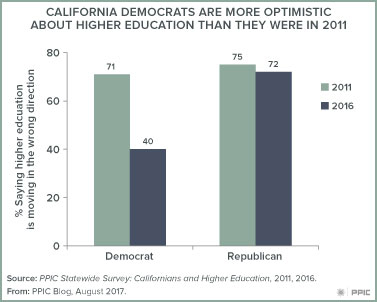
Is there a similar partisan divide over higher education in California? The PPIC Statewide Survey found a similar divergence over the past few years when we asked a different question: Is the state’s public higher education system generally going in the right or wrong direction? In 2016, California Republicans were far more likely than Democrats to say the system is headed in the wrong direction. This marked a change in the five years since we’d last asked this question. When we asked the question in 2011—toward the end of the recession and after large tuition increases—Californians in both parties overwhelmingly said higher education was moving in the wrong direction. Unlike national polling, which shows a shift in Republican opinion, PPIC surveys show a shift in the opinions of Democrats, who have become more positive, while Republicans have remained about the same.
Californians’ responses to other survey questions about higher education point to longer-term partisan divisions. Republicans have generally been more likely than Democrats to say that the overall quality of education in California’s public colleges and universities is a big problem or somewhat of a problem. Views about the direction and overall quality of public higher education are reflected in attitudes about California’s three public higher education systems. Currently about half of Republicans say that each of the systems—community colleges, California State University, and University of California—are doing an excellent or good job. More Democrats—about three-fourths—express this view.

Partisans have also historically differed on higher education funding. Compared to Republicans, Democrats are more likely to say that higher education does not receive enough funding, and Democrats are generally willing to pay higher taxes to support higher education.

Interestingly, there is some evidence that Californians’ views about the importance of college for individual success differ along party lines. A majority of Democrats (68%) say a college education is necessary for a person to be successful in today’s working world, while a majority of Republicans (72%) say there are other pathways to success. It is also true, however, that Californians in both parties have become more optimistic about the chances of success without a college degree since 2011—when the state was recovering from recession.

Finally, there are some areas of agreement. We find that members of both parties generally think that college affordability is a problem and students have to borrow too much money. Perhaps most significant is our finding that overwhelming majorities of both Republicans and Democrats say that the state’s system of higher education is important to California’s economic future and quality of life.

Learn more

Visit the PPIC Higher Education Center

UC Admissions: What the Numbers Mean

The University of California’s recently released admissions data shows that about 62% of all applicants were admitted to the system for fall 2017. There are big differences among campuses: admission rates range from 16% at UCLA to 72% at UC Merced. And UC expects that less than half of admitted students will enroll.

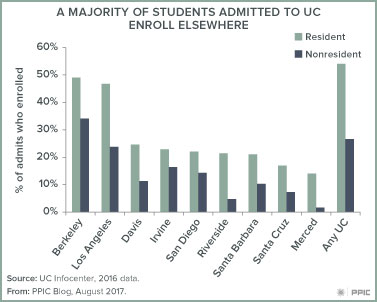
Figure 2: A Majority of Students Admitted to UC Enroll ElsewhereThe proportion of admitted students who enroll is called the yield rate. The yield rate is a product many factors, including which campuses students are admitted to and whether they are California residents. UC’s systemwide yield rate was around 45% last year; at each campus, the yield rate for nonresidents (27%) is much lower than that for residents (54%). The Berkeley and LA campuses have the highest yield rates, with almost half of their admitted students enrolling. Only about one in five admitted students enroll at the other campuses.
Where do students who decide not to go to the UC campus(es) that admitted them end up enrolling? UC generally faces competition from private schools in California and public and private universities in other states. Students also choose to go to a local CSU or plan to start at a community college, and low yield rates at some campuses are a byproduct of competition among UC schools. The average UC applicant for fall 2016 applied to four UC campuses, and the average admitted student was admitted to 2.3 campuses.

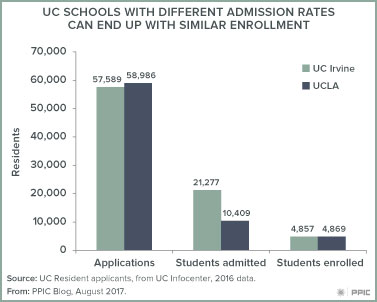
A UC school with higher admissions rates isn’t necessarily serving a larger number of Californians. The LA and Irvine campuses are about 50 miles away from one another and receive about the same number of resident applications. In 2016 UC Irvine admitted more than twice as many California residents (37% of applicants) as UCLA (18%). However, students admitted to UCLA are about twice as likely to enroll there, which leaves the two campuses with about the same number of entering students.

Figure 2: UC Schools with Different Admission Rates Can End Up With Similar Enrollment

The story is similar for nonresidents. Because UC’s yield rate for nonresidents is about half the yield rate for residents, a larger share of nonresidents are admitted: in 2016, nonresidents made up 33% of admitted applicants but only 19% of enrollees.

Campuses generally have state support and classroom space for a certain number of students and use their knowledge of yield rates to reach that target. Campuses with lower yield rates make many more admission offers, and all campuses make offers to more nonresidents than they plan to enroll.

That admissions strategy can be a problem for less competitive institutions. It is impossible, after all, to know if any given student will decide to enroll, and a small change in the yield rate can have big consequences. For example, while UC Irvine’s yield rate was 23%, a small jump to 25% would have resulted in more than 400 additional enrollees. Officials at Irvine maintain that over-enrollment was not the reason for their decision last month to rescind offers of admission to about 500 students (the campus has since readmitted many of those students). However, it is easy to see how high-stakes admissions decisions based in part on predictions of applicant behavior could quickly lead to either over- or under-enrollment.

Learn more

Visit the PPIC Higher Education Center

UC’s Experiment in Measuring Costs

When it comes to government budgets, the focus is usually on who gets how much. But that’s only part of the story of the California state budget, which usually includes a host of provisions that specify how the money is to be used. This year’s budget is no exception—and one relatively obscure provision could help University of California (UC) campuses optimize their budgetary decision-making.

A lot of attention has been paid to the budget provision that withholds $50 million from UC until the university’s Office of the President (UCOP) implements the recommendations contained in an unflattering state audit. Our focus, however, is on another, little-noticed provision that requires UCOP to complete an experiment in “activity-based costing”—a detailed way of tracking and measuring university expenditures.

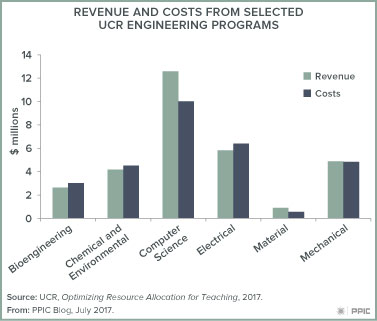
As we noted in a recent report, it is challenging to track dollars as they flow through higher education systems. Public universities typically have multiple funding sources and several missions and activities, all of which combine to create an intricate web of dollars. Activity-based costing focuses on an institution’s expenditures to identify where money is going. In a pilot program at UC Riverside, administrators have combined data on students, faculty, courses, and finances to create a detailed picture of the costs associated with instruction. The information enables administrators to estimate costs at various levels—from how much it spends to run a department down to the cost of teaching a single class section. The enacted budget requires UCOP to expand UC Riverside’s activity-based costing to three departments on each of two additional campuses.

Activity-based costing has the potential to inform conversations among campus administrators about the trade-offs involved in using resources to improve student outcomes. For example, the conventional wisdom is that it is expensive to increase enrollment in STEM (science, technology, engineering, and math) programs. By applying activity-based costing, UCR budget and planning officials found that expanding the biology and computer science departments would not necessarily be costly. Because of the size of enrollment and the way courses are taught and faculty are assigned, the revenue generated by those departments exceeds the cost of expansion. The cost of expanding programs in electrical engineering and bioengineering, on the other hand, is currently higher than the revenue generated from enrollment.

The takeaway is that if administrators feel that expanding the electrical engineering program is a priority, they should pursue it knowing that they will need to find additional sources of revenue.

The UCR pilot has also enabled the university to understand the costs of instruction at a high level of detail. Our report calculated the changes in the cost per degree over time for both the UC and California State University systems. UCR was able to break down the cost per degree by type. For example, producing an engineering degree costs, on average, 16% more than a degree in social science. The cost of a humanities degree falls between the two. A significant portion of that cost difference could be attributed to the fact that it takes longer for engineering students to complete their degree requirements.

Activity-based costing isn’t a substitute for goal-setting and planning. It is a tool that can help an institution better align its resources with its goals. Another takeaway from the UCR pilot is that implementing activity-based costing is a complicated endeavor that requires a broad commitment from the institution. The process of expanding this pilot—and what administrators learn from it—bears watching.

Learn more

Year-Round Pell Grant Revived

As California State University and the University of California work to increase the number of students who graduate within four years, the federal government has reinstituted the year-round Pell Grant—a financial aid program that can help accomplish this goal. Increasing on-time graduation rates has benefits for both students and the state—opening up more spots in the state’s higher education institutions, reducing the total amount of tuition and fees that students pay, and allowing students to enter the workforce sooner.

The year-round Pell Grant is designed to address a specific problem: while students need to take 15 units in the fall and in the spring semester to graduate on time, many take only 12 units, which adds an extra year to their time to degree. Acknowledging this issue, some campuses are adopting the “Finish in Four” model, which encourages students to complete 30 units per year while giving them flexibility in how they meet that goal. For example, a student could take 12 units in the fall, 12 in the spring, and 6 in the summer. The year-round grant program complements this model by allowing recipient students flexibility to use Pell funding for summer coursework.

Many California students already receive Pell Grants―around 46% of students at CSU and UC, and 29% at the community colleges. The new year-round grant allows recipients to receive one-and-a-half Pell awards in one academic year. While this may not cover the full cost—six units during the summer term costs about $120 more than six units in the fall and spring terms—it makes attending more affordable.

However, it is unclear if the program will incentivize students to enroll in the summer term to stay on track for timely graduation. The program was previously only in effect for two years (2009–2011), and the limited research studying its impact suggests mixed results. Preliminary findings from a study presented at the Association for Public Policy Analysis and Management conference found a small increase of 3.5 percentage points in Pell students’ summer enrollment. Initial findings from another study presented at the Association for Education Finance and Policy conference found that summer enrollment increased by 28 percentage points. Given the short lifespan of the first year-round Pell, its impact may have been limited by students’ lack of awareness of the program and campuses’ lack of infrastructure to offer the right courses.

To ensure the program’s effectiveness, colleges need to help students use the summer semester to reach a full 30 units per year. The year-round Pell is not the only effort to help students use their summers to finish on time. For example, Sacramento State University is offering $1,000 grants for students who enroll in the summer term. Given the uncertainty of long-term federal funding for a year-round Pell, campuses may need to develop other similar programs to incentivize summer enrollment and encourage on-time graduation.

Learn more

Visit the PPIC Higher Education Center