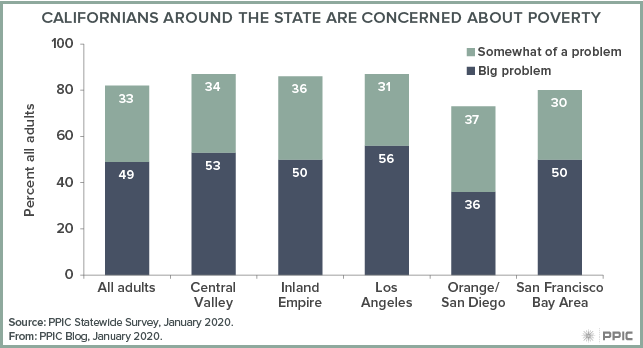
Even as California’s economy is surging—with unemployment at a historically low 3.9% last month—residents around the state are worried about poverty. About eight in ten adults say that poverty is a big problem (49%) or somewhat of a problem (33%) in their part of California. Likely voters hold similar views (47% big, 35% somewhat). This concern is high across every region of the state.
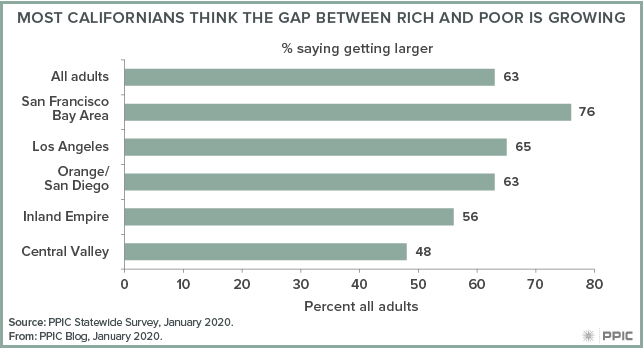
Income inequality has grown substantially across the nation, and it is particularly notable in California. About two in three adults (63%) and seven in ten likely voters (68%) think the gap between rich and poor is getting larger in their part of California. Across regions, nearly half to three-quarters of residents hold this view.
California students may fall through cracks in the state’s public education system because K–12 data and college data are not connected. For example, the state and its public universities are currently unaware of students who do not apply to UC or CSU despite being eligible, making it impossible to encourage these students to apply. Connecting education data can help California recognize and improve key transitions in student progress.
The current data system is fragmented across institutions, leaving California as one of eight states without a modernized approach to tracking its educational pipeline. By passing the 2019 California Cradle-to-Career Data System Act, the state is taking action toward linking education data across its many sectors.
As a first step, California has appointed a workgroup that will recommend a framework to the legislature and the Department of Finance within a year. This workgroup will determine relevant data elements to include—variables such as graduation, eligibility, and enrollment—along with when and how to combine data, where to store results, and who governs access to data.
So far the process has been inclusive and transparent, with representatives from all sectors of education, advocacy groups, researchers, technology experts, lawyers, and others stepping forward to serve on committees and advisory groups. Many member organizations of the California Education Data Collaborative, an organization convened by PPIC, are serving in advisory groups. Advisory group meetings are open to the public, and people can find information, meeting materials, and notes on the California Data System website. Public comments are encouraged at all meetings and on the website.
On January 16, PPIC attended its first meeting with the Policy and Analytics Advisory Group, where we discussed use cases around research and accountability, such as analyzing how financial aid offers to high school students impact college outcomes. The advisory group also agreed on a critical first step for the state: evaluation and analysis of student pathways from school to work. Advice from this advisory group and others will help the state’s workgroup make recommendations on January 30 to determine the scope and first phase of the data system.
PPIC will continue to participate in the advisory group and monitor the monthly workgroup meetings; notes and materials will be posted at California Data System, and we will update progress on this blog.
This is the final post in a two-part series on how the governor’s budget proposal addresses natural resources. The first post looked at water and climate issues.
In recent years, California has experienced some of the worst wildfires on record, and the risk is increasing as the climate warms and precipitation becomes more variable. Governor Newsom’s proposed budget supports an array of tools for reducing the threat of wildfire. Funding for these investments would come from the state General Fund, a proposed climate resilience bond, and the greenhouse gas reduction fund (GGRF). The budget prioritizes three wildfire-related areas:
Boosting fire suppression resources: The budget would increase the California Department of Forestry and Fire Protection’s (Cal Fire), annual budget by $120 million. It would also add 677 staff positions over five years—an 11% increase in the state’s permanent firefighting force. These investments would improve Cal Fire’s ability to ramp up fire suppression efforts through a longer fire The budget also provides $9 million for the development of an interagency center to improve wildfire detection and responsiveness, as required by SB 209 (2019).
Bolstering community resilience: The budget proposes significant funding increases to make homes and community infrastructure less vulnerable to wildfire damage. It earmarks $500 million to reduce fire risks to community infrastructure, including drinking water systems, emergency shelters, and public medical facilities. It also includes $25 million for a pilot program that would provide financial assistance for home hardening (for example, switching to fire-resistant roofing) in low-income communities, as required by AB 38 (2019). Another $25 million is proposed for community resilience planning, including the development of local wildfire emergency plans. And the California Office of Emergency Services would get $50 million to help local governments prepare for, respond to, and mitigate the impact of wildfire-related power outages.
Improving forest health: Actions that help the state’s forests withstand high-severity wildfire, drought, and pests are essential to reduce wildfire threats. The budget builds on past efforts by allocating $165 million to Cal Fire’s forest health grant program. It also includes $250 million to supplement existing forest health programs funded by the GGRF. Finally, the $80 million allocation for the development of statewide LiDAR maps can help the state target its investments in forest management.
Managing the state’s climate-fueled wildfire threat requires both emergency fire suppression and risk reduction actions. Governor Newsom’s budget continues to move the state toward a useful balance of these efforts.
Leon Panetta, former secretary of defense and CIA director, joined PPIC president Mark Baldassare in Sacramento last week for a wide-ranging conversation about leadership. Baldassare began by asking Panetta to “put on your CIA hat” and compare the targeting of Osama bin Laden during the Obama administration with the recent killing of Iranian general Qasem Soleimani. The main difference, Panetta said, is that bin Laden had directly attacked the United States, and that he and other Al-Qaeda leaders were almost certainly planning more attacks.
Panetta explained that the Obama administration “never seriously considered an attack on Soleimani,” because “the result would be that we would increase the chances of war with Iran.” The issue was not whether Soleimani was a “bad actor,” but whether the US wanted to escalate the conflict: “When you make those kinds of decisions, you ought to damn well consider the risks of war.”
For Panetta, the tense situation with Iran underlines the importance of leadership. “In a democracy we govern either by leadership or by crisis.” Leadership, he continued, involves actively addressing major challenges—and this, in turn, entails uncertainty and risk. “If you’re not willing to take the risks associated with leadership . . . , crisis will drive policy in this country.”
Panetta sees impeachment as “a reflection of our times”—we have “a president who doesn’t abide by moral boundaries” and a Congress that “can’t work together.” But he is hopeful that the Senate will deal with the trial “in a fair and impartial way.” Otherwise, he continued, “there is a danger that impeachment is going to become just another political tool.”
Asked to assess how things are going in California, Panetta identified three interrelated leadership challenges: political imbalance, economic inequality, and education. To have a chance of restoring political balance in Sacramento, he said, Republicans are “going to have to look at immigration . . . inequality . . . climate change.” At the same time, the state’s Democratic leadership will have to collaborate with a broad range of stakeholders to tackle economic inequality—and its efforts will need to include a focus on education, which “is absolutely critical to the future of California.”
While Panetta is clearly worried about the level of dysfunction in Washington, he is not entirely pessimistic. “I’ve seen Washington at its best and Washington at its worst. The good news is that I’ve seen Washington work!” More seriously, he stressed the need for people to engage in the political process: “They’ve gotta be willing to fight for what they believe is right.” He conceded that politics “has gotten tougher.” But, he added, the great satisfaction of being involved in our democracy is that “you can do things to make people’s lives better.”
Earlier this month the Newsom administration laid out its vision for addressing the linked issues of water and climate in two key policy documents: the much-anticipated draft of its Water Resilience Portfolio (WRP) and the governor’s budget proposal. The WRP, which resulted from an April 2019 executive order, was developed with extensive input from state agencies and stakeholders from around California. It outlines more than 100 actions designed to ensure that communities, the economy, and ecosystems across California’s diverse regions are able to weather our increasingly volatile climate. The January budget provides a roadmap of the administration’s initial spending priorities in this area.
The big ticket item is the $4.75 billion Climate Resilience Bond, which could appear on the November 2020 ballot. More than 60% of the bond amount would directly support actions in the WRP—including integrated regional water projects, safe drinking water, flood protection, and environmental stewardship. The remainder would address other climate resilience issues for California communities—including reducing risks from wildfire, sea level rise, and extreme heat—and closing the funding gap for restoration efforts in the troubled Salton Sea.
The administration also proposes a modest allocation of General Fund dollars to near-term actions on the portfolio’s long to-do list. Key areas of investment include:
Groundwater sustainability: Groundwater is an essential drought reserve. This year, local agencies and water users in the state’s most stressed basins will begin implementing the landmark Sustainable Groundwater Management Act to bring their basins into balance. The budget proposes to spend $60 million on the hard work of reducing water demand in ways that support local communities and economies, such as water trading and making the best use of fallowed cropland.
Better data for decision making: The WRP emphasizes the importance of modernizing data use to make the most of our water resources, and acknowledges the key role of the state as a data collector and developer. Of note is the proposed allocation of $80 million toward development of statewide LiDAR maps—landscape contour images that can help guide investments in habitat improvements and efforts to reduce risks from flooding and sea level rise.
Cutting “green tape”: The WRP also stresses the importance of improving the approval process for projects designed to enhance the natural environment, which is especially vulnerable to climate change. The current process, which involves many agencies, causes lengthy and costly delays. The budget proposes to reduce “green tape” by allocating $4 million for new staff positions to help make the approval process more efficient. Even modest additional resources, coupled with strong direction from state leadership to agency staff, could help California move toward truly coordinated, expedient, and effective stewardship of our natural environment.
The administration’s proposals provide much food for thought about state priorities in the California water arena. The WRP in particular emphasizes the state’s role in facilitating and supporting efforts at local and regional levels, where most water investments take place. In the coming months, there will no doubt be a lively debate about the specifics of the Climate Resilience Bond—which must be finalized by early summer to qualify for the ballot—as well as the other ways the Newsom administration and the legislature can help the state’s communities, economies, and environment build water resilience.
The governor unveiled his proposed 2020-21 budget last week, which includes record-high levels of K-12 and community college funding—a $3.8 billion dollar increase over last year. This includes $900 million for K–12 educator recruitment and development, building on a nearly $150 million investment from last year’s budget.
These new investments are an attempt to address the statewide teacher shortage, which is most acute in the high-need subjects of math and science (special education is also a high-need area). The hope is that these investments will pay dividends in improving the size and the quality of the teaching force in these subjects, which are important for college success and for jobs in the 21st century economy.
Most notably, the proposed funding includes one-time increases to address teacher shortages in key ways:
$350 million in competitive grants for teacher professional development
$193 million to address teacher shortages in high-need subjects
$175 million for residency programs to prepare and retain teachers in high-need subjects
$100 million to fund $20,000 stipends for teachers in high-need subjects at a high-need school for at least four years
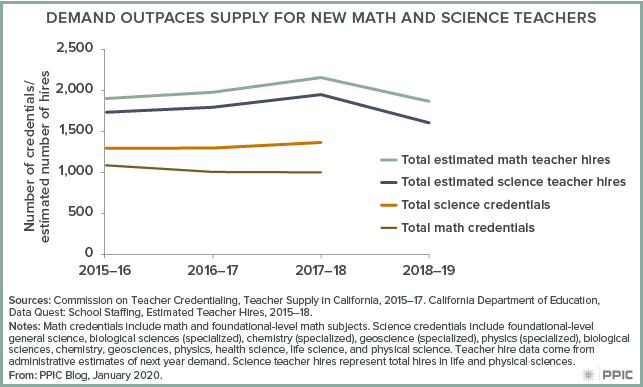
Schools across the state face critical teaching shortages in math and science, leading many schools to increase their reliance on less-credentialed and less-experienced educators. Difficulty in staffing these subjects also means that some schools must reduce course offerings, impeding student access to math and science coursework. Indeed, the number of new math and science teaching credentials has not matched demand for such teachers in recent years. In fact, the number of new math credentials has actually fallen over the past two years, constraining schools in both hiring and course offerings.
These continued shortages have important implications for student opportunities in STEM fields. For example, nearly one-third of high school graduates do not meet current UC and CSU requirements for science coursework, and many schools do not have the number of teachers required to offer three or four years of math and science to all interested students. Proposed increases to science eligibility requirements for UC admission—and for math requirements at CSU—mean that increasing the supply of qualified new math and science teachers is more essential than ever. Continued shortages will make it difficult to both accommodate this increased demand and to address equity gaps in the availability of high-quality math and science coursework.
In this light, the governor’s proposal provides reason for optimism. Increased funding for teacher recruitment and retention should help to encourage young adults to enter teaching and retain those who do. And more money for training and development should help to ensure that schools are able to choose among qualified teachers. Whether this will be enough to truly make a dent in the state’s teacher shortage remains to be seen; it depends crucially on whether these investments will be continued in future years or end up as one-time relics from a strong budget year.
Independents may play a central role in the March primary, as they now comprise the second-largest voting bloc in California. The share of Californians registered as independents, also known as “decline to state” or “no party preference” (NPP), was 26.7% of registered voters as of October—up from 24% at the same point before the last presidential primary. With independents a growing faction, it is critical to understand these voters and their motivations.
In PPIC’s November Statewide Survey, 28% of registered voters were independents. About six in ten say they have always been an independent voter, while four in ten say they previously registered with a major party—with 56% naming the Democratic Party and 40% the Republican Party. Today, about half of independent voters (48%) consider their views closer to the Democratic Party, while fewer say the Republican Party (24%) or neither party (22%).
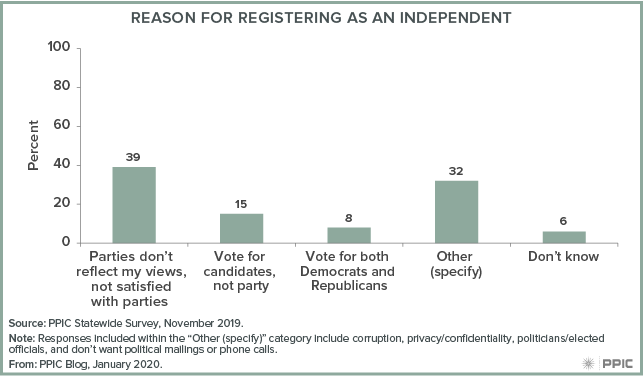
When asked the main reason they are registered as an independent and not as a member of a political party, a plurality (39%) say they are not satisfied with the parties and they do not reflect their views. Another 15% say they vote for candidates, not parties, and 8% vote for both Democrats and Republicans.
In California, political parties decide whether independents can vote in their presidential primary, and three political parties allow it: the American Independents, Democrats, and Libertarians. One in four independent voters in our November survey plan to vote in the Democratic primary, while about half say they will vote on the nonpartisan ballot.
Independents seeking to vote in the Republican presidential primary must re-register to vote with that party. Without registering as a Republican, independents will be unable to cast a vote for President Trump or potential challengers in the Republican presidential primary. (Members of the Green or Peace and Freedom parties must also re-register with and request a ballot from the major party of their choice.)
Independents who want to vote for US president in the primary must request a ballot with presidential candidates on it; otherwise, they receive a nonpartisan ballot. Although the deadline to request a ballot has passed, independents can still exchange their ballot at a local elections office or re-register with another party.
PPIC will continue to track voter and party profiles in 2020, with a focus on the state’s evolving independent voting bloc.
California saw some especially big changes over the past year in its ever-changing water world. New groundwater sustainability agencies finalized their plans to better manage overtapped groundwater supplies, and are poised to begin implementing them. In October, the Trump administration announced plans to pump more water from the Delta, complicating efforts to negotiate solutions to water supply and ecosystem management conflicts in the Central Valley. And the Newsom administration recently released a plan to make the state’s extensive water system more resilient to climate change. All of this—and much more—took place in 2019.
The PPIC Water Policy Center continued its engagement on the big water issues facing California, and offered ways to tackle them.
Climate change
Climate change is bringing pressures that will seriously impact California’s water system: warming temperatures, shrinking snowpack, shorter and more intense wet seasons, more volatile precipitation, and rising seas. The issue is a defining element in much of the center’s work. Highlights from this year include:
The Newsom administration asked the center to summarize key water policy priorities to improve climate resilience, and ways to improve integration across state agencies to implement these priorities. Our recommendations informed the administration’s “water resilience portfolio.”
Our research on managing wastewater in a changing climate reviews how this important sector can maintain water quality in the face of reduced indoor water use, make smart recycled water investments, and build resilience to severe drought.
I gave testimony at a House of Representatives committee on preparing western water infrastructure for a more volatile climate.
Our biennial Priorities for California’s Water report provided recommendations for improving water management and preparing the state’s water systems and natural environment for a changing climate. The publication inspired multiple panel discussions at our annual water conference in November.
Sustainable groundwater management
The San Joaquin Valley—California’s largest agricultural region and an important contributor to the nation’s food supply—faces growing water stress. We released a far-reaching report that details the valley’s water-related challenges, and lays out cooperative approaches that can help bring groundwater basins into balance, provide safe drinking water, and manage changes to water and land that will maximize benefits to people and nature. The center partnered with Fresno State’s California Water Institute to host a half-day event to discuss the new report’s findings. Our team also took our findings to the state legislature, various stakeholder groups, the media, multiple state agencies, and more.
Freshwater ecosystems
Our latest report calls for a new approach to protect the many benefits Californians derive from freshwater ecosystems. It lays out a plan to manage water, land, and species simultaneously to improve ecosystem health while also protecting native biodiversity and human uses of ecosystems. The approach, summarized here, is consistent with state and federal endangered species laws. We also held an event to hear from practitioners from around the state, who highlighted the advantages of this approach and the need to implement it more rapidly.
We’re thankful for these opportunities to help find creative and collaborative solutions to California’s most difficult and pressing water challenges. And as always, we thank our supporters who enable this important work.
With best wishes for a hopefully wet (but not too wet!) 2020,
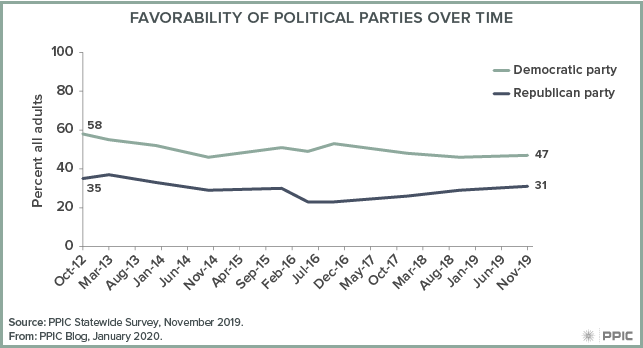
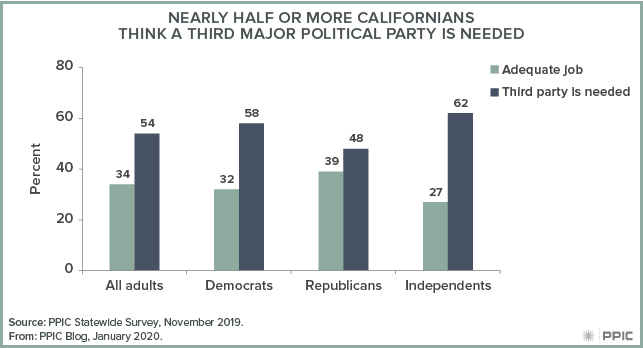
How do Californians view the two major political parties in this era of hyper-partisanship? In our recent survey, 47% of adults and 46% of likely voters report a favorable impression of the Democratic Party and 31% of adults and 34% of likely voters report a favorable impression of the Republican Party. In expressing their relative discontent with how these two parties represent the American people, a majority of adults (54%) and likely voters (57%) say a third major party is needed.
Since we first asked about party favorability in March 2010, positive views of the parties have rarely exceeded 50% and impressions have remained steady among adults and likely voters. Although favorability toward the Democratic Party sits below 50% overall, it rose among certain groups, including African Americans (52% 2010, 71% today), those with annual household incomes of $40,000 to $80,000 (39% in 2010, 49% today), and college graduates (39% in 2010, 48% today). Party favorability remained stable across all other regions and demographic groups.
For the Republican Party, favorability has increased somewhat among Central Valley residents (30% 2010, 38% today) but declined somewhat among 18 to 34 year olds (32% in 2010, 24% today). However, favorability is steady among all other regions and demographic groups.
While less than half of adults and likely voters hold positive views about either major party, majorities of partisans continue to regard their party well. Favorability has climbed among party members since 2010 (Democratic 68% 2010, 76% today; Republican 54% 2010, 77% today). Among independents, impressions of both parties remain similar to 2010, but about six in ten independents, who comprise more than a quarter of the California electorate, report a poor impression of both parties (60% Democratic, 63% Republican). Notably, today, 21% of adults and 14% of likely voters have an unfavorable view of both parties.
With both parties facing mediocre ratings, about half or more of California’s residents have consistently called for a third major political party since October 2006. Today, just one in three adults (34%) and likely voters (32%) think that the two major parties do an adequate job representing the American people. About half or more across parties and regions—and a plurality among demographic groups—feel a third major party is needed, with independents (62%) and those earning over $40,000 annually (62%) most likely to hold this view.
The number of high school graduates has remained steady for several years, with no expectation of significant increases any time soon. And yet demand for admission to the state’s public universities continues to grow.
A quick look at trends among California’s high school graduates—in particular, their preparation for college—helps explain this paradox. Other sources of enrollment growth, including increases in transfer students and improved retention, also play an important role. Understanding these trends is critical, since annual state funding for the University of California (UC) and the California State University (CSU) depends partly on anticipated enrollment growth.
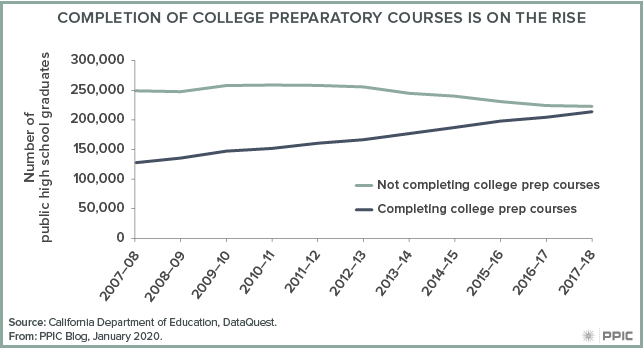
The good news is that more and more of California’s high school graduates have passed the college preparatory curriculum (known as the “A-G” courses) required by UC and CSU. Over the past five years, the number of high school graduates completing the A-G courses has increased 28%, even as the total number of high school graduates has remained largely unchanged.
By 2017–18 (the most recent data available), almost half (49%) of California’s high school graduates had completed the A-G courses, a remarkable increase from just ten years earlier when only about one-third (34%) did so. As a consequence, the number of high school graduates eligible for UC and CSU has reached record numbers.
Of course, enrollment demand depends on more than just new freshmen. The number of students that transfer from the state’s community colleges also adds to enrollment growth. Over the past five years, that number has also grown (up 25% at UC and 14% at CSU).
Improvements in persistence and completion also lead to greater enrollment, as fewer students drop out. At both UC and CSU, persistence and graduation rates are increasing. For example, at CSU the share of freshmen that graduate within six years has increased from 54% (fall 2008 entering cohort) to 62% (fall 2013 entering cohort).
Accommodating this enrollment growth is good for the state. College graduates are in high demand in the state’s labor market and—on average—earn far higher wages than less educated workers. PPIC has projected that demand for highly educated workers will keep growing as the state’s economy continues to change. Finding ways for California students to attend and graduate from college improves their well-being—and that of the state.






 The PPIC Water Policy Center continued its engagement on the big water issues facing California, and offered ways to tackle them.