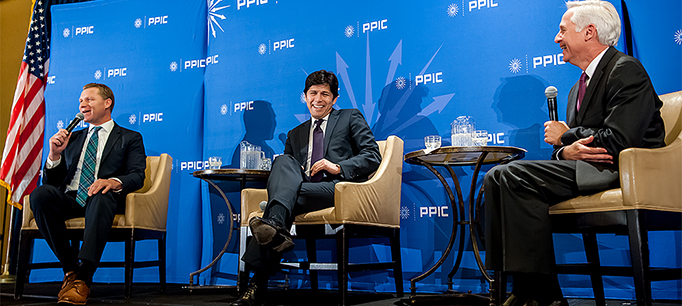
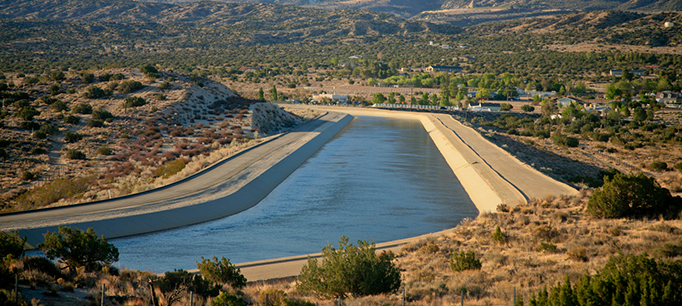
Video: Congressman Kevin McCarthy in Conversation

The majority leader of the US House of Representatives ticked off the issues in an ambitious agenda that he and Congressman Paul Ryan, the House Speaker, are working on in Congress. Congressman Kevin McCarthy told a Sacramento audience that they include national security, the economy, tax reform, poverty, regulatory reform, innovation in government, and water.

McCarthy shares a sense of urgency with Senator Dianne Feinstein about getting a water bill through Congress this year. But he made clear in his conversation with Mark Baldassare, president and CEO of PPIC, that he and the senator—who spoke to a PPIC audience last month—differ in their policy priorities. His include building more water storage and pumping more water from the Sacramento-San Joaquin River Delta.

McCarthy said he thought a water bill could be passed this year, perhaps in a bill that addresses the water problem in Flint, Michigan.

“I think there’s a window of opportunity,” he said.

When the conversation turned to the presidential race, McCarthy was asked to compare two political outsiders—presidential candidate Donald Trump and former Governor Arnold Schwarzenegger. McCarthy said both tapped frustration in the electorate and both brought new voters to the process.

“When I went to the rallies with Arnold it was amazing,” he said. “There’d be 7,000 people in Bakersfield. Lived there my whole life, but I’d see people I’d never met before.”

Today, he said, “the country feels as though the government is not listening to them, they’re divided on all sides, and they’re just not going to take it anymore.”

“I don’t believe it’s a bad thing at all. I believe it’s good.”

Video: California’s Voter Turnout Problem

Voter turnout in California has been declining—it reached record lows last year, raising concerns about the state’s democratic process. PPIC research fellow Eric McGhee told a Sacramento audience last week that turnout in California has not only dropped in absolute terms but has fallen behind that of other states. While participation in fall presidential elections has been holding steady, turnout is on the decline in midterm elections—when the state elects a governor and other statewide officials—and, to some extent, in presidential primaries.

A big part of the problem is California’s voter registration rate, said McGhee, who coauthored the new report Putting California’s Voter Turnout in Context. It has not changed significantly, though it should have been climbing, as it has in other states.

California has been working hard to make the voting and registration processes as easy as possible, and other policy changes are under discussion. Will they result in higher turnout? They may help, but they aren’t panaceas, McGhee said. Ongoing mobilization efforts will be needed to motivate more people to cast a ballot.

Video: Reforming Federal Drought Management

The federal government is a key partner in just about every aspect of western water management. It’s the West’s largest landowner, chief environmental regulator, major supplier of irrigation water and hydropower, key provider of water information, and an important source of water-related funding. The vast scale of its involvement has brought big challenges to how it manages the drought that has affected the entire 11-state region in recent years.

The fed’s role in managing droughts in the West was the topic of a seminar in Washington, DC, last week, a joint effort of Resources for the Future and the PPIC Water Policy Center. Along with a panel of prominent national experts, we discussed how to improve policies and practices to build drought resilience at the federal level, with a focus on pragmatic changes that are doable in the near term. I introduced recommendations from our new report, Improving the Federal Response to Drought: Five Areas for Reform, to help structure the conversation.

A panel discussion followed, with my colleague Jeffrey Mount moderating. He asked panelist Ann Mills, deputy under secretary for natural resources and environment at the US Department of Agriculture, about how USDA’s vast array of programs could be better coordinated for drought.

Noting that there are 15 agencies just within the department that have some influence on water management, Mills said, “We’ve started to create USDA water teams at the senior policy level … to make sure we’re coordinating our work as effectively as possible. There are real challenges in breaking down silos in the USDA and the federal family.” Mills noted that USDA is also seeking to improve its data and make it actionable and more available to customers. “And we’re building on the really great work that’s already happening on the ground,” she said.

Panelist Mark Kramer of The Nature Conservancy was asked about the lack of a “drought plan” for the environment during the latest drought, which might have reduced the crisis now facing some species.

“The pressure to squeeze more water out of the system is enormous,” Kramer said. Water has been framed as an “either-or” proposition—either it goes to the environment or to human uses. But, he noted, it can be managed in ways that address environmental needs without harming other users. The Nature Conservancy has been working on pilot projects that help farmers put water “when and where it’s needed”—for example, to create temporary wetlands for birds during drought. To scale up these efforts, some agencies may need more funding and other tools.

These are tough, multidimensional problems, and solving them will require a heavy lift. But increasingly, people in the West realize we can’t continue with “business-as-usual” water management. Tom Iseman, deputy assistant secretary for water and science at the US Bureau of Reclamation, noted that westerners are already experiencing the impacts of hotter, longer droughts, and realizing some things will need to change. “We’re trying to get ahead of these problems, to promote long-term drought resilience.”

Learn more

Read a summary of policy recommendations from Improving the Federal Response to Western Drought (February 2016)
Read “There’s Always Drought Somewhere in the West” (PPIC blog, February 4, 2016)

Putting the Governor’s Sentencing Proposal in Context

Governor Brown has proposed a ballot measure—the Public Safety and Rehabilitation Act—that could significantly alter sentencing in California. If it qualifies for the ballot—which seems likely—and is approved by voters in November, the measure would allow non-violent felons who have earned enough credits for good behavior to spend less time in state prison. It would also shift the power to determine whether juveniles should be tried as adults from prosecutors to judges. The measure follows the path of decreased reliance on incarceration that California has been on since 2009.

Motivated primarily by a federal court’s 2009 mandate to improve health care and reduce overcrowding in the state’s prison system, California has implemented a number of measures that have considerably reduced the prison population. Since reaching a historic high in 2006, the prison population has dropped by 45,000, a decrease of about 26 percent, and the state’s overall incarceration rate is down to levels not seen since the early 1990s.

Although a number of policies have contributed to this decline, it is largely attributable to two recent major reforms: the 2011 Public Safety Realignment Act, or AB 109, which shifted responsibility for many non-serious, non-violent, and non-sexual offenders to county jail and probation systems; and Proposition 47, which reclassified some drug and property felonies as misdemeanors. Since January 2015, two months after voters approved Prop 47, the prison population has remained below the court-mandated target. That is good news for the state. However, the institutional population is only about 1.1 percent, or 900 inmates, below the target. Given this slim margin—and given the fact that the state still needs to show that it is providing adequate health care—the pressure is still on.

Californians appear to be supportive of lessening penalties for crime and downsizing state prisons. Recent criminal justice initiatives, such as Proposition 36 in 2012 (which revised California’s three-strikes law) and Proposition 47 in 2014, passed by rather wide margins—close to 70 percent and around 60 percent respectively.

Voters may well be inclined to see reductions in spending on prisons, and with good reason. California’s corrections budget continues to grow, with the governor requesting $10.6 billion from the General Fund for 2016–17—a historic high. This amount does not include more than $1 billion annually that the state transfers to counties to implement realignment. For 2016–17, the state is projecting the cost of the prison system to be almost $70,000 per prisoner. A significant reduction in the prison population could finally allow the state to stop the use of out-of-state contract beds and possibly close a state prison. These actions could potentially lead to hundreds of millions of dollars in annual savings. Without further reductions in the prison population, it will be difficult for the state to stop using contract beds and remain below the court-ordered population cap.

Finally, it should be noted that, unlike realignment and Propositions 36 and 47, which implemented changes based on the kind of offenses committed, this measure focuses mainly on the behavior of the offenders. After they earn enough credits for good behavior and achievements in education and rehabilitation, non-violent prison inmates can be paroled and released early. If this incentive is accompanied by effective educational and rehabilitative programs, it could reduce recidivism. More broadly, this measure, combined with the redirection of spending toward cost-effective crime preventive strategies, could help California use its corrections resources more wisely.

Chart source (TOP): California Department of Corrections and Rehabilitation (CDCR) monthly population reports.

Chart source (BOTTOM): California Department of Finance.

Video: A Conversation with Legislative Leadership

At a PPIC event last week, Kevin de León, senate leader pro tem, and Chad Mayes, the Assembly Republican leader, were asked to name the top three issues the legislature should work on with the governor. Though the leaders come from different sides of the aisle, the list of issues they named before a large Sacramento audience had a lot in common. De León’s priorities began with income inequality between the coastal and inland regions, a “tale of two states.” He also listed water and making targeted investments, particularly in higher education. He went on to list a fourth issue: climate change.

Mayes named water and a lack of water infrastructure, and the many Californians left behind in the state’s economic recovery. His third issue was transportation, the focus of an ongoing special legislative session.

“Everywhere that I go in California,” he said, “I’m stuck in traffic. So we know there’s a problem.”

The leaders’ top issues dovetail with findings from the latest PPIC Statewide Survey in which Californians identify water and the economy as the most important issues for the legislature and governor to work on in 2016. 

Though De León and Mayes named similar priorities, there was much less agreement on solutions. But the two maintained a collaborative tone throughout their conversation, denounced what Mayes termed “demagoguery on the national stage,” and repeated their commitment to working together productively.

De León said the legislature can avoid being mired in bitter national political debates if leaders continue to work cooperatively to “get some real tangible victories for Californians.”

“We’re doing things very differently in the state of California,” he said.

Would Making Voting Easier Increase Turnout?

In the wake of record-low turnout in both the primary and general elections in 2014, efforts to improve voter participation are under way. The senate is set to consider one reform—SB 450—that would require county election officials to mail ballots to every registered voter. Voters could return the ballots by mail or drop them off at vote centers that would be open during regular business hours for 28 days before elections. The PPIC Statewide Survey looked at the impact this reform might have on voter turnout.

We asked registered voters who do not always vote how likely they would be to do so in this scenario. Two in three (66%) said they would be very likely to vote. Strong majorities across parties concurred (72% Democrats, 67% independents, 65% Republicans), as did majorities across age, income, and education groups.

But this view is less frequently expressed among groups who are historically less likely to vote: Latinos (60%), voters age 18 to 34 (62%), those with only a high school diploma (59%), and those with household incomes under $40,000 (59%).

Attitudes about government matter as well. Those who say they have a great deal or a fair amount of interest in politics are much more likely than those with little or no interest to say they are very likely to vote (73% to 57%). And 69 percent of those who agree with the statement that voting gives “people like me some say in what government does” said they are very likely to vote. Among those who disagree with that statement, 60 percent said they are very likely to vote.

Overall, nearly half of registered voters who report that they vote part of the time, seldom, or never say this reform would make them very likely to vote (48% compared to 77% of frequent voters). These findings sugges
t that while this reform may not be a cure all, it could encourage Californians who say they don’t always vote to cast ballots more often.

Good Timing for New Federal Education Law

Since it passed in 2001, many states—including California—have chafed under the requirements that No Child Left Behind (NCLB) attached to billions of dollars in federal K–12 education aid. Congress voted to replace the law this week, reauthorizing those aid programs and loosening those strings—a lot. The president signed the bill yesterday.

This new flexibility comes at a good time for California. The state is in the middle of implementing a new K–12 accountability system and the new federal law, the Every Student Succeeds Act, or ESSA, gives California a chance to prove that its approach to improving schools can work—without running the risk of losing federal money.

NCLB and subsequent Obama administration programs dramatically increased the federal role in K–12 education, particularly when it came to accountability. NCLB required most students to take tests in math and reading every year. The results of those tests were used to determine whether or not a school was successful. Failing schools were required to take certain actions. If a state didn’t follow the rules or couldn’t make progress in improving its failing schools, it risked losing federal funding.

While NCLB provided a one-size-fits-all approach to accountability, the new law lets each state devise its own system, as long as it meets some core criteria:

It took eight years of legislative wrangling to produce ESSA. During that time, the message from state education chiefs was consistent: We believe in accountability, but give us the flexibility to do it our own way. They now have that flexibility, and with it, the responsibility to demonstrate they can hold schools accountable.

Luckily, the new federal law appears to mesh well with California’s plans for its accountability program. The State Board of Education is currently working to align its program with the eight state priorities defined in the Local Control Funding Formula (LCFF), which determines how state money is allocated to schools. The board has suggested that it will discontinue the Academic Performance Index—which ranked schools on a scale from 200 to 1,000, based on student scores on state proficiency tests—and replace it with a “dashboard” of indicators that will provide information on the LCFF priorities.

It would be a welcome development if California could merge its state and federal accountability programs. In our 2014 report, Designing California’s Next School Accountability Program, we found that separate state and federal measures were confusing and sent mixed messages to educators and the public. An approach to accountability that uses multiple measures and incorporates LCFF performance data could fix that problem and generate more accurate and useful accountability information. But there are critical steps for the state to take, including:

  • Ensuring data are accurate. The law calls for valid and reliable indicators of student or school performance, so that data can be compared across schools and districts. Currently, we do not have definitions of several of the LCFF indicators, including student suspension and graduation rates, that allow good comparisons.
  • Focusing on what’s most important. There are twenty-two performance measures across the eight state priorities in the LCFF. The state can help schools by including only the most important goals and measures in its new accountability program.
  • Supporting the local improvement process. More resources and attention should be given to developing a robust program of technical assistance for schools and districts. The state needs to recognize that local educators do not always know how to accomplish state goals. In fact, our report on LCFF implementation finds that the problem of technical know-how includes activities such as planning and budgeting to support school improvement.

While the fit between the new federal law and the Local Control Accountability Plan approach is promising, the new ESSA also raises questions about using a dashboard of indicators to assess school performance. The ESSA requires states to intervene in the lowest performing 5 percent of schools. State board members have been quoted as saying that the new system will not reduce school performance to one number—as the API did. It will be interesting to see how the state identifies schools that need improvement, since a dashboard approach implies using multiple measures of performance.

The passage of ESSA recognizes that using the states as laboratories of democracy is a robust approach to school accountability. California, with LCFF, has already started its experiment. The new federal law requires state accountability plans to be ready by school year 2017–18. The state board will be spending a lot of time in the lab until then.

Video: PPIC Survey Examines Election Landscape

As California heads into an election year, the PPIC Statewide Survey looks at residents’ views on a broad range of issues that are already flashpoints in the presidential primary races and will likely surface in statewide campaigns next year.

PPIC research associate Lunna Lopes presented the survey’s key findings at a Sacramento briefing last week. She was joined by Mark Baldassare, PPIC president and CEO, for a question and answer session afterward. He noted a link between Californians’ “modestly optimistic view of the economy,” their belief that there is income inequality in the state, and their attitudes about which ballot issues are important. Twice as many residents say that increasing the state minimum wage is very important than say legalizing marijuana is very important.

“In California, the belief that this state is divided into the haves and have-nots—and the feeling among many Californians that they are among the have-nots—are going to be driving forces in the election,” he said. The survey briefing was held just after the mass shooting in San Bernardino, and the briefing touched on Californians’ views about gun laws. PPIC research associate David Kordus provided findings from the September survey on this issue: Compared to adults nationwide, Californians are more likely to favor stricter laws than we have now. Most also say that controlling gun ownership is more important than protecting the right of Americans to own guns.

Improving Water Allocation During Droughts

The drought has been a stress test for California’s water system. Brian Gray—an adjunct fellow at the PPIC Water Policy Center and professor emeritus at UC Hastings College of the Law in San Francisco—is a coauthor of our new report Allocating California’s Water: Directions for Reform. We talked to him about its findings.

PPIC: How did our water allocation system fare during the drought?

Brian Gray: California is straining to meet a range of demands while also maintaining a healthy environment. Water rights matter most during times of shortage. In fact, their purpose is to define who is entitled to use water when there isn’t enough for all right-holders.

This drought was the first time the State Water Board curtailed water rights since 1977. Some senior water right-holders successfully challenged the board’s authority to apply the priority system to them. The board found it difficult to ensure that enough water remained in rivers to support at-risk fish species (many of which are protected by federal and state endangered species acts).

Because this drought is a harbinger of a “new normal,” we wanted to harvest its lessons. We found three key areas for improvement.

First, we believe the state can maintain its water-rights seniority system, but it must improve how water rights are administered. We should eliminate an archaic distinction between categories of water rights by bringing all surface water rights under the water board’s jurisdiction. We also need better information on water use and availability to enable more effective, real-time decision making.

Second, although we have legal protections for the environment, we don’t have a clear process for allocating water to critical environmental needs during droughts. We recommend that the water board define the amount of water required to protect fish, wildlife, and water quality within each watershed. This environmental water, along with water needed to protect public health and safety, would have top priority.

Finally, during droughts we need flexibility to allocate water to vital uses (such as domestic supply, permanent crops, and the environment) that may be short of water. Trading water can provide that flexibility. Yet during this drought trading was limited, in part because California’s water transfer rules are fragmented and inconsistent. We need to make it easier to trade water during droughts.

PPIC: Why shouldn’t the state create a new water rights system?

BG: There have been calls for a complete overhaul of California’s water rights system, which is quite complex and doesn’t always work smoothly. It’s unlikely that anyone would design this system today if starting from scratch. But water rights are property rights, so a wholesale change would raise significant constitutional questions under federal and state law. It’s probably better to maintain our system as long as we strengthen the water board’s oversight of water rights, and increase transparency and flexibility of water allocations. Improving information is key. Effective management requires that we know who has what water rights, how much they are diverting, and how much they are returning to the system following use.

We think the time is right to start making these changes toward a more efficient and fairer water rights system. The Sustainable Groundwater Management Act, the governor’s emergency drought orders, and other initiatives demonstrate that the state is ready for reforms. Many of our recommendations are not nearly as challenging as these. And they will help us manage water better during the next drought.

Learn More

Read our report What If California’s Drought Continues? (August 2015)

Video: Governing in a Time of Change

At a time when economic, environmental, and demographic forces are changing California, Governor Jerry Brown’s chief aide, Nancy McFadden, was asked to describe three administration priorities requiring bold leadership.

The first priority is keeping the state on a fiscally stable road, she told PPIC president and CEO Mark Baldassare before a Sacramento audience last week. This requires tough choices, she said, as the governor demonstrated when he vetoed bills that were worthy ideas but had budget implications for the state General Fund.

“Sometimes bold leadership means saying no,” she said.

Second, the administration will continue to implement the far-reaching changes adopted in past years, such as corrections realignment and the Local Control Funding Formula for schools, which targets money to the state’s neediest students and shifts funding control to the local level.

McFadden said the third priority is the “whole panoply of climate change and environment issues facing not only our state but our world.” Extreme weather events—drought, wildfires, and flooding—pose immediate challenges that have to be managed.

McFadden’s conversation with Baldassare was followed by a panel discussion about leadership—what it takes and when elected officials have demonstrated it. The panelists were Jim Brulte, chair of the California Republican Party and former state senate Republican leader; state senators Loni Hancock and Carol Liu; and Darrell Steinberg, chair of the California Government Law and Policy Practice at Greenberg Traurig and former senate president pro tem. The moderator was John Myers, Sacramento bureau chief of the Los Angeles Times.