Video: Health Coverage & Undocumented Immigrants

Legislative efforts, executive decisions, and public opinion all suggest interest in expanding health coverage to California’s undocumented immigrants. The state’s decision to provide Medi-Cal benefits to undocumented children reflects that support. But the vast majority of undocumented residents in California are adults, and they make up a sizable share of residents without health insurance.

A new PPIC report finds that half of California’s undocumented immigrants—about 1.4 million—have incomes low enough to qualify for full Medi-Cal benefits should legislative proposals to offer coverage be enacted.

This week at a briefing in Sacramento, PPIC research associates Shannon McConville and Iwunze Ugo presented their report, which includes estimates of the number of undocumented immigrants across family income levels and the Covered California insurance regions. These estimates can help policymakers plan for the increase in Medi-Cal participants if coverage is expanded—which will depend on the legislature, governor, and federal courts.

Voter Registration: Not Quite Automatic Yet

The New Motor Voter Act creates a computerized voter registration process for anyone who uses the Department of Motor Vehicles (DMV) to apply for a new driver’s license, renew an old one, or change their address. The law—AB 1461—reduces paperwork and transfers voter registration information electronically from the DMV to the secretary of state. It has the potential to register millions more residents and virtually eliminate one of the most important administrative hurdles to voter participation.

However, the devil is in the details. Whether AB 1461 will result in big increases in registration will depend largely on how the law is implemented. Though the new registration process is sometimes called automatic, it does not actually register anyone by default. At its core, the law simply tells the DMV to transfer information to the secretary of state and then tells the secretary what to do with that information.

Some information is guaranteed to be there. DMV applicants will be required—as they are now—to provide their name, date of birth, address, and the like. If they don’t answer these questions, the process of getting a driver’s license stops.

Other information is less certain. The law adds two pieces of information that together determine whether DMV customers get registered to vote: first, whether they attest that they are eligible to vote, and second, whether they decline to be registered. Customers who attest to eligibility and do not decline will be added to the voter rolls. Yet unlike the other items listed above, applicants don’t currently have to answer either question to get a driver’s license.

Note also the significant difference between the two questions. The eligibility question has the secretary of state looking for a “yes”: DMV customers will not be registered unless they attest to eligibility, which means that any customer who fails to answer the question will not be registered. By contrast, the registration question has the secretary looking for a “no”: customers will be registered unless they do not want to be. That means that those who fail to answer this question will be registered, as long as they also say they are eligible.

It is hard to overstate the importance of this distinction. Research on how people make decisions has consistently demonstrated the power of the default option. People are much more likely to sign up when enrollment is the default option—even when there is an option to decline—than they are when nonparticipation is the default. The option to enroll as an organ donor when getting a driver’s license offers a particularly apt example. Many do not sign up even though it’s not very hard to do, and even if they say they are willing, in principle, to become donors. In one study, 82 percent became donors when they had to opt out explicitly, compared to 42 percent when they had to opt in.

Given this reality, the default option can be critical. If the goal is a large increase in registration, the fact that the eligibility question requires people to opt in should be a cause of concern.

This suggests a solution: the DMV should make a response to the eligibility question a condition for receiving a driver’s license. Some have already called for this approach, which is not as onerous as it may sound. Driver’s license applicants are already required to provide documented proof of legal residence, such as a birth certificate or passport. That’s a much higher hurdle than answering a single question.

In Oregon—which became the first state to adopt automated registration earlier this year—such proof of legal residence is also required, but it’s automatically treated as evidence of eligibility. No additional question is needed. If California were to require a response to its eligibility question, its system would be essentially identical to the one in Oregon on most important dimensions. In fact, by allowing people to opt out up front, the California system would be more transparent and might do a better job of preserving freedom of choice.

The California DMV could go a step further and also require a response on the registration question, thus ensuring that people know they are being registered. There is no reason to think that forcing a choice in this way would limit the law’s impact. The study on organ donor participation mentioned above found that enrollment declined only slightly (from 82% to 79%) when people were asked to make the choice explicitly. It seems fair to expect a similar dynamic with voter registration. Only those firmly opposed to being registered are likely to say “no” to registration, and that group will probably be small.

In short, AB 1461 could result in a legitimately automatic registration system similar to the one in Oregon and many other countries. Such a system would eventually bring the vast majority of eligible unregistered adults onto the voter rolls. But the law’s potential will only be realized if the state truly streamlines the process to make it as easy as possible.

Leon Panetta on Leadership and Crisis

In 50 years of public life, Leon Panetta said he has learned that “in a democracy, you can govern either by leadership or by crisis.”

“If for some reason the leadership is not there, then we will govern by crisis,” said Panetta, who has served as US secretary of defense, CIA director, presidential chief of staff, director of the Office of Management and Budget, and director for the Office of Civil Rights—as well as representing California’s Central Coast in Congress for 16 years.

In a wide-ranging conversation with Mark Baldassare, PPIC president and CEO, Panetta touched on global flashpoints, presidential politics, dysfunction in Washington, and electoral reform in California.

His main criticism of Washington today? “Too much in Washington is done on a crisis-by-crisis basis.” He contrasted last week’s budget agreement—a temporary solution to the threat of default and government shutdown—to earlier budget negotiations that involved two presidents, George H. W. Bush and Bill Clinton, making tough trade-offs with members of Congress. Leadership requires taking risks and that can mean paying a political price—as the elder Bush believes he did in the 1992 election.

Panetta said that as CIA director, he saw President Obama demonstrate leadership in the raid on Osama bin Laden’s compound, an operation fraught with risk. Despite good evidence that the al-Qaeda leader was in the compound—including confirmation that the laundry hung on the clothesline matched up with bin Laden’s family—there was no certainty he was there.

A majority of members of National Security Council thought the mission was too risky. The president asked Panetta’s advice. Panetta told him about a method he had used to make decisions as a member of Congress: “If I had a tough issue I’d ask myself, what if I asked an ordinary citizen in my district, ‘If you knew what I know, what would you do on this issue?’ And I think that if I told an ordinary citizen that we had the best evidence on the location of bin Laden since Tora Bora, then I think the average citizen would say, ‘You have to do this.’”

The next morning Obama made the decision. The mission was a go.

“Tough decision. Leadership. Taking a risk,” said Panetta. “But ultimately, that’s what it takes to be president of the United States. That’s what it takes to be a member of Congress.

Other highlights from Panetta’s remarks:

  • Of all the global threats, what does he worry about most? “Cyber-attack.”
  • What does he think of Republican presidential candidates who promote their lack of experience in government? Deep down, people know that you don’t want to elect a snake-oil salesman.”
  • Who’s to blame for the logjam in Congress? “You can’t reach this level of dysfunction and not have both parties share a little bit of the blame.”
  • What’s the difference between Washington and California? “I feel pretty good about California.”

Proposition 47 and Crime

Last November, voters approved Proposition 47, which reclassified a number of drug and property offenses from felonies to misdemeanors. As a result, inmate populations have dropped in California’s capacity-challenged state prisons and county jails. Reports of increases in violent crime in some areas have raised concerns, and the significant drawdown in the jail and prison populations—by roughly 17,000 inmates so far—certainly carries the risk of increased crime. But it would be premature to blame Proposition 47 for the uptick.

Proposition 47 helped bring down the prison population by about 8,000 inmates, below the mandated target of 137.5 percent of design capacity (the number of inmates that facilities were designed to house). The target was set by a federal court in 2009 in the wake of lawsuits over prison conditions; at the time, it meant a reduction of almost 40,000 prisoners. The prison population has remained below the target since January 2015. This is a key requirement for the state to regain control of prison health care, which is currently overseen by a court-appointed receiver. The total prison population has dropped by slightly more than 45,000 inmates since it peaked in 2006.

Proposition 47 also helped bring the jail population below the statewide rated capacity (here again, the number of inmates facilities are designed to hold), after three years of increases that were driven by public safety realignment. In stark contrast to the increase of about 11,000 inmates between September 2011 and October 2014, the county jail population dropped by almost 9,000 inmates, or 10.7 percent, between October 2014 and March 2015 (the most recent month of available data).

As we noted above, reports of increased crime in a number of cities and counties in 2015 have fueled concerns about the impact of these population reductions. Between January and August, violent crime in Sacramento was up by 24 percent compared to the same months in 2014. In Riverside County, violent crime was up almost 11 percent in the first six months of 2015. In the City of Los Angeles, it was up almost 21 percent in the same time period.

There are good reasons to be cautious about attributing these upticks to Proposition 47. Crime trends fluctuate frequently and widely and it is challenging to pinpoint specific causes. The first year of realignment provides a good example of this. After a long decline, both violent and property crime in California increased in 2012, the year after realignment was implemented, and many blamed the reform. However, as our careful analysis has shown, there is no evidence that realignment led to more violent crime, and the only uptick that can be attributed to the reform is auto theft. Another reason to be cautious is that other states have seen increases in crime this year—the New York Times recently reported that violent crime, as represented by murder rates, has gone up noticeably in a number of US cities. With all this in mind, at this time we urge against drawing any firm conclusions about Proposition 47’s impact on crime.

Chart sources: (TOP) California Department of Corrections and Rehabilitation, monthly population reports. (BOTTOM) Board of State and Community Corrections, jail profile surveys.

Commentary: California Leads in Voting Reform

When Gov. Jerry Brown recently signed Assembly Bill 1461, the New Motor Voter Act, he ushered in a new chapter of California electoral history. The law seeks to boost California’s recent record-low election turnout rates with a new system of automated registration.

Under existing law, citizens must register to vote before they can cast a ballot. The new law all but eliminates this step by registering anyone who applies for a new driver’s license, renews an old one or updates an address with the DMV, unless they opt out. With the stroke of a pen, California is now at the vanguard of American voting reform.

(Continue reading on sacbee.com.)

Video: Higher Education & Our Economic Future

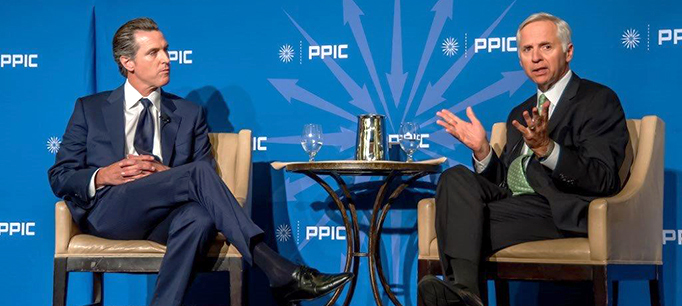
“The world is radically changed,” Gavin Newsom, California’s lieutenant governor, told a Sacramento audience this week.

“We’re competing against billions and billions of people, not just competing against cheap labor now, but against cheap genius,” he continued.

Newsom—who is also a University of California regent and California State University trustee—spoke in a conversation with Mark Baldassare, PPIC president and CEO. PPIC’s new report Will California Run Out of College Graduates? provided the context for the discussion. The report concludes that California will fall 1.1 million college graduates short of economic demand by 2030, if current trends persist.

Newsom said that “there is not a major industrialized nation in the world that is not focusing with intention on radically transforming their education system. One of the remarkable things about California is that we do not have a plan.”

He summed up: “We need goals. And we need to be able to measure those goals. And those goals must emanate from the state itself.”

Newsom was not the only speaker at the PPIC event to use words like “radical” and “revolution” to describe changes needed in higher education.

At a subsequent panel discussion, state assemblymember Catharine Baker said she is concerned that the state is falling short of the workforce needed even now. She noted that there is bipartisan agreement in the legislature that higher education is important but not about the need for major change. “There is a lot more focus on issues around the margins, that is, on how many students are we admitting, what few changes we can make in the community college system.”

Eloy Ortiz Oakley, superintendent-president of the Long Beach Community College District, said, “We almost need a revolution in our system. We started to get there when we were in crisis mode.”

“During the recession, we saw more creativity than ever before in the community college system and we began to focus,” he said. “I fear that post-recession that focus will start to dissipate.”

Hans Johnson, coauthor of the PPIC report and PPIC senior fellow, said the big challenge for the state is replacing the retiring baby boom generation with young, well-educated workers.

“I think there is a very clear path to closing that skills gap,” he said. “We need to have more students going to colleges—especially four-year colleges. We need improve completion rates—that opens up room for more students. We need to improve transfer rates from community colleges to the four-year colleges. And if we do all of those things—and these are all decisions we can make, as policymakers and higher education officials—we can actually close that skills gap.”

Timothy White, California State University chancellor, said CSU can do its part to fill the workforce skills gap—with the help of its educational and funding partners. He called the PPIC report “a very sobering clarion call that is of crisis proportion— not for the CSU or for the University of California, or the community colleges, but rather for California. And I hope we take it with the seriousness that it deserves.”

New Water Laws Address Groundwater, Marijuana

As the California legislative session came to a close, Governor Brown signed more than 20 bills that address different aspects of water policy, ranging from water conservation and measurement to water quality. Two bill packages took important steps toward improving groundwater management and reducing the negative environmental impacts of marijuana farming.

New tools for groundwater management

Our recent report What if California’s Drought Continues? noted that improved management of our groundwater resources is critical to weathering droughts now and in the future. The 2014 Sustainable Groundwater Management Act (SGMA) seeks to ensure long-term viability and reduce over-pumping by setting deadlines for local agencies to develop and implement plans for basin sustainability. Before SGMA, groundwater users in some Southern California basins recognized the need to balance their groundwater use and went through a legal process called adjudication, in which courts determine individual rights to groundwater and appoint an entity to oversee its use. By clarifying pumping rights, adjudication makes it much easier to manage basins. But the time and cost of some adjudications have discouraged the use of this tool in other regions. Two new bills will make adjudication more suitable for managing the state’s groundwater resources:

  • AB 1390 streamlines adjudication by expediting the identification of groundwater use in a basin, giving courts new power to quickly resolve disputes among pumpers, and other procedural improvements. The goal of the bill is to create a more affordable, easier, and faster adjudication process that is applicable to any groundwater basin in the state.
  • SB 226 is designed to ensure that streamlined adjudication doesn’t conflict with SGMA by requiring severely over-drafted basins to comply with its provisions and deadlines regardless of ongoing adjudication actions. The bill also is intended to provide guidance for courts to align adjudications with SGMA requirements such as groundwater sustainability plans and groundwater sustainability agencies.

Marijuana regulation

Another challenge highlighted by the current drought is the impact of marijuana cultivation on our water resources and environment. The State Water Resources Control Board and the Department of Fish and Wildlife (DFW) are running a joint pilot project to address these issues in the North Coast region. The Cannabis Pilot Project evaluates potential policy solutions for reducing the environmental impact of cultivation practices and managing illegal use of stream water for irrigation. The medical marijuana bill package —AB 243, AB 266, and SB 643—creates a foundation for making this pilot permanent and building a statewide program to regulate the impact of marijuana on water and the environment.

For example, AB 243 and SB 643 direct the Water Board and DFW to take statewide regulatory actions that protect instream fish spawning, migration, and rearing from the damaging impacts of marijuana cultivation.

Questions remain about how to fund this new effort, however. The Cannabis Pilot Project is funded for just three years, and covers just a small portion of the state. Additional funding will be required to expand regulations to cover California’s estimated 50,000 marijuana growers. AB 243 proposes a $10 million loan from the state’s general fund to jumpstart the new Bureau of Medical Marijuana Regulation in the Department of Consumer Affairs, but these funds will not support the environmental programs run by the Water Board and DFW. A fee on all marijuana cultivators is the best way to fund these programs over the long term, and the Water Board has authority to establish such fees.

Learn More:

Visit the PPIC Water Policy Center drought resource page

Video: Survey Looks at Taxes and Pensions

As interest groups work to turn their ideas into initiatives for next year’s statewide ballot, the September PPIC Statewide Survey examined Californians’ views in two areas that may be put before voters in 2016: taxes and public employee pension reform.

Mark Baldassare, PPIC president and CEO, and Dean Bonner, associate survey director, presented the findings at a briefing in Sacramento last week.

Among the survey findings:

  • Half of likely voters favor extending the tax increases in Proposition 30 temporarily, but just a third favor making them permanent.
  • There is bipartisan support for raising taxes on cigarette purchases.
  • A majority of likely voters favor changing Proposition 13 to tax commercial properties according to their current market value.
  • Solid majorities of Californians see public pension spending as a problem, and most think voters should weigh in on changes to the system.
  • Most likely voters favor placing new public employees in a defined contribution system, similar to a 401(k) plan, rather than a defined benefits system.

The survey shows that Californians give their state leaders—the governor, legislature, and their own legislators—high approval ratings at the close of the legislative session. Baldassare offered his explanation at the briefing: there was little drama around the budget, the economy’s going well, and very few respondents in the survey mentioned fiscal issues as the most important ones.

Congress, on the other hand fares far less well in Californians’ eyes. Its 17% rating is not only much lower than the ratings likely voters give their state leaders, it is much lower than those of President Obama, Senators Barbara Boxer and Dianne Feinstein, and Californians’ own representative in the US House.

“Congress is a government institution that needs work, according to most Californians,” Baldassare said.

Inspiring Civic Engagement

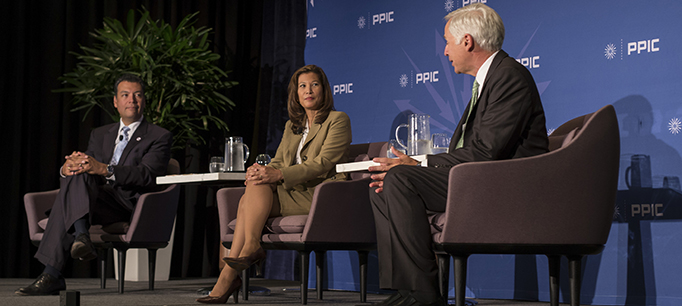
Many eligible Californians don’t register to vote, turnout in statewide elections has reached record lows, and PPIC surveys show many residents are disengaged from state government. What can be done to increase participation in elections and engage residents more broadly in all aspects of civic life? Tani G. Cantil-Sakauye, California’s chief justice, and Alex Padilla, California secretary of state, offered their responses last week in Los Angeles at an event co-sponsored by PPIC and the California Community Foundation.

In a conversation with Mark Baldassare, PPIC president and CEO, both emphasized the contribution schools can—and should—make to civic engagement.

Cantil-Sakauye noted that her teen-agers were taught civics in the second semester of his senior year in high school. “Now, think back where you were mentally in your second semester of senior year,” she told the audience. “Not the best place.”

She described Power of Democracy, a judicial branch initiative that includes Padilla and is an effort to elevate the status of civics education. Rather than focusing on teaching civics as a stand-alone subject, the group helps to integrate it into all school subjects, school projects, and community service. Partnering with Tom Torlakson, state superintendent of public instruction, as well as organizations and school districts, Power of Democracy provides schools the resources to do so, she said.

Padilla and Cantil-Sakauye each described personal experiences that sparked their interest in government and the people who had been influential along the way. Padilla said that after his freshman year at MIT, he returned to Los Angeles and visited his high school government teacher, who told his former student, “You’re 18 years old now. Have you registered to vote?” Then the teacher pulled out a voter registration form from his desk. “He wouldn’t let me leave until I filled it out,” said Padilla. That teacher, Alex Reza, was in the Los Angeles audience at last week’s event.

Cantil-Sakauye said she developed an interest in how decisions are made and who makes them after hearing adults in the Filipino community talk about their frustrations with government. When she was 9 years old, her family lost their home in an eminent domain proceeding. Cantil-Sakauye said her mother went to court and came back feeling “disrespected and humiliated.” Later on, her mother took her to see the pioneering Filipina lawyer, Gloria Megino Ochoa. “My mom threw me an elbow and said, you could do that!”

Video: Senator Boxer Comes to PPIC

In more than 20 years in the US Senate, Barbara Boxer said there have been good changes (more women today) and bad (the “chasm” that divides the parties). But sometimes, despite the gridlock and insults, there is common ground, she told an audience at PPIC yesterday. She and Republican Senator Mitch McConnell found it in teaming up on a multi-year highway bill.

“Working with Mitch McConnell was unexpected,” she said. “We actually hadn’t talked too much in 20 years.” Bringing senators from both parties to an agreement—particularly on how to pay for the bill—was tough. But the bill got the votes. It passed the Senate and is now pending in the House.

Boxer told this story and others in a wide-ranging conversation with Mark Baldassare, PPIC’s president and CEO, that touched on climate change, California water policy, the presidential race, and the nuclear deal with Iran.What’s next? For the record, Boxer says she is not retiring. She’s just not running for Senate again.