Exploring Math Pathways under Common Core

California adopted the Common Core State Standards (CCSS) in math and English in 2010. CCSS describes what students should know in math and English by the end of each grade. These standards also prepare students to be ready for college and beyond. Nearly nine years after its adoption, awareness of and support for CCSS remain strong among Californians. What do we know so far about the reach and effectiveness of this change, particularly in math?

One of the paradigm shifts introduced by CCSS is how math is organized and taught in high schools. CCSS standards are organized into two pathways:

  • Traditional, which follows the standard sequence and includes Algebra I, Geometry, and Algebra II.
  • Integrated, which consists of Mathematics I, II, and III, with each course containing standards from all conceptual categories. For instance, Mathematics I covers topics in numbers, algebra, geometry, and statistics.

Acceleration, which gives students the opportunity to reach higher-level math such as calculus earlier, is possible in both pathways. For instance, a 9th grade student may complete 9th grade math (Algebra I or Mathematics I) and 10th grade math (Geometry or Mathematics II) concurrently. Districts can decide when and how students may accelerate.

During the 2017–18 school year, 54% of districts followed the traditional pathway while 46% percent chose the integrated pathway. Significant and important differences in these choices exist across districts. Districts with more high-need students—low-income students, English learners and/or foster youth—were more likely to adopt an integrated model; districts with more certified math teachers, who are authorized to teach both pathways, were slightly more likely to choose the traditional pathway.
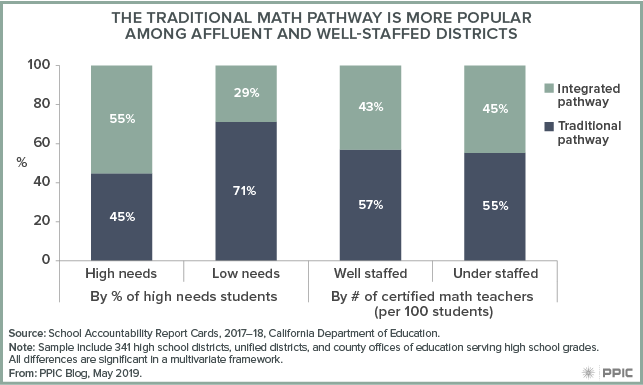
figure - The Traditional Math Pathway Is More Popular Among Affluent and Well-staffed Districts

Does the difference suggest that students in high-need districts may be left behind? Not necessarily. There was no significant variation based on student performance, such as the a-g completion rate. In addition, staffing, which tends to be worse in high-need districts, did not drive most of the differences in those decisions. Other factors, such as district capacity, pedagogical approach, and teaching philosophy may also be at play.

State assessment data does not seem to show any significant difference in student performance based on pathways; however, more formal evaluation is needed. So far, there have been no large scale studies that compare the effectiveness of these approaches. Doing so will require more and better data on a district’s chosen pathway (e.g., the first time these pathways were available) and student outcomes (e.g., postsecondary outcomes)—which the state currently does not collect. The governor’s proposal to create a statewide longitudinal database is a good first step toward building the capacity to evaluate one of California’s signature educational reforms.

Video: Californians and Education

Last week in Sacramento, Alyssa Dykman outlined the key findings from PPIC’s 15th annual survey on Californians and K–12 education, which tracks opinions on educational quality and school funding. This month’s survey was the first ever to be conducted with a fully online methodology.

A strong majority of Californians want Governor Newsom to prioritize K–12 public education, and majorities support many of the governor’s education-related budget proposals—including the expansion of special education and full-day preschool and kindergarten. Solid majorities also support teacher strikes for higher pay.

But Californians have mixed views on charter schools: most say they are an important option for parents in low-income areas, but many express concern about charters diverting funding from traditional public schools.

Other survey highlights:

  • Most Californians think the level of state funding for local public schools is not adequate.
  • More than half of residents across regions say teacher salaries in their community are too low.
  • Majorities of adults and likely voters would vote for a ballot measure that would amend Proposition 13 to create a “split roll” property tax system and direct some of the revenue to K–12 education.
  • Many parents think the goal of K–12 public education should be to prepare students for college—but many worry about the affordability of a college education.

How California’s Digital Divide Affects Students

As the internet becomes increasingly essential for student learning and testing, California’s digital divide threatens to exacerbate preexisting inequities in education.

The good news is that K‒12 schools have largely made the digital transition. In 2018, 90% of California schools met the Federal Communications Commission’s (FCC) minimum threshold for digital learning and had the internet resources necessary to administer the state’s online assessment.

But at home not all students have reliable internet access or a traditional computer, such as a desktop or laptop. Overall, 16% of school-aged children in California do not have any internet access at home, and 27% do not have a high-speed connection, meaning they rely on slower connections like dialup or satellite. In addition, nearly 10% access the internet with a cellular data plan, which usually means slower speeds and suggests they are relying solely on a smartphone or tablet.

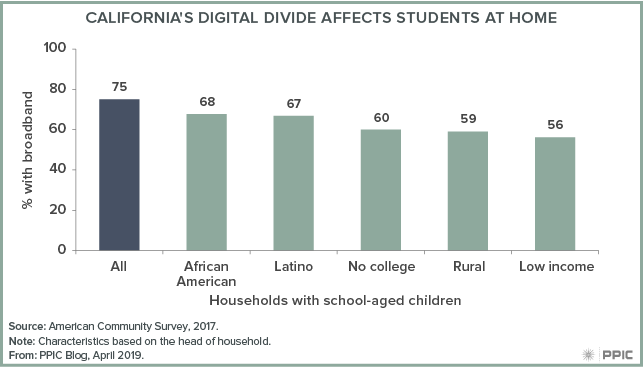
Gaps exist for several demographic groups. For example, 56% of low-income households with school-aged children have broadband subscriptions, compared to 75% of all households with school-aged children.

figure -California’s Digital Divide Affects Students at Home

This digital divide in broadband access at home—known as the “homework gap”—may affect student learning. An analysis by the Pew Research Center found 17% of teens say they are often or sometimes unable to complete their homework due to a lack of reliable internet or computer access, with about a quarter of low-income and African American teens saying this. Another study shows that eighth graders who do not have internet access at home score lower on national exams in reading and math than their peers. Similarly, students without computers at home score lower in their ability to use computers and other digital devices. These factors may worsen the disadvantages faced by lower-income students, who have lower high school graduation rates and lower standardized test scores than their wealthier peers.

While there are discounts available to lower-income families struggling to afford internet access, three in four California households without broadband are unaware of these discounts, according to a Berkeley Institute of Government Studies poll—suggesting that federal and state policymakers can do a better job promoting these programs.

Some districts have developed innovative approaches to address the digital divide. For example, a few years ago Coachella Valley Unified outfitted school buses with Wi-Fi and parked them throughout the district’s rural neighborhoods to serve as mobile hotspots. As more schools embrace digital learning, developing new ways to broaden internet access is key to closing equity gaps and ensuring that learning continues outside the classroom.

Testimony: Special Education Finance in California

Paul Warren, research associate at PPIC, testified today (March 28, 2019) before the Senate Education Budget Subcommittee, as part of a hearing on district financial conditions. Here are his prepared remarks.

The committee asked PPIC to help them understand why district special education costs are rising so quickly.

First, some background. The AB 602 formula provides about $500–600 in state special education funds per student in each district, based on average daily attendance (ADA). The number of students with disabilities in a district does not affect state funding amounts. Each year, that amount is increased by the change in ADA and by a cost-of-living adjustment.

In the PPIC report, Special Education Finance in California, my colleagues and I identified several reasons why AB 602 funding has not kept pace with district costs:

  • Changes in the rate and type of disabilities. We estimated that these changes increased annual district costs by around $1.1 billion. The state formula is currently based on average district costs from the late 1990s.
    • The share of students identified with disabilities increased by 5.7 percent from 2010–11 to 2015–16.
    • Disabilities that are, on average, expensive to address have increased. Autism, in particular, continues to increase as a share of students with disabilities.
  • Growth in preschool for children with disabilities under the age of 5. This population grew about 10 percent from 2005 to 2015. The AB 602 formula does not adjust district funding for changes in this group, as pre-school children with disabilities do not count toward ADA.
  • Higher district salaries since the Great Recession. The large LCFF increases during the economic recovery shaped salary negotiations. But AB 602 did not adjust to the higher costs for special education teachers and administrators.

In a report from last year, Revisiting Finance and Governance Issues in Special Education, we provide two options for modifying the AB 602 formula:

  • Increase AB 602 by the same percentage amount as LCFF funding. This makes sure that state funding for special education increases at the same rate as LCFF.
  • Increase AB 602 by the actual increase in special education costs. This would hold the state share of special education costs constant over time.

We also recommend caution when considering proposals to base state special education funding on counts of students with disabilities. Differences in district identification practices affect the share of students identified for special education services. We found that the county with the lowest rate of students with disabilities reported that about 8.8 percent of students were in special education. In contrast, the county with the highest rate reported that about 17.6 percent of students were in the program. This disparity strongly suggests that district practices affect district caseloads, and basing state funding on the number of students with disabilities could create financial incentives to identify more students.

Our two options would avoid this identification problem while better aligning state funding for special education with LCFF and district costs.

Thank you for the opportunity to discuss these important issues.

Video: A Conversation with San Francisco Mayor London Breed

As part of our Speaker Series on California’s Future, PPIC invites elected leaders from across the political spectrum to participate in public conversations. The purpose is to give Californians a better understanding of how our leaders are addressing the challenges facing our state.

As a mayoral candidate, London Breed promised to focus on homelessness and affordable housing—two major challenges for San Francisco and for California as a whole. Not surprisingly, these issues took center stage in her conversation with PPIC president Mark Baldassare earlier this week.

“It is no secret that homelessness is one of the biggest challenges that’s facing our city, and that also comes with the need to build more housing,” said Breed. “I’ve been on a mission! I hired a housing delivery director—someone whose sole purpose is to cut back on bureaucratic red tape that gets in the way of building housing.”

Breed stressed the need for new approaches to behavioral health issues that complicate homelessness: “We have to think about this challenge differently and we have to make hard decisions.” For example, she favors strengthening conservatorship laws. She acknowledged that conservatorship for mentally ill adults is “very controversial.” But, she added, “our jails are being used as mental health facilities, and that’s not a solution.” She is also pushing for safe injection sites, which can provide substance abuse treatment when people are ready to seek it. “Treatment on demand is something we have to start looking at.”

The mayor is also committed to trying new strategies in other policy areas, such as police-community relations and education. “I do think we need to take some risks and propose some things that may make people uncomfortable but ultimately may help us to get the kind of results that will . . . make a difference.”

But Breed also emphasized accountability. Explaining why she wants to hire a mental health director, she said, “We’re a little bit all over the place right now and I want us to address those issues, organize things a lot better for the purposes of helping people.” In this and other areas, she said, “I want to see us make the right investments.”

Video: A Conversation with Chief of Staff Ann O’Leary

As the Newsom administration lays out its initial plans, PPIC invited chief of staff Ann O’Leary to discuss some of the governor’s top priorities. In a wide-ranging discussion with PPIC president Mark Baldassare last week, O’Leary identified the “cost crisis” in California as one of the main challenges that Governor Newsom plans to address.

“By ‘cost crisis,’ I mean how do we make sure that people in California can have affordability and the opportunity to really take advantage of the California dream?” O’Leary said. “I think too many people in California are really seeing that slip away. They’re not able to afford homes, they’re not able to afford child care, and they’re not able to pay for college for their children as they grow older.”

O’Leary pointed out that confronting this cost crisis would take many forms, such as taking on health care affordability, investing in “cradle to career” education, and addressing housing production and rising rents.

She underscored that the governor’s first proposed budget reflects his vision for promoting affordability and opportunity while ensuring the state’s long-term financial stability. Newsom’s plan includes a mix of one-time and ongoing funding as well as a robust rainy day fund, but “we also go further than that. We have a reserve fund for the safety net, and we also look at how we could use some of the surplus to pay down pension liabilities.”

The governor has also focused on other key challenges—for example, responding to wildfires and tackling the unmet need for safe drinking water in many parts of the state.

On wildfires, O’Leary noted that the governor wants to “make sure that we’re continuing with those recovery efforts to help communities that have been harmed, but also to prepare for future wildfires.” On drinking water, O’Leary said that the governor has already worked with the legislature to provide $20 million in emergency funding to address this issue.

Navigating the PG&E bankruptcy filing is another immediate priority. O’Leary said that over the next 60 days the governor’s team would be creating a roadmap for the state to “protect wildfire victims, protect employees who are out there every day trying to make sure we’re safe, and make sure fundamentally that we have safe and affordable power and that we’re meeting our clean-energy goals.”

O’Leary also discussed the federal-state relationship and how the governor plans to manage it. While pointing out that the state and federal governments need to work together as much as possible, O’Leary also underscored that California must stand up for its values when fundamental disagreements exist, especially on issues such as immigration and family planning. “These are differences of opinion. And it’s a needle we have to thread, but we’re going to do our best.”

Declining K–12 Enrollment Forces Major Budget Cuts in Many Districts

The teacher strikes in Los Angeles and Oakland reflect the fiscal stresses facing many school districts across the state. Rising pension and health care costs account for some of this pressure. For many districts, declining student enrollment is another factor.

Because state funding is based on average daily attendance, falling enrollment leads to lower state funding levels. Significant, sustained declines require districts to make difficult decisions to stay afloat financially. Since an average of 82% of K–12 spending goes to salaries and benefits, downsizing often means reducing teachers and administrators—or possibly closing a school.

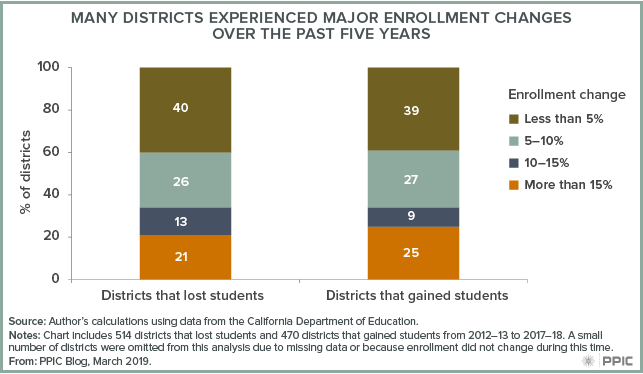
Over the past five years, overall K–12 enrollment in California increased by only 0.1%, or 6,600 students out of the more than 6.2 million attending public schools. This stable picture masks significant variation across districts. Roughly half of the state’s nearly 1,000 districts experienced enrollment losses, while the other half grew over this time. In many cases, the change was small: about 40% of districts experienced a net change—gain or loss—of less than 5% from 2012–13 to 2017–18.

However, the majority of districts saw an enrollment change of more than 5%. Indeed, 107 districts lost more than 15% of students. These districts were generally small: the average school had 700 enrolled students in 2012–13 and lost more than 170 students over the five-year period. In some cases, these large enrollment losses were associated with the closing of a charter school. Many of these districts, though, have only one school, and large percent reductions in enrollment require significant cuts in teachers, administrators, and other staff.

Many Districts Experienced Major Enrollment Changes Over the Past Five Years

Many large districts also lost significant numbers of students over the past five years. In Los Angeles County, for instance, 61 of 79 districts experienced enrollment declines—including Los Angeles Unified, which lost 34,000 students (a 5% decline) and Long Beach Unified, which lost almost 7,600 students (9%). In addition, seven districts with more than 10,000 students lost between 10% and 15% of enrollment. For a district of 10,000 students, losing 10% of enrollment translates into 1,000 fewer students—equal in size to two typical elementary schools. For example, Montebello Unified saw a dramatic 13% decline, losing more than 4,000 students during the five-year period.

Declining student enrollments can be due to a wide range of factors—changes in charter school enrollments, decreasing birth rates, or families moving away, among others. Laying off teachers and adminsitrators is painful—and closing schools is a particularly wrenching topic, as parents value their local schools.

Governor Newsom’s proposal to help districts with rising pension costs may relieve some—but not much—of the financial pressure for districts. K–12 financing in California is also affected by voter-approved initiatives that make significant school funding increases unlikely in the near term. There’s no easy solution, but unless these dynamics change, districts will need to learn to adjust to long-term enrollment and revenue reductions or face the risk of insolvency.

Video: Californians and Their Government

As efforts are gearing up in Sacramento to craft a new state budget, a majority of Californians say they approve of Governor Gavin Newsom’s proposed spending plan. Californians also express optimism about the general direction of the state. These and other key findings of the latest PPIC Statewide Survey were outlined by Alyssa Dykman at a Sacramento briefing last week.

The governor’s budget proposal, which calls for increased funds for education and health and human services, garners support from 70% of California adults. More than three-quarters approve of two key components of the proposal: 77% favor allocating $1.8 billion to expand pre-kindergarten and early childhood programs and facilities, and 78% support an $832 million funding increase for public colleges and universities.

The survey also asked whether Californians believe the state is going in the right direction. A majority of adults (55%) approve of where California is headed. This contrasts with less than a third (30%) saying things are going in the right direction for the country. In addition, a record-low 25% of Californians say that President Trump and Congress will be able to work together and accomplish a lot this year.

Other survey highlights:

  • Asked what the most important issue is for the governor and legislature to address in the coming year, more Californians name immigration and illegal immigration (15% adults) than any other issue.
  • Most Californians (67%) are optimistic that Governor Newsom and the legislature will be able to work together and accomplish a lot in the next year.
  • A strong majority of California adults (64%) say President Trump and Republicans in Congress were primarily responsible for the recent partial shutdown of the federal government. Only 24% say Democrats in Congress were responsible.
  • Only about a quarter of Californians (27%) say the situation with illegal immigration across the US-Mexico border is a crisis.

Video: A Conversation with California’s Legislative Leadership

When Toni Atkins, President Pro Tem of the California State Senate, sat down to talk with PPIC president Mark Baldassare last week, she brought along a list of pressing issues. Asked to name the top two issues facing the state, she led off with housing: “The growing crisis around the lack of housing supply for all levels of Californians is one of our most critical issues.” Next came climate change and its effects across California. And then she added a third issue: water sustainability. In reality, she said, “there is always a list of issues and challenges that we are working on in California.”

Despite this long list, Atkins was optimistic about the legislature’s chances of working productively with Governor Newsom. “It’s early, but I would say that what I appreciate and enjoy about Governor Newsom is he really is a policy wonk at heart.” She added that while Jerry Brown and Gavin Newsom share many priorities, the two have very different styles. “Jerry Brown proposed a budget and he only wanted a few things,” while Governor Newsom “has thrown everything out there.”

After noting that it will be interesting to see how the legislature approaches this year’s budget process, Atkins highlighted the governor’s focus on homelessness and mental health issues and his commitment to early childhood education—which, she added, has been “a huge driving issue for the legislative women’s caucus.” She expressed particular interest in the governor’s proposal to “take juvenile justice offenders out of CDCR—the California Department of Corrections and Rehabilitation—and into more of a health/social services arena.”

Shifting from the state budget process to the ongoing drama over the budget—and border wall—at the federal level, Baldassare asked Atkins about the state government’s response to what is happening in Washington, DC. “You know, I’m so glad to be in California,” she replied. Citing the state’s diversity and the policies that foster it, she said that “to have that attacked in many ways at the federal level means all of a sudden you’ve got California really promoting state’s rights, to protect our policies, our values, and things that we hold dear.”

Atkins tended to be optimistic about even the thorniest issues—such as forestry management, building more housing, and water sustainability. Speaking about the cluster of issues related to climate change, she said, “Maybe the result of these catastrophic fires, and floods, and mudslides—maybe that is the way we’re now able to have a conversation we couldn’t have five years ago, before it was a crisis.” But she added that in order to move an agenda forward, “you’ve got to still have all the stakeholders at the table.”

More generally, Atkins stressed the importance of representing all Californians, regardless of party: “I think we have work to do together.”

Video: Academic Progress for English Learners

More than 40 percent of students in California’s public K–12 system speak a language other than English at home. Almost half of these students are considered English Learners (ELs), in need of language and academic support to succeed in school. In middle and high school, ELs face the dual challenge of attaining fluency in English and working toward a high school diploma.

At a lunchtime briefing in Sacramento last week, Laura Hill—a senior research fellow at PPIC—and Megan Hopkins—an assistant professor at UC San Diego—outlined the findings of a new report on two distinct types of EL students: long-term ELs, who have been in US schools for several years without being reclassified as fluent in English, and late-arriving ELs, who first enroll in the district in grade 6 or higher. The authors looked at the impact of a school’s language environment on academic progress and examined trends in English language development (ELD) courses.

The report focused on the state’s two largest school districts, Los Angeles Unified School District (LAUSD) and San Diego Unified School District (SDUSD). Together, they enroll about 14% of the state’s EL population—and about 4% of the EL population in schools nationwide. As Laura Hill put it, “It’s a big deal to be able to study in these two districts.”

How might the language mix among students at a school be associated with academic outcomes—both for both fluent English speakers and for ELs? The report finds that the academic outcomes of native or initially fluent English speakers was not related to the percentage of EL students at a school. The evidence is mixed on the relationship between the percentage of ELs in a school and the academic performance of ELs.

Megan Hopkins outlined key findings on ELD courses. She noted that in recent years the rate of EL students receiving ELD instruction has declined in Los Angeles and risen somewhat in San Diego. These trends may be influenced by district-level factors; they are important because, in both SDUSD and LAUSD, long-term ELs who do not have ELD instruction experience slower growth on statewide English language arts tests. These findings suggest that efforts should be made to support ongoing ELD and other language supports, but Hopkins noted that ensuring access to core academic content is also important.

More generally, this study underlines the importance of understanding the factors that contribute to the progress and struggles of California’s large EL population—so that schools can help all ELs advance linguistically and academically.