UC May Struggle to Meet Transfer Requirement

Governor Brown’s May budget proposal withholds $50 million from the University of California (UC), which must undertake a series of reforms to restore the funds. One requirement—the result of a deal made during the 2015 budget process—is that UC meet its fall 2017 target of enrolling only two new in-state freshmen for every in-state transfer student, both systemwide and at each campus (except Merced). In 2016, the system enrolled 2.3 freshmen for every transfer student. The 2:1 target is intended to increase the number of transfer students served by UC. But reaching this freshmen-to-transfer ratio while responding to growing freshmen demand could prove very difficult this year and in the future.

UC has made progress in enrolling more transfer students but has not come closer to meeting its target ratio. In the last year, UC enrolled almost 2,000 more transfer students, a 13% increase and the biggest jump in more than a decade. However, UC also enrolled more than 5,000 additional freshmen compared with the previous year (a 17% increase)—leaving the freshmen-to-transfer ratio slightly higher.

In recent years, demand to attend UC has increased much faster for freshmen than for transfers. This year, there are more than 3.5 freshmen applicants for every transfer applicant. Since 2011, freshmen applications have increased by 31%, while transfer applications have declined by 1%.

Can UC attain a 2:1 ratio while responding to growing demand for freshmen slots in 2017? To do so, the system would need to draw more transfer students from a smaller applicant pool—especially if officials also plan on increasing freshmen enrollment. Compared to last year, 1,000 fewer in-state transfer students and 6,000 more in-state freshman applied. This problem is particularly acute at Santa Cruz and Riverside, which enrolled more than 3.5 freshmen for every transfer student in 2016 and may not meet the 2:1 goal this year.

UC may also have trouble meeting its target freshmen-to-transfer ratio in the future. If the number of freshmen applicants keeps increasing while the number of transfer applicants stagnates, UC may have to turn away more in-state freshmen applicants to meet its goal. To increase the quantity and quality of future transfer pools, the system is working to expand existing transfer agreements between UC campuses and nearby community colleges. In addition, UC’s new Transfer Pathways program helps prepare community college students in the most popular majors to transfer as juniors to any UC campus. The new program could start showing results in the next couple of years.

Though transfer demand at UC is sluggish, transferring is still a popular path for students elsewhere. California State University (CSU) has seen 14% growth in transfer applications since 2011 and, in 2016, received over 106,000 transfer applications (about three times as many as UC). UC could look to a recent success at CSU, which worked with the California Community Colleges to develop the Associate Degree for Transfer (ADT). Like the Transfer Pathways program, the ADT prepares community college students for junior-level entry at any CSU campus. But the ADT goes further by guaranteeing that students will only need 60 more units at CSU to graduate from their major. It also guarantees students admission to the CSU system and offers priority consideration at a local CSU campus. The ADT is quickly becoming a popular option, with 30,000 ADTs awarded in 2015–16 alone. Of course, students are considering other factors, such as cost, distance, eligibility, and availability when choosing where to apply for transfer. Guaranteed pathways to a degree and priority consideration in admission, however, are likely to entice potential transfers.

It will be difficult for UC to achieve its 2017 transfer requirement, especially at Santa Cruz and Riverside—putting into question whether the system will receive the $50 million withheld in the governor’s budget proposal. With increasing demand for freshmen slots, UC must work to increase the pool of transfer applicants to meet both the 2:1 goal and freshmen demand going forward.

Learn more

Read the report Higher Education in California: Expanding College Access
Visit the PPIC Higher Education Center

The Growth of Cal Grants

The Cal Grant program is the primary program for providing tuition assistance and financial aid to California’s college students. It has allowed California to maintain access to college for low-income students during a time of rapid tuition increases. The program has grown significantly since its inception in 1955 and now serves more than 300,000 students at an annual cost of around $2 billion.

State law protects Cal Grant recipients from tuition increases at UC or CSU: when tuition rises, so do these students’ Cal Grants. Consequently, as tuition has increased and enrollment of low-income students has expanded, the program has grown rapidly. Next fall, tuition is scheduled to increase by $280 per year at UC and by $270 per year at CSU. In addition, UC, which has enrolled 7,400 new undergraduates in each of the last two years, plans to enroll an additional 2,500 in the fall of 2017‒18, the largest three-year increase in seventy years. CSU has added around 50,000 additional students over the past five years. The expansion of Cal Grants has drawn the attention of the governor. He noted in his May budget revision that “rising Cal Grant costs from tuition hikes will also limit the state’s ability to increase General Fund support in the future.”

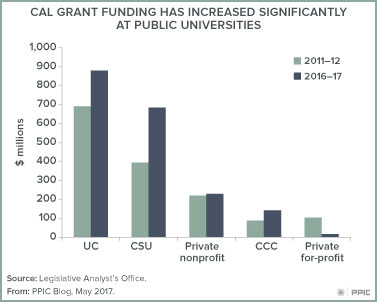
Figure: Cal grant funding has increased significantly at public univerisities

Nearly all of the Cal Grant funding increases have gone to students attending public institutions. CSU has seen a 75% increase in Cal Grant funds since 2011‒12, while the community colleges and UC have received a 61% and 27% increase respectively. Private nonprofit colleges, on the other hand, have seen their Cal Grant funding stagnate. The governor’s budget revision acknowledges this by reallocating $8 million that had been targeted to UC and CSU in his January budget proposal to non-profit private Cal Grant funding. These funds will prevent a planned cut to the maximum award for students attending a nonprofit private college.

By contrast, for-profit colleges have seen their Cal Grant funding decrease substantially over the past five years. The 2012‒13 budget introduced restrictions on access to state Cal Grants which affected many for-profit colleges. To some degree, for-profit colleges satisfy an unmet need for access to higher education for non-traditional students. But investigators have found that many of these colleges engage in predatory marketing and lending practices—targeting vulnerable students, making false statements regarding job placement, and overestimating the value of the degrees they provide. To address these issues the state established new institutional eligibility standards for Cal Grants. To be eligible, a higher education institution must now have a minimum graduation rate of 30% and a loan default rate of less than 15.5%. The 2012‒13 budget also cut the maximum award for a student attending a for-profit college from $9,708 to $4,000. These regulations have saved the state nearly $100 million since 2011‒12, reduced by more than half the number of for-profit colleges eligible for Cal Grants, and ensured that low-income and first generation students were not taken advantage of by higher education institutions that did not serve their economic interest.

Cal Grants are an essential tool for improving the economic mobility of the state’s neediest residents. They also allow the state to reduce the burden of federal loans on young Californians. Maintaining Cal Grants for high performing colleges— public and private—will improve access to college for all Californians.

Learn morEVisit the PPIC Higher Education Center

Students Choose College with Future Jobs in Mind

Throughout California and the nation, hundreds of thousands of high school seniors are currently making decisions about where to attend college. An increasingly important part of that decision is based on career opportunities. PPIC’s statewide survey on higher education finds that the vast majority of Californians (77%) believe the state’s higher education system is very important to the economic vitality of the state.

Students’ career goals play an important role in the decision to go to college at all. According to an annual nationwide survey of freshmen conducted by UCLA’s Higher Education Research Institute, the vast majority of students agree that a very important reason to go to college is “to be able to get a better job” (85%) and “to get training for a specific career” (76%). A record-high 60% of students say that a very important consideration in choosing a college is the ability of its graduates to obtain good jobs.

Students are right in thinking that college can give them economic advantages. Using data from the 2014 and 2015 American Community Survey, we examine some basic labor market outcomes for recent college graduates (ages 22 to 29) in California. The advantages in terms of employment and wages are clear. Young adults with a college degree are much less likely to be unemployed and, on average, earn far higher wages.

Of course, not all majors are equal when it comes to career opportunities. Among young adults with a bachelor’s degree, wages vary widely by major. Among the ten most popular majors for young adults in California, the most remunerative major is computer and information sciences; young workers with those degrees earn more than twice as much as young workers who majored in psychology. But even among those paid least, wages are still substantially higher than those of less educated workers.

Students attend college for many important reasons beyond economics. But because career opportunities are an important consideration for most, state policymakers and higher education institutions should seek ways to provide students with accurate and meaningful information about labor market outcomes by college and by major. The American Community Survey does not provide information for specific colleges nor for community college certificates, but public colleges in California can link student records with wage records from the Employment Development Department. For example, California’s community colleges have created a “Salary Surfer,” which offers useful information on wages for students contemplating different career paths and provides a good model for other colleges to follow.

The Growth of College Promise Programs

A majority of Californians believe that college affordability is a big problem for the state, according to the PPIC Statewide Survey. Low family incomes and the high cost of living have made it difficult for many students to pay the full price of college. This is true even though California’s public colleges and universities have some of the lowest tuition levels in the country and the majority of community college, UC, and CSU students receive grants to cover the cost of tuition. Policymakers have taken notice of the public’s concerns.

Many local governments, school districts, colleges, and business communities have been addressing the issue of access and affordability through “promise programs.” The “promise” label has been adopted to represent a wide range of programs that share at least two specific characteristics: they are limited to individuals in a particular geographic area, such as a city or school district, and they provide some level of financial support for postsecondary education. Nearly 80 promise programs have been launched nationwide since 2001. In California, according to WestEd, 23 of these programs have been created since 2008—13 of them in the past two years.

The most well-known California-based promise program is the Long Beach Promise, which offers all public school students in the district a tuition-free first semester at Long Beach Community College. It also guarantees admission to Long Beach State University for students who complete required college preparatory courses with the necessary grades.

College promise programs often couple financial incentives with extensive outreach to middle-school students and improved student services like tutoring and counseling. In California, the vast majority of these programs are focused on getting students to enroll in community colleges—most offer one semester of free community college tuition and do not provide enrollment guarantees to a four-year college.

While it’s important to ensure that students who might not otherwise consider college be given incentives to attend, the state’s biggest challenge is ensuring that college students stay in school and earn a degree or certificate. Only about half of California community college students receive an associate degree or certificate, transfer to four-year schools, or complete 60 transferable units within six years of enrolling. There is some anecdotal evidence that promise programs improve college-going rates, but they do not seem to boost college completion. In order to improve completion rates, programs may need to provide support services for participants who have entered college.

More generally, the wide range of program designs makes it difficult to assess their effectiveness—even within California, promise programs have different residency requirements, eligibility criteria, grades of entry (middle school vs. freshman year of high school), financial awards, support services, and levels of financial sustainability. Defining the basic elements of promise programs and developing effective standards for program design and implementation will help ensure their future success.

Learn more

Read the PPIC Statewide Survey: Californians and Higher Education
Visit the PPIC Higher Education Center

More Students Completing College Prep Courses

Over the past few years more school districts have made college preparatory courses mandatory for high school graduation. These districts have aligned their graduation requirements to the CSU and UC a-g sequence in an effort to make more students college ready. Some of these districts include Los Angeles, Oakland, San Francisco, San Jose, Sonoma Valley, and Vallejo City Unified; the East Side Union High School District in San Jose; and the San Diego Unified, Carlsbad Unified, and Sweetwater Union High School District in San Diego County. Most of these requirements are too new to evaluate, but as more districts make this change, it is important to understand the potential impact. A PPIC report on San Diego Unified found that about 10 percent more students would become eligible to apply to UC and CSU because of the requirement.

The a-g sequence is a set of high school courses required for admission to UC and CSU. The content is rigorous and broad, designed to provide students with a solid foundation of general knowledge. It covers seven different subject areas: (a) history/social science, (b) English, (c) mathematics, (d) laboratory science, (e) foreign language, (f) visual and performing arts, and (g) college-preparatory electives; it includes a total of 15 year-long courses or 30 semesters. These courses are viewed as more rigorous than standard high school courses, as they must meet the criteria developed by the UC’s Board of Admissions and Relations with Schools (It is possible that a non-a-g course is equally rigorous but has simply not undergone a-g approval).

The new a-g graduation requirements have raised concern that many students would be unable to meet them—the reform designed to prepare more students for college might result in lower high school graduation rates. Given this concern, most a-g aligned districts require that students earn a D or higher, which is lower than the UC and CSU requirement of a grade of C or higher.

As it turns out, more students are meeting the a-g requirements with a C or higher. Over the last 10 years there has been an increase of 48% in those meeting the requirements—or 60,000 more high school graduates—with 43% of the class of 2015 doing so.

As more students complete the a-g sequence, the UC and CSU systems receive more applications and admit more students. Between 2011 and 2016, 23% (or 54,383) more Californians applied to UC and CSU, and the systems admitted 20% (or 33,557) more California applicants. However, both systems still limit or deny access to some qualified students. In the 2014‒15 school year, UC redirected 10,688 eligible California students to UC Merced―they had been denied admission to other campuses―but only 195 actually enrolled. The following year, the CSU denied over 17,000 eligible California students, which amounts to almost 55% of denied applicants.

Improvements in college preparation among California’s high school graduates is great news. The challenge is to ensure that our colleges and universities are able to accommodate the increase in demand that comes with it.

Learn more

Read the report College Readiness in California: A Look at Rigorous High School Course-Taking
Visit the PPIC Higher Education Center

Can Mandatory College Entrance Exams Boost College Access?


This post is part of an occasional series examining how California can learn from policies in other states.

California ranks 47th out of the 50 states in the proportion of recent high school graduates that attend a four-year college. There are big recognizable barriers to attending a four-year college, such as cost. However, there are also smaller barriers—like taking a college entrance exam such as the SAT or ACT—that can keep students from even being eligible for entry to a four-year college.

Policy: Mandatory College Entrance Testing in High School

Several states have recently instituted statewide college entrance exams for high school students through allowances in the federal Every Student Succeeds Act (ESSA), which mandates that states test their students for accountability purposes. The ESSA allows states to use college entrance tests as their high school tests. Students in states that use college entrance exams have one less hurdle to college eligibility, as well as experience taking the test and a signal of their level of college readiness. These benefits could help students make their way to a four-year college. Does the policy work?

Policy Impact

Because many states are only recently requiring a college entrance exam, there has not been enough time to analyze long-term trends. However, a 2015 study by Daniel Klasik evaluates the college-going behavior of students in three states (Illinois, Colorado, and Maine) that have long required all students to take national college entrance exams in high school. The study shows that statewide college enrollment may not necessarily increase, but students may have enrolled in different types of institutions than they otherwise would have. In Illinois and Maine the entrance exam policy was associated with a shift in enrollment away from public two-year colleges, which generally don’t require entrance exams; Illinois saw increases in four-year college attendance. Students in Maine and Colorado were more likely to enroll in institutions that required entrance exams for admission. All three states saw a positive impact on attendance at private four-year colleges.

Lessons for California

California currently uses the Smarter Balanced Assessment Consortium (SBAC) tests, which students take in grades 3-8 and 11. Of the fifteen states in SBAC, six use a college exam for federal accountability for their high schools and another three states require (and pay for) all students to take a college exam in addition to their normal state test.

The trend is catching on in California. Right now only 60% of students take the SAT, but several California districts are offering the test free to all students. In fact, Long Beach Unified School District recently asked the state if it could replace the SBAC test with the SAT, citing similar schoolwide accountability scores and the additional college-going benefits. The state declined, citing concerns about alignment with the Common Core State Standards, the ability of the SAT to accurately assess lower-performing students, and accommodations for students with limited English proficiency or learning disabilities.

But mandatory college entrance exams could remove a barrier to college entry for California students. As we have examined in prior research, the SBAC tests already link high school testing to college readiness at the California State University (CSU) and some community colleges through the Early Assessment Program. However, the University of California and many private schools still require a college entrance exam score. And while CSU does not require an entrance exam for all students, it does require an ACT or SAT score for students with GPA that is below 3.0 and for those applying to some impacted campuses or majors.

A statewide entrance exam program may not solve all of California’s enrollment issues—in part because California’s master plan limits entry to public universities and many campuses are not currently able to accept all qualified applicants. California could still benefit if the policy increases enrollment at four-year private schools, as students starting at four-year institutions are generally more likely to obtain a bachelor’s degree than those who start at a community college. In a state that is facing a 1.1 million degree gap by 2030, removing barriers to college entry is an important step toward producing more college graduates.

Video: Top Goals of Higher Education Leaders

California’s higher education system is not keeping up with the economy’s changing needs, PPIC research has shown. Falling behind in creating a skilled workforce could curtail economic growth, limit economic mobility, and increase inequality in the state. The leaders of the California Community Colleges (CCC), California State University (CSU), and University of California (UC) are essential in the effort to increase the number of educated workers, because the vast majority of the state’s college students attend public colleges and universities.

Hans Johnson, director of the PPIC Higher Education Center, summarized this research, and the three leaders of the higher education system sat down last week with Mark Baldassare, PPIC president and CEO, to talk about their goals before a large Sacramento audience.

The first question: What are your top goals in the next decade?

Eloy Ortiz Oakley, CCC chancellor, said it is a critical time for the 113-campus system. “We connect with so many Californians at a time when the economy is changing before our eyes, and the default to get into the workforce is no longer a high school diploma. Some sort of post-secondary credential is essential. That is our focus.”

He said he is working with the other higher education branches and the K–12 system to integrate them into “one public system of education, not four separate systems.”

Timothy White, CSU chancellor, had a similar focus on results. “Our number -one priority in the years ahead is to improve the success rates of our students,” he said, adding that just 20 percent of CSU students earn their degrees in four years. He said he wants to make sure CSU students have access to courses when they need to take them, as well as sufficient faculty and academic support.

Janet Napolitano, UC president, said, “My vision is that the University of California remain the top public university in the world.” Citing the recent growth in enrollment of in-state students, she said that sustaining academic excellence, increasing diversity, and producing students who will be the next generation of California’s leaders are all key parts of this vision.

Learn more

Visit the PPIC Higher Education Center

Testimony: Ensuring That More Students Succeed in College

Hans Johnson, director of the PPIC Higher Education Center and PPIC senior fellow, testified before the Assembly Budget Subcommittee Number 2 on Education Finance in Sacramento today (March 9, 2017). Here are his prepared remarks.


Thank you for the opportunity to testify this morning. My name is Hans Johnson and I am the director of the Higher Education Center at the Public Policy Institute of California. PPIC is a nonpartisan policy research organization and does not take positions on legislation. My comments are based on research we have conducted at PPIC on California’s higher education system.

Providing affordable higher education opportunities for all Californians, especially those with limited resources, is essential if we are to realize the benefits of higher education for our state and its residents. Higher education is not only the single best predictor of an individual’s wages and income, but also the strongest determinant of a society’s economic well-being. PPIC has estimated that California’s colleges and universities are not producing enough bachelor’s degrees and will fall 1.1 million degrees short of economic demand by 2030 unless we improve access to and completion in our higher education systems. While economic gains are strongest for workers with at least a bachelor’s degree, recent PPIC research has also shown strong gains for many—but not all—students who complete vocational programs in the state’s community colleges.

One of the central challenges facing higher education today is ensuring that college serves as a ladder for economic and social mobility. This challenge is especially acute in California, where 60% of high school students are identified by the California Department of Education as socioeconomically disadvantaged (meaning they are eligible for free or reduced-price lunch or come from a family in which neither parent has graduated high school). To close the workforce skills gap, California needs to find ways to improve college completion among students from underrepresented groups, including Latino, African American, low-income, and first-generation students.

The good news is that, compared to other states, California’s public colleges and universities enroll a diverse population. Recent research by the Equality of Opportunity Project shows that California’s public universities enroll more low-income students than comparable colleges in the rest of the country. For example, among elite colleges, UCLA ranks first in the nation in the share of students from low- and middle-income backgrounds. Among all large public universities, Cal State Los Angeles ranks 2nd (after City College of New York) in economic mobility, propelling students from lower-income families into middle- and upper-income groups.

The challenge is ensuring that even more students succeed in our higher education systems. The University of California has an excellent track record of graduating low-income and underrepresented students, and California State University has made significant progress in improving graduation rates for all groups. But graduation gaps remain at both institutions. CSU has developed a new and ambitious graduation initiative that would substantially increase graduation rates and completely close graduation gaps by 2025. However, neither institution has been able to fully enroll all qualified applicants. In recent years, thousands of qualified Californians—both freshmen and transfer applicants—have been turned away from UC and CSU due to a lack of funding.

Of the state’s three systems of public education, our community colleges best represent the diversity of young Californians. The state’s community colleges provide higher education opportunities for almost two million students, a majority of whom are from low-income families or other underrepresented groups. However, far too many students who enter community colleges do not succeed: most never transfer to a four-year college or earn a degree or certificate. Hundreds of millions of dollars have recently been invested in efforts like the Basic Skills Initiative (BSI) and the Student Success and Support Program (SSSP) to improve student outcomes at California’s community colleges. These and other efforts—such as Guided Pathways, a new initiative to help students establish clear objectives and provide support to achieve their goals—hold a great deal of promise for improving student outcomes.

Expanding access to our public universities and improving outcomes throughout our higher education system will almost certainly take more resources. But using current and new funding to improve student outcomes in the most efficacious manner possible must be a high priority. Better coordination between UC, CSU, the community colleges, and our K–12 system can be a cost-effective way of providing students with a seamless pathway from high school to a higher education degree or certificate. Improving access and programs, including financial aid and student support services, to students with the most need can also help reduce gaps in educational attainment and economic success. The role of higher education officials and state legislators is to ensure that resources are spent on programs that really work for students. PPIC is already working on a number of projects that focus on improving student success, and we look forward to continuing to contribute to such efforts.

For-Profit Colleges Face an Uncertain Future

California’s private for-profit colleges are in flux now that the US Department of Education has parted ways with the Accrediting Council for Independent Colleges and Schools (ACICS)―one of the largest for-profit accreditation agencies. Former education secretary John B. King Jr. based his decision to reject ACICS’s bid to continue overseeing hundreds of colleges nationwide on findings that ACICS was allowing colleges such as ITT Tech and Corinthian Colleges (known as Everest College in California) to keep their accreditation despite very low graduation rates and allegations of fraud and predatory practices.

This decision—which is being appealed by ACICS—is important because without accreditation, colleges cannot receive federal Pell Grants and student loans. ACICS-accredited schools across the country received $4.76 billion in federal student aid in 2015. Even though these schools have 18 months to gain accreditation through other agencies, some fear they will not meet the deadline since gaining accreditation is a lengthy process. Without accreditation, colleges may be forced to shut down, which could affect up to 600,000 students nationwide.

How might this decision affect students in California? The most recent enrollment data from the Integrated Postsecondary Education Data System and the Bureau for Private Postsecondary Education indicates that campus closures would not have a major effect on overall student enrollment. (This data is from 2014, so to get closer to what for-profit enrollment looks like today, I subtracted enrollment at colleges that have closed since then: Brooks, Everest, Heald, International Academy of Design and Technology, ITT Tech, Sage, TransWestern Truck Driving School, Westwood, and Wyotech.) In California, ACICS oversaw 53 campuses, including Le Cordon Bleu College of Culinary Arts and Kaplan College (which was recently acquired by Brightwood College). In total, 26,478 students attended ACICS colleges; this number represents 11.1% of for-profit college enrollment and only 1.1% of California’s total postsecondary student population.

However, the 26,500 students who could be displaced by campus closures may face difficult decisions. These students have several options: they could transfer to another college, apply to have their loans forgiven by the federal government, or apply to the state student tuition recovery fund for reimbursement. But none of these options are perfect. Community colleges that accept for-profit students may not accept all of their credits. Enrolling in another for-profit carries the risk that it will close, too. Students who apply for federal loan relief may experience long waiting periods, and there is uncertainty about whether this relief will continue. At the state level, the student tuition fund may not refund all of a student’s debt.

It is possible that the Trump administration will loosen for-profit regulations, which may forestall additional campus closures. But given the uncertain future of this sector, along with low graduation rates and high levels of student debt at many for-profit colleges, students may want to find alternative programs in the public and private not-for-profit sectors.

Learn more

Visit the PPIC Higher Education Center

Californians Favor Higher Taxes over Higher Tuition

After six years without tuition increases, California’s public universities are considering proposals to modestly raise tuition for California residents. The University of California (UC) has proposed increasing systemwide tuition and fees for undergraduates by $336 to a total of $12,630 for the academic year. The California State University (CSU) has proposed increasing in-state student undergraduate tuition by $270 to a total of $5,742 for full-time students. Campuses at each system charge additional fees, which currently average about $1,200 at UC and $1,400 at CSU.

A recent PPIC Statewide Survey on Californians and higher education indicates that these proposals are likely to be unpopular with the public. The survey found that Californians are concerned about the cost of college: 57% said that the overall affordability of California’s public colleges and universities is a big problem. Only 23% of Californians would be willing to increase student fees in order to increase funding for California’s public higher education system.

This is not the first time Californians have voiced disapproval of tuition increases. Before UC and CSU raised tuition in 2011, PPIC’s 2010 higher education survey found that only 35% of Californians favored increasing student fees as a way to maintain higher education funding levels in the face of state budget cuts. In 2011, our survey found that 65% of Californians were very concerned about increasing student tuition and fees as a way to deal with decreased funding.

Today, when many policy preferences are often divided along party lines, there is partisan consensus on this issue: at least 70% of Californians across parties say they would be unwilling to increase student fees to fund higher education. Indeed, less than a third of Californians across all regions and demographic groups say they would be willing to increase student fees.

At the same time, a majority of Californians (67%) believe that the current level of state funding for public colleges and universities is inadequate. So what are Californians willing to do to increase funding for public higher education? Overall, they are twice as likely to say they are willing to pay higher taxes as to say they are willing to increase student fees (48% to 23%). However, and perhaps unsurprisingly, we see notable partisan differences when it comes to willingness to pay higher taxes. While 68% of Democrats say they would be willing to pay higher taxes to increase funding for public colleges and universities, only 20% of Republicans say the same.

Another way to increase funding for California’s public colleges and universities would be to admit more out-of-state students, who pay higher tuition. Californians are somewhat divided on this issue, with half saying they would not be willing to admit more out-of-state students, while 46% say they would be willing to do so. However, only 21% of Californians support admitting more out-of-state students if this would mean admitting fewer in-state students. This view holds across party lines: only one in four Republicans (25%), and even fewer independents (21%) and Democrats (16%), are willing to admit more out-of-state students if this would mean admitting fewer in-state students. UC has proposed increasing systemwide out-of-state tuition and fees by over $1,600 to almost $40,000.

Our survey findings suggest that the proposed UC and CSU tuition and fee increases may be unpopular among Californians of all political persuasions—and that Californians’ reluctance to increase the financial burden on the state’s students may be driven by concerns about access and affordability.

Learn more

Read the PPIC Statewide Survey: Californians and Higher Education
Find out more about the PPIC Statewide Survey
Visit the PPIC Higher Education Center