Preparing Community College Students for Success

Each year hundreds of thousands of students entering California’s community colleges are identified as unprepared for college work and placed in remedial courses, also known as developmental education courses. Colleges vary widely in the way they assess and place students—for example, even colleges that use the same test base their placement decisions on different cut-off scores.

The impact of remedial placement is profound. Most students who enroll in a developmental education class never go on to earn a certificate or degree or transfer to a four-year college. Latino, African American, and low-income students are overrepresented in these courses, raising equity issues at the colleges—the entry point to higher education for most students in the state.

Two PPIC reports document the state of developmental education in California and examine the reforms that have been adopted to change it. Olga Rodriguez, PPIC fellow and coauthor of both reports, presented the findings at a briefing in Sacramento last week, followed by a panel discussion of higher education experts moderated by coauthor Hans Johnson, PPIC senior fellow and director of the PPIC Higher Education Center.

Panelists included Mónica Henestroza, higher education advisor for Assembly Speaker Anthony Rendon; Myra Snell, math instructor at Los Medanos Community College and cofounder of the California Acceleration Project; and Theresa Tena, vice chancellor of institutional effectiveness in the California Community Colleges Chancellor’s Office.

The three panelists emphasized the widespread recognition that reform is needed and under way.

Henestroza said the PPIC reports underscored what she hears directly from students—that they are being sidetracked from pursuing their career goals by developmental education. She also said that the savviest students know that it’s easier to pass placement tests at some colleges than others.

Snell said that when looking at the wide variation in college placement policies and the large numbers of students placed in developmental education, many mistakenly blame high schools for not preparing students. “Really, what we’re beginning to understand is that our definitions of preparedness are problematic.”

She said that student scores on Accuplacer, a commonly used placement test, are not a reliable predictor of college success. Colleges making robust use of multiple measures—including, for example, previous high school work—in placement decisions are seeing higher student success rates, she added.

Snell also pointed to promising reforms elsewhere. Tennessee, for example, enrolls students directly into college-level courses and providing remedial support where it’s needed. In other words, she suggested, reform efforts should focus on bypassing developmental education altogether.

Tena noted that colleges are implementing redesigned courses in developmental education that are intended to improve student outcomes. PPIC is currently conducting research to evaluate these new reforms.

Learn more

Preparing Students for Success in California’s Community Colleges
Determining College Readiness in California’s Community Colleges: A Survey of Assessment and Placement Policies
Visit the PPIC Higher Education Center

Testimony: California’s Future Need for Bachelor’s Degrees


Patrick Murphy, PPIC research director, testified before the Senate Budget Subcommittee Number 1 on Education at San Diego City College in San Diego today (November 1, 2016). Here are his prepared remarks.

The Public Policy Institute of California (PPIC) projects that between now and 2030 California will fall 1.1 million bachelor’s degrees short of workforce demand. Closing this gap will require substantial improvements in access to four-year colleges, transfer rates from community colleges, and completion rates among college students. This testimony describes specific targets for California’s public and private colleges and universities to help ensure that the state will have a sufficient number of highly educated workers in the future. It also briefly describes a recent pilot program in California that offers bachelor’s degrees at community colleges and similar efforts in other states in the context of closing the workforce skills gap.

PPIC senior fellow Hans Johnson, in testimony before the Assembly Budget Subcommittee Number 2, has offered a scenario for how the state might close the workforce skills gap relative to its current baseline. Assuming that college enrollment rates, completion rates, and transfer rates remain at current levels, the state will produce 3.1 million bachelor’s degrees over the next 15 years. Our closing-the-gap scenario charts a course to producing 4.2 million bachelor’s degrees by 2030—a 36% increase over the baseline for the entire projection period. It should be emphasized that this goal cannot be realized unless the state substantially improves the attainment of degrees by currently underrepresented groups, including first-generation college students, low-income students, Latinos, and African Americans.

There are two important issues to note regarding our closing-the-gap scenario. First, successfully reaching this goal requires contributions from all three of the state’s higher education systems as well as private colleges. Our scenario sets the following targets:

  • Access to four-year public institutions will increase, with eligibility increasing 5 percentage points over current levels at UC (the top 17.5% of high school graduates will be eligible for UC, up from the 12.5% set by California’s Master Plan for Higher Education) and 6.7 percentage points at CSU (the top 40% will be eligible for CSU, up from the top third). These new eligibility levels will be phased in over an eight-year period.
  • The number of transfer students from community colleges will grow incrementally to 35% above baseline levels over a five-year period.
  • Completion rates will increase 9 percentage points at UC and 17 percentage points at CSU. At UC, completion rates for students who enroll as freshmen will increase incrementally from 83% in 2016 to 92% by 2026. Completion rates for freshmen at CSU will increase incrementally from 57% in 2016 to 74% by 2030.
  • Private nonprofit colleges, which produce about one-third of all bachelor’s degrees annually, will keep pace with the relative rate of growth, increasing their production of degrees by 26% over baseline levels.

The second notable point is that there is no single solution to closing this gap. Our scenario represents only one path toward reaching the number of bachelor’s-degree holders the state needs. Based on the structure and performance of the current system, our scenario estimates the relative contribution that higher education segments could make in the future. Other combinations are conceivable. For example, a smaller expansion in eligibility and greater improvements in completion rates could also close the gap.

The assumptions underpinning our closing-the-gap scenario are clearly ambitious. Are the assumptions realistic? Is it possible to, for example, raise the completion rate at CSUs by 17 percentage points? Based on recent improvements, we think so. In another PPIC report, my colleagues Jacob Jackson and Kevin Cook observed that, from 2009 to 2015, the CSU system increased its six-year graduation rate 6 percentage points, from 51% to 57%. These increases came at a time when the system was focused on improving completion as part of its 2015 Graduation Initiative. This past September, Chancellor White announced that CSU seeks even greater improvements as part of its 2025 Graduation Initiative. The recently announced goals, including achieving a six-year graduation rate of 70% by 2025, are consistent with our closing-the-gap scenario.

We did not include in our scenario any assumptions regarding the potential for California’s community colleges to produce bachelor’s degrees. Beginning in 2015, the California Community Colleges Chancellor’s Office granted approval to 15 colleges to offer bachelor’s degrees in specific majors as a pilot program under Senate Bill 850. At this time, these programs are quite small and it is difficult to predict what impact they may have on the long-term production of bachelor’s degrees. A brief review of the experiences of two other states provides examples of different trajectories this pilot program could take.

Community colleges in Washington State began a pilot program offering applied bachelor’s degrees following legislation passed in 2005. The program, which focuses on fields currently not addressed by the state’s four-year public institutions, became part of the state’s regular programming in 2010. Community colleges currently offer bachelor’s degrees in 30 fields but produced only about 300 (less than 1%) of the more than 33,000 bachelor’s degrees conferred in the state in 2015.

In Florida, legislation authorizing community colleges to begin offering bachelor’s degrees passed in 2001. Florida has been quite aggressive in expanding the programs and schools offering bachelor’s degrees, with 24 of the state’s 28 colleges offering a total of 170 such programs. In 2015, these colleges produced 6,900 (about 7%) of the state’s 100,500 bachelor’s degrees.

As it is currently configured, California’s pilot program resembles the Washington approach. It has the potential to supply applied degrees in specific fields, making a contribution to the demand for skilled labor in some professions. But, due to its small scale, it is unlikely to have a significant impact on the overall workforce skills gap in the near term.

This is not to suggest that community colleges do not play a role in meeting the growing demand for bachelor’s degrees. In fact, about 103,000 community college students in California transfer to four-year institutions each year. Our closing-the-gap scenario assumes an increase in the number of transfers of 35% over five years—which would mean an additional 36,000 students moving on to four-year institutions. Should those students complete their bachelor’s degrees at rates similar to today’s transfer students, this would lead to tens of thousands of additional bachelor’s-degree holders by 2025.

Community colleges, UC, CSU, and private colleges must all play a role in the state’s efforts to meet the demands of a changing economy. Closing the workforce skills gap will lead to better economic outcomes for all Californians, increased state revenues, and reduced social service demands.

The Growing Gender Divide in Higher Education

In California and across the nation, women have surpassed men in educational attainment. In 2006, for the first time ever, a majority of college graduates in the state were women. By 2014, 52% of California adults ages 18 to 64 with at least a bachelor’s degree were women, up from 45% in 1990. This gender divide in educational attainment is likely to continue to grow because the disparity is especially notable among younger adults: in 2014, 718,000 (55%) of California’s college graduates under 30 were women, compared to only 588,000 men.

Why are women now more likely to earn a college degree than men? The most direct and obvious answer is that women are more likely to be prepared for college, and thus more likely to enroll in college and graduate from college once enrolled. For example, among high school graduates in California, women are more likely to have completed the courses required for admission to the University of California and California State University. In 2014–15, almost half (49%) of female high school graduates completed these college preparatory courses, compared to only 38% of their male peers. This gap has grown since 2004–05, when 39% of female and 31% of male high school graduates completed these college preparatory courses.

Better academic preparation among women leads to higher college enrollment and graduation rates. According to US Department of Education data, 55% of all undergraduates enrolled in California’s colleges and universities in 2014 were women. And once enrolled, women are more likely to graduate. Six-year bachelor’s degree completion rates in the state were 61% for women and 57% percent for men.

The strong progress that women have made in higher education is good news. Yet inequities remain. Female college graduates earn less than their male peers. Women also have lower rates of employment than men. Policies that promote pay equity, flexible work schedules, and parental leave may help address these issues.

Women are especially underrepresented in important fields such as computer science and engineering—as are African American and Latino men. For California to meet the challenges of the 21st century economy, we need even more women and men—including those from groups traditionally underrepresented in higher education—to earn a college degree.

Learn more

Visit the PPIC Higher Education Center

Regional Higher Education Gap Grows

Just as income gaps have grown across California’s regions, so too have disparities in levels of education. Because higher education is a major contributor to economic opportunity, these disparities have significant implications for the future well-being of the state and its residents.

Since 1980, personal income has grown at vastly different rates across the state. Workers in the Bay Area and Orange County earn substantially more (on an aggregate, per capita basis) than the average Californian. Residents in the Central Valley and Sierras, the Inland Empire, and the far north earn substantially less than the statewide average. These disparities have grown over time. In 1980, per capita regional income ranged from 80% to 111% of statewide per capita income. Today, this range is wider, with the Inland Empire at 66% and the Bay Area at 138% of the statewide average.

Regional income differences are tied to the industries and occupations that make up regional economies, as well as broad economic drivers that have accelerated growth in some industries but not others. These same factors affect individual workers’ decisions about where to live.

Given the importance of post-secondary education to economic opportunity, it is not surprising that regional differences in the share of adults with college degrees are similar to differences in income. In the Bay Area as well as Orange and San Diego Counties, the share of adults with four-year college degrees is much larger than the statewide share. The Central Coast region, Sacramento metro area, and Los Angeles County have roughly similar concentrations of college degrees as the state overall; the Central Valley, Inland Empire, and far northern parts of the state have substantially smaller shares.

However, the value of post-secondary degrees has been increasing even in occupations that traditionally have not required college education—including the jobs that comprise a larger share of the economy in lower-income regions of the state. So we might expect regional disparities in college degree attainment to be narrower today. But this is not the case.

In fact, the distribution of higher education credentials across California has become more uneven over time. For example, in 1980 the share of Bay Area adults with college degrees was 128% of the statewide average; today, that share is 138%. Over the same period, the share of college graduates in the Central Valley has fallen from 65% of the statewide average to 56%.

These widening educational disparities are a warning sign for the state’s future. Narrowing regional gaps in educational attainment probably won’t eliminate differences in income, but it could increase competitiveness across all regions and expand economic opportunities for individual Californians.

Note (TOP CHART):The “far north” region includes Butte, Colusa, Del Norte, Glenn, Humboldt, Lake, Lassen, Mendocino, Modoc, Nevada, Plumas, Shasta, Sierra, Siskiyou, Tehama, and Trinity Counties.
Source (TOP CHART): Author calculations from Bureau of Economic Analysis data.

Note (BOTTOM CHART): Share of regional population with a bachelor’s degree or higher compared to statewide share in each year. Source (BOTTOM CHART):Author calculations from the 1980 and 2000 Decennial Censuses and the 2014 American Community Survey, age 25–64 in California.

Learn more

Will California Run Out of College Graduates?
Income Inequality and the Safety Net in California

Does Free Community College Grow Enrollment?

This post is the first in an occasional series examining how California can learn from policies in other states.

Tuition-free community college has garnered increasing political support over the past two years. In his recent budget requests, President Obama proposed legislation entitled America’s College Promise to make community college free nationwide. Three states—Oregon, Minnesota, and Tennessee—already have free community college programs, while nine more are considering legislation to create similar programs.

Supporters say that making community college more affordable will increase enrollment and graduation. But will free community college increase overall college enrollment, or will it merely shift enrollment from four-year colleges to two-year colleges?

Policy: Tennessee’s College Promise
Tennessee’s College Promise program—the model for the federal America’s College Promise program—offered its first scholarships to students starting college in the 2015–16 academic year. This program is part of a larger effort to increase the state’s percentage of college graduates from 32% to 55% by 2025.The program provides “last-dollar” scholarships that cover the remaining cost of tuition after a student has used all other available federal, state, and local grant and scholarship aid. Funded by state lottery revenues, Tennessee’s College Promise program will cost an estimated $12 million and provide scholarships to nearly 15,000 students in its first year.

Policy Impact
Initial results suggest that free community college may shift enrollment, rather than growing enrollment. According to an article in the Tennessean, community college enrollment rose by nearly 14% following the program’s implementation, while enrollment at the state’s public four-year institutions decreased. At the University of Tennessee at Martin, enrollment declined by 13% in one year. The University of Tennessee at Chattanooga also saw declines in freshmen enrollment, while two nearby community colleges saw dramatic increases.These preliminary results run counter to national trends, which have shown a shift in enrollment away from community colleges to public four-year institutions since 2010.

Lessons for California
California’s community colleges play an essential role in our higher education pipeline. They often serve non-traditional and underserved minority students, and provide workforce training to help students ascend the economic ladder. If providing free community college increased enrollment and graduation, this could lead to higher earnings, more tax revenue, and reduced demand for social services in the state.

But there’s a chance the policy could limit degree production. According to our research, students who begin their postsecondary career at a four-year college are much more likely than those who enroll at a community college to earn a bachelor’s degree, even when controlling for student characteristics. For example, students from low-income families who begin at a four-year college are, on average, two to three times more likely to finish their bachelor’s degree, regardless of their high school GPA.

Other approaches to making college more affordable might have a bigger impact. In California, two-thirds of students already receive free tuition, and about 90% of the cost of attending community college comes from living expenses. Increasing state awards for non-tuition educational costs would be a logical step to improve student access and educational attainment. The Cal Grant B access award currently provides low-income students with up to $1,656 to help pay for items like books, housing, and food. If funding for this award, which started in 1969–70, had kept up with inflation, it would currently by worth over $6,000, nearly four times its current value.

Compared to other states, California ranks 47th in sending our high school graduates to four-year colleges. Improving access and affordability is vital, but California should make sure that policies also increase students’ likelihood of earning a bachelor’s degree, so that more individuals have the opportunity to realize the myriad benefits—economic and otherwise—that these degrees confer.

Figure source: Author’s calculations based on logit regression models using College Futures Foundation student data. Students followed for six years. Data and methods available in Technical Appendix A of the report Making College Possible for Low-Income Students.

Learn more

Visit the PPIC Higher Education Center

Testimony: Closing California’s Workforce Skills Gap

Hans Johnson, director of the PPIC Higher Education Center and PPIC senior fellow, testified before the Assembly Budget Subcommittee Number 2 on Education Finance in Sacramento yesterday (May 17, 2016). Here are his prepared remarks.


The Public Policy Institute of California (PPIC) projects that between now and 2030 California will fall 1.1 million bachelor’s degrees short of workforce demand.1 Closing this gap will require substantial improvements in access to four-year colleges, transfer rates from community colleges, and completion rates among students who enroll in college. In this testimony, PPIC identifies specific goals for access, transfer, and completion at California’s public colleges and universities, and increases in private colleges that together could close the workforce skills gap.

Our work on this issue emphasizes that closing the workforce skills gap will require strong improvements in college enrollment and completion among underrepresented groups, including low-income students, first-generation college students, Latinos, and African Americans. California cannot succeed economically unless gaps in educational attainment are eliminated or at least substantially reduced. A forthcoming report from PPIC will show how new goals for access, completion, and transfer will improve equity in California.

In our baseline scenario, which is based on current practices and procedures, California’s public and private higher education institutions will produce 3.1 million bachelor’s degrees between 2015–16 and 2029–30. This baseline scenario assumes that the state’s college enrollment rates, completion rates, and transfer rates will remain at current levels.

Our “closing-the-gap” scenario charts a course to producing 4.2 million bachelor’s degrees over the next 15 years. In this scenario, the total number of bachelor’s degrees awarded in 2029–30 would be 60 percent higher than in the baseline scenario—and it would be 72 percent higher than the number of degrees awarded in 2014–15. Such dramatic increases are not entirely without precedent. Between 2002–03 and 2014–15, the annual number of bachelor’s degrees awarded by California’s public and private universities increased almost 50 percent. Gains in earlier periods were even more impressive. For example, between 1964–65 and 1979–80 the number of bachelor’s degrees awarded at CSU increased 95 percent.

In the recent past, growth in the number of bachelor’s degrees awarded at UC and CSU was fueled primarily by increases in the number of students who enrolled in college and secondarily by increases in completion rates. Even though the share of high school graduates entering UC and CSU did not change appreciably, enrollment increased as the number of high school graduates grew.

The California Department of Finance projects that the number of high school graduates will not change substantially over the next fifteen years. This means that increasing the number of bachelor’s degrees awarded will require changes in three key thresholds in the education pipeline from high school to college to degree.

  • First, the share of recent high school graduates eligible for and enrolling in four-year colleges will need to increase.
  • Second, persistence and completion rates for students enrolled in college must increase.
  • Third, the number of students who transfer from community colleges to four-year colleges (or return to college) must increase.

The exact mix of improvements in these three areas is not set in stone. Our closing-the-gap scenario is based on empirical trends, and our current focus is on public institutions. We assume that private colleges will keep pace with those in the public sector, continuing to produce about a third of all bachelor’s degrees awarded each year. Also, we have not incorporated applied bachelor’s degrees awarded by the state’s community colleges, as those numbers are still very small. This means that UC and CSU together would need to produce an additional 730,000 bachelor’s degrees over this period and private colleges would need to produce an additional 340,000 bachelor’s degrees (a total of 1.1 million) to fully close the degree gap by 2030. Private nonprofit colleges would account for the vast majority of the additional degrees awarded by the private sector.

Our initial closing-the-gap scenario sets the following targets for the state’s public colleges and universities:

  • Eligibility will increase 5 percentage points over current levels at UC (the top 17.5 percent of high school graduates will be eligible for UC, up from the 12.5 percent share set by California’s Master Plan for Higher Education) and 6.7 percentage points at CSU (the top 40 percent will be eligible for CSU, up from the top third). These new eligibility levels will be phased in over an eight-year period.
  • The number of transfer students will increase 35 percent over baseline levels. These increases will be phased in over a five-year period.
  • Completion rates will increase 9 percentage points at UC and 17 percentage points at CSU. At UC, completion rates for students who enroll as freshmen will increase incrementally from 83 percent in 2016 to 92 percent by 2026. Completion rates for freshmen at CSU will increase incrementally from 57 percent in 2016 to 74 percent by 2030. There will be similar increases in completion rates for transfer students at both institutions.

CSU will account for most of the increase in degrees awarded over the entire projection period—it will award 481,000 additional degrees, compared to UC’s increase of 251,000. This is both because CSU is a larger institution, enrolling many more students than UC, and because CSU has much more room for improvement in graduation rates. Private nonprofit colleges would also play an important role, adding an additional 206,000 degrees. Other additional sources, such as private for-profit colleges, online degree programs, and bachelor’s degrees awarded by community colleges, will also need to play a role (see Table 1).

Most of the projected increase in degrees awarded at CSU comes from improvements in completion, while increased eligibility accounts for almost half of UC’s increase. Increased transfer rates will also be necessary to close the gap (see Table 2).

Of course, this is just one scenario for closing the workforce skills gap (our interactive model is available upon request). In the future, we expect to develop alternative closing-the-gap scenarios; we will also examine the potential impact of shortening the time it takes students to get their degrees. Additional work should assess the role that private institutions might play. Other scenarios might involve different assumptions and targets. But, however it is accomplished, closing the gap will lead to better economic outcomes for all Californians, increased state revenues, and reduced social service demands.

1. Hans Johnson, Marisol Cuellar Mejia, and Sarah Bohn, Will California Run Out of College Graduates? (PPIC, 2015).
Figure note (middle): “Other” includes online degrees, private for-profit degrees, and applied bachelor’s degrees awarded by the community colleges.
Photo credit: Public Affairs/Sacramento State

Introducing the PPIC Higher Education Center

California’s higher education system is not keeping up with the state’s changing economy. Population and education trends suggest that California will face a shortfall of 1.1 million college graduates by 2030. To close this gap and meet future workforce demand, the state needs to act now.

The good news is that higher education policy has gained new prominence in Sacramento. Concerns about affordability and efficiency have opened the way for wide-ranging change in higher education. Identifying policies and resources that improve both student success and institutional effectiveness are essential.

And that is where PPIC comes in.

Today, we are pleased to announce the establishment of the PPIC Higher Education Center. It is dedicated to advancing practical, evidence-based solutions that enhance educational opportunities for all of California’s students—improving lives and expanding economic growth across the state. The center expands on the model of independent, nonpartisan research and constructive engagement that defines all of PPIC’s work.

PPIC laid the groundwork for the center over the past decade with high-quality research on major higher education issues and productive conversations about solutions. The PPIC Higher Education Center represents a significant ramping up of investment in this critical area, and we thank the Sutton Family Fund for its core support of this effort.

The center will focus on three critical issues:

  • Expanding access. Identifying policies that increase and strengthen pathways to higher education, ensuring that all Californians have the opportunity to earn a college degree.
  • Managing finances. Helping to determine the most effective funding approaches, to keep college affordable and broaden the impact of the state’s higher education investments.
  • Improving outcomes. Promoting strategies that produce more college graduates and prepare Californians—and the state’s economy—to be successful in a changing world.

In conjunction with the launch of center, PPIC is releasing Higher Education in California, a set of seven policy briefs on the state’s most critical challenges in higher education. This briefing kit is designed to inform state leaders and to raise awareness more broadly about the important higher education issues facing California.

We invite you to read Higher Education in California and visit our new PPIC Higher Education Center online. We also invite you to stay up to date with PPIC Higher Education Center activities: ·

Photo courtesy of Public Affairs/Sacramento State.

Community Colleges and Career Technical Education

The governor’s January budget proposal allocates increased funding to support the Strong Workforce Program, which will enable California’s community college system to expand access to career technical education (CTE), commonly referred to as vocational education.

This proposal comes at a time of renewed attention to CTE. The federal 2014 Workforce Innovation and Opportunity Act focuses in part on improving community colleges’ engagement in workforce training. In California, in addition to the investment proposed by the governor, the California Career Pathways Trust—a pilot program created by 2014 legislation—aims to ensure the development and strengthening of career pathway training programs.

California’s community colleges have always played a key role in providing CTE training opportunities. While CTE training can start as early as high school, CTE at the community colleges provides a closer tie to workforce opportunities—to meet both student and employer needs. For-profit colleges, which offer a number of CTE programs, are under increased scrutiny due to poor graduation rates, mounting student debt, and questions about the value of their degrees—putting even more focus on the state’s public two-year colleges to provide training opportunities in high-demand programs.

Training programs in the health care field are a prime example. The health care sector in California is large and growing, providing essential services to the state’s population as well as employment opportunities to a wide variety of workers. And according to our recent report, nearly 200,000 new health care jobs over the next decade will require some college training but not a bachelor’s degree. Given the state’s interest in serving employment needs and diversifying the health care workforce, it is crucially important to understand the ability of California’s community colleges to effectively train health workers for needed jobs.

Beyond meeting the state’s workforce needs, career technical education also has the potential to substantively improve labor market outcomes for a wide range of students. Research has identified sizable labor market returns to obtaining a career technical credential, and the California Community College Chancellor’s Office makes this information publicly available through its Salary Surfer web tool. But much remains unknown, especially why economic returns vary across programs and student groups and why more students do not complete a credential at all. To ensure recent state and federal investments—and future reforms—are effective, it is important to fill the knowledge gaps on the student, institutional, and policy choices that lead to optimal outcomes.

Perhaps more importantly, if vocational training is to be a viable mechanism for improving economic mobility, especially for disadvantaged groups, we need a better understanding of the most promising pathways. Upcoming PPIC research will examine this very issue, looking at student success at California’s community colleges across health CTE programs and student demographic groups to provide a clearer picture of effective career technical education.

Testimony: Closing California’s Degree Gap

PPIC senior fellow Hans Johnson testified at a joint hearing of the Assembly Higher Education Committee and Assembly Budget Subcommittee on Education Finance yesterday (March 2, 2016). The topic was “Closing California’s Certificate and Degree Attainment Gap.” Here are his prepared remarks.


Thank you for organizing this joint hearing on such an important topic. My name is Hans Johnson. I am a senior fellow at the Public Policy Institute of California. PPIC is a nonpartisan, independent research institute and as such does not take positions on bills before the legislature. My testimony today is based on a recently released PPIC report, Will California Run Out of College Graduates?, which I authored with my colleagues Marisol Cuellar Mejia and Sarah Bohn.

Educational attainment is the single most important determinant of economic well-being for individuals, for states, and for countries. As the California economy continues to change, becoming more technical and requiring more skills of workers, a key question is whether the state’s workforce will be ready to meet these future challenges.

To answer this question, PPIC has developed projections of California’s workforce skills through 2030, focusing on the supply and demand for workers with a bachelor’s degree. We find that the state will fall about 1.1 million college graduates short of economic demand if current trends persist—a problem we call the workforce skills gap. We project that 38 percent of all jobs will depend on workers with at least a bachelor’s degree, but only about 33 percent of workers will have one in 2030. These projections are based on recent economic trends and on forecasts that show a continued increase in the demand for highly educated workers, a demand that is not going to be met by expected increases in the supply of college graduates. So the challenge is clear: either improve educational outcomes for Californians or face a future that has relatively dim economic prospects.

Already we see evidence of strong and increasing demand for highly educated workers. In today’s labor market, workers with a bachelor’s degree have better economic outcomes than those with less education, and that advantage is at or near all-time highs. Over time, college graduates have seen lower rates of unemployment and higher wages than other workers—even through the Great Recession and certainly in the recovery—illustrating that college degrees have become increasingly valuable in California’s labor market.

Future Jobs

To assess California’s future job market, we rely on long-term occupational projections from the state’s Employment Development Department (EDD). Here, we are concerned not just with changes in the state’s overall occupational mix but also with changes in skill requirements within occupational categories. Understanding these changes helps to provide a clearer picture of where the growth in demand for college degrees is likely to occur. To do so, we look at both broad occupational categories, such as business operations, and jobs within those categories, such as marketing specialists.

The projections suggest that the mix of occupational categories in California’s labor market is not going to change drastically over the next decade or so. The fastest-growing categories will include both high and low skills. Among the ten fastest-growing categories, five require high levels of educational attainment and five do not. This means that the bifurcation of California’s occupational mix, an important component of wage inequality, is expected to continue.

Because the demand for highly educated workers within occupational categories has been growing over the past decade, even though the mix of these categories is not shifting much, we expect the economy to require a higher share of educated workers by 2030. In most occupational categories, the share of workers holding at least a bachelor’s degree is projected to increase by 2030.

These increases are projected to occur in most occupational categories, from those regarded as high skill (such as management) to those regarded as low skill (food preparation). Some of this increase will be caused by a shift toward specific occupations within broader occupational categories. But the larger shift is likely to be an increase in educational attainment within specific occupations themselves.

Business operations is a case in point. In 2000, about half of the workers in the business operations occupational category held a bachelor’s degree; by 2013, this share had increased to 60 percent. If these trends continue, 74 percent will have a bachelor’s degree in 2030—a 14 percentage point increase over 17 years. But as an overall occupational category, business operations will make up a similar share of the economy as it does today—3.0 percent in 2030, compared with 2.7 percent in 2013.

The increase in educational attainment within this occupational category is occurring because its fastest-growing specific occupations include some with high levels of education—for example, market research analysts and marketing specialists, 75 percent of whom hold at least a bachelor’s degree. In addition, some specific occupations have seen a large increase in the share of workers with college degrees—for example, the share of fundraisers with a bachelor’s degree increased from 44 percent in 2000 to 84 percent in 2013.

Overall, there are no indications that the rocky economic landscape of the recent recession has shifted the trend in demand for highly educated workers. In the past, a strong demand for highly educated workers occurred as the economy shifted toward occupational categories and industries that demanded these workers. But in the 1990s and—based on our current analysis—through the 2000s, the strong demand for highly educated workers has reflected growth in education levels within industries and occupations.

Do these projections indicate a real demand, or are they simply evidence of a trend toward overeducating the workforce? One way to distinguish between these two possibilities is to examine the wage premium paid to college workers—that is, the extra wages employers are willing to pay college workers compared with less educated workers in the same occupational category. Positive and increasing wage premiums for college-educated workers reflect the economic demand for high skills. In general, the college wage premium is large and increasing economy-wide; moreover, we find that within occupational categories, the same is generally true. College-educated workers enjoy positive and significant wage premiums within almost every occupational category. These findings indicate that the strong demand for highly educated workers is likely to continue because employers and the economy require the skills associated with more highly educated workers.

Of course, the labor market does not value all college degrees equally. For degrees in highly lucrative fields, such as engineering and computer science, the lifetime wage premium—that is, the expected present value of the gain in wages by completing college, even after accounting for college costs—can total more than $1 million; but even for degrees with the lowest economic returns, the lifetime wage premium totals more than $200,000.

Future Educational Attainment

The share of adults in the workforce with a bachelor’s degree or more will increase only slightly—about 1 percent—by 2030. To a great extent, this slow growth stems from the retirement of the numerous and very highly educated members of the baby boom generation. Today, the best-educated age group in California consists of adults age 60 to 64. By 2030, these adults will be retired.

In the past, retirees tended to be less educated and relatively few in number—and they were replaced by younger, more-numerous, and more-educated adults. In the future, this will no longer be the case. Indeed, the retirement of the baby boomers represents the first time in California’s history that such a large and well-educated generation is exiting the labor force. This loss helps to explain the size of the skills gap we see in 2030.

California is unlikely to attract enough highly educated migrants from elsewhere to close the skills gap. For a long time, the state has relied on migrants to supply employers with the college graduates they need. Until recently, more of California’s college graduates, by percentage, were born elsewhere in the United States. And since 1980, the share of college graduates from other countries has increased quickly, a reflection of the globalization of the state’s economy—and we expect this to continue. Were it not for these increases, the size of the skills gap would be even larger.

California residents are making slight improvements in educational attainment. Indeed, in 2010, for the first time in the state’s history, more of California’s college graduates were born in the state (37%) than in other states (33%) or internationally (30%). Going forward, California’s best approach to closing its skills gap will be to concentrate on improving the educational attainment of its residents.

Policy Implications

We believe that the most promising approach to closing the workforce skills gap is to concentrate on improving the educational attainment of California residents. Here, I will outline four key strategies for the state and its colleges and universities to pursue. Implementing these strategies—which should be the core of a new state plan for higher education—would require increased coordination across institutions.

First, increase access. Research shows that students are much more likely to earn a bachelor’s degree if they first enroll in a four-year college, rather than in a community college—even when we account for differences in academic preparation. This means that increasing the share of high school graduates eligible for the University of California and California State University would be an important step toward increasing the number of college graduates. It would also improve access for students from low-income families and other underrepresented groups.

Second, improve completion rates and time to degree. Despite progress by both university systems to address these issues, only 19 percent of students at CSU and 60 percent of those at UC earn a bachelor’s degree in four years. Current strategies to graduate more students more quickly should be assessed to identify which are most effective. And new approaches—such as offering colleges fiscal incentives to increase the share of students taking a full, 15-unit course load—should be considered.

Third, expand transfers to four-year colleges. Improving transfer pathways from community colleges to four-year institutions is essential because California relies heavily on its two-year institutions. Currently, the vast majority of community college students do not earn degrees or certificates. Associate degree programs guaranteeing that qualified community college students can transfer to CSU should be expanded. These programs now depend on individual agreements between specific campuses and apply only to specific majors; expanding them to include more majors and transfers to UC is likely to increase the number of students who ultimately earn bachelor’s degrees.

Finally, be smart about aid. Grant and aid programs mean that most low-income and even some middle-income students do not have to pay tuition at the state’s public colleges and universities. But other educational costs are not well covered and student debt has been rising, raising questions about whether state Cal Grants should cover more than tuition. The state should also consider increasing the size of Cal Grants to students attending private colleges that have good graduation rates and low loan-default rates.

In summary, a state plan for higher education should ensure that enough high school graduates are ready for college, enough slots are available for new college students, more community college students are able to transfer to four-year institutions, and more students complete college in four years. Of critical importance, California and its higher education institutions must strengthen access to and success in college for low-income and underrepresented students, who make up an increasing share of the state’s population. Ultimately, closing the workforce skills gap will result in a more productive economy, higher incomes, greater tax revenues, less pressure on the social safety net—and a brighter future all Californians.

Video: Higher Education & Our Economic Future

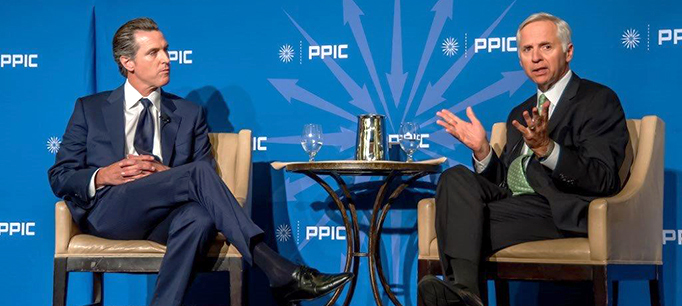
“The world is radically changed,” Gavin Newsom, California’s lieutenant governor, told a Sacramento audience this week.

“We’re competing against billions and billions of people, not just competing against cheap labor now, but against cheap genius,” he continued.

Newsom—who is also a University of California regent and California State University trustee—spoke in a conversation with Mark Baldassare, PPIC president and CEO. PPIC’s new report Will California Run Out of College Graduates? provided the context for the discussion. The report concludes that California will fall 1.1 million college graduates short of economic demand by 2030, if current trends persist.

Newsom said that “there is not a major industrialized nation in the world that is not focusing with intention on radically transforming their education system. One of the remarkable things about California is that we do not have a plan.”

He summed up: “We need goals. And we need to be able to measure those goals. And those goals must emanate from the state itself.”

Newsom was not the only speaker at the PPIC event to use words like “radical” and “revolution” to describe changes needed in higher education.

At a subsequent panel discussion, state assemblymember Catharine Baker said she is concerned that the state is falling short of the workforce needed even now. She noted that there is bipartisan agreement in the legislature that higher education is important but not about the need for major change. “There is a lot more focus on issues around the margins, that is, on how many students are we admitting, what few changes we can make in the community college system.”

Eloy Ortiz Oakley, superintendent-president of the Long Beach Community College District, said, “We almost need a revolution in our system. We started to get there when we were in crisis mode.”

“During the recession, we saw more creativity than ever before in the community college system and we began to focus,” he said. “I fear that post-recession that focus will start to dissipate.”

Hans Johnson, coauthor of the PPIC report and PPIC senior fellow, said the big challenge for the state is replacing the retiring baby boom generation with young, well-educated workers.

“I think there is a very clear path to closing that skills gap,” he said. “We need to have more students going to colleges—especially four-year colleges. We need improve completion rates—that opens up room for more students. We need to improve transfer rates from community colleges to the four-year colleges. And if we do all of those things—and these are all decisions we can make, as policymakers and higher education officials—we can actually close that skills gap.”

Timothy White, California State University chancellor, said CSU can do its part to fill the workforce skills gap—with the help of its educational and funding partners. He called the PPIC report “a very sobering clarion call that is of crisis proportion— not for the CSU or for the University of California, or the community colleges, but rather for California. And I hope we take it with the seriousness that it deserves.”