Regional Higher Education Gap Grows

Just as income gaps have grown across California’s regions, so too have disparities in levels of education. Because higher education is a major contributor to economic opportunity, these disparities have significant implications for the future well-being of the state and its residents.

Since 1980, personal income has grown at vastly different rates across the state. Workers in the Bay Area and Orange County earn substantially more (on an aggregate, per capita basis) than the average Californian. Residents in the Central Valley and Sierras, the Inland Empire, and the far north earn substantially less than the statewide average. These disparities have grown over time. In 1980, per capita regional income ranged from 80% to 111% of statewide per capita income. Today, this range is wider, with the Inland Empire at 66% and the Bay Area at 138% of the statewide average.

Regional income differences are tied to the industries and occupations that make up regional economies, as well as broad economic drivers that have accelerated growth in some industries but not others. These same factors affect individual workers’ decisions about where to live.

Given the importance of post-secondary education to economic opportunity, it is not surprising that regional differences in the share of adults with college degrees are similar to differences in income. In the Bay Area as well as Orange and San Diego Counties, the share of adults with four-year college degrees is much larger than the statewide share. The Central Coast region, Sacramento metro area, and Los Angeles County have roughly similar concentrations of college degrees as the state overall; the Central Valley, Inland Empire, and far northern parts of the state have substantially smaller shares.

However, the value of post-secondary degrees has been increasing even in occupations that traditionally have not required college education—including the jobs that comprise a larger share of the economy in lower-income regions of the state. So we might expect regional disparities in college degree attainment to be narrower today. But this is not the case.

In fact, the distribution of higher education credentials across California has become more uneven over time. For example, in 1980 the share of Bay Area adults with college degrees was 128% of the statewide average; today, that share is 138%. Over the same period, the share of college graduates in the Central Valley has fallen from 65% of the statewide average to 56%.

These widening educational disparities are a warning sign for the state’s future. Narrowing regional gaps in educational attainment probably won’t eliminate differences in income, but it could increase competitiveness across all regions and expand economic opportunities for individual Californians.

Note (TOP CHART):The “far north” region includes Butte, Colusa, Del Norte, Glenn, Humboldt, Lake, Lassen, Mendocino, Modoc, Nevada, Plumas, Shasta, Sierra, Siskiyou, Tehama, and Trinity Counties.
Source (TOP CHART): Author calculations from Bureau of Economic Analysis data.

Note (BOTTOM CHART): Share of regional population with a bachelor’s degree or higher compared to statewide share in each year. Source (BOTTOM CHART):Author calculations from the 1980 and 2000 Decennial Censuses and the 2014 American Community Survey, age 25–64 in California.

Learn more

Will California Run Out of College Graduates?
Income Inequality and the Safety Net in California
Income and Inequality Vary Widely Across California

Income inequality has been growing for decades and—despite the recovery from the Great Recession—remains historically high. Today, the low end of the income spectrum (the 10th percentile) in California is 19% lower than what it was in 1980, and the upper end of the spectrum (90th percentile) is 40% higher, according to our new report. As a result of these trends, the ratio of high to low incomes—a key measure of income inequality—is nearly twice the size it was three decades ago.

In Los Angeles County, high-income families have 15 times more income than low-income families.

Both income and income inequality vary substantially across California. Looking at after-tax family incomes, we find that, in 2014, the Bay Area had the highest incomes. However, the gap between high and low incomes was biggest in Los Angeles County, the Central Valley, and northern parts of the state—places where low incomes tend to be particularly low. For example, in Los Angeles County, high-income families have 15 times more income than low-income families. At the other end, the Inland Empire and Orange County have the lowest income inequality.

Why does the gap between families across the income spectrum matter? In part because low-income families may have insufficient resources to meet their basic needs. If family incomes are widely spread (inequality is high) but even families at the low end of the economic spectrum are able to attain a sufficient level of well-being (poverty is low), income inequality may not be a big problem. But that is not the case: one in five Californians live in poverty.

Inequality itself may also raise concerns for a host of social, cultural, and political reasons. One economic consequence of inequality is that the greater spread of incomes may inhibit upward mobility. Recent research finds a correlation between income inequality in a region and the upward mobility of its children. Low-income children who grew up in areas with higher income inequality have, on average, lower incomes as adults than otherwise similar children who grew up in regions with less income inequality. In this and other ways, the consequences of growing income inequality may play out over generations, highlighting the need for policies that take this long-range view into account.

Source: Based on California Poverty Measure data, 2012–2013 (Bohn and Danielson 2016).
Notes: Dollar amounts are rounded to the nearest $1,000. Income shown includes cash from work and retirement sources net of federal and state income and payroll taxes; low-income tax credits are not included. Dollar amounts adjusted to represent a family of four. The inequality ratio shown is calculated as the ratio of the 90th percentile of income to the 10th percentile of income; higher numbers indicate greater income inequality. Regions defined as follows. Northern: Butte, Colusa, Del Norte, Glenn, Humboldt, Lake, Lassen, Mendocino, Modoc, Nevada, Plumas, Shasta, Sierra, Siskiyou, Tehama, and Trinity Counties; Sacramento area: El Dorado, Placer, Sacramento, Sutter, Yolo, and Yuba Counties; Bay Area: Alameda, Contra Costa, Marin, Napa, San Francisco, San Mateo, Santa Clara, Santa Cruz, Solano, and Sonoma Counties; Central Valley and Sierra: Alpine, Amador, Calaveras, Fresno, Inyo, Kern, Kings, Madera, Mariposa, Merced, Mono, San Joaquin, Stanislaus, Tulare, and Tuolumne Counties; Central Coast: Monterey, San Benito, San Luis Obispo, Santa Barbara, and Ventura Counties; Inland Empire: Imperial, Riverside, and San Bernardino Counties. Los Angeles, Orange, and San Diego Counties are shown separately.

Learn more

Read the report Income Inequality and the Safety Net in California

Video: Californians Weigh in on Presidential Race

The strong partisan divisions prominent in the nation this election year are also evident in California, the latest PPIC Statewide Survey shows. As the primary nears, Democrats and Republicans are deeply divided in their views about the appropriate role and size of government. Dean Bonner, the PPIC survey’s associate director, presented these and other key survey findings in Sacramento last week.

Bonner noted that preferences among California’s likely voter in the upcoming presidential primary are similar to those seen in many states that have already voted. Among Democratic likely voters—including independents who say they will vote in the Democratic primary—48% support Hillary Clinton and 41% support Bernie Sanders. Most young voters support Sanders and most over age 45 support Clinton. Clinton leads among Latinos, women, and those who describe themselves as politically middle of the road, while Sanders leads among men and voters who describe themselves as very liberal.

Donald Trump leads the Republican field with 38%, followed by Ted Cruz with 27% and John Kasich with 14%. Bonner noted evidence in the survey of discontent with the status quo in the nation—signs that may have fueled the candidacies of “outsiders” in both major parties. A majority of likely voters—63%—say the nation is going in the wrong direction and 47% say the US will have bad times financially in the coming year. And Congress’ job performance gets a very low rating—across party lines. Notably, Republicans are more likely to approve of President Obama (20%) than they are to approve of the Republican-led Congress (11%).

Video: Senator Dianne Feinstein in Conversation

Underscoring her role in three contentious policy issues, California’s senior senator spoke to a Sacramento audience last week about filling the vacancy on the US Supreme Court, the dispute between Apple and the FBI, and drought relief.

Senator Dianne Feinstein urged speedy consideration of a nominee to replace the late Antonin Scalia on the court, saying that Senate can consider and confirm a new justice within 69 days—the average time for the process has taken in the past. She acknowledged that it would not be easy.

“I wish we could go back to the days when I first went to the Senate when the belief was that every president deserves his nominations,” she told Mark Baldassare, PPIC president and CEO, at the PPIC event.

Asked about the Apple controversy, she called on the company to reconsider its position and cooperate with the FBI to access data on a phone used by one of the San Bernardino killers. “Apple is not above the laws of the United States,” she said.

She said her position on the Senate Intelligence Committee—which occupies most of her time—gives her a perspective not shared by many on the dangers posed by terrorists.

Feinstein also detailed some of the provisions in her drought-relief bill, which would fund recycling, desalination, and water storage projects, as well as ease water trading.

She closed by describing her leadership style, saying she tries to “use the time to get things done. If I can’t do them through legislation, I’ll do them another way.”

Video: A Conversation with Legislative Leadership

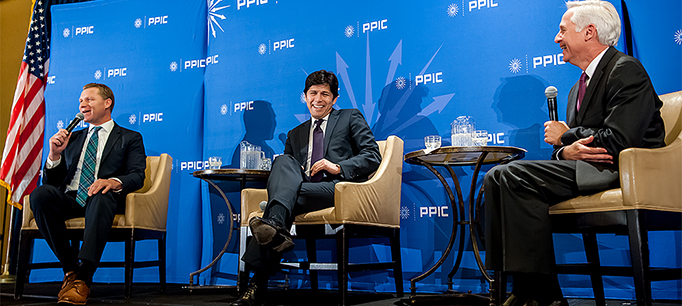
At a PPIC event last week, Kevin de León, senate leader pro tem, and Chad Mayes, the Assembly Republican leader, were asked to name the top three issues the legislature should work on with the governor. Though the leaders come from different sides of the aisle, the list of issues they named before a large Sacramento audience had a lot in common. De León’s priorities began with income inequality between the coastal and inland regions, a “tale of two states.” He also listed water and making targeted investments, particularly in higher education. He went on to list a fourth issue: climate change.

Mayes named water and a lack of water infrastructure, and the many Californians left behind in the state’s economic recovery. His third issue was transportation, the focus of an ongoing special legislative session.

“Everywhere that I go in California,” he said, “I’m stuck in traffic. So we know there’s a problem.”

The leaders’ top issues dovetail with findings from the latest PPIC Statewide Survey in which Californians identify water and the economy as the most important issues for the legislature and governor to work on in 2016. 

Though De León and Mayes named similar priorities, there was much less agreement on solutions. But the two maintained a collaborative tone throughout their conversation, denounced what Mayes termed “demagoguery on the national stage,” and repeated their commitment to working together productively.

De León said the legislature can avoid being mired in bitter national political debates if leaders continue to work cooperatively to “get some real tangible victories for Californians.”

“We’re doing things very differently in the state of California,” he said.

Video: PPIC Survey Examines Election Landscape

As California heads into an election year, the PPIC Statewide Survey looks at residents’ views on a broad range of issues that are already flashpoints in the presidential primary races and will likely surface in statewide campaigns next year.

PPIC research associate Lunna Lopes presented the survey’s key findings at a Sacramento briefing last week. She was joined by Mark Baldassare, PPIC president and CEO, for a question and answer session afterward. He noted a link between Californians’ “modestly optimistic view of the economy,” their belief that there is income inequality in the state, and their attitudes about which ballot issues are important. Twice as many residents say that increasing the state minimum wage is very important than say legalizing marijuana is very important.

“In California, the belief that this state is divided into the haves and have-nots—and the feeling among many Californians that they are among the have-nots—are going to be driving forces in the election,” he said. The survey briefing was held just after the mass shooting in San Bernardino, and the briefing touched on Californians’ views about gun laws. PPIC research associate David Kordus provided findings from the September survey on this issue: Compared to adults nationwide, Californians are more likely to favor stricter laws than we have now. Most also say that controlling gun ownership is more important than protecting the right of Americans to own guns.

Video: PPIC Statewide Survey Briefing

As discussions continue in Sacramento about drought relief, funding for higher education and transportation projects, and an extension of Proposition 30 tax increases, PPIC surveyed public opinion on these and many other topics. At a briefing last week in the capital, PPIC researcher Jui Shrestha provided the survey findings. Among the key points:

  • Two-thirds of Californians say the regional water supply is a big problem, and two-thirds say people in their part of the state are not doing enough to respond to the drought.
  • While most adults say that spending money on the maintenance of California roads, highways, and bridges is very important, there is little support for increasing the gasoline tax or vehicle registration fees to do so.
  • Half of Californians favor extending the Proposition 30 tax increases, and about a third favor making them permanent.

California Politics and the Future

Jim Brulte, chair of the California Republican Party, says Governor Brown is “clearly the master of Sacramento.”

Jennifer Medina, national correspondent for the New York Times, says the governor hasn’t talked much about poverty or income inequality— an issue his Republican opponent used in the election this year.

And Garry South, longtime Democratic strategist, says the governor needs to take on the tough issue of fiscal reform because this can only be done by a Democrat.

These are a sample of comments from a panel of experts speaking at a briefing hosted by PPIC in Sacramento this week. The discussion focused on the challenges and opportunities ahead for the governor and legislature. The event began with a presentation of the results of the new PPIC Statewide Survey by Dean Bonner, associate survey director. The survey included a wide range of topics, including tax reform, health care, climate change, and the approval ratings of state leaders.


May Survey Looks at Views on Budget, Drought

The May edition of the PPIC Statewide Survey, Californians and their Government, explores attitudes toward the governor’s latest proposed budget and gauges preferences in the gubernatorial primary. It also examines opinions on health care reform, the drought, poverty, and climate change.

PPIC research associate Dean Bonner presented the results of this wide-ranging survey at a lunch briefing in Sacramento last week.

Is College the Answer to Income Inequality?

In both California and the nation, income inequality is at or near record levels. Educational attainment is by far the single most important determinant of an individual’s income. A key question, then, is whether improvements in educational outcomes can reduce inequality. In a recent commentary for EdSource, we conclude that increases in college completion will increase wages, but will not significantly narrow the income gap. Here’s why:

College graduates earn a lot more than workers with less education. For example, workers with a bachelor’s degree earn 57 percent more on average than similar workers with only a high school diploma. But the range in wages for college graduates is much greater than the range for less educated workers. For example, among workers with a graduate degree, the top wage earners (those in the 75th percentile) earn $33 more per hour than those at the bottom of the wage distribution (25th percentile). Wage gaps are much lower among less educated workers – only $11 among workers with a high school diploma. Moreover, during the past three decades wage gaps have increased dramatically among college graduates. The large and growing variation in wages among college graduates leads to higher inequality.

This does not mean we should abandon policies to increase college enrollment and completion. Inequality at relatively high wages is better than low wages for everyone, and improvements in educational attainment will lead to higher incomes on average. But don’t expect to substantially reduce income inequality simply by increasing the rate of college graduation.