Food Assistance Linked to Student Success in College

Student hunger on college campuses is a serious concern, potentially affecting students’ health and academic achievement. At the University of California (UC), as many as 42% of students faced some degree of food insecurity in 2016, with one in five reporting reduced food intake due to limited resources. With funding provided by the UC system, individual campuses have undertaken a range of strategies to address the problem—including food pantries, free food cafes, and efforts to increase enrollment in CalFresh, the state’s food assistance program for low-income residents.

Increasing CalFresh enrollment among college students has also been the focus of recent state legislation, which has eased work requirements and removed barriers to enrollment. For example, low-income or first-generation students who qualify for California’s Educational Opportunity Program (EOP) are now automatically eligible for CalFresh. In 2016, just 2% of UC students were enrolled in CalFresh, but we don’t yet know how recent changes to eligibility have affected enrollment.

In addition to providing food assistance, enrolling in CalFresh appears to be a promising strategy to promote student success, according to our research at the University of California, Santa Cruz (UCSC). Our study of students who participated in the campus’s Slug Support program—a basic-needs program that provides food, housing, financial, and crisis assistance for students—shows that CalFresh enrollment is associated with improved retention in students’ first two years.

The first-year retention rate for Slug Support students (87%) is substantially lower than the overall retention rate at UCSC (92%), but CalFresh enrollees experienced a slightly higher-than-average first-year retention rate (94%). These results are especially encouraging as students who are eligible for CalFresh are socioeconomically disadvantaged and more likely to come from under-resourced high schools—characteristics typically associated with lower retention. This pattern persists for those enrolling in CalFresh their second year but wanes after that: students who wait to enroll in CalFresh until their third year have slightly lower retention rates than third-year UCSC students overall.
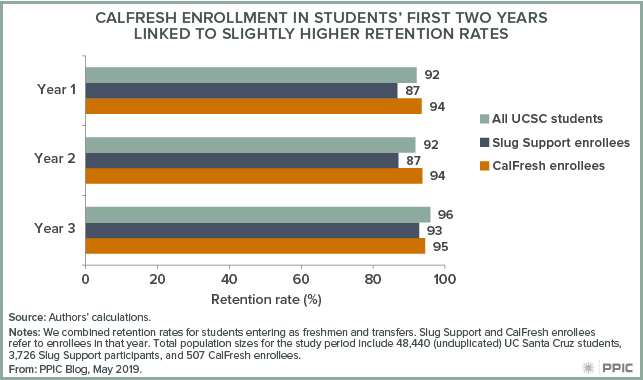
figure - CalFresh Enrollment in Students' First Two Years Linked to Slight Higher Retention Rates

Compared to Slug Support students who used other services but did not enroll in CalFresh, CalFresh enrollees were consistently more likely to return to campus the following fall. About a third (34%) of UCSC students are EOP-eligible—and therefore now eligible for CalFresh—suggesting that recent legislative changes have the potential to greatly improve food security and student outcomes.

Governor Newsom’s revised budget for 2019–20 allocates $18.5 million to address hunger and housing in the UC system. To build upon recent efforts, policymakers and higher education leaders should consider additional mechanisms to support access to CalFresh—such as tracking CalFresh enrollment among eligible students, confirming students are aware of their eligibility, and streamlining the enrollment process. These steps could help further ensure that California students have access to the resources that will help them complete their degrees.

Brandon Balzer Carr is a doctoral candidate in psychology at UC Santa Cruz. Rebecca London is an adjunct fellow at PPIC and an assistant professor in sociology at UC Santa Cruz.


Video: English as a Second Language in California Community Colleges

While the educational goals of students who enroll in ESL courses at California’s community colleges may vary, the economic benefits of effective ESL programs are clear: English proficiency can facilitate social and economic mobility for non-native speakers. But little is known about ESL programs across the state, or about the trajectories of ESL students. Now that a new law—Assembly Bill (AB) 705—is motivating colleges across the state to assess and reform their ESL programs, we need to better understand the ESL student population and the programs that serve them.

At an event in Sacramento earlier this week, PPIC researcher Bonnie Brooks outlined the findings of a new report on ESL in the community colleges and a panel of experts discussed AB 705’s impact on ESL in the community college system.

Kathryn Wada, who has taught ESL for 30 years at Cypress College, noted that the fact that AB 705 distinguishes ESL from developmental (or remedial) English and recognizes that ESL students are working toward proficiency in a foreign language is “huge for our field.”

AB 705 requires colleges to reform “credit” ESL programs—which offer credit-bearing courses for which students pay tuition—so that they do not deter or delay educational progress. By fall 2020, colleges must implement policies that maximize the chances that students complete a transfer-level English course within three years.

A look at the length of ESL course sequences across the system indicates that students at many colleges could, theoretically, complete transfer-level English in three years. In reality, however, most students don’t get this far. As Brooks noted, simply offering a sequence that is short enough to allow students to get through transfer-level English in three years “isn’t necessarily enough to maximize the probability of completion.”

Fortunately, many colleges are taking new approaches to ESL instruction that do increase the likelihood of completion. Courses that take an integrated approach—teaching more than one English skill at a time—and policies that allow students to move directly from ESL to transfer-level English instead of requiring them to enroll in developmental courses are likely to be key to fulfilling AB 705’s mandate. And, as Wada noted, new policies that make credits from advanced ESL courses transferable to UC and CSU moves credit ESL programs beyond the goals of AB 705: “If students are able to fulfill CSU and UC general education requirements directly with ESL courses . . . that’s huge.”

These new instructional approaches usher in a new era for ESL students. As Alice Perez, vice chancellor of academic affairs in the California Community Colleges Chancellor’s Office noted, “Many of our faculty and our institutions are set up to receive students assuming a major deficit: ‘You’re not college ready, and this placement test shows us this.’” Melissa Reeve, an English and ESL professor at Solano College, echoed Perez’s call for a “mindset shift,” citing the importance of “all of us having a belief in our students and what they are able to do, and sharing that with them in every facet of what we do.”

Immigrants Are Key to California’s Health Workforce

Governor Newsom’s proposed budget includes more than $85 million to train health care workers—a reflection of the state’s anticipated need to fill over 107,000 new health care jobs every year between 2016 and 2026. This projected increase is due to a growing and aging population, as well as greater access to care under the Affordable Care Act. California’s immigrant population will be an important source of workers in this sector.

In California, nearly one in three health care workers is foreign born, compared to one in six nationwide. This is partly because of the high share of immigrants among California’s working-age population. While immigrants make up about a quarter of all Californians, they are almost a third of working-age Californians—with even higher shares of immigrants among those with less than a high school diploma (49%) or those holding a graduate or professional degree (36%).

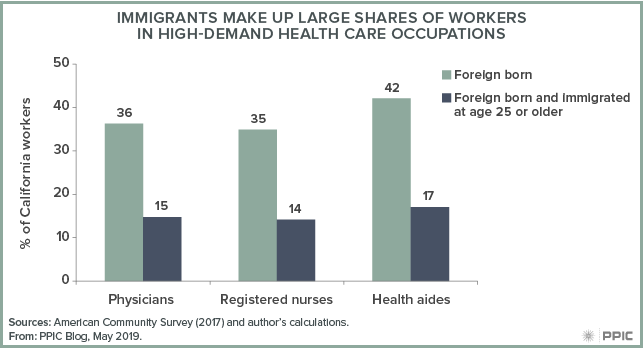
Immigrants also make up a large proportion of California workers in high-demand health care occupations, such as primary care providers (who are particularly needed in rural areas), nurses, and health aides. In 2017, 36% of the state’s physicians and 35% of registered nurses were foreign born. Forty-two percent of California’s nursing, psychiatric, and home health aides were foreign born.

figure - Immigrants Make Up Large Shares of Workers in High-demand Health Care Occupations

As California considers how to train people for these jobs, programs that account for the diversity of immigrants’ educational backgrounds will be important. Many highly skilled immigrant health workers were age 25 or older when they arrived in the country, suggesting that they may have had at least some training abroad. To help foreign-trained health professionals, some California universities already have programs to guide them through the steps necessary to enter the state’s health workforce. Training programs for support roles in health that require less than a four-year college degree are another opportunity that could encourage lower-skilled immigrants to enter the health sector.

Immigrants can also benefit the health workforce in other ways. For example, health care workers who speak languages other than English, as many immigrant workers do, can be a resource for low-income patients facing linguistic barriers to health care access. In the coming years, meeting California’s health care workforce needs will require multiple strategies—but engaging the state’s immigrant population can be a part of the solution.

Leveling the Playing Field in College Admissions

Recent news of wealthy parents allegedly paying bribes to get their children into elite colleges has raised a lot of questions about the college admissions process. While fewer than 100 students were involved—out of more than 1 million new college freshmen every year—the scandal brings up larger issues of equitable college access and high income inequality in California.

More than half of Californians (53%) say qualified students from low-income families have less opportunity than other students to get a college education, according to a 2018 PPIC survey. Even without resorting to bribery, there are many advantages that students from high-income families have in college admissions, including living in safer neighborhoods, attending better high schools, and having more help preparing for the application process (e.g., paying for SAT or ACT prep courses). Admission practices at most private colleges also favor students who can pay the full price of attending.

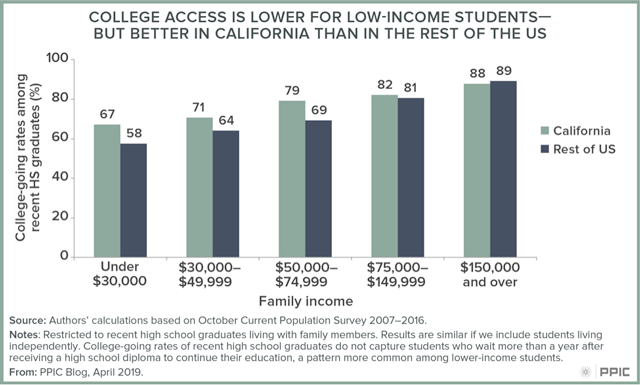
Our recent report on economic mobility and higher education highlights the challenges facing low-income students in California—but also offers some hope. Although recent high school graduates from low-income families are less likely to enroll in college than students from higher-income families, a greater percentage of low-income students go to college in California (67%) compared to other states (58%). Enrollment gaps between low- and high-income students in California (21 percentage points) are also substantially lower than in the rest of the country (31 percentage points).

Figure 1: College Access is Lower For Low-Income Students--But Better in California Than In the Rest of the US

California’s large public higher education system is key to ensuring broad access. The University of California (UC) enrolls more low-income students than any other public research university system in the country. Indeed, applicants from disadvantaged backgrounds are given extra consideration in UC’s “holistic review” process. Thirty-eight percent of UC undergraduates in 2016–17 received Pell grants (federal grants to low-income students), compared to 26% of undergraduates at public research universities in the rest of the country.

California State University (CSU), the largest public university system in the country, provides even more access than UC. Almost half (49% in 2016–17) of CSU students receive Pell grants. California’s private nonprofit colleges also play an important role, with 29% of their undergraduates receiving Pell grants.

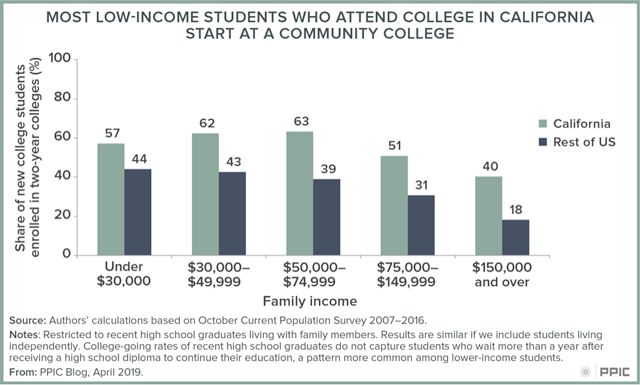
But perhaps most important are California’s community colleges. More than half of low-income students who attend college in California start at a community college.

Figure 2: Most Low-Income Students Who Attend College in California Start at a Community College

Although college access for low-income students in California is relatively good compared to the rest of the nation, more can be done. For example, improving financial aid would make college more accessible to more low-income students and would likely lead to higher graduation rates. And because so many low-income students start at community colleges, increasing transfer rates is critical to ensuring that higher education continues to serve as a ladder of economic mobility. New reforms at the community colleges—including changes in remediation and the Associate Degree for Transfer program—should lead to substantial increases in transfer and help more students achieve their academic and economic goals.

Helping Community College Students Succeed

California’s community colleges are implementing new policies in developmental (or remedial) education that could improve completion of transfer-level courses for tens of thousands of students every year. Recently passed legislation should result in the vast majority of entering community college students bypassing developmental education and enrolling directly into transfer-level courses in English and math. Many of these students will be provided with concurrent remedial support to help them succeed—namely, co-requisite courses, which feature group work to reinforce difficult concepts, just-in-time remediation, and other activities.

These reforms mark a dramatic change from the traditional approach, which required most students to complete developmental English and math before they could take transfer-level courses. In fact, as of the 2017–18 academic year only half of students enrolling in an English course for the first time and about one-third of first-time math students were able enroll in a transfer-level course. Previous PPIC research shows that students who start college in developmental education are significantly less likely to successfully complete transfer-level courses.

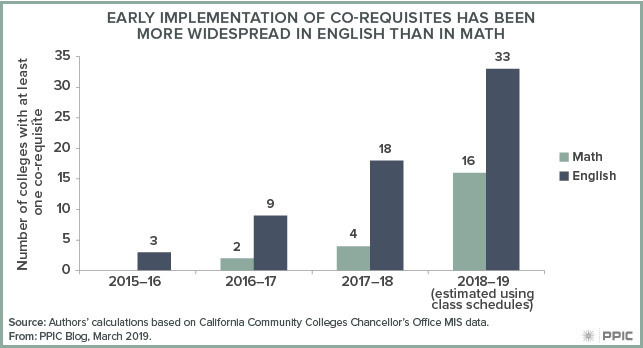
The new policies will be implemented systemwide by fall of 2019, but some colleges began offering co-requisite courses ahead of schedule—as early as 2015–16. Implementation has been faster in English than math: as of 2017–18, 33 of the state’s 115 community colleges were offering English co-requisites, while only 16 offered math co-requisites. This is not surprising, considering that co-requisite support in math must be tailored to the transfer-level courses required for different majors (e.g., statistics, business calculus, pre-calculus, college algebra, math for liberal arts). Between 2016–17 and 2017–18, enrollment in English co-requisites more than doubled (to 8,200), while enrollment in math co-requisites increased 36% (to 1,300).

figure - Early Implementation of Co-requisites Has Been More Widespread in English than in Math

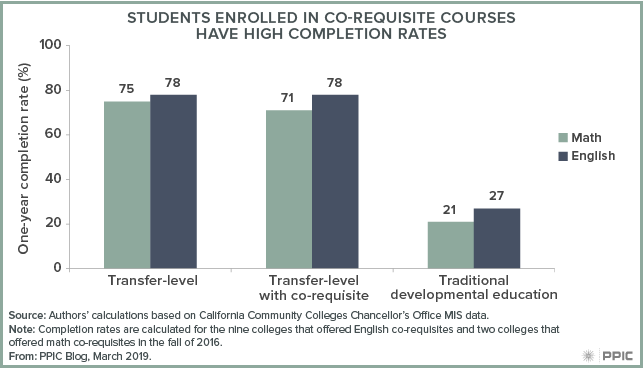
A recent PPIC report found that students enrolled in co-requisite courses are significantly more likely to successfully complete transfer-level courses in math and English than students who started in traditional prerequisite developmental education courses. And they are as likely as those who do not receive co-requisite support to complete transfer-level courses within a year. This is notable because students who take transfer-level courses without co-requisites have been identified as college ready.

figure - Students Enrolled in Co-requisite Courses Have High Completion Rates

The early evidence on co-requisites is promising. As colleges move into the full implementation phase, ongoing research can help them understand what happens as they broaden access to transfer-level courses to a diverse group of students, what types of concurrent support work best, and how co-requisite students perform in subsequent college-level courses.

State-level Strategies to Reduce Student Debt

As college costs have increased, the total amount of loan debt in California has risen. At four-year colleges and universities in California in 2016, 40% of first-time, full-time students took out loans to help pay for their education, according to federal data.

The average debt for California students who attend four-year public and private nonprofit schools is nearly $22,800. Repaying college debt can be a big challenge, in part because the federal landscape for repaying loans is extremely complicated. To reduce student debt, state policymakers are actively thinking about new ways to help students repay their college costs.

In 2018, nearly half (47%) of borrowers enrolled in the federal “standard repayment” plan. Under this plan, a graduate makes fixed monthly payments over the course of ten years, paying down the entire loan with interest. Regardless of income level, a graduate with a loan of $22,800—the average amount—would, at 5% interest, face payments of about $240/month. For those in less well-paying occupations or who face very high monthly payments, this kind of plan can be financially challenging.

Another option is income-based repayment, which is often more financially manageable—but a much smaller share (29%) of borrowers enrolled in an income-based program in 2018. Monthly payments might start at 10% of discretionary income, but payments increase if the graduate starts earning more. Under these plans, borrowers generally pay smaller monthly amounts over a longer period of time.

Possible reasons for lower participation in income-based repayment programs include complex eligibility requirements and missing the deadline for declaring income. Streamlining the federal loan process, including clarifying eligibility criteria, could help make the process less confusing and allow students to make the best financial choices.

At the state level, policymakers are exploring other options to ease the burden of college debt. For example, AB 140 (Cervantes) would authorize the California Student Aid Commission, which administers the state’s financial aid programs, to pay an eligible student’s monthly loan payments for two years. And AB 154 (Voepel) would pilot an “income share” program at one University of California campus and one California State University campus. This program would enable campuses to pay for some of an eligible student’s educational expenses. After graduating, students then repay a portion of their income to the campus.

It’s a positive sign that California policymakers are pursuing state-level strategies to address growing college debt. Establishing an easy-to-use application process and clear-cut eligibility criteria will be key to ensuring that students are able to benefit from these programs. Perhaps most important, more comprehensive financial aid counseling and outreach are necessary to help students make the best choice when repaying their loans.

A Coordinating Council for Higher Education

The California Legislature and Governor Newsom are interested in creating a new coordinating entity for the state’s public higher education system. The state has been without such an entity since 2011, when Governor Brown vetoed funding for the California Postsecondary Education Commission (CPEC). A new coordinating entity can help the governor and legislature improve higher education by providing expertise and analysis. But it will require policymakers to provide a solid foundation for its work.

California’s 1960 Master Plan for Higher Education gives the three state public higher education segments—the University of California, the California State University, and the California Community Colleges—significant autonomy. CPEC was created to help policymakers conduct long-term planning, monitor student outcomes, and oversee intersegmental policies that make it easier for students to navigate through the college and university systems. A new PPIC report looks at the strengths and weaknesses of CPEC to provide suggestions about how to make a new coordinating entity as effective as possible.

CPEC’s experience underlines the need for clear state goals and objectives. A higher education coordinating body can advocate effectively for student success and assess how well the segments are meeting the needs of the state economy. But higher education in California has changed significantly over the past several decades, and the Master Plan is either silent or outdated in important areas.

CPEC’s history also shows that the details of the coordinating entity’s design are important in giving it a strong, unified voice in the budget and policy process. A coordinating entity should be empowered to monitor whether the state’s higher education goals are being met and suggest ways to make the system more effective. When the segments fall short or when there are conflicts about how best to accomplish state goals, the coordinating entity should be able to work with the colleges, universities, and state policymakers to find workable solutions.

In this time of heightened demand for higher education, the governor and legislature could benefit from a coordinating body that acts as an honest broker in helping the state provide access to all interested students while maintaining the quality of public higher education that California is known for.

Serving California’s Diverse College Students

As part of his cradle-to-career initiative, Governor Newsom has emphasized higher education as a key means of expanding Californians’ social and economic opportunities. From proposing more higher education funding in this year’s budget to supporting two years of free tuition for first-time community college students, many of his initiatives are focused on making college accessible and affordable to more of the state’s residents. For these initiatives to succeed, it will be essential to enroll a broad array of students—in particular, those who have been historically underserved in higher education–and to ensure that more students successfully complete college.

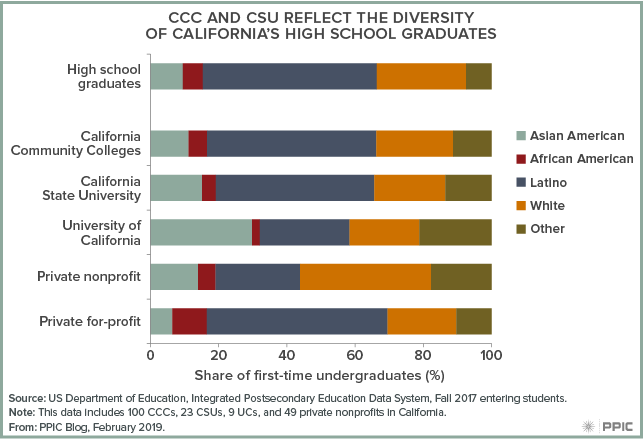
The good news is that the state is enrolling a diverse set of students, especially at the two largest systems, California State University (CSU) and the California community colleges (CCC). Overall, these two systems closely reflect the racial and ethnic make-up of California’s high school population—which is critical given that these two systems are key entry points for African American, Latino, low-income, and first generation college students. UC and private nonprofit colleges in California serve diverse populations, including more first generation and low-income students than their peer institutions in the rest of the country, but they do not reflect the full ethnic diversity of the state’s high school graduates.

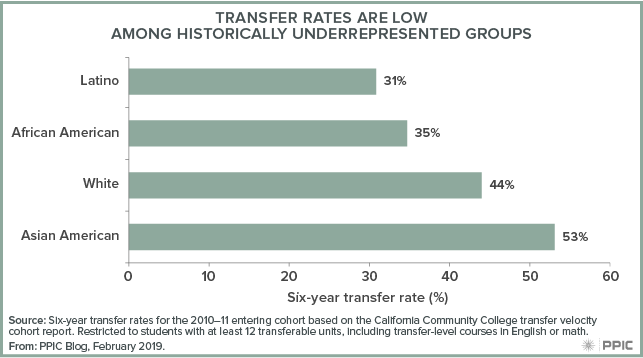
More challenging is helping students to successfully complete a four-year degree. Graduation rates are very high at UC and at most private nonprofit colleges. At CSU, graduation rates have improved dramatically, but even so about 40% of students do not earn a degree within six years. Most students who enter community colleges with the intent to transfer to a four-year college never do so. Transfer rates are especially low for African American and Latino students.

Both CSU and CCC have launched new policies and programs that hold the promise of improving transfer and reducing inequities. For example, community college reforms in developmental—also known as remedial—education will lead to substantial increases in the share of students taking college-level courses in English and math. The Associate Degree for Transfer (ADT) program is making the transition to California State Universities much more straightforward. And the new Guided Pathways initiative provides support services and clear course-taking patterns to community college students to promote success.

These are important steps in the right direction. Renewed interest in Sacramento regarding higher education will help. And Californians are well aware of the stakes. A majority of adults in California (56%) say a four-year college degree is very important for economic and financial success in today’s economy, and 75% believe California’s higher education system is very important to the quality of life and economic vitality of the state.

Video: Californians and Their Government

As efforts are gearing up in Sacramento to craft a new state budget, a majority of Californians say they approve of Governor Gavin Newsom’s proposed spending plan. Californians also express optimism about the general direction of the state. These and other key findings of the latest PPIC Statewide Survey were outlined by Alyssa Dykman at a Sacramento briefing last week.

The governor’s budget proposal, which calls for increased funds for education and health and human services, garners support from 70% of California adults. More than three-quarters approve of two key components of the proposal: 77% favor allocating $1.8 billion to expand pre-kindergarten and early childhood programs and facilities, and 78% support an $832 million funding increase for public colleges and universities.

The survey also asked whether Californians believe the state is going in the right direction. A majority of adults (55%) approve of where California is headed. This contrasts with less than a third (30%) saying things are going in the right direction for the country. In addition, a record-low 25% of Californians say that President Trump and Congress will be able to work together and accomplish a lot this year.

Other survey highlights:

  • Asked what the most important issue is for the governor and legislature to address in the coming year, more Californians name immigration and illegal immigration (15% adults) than any other issue.
  • Most Californians (67%) are optimistic that Governor Newsom and the legislature will be able to work together and accomplish a lot in the next year.
  • A strong majority of California adults (64%) say President Trump and Republicans in Congress were primarily responsible for the recent partial shutdown of the federal government. Only 24% say Democrats in Congress were responsible.
  • Only about a quarter of Californians (27%) say the situation with illegal immigration across the US-Mexico border is a crisis.

Proposed Budget Prioritizes College Students in Need

Governor Newsom’s January budget proposal includes $1 billion in new funding for higher education. Much has been made of his plan to cover two years of tuition for first-time, full-time community college students. But that is just one aspect of an overall approach that provides extensive support to a wide variety of students.

Newsom’s proposal increases by nearly 15% the number of “competitive” Cal Grants—a distinct type of support available to students who do not qualify for entitlement grants. Recipients of competitive Cal Grants are often older, non-traditional students. Further, all Cal Grant recipients who have dependent children would receive an additional $6,000 to help with non-tuition related costs. In addition, Newsom’s budget allocates nearly $50 million to programs that address housing and student hunger—and those that provide legal services for undocumented students, staff, and faculty.

The governor’s focus on affordability aligns with Californians’ concerns regarding higher education. According to the latest PPIC survey on Californians and higher education, 58% of all adults noted that affordability was a big problem for California’s public higher education systems; just 14% said that it was not much of a problem. Most Californians also said that higher education should be a high priority for the new governor. This budget proposal suggests that Governor Newsom is listening.